From Hollywood strikes to digital portraits, AI’s potential to steal creatives’ work and how to stop it has dominated the tech conversation in 2023. The latest effort to protect artists and their creations is Nightshade, a tool allowing artists to add undetectable pixels into their work that could corrupt an AI’s training data, the MIT Technology Review reports. Nightshade’s creation comes as major companies like OpenAI and Meta face lawsuits for copyright infringement and stealing personal works without compensation.
University of Chicago professor Ben Zhao and his team created Nightshade, which is currently being peer reviewed, in an effort to put some of the power back in artists’ hands. They tested it on recent Stable Diffusion models and an AI they personally built from scratch.
Nightshade essentially works as a poison, altering how a machine-learning model produces content and what that finished product looks like. For example, it could make an AI system interpret a prompt for a handbag as a toaster or show an image of a cat instead of the requested dog (the same goes for similar prompts like puppy or wolf).
Professor Ben Zhao | University of Chicago
Nightshade follows Zhao and his team’s August release of a tool called Glaze, which also subtly alters a work of art’s pixels but it makes AI systems detect the initial image as entirely different than it is. An artist who wants to protect their work can upload it to Glaze and opt in to using Nightshade.
Damaging technology like Nightshade could go a long way towards encouraging AI’s major players to request and compensate artists’ work properly (it seems like a better alternative to having your system rewired). Companies looking to remove the poison would likely need to locate every piece of corrupt data, a challenging task. Zhao cautions that some individuals might attempt to use the tool for evil purposes but that any real damage would require thousands of corrupted works.
This article originally appeared on Engadget at https://www.engadget.com/new-tool-lets-artists-fight-ai-image-bots-by-hiding-corrupt-data-in-plain-sight-095519848.html?src=rss
Increasing access to computing education is a global challenge, and at the Raspberry Pi Foundation we take a global approach in addressing it. One way we do this is to partner with organisations around the world and support them to introduce Code Clubs and CoderDojos in their local or national communities.
Code Club and CoderDojo are the two global networks of free, volunteer-led coding clubs for young people that we support. They are a great fit for a lot of organisations that share our vision and values and work with young people from backgrounds that are currently under-represented in computing. Right now, our Global Clubs Partner network involves more than 50 organisations in over 40 different countries around the world. Seven new partners have joined us since August.
New members in the Global Clubs Partner network
We send a warm welcome to our seven new partners. Here is some of what they are working on:
CSEd Botswana is training 25 teachers in rural areas to run Code Clubs in their schools
Hacedores in Mexico is working towards establishing CoderDojos in their 80 makerspaces, and Code Clubs in the local schools of their community members.
Code Club Luxembourg is already running several clubs and also hosts a number of workshops each year to encourage children to carry on their coding journey by joining a Code Club or CoderDojo.
Light Into Europe works with the Deaf community in Romania. They plan to open up coding to children with hearing impairments through accessible Code Clubs, supported by interpreters and adults who are also deaf.
KIT Hub in Burundi have plans to establish CoderDojos to support children from underserved areas, including a sizable community of Congolese young people living in refugee camps in Burundi.
Orientations Training Centre in Sudan will be setting up clubs in Khartoum and Darfur, and they are planning a special passion for supporting young people to submit entries to the Coolest Projects online showcase in 2024.
Savanna Developer Network will establish CoderDojos in northern Ghana to narrow the income and infrastructure gap between the north and the south by ensuring that children in the north aren’t left behind in computing education.
We are really excited that these organisations have chosen to join the Global Clubs Partner network.
Benefits of partnering with us
When they join our Global Clubs Partner network, organisations work with us to grow the Code Club and CoderDojo communities around the world. Our Global Clubs Partners share our mission to enable young people to realise their full potential through the power of computing and digital technologies, and they commit to working towards this mission with our support.
Our new partners are as glad as we are to have joined our network.
Abdelmoneim Mohammed of Orientations Training Centre in Sudan is excited by the impact Code Club will have on his young coders, telling us:
I expect this can help to make our citizens a global citizen, [by] learning from a well-established and developed educational system.
For Ethel Tshukudu of CSEd Botswana, it is the community focus and available support network that is important. She tells us:
The strong sense of community and the availability of mentorship opportunities are particularly appealing, as they ensure that CSEdBotswana can consistently access the support needed to enhance our coding clubs and create a more significant impact.
Our partner from KIT Hub in Burundi, Ferdinand Alimasi, values how establishing clubs promotes collective learning and engagement in the community. He says:
Education and preparation of [the] future workforce require collective work and responsibilities, so these clubs will bring the change in communities by offering opportunities to learn for kids and teens, as well as opportunities for everyone to be involved in building a better future for all.
What we learn from our partnerships
Our partners work in lots of different circumstances all around the world. A key learning for us is that there is no ‘one size fits all’ approach to computing education. We support our partners to adapt and deliver our resources in a way that they know will best engage their learners. This highlights how important it is to work in a culturally sensitive way, and to prioritise providing opportunities for learners to use digital technology to make things that matter to them. That looks very different depending on where you are in the world, and who you are working with.
Through working with our partners, we also see just how much world events can impact the already unequal access young people have to learning new digital skills. Climate crisis events such as floods and wildfires, and political crises such as war, conflict, and changes in government have affected many of our global partners this year. The resulting closures of schools and other educational venues, electricity blackouts, and funding challenges cause further educational disadvantage to the children in the affected areas. Our partners play a key role in providing additional educational opportunities for young people when it is safe to do so.
Young tech creators at a Code Club in Brazil.
The experiences and perspectives we’ve gained through our partnerships with global organisations are extremely important to us and our mission. They help to inform the work we do to make computing education truly accessible for all learners and educators around the globe.
Could your organisation become a Global Clubs Partner?
You can find out more about how your organisation could join our Global Clubs Partner network on the CoderDojo and Code Club websites, or contact us directly with your questions or ideas about a partnership.
GM has announced that it will pay $1,400 to owners of 2020-2022 Bolt EVs and EUVs who endured a recall that limited range to 80 percent for a significant period of time, Electrek has reported. It’s effectively an upfront payment to customers as part of an expected class action settlement.
“GM is announcing a compensation program for 2020-22 Bolt EV/EUV owners upon installation of the final advanced diagnostic software as part of the original battery recall,” a spokesperson wrote in a statement. “Owners are eligible to receive a $1,400 Visa eReward card upon installation. This applies to Bolt EV/EUV owners in the US only. We’re grateful to our customers for their patience and understanding.”
Owners must install a “software final remedy” by December 31, 2023 and sign a legal release — those who decline will have to wait for the class action lawsuit to play out. If the settlement ends up being more than $1,400, those who accept the payment will still receive the difference.
It seems like Chevy’s Bolt EVs (and larger EUVs that came along in 2021) have never not had problems with their batteries. The 2017-2019 models had serious defects that could cause fires, forcing GM to recall them and install special software, reducing maximum charge levels to 90 percent.
The 2020-2022 models affected by the lawsuit used new battery chemistry with a different issue that could also cause a fire when the car was fully, or nearly fully charged. GM issued a recall for those models as well, installing diagnostic software that would reduce maximum charging levels to 80 percent (cutting range from about 259 miles to 207 miles). The software will eventually either warn customers that their battery pack needs to be replaced, or automatically return the maximum charge to 100 percent.
The problem is, the vehicles needed to reach 6,200 miles of use before the final assessment. That could be years for some buyers, and GM mandated that owners complete the diagnostic by March 2025 in order to qualify for an extended warranty or replacement battery, if needed.
GM announced earlier this year that it was discontinuing the Bolt EV amid the company’s shift to the Ultium platform, possibly because it felt the name had been sullied by the battery issues. Following an outcry, though, it backtracked and said that a next-gen Bolt was in the works — showing that people still liked what the Bolt stood for (a practical, cheap EV with decent range) despite the recalls.
Presumably, any potential settlement would cover owners who effectively lost the full and expected use of their vehicle during the period. If you’re part of the recall, you should receive a letter soon with more information and a unique PIN to access their site — more information is available here.
This article originally appeared on Engadget at https://www.engadget.com/chevy-offers-1400-to-bolt-ev-owners-who-endured-lower-charging-levels-091547025.html?src=rss
NASA has revealed that it has already processed 70.3 grams of rocks and dust collected by the OSIRIS-REx mission from asteroid Bennu. That means the mission has way exceeded its goal of bringing 60 grams of asteroid samples back to Earth — especially since NASA scientists have yet to open the primary sample container that made its way back to our planet in September. Apparently, they’re struggling to open the mission’s Touch-and-Go Sample Acquisition Mechanism (TAGSAM) and could not remove two of its 35 fasteners using the tools currently available to them.
The scientists are processing the samples inside a specialized glovebox (pictured above) with a flow of nitrogen in order to keep them from being exposed to our atmosphere and any contaminants. They can’t just use any implement to break the container’s fasteners open either: The tool must fit inside the glovebox, and it also must not compromise the samples’ integrity. NASA has sealed the primary container sample for now, while it’s developing the procedure to be able to open it over the next few weeks.
If you’re wondering where the 70.3 grams of rocks and dust came from, well, NASA collected part of it from the external sample receptacle but outside TAGSAM itself. It also includes a small portion of the samples inside TAGSAM, taken by holding down its mylar flap and reaching inside with tweezers or a scoop. NASA’s initial analysis of the material published earlier this month said it showed evidence of high carbon content and water, and further studies could help us understand how life on Earth began. The agency plans to continue analyzing and “characterizing” the rocks and dust it has already taken from the sample container, so we may hear more details about the samples even while TAGSAM remains sealed.
This article originally appeared on Engadget at https://www.engadget.com/nasas-osiris-rex-mission-collected-more-bennu-asteroid-samples-than-first-thought-083605172.html?src=rss
Sammy Gecsoyler reports via The Guardian: A research team in Finland, led by Robin Ras, from Aalto University, and aided by researchers from the University of Jyvaskyla, has developed a mechanism to make water droplets slip off surfaces with unprecedented efficacy. Cooking, transportation, optics and hundreds of other technologies are affected by how water sticks to surfaces or slides off them, and adoption of water-resistant surfaces in the future could improve many household and industrial technologies, such as plumbing, shipping and the auto industry. The research team created solid silicon surfaces with a “liquid-like” outer layer that repels water by making droplets slide off surfaces. The highly mobile topcoat acts as a lubricant between the product and the water droplets.
Sakari Lepikko, the lead author of the study, which was published in Nature Chemistry on Monday, said: “Our work is the first time that anyone has gone directly to the nanometer-level to create molecularly heterogeneous surfaces.” By carefully adjusting conditions, such as temperature and water content, inside a reactor, the team could fine-tune how much of the silicon surface the monolayer covered. Using the new method, the team ended up creating the slipperiest liquid surface in the world. According to Lepikko, the discovery promises to have implications wherever droplet-repellent surfaces are needed. This covers hundreds of examples from daily life to industrial environments.
Amazon, the biggest e-commerce website in most countries, now supports passkeys. That gives users access to the new login solution that’s considered more secure than passwords, allowing them to access their account using the biometrics or PIN they use to unlock their devices. The company started rolling out the capability a few days ago but has only just announced the feature, which is now available on browsers and is gradually making its way to all users accessing Amazon through its iOS app. Passkey support is also “coming soon” to Amazon’s Android application.
Passkeys are resistant to phishing, the effects of data leaks or social engineering, because there are no passwords to steal or give away. Instead, the technology uses cryptographic pairs, one of which is a public key saved on a particular service’s servers, while the other one remains private and is securely saved to a user’s device. These pairs are unique for every service, and they must match for someone to be able to log in. It’s also a lot less involved than two-factor authentication, though for some reason, Amazon will not automatically switch it off for those who turn on passkey support.
In its FAQs, Amazon says that those who have two-factor switched on will still need to verify their identities with a one-time code even after they activate the new login option. It’s unclear if users will no longer have to key in two-factor codes after their initial login with a passkey, but upon trying it out, we weren’t asked for one the next time we signed in. To switch on passkey login, users only need to go to Login & Security under Your Account on Amazon and then choose “Set up” next to the new Passkeys option.
This article originally appeared on Engadget at https://www.engadget.com/amazon-now-supports-passkey-logins-on-browsers-and-ios-devices-050129183.html?src=rss
An anonymous reader quotes a report from MIT Technology Review: A new tool lets artists add invisible changes to the pixels in their art before they upload it online so that if it’s scraped into an AI training set, it can cause the resulting model to break in chaotic and unpredictable ways. The tool, called Nightshade, is intended as a way to fight back against AI companies that use artists’ work to train their models without the creator’s permission. Using it to “poison” this training data could damage future iterations of image-generating AI models, such as DALL-E, Midjourney, and Stable Diffusion, by rendering some of their outputs useless — dogs become cats, cars become cows, and so forth. MIT Technology Review got an exclusive preview of the research, which has been submitted for peer review at computer security conference Usenix.
AI companies such as OpenAI, Meta, Google, and Stability AI are facing a slew of lawsuits from artists who claim that their copyrighted material and personal information was scraped without consent or compensation. Ben Zhao, a professor at the University of Chicago, who led the team that created Nightshade, says the hope is that it will help tip the power balance back from AI companies towards artists, by creating a powerful deterrent against disrespecting artists’ copyright and intellectual property.
Zhao’s team also developed Glaze, a tool that allows artists to “mask” their own personal style to prevent it from being scraped by AI companies. It works in a similar way to Nightshade: by changing the pixels of images in subtle ways that are invisible to the human eye but manipulate machine-learning models to interpret the image as something different from what it actually shows. The team intends to integrate Nightshade into Glaze, and artists can choose whether they want to use the data-poisoning tool or not. The team is also making Nightshade open source, which would allow others to tinker with it and make their own versions. The more people use it and make their own versions of it, the more powerful the tool becomes, Zhao says. The data sets for large AI models can consist of billions of images, so the more poisoned images can be scraped into the model, the more damage the technique will cause.
Nightshade exploits a security vulnerability in generative AI models, one arising from the fact that they are trained on vast amounts of data — in this case, images that have been hoovered from the internet. Nightshade messes with those images. Artists who want to upload their work online but don’t want their images to be scraped by AI companies can upload them to Glaze and choose to mask it with an art style different from theirs. They can then also opt to use Nightshade. Once AI developers scrape the internet to get more data to tweak an existing AI model or build a new one, these poisoned samples make their way into the model’s data set and cause it to malfunction. Poisoned data samples can manipulate models into learning, for example, that images of hats are cakes, and images of handbags are toasters. The poisoned data is very difficult to remove, as it requires tech companies to painstakingly find and delete each corrupted sample. Nightshade is going to make AI companies think twice, “because they have the possibility of destroying their entire model by taking our work without our consent,” says Eva Toorenent, an illustrator and artist who has used Glaze.
“I’m just really grateful that we have a tool that can help return the power back to the artists for their own work,” added Autumn Beverly, another artist.
Paul Kunert reports via The Register: A gaggle of MPs are calling for government to put together a timetable for the replacement of millions upon millions of smart meters that will be defunct when 2G and 3G mobile networks are switched off. The Public Accounts Committee (PAC) comprised of cross-party MPs penned a report to update the rollout of the smart meters, with multiple deadlines missed along the way of the $17 billion billion project. The report echoes an earlier one by the National Audit Office (NAO), which found that as of March 2023, energy companies had rolled out the devices to just 57 percent (roughly 32.4 million out of a potential install base of 57.1 million) homes and businesses. Of these devices, around 9 percent were not functioning properly.
The PAC says in its latest report: “A fifth more (an estimated seven million) will lose functionality when the 2G and 3G mobile communications networks are closed if they do not receive costly hardware upgrades (the cost of which will ultimately be borne by the billpayers).” UK comms regulator Ofcom announced last month that UK mobile operators do not intend to provide 2G and 3G mobile networks past 2033. “The switch-off will affect customers using older mobile devices and services.” The PAC wants to know what the Department for Energy Security and Net Zero (DESNZ), as well as energy regulator Ofgem, are doing to plan the smooth running of a replacement scheme.
It asks both to set out “what they will do to ensure suppliers assign more importance than at present to replacing those smart meters not functioning properly” and “a timetable for replacing the communication hub element of smart meters that will lose functionality when the 2G and 3G mobile networks are switched off.” […] The PAC also want DESNZ and Ofgem to outline “measures to ensure that suppliers use future-proofed technology — for example, by excluding 2G or 3G connectivity — in all new smart meter installations.” And it wants the department and the energy watchdog to detail program costs to Parliament on an annual basis to inform decisions about the rollout.
Discover the lightweight yet powerful open-source Geany text editor alternative to Notepad++ on Linux with this installation tutorial and a few tips and tricks.
One of the main innovations introduced by Podman was the ability to run rootless containers. Security wise, this was a big improvement, since a potentially compromised container running as root represents a security threat for the host system. In order to obtain a similar behavior, recent versions of Docker support running the docker daemon in the user context. Running unprivileged containers, albeit more secure, has also its drawbacks, as the inability to bind to privileged host ports.
Lawrence Abrams reports via BleepingComputer: 1Password, a popular password management platform used by over 100,000 businesses, suffered a security breach after hackers gained access to its Okta ID management tenant. “We detected suspicious activity on our Okta instance related to their Support System incident. After a thorough investigation, we concluded that no 1Password user data was accessed,” reads a very brief security incident notification from 1Password CTO Pedro Canahuati. “On September 29, we detected suspicious activity on our Okta instance that we use to manage our employee-facing apps. We immediately terminated the activity, investigated, and found no compromise of user data or other sensitive systems, either employee-facing or user-facing.”
On Friday, Okta disclosed that threat actors breached its support case management system using stolen credentials. As part of these support cases, Okta routinely asks customers to upload HTTP Archive (HAR) files to troubleshoot customer problems. However, these HAR files contain sensitive data, including authentication cookies and session tokens that can be used to impersonate a valid Okta customer. Okta first learned of the breach from BeyondTrust, who shared forensics data with Okta, showing that their support organization was compromised. However, it took Okta over two weeks to confirm the breach.
After a string of tricky puzzles, we have an easy one for once! Or at least I thought so. If you’re looking for the Connections answer for Tuesday, October 24, 2023, read on—I’ll share some clues, tips, and strategies, and finally the solutions to all four categories. Along the way, I’ll explain the meanings of the…
Bitcoin has surged past $33,000 per coin on Monday, rising nearly 11% in 24 hours. According to CoinGecko, the coin is up more than 17% in the past seven days. Decrypt reports: Bulls have flooded the space as talk about a spot Bitcoin ETF has investors hopeful that the long-awaited crypto product will soon get approval from the U.S. Securities and Exchange Commission. A Monday CoinShares report showed that institutional investors are pouring money into the space; JPMorgan analysts said last week that a spot Bitcoin ETF could be approved by Christmas.
High-profile investment firms that have applied to the SEC for a spot ETF are fine tuning their applications in the hope that the regulator will give them the green light. Investors have been hungry for a spot Bitcoin ETF for the best part of a decade but Wall Street’s biggest regulator experts say has denied applications for such a product, mostly citing the potential for market manipulation as one of the main reasons.
But analysts are now more optimistic than ever before: BlackRock, world’s biggest fund manager, applied for a Bitcoin ETF of its own. Not long after, manager Grayscale scored a victory against the SEC when a federal judge sided with the firm over its application to convert its flagship Bitcoin fund into an ETF.
The Moon’s crater-covered countenance was previously thought to be a youthful 4.42 billion years old, give or take about 10 million years. But now, samples of crystals taken from the rocky satellite half a century ago indicate that the Moon is about 40 million years older than we knew.
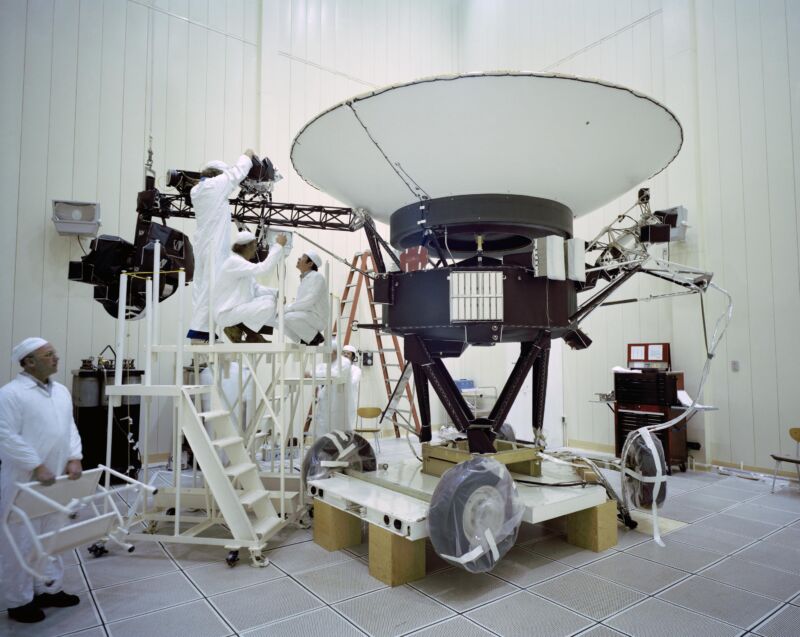
Forty-six years in deep space have taken their toll on NASA’s twin Voyager spacecraft. Their antiquated computers sometimes do puzzling things, their thrusters are wearing out, and their fuel lines are becoming clogged. Around half of their science instruments no longer return data, and their power levels are declining.
Still, the lean team of engineers and scientists working on the Voyager program at NASA’s Jet Propulsion Laboratory are taking steps to eke out every bit of life from the only two spacecraft flying in interstellar space, the vast volume of dilute gas outside the influence of the Sun’s solar wind.
“These are measures that we’re trying to take to extend the life of the mission,” said Suzanne Dodd, Voyager project manager at JPL, in an interview with Ars.
An anonymous reader quotes a report from Wired: Hamas’ attacks against Israel on October 7 have shifted the geopolitical landscape and triggered a looming Israeli ground assault in the Gaza Strip. Now the ripple effects are reaching the cryptocurrency industry, where they’ve become the United States Department of the Treasury’s rallying cry for a crackdown on cryptocurrency anonymity services. The US Treasury’s Financial Crimes Enforcement Network (FinCEN) [on October 19th] released a set of proposed rules that would designate foreign cryptocurrency “mixers” — services that blend users’ digital funds to offer more anonymity and make them harder to trace — as money laundering tools that pose a threat to national security and would thus face new sanctions and regulations. The new rules, if adopted following a 90-day period of public comment and debate, would potentially represent the broadest restrictions imposed yet on the mixing services and could make it far harder for cryptocurrency holders to put their money through the services before cashing it out at a US cryptocurrency exchange, or even at a foreign exchange that accepts US customers.
While the proposed rules were almost certainly in the works long before October 7, the Treasury’s announcement tied the push for a change in policy directly to the use of cryptocurrency by Hamas and militant groups in Gaza. “The Treasury Department is aggressively combatting illicit use of all aspects of the CVC ecosystem by terrorist groups,” Wally Adeyemo, deputy secretary of the Treasury, wrote in a statement, using the term “CVC” to mean convertible virtual currency. Adeyemo says that this includes Hamas and Palestinian Islamic Jihad, a militant group that often aligns with Hamas, which Israel blamed for an explosion at a hospital in Gaza earlier this week.
Cryptocurrency mixers have existed almost as long as Bitcoin itself. They offer to take in a user’s cryptocurrency, blend it with that of other users, and return the funds so that they are harder to follow from their origin to destination on blockchains, which generally record every transaction in full public view. The Treasury’s rule change would designate those cryptocurrency-mixing services — or at least the majority of them that are based outside the US — as a “primary money laundering concern.” They would thus be considered a threat to US national security as defined by section 311 of the Patriot Act, a section of the law designed to restrict how domestic financial institutions interact with potential sources of terrorist financing. The rule change would mean that US financial services, as well foreign ones with US customers — including cryptocurrency exchanges — would have to go through extra record-keeping and reporting requirements for funds that have touched a foreign cryptocurrency mixer, and it might even allow the Treasury to block US exchanges from handling those funds. “Weâ(TM)ve never seen anything like this before,” says Ari Redbord, the head of global policy for TRM Labs, a blockchain analysis firm. Redbord notes that the rule change isnâ(TM)t proposing a blanket ban on foreign mixing services, only new rules for interacting with them. “The reality, however, is that 311 actions oftentimes have a sort of name-and-shame effect, where people are just not wanting to engage with these platforms out of fear of being caught up in money laundering or other type of illicit activity.”
“I think the challenge for regulators is, how do we thread the needle between stopping illicit actors from using these platforms but at the same time allow regular users to enable some degree of privacy?” Redbord added. “I think the concern is that this could very much be throwing the baby out with the bathwater.”
qBittorrent 4.6 has been released today as a major update for this open-source, free, and cross-platform BitTorrent client written in Qt and available for GNU/Linux, macOS, and Windows systems.
Brian Steinberg reports via Variety: So-called “pause ads” — they only turn up a few seconds after a viewer has decided to halt the programming, and not every time one does — are seeing new movement in the streaming world, with the format appearing more frequently on Hulu since July, according to Josh Mattison, senior vice president of revenue management and operations for Disney Advertising. Pause ads are also in motion in venues such as NBCUniversal’s Peacock and Warner Bros. Discovery’s Max.
As more media companies seek to goose subscriber rates by offering cheaper ad-supported versions of their streaming services, this type of commercial may become more handy. One of the main attractions of streaming, after all, is that it boasts fewer traditional commercials than its linear TV counterpart. The industry hopes that a pause ad — other “out of pod” commercial experiences are also in development — can appear on screen without upsetting a subscriber who gets viscerally roiled by the prospect of a glut of typical TV spots.
Others have also found ways to work ads into the moments when streaming fans come to a stopping point. NBCUniversal’s Peacock launched with pause ads, says Peter Blacker, executive vice president of streaming and data products for NBCUniversal’s ad-sales division, while Warner Bros. Discovery’s Max introduced them in 2022, says Ryan Gould, head of digital ad sales and client partnerships at the company. No one has been holding back on the new format. Hulu has experimented with pauses since at least 2018, and an early version of the idea surfaced last decade when Coca-Cola and Universal Pictures tested concepts with ReplayTV, an early backer of digital video recording technology. Coke, which once used the slogan “the pause that refreshes” to great effect, and Charmin, the Procter & Gamble toilet tissue that can offer succor during many breaks in TV viewing, tested the format with Hulu in 2019.