Stainless steel cookware is the journeyman of the kitchen. It quietly and competently does its job, without the need for pampering (like cast iron) or any public drama (like Teflon-coated nonstick). If cast iron is a flashy Leo who lives for praise, stainless steel is an efficient, self-assured Capricorn. (I’m not…
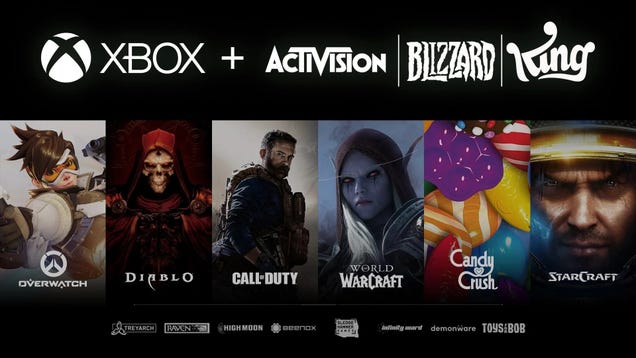
The biggest acquisition in gaming history and one of the largest in the tech industry is in the books. Twenty-one months after the deal was announced, Microsoft has bought Activision Blizzard for $68.7 billion, the largest acquisition in the company’s history. CEO of Microsoft Gaming Phil Spencer has asked Activision CEO Bobby Kotick to stay on until the end of 2023, at which point he’ll be leaving the company. It’s been a long road filled with plenty of twists and turns to get to this point.
In an attempt to win over the UK regulator, Microsoft agreed to sell the cloud gaming rights for Activision Blizzard titles to Ubisoft. That means that not only should Activision Blizzard’s games be on Xbox Game Pass, but they’ll land on Ubisoft+ and any other game-streaming service Ubisoft decides to work with. Concerns about competition in the cloud gaming market was the CMA’s reasoning for initially blocking Microsoft’s takeover of Activision, but the watchdog said in September that the Ubisoft concession “opens the door to the deal being cleared.” A few weeks later, the CMA has rubberstamped the merger.
Microsoft also signed 10-year agreements with Nintendo and severalcloud-gamingcompanies to offer its titles on their platforms. Those moves led to the European Union giving the merger the green light. The bloc’s competition officials reportedly didn’t see anything in the amended merger agreement (with the Ubisoft plan factored in) that would prompt a fresh antitrust investigation.
The Federal Trade Commission’s attempts to stop the deal over competition concerns haven’t panned out. The agency sued to block it in December and an evidentiary hearing in that case was slated to take place on August 2nd. The FTC tried to temporarily block the merger with a preliminary injunction ahead of its administrative trial, but a judge denied that effort.
The FTC still plans to challenge the merger. If that effort is successful, Microsoft could be forced to divest some or all of Activision Blizzard.
But for now, the deal is done. It means, among other things, that Activision Blizzard titles will be available on cloud gaming platforms for the first time since the publisher pulled its titles from GeForce Now in early 2020. Its games will surely join Game Pass in the coming months, including on Xbox Cloud Gaming, and they’ll pop up on Ubisoft+ and other platforms Ubisoft works with.
Those waiting for Activision Blizzard’s two biggest games of 2023 to hit Game Pass will certainly need to remain patient, though. The publisher has said Call of Duty: Modern Warfare III and Diablo IVwon’t hit the service until next year.
Meanwhile, Blizzard games are already coming to Steam rather than being siloed on the Battle.net launcher. We’ll probably see them appearing on Xbox’s PC app too. For what it’s worth, in court filings, Microsoft called Activision’s strategy of releasing PC versions of Call of Duty titles exclusively on Battle.net in a bid to grow the platform a “resounding failure.“
ASSOCIATED PRESS
One of the key reasons Microsoft gave for pursuing the deal was to accelerate its aim of becoming a major player in the mobile gaming market. With Activision Blizzard pulling in $1.9 billion in mobile revenue in the first six months of 2023 alone, it will achieve that goal practically overnight.
King, which is behind the hugely successful Candy Crush franchise, generated more revenue ($1.49 billion) than Activision ($1.15 billion) in the first half of this year. Thanks largely to the massive success of Diablo IV, Blizzard brought in the most of the three units during that period with a hair over $1.5 billion. Still, King had 238 million monthly active users as of June 30th, just over twice as many as Activision and Blizzard combined. It recently emerged that Candy Crush Saga has generated over $20 billion in lifetime revenue.
Blizzard has also been making a push into mobile gaming with the likes of Diablo Immortal. Activision, meanwhile, has Call of Duty Mobile in its portfolio and Call of Duty: Warzone Mobile is on the way. The company said in its most recent earnings report Call of Duty has around 90 million monthly players, “with over half of all engagement on the mobile platform.”
As for exclusivity of future projects, Microsoft Gaming CEO Phil Spencer has promised to “do whatever it takes” to keep shipping Call of Duty games on PlayStation. After months of refusing to do so, Sony eventually signed a 10-year pact just before the initial merger deadline of July 18th to keep that particular franchise on PlayStation, conceding defeat in its efforts to halt the acquisition. However, Microsoft will likely opt to keep other Activision Blizzard games off of PlayStation platforms, as it has done with ZeniMax/Bethesda titles Redfall and Starfield, as well as MachineGames’ upcoming Indiana Jones project.
Meanwhile, many observers hope that Microsoft will help stamp out the alleged toxic workplace culture at Activision Blizzard. Earlier this year, Activision Blizzard paid $35 million to settle SEC charges related to how it handled employees’ workplace misconduct complaints.
In 2021, the California Civil Rights Department (formerly the Department of Fair Employment and Housing) sued the company and accused it of fostering a “frat boy” culture in which female employees were harassed and discriminated against. Activision Blizzard countersued the CRD in December. The case hasn’t been resolved. In fact, the CRD’s lawsuit (which, along with other events, sent Activision’s stock tumbling) set the ball rolling on Microsoft’s acquisition of the company in the first place.
Spencer hinted at efforts to improve the publisher’s workplace culture. “Today is a good day to play. We officially welcome Activision Blizzard King to Team Xbox,” he wrote on X. “Together, we’ll create stories and experiences that bring players together, in a culture empowering everyone to do their best work and celebrate diverse perspectives.” Spencer added that “whether you play on Xbox, PlayStation, Nintendo, PC or mobile, you’re always welcome here — even if Xbox isn’t where you play your favorite franchise. Because when everyone plays, we all win.”
Now that the acquisition has closed, a labor neutrality agreement between Microsoft and the Communications Workers of America will go into effect for Activision Blizzard workers in 60 days. That should make it easier for more of the publisher’s employees to unionize. Some of Activision Blizzard’s quality assurance (QA) workers have already formed unions. Earlier this year, hundreds of QA workers at ZeniMax Studios, a Microsoft subsidiary, voted to unionize with the CWA.
Update, October 10, 2023, 9:34AM ET: This story has been updated to include comments from Phil Spencer, and to add context about the labor neutrality agreement and unionization efforts at Activision Blizzard and Microsoft.
This article originally appeared on Engadget at https://www.engadget.com/activision-blizzard-now-officially-belongs-to-microsoft-125053787.html?src=rss
In August and September, threat actors unleashed the biggest distributed denial-of-service attacks in Internet history by exploiting a previously unknown vulnerability in a key technical protocol. Unlike other high-severity zerodays in recent years—Heartbleed or log4j, for example—which caused chaos from a torrent of indiscriminate exploits, the more recent attacks, dubbed HTTP/2 Rapid Reset, were barely noticeable to all but a select few engineers.
HTTP2/Rapid Reset is a novel technique for waging DDoS, or distributed denial-of-service attacks, of an unprecedented magnitude. It wasn’t discovered until after it was already being exploited to deliver record-breaking DDoSes. One attack on a customer using the Cloudflare content delivery network peaked at 201 million requests per second, almost triple the previous record Cloudflare had seen of 71 million rps. An attack on a site using Google’s cloud infrastructure topped out at 398 million rps, more than 7.5 times bigger than the previous record Google recorded of 46 million rps.
Doing more with less
The DDoSes hitting Cloudflare came from a network of roughly 20,000 malicious machines, a relatively small number compared with many so-called botnets. The attack was all the more impressive because, unlike many DDoSes directed at Cloudflare customers, this one resulted in intermittent 4xx and 5xx errors when legitimate users attempted to connect to some websites.
AMD has published the Advanced Media Acceleration (AMA) v1.0 SDK as a software stack aimed for hardware video acceleration and capable of high density real-time transcoding. The AMD AMA SDK integrates with the likes of the open-source FFmpeg and GStreamer projects for fitting nicely in the Linux software ecosystem as well as sporting its own C-based API…
The Meta Quest 3 is here, and it’s the best standalone VR headset we’ve ever seen. But is that enough to make people care about virtual reality? In this episode, Devindra and Senior Writer Sam Rutherford chat with Tested’sNorm Chan about the Quest 3 and Meta’s mixed reality future. While the company’s vision of the metaverse is pretty sterile, it’s still nice to see Meta learning from the mistakes of the Quest Pro. (Be sure to check out Norm’s hour-long review of the Quest 3 as well!)
Sam also dives into his Pixel 8 and Pixel 8 Pro reviews, as well as his thoughts about the Pixel Watch 2. We also dive into Wired’s retraction of an op-ed claiming that Google manipulated your search queries, as well as Twitter/X’s complete inability to deliver accurate news during the Hamas and Israel conflict.
Listen below or subscribe on your podcast app of choice. If you’ve got suggestions or topics you’d like covered on the show, be sure to email us or drop a note in the comments! And be sure to check out our other podcast, Engadget News!
People love to get weird about cast iron pans. Some fear them, some fetishize them, but everyone has an opinion about them. Be not afraid: Cast iron is cheap and hard to permanently damage beyond repair. With a little know-how and a reasonable amount of care, it’s one of the easiest (and most rewarding) pans to cook…
Following last week’s PipeWire 1.0 release candidate, today a second release candidate was published as part of the project’s plan for reaching v1.0 before the end of the year for this widely-used Linux audio/video streams server that is a viable replacement to the likes of PulseAudio and JACK…
The fight to keep DVD sales going is taking another big hit. Best Buy is allegedly ending all physical media sales — that means Blu-ray, DVD and 4K Ultra HD — in-store and online, The Digital Bits reported. Multiple sources claim the move will occur in early 2024, possibly as soon as the first quarter. The news of Best Buy’s decision comes only a few weeks after Netflix ended its 25-year DVD delivery service, sending out its final copies on September 29.
Best Buy’s exit from the DVD and Blu-ray market leaves limited options in the United States. Walmart (which has a 45 percent share of the market) and Target still offer the discs at their physical stores, while Redbox is holding on to 29,000 rental kiosks. Amazon stands as a major player online, with Paramount recently releasing their Blu-ray and 4K Steelbook exclusive titles on the site versus Best Buy.
Disc purchases have been dropping since streaming came on the scene. According to the Digital Entertainment Group, the first six months of 2023 saw a 28 percent drop in physical products sold compared to the same period in 2022. Scondhand stores may be the best place to find DVDs for the time being, unless they come back in fashion like vinyls.
This article originally appeared on Engadget at https://www.engadget.com/best-buy-may-end-dvd-and-blu-ray-sales-early-next-year-121318167.html?src=rss
Hello, and welcome to The Grown-up Kitchen. While Allie and I usually focus on helping people cook better, smarter, and faster through tips, tricks, and (of course) hacks, we’re getting back to basics here, and giving true culinary beginners the attention they deserve.
Netflix is reportedly planning to open several bricks-and-mortar venues, called Netflix House. The stores will sell merchandise for hit Netflix shows, hopefully of a higher quality than that Target Squid Game tee you sleep in. Talking of Squid Game, the two initial locations will reportedly feature obstacle courses based on the hit show, entirely missing the point of the show’s scathing view of modern capitalism.
There will also be rotating hit-show art installations and live performances to excite fans. Additionally, an in-house restaurant will serve themed cuisine and drinks from Netflix’s food-based reality shows. I can’t get enough of themed restaurants, so count me in. The first two will be in the US, but more will appear across the world.
Netflix has dabbled in real-world events and venues before. It opened pop-up experiences across the planet to celebrate shows likeStranger Things and many of its reality shows. In the UK, Netflix’s Stranger Things: The First Shadow theater production will begin performances at the Phoenix Theatre in London this November.
— Mat Smith
You can get these reports delivered daily direct to your inbox. Subscribe right here!
The UK’s antitrust regulator has given Microsoft the green light to buy Activision Blizzard for $68.7 billion. The regulator called Microsoft’s concession to sell cloud gaming rights to Ubisoft a “gamechanger that will promote competition.” With the last major obstacle out of the way, the Competitions and Markets Authority (CMA) has now largely cleared the path for the companies to close the biggest merger in gaming history. The decision was widely expected after the watchdog said in September the company’s revised merger agreement “substantially addresses previous concerns and opens the door to the deal being cleared.”
Three areas are getting the X-Class upgrade to start.
Comcast is upgrading its residential cable internet service to offer upload and download speeds of up to 2 Gbps through decades-old coaxial cables. The company says it’s the first ISP in the world to offer multi-gigabit symmetrical speeds to customers through DOCSIS 4.0 technology, which it’s powering through the Xfinity 10G network. Comcast has been working on this technology for several years, and it aims to offer 2 Gbps symmetrical service in more than 50 million homes by the end of 2025.
A global team of researchers investigating the statistical and physical nuances of coin tosses worldwide concluded that a coin is 50.8% likely to land on the same side it started on. The authors of the new paper conducted 350,757 flips, using different coins from 46 currencies to eliminate a heads–tails bias between coin designs. (They also used a variety of people to rule out biased flipping techniques.) Regardless of the coin type, the same-side outcome could be predicted at 0.508, which rounds up to 49/51 odds.
The Swedish capital joins other low-emission zones in Europe.
While we wait for electric vehicles to be the dominant engines on the road, some areas have taken it upon themselves to solve the issue of air pollution related to combustion engines. Stockholm, the capital of Sweden, just announced a ban on diesel and petrol-powered vehicles throughout its city center, starting in 2025. The ban doesn’t impact the entire capital city, only the 20-block city center.
This article originally appeared on Engadget at https://www.engadget.com/the-morning-after-netflixs-next-big-thing-is-branded-retail-stores-111551264.html?src=rss
Enlarge/ A Vega rocket rides a column of exhaust from its solid-fueled first stage, kicking off a mission to deliver 12 small satellites into orbit. (credit: ESA/CNES/Arianespace)
Welcome to Edition 6.15 of the Rocket Report! We’re now more than three-quarters of the way through the year, and as of Thursday, there have been 156 orbital launches since January 1. Last year, which set a record for global launch activity, we didn’t reach 156 orbital launches until mid-November. At the cadence set so far in 2023, we could end the year at roughly 200 orbital launches. We’ll see if the world’s launch providers, led by SpaceX and China, keep pace for next couple of months. I’m betting they do.
As always, we welcome reader submissions, and if you don’t want to miss an issue, please subscribe using the box below (the form will not appear on AMP-enabled versions of the site). Each report will include information on small-, medium-, and heavy-lift rockets, as well as a quick look ahead at the next three launches on the calendar.
A Spanish rocket startup launched its first test flight. A Spanish launch company, named PLD Space, claimed success on Saturday after its suborbital Miura 1 rocket lifted off and achieved an altitude of 46 kilometers (29 miles) before plummeting into the Atlantic Ocean, Ars reports. Saturday’s launch from Southern Spain is exciting for several reasons, but most notably because PLD Space is the first of Europe’s new space launch companies to have some credible success. To that end, Saturday’s modest flight represented the dawn of the European commercial space age.
Cruise has been testing its self-driving vehicles in Houston since May, and it started giving employees, along with select friends and family members, fully driverless rides in August. Now, it’s offering the public the chance to catch a ride to their destinations on robotaxis with no drivers behind the wheel. The company is now onboarding Houston residents who signed up for its waitlist, and it’s also encouraging those who’ve yet to do so to visit its website and send in a request for access. Those who do get in early will be able to hail a driverless ride through its app for a flat fare of $5 for a limited time.
Initially, Cruise will have the authority to operate seven days a week from 9PM to 6AM only in Downtown, Midtown, East Downtown, Montrose, Hyde Park and River Oaks neighborhoods. The company typically begins by deploying a small fleet of vehicles to cover a limited number of locations in a city, but it eventually expands its vehicles’ availability.
It will probably take some time before the company can operate around the clock in Houston, though. In San Francisco, for instance, Cruise was only given permission to offer paid daytime rides in August, months after staff members started testing its 24/7 service. It’s worth noting that while Cruise was able to secure permission for the expansion, the company still faces pushback from critics raising concerns about the safety of autonomous vehicle tech. One of the commissioners from the California Public Utilities Commission (CPUC) even voted against allowing the company to operate during daytime hours, arguing that the agency didn’t have enough information to accurately evaluate the impact of autonomous vehicles on first responders.
Shortly after the CPUC gave the company permission to offer paid daytime rides, the California DMV opened an investigation into a Cruise robotaxi’s collision with a fire truck. The agency then asked Cruise to cut its fleet in half and to limit its driverless vehicles in operation to 50 during daytime and 150 at night while the investigation is ongoing.
Howdy, Houston 👋 Starting today we will be welcoming members of the public to our driverless service.
While some Linux distributions like Fedora and Arch are enabling the native Wayland back-end for Firefox by default, upstream Firefox continues to not enable this Wayland support as part of their default builds. But — at long last — that might finally change soon…
Protecting user privacy is a core element of Mozilla’s vision for the web and the internet at large. In pursuit of this vision, we’re pleased to announce new partnerships with Fastly and Divvi Up to deploy privacy-preserving technology in Firefox. Mozilla builds a number of tools that help people defend their privacy online, but the […]
Following this week’s release of Qt 6.6, the Qt Creator 12 beta has been released for this Qt and C++ focused integrated development environment (IDE)…
OpenSUSE Leap Micro 5.5 is now available as the latest community version of SUSE Linux’s Enterprise Micro. openSUSE Leap Micro 5.5 is a great choice for a lightweight Linux OS particularly for VMs and containers…
Meta has shared an updated content monitoring action plan as the devastating Israel-Hamas war continues. It follows a stern letter from Thierry Breton, the European Union’s (EU) regulatory commissioner, to Meta CEO Mark Zuckerberg about misinformation concerns (such as deep fakes) and compliance with the EU’s Digital Services Act (DSA). The company had 24 hours to respond.
In its statement, Meta said that it created an ever-evolving operations center with experts fluent in Hebrew and Arabic: “Since the terrorist attacks by Hamas on Israel on Saturday, and Israel’s response in Gaza, expert teams from across our company have been working around the clock to monitor our platforms while protecting people’s ability to use our apps to shed light on important developments happening on the ground.” Meta claims this new setup lets them remove content and fight misinformation faster.
Meta reportedly took over 795,000 distinct pieces of content in Hebrew or Arabic and removed or marked them with a disturbing label in the three days following the terrorist attack by Hamas. Seven times more content across these two languages was removed daily for violating its Dangerous Organizations and Individuals policy compared to the two months leading up to the conflict.
Hamas is listed under Meta’s Dangerous Organizations and Individuals policy and banned from all of the company’s platforms — as is any content praising the terrorist group. However, “social and political discourse,” such as news articles and general discussion, are allowed.
Further actions by Meta include restricting certain hashtags that are regularly associated with content that violates its policies and removing any content that clearly identifies a hostage (though blurred images are allowed). The company has also lowered the threshold for its monitoring technology, ideally reducing the chances of it recommending harmful content to users. “We want to reiterate that our policies are designed to give everyone a voice while keeping people safe on our apps,” Meta’s statement continued. “We apply these policies regardless of who is posting or their personal beliefs, and it is never our intention to suppress a particular community or point of view.”
This article originally appeared on Engadget at https://www.engadget.com/meta-responds-to-eu-misinformation-concerns-regarding-israel-hamas-conflict-102640126.html?src=rss
Ed Cara reports via Gizmodo: Scientists appear to have developed a hand prosthetic that provides much more control and comfort than those available today. In new research this week, they’ve detailed the case of a Swedish woman who has successfully worn the advanced bionic limb for years with no major issues, while experiencing significantly less pain than before. The woman, identified as Karin, suffered a farming injury that took much of her right arm below the elbow over 20 years ago. Like many amputees, Karin went on to develop phantom limb pain, which required her to take high doses of medication to manage. She also benefited little from conventional prosthetics, finding them too unwieldy to use for daily life. But several years ago, Karin became one of the first patients enrolled in the DeTOP project, an expansive research study funded by the European Union and involving dozens of scientists across Europe that’s looking to develop the next generation of bionic limbs.
Karin’s prosthesis was created by the Italian company Presilia and is nicknamed Mia Hand. It’s outfitted with state-of-art technology, including AI. And to further improve its functionality, her surgeons performed osseointegration during the attachment procedure, a process that directly fuses bone to the implant, ideally creating a stronger mechanical connection. They also implanted electrodes in her arm muscles and nerves, as well as rewired some of her nerves in the remaining part of the arm. The result is a robotic limb that’s directly connected to Karin’s neuromusculoskeletal system.
Much like a real flesh-and-blood hand, it’s controlled by Karin’s nervous system and provides sensory feedback. Her new hand can purportedly perform around 80% of the typical daily tasks that a regular limb would be able to do. And it’s substantially reduced her phantom limb pain and the need for medication. The team’s findings on Mia Hand’s initial success are published in the journal Science Robotics. Karin is one of three patients enrolled in the DeTOP project. And while it may take time for the research on these patients to reach completion, the hope is that these prosthetics can eventually become the new standard for upper limb amputees. For Karin, it’s already been a tremendous gift.