

Intel Core i9-14900K – $589, Intel i7-14700K- $409, Intel Core i5-14600K – $319 Intel’s 14th Gen Core “Raptor Lake Refresh” processors fit in the same socket as 13th Gen CPUs, but crank up the clocks, in some cases cores, and power. High Performance Single Thread Leadership More Cores, Higher Clocks Socket Compatibility…
Source: Hot Hardware – Intel 14th Gen Core Raptor Lake Refresh Benchmarks: MOAR Power
Monthly Archives: October 2023
Microsoft Copilot: Here's everything you need to know about the company's AI assistant
Microsoft’s new Copilot AI has wormed its way into nearly every aspect of Windows 11. However, there’s a bit of a learning curve, but don’t worry. We’ve got you covered. We’ve put together a primer on the company’s new AI assistant, along with step-by-step instructions on how to both enable and disable it on your Windows computer.
What does Microsoft Copilot do?
Microsoft’s Copilot is a suite of AI tools that work together to create a digital personal assistant of sorts. Just like other modern AI assistants, the tech is based on generative artificial intelligence and large language models (LLM.)
You can use Copilot to do a whole bunch of things to increase productivity or just have fun. Use the service to summarize a web page or essay, write an email, quickly change operating system settings, generate custom images based on text, transcribe audio or video, generate a screenshot and even connect to an external device via Bluetooth. It also does the sorts of things other AI chatbots do, like creating lists of recipes, writing code or planning itineraries for trips. Think of it as a more robust version of the pre-existing Bing AI chatbot.
How to enable Microsoft Copilot
Update your computer to the latest version of Windows 11
First of all, you need the latest Windows 11 update, so go ahead and download that first.
1. Head to Settings and look for the Windows Update option.
2. Follow the prompts and reset your computer if required.
You’re now ready to experience everything Copilot has to offer. If Microsoft just dropped an update, you may have to wait a bit before it reaches your region. Click the tab to automatically install the latest update when available.
Once your computer is updated, click the Copilot button
As for enabling the feature, click the Copilot button on the taskbar or press Win + C on the keyboard. That’s all there is to it.
How to disable Microsoft Copilot
Engadget/Terrence O’Brien
Microsoft Copilot isn’t an always-on feature. Once it shows up in the taskbar, it only works when you ask it something. However, if you want to disable or delete the feature entirely, you have a couple of options.
The easiest method is to remove it from the taskbar. Out of sight, out of mind, right? Open up Settings and click on Personalization. Next, tap the Taskbar page to the right side. Look for Taskbar Items and then click on the Copilot toggle switch to remove it from the line-up. This ensures you won’t ever accidentally turn it on via the Taskbar, but you can still call up the AI by typing Win + C.
If you want to delete the toolset entirely, the process is a bit more involved. Start by opening a PowerShell window. Search for Windows PowerShell, right-click on the results and select the option to run as an administrator. Next, click yes on the UAC prompt. This opens up a command prompt.
Paste the following into the window: reg add HKCUSoftwarePoliciesMicrosoftWindowsWindowsCopilot /v “TurnOffWindowsCopilot” /t REG_DWORD /f /d 1
That should do it. Every trace of Copilot will disappear from your system.
What are the limitations of Copilot?
This is new technology, so the limitations are extensive. Like all modern LLMs, Microsoft’s Copilot can and will make up stuff out of thin air every once in a while, a phenomenon known as hallucination. It also doesn’t retain information from conversation to conversation, likely for security reasons. This means it restarts the conversation from a blank slate every time you close a window and open another one. It won’t remember anything about you, your preferences or even your favorite order from the coffee shop down the street. Finally, it doesn’t integrate with too many third-party sources of data, beyond the web, so you won’t be able to incorporate personal fitness data and the like.
What’s the difference between Github Copilot and Microsoft Copilot?
There is a primary difference between the two platforms, despite the similar names. Github Copilot is all about helping craft and edit code for developing software applications. Microsoft Copilot can whip up some rudimentary code but it’s far from a speciality. If your primary use case scenario for an AI assistant is code, go with Github. If you only dabble in coding, or have no interest at all, go with Microsoft.
This article originally appeared on Engadget at https://www.engadget.com/microsoft-copilot-heres-everything-you-need-to-know-about-the-companys-ai-assistant-130004909.html?src=rss
Source: Engadget – Microsoft Copilot: Here’s everything you need to know about the company’s AI assistant
Google Asks Congress To Not Ban Teens From Social Media
An anonymous reader quotes a report from The Verge: Google responded to congressional child online safety proposals with its own counteroffer for the first time Monday, urging lawmakers to drop problematic protections like age-verification tech. In a blog post, Google released its “Legislative Framework to Protect Children and Teens Online” (PDF). The framework comes as more lawmakers, like Sen. Elizabeth Warren (D-MA), are lining up behind the Kids Online Safety Act, a controversial bill intended to protect kids from dangerous content online.
In the framework, Google rejects state and federal attempts at requiring platforms to verify the age of users, like forcing users to upload copies of their government IDs to access an online service. Some states have recently gone as far as passing laws requiring platforms to obtain parental consent before anyone under 18 is allowed to use their services. Google dismisses these consent laws, arguing that they bar vulnerable teens from accessing helpful information. “Good legislative models — like those based on age-appropriate design principles — can help hold companies responsible for promoting safety and privacy, while enabling access to richer experiences for children and teens,” Kent Walker, Google’s president of global affairs, said in the blog post.


Read more of this story at Slashdot.
Source: Slashdot – Google Asks Congress To Not Ban Teens From Social Media
Intel Core i9-14900K, Core i7-14700K and Core i5-14600K Review: Raptor Lake Refreshed
In what is to be the last of Intel’s processor families to use the well-established Core i9, i7, i5, and i3 naming scheme, Intel has released its 14th Generation Core series of desktop processors, aptly codenamed Raptor Lake Refresh (RPL-R). Building upon the already laid foundations of the 13th Gen Core series family, Intel has announced a variety of overclockable K and KF (no iGPU) SKUs, including the flagship Core i9-14900K, the reconfigured Core i7-14700K, and the cheaper, yet capable Core i5-14600K.
The new flagship model for Intel’s client desktop products is the Core i9-14900K, which looks to build upon the Core i9-13900K, although it’s more comparable to the special edition Core i9-13900KS. Not only are the Core i9-14900K and Core i9-13900KS similar in specifications, but the Core i9-14900K/KF are the second and third chips consecutively to hit 6.0 GHz core frequencies out of the box.
Perhaps the most interesting chip within Intel’s new 14th Gen Core series family is the Core i7-14700K, which is the only chip to receive an uplift in cores over the previous SKU, the Core i7-13700K. Intel has added four more E-cores, giving the Core i7-13700K a total of 8 P-cores and 12 E-cores (28 threads), with up to a 5.6 GHz P-core turbo and a 125 W base TDP; the same TDP across all of Intel’s K and KF series 14th Gen core chips.
Also being released and reviewed today is the Intel Core i5-14600K, which has a more modest 6P+8E/20T configuration and has the same configuration 5.3 GHz boost frequency and 3.5 GHz base frequency on the P-cores as the Core i5-13600K. Intel has only boosted the E-core boost frequency by 100 MHz to justify the Core i5-14600K, which means it should perform similarly to its predecessor.
Despite being a refreshed selection of Intel’s 13th Gen Raptor Lake platform, the biggest question, aside from the performance, is what are the differences, and are there any nuances to speak of, and how do they correlate regarding performance to 13th Gen? We aim to answer these questions and more in our review of the Intel 14th Gen Core i9-14900K, Core i7-14700K and Core i5-14600K processors.
Source: AnandTech – Intel Core i9-14900K, Core i7-14700K and Core i5-14600K Review: Raptor Lake Refreshed
Make an Autumnal Beurre Blanc With Apples and Sage

The French lean pretty heavily on butter—and we let them, because they do wonderful things with it. Beurre blanc, for example, is a sauce made with a shallot-infused wine and vinegar reduction, a healthy slug of cream, and two whole sticks of butter. Of course it tastes good—all creamy, tangy, and rich—but you can…
Source: LifeHacker – Make an Autumnal Beurre Blanc With Apples and Sage
Debian Repeals The Merged "/usr" Movement Moratorium
Debian 12 had aimed to have a merged “/usr” file-system layout similar to other Linux distributions, but The Debian Technical Committee earlier this year decided to impose a merged-/usr file movement moratorium. But now with Debian 12 having been out for a few months, that moratorium has been repealed…
Source: Phoronix – Debian Repeals The Merged “/usr” Movement Moratorium
You Can Get the Xbox Elite Series 2 Core Controller for $89

The Elite Series 2 Core wireless controller has hit one of its lowest prices since its release in September 2022. You can get it from the Microsoft website for $88.99 (originally $129.99). The lowest price it’s been on Amazon is $98.52 this summer, according to Camelcamelcamel, but still higher than the $79 it briefly…
Source: LifeHacker – You Can Get the Xbox Elite Series 2 Core Controller for
AMD Takes SEV-SNP Hypervisor To v10, Intel TDX Host Support Up To 14 Revisions
Both AMD and Intel engineers have experienced a lengthy journey getting their latest virtualization security features into the mainline Linux kernel — and one that is still ongoing…
Source: Phoronix – AMD Takes SEV-SNP Hypervisor To v10, Intel TDX Host Support Up To 14 Revisions
WhatsApp debuts passkey logins on Android
WhatsApp just made logging in a much simpler and faster process, at least on Android devices. The Meta-owned chat application has launched passkey support for Android, which means users no longer have to use OTPs from two-factor authentication to be able to log into their account. Passkeys are a relatively new login technology designed to be resistant to phishing attacks, password leaks and other security vulnerabilities plaguing its older peers.
They’re made up of cryptographic pairs consisting of one public key and one private key that lives on the user’s device. Services that support passkeys don’t have access to that private key, and it also can’t be written down or given away. Without that private key, nobody else can log into somebody’s account. Now that WhatsApp has launched passkey support, users can log in using their device’s authentication procedure, so they can simply verify their identities with their face, fingerprint or their PINs.
While a lot of applications still don’t have passkey support, the list continues to grow. PayPal launched passkey logins for Android back in March, while TikTok rolled out support for the technology in July. More recently, 1Password rolled out passkeys to all its users on desktop and iOS after testing the login solution for three months.
Android users can easily and securely log back in with passkeys 🔑 only your face, finger print, or pin unlocks your WhatsApp account pic.twitter.com/In3OaWKqhy
— WhatsApp (@WhatsApp) October 16, 2023
Source: Engadget – WhatsApp debuts passkey logins on Android
EV startup Volta Trucks files for bankruptcy
Volta Trucks has declared bankruptcy in Sweden after four years in business. The EV manufacturers’ board announced the news in a statement that thanked its workers and pointed to its existing accomplishments and unattained potential. “We created the world’s first purpose-built 16-tonne all-electric truck, including a unique cab and chassis design, that would have contributed to decarbonising the environment and enhanced the health and safety and air quality of urban centres.” The company had piloted its delivery vehicle, Volta Zero, in five European countries and originally planned to expand to Los Angeles in mid-2023.
Volta Trucks blames its situation, in part, on that of another bankruptcy: Its battery supplier, Proterra, filed for bankruptcy protection in August following cost-trimming efforts. According to Volta Trucks, this turn of events reduced the number of vehicles it planned to produce and made raising the capital necessary to continue operations more challenging.
The EV industry has faced a great deal of layoffs and closures, especially from startups navigating the ever-evolving (and supply chain issues-plagued) field. Lordstown Motors declared bankruptcy in mid-2023 after five years in business, and Arrival has gone through multiple rounds of layoffs with all signs pointing toward bankruptcy — to name only two examples. As was the case with Lordstown Motors, Volta Trucks could seek a buyer for its existing technology.
This article originally appeared on Engadget at https://www.engadget.com/ev-startup-volta-trucks-files-for-bankruptcy-115059284.html?src=rss
Source: Engadget – EV startup Volta Trucks files for bankruptcy
Can selection tie evolution more closely to physics?

Enlarge / Does Assembly Theory have useful things to say about evolution? The paper written by its proponents makes that difficult to tell. (credit: Andriy Onufriyenko)

Usually, when someone starts talking about the interface between evolution and physics, it’s a prelude to a terrible argument that attempts to claim that evolution can’t possibly happen. So, biologists tend to be slightly leery of even serious attempts at theorizing about bringing the two fields closer.
Yet this October has seen two papers that claim to describe how a key component of evolutionary theory—selection—fits in with other areas of physics. Both papers are published in prestigious journals (Nature and PNAS), so they can’t be summarily dismissed. But they’re both pretty limited in ways that probably are the product of the interests and biases of their authors. And one of them may be the worst written paper I’ve ever seen in a major journal.
So buckle up, and let’s dive into the world of theoretical biology.
Read 23 remaining paragraphs | Comments
Source: Ars Technica – Can selection tie evolution more closely to physics?
The Morning After: Get ready for the Myspace documentary
Myspace is getting the documentary treatment, with a film currently in the works chronicling the rise and fall of arguably the first big social network. When it launched in 2003, you chose your top eight digital friends, and drama ensued. The platform went mainstream, becoming an important music promotional tool long before Bandcamp or even YouTube.
The movie will be a joint project between production companies Gunpowder & Sky and The Documentary Group. Gunpowder & Sky has produced documentaries like 69: The Saga of Danny Hernandez and Everybody’s Everything, about deceased rapper Lil Peep. The Documentary Group’s behind shows like Amend: The Fight for America and The Deep End, a series focusing on spiritual wellness guru Teal Swan.
Maybe, just maybe, we’ll even learn what Tom from Myspace’s last name is.
— Mat Smith
The biggest stories you might have missed
Intel hits 6GHz (again) with its 14th-gen desktop CPUs
Alienware’s new Aurora desktop can overclock to an astounding 6.1GHz
Google Pixel 8 bundles are up to 25 percent off at Amazon
Twitch adds stories to keep followers tuned in
Australian regulators fine X for dodging questions about CSAM response
The best VPN services for 2023
You can get these reports delivered daily direct to your inbox. Subscribe right here!
Marvel’s Spider-Man 2 review
Bigger and better.
Sony
Web-swinging around New York City in Marvel’s Spider-Man might be the best game mechanic in recent times, but why not add wings? With the sequel, Insomniac did just that — and gave players two Spideys to control.
The team has also streamlined and expanded combat movesets and abilities. A lot of the gadgets from the first game return, but they’re easier than ever to access. Previously, if you wanted to use a gadget, you’d have to hold R1 and switch from your web-shooters to another option. Now, web shooters are always triggered by mashing R1, but you can hold R1 and hit one of the four face buttons to activate your slotted gadgets. It’s all further augmented by a compelling plot featuring the likes of Venom’s symbiote, the Lizard, Sandman, and more.
Ray-Ban Meta smart glasses review
Instagram-worthy shades.
Engadget
After a week with the Meta and Ray-Ban’s latest $299 smart sunglasses, they still feel a little bit like a novelty. But Meta has improved the core features, with better audio and camera quality, as well as the ability to livestream directly from the frames. If you’re a creator or already spend a lot of time in Meta’s apps (Facebook, Instagram, even WhatsApp), though, there are plenty of reasons to give the second-generation shades a look. These Ray-Ban Meta smart glasses feel more like a finished product.
The Nintendo 64 gets a retro console remake from Analogue.
The Analogue 3D will output old game carts in 4K.
Analogue’s 3D aims to be the ultimate Nintendo 64 console tribute, playing original cartridges on modern 4K displays. All Analogue’s machines use field-programmable gate arrays (FPGA) coded to mimic the original hardware. Instead of playing often legally questionable ROM files, like most software emulators, Analogue consoles play original media, without the downsides that software emulation often brings. The Analogue 3D is currently slated to ship in 2024, but no price yet.
This article originally appeared on Engadget at https://www.engadget.com/the-morning-after-get-ready-for-the-myspace-documentary-111556330.html?src=rss
Source: Engadget – The Morning After: Get ready for the Myspace documentary
Intel's Habana Labs Driver Finishes Adapting To The Linux Accel Subsystem
In addition to Intel putting the finishing touches on Meteor Lake graphics support for the upcoming Linux 6.7 cycle, Intel’s Habana Labs AI accelerator driver also has some notable changes for this next kernel version…
Source: Phoronix – Intel’s Habana Labs Driver Finishes Adapting To The Linux Accel Subsystem
Snapchat enables video and stories embeds
Snapchat has rolled out two new features, including the ability to embed content from the platform into a website. Users can now embed Lenses, Spotlight videos and public stories or profiles through their computer browser by clicking the embed button under share options. This will automatically copy the code — just as competitors like Instagram and TikTok have long allowed users to do.
Following years of trying to broaden from just a platform to send pictures back and forth with friends, the option to embed is a logical next step from Snapchat. It builds on other features like articles and discovering local places of interest and, in 2022, Snapchat for Web.
Along with embeds, Snapchat has also launched an OpenAI-powered feature that lets users extend their snaps to include more of their possible surroundings. The tool is reminiscent of Photoshop’s Content-Aware Fill but, in this case, estimates what the entire border area looks like versus one targeted piece. Engadget has confirmed this feature is available for Snapchat+ subscribers.
The company has regularly been using AI tools as perks for its now five million-plus Snapchat+ subscribers. The company’s AI-powered Dreams feature — which lets users generate eight packs of “fantastical” images — is limited to one time only for regular users or one set per month for Snapchat+ subscribers. Anyone can buy extra packs for $0.99 each.
Snapchat was quick to hop on the AI boom, rolling out a chatbot called My AI using “OpenAI’s GPT technology that the authors have customized” back in February. Initially also available solely to Snapchat+ subscribers, My AI expanded to all global users two months later with everything from restaurant recommendations to photo responses (as has been the case for AI bots in 2023, not always appropriately).
This article originally appeared on Engadget at https://www.engadget.com/snapchat-enables-video-and-stories-embeds-103535731.html?src=rss
Source: Engadget – Snapchat enables video and stories embeds
Google Proposes New mseal() Memory Sealing Syscall For Linux
Google is proposing a new mseal() memory sealing system call for the Linux kernel. Google intends for this architecture independent system call to be initially used by the Google Chrome web browser on Chrome OS while experiments are underway for use by Glibc in the dynamic linker to seal all non-writable segments at startup…
Source: Phoronix – Google Proposes New mseal() Memory Sealing Syscall For Linux
Disney is making a live-action Gargoyles show with James Wan
Disney its turning Gargoyles, its animated cult classic from the 90s, into a live-action TV series for its streaming service. It’s also teaming up with two of the most well-known names in horror films today to make it happen. According to The Hollywood Reporter, James Wan’s Atomic Monster production company and Gary Dauberman are in the early stages of developing a live-action Gargoyles for Disney+. You may know James Wan as the creator of The Conjuring franchise and as co-creator of the Saw and Insidious franchises, in addition to directing Aquaman. Dauberman, a frequent Wan collaborator who had written the Annabelle movies, will serve as showrunner, writer and executive producer.
Gargoyles ran for three seasons from 1994 to 1997. It was more complex and darker in tone than your typical Disney cartoon and revolved around a clan of “gargoyles,” species of nocturnal creatures that turn to stone during the day, along with police officer Elisa Maza. The clan used to live in a castle in Scotland before they were betrayed by humans and were cursed to be frozen in stone. A thousand years later, the gargoyles wake up in New York City and choose to serve as its protectors at night.
Of course, whether a live action Gargoyles is a good thing or a bad thing depends on how you liked Disney’s remakes so far. We could only hope that Dauberman and Wan’s company could do the show justice, especially since it will mostly likely use a lot of CGI to stay true to the source material. Disney has been getting a lot of flak over its use of CGI lately, which critics consider visually unappealing and subpar, including in movies like The Little Mermaid and Marvel’s Ant-Man and the Wasp: Quantumania
This article originally appeared on Engadget at https://www.engadget.com/disney-is-making-a-live-action-gargoyles-show-with-james-wan-100025832.html?src=rss
Source: Engadget – Disney is making a live-action Gargoyles show with James Wan
Bandcamp Slashes Nearly Half Its Staff After Epic Sale
Aidin Vaziri reports via the San Francisco Chronicle: Epic Games has initiated layoffs at Bandcamp, the Oakland-based online music distribution platform it recently sold to Songtradr. Among those affected were members of Bandcamp Daily, the platform’s editorial arm, as confirmed by former staff members on social media channels. “About half the company was laid off today,” senior editor JJ Skolnik announced on X (formerly Twitter) on Monday morning. This move comes weeks after Songtradr’s acquisition of Bandcamp was announced on Sept. 28. The company did not disclose how many employees were impacted by the cuts.
Songtradr, a Santa Monica-based licensing company, had previously stated that not all Bandcamp employees would be absorbed after the platform’s sale from Epic, citing the service’s financial situation as the basis for workforce adjustments. […] The sale comes as the company cuts around 16% of its workforce, about 830 employees, in the face of lower profits that were outpaced by growing expenses.


Read more of this story at Slashdot.
Source: Slashdot – Bandcamp Slashes Nearly Half Its Staff After Epic Sale
Young children’s ScratchJr coding projects: Assessment and support
Block-based programming applications like Scratch and ScratchJr provide millions of children with an introduction to programming; they are a fun and accessible way for beginners to explore programming concepts and start making with code. ScratchJr, in particular, is designed specifically for children between the ages of 5 and 7, enabling them to create their own interactive stories and games. So it’s no surprise that they are popular tools for primary-level (K–5) computing teachers and learners. But how can teachers assess coding projects built in ScratchJr, where the possibilities are many and children are invited to follow their imagination?

In the latest seminar of our series on computing education for primary-aged children, attendees heard about two research studies that explore the use of ScratchJr in K–2 education. The speaker, Apittha (Aim) Unahalekhala, is a graduate researcher at the DevTech Research Group at Tufts University. The two studies looked at assessing young children’s ScratchJr coding projects and understanding how they create projects. Both of the studies were part of the Coding as Another Language project, which sees computer science as a new literacy for the 21st century, and is developing a literacy-based coding curriculum for K–2.
How to evaluate children’s ScratchJr projects
ScratchJr offers children 28 blocks to choose from when creating a coding project. Some of these are simple, such as blocks that determine the look of a character or setting, while others are more complex, such as messaging blocks and loops. Children can combine the blocks in many different ways to create projects of different levels of complexity.

At the start of her presentation, Aim described a rubric that she and her colleagues at DevTech have developed to assess three key aspects of a ScratchJr coding project. These aspects are coding concepts, project design, and purposefulness.
The rubric lets educators or researchers:
- Assess learners’ ability to use their coding knowledge to create purposeful and creative ScratchJr projects
- Identify the level of mastery of each of the three key aspects demonstrated within the project
- Identify where learners might need more guidance and support
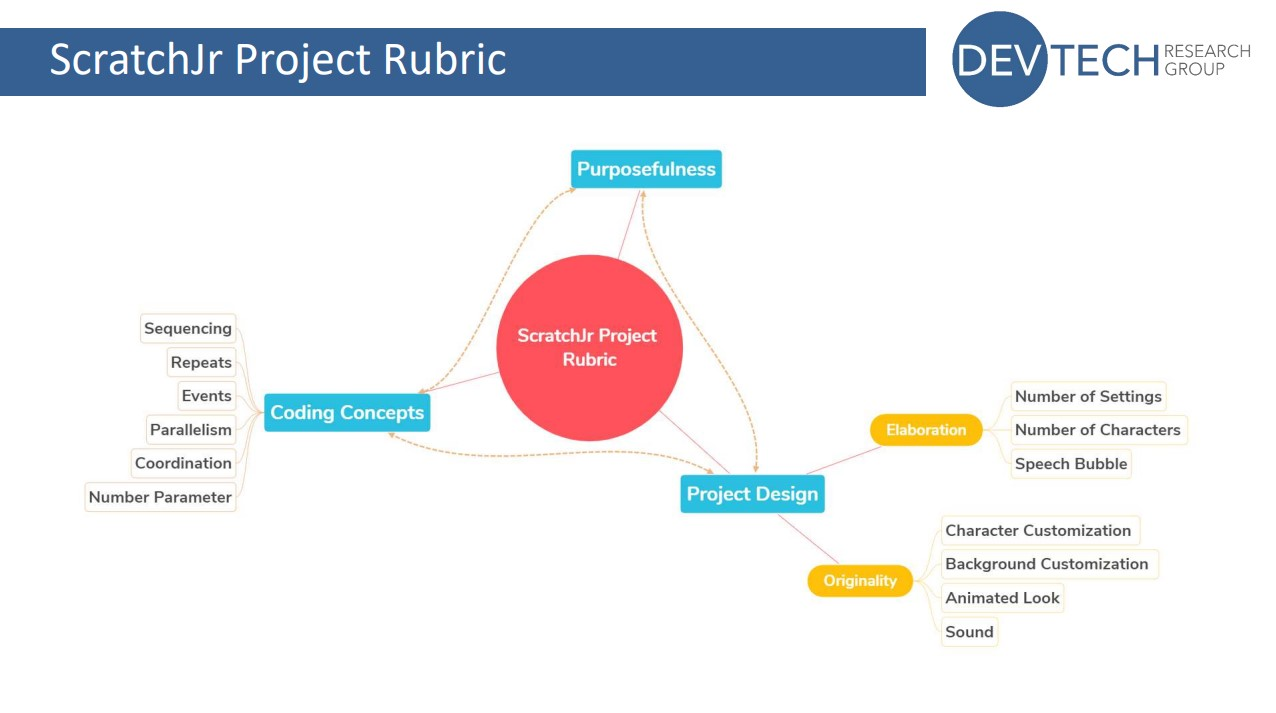
As part of the study, Aim and her colleagues collected coding projects from two schools at the start, middle, and end of a curriculum unit. They used the rubric to evaluate the coding projects and found that project scores increased over the course of the unit.
They also found that, overall, the scores for the project design elements were higher than those for coding concepts: many learners enjoyed spending lots of time designing their characters and settings, but made less use of other features. However, the two scores were correlated, meaning that learners who devoted a lot of time to the design of their project also got higher scores on coding concepts.
The rubric is a useful tool for any teachers using ScratchJr with their students. If you want to try it in your classroom, the validated rubric is free to download from the DevTech research group’s website.
How do young children create a project?
The rubric assesses the output created by a learner using ScratchJr. But learning is a process, not just an end outcome, and the final project might not always be an accurate reflection of a child’s understanding.
By understanding more about how young children create coding projects, we can improve teaching and curriculum design for early childhood computing education.
In the second study Aim presented, she set out to explore this question. She conducted a qualitative observation of children as they created coding projects at different stages of a curriculum unit, and used Google Analytics data to conduct a quantitative analysis of the steps the children took.

Her findings highlighted the importance of encouraging young learners to explore the full variety of blocks available, both by guiding them in how to find and use different blocks, and by giving them the time and tools they need to explore on their own.
She also found that different teaching strategies are needed at different stages of the curriculum unit to support learners. This helps them to develop their understanding of both basic and advanced blocks, and to explore, customise, and iterate their projects.
Early-unit strategy:
- Encourage free play to self-discover different functions, especially basic blocks
Mid-unit strategy:
- Set plans on how long children will need on customising vs coding
- More guidance on the advanced blocks, then let children explore
End-of-unit strategy:
- Provide multiple sessions to work
- Promote iteration by encouraging children to keep improving code and adding details

You can watch Aim’s full presentation here:
You can also access the seminar slides here.
Join our next seminar on primary computing education
At our next seminar, we welcome Aman Yadav (Michigan State University), who will present research on computational thinking in primary school. The session will take place online on Tuesday 7 November at 17:00 UK time. Don’t miss out and sign up now:
To find out more about connecting research to practice for primary computing education, you can find the rest of our upcoming monthly seminars on primary (K–5) teaching and learning and watch the recordings of previous seminars in this series.
The post Young children’s ScratchJr coding projects: Assessment and support appeared first on Raspberry Pi Foundation.
Source: Raspberry Pi – Young children’s ScratchJr coding projects: Assessment and support
Xiaomi’s new ‘HyperOS’ will power its smartphones and beyond
Much like how Huawei developed its own HarmonyOS as an Android substitute, Xiaomi is about to pull a similar move to bolster its ecosystem — especially with its electric car due to arrive in the first of half next year. Dubbed “HyperOS,” this MIUI replacement will apparently be a blend of Android and Xiaomi’s very own “Vela” system, hence a “completely rewritten underlying architecture” that would supposedly allow users, vehicles and smart home — of over 200 product categories — to connect with one another seamlessly. It’s safe to assume that Xiaomi’s electric car will also feature HyperOS, thus going head to head with Huawei’s Aito line of EVs.
In a Weibo post, CEO Lei Jun said development on HyperOS dates back to 2017, with a mission to build “a unified, integrated system framework that supports the entire ecosystem of devices and applications.” The exec added that this new platform will debut on the upcoming Xiaomi 14 series smartphones, which have apparently entered production, though he stopped short of sharing a launch date (rumors say end of this month). Separately, when asked on X whether HyperOS will be heading to Xiaomi’s international line of products, Lei only responded with “stay tuned.” And so we shall.
Today marks a historic moment. After years of collective work, our new operating system, #XiaomiHyperOS, is set to make its official debut on #Xiaomi14Series. pic.twitter.com/bNJqIyD8y0
— Lei Jun (@leijun) October 17, 2023
Source: Engadget – Xiaomi’s new ‘HyperOS’ will power its smartphones and beyond
Bandcamp loses half its staff after being bought by Songtradr
Half of Bandcamp’s employees have lost their jobs following the company’s acquisition by Songtradr, according to SFGate and Variety. Songtradr spokesperson Lindsay Nahmiache has admitted to SFGate that only 58 of Bandcamp’s 118 employees received an offer during the transition. A remaining employee has confirmed Nahmiache’s statement to the publication, reporting that half of the company has disappeared from its Slack chatroom and that the account owned by co-founder and former CEO Ethan Diamond has been deactivated. Some former employees who didn’t receive offers have taken to social networks to reveal that they had been kept in the dark and were in limbo over the past couple of weeks.
Based on Songtradr’s statement to Variety, the move was financially motivated: “Over the past few years the operating costs of Bandcamp have significantly increased,” they said. “It required some adjustments to ensure a sustainable and healthy company that can serve its community of artists and fans. We are committed to keeping the existing Bandcamp services that fans and artists love, including its artist-first revenue share, Bandcamp Fridays and Bandcamp Daily. We are looking forward to welcoming Bandcamp into our musically aligned community. We share a deep passion for all things music and will continue to serve artists, labels and the fans who make it all possible.”
What the spokesperson said echoes an email written by Songtradr CEO Paul Wiltshire to the remaining Bandcamp employees. He said that Bandcamp has not been healthy financially, and that while its revenue has been consistent, its operating costs have “significantly increased making it impossible to continue running the business the way it has been.”
Songtradr purchased Bandcamp from Epic Games in September, merely a year and a half after the game developer’s surprise acquisition of the music company. Bandcamp employees had organized under Epic, and they’re now fighting for Songtradr to recognize their union. Members told SFGate that they will now negotiate severance packages with Epic, while nonmembers will receive six months of severance pay.
This article originally appeared on Engadget at https://www.engadget.com/bandcamp-loses-half-its-staff-after-being-bought-by-songtradr-071319836.html?src=rss
Source: Engadget – Bandcamp loses half its staff after being bought by Songtradr