OnePlus Open review: A thinner and more affordable flagship foldable

Samsung was the first manufacturer to make a proper foldable phone, but it’s gotten a bit complacent. Now OnePlus is releasing its first phone with a flexible screen and it’s already giving the Galaxy Z Fold 5 a run for its money. Not only does the Open pack larger displays, both inside and out, it’s also thinner and lighter. That is, as long as you don’t count its massive camera module. And with its Open Canvas software, OnePlus is taking a novel approach to multitasking that makes it super fast and easy to switch between apps. 

But perhaps the most impressive thing the Open is doing, is putting pressure on the price of big fancy foldables, because starting at $1,700, it costs $100 less than the Z Fold 5 and Google’s Pixel Fold – and that’s before you factor in OnePlus’ deal that knocks another $200 off with the trade-in of any phone. In a year when we’ve already seen Google release its first foldable phone, the arrival of the OnePlus Open is adding even more excitement to the category.

Displays: Super bright

Similar to Samsung’s Galaxy Z Fold line, the OnePlus Open sports two displays: a skinner 6.3-inch exterior screen along with a 7.8-inch flexible panel on the inside. Both panels are slightly bigger than those on the Z Fold 5 while also featuring 120Hz refresh rates. But the thing the OnePlus has really pushed is brightness, which hits around 1,400 nits during normal use, or up to a mindblowing 2,800 nits in certain situations like when watching HDR content outdoors. And once again, that’s for both displays. However, those numbers are so high, it maxed out my colorimeter, so I can’t fully verify OnePlus’ claims. Regardless, brightness was never an issue.

Design: When every gram matters

OnePlus hasn’t messed around too much with Samsung’s template and stuck with an inward folding design. However, it does feel like the company tried to shave off every extra gram or millimeter. The black model which features a vegan leather back weighs just 239 grams, just one gram lighter than an iPhone 14 Pro Max. Meanwhile, our emerald dusk review unit sports a glass back and only comes in a touch heavier at 245 grams.

The Open is also surprisingly sleek measuring just 11.7mm thick. That’s even thinner than the Pixel Fold (12.1mm). That is, until you factor in its massive camera module which brings the phone’s true thickness to around 18mm. The Open also has a wider exterior display, which makes typing on it much nicer without a ton of added bulk.

At 11.7mm thick, the OnePlus Open is even thinner than a Google Pixel Fold (12.1mm), just as long as you don't count its huge camera bump.
Photo by Sam Rutherford/Engadget

Of course, some of the biggest areas of concern on a foldable are its hinge and crease. Thankfully, OnePlus has done a pretty good job with both. There is a faint groove that runs down the middle of its main display, but it’s subtle. You only notice it when viewed from acute angles or if you really go looking for it.

The hinge is also surprisingly smooth and, unlike its rivals, there’s a bit of spring-loaded action to it. So after a certain point it just swings wide open. That’s a nice change coming from the Pixel Fold which always seems to stop right at 179 degrees, no matter what you do. Another detail I appreciate is that the Open closes flush, so you don’t have to worry about keys or other small objects getting inside. Unfortunately, you only get an IPX4 rating for water resistance, which is far short of the IP68 classification on the Pixel Fold and Z Fold 5.

Performance: Mobile multitasking made easy

The OnePlus Open features a Snapdragon 8 Gen 2 chip that results in very similar performance to that of the Galaxy Z Fold 5. Samsung’s phone does enjoy about a five to 10 percent lead in tests like Geekbench 6 due to slightly higher clock speeds. But during everyday use, the advantage is basically imperceptible. But the OnePlus does have 16GB of RAM (versus 12GB on the Z Fold) along with 512GB of base storage–which is double what you get from both Samsung and Google.

OnePlus' Open Canvas software lets you easily multitask with a UI that lets apps slide in and out of view as if they were cards.
Photo by Sam Rutherford/Engadget

However, my favorite thing about the Open is how it handles multitasking. You can obviously do stuff like having two apps open in splitscreen. But if you want more, OnePlus’ Open Canvas software makes it possible to open three apps at once, with little tabs that let you move things around with a single tap. It’s like each app is a little card that slides in and out of view as you need them, and it works surprisingly well. It’s so much faster than sliding up and holding to open recent apps, but without adding too much clutter. And as a tweak on Samsung and Google’s taskbars, OnePlus added a dedicated icon for recent files, so it’s super easy to drag and drop docs or photos into email or messages.

That said, as someone who loved older versions of Oxygen OS, I feel like the current design of OnePlus’ UI (following the company’s merger with Oppo) looks a bit cheap. Almost every button aside from in the quick settings is some kind of rounded rectangle, and while it’s functional, it’s also kind of boring.

Cameras: A big bump from Hasselblad

The OnePlus Open features three rear cameras including a 48-MP main camera with a large 1/1.43” sensor, a 64-MP telephoto camera and a 48-MP ultra-wide that can also shoot macro photos.
Photo by Sam Rutherford/Engadget

Ever since OnePlus partnered with Hasselblad to upgrade its cameras, the modules on the backs of its phones have gotten bigger and bigger. And while it’s a bit of an eyesore, the Open’s huge camera bump isn’t without reason as it holds a large 1/1.43-inch 64-MP LYTIA T808 main sensor from Sony with a new pixel architecture designed to increase the amount of light it can capture for even better nighttime photos. OnePlus claims it delivers the best image quality on any foldable available today and, while I won’t go quite that far, its pics are relatively close to what you can capture with a Pixel Fold. Photos are sharp and detailed, the one shortcoming is that OnePlus’ low-light processing isn’t quite as good as Google’s Night Sight. But compared to the Z Fold 5, the Open’s pics often had better dynamic range and less exaggerated sharpening.

You also get a 48-MP ultra-wide cam that can also shoot macros, and a 64-MP telephoto with a 3x optical zoom that goes up to a 6x lossless magnification. Once again, while that 3x zoom is every bit a match for the Z Fold 5’s 3x telephoto cam, it’s 6x lossless just isn’t quite as sharp as the 5x optical lens on the Pixel Fold. But that’s not a big surprise because there still isn’t a true replacement for high-quality glass.

Battery life: Great longevity but no wireless charging?!

OnePlus has always had somewhat spotty support for wireless charging. Its first phone to have it was the OnePlus 8 Pro in 2020, which was years after its competitors got on board. That support continued on the OnePlus 9, OnePlus 9 Pro, and the OnePlus 10 Pro. But then OnePlus dropped wireless charging for the 10T and the 11, and unfortunately, we don’t get it here on the Open either.

While the Open features speedy 67-watt wired charging, sadly it doesn't support any form of wireless charging.
Photo by Sam Rutherford/Engadget

The lack of wireless charging on any $1,000 phone is pretty disappointing, let alone a brand new flagship foldable. My suspicion is that OnePlus didn’t include it because charging coils would have added one or two millimeters in thickness, which would have detracted from the phone’s design. And if that’s true, that’s a pretty weak justification.

On the bright side, wired charging is significantly faster than its competition at 67 watts. And it’s even faster in Europe at 80 watts due to their 240-volt power standard. However, because of OnePlus’ proprietary charging system, you only get those speeds when you use the included brick, so if you switch to a third-party adapter, speeds drop in half to around 30 watts.

Thankfully battery life is great. With its exterior display, the Open lasted 25 and a half hours on our video rundown test, which is an hour and a half better than the Z Fold 5. And with its main display, it lasted just over 19 hours, which is also quite respectable.

Pricing: An almost unbelievable discount

The Open's 6.3-inch exterior display doesn't sound like a big increase over the Z Fold 5's 6.2-inch Cover Screen, but that tiny bit of added width makes a big difference in overall usability.
Photo by Sam Rutherford/Engadget

When it comes to pricing, big foldables like this have always been pretty expensive, though at $1,700, the Open costs $100 less than both the Z Fold 5 and the Pixel Fold. But to sweeten the pot even further, OnePlus has an enticing deal that will knock another $200 off the price with the trade-in of any phone. Typically there are some limits or restrictions to promos like this, so I had to confirm the details with OnePlus. But the company really does mean any device, regardless of how old it is or what condition it’s in. That means you can finally get rid of the Nokia brick that’s been living in a drawer for the last 10 or 15 years and get some value out of it. And if you do, you’re looking at an effective price of $1,500, which still ain’t cheap, but it is significantly lower than the competition. The caveat is that this discount is only available directly through OnePlus.

Wrap-up

When I first heard OnePlus was making a foldable phone, I wasn’t sure what their goal was. The company hasn’t been in the business of making flagship killers for a while. But with the Open, OnePlus has crammed some rather impressive hardware into a device with a novel approach to multitasking. The Open’s cameras are as good if not slightly better than what you get on a Z Fold 5, and it has bigger screens too. Honestly, there are a lot of things about the Open’s design that I wish we were getting from Samsung, as opposed to the three years of minor refinements we’ve seen following the release of the Z Fold 3.

Along with a cable and OnePlus' proprietary charging brick, the Open also comes with an included case which is a nice bit of added value.
Along with a cable and OnePlus’ proprietary charging brick, the Open also comes with an included case which is a nice bit of added value.
Photo by Sam Rutherford/Engadget

It’s also important to note that the Open has an alter ego, because depending on where you live, this thing will also be known as the Oppo Find N3. The two phones are essentially the same device just with different branding. That said, the Open will still get four years of Android updates and five years of security patches along with support for all the major US carriers. But unlike Google and Samsung’s offerings, the Open will only be available through online retailers and because OnePlus doesn’t have any local US retail partners, the only way to get the Open serviced is to send it in. That’s a bit of concern as pretty much every foldable phone tends to have an issue with its built-in screen protector bubbling after about a year. So even though OnePlus offers free shipping for repairs under warranty, no one wants to be without their phone for a week or more while it’s in the shop.

Still, I’m impressed with what OnePlus is bringing out the gate.

This article originally appeared on Engadget at https://www.engadget.com/oneplus-open-review-a-thinner-and-more-affordable-flagship-foldable-specs-price-150031633.html?src=rss

Source: Engadget – OnePlus Open review: A thinner and more affordable flagship foldable

The OnePlus Open is a 7.8-inch foldable that’s lighter than some slab phones

Read 2 remaining paragraphs | Comments


Source: Ars Technica – The OnePlus Open is a 7.8-inch foldable that’s lighter than some slab phones

Elon Musk talks Tesla: “We dug our own grave with the Cybertruck”

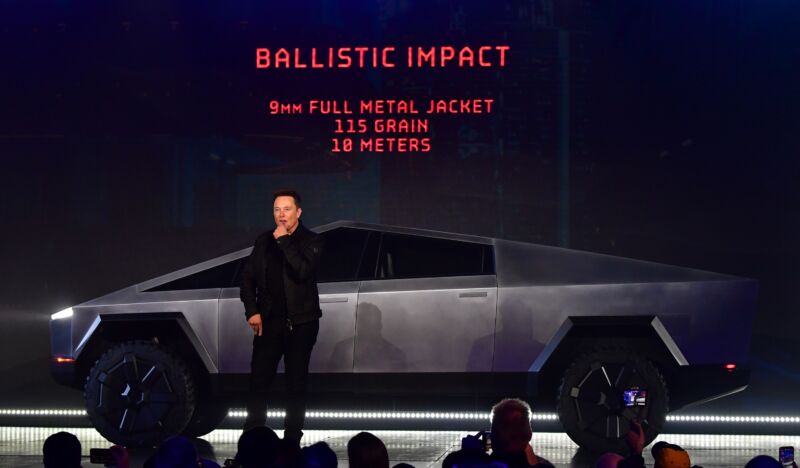
Elon Musk on stage with a prototype Cybertruck. In the background a slide claims the truck is bulletproof

Enlarge / The Cybertruck during its 2019 debut, shortly before one of the supposedly bulletproof windows was shattered by a hammer. (credit: FREDERIC J. BROWN/AFP via Getty Images)

Tesla’s unconventional electric pickup is about to go into production, according to company CEO Elon Musk. As Ars noted yesterday, Tesla’s financial results for the third quarter of 2023 included the news that the company plans to begin deliveries of the Cybertruck at the end of November. But Musk also warned of probable complications ahead as his company tries to scale production.

The Cybertruck was first revealed during a chaotic presentation back in 2019. It featured an exterior design that looked like it had been sketched with Mars in mind, clad in unpainted stainless steel panels like the ill-fated DeLorean DMC12, and allegedly with bullet proof properties, all with a starting price of $39,900.

At the time, Musk promised Tesla was going to reinvent the most quintessentially American vehicle form factor. Instead of body-on-frame construction like the majority of trucks on our roads, or even a unibody construction like the Honda Ridgeline, the Cybertruck was originally going to feature a monocoque body, similar to a Formula 1 car or prototype, except made of folded stainless steel rather than carbon fiber.

Read 10 remaining paragraphs | Comments


Source: Ars Technica – Elon Musk talks Tesla: “We dug our own grave with the Cybertruck”

OnePlus Open Review: This Phone Changed My Mind About Foldables

Compared to a few of my coworkers, I’ve been a real Debbie Downer regarding foldables. Huddled for drinks or games with friends, I’d receive the usual “oohs” and “ahhs” every time I took out a new foldable I was reviewing. Then I would tell them the price. They’d grimace and say some variation of “No way I’m spending…

Read more…


Source: Gizmodo – OnePlus Open Review: This Phone Changed My Mind About Foldables

OnePlus Open Review: This Folding Phone Puts All Others On Notice

OnePlus Open Review: This Folding Phone Puts All Others On Notice
OnePlus Open – Starting at $1699 The OnePlus Open is the most affordable book-style folding phone available in the US today. It delivers superb hardware, excellent cameras, and great software, with few compromises. Unrivaled value Superb design and build Beautiful displays Excellent cameras Blazing performance 67W wired fast charging, charger…

Source: Hot Hardware – OnePlus Open Review: This Folding Phone Puts All Others On Notice

You Should Waffle Some Instant Mashed Potatoes

I have a secret shame, and his name is Bob. Bob’s Red Mill Instant Mashed Potatoes, to be exact. I originally bought them to thicken up soups, but things have spiraled out of control. As a professional food writer, I have no business eating these; as a lazy powerlifter, I cannot stop eating them, usually alongside a…

Read more…


Source: LifeHacker – You Should Waffle Some Instant Mashed Potatoes

Seagate Unveils Exos X24 24TB and 28 TB: Setting the Stage for HAMR HDDs

Seagate on Wednesday introduced its Exos X24 family of hard drives, it’s highest capacity series of drives to date. The new family is comprised of both conventional magnetic recording technology (CMR) and shingled magnetic recording (SMR) models, with the CMR drive topping out at 24 TB, while SMR brings the peak capacity up to 28 TB. Both are, as of now, the highest-capacity HDDs in their respective segments. But perhaps the most important technological development with the Exos X24 lineup is that it uses a platform that will be largely re-used for the upcoming HAMR drives.


The Seagate Exos X24 3.5-inch helium-filled hard drive family includes 12 TB, 16 TB, 20 TB, and 24 TB models, which are built using up to 10 2.4 TB platters. Seagate’s platters feature perpendicular magnetic recording (PMR) and heads utilizing two-dimensional magnetic recording (TDMR) technology (to minimize adjacent track interference and ensure reliable reading at high track pitch densities). In addition, Seagate offers a sole 28 TB SMR version of the Exos X24 to select cloud customers who can self-manage shingled recording in their datacenters.


Seagate’s Exos X24 HDDs operate at a spindle speed of 7200 RPM and feature a segmented 256 MB cache (check out all of its specifications in tables below). The family’s 2.4 TB platters have an areal density of 1260 Gbit/inch2, allowing for a peak sustained transfer rate of 285 MB/s, which is in line with previous-generation HDDs (which is a bit surprising as typically higher areal density enables higher transfer rates). The entire Exos X24 range offers up to 168/550 random read/write IOPS (4K, QD16), which is again in line with previous-generation drives.


Seagate plans to make the Exos X24 HDDs available with either a SATA 6 Gbps or a dual-port SAS 12 Gbps interface to cater to varying customer needs.


As for power consumption of Exos X24, it ranges from 6.3W (idle) to 8.9W (max) for SATA versions and from 6.5W (idle) to 9.8W (max) for the SAS SKUs. Exos X24 HDDs are also adaptable to meet the diverse needs of major clients, supporting PowerBalance technology, which offers data centers the ability to harmonize power usage with IOPS performance. Additionally, they feature PowerChoice technology, optimizing power consumption during periods of inactivity.


Seagate Exos X24 – Metrics of Interest
Rated Workload (TB/yr) 550
Max. Sustained Transfer Rate (MBps) 285
Random Read/Write 4K QD16 WCD (IOPS) 168/550
Areal Density 1260 Gbit/inch2
Rated Load / Unload Cycles 600K
Unrecoverable Read Errors 1 in 10E15
MTBF (Hours) 2.5M
Power (Idle / Active) (W) SATA: 6.3W – 8.9W | SAS: 6.5W – 9.8W
Warranty (Years) 5
Datasheet PDF


The enterprise-focused drives otherwise check all of the usual boxes for this market segment, including vibration resistance and RV sensors. The drives are rated to handle workloads up to 550 TB/year, with a 5 year overarching warranty.


Seagate said it had commenced shipping of qualification Exos X24 drives to select customers, and the production drives are slated to be widely available for channel distribution in December.


Finally, and most interesting of all, the company has also revealed that the 10-platter helium-sealed platform will be significantly re-used for the company’s upcoming heat-assisted magnetic recording (HAMR) hard drives. Those drives will be available in capacities up to 32 TB, with Seagate set to ramp up production in early 2024.


Source: AnandTech – Seagate Unveils Exos X24 24TB and 28 TB: Setting the Stage for HAMR HDDs

Nokia To Axe Up To 14,000 Jobs To Cut Costs

Finnish telecoms giant Nokia is to axe between 9,000 and 14,000 jobs by the end of 2026 to cut costs. From a report: The announcement was made as the company reported a 20% drop in sales between July and September. The company blamed slowing demand for 5G equipment in markets such as North America. It currently has 86,000 employees around the world, and has axed thousands of jobs since 2015. Nokia wants to cut costs by between $845m and $1.27bn by 2026, it said.

Its customers have been cutting spending amid high inflation and interest rates, it said. Advances in cloud computing and AI will need “significant investments in networks that have vastly improved capabilities,” said chief executive Pekka Lundmark. “However, given the uncertain timing of the market recovery, we are now taking decisive action,” he said. It said it wanted to “act quickly” by cutting costs by $422m in 2024, and $317m in 2025.

Read more of this story at Slashdot.


Source: Slashdot – Nokia To Axe Up To 14,000 Jobs To Cut Costs

Google To Manufacture Pixel Smartphones in India

Google plans to begin assembling its Pixel smartphone lineup in India, a company executive said, becoming the latest tech giant to bet on the South Asian market for devices manufacturing. From a report: The company intends to start the local manufacturing with the current lineup — both the Pixel 8 and Pixel 8 Pro — in India and expects to ship the India-made batch starting next year, Rick Osterloh, Senior VP of Devices and Services at Google, shared at the company’s annual India event Thursday. India is a key overseas market for Google, which identifies the world’s most populous nation as its largest for many of its services including Android, Google Search, YouTube by user count. Thursday’s announcement follows Google, which has committed to invest over $10 billion in country over the the next few years, recently partnering with HP to manufacture Chromebook laptops in India.

Read more of this story at Slashdot.


Source: Slashdot – Google To Manufacture Pixel Smartphones in India

New York AG Sues Winklevoss Owned Gemini in $1 Billion Cryptocurrency Fraud

New York Attorney General Letitia James filed a lawsuit Thursday morning against cryptocurrency companies Gemini Trust, Genesis Global Capital, and Digital Currency Group (DCG) for defrauding over 230,000 investors of over $1 billion.

Read more…


Source: Gizmodo – New York AG Sues Winklevoss Owned Gemini in Billion Cryptocurrency Fraud

NASA Shocked To Discover Cause Of Largest Mars Quake Ever Detected On The Red Planet

NASA Shocked To Discover Cause Of Largest Mars Quake Ever Detected On The Red Planet
Scientists were surprised to discover the actual cause of the largest quake ever detected on Mars was not a meteoroid impact. Labled as “Marsquake S1222a,” it was detected on May 4, 2022, and resembled two prior seismic events that were caused by meteoroids smashing onto the surface of the Red Planet.

The marsquake in question had a magnitude

Source: Hot Hardware – NASA Shocked To Discover Cause Of Largest Mars Quake Ever Detected On The Red Planet

Oppo Announces Its Latest Foldable, the Find N3

Just ahead of the launch of OnePlus’s big flagship foldable, Oppo is horning in on the spotlight with the announcement of the latest foldable in its Find series, the Find N3. There are four main areas in which the phone prides itself: a slim body, an algorithm-powered smart camera, a well-thought-out efficient design…

Read more…


Source: Gizmodo – Oppo Announces Its Latest Foldable, the Find N3

U.S. Endangered Species List Gets 21 Species Smaller (in the Bad Way)

The U.S. is officially saying goodbye to 21 species that have been feared gone for years. These animals, which include many birds and marine mammals, have been delisted from the Endangered Species Act because they are now declared extinct, the U.S. Fish and Wildlife Service said this week. One famous bird, the ivory-bi…

Read more…


Source: Gizmodo – U.S. Endangered Species List Gets 21 Species Smaller (in the Bad Way)

Meta’s Chief AI Guy Says Don't Regulate Us, AI Just Isn’t That Smart

AI is too dumb to regulate now, according to Meta’s head of artificial intelligence research in an interview with the Financial Times. Yann LeCun, Meta’s chief AI scientist, tried to dismiss the most overblown fears of AI while offering a libertarian take against any real attempt to regulate the rapidly expanding…

Read more…


Source: Gizmodo – Meta’s Chief AI Guy Says Don’t Regulate Us, AI Just Isn’t That Smart

‘Biophilic Design’ Is the New Home Decor Trend

“Biophilic design” is a term used to describe an overall connection with nature in the composition of an interior space. Humans have a tendency to be attracted to other life forms, and biophilic design taps into the inherent allure of our ecosystem–even as our architecture often separates us from it. While there are…

Read more…


Source: LifeHacker – ‘Biophilic Design’ Is the New Home Decor Trend

Updates From Netflix's Bioshock Movie, Alien: Romulus, and More

Michael Giacchino talks about Werewolf by Night’s future. Chucky gets knives out in a trailer for his midseason finale. Plus, another new look at The Boy and the Heron. Plus, see some Ubisoft cameos in Captain Laserhawk’s new posters. To me, my spoilers!

Read more…


Source: Gizmodo – Updates From Netflix’s Bioshock Movie, Alien: Romulus, and More

AMD's Monstrous Threadripper 7000 CPUs Aim For Desktop PC Dominance

AMD’s powerhouse Threadripper chips are back for desktop PCs. Despite declaring the end of consumer Threadripper chips last generation, AMD announced three new Ryzen Threadripper 7000-series chips on Thursday, with up to 64 cores and 128 threads — and the option of installing a “Pro”-class Threadripper 700 WX series for a massive 96 cores and 192 threads, too. PCWorld: Take a deep breath, though. The underlying message is the same as when AMD released the Threadripper 3970X back in 2019: these chips are for those who live and breathe video editing and content creation, and are optimized for such. Nevertheless, they almost certainly represent the most powerful CPU you can buy on a desktop, for whatever purpose.

The key differences between the older workstation-class Threadripper 5000 series and these new 7000-class processors are simple: AMD has brought forward its Zen 4 architecture into Threadripper alongside a higher core count, faster boost frequencies, and a generational leap ahead to PCI Express 5.0. Consumers will need new motherboards, though, as the new “TRX50” consumer Threadripper platform uses the new AMD TRX50 HEDT (high-end desktop) chipset and sTR5 socket. And did we mention they consume (gulp) 350W of power? In some ways, though, the new Threadripper 7980X, 7970X, and 7960X consumer Threadripper offerings are familiar. They stick with AMD’s tried-and-true 64-core configuration, the same as the Threadripper 5000 series, moving down to 24 cores. The 12- and 16-core configurations have been trimmed off from the prior generation.

Read more of this story at Slashdot.


Source: Slashdot – AMD’s Monstrous Threadripper 7000 CPUs Aim For Desktop PC Dominance