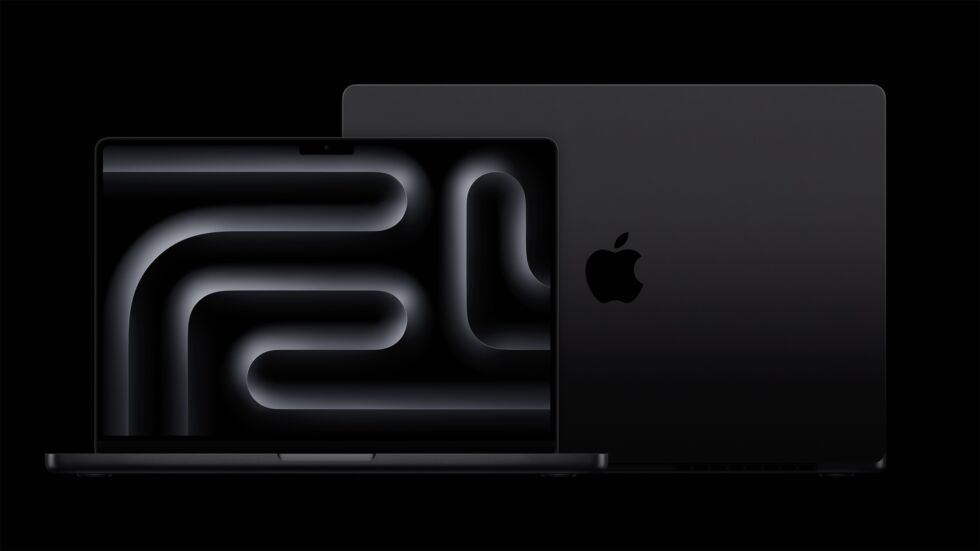
Apple leans into its event’s spooky vibes with the new space black version of the MacBook Pro. [credit:
Apple ]
NEW YORK—As expected, Apple has launched a newly refreshed lineup of 14- and 16-inch MacBook Pros at its “Scary Fast” product event this evening, replacing not just the last-generation versions of those laptops but also the old 13-inch MacBook Pro.
The company is accomplishing that last goal by introducing a less-expensive $1,599 version of the 14-inch MacBook Pro that uses a regular M3 chip instead of the M3 Pro or M3 Max.
(Ars Technica may earn compensation for sales from links on this post through affiliate programs.)
It isn’t as fast, it starts with a skimpy 8GB of RAM of storage, it has one fewer Thunderbolt port (for a total of two), and it only supports a single external display. But at $1,599, the M3 MacBook Pro is $400 cheaper than the M2 Pro/M3 Pro version of the laptop, and it still uses the larger high-refresh-rate ProMotion display, the contrast-boosting and bloom-reducing mini LED screen technology, the MagSafe connector, the 1080p camera, 512GB of storage in the base model, the speaker system, and a full-sized HDMI port. And while Apple quotes the same “up to 22 hours of battery life” for all of the new MacBook Pro models, in the real world, the M3 should give you a bit more runtime than the M3 Pro or Max.
Enlarge/ Apple’s 13-inch MacBook Pro, gone but not forgotten. (credit: Apple)
NEW YORK—Apple refreshed its MacBook Pro lineup earlier today, and there was one surprise that the rumor mill hadn’t anticipated: a new base model of the 14-inch MacBook Pro with a plain-old M3 chip in it, starting at $1,599. That new 14-inch MacBook Pro is totally replacing the old 13-inch MacBook Pro in Apple’s lineup.
The 13-inch MacBook Pro still used the same basic design that Apple had been using since 2016, when Apple redesigned the MacBook Pros to make them thinner and lighter and to replace all of their ports with Thunderbolt. The 14- and 16-inch MacBook Pros backtracked on several of those design decisions, but the 13-inch model stayed as it was, complete with the regular notchless display and the Touch Bar.
This effectively means that the MacBook Pro is getting a price increase from $1,299 to $1,599. But the $1,599 Pro includes many features that were never included in the 13-inch Pro, including the larger high-refresh-rate ProMotion display, the contrast-boosting and bloom-reducing mini LED screen technology, the MagSafe connector, the 1080p camera, and the return of the HDMI port. Apple also now sells a 15-inch MacBook Air at that $1,299 starting point, giving people another option in between the mainstream 13-inch Air and the Pro lineup.
On Monday at its “Scary Fast” event, Apple announced an updated line of 14- and 16-inch MacBook Pros featuring a range of new M3 chips and Space Black chassis.
Compared to a similarly specced M2 model, a base M3 14-inch MacBook Pro will now start at $1,599 ($400 less than its predecessor) with prices going up from there for configurations with M3 Pro or M3 Max processors. Meanwhile, a base 16-inch MacBook Pro with an M3 Pro chip will have the same $2,499 starting price as its M2 Pro-equipped predecessor.
The fresh Space Black color option–which looks more like a matte charcoal gray in person–will be available on both 14- and 16-inch systems with M3 Pro and M3 Max chips and helps hide fingerprints better than the classic silver models. The rest of the laptops’ hardware will remain largely the same including features such as Apple’s 1080p FaceTime cameras and six-speaker sound systems. The one small change is that the Liquid Retina XDR displays on the new M3 MacBook Pros can now display SDR content 20 percent brighter than before with peaks of 600 nits (up from 500 nits on the previous generation).
Apple
That said, thanks to the new M3 chips, these refreshed MBPs should have some very notable boosts in performance. In general use, Apple claims a 14-inch M3 MacBook Pro is 60 percent faster than a 13-inch M1 model while still offering up to 22 hours of battery life. And if you move up to a laptop with an M3 Pro chip, you’re looking at 40 percent faster performance than an equivalent M1 Pro MBP. Finally, 14- and 16-inch M3 Max systems will support up to a massive 128GB of unified memory for improved workflows in apps like MATLAB, DaVinci Resolve and others. However, the most stunning figure is that when compared to the fastest Intel-based MacBook Pros (which date back to 2021), Apple is touting 11x faster performance for systems equipped with M3 Max chips.
Another important upgrade on the M3 chips is that they support hardware acceleration for both ray tracing and mesh shading. This could prove to be a massive improvement for gamers or people like animators and 3D modelers, who will be able to take advantage of the M3’s more efficient on-chip processing power in supported apps.
The new Space Black color on Apple’s refreshed MacBook Pros should hide fingerprints better than traditional silver models.
Apple
Pre-orders for all the new M3 MacBook Pro models go live today with M3 and M3 Pro systems shipping as soon as next week on November 7, with M3 Max configs slated to arrive slightly later next month. The 14-inch M3 MacBook Pro will start at $1,599 ($1,499 for education) or $1,999 for one with an M3 Pro ($1,849 for education) while the 16-inch M3 Pro MacBook Pro will start at $2,499 ($2,299 for education).
Follow all of the news from Apple’s “Scary Fast” October event right here.
This article originally appeared on Engadget at https://www.engadget.com/apple-updates-its-14-inch-and-16-inch-macbook-pros-with-new-m3-chips-specs-price-003015893.html?src=rss
The new iMac comes in the same seven colors as the old one. [credit:
Apple ]
NEW YORK—The new MacBook Pros are the biggest news from Apple’s October Mac event, but one other model got a long-overdue refresh, too—the 24-inch iMac, most recently refreshed with an Apple M1 processor in June 2021.
(Ars Technica may earn compensation for sales from links on this post through affiliate programs.)
The new iMac is available for order today, and the first ones will arrive on November 7. The base model, which includes an M3 with an 8-core GPU, 256GB of storage, two Thunderbolt ports, a non-Touch ID keyboard, and 8GB of RAM, starts at $1,299. An upgraded version with a 10-core GPU, a power brick-mounted gigabit Ethernet port, two additional USB-C ports, and a Touch ID keyboard starts at $1,499. Those prices are $1,249 and $1,399, respectively, for education users.
The most important upgrade—and really the only one of note—is an upgrade to the new M3 chip. Because it was the only Mac to totally skip the M2, the new iMac hops forward two generations at once. Apple says that the M3’s four high-performance CPU cores are up to 30 percent faster than those in the M1, and that its four high-efficiency CPU cores are as much as 50 percent faster. Apple says that the 10-core GPU in the M3 is up to 2.5 times faster than the M1, and that its 16-core Neural Engine is up to 60 percent faster.
Apple had a bit of a Halloween treat for Mac desktop aficionados at its “Scary Fast” event. As expected, the 24-inch iMac is getting more oomph thanks to Apple’s new M3 chipset. The company says the latest model will be up to twice as fast as the last iMac, which has an M1 chipset. Those making the switch from an Intel-based iMac will find that the new model is up to 2.5 times faster than some of the most popular 27-inch models.
The M3 has an eight-core CPU and up to a 10-core GPU. The graphics cores support hardware-accelerated mesh shading and ray-tracing. The chipset has a 16-core Neural Engine and support for up to 24GB of unified memory too.
Compared with the M1 iMac from 2021, the M3-powered version will deliver up to a 30 percent speed boost in Safari and productivity apps such as Microsoft Excel, Apple says. The company notes that games will run at up to 50 percent improved frame rates too. Creatives will be able to edit and play back up to 12 4K video streams, three times as many as before. Apple also says that processing images in apps such as Adobe Photoshop and tackling video projects in Final Cut Pro and Adobe Premiere Pro will be up to twice as fast.
Apple
There aren’t too many upgrades elsewhere in the latest Mac. Apple is sticking with a 4.5K Retina display, for instance. There are some handy changes on the connectivity front. The latest iMac supports Wi-Fi 6E and Bluetooth 5.3 — the M1 iMac had Wi-Fi 6 and Bluetooth 5.0. Still, the M3 iMac might be worth the upgrade for those who have been clinging onto an older model.
Orders for the M3 iMac open today and it will ship on November 7. The base model comes with an eight-core GPU, two Thunderbolt ports, Magic Keyboard, and Magic Mouse. However, it once again has a paltry 256GB of SSD storage and 8GB of unified memory. This variant will run you $1,299 (or $1,249 for education). It’s available in green, pink, blue and silver.
If you’d like an M3 iMac that has a 10-core GPU, that starts at $1,499 ($1,399 for education). Other upgrades include two additional USB 3 ports, a Gigabit Ethernet port and Magic Keyboard with Touch ID. However, the base storage and RAM remain the same at 256GB and 8GB, respectively. This model is available in green, yellow, orange, pink, purple, blue and silver.
Follow all of the news from Apple’s “Scary Fast” October event right here.
This article originally appeared on Engadget at https://www.engadget.com/apples-24-inch-m3-imac-starts-at-1299-and-ships-on-november-7-003010226.html?src=rss
Apple had a bit of a Halloween treat for Mac desktop aficionados at its “Scary Fast” event. As expected, the 24-inch iMac is getting more oomph thanks to Apple’s new M3 chipset. According to the presentation in tonight’s Apple Event, the latest model will be up to twice as fast as the last iMac, which has an M1 chipset. Those making the switch from an Intel-based iMac will find that the new model is up to 2.5 times faster than some of the most popular 27-inch models.
The M3 has an eight-core CPU and up to a 10-core GPU. The graphics cores support hardware-accelerated mesh shading and ray-tracing. The chipset has a 16-core Neural Engine and support for up to 24GB of unified memory too.
Compared with the M1 iMac from 2021, the M3-powered version will deliver up to a 30 percent speed boost in Safari and productivity apps such as Microsoft Excel, Apple says. The company notes that games will run at up to 50 percent improved frame rates too. Creatives will be able to edit and play back up to 12 4K video streams, three times as many as before. Apple also says that processing images in apps such as Adobe Photoshop and tackling video projects in Final Cut Pro and Adobe Premiere Pro will be up to twice as fast.
Apple
There aren’t too many upgrades elsewhere in the latest Mac. Apple is sticking with a 4.5K Retina display, for instance. There are some handy changes on the connectivity front. The latest iMac supports Wi-Fi 6E and Bluetooth 5.3 — the M1 iMac had Wi-Fi 6 and Bluetooth 5.0. Still, the M3 iMac might be worth the upgrade for those who have been clinging onto an older model.
Orders for the M3 iMac open today and it will ship on November 7. The base model comes with an eight-core GPU, two Thunderbolt ports, Magic Keyboard, and Magic Mouse. However, it once again has a paltry 256GB of SSD storage and 8GB of unified memory. This variant will run you $1,299 (or $1,249 for education). It’s available in green, pink, blue and silver.
If you’d like an M3 iMac that has a 10-core GPU, that starts at $1,499 ($1,399 for education). Other upgrades include two additional USB 3 ports, a Gigabit Ethernet port and Magic Keyboard with Touch ID. However, the base storage and RAM remain the same at 256GB and 8GB, respectively. This model is available in green, yellow, orange, pink, purple, blue and silver.
If you’re more of a laptop fan, Apple also announced 14- and 16-inch MacBook Pro models with the M3, M3 Pro and M3 Max chipsets — you can get all the details on those here.
Follow all of the news from Apple’s “Scary Fast” October event right here.
This article originally appeared on Engadget at https://www.engadget.com/apple-24-inch-price-release-date-specs-003010278.html?src=rss
There’s nothing truly spooky about Apple’s new M3 chips — except, perhaps, for how scared they’ll make Intel, AMD and Qualcomm. During its “Scary Fast” Halloween Eve product event (at 8PM Eastern Apple, really?) the company officially debuted its new M3, M3 Pro and M3 Max chips. They’ll be featured in the revamped MacBook Pro 14-inch and 16-inch, as well as the 24-inch iMac, which never got an M2 refresh.
Apple is mainly positioning the M3 chips as major upgrades over its M1 hardware — if you bought an M2 system, you’re probably not itching for a replacement just yet. The M3’s GPU is the biggest leap forward, delivering new features like hardware-accelerated raytracing and mesh shading, which will enable more realistic lighting and better geometry handling. Apple claims the M3’s GPU is 1.8 times faster than the M2 and 2.5 times faster than the M1 in “Pro apps” — as usual, the company didn’t reveal its testing criteria. You can also expect better power efficiency, as the M3’s GPU can hit the M1’s performance level while using half the power.
Here’s how Apple’s new hardware breaks down: The plain M3 features an 8-core CPU (made up of four performance cores and four efficiency cores) and a 10-core GPU. Apple claims it’s up to 35 percent faster than the M1, and it can also support up to 24GB of unified RAM. The M3 Pro ups the ante with a 12-core CPU (six performance, six efficiency) and an 18-core GPU. It can squeeze in up to 36GB of memory, and Apple says that it’s single-threaded performance is up to 30 percent faster than the M1 Pro.
Apple
And then there’s the M3 Max, featuring a 16-core CPU (12 performance, four efficiency, a 40-core GPU and support for up to 128GB of RAM. Apple claims it’s up to 80 percent faster than the M1 Max. It also sports two ProRes engines to satisfy even the most demanding video professionals.
The M3 chips are also notable for being the first PC chips built on a 3 nanometer process, rather than the M1 and M2’s 5nm process. The increased transistor density helps with power efficiency, as well as providing better overall performance. According to Apple, the M3’s performance cores are 15 percent faster than the M2’s, while the efficiency cores are 30 percent faster.
Given that Apple just debuted the 3nm A17 Pro for the iPhone 15 and 15 Pro, it’s not too surprising that the M3 has been similarly shrunken down. In comparison, AMD debuted its 4nm Ryzen 7040 chip this year, and Intel plans to launch its Core Ultra Meteor Lake laptop chips in December, which is built on the “Intel 4” platform (using a 7nm process). The differences between architectures, some of which rely on newer tech like 3D stacking, makes it difficult to directly compare processing node sizes. But for now, Apple can lord its 3nm figure over the rest of the PC world.
When it comes to other upgrades, Apple says the M3’s Neural Engine, which handles AI tasks, is up to 60 percent faster than M1 chips. The M3 also sport a media engine with hardware acceleration for H.264, HEVC, ProRes (both standard and RAW). That engine also finally supports AV1 video decoding, which should make streaming AV1 content more power efficient.
Like most chip makers, it makes sense for Apple to follow up a major release like the M1 with a minor refresh like the M2. The M3 needs to prove itself to be the substantial upgrade over the M1 that Apple claims. And with the addition of ray tracing and better graphics, it may finally make Macs more enticing for developers and gamers alike. (Just in time for major titles like Death Stranding and Resident Evil Village to hit the App Store.)
Follow all of the news from Apple’s “Scary Fast” October event right here.
This article originally appeared on Engadget at https://www.engadget.com/apples-m3-chips-pro-max-003004080.html?src=rss
An anonymous reader quotes a report from TorrentFreak: Brazil’s telecoms regulator Anatel claims that during an operation last week, it successfully blocked around 80% of pirate ‘TV boxes’ in the country. Estimates from early 2023 suggest that seven million were active in Brazil. The operation, claimed to be the most significant ever carried out, arrives just weeks after Google & Cisco were criticized for “turning a blind eye” to the IPTV piracy problem. […] Whatever the approach, if Anatel had somehow managed to prevent 80% of all TV boxes receiving pirated content in the space of a year, that would be an extraordinary achievement. Even a week would be astonishing but the claim of millions in a day seems either incredible, non-credible, or entirely dependent on more important information or nuance that isn’t being reported. Another angle is that disruption on a large scale tends to register in search results and Google data on various related search terms doesn’t seem to reflect millions of TV boxes suddenly going dark in Brazil last week. At least, not for any significant length of time.
Join us here at 5pm Pacific/8pm Eastern/00:00 UTC for what should prove to be an interesting event from Apple. The Cupertino, California company is holding an unusual, evening broadcast event that they’re calling “Scary Fast“, an apt name for a product launch taking place the night before Halloween.
In typical Apple fashion, the company is tight-lipped ahead of this evening’s presentation. But based on some recent regulatory filings, it looks like we’re in store for some new MacBook Pros and other products – and almost certainly based on a new Apple Silicon SoC, which would be the M3 family. Apple just launched the M2 MacBook Pro family back in January, so this would be a quick turnaround for a new generation of Macs, but it’s not without precident.
More interesting, at least in advance, is Apple’s decision to host this event in the evening. While this makes for prime-time viewing on the US east coast, it’s during commuter hours in the west coast, and Europe is outright asleep. So it will be interesting to see if this is going to become a trend from Apple to try to more directly reach consumers in the evening, or if this is a one-off event due to everything else going on today.
Pete Syme reports via Insider: A British software company is giving Meta 30 days to stop using the name Threads in the UK because it owns the trademark. Threads Software Limited says its lawyers wrote to the Facebook and Instagram parent company on Monday. If Meta doesn’t stop using the name Threads, Threads Software Limited says it will seek an injunction from the courts.
The British company trademarked Threads in 2012 for its intelligent messaging hub, which can store a company’s emails, tweets, and voice over internet protocol phone calls in a cloud database. In a press release, it said it had declined the four offers that Meta’s lawyers made to purchase its domain name “threads.app.” Then when Meta launched Threads, its social media app designed to compete with Elon Musk’s X, the British company says it was removed from Facebook. John Yardley, the managing director of Threads Software Limited, said the business “faces a serious threat from one of the largest technology companies in the world.”
“We recognize that this is a classic ‘David and Goliath’ battle with Meta,” said Yardley. “And whilst they may think they can use whatever name they want, that does not give them the right to use the Threads brand name.”
Citing an “unacceptable level of risk to privacy and security,” Canada banned Chinese messaging application WeChat and Russian antivirus program Kaspersky on government-issued mobile devices. Reuters reports: The ban was announced after an assessment by Canada’s chief information officer that Tencent-owned WeChat and applications made by Moscow-based Kaspersky “present an unacceptable level of risk to privacy and security,” the Treasury Board of Canada, which oversees public administration, said in a statement. Kaspersky said it was surprised and disappointed, and that the decision was made without warning or an opportunity for the firm to address the government’s concerns. “As there has been no evidence or due process to otherwise justify these actions, they are highly unsupported and a response to the geopolitical climate rather than a comprehensive evaluation of the integrity of Kaspersky’s products and services,” the company said in a statement.
The Treasury Board said it has no evidence that government information has been compromised, but the collection methods of the applications provide considerable access to a device’s contents, and risks of using them were “clear.” “The decision to remove and block the WeChat and the Kaspersky applications was made to ensure that government of Canada networks and data remain secure and protected and are in line with the approach of our international partners,” the statement said. The applications will be removed from government-issued mobile devices on Monday, and users will be blocked from downloading them in the future.
This seven-inch car infotainment system with Apple CarPlay, Android Audio, and phone mirroring capabilities is on sale for $99.99 (reg. $139.99) now through Oct. 31. It works with most, but not all, car models.
Last Thursday, Hasbro had an investor’s call to discuss the third quarter, and while Hasbro itself might be going through a rough time, with lower-than-expected earnings, Wizards of the Coast was once again the high earner for the company—bolstered by two big releases.
A UK-based software company called Threads Software Limited is threatening legal action against Meta over its use of the name Threads. The company, which says it’s owned the “Threads” trademark since 2012, makes an “intelligent message hub” that uses AI to help businesses keep track of phone calls, emails and other messages.
Threads Software Limited claims that Meta lawyers made four separate attempts, beginning in April 2023, to buy the software company’s threads.app domain, and eventually shut down its Facebook account. “Every offer was declined,” the company said in a statement. “It was made clear to Meta’s Instagram that the domain was not for sale. In July 2023, Meta’s Instagram announced its ‘threads’ social media platform and removed Threads Software Limited from its Facebook platform.”
The software company said that it’s giving Meta 30 days to “stop using the Threads name” and that it will “seek an injunction from the UK courts” if the social media company declines to do so. In a statement, Threads Software’s CEO John Yardley said it was “not an easy decision” to take on Meta, but that the “business now faces a serious threat from one of the largest technology companies in the world.”
Meta didn’t immediately respond to a request for comment. It’s not clear how much money Meta may have offered for threads.app, but Yardley’s statements offer a rare look at the kind of backroom negotiations that can happen in order to secure a sought-after domain or username.
It’s also worth noting that the software maker wasn’t the only company using the Threads name at the time Meta launched its Twitter competitor. Fashion retailer American Threads controlled the @Threads handle on Instagram at the time of the service’s launch. The company jokingly responded to commenters at the time, and posted on the new Threads service about people mixing up the clothing brand with the Meta-owned service. Meta used @threadsapp on Instagram and threadsapp.net on Threads, at the time of the service’s launch.
Screenshot by Karissa Bell via Instagram
A month later, the retailer’s Instagram account changed handles to @americanthreads (and americanthreads.net on Threads) without explanation, while Meta took control of the @Threads handle. Representatives for the clothing brand didn’t immediately respond to a request for comment, but the circumstances are strikingly similar to how Meta quietly gained control of the @Meta handle on Instagram more than a year ago. That username was also controlled by a separate entity — an independent motorcycle publication called META — but the account was later subsumed by the social network without explanation.
Representatives of Meta, the magazine, never commented directly on how their account changed hands, but wrote about their dismay in learning of Facebook’s name change. “With the flip of a switch our identity was suddenly watered down, and we watched our name circle the drain and wash away with something we had no control over,” the magazine’s cofounder wrote in a blog post that’s since been deleted. The magazine now uses the name Vahna.
For now, it appears Threads Software Limited is hoping for a different outcome. “Over the last 10 years, we have made a large investment in the Threads name and we did not want to potentially have to write-off this investment simply because Meta happened to like the name we had already coined for a messaging service,” it wrote in a blog post. “For us to change the service name simply to avoid confusion with Meta’s product could well set back the service enough for us to lose that technological lead.”
If you have been offered money in exchange for your domain name or handle from Meta or another social media company, reach out to me at karissa.bell [at] engadget.com or on Signal at +1.628.231.0063.
This article originally appeared on Engadget at https://www.engadget.com/a-software-company-called-threads-says-meta-tried-to-buy-its-domain-and-kicked-it-off-facebook-221928864.html?src=rss
An anonymous reader quotes a report from TechCrunch: After a weekend of almost complete internet blackout, connectivity in Gaza has been partially restored. On Friday, internet monitoring firms and experts reported that access to the internet had significantly degraded in the Palestinian enclave. The local internet service NetStream “collapsed,” according to NetBlocks, a firm that tracks internet access across the world. At the same time, IODA, another internet monitoring system, showed outages and degradation across several Palestinian internet providers. The lack of internet communications caused emergency lines to stop ringing, made it hard for paramedics to locate the wounded, and for family members to reach relatives and friends, according to The New York Times.
On Sunday, IODA reported “marginal restoration” of internet connectivity in Gaza. Abdulmajeed Melhem, chief executive of the Palestinian main telecommunications company Paltel Group, told The Times that the internet had come back even though the company had not made any repairs. Then on Monday, Gaza had roughly the same access to internet connectivity as before Friday, according to several experts and firms that are monitoring the internet in the region, including Doug Madory, an expert who for years has focused on monitoring networks across the world. “There was the 34 hour complete blackout from Friday to Sunday — a first for Gaza. Then there was last night’s partial outage in northern Gaza,” Madory, who is the director of internet analysis at Kentik, told TechCrunch on Monday. “The situation is still very precious: no power, little water. Service could potentially drop out again at any time.” […]
It’s unclear what caused the internet outages in Gaza on Friday and what caused the improvements on Sunday and Monday. The Washington Post reported on Sunday that the U.S. government put pressure on the Israeli government to switch the internet back on in Gaza, citing an unnamed U.S. official. “We made it clear they had to be turned back on,” the official said. “The communications are back on. They need to stay on,” The Post quoted the official as saying. Also on Sunday, The Times reported that the U.S. government believed that the Israeli government was responsible for the near-blackout of the internet in Gaza.
It was a proto-netbook, it was a palmtop, it was a PDA, it was Windows Phone 7 but not Windows Phone 8, and then it was an embedded ghost. It parents never seemed to know what to do with it after it grew up, beyond offer it up for anybody to shape in their own image. And then, earlier this month, with little notice, Windows CE was no more, at least as a supported operating system. Windows Embedded Compact 2013, better (but not popularly) known as Windows CE 8.0, reached end of support on October 10, 2023, as noted by The Register.
Windows CE was initially Microsoft Pegasus, a team working to create a very low-power, MIPS or SuperH-based reference platform for manufacturers making the smallest computers with keyboards you could make back then. Devices like the NEC MobilePro 200, Casio (Cassiopeia) A-10, and HP 300LX started appearing in late 1996 and early 1997, with tiny keyboards, more-landscape-than-landscape displays, and, by modern standards, an impressive number of ports.
Ubisoft has announced plans to shut down online services for nearly a dozen video games, including Assassin’s Creed 2 and Splinter Cell: Conviction. The games will lose online functionally on January 25, 2024.
A vulnerability that allows attackers to bypass multifactor authentication and access enterprise networks using hardware sold by Citrix is under mass exploitation by ransomware hackers despite a patch being available for three weeks.
Citrix Bleed, the common name for the vulnerability, carries a severity rating of 9.4 out of a possible 10, a relatively high designation for a mere information-disclosure bug. The reason: the information disclosed can include session tokens, which the hardware assigns to devices that have already successfully provided credentials, including those providing MFA. The vulnerability, tracked as CVE-2023-4966 and residing in Citrix’s NetScaler Application Delivery Controller and NetScaler Gateway, has been under active exploitation since August. Citrix issued a patch on October 10.
Repeat: This is not a drill
Attacks have only ramped up recently, prompting security researcher Kevin Beaumont on Saturday to declare: “This vulnerability is now under mass exploitation.” He went on to say, “From talking to multiple organizations, they are seeing widespread exploitation.”
Back at Innovation ’23, Intel announced that its Meteor Lake processors would be officially-launched on December 14th. Despite the fact that they haven’t made their debut, Intel’s first disaggregated CPUs have already appeared in a few places, including a handheld from Hong Kong as well as in some Lenovo laptops being sold in Bulgaria.