OpenAI’s global outages for ChatGPT and its API yesterday were due to a Distributed Denial of Service (DD0S) attack, according to a post on the company’s outage page Wednesday evening. CEO Sam Altman said the company was planning to go live with GPTs, its new customizable chatbots, for all subscribers on Monday in a tw…
The OnePlus 12 hype train continues to build momentum with the company dropping more details about the camera package, particularly the Sony LYTIA primary sensor. OnePlus claims that the sensor in the upcoming smartphone will be the best LYTIA one can buy, even topping the one of the fantastic OnePlus Open.
After months of high-level meetings and discussions, government officials and Big Tech leaders have agreed on one thing about artificial intelligence: The potentially world-changing technology needs some ground rules. But many in Silicon Valley are skeptical. WashingtonPost: A growing group of tech heavyweights — including influential venture capitalists, the CEOs of midsize software companies and proponents of open-source technology — are pushing back, claiming that laws for AI could snuff out competition in a vital new field. To these dissenters, the willingness of the biggest players in AI, such as Google, Microsoft and ChatGPT maker OpenAI to embrace regulation is simply a cynical ploy by those firms to lock in their advantages as the current leaders, essentially pulling up the ladder behind them. These tech leaders’ concerns ballooned last week, when President Biden signed an executive order laying out a plan to have the government develop testing and approval guidelines for AI models — the underlying algorithms that drive “generative” AI tools such as chatbots and image-makers.
“We are still in the very early days of generative AI, and it’s imperative that governments don’t preemptively anoint winners and shut down competition through the adoption of onerous regulations only the largest firms can satisfy,” said Garry Tan, the head of Y Combinator, a San Francisco-based start-up incubator that helped nurture companies including Airbnb and DoorDash when they were just starting. The current discussion hasn’t incorporated the voices of smaller companies enough, Tan said, which he believes is key to fostering competition and engineering the safest ways to harness AI. Companies like influential AI start-up Anthropic and OpenAI are closely tied to Big Tech, having taken huge amounts of investment from them.
“They do not speak for the vast majority of people who have contributed to this industry,” said Martin Casado, a general partner at venture capital firm Andreessen Horowitz, which made early investments in Facebook, Slack and Lyft. Most AI engineers and entrepreneurs have been watching the regulatory discussions from afar, focusing on their companies instead of trying to lobby politicians, he said. “Many people want to build, they’re innovators, they’re the silent majority,” Casado said. The executive order showed those people that regulation could come sooner than expected, he said. Casado’s venture capital firm sent a letter to Biden laying out its concerns. It was signed by prominent AI start-up leaders including Replit CEO Amjad Masad and Mistral’s Arthur Mensch, as well as more established tech leaders such as e-commerce company Shopify’s CEO Tobi Lutke, who had tweeted “AI regulation is a terrible idea” after the executive order was announced.
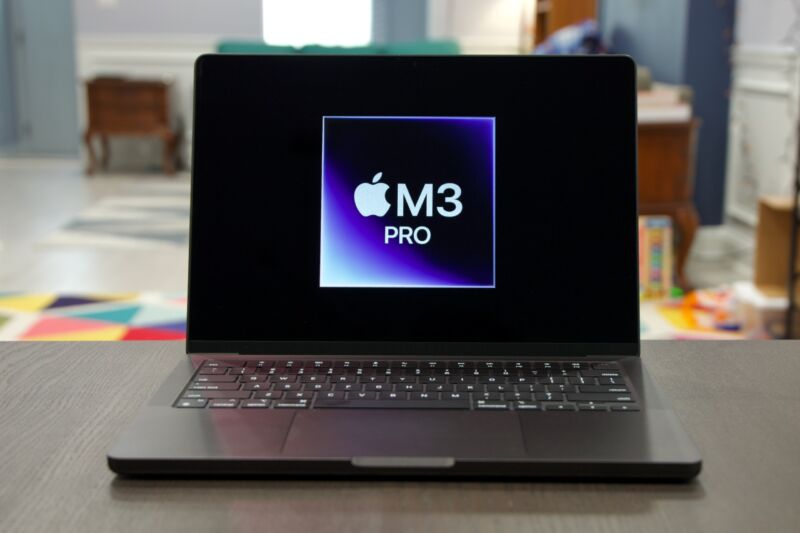
Enlarge/ A 14-inch MacBook Pro with Apple’s M3 Pro inside. (credit: Andrew Cunningham)
When Apple announced the first three chips in its M3 processor family, the M3 Pro immediately stood out. Not because it was a huge leap over the prior generation, but because it was the first time we had seen Apple reduce key specs like transistor count, CPU and GPU core count, and memory bandwidth from one generation to the next.
Transistor count is an imperfect proxy for performance, but adding transistors is one of the primary ways to improve a chip’s performance (ramping clock speeds up is another, which we’ll revisit shortly). Both the M3 and M3 Max feature substantial transistor count boosts compared to their M2 counterparts—from 20 billion to 25 billion for the M3, and from 67 billion to 92 billion with the M3 Max. The M3 Pro has 37 billion, down from 40 billion in the M2 Pro.
That didn’t tell us much by itself, but it did set us up to expect an M3 Pro that was a modest-at-best improvement over the M2 Pro. Now that we’ve been able to test one in a 14-inch MacBook Pro, we can confirm that this is the case. The M3 Pro is still decidedly faster than the regular M3, and building a chip with fewer transistors on a newer 3 nm manufacturing process has other benefits. But there’s a wider performance gap between the M3 Pro and M3 Max than there was in the M2 generation, and you’ll need to wait for the M4 generation before you see substantially faster Pro chips.
AMD continues to chip away at Intel’s dominant lead in x86 CPU market share with a round of gains across the board, including desktop PCs, laptops, and servers, according to the latest audit performed by Mercury Research and shared by AMD. The updated figures cap off an impressive year for AMD, which looks to end 2023 just at it had started—by
What happens on your PC doesn’t have to stay on your PC. If you ever want to show others what’s happening on your screen, whether that’s for a YouTube video, a social media post, or to teach a relative how to do something on their computer, record it! Windows 11 has two built-in ways to screen record, so there’s no…
During Warner Bros Games’ 2023 Q3 earnings call, WB Discover CEO David Zaslav explained that the publisher behind games like Batman: Arkham Knight and Suicide Squad will focus on creating more always-online, free-to-play, live-service games.
The holidays are a time to gather, drink and share your favorite dishes. And for the people who are doing the cooking, there’s no better way to show your appreciation (besides offering them a helping hand) than by giving them something to make the process faster, simpler, or just more fun. So regardless of whether they prefer baking, cooking savory dishes or making healthy juices, we’ve got a huge range of tried and tested gear that will make great gifts for foodies.
KitchenAid Cordless Variable Speed Hand Blender
Made-in Half Sheet Pan
Silpat Baking Sheet
Breville Juice Fountain
Kan Kitchen Chef Knife
Kyocera Ceramic Chef Knife
Misen Non-stick pans
Instant Vortex Plus air fryer
Anova Precision Cooker 3.0
Microplane Classic Grater
ThermoWorks ThermoPop 2
John Boos cutting board
The Good Shears by Material
Zojirushi Neuro Fuzzy rice cooker
Vitamix Explorian blender
OXO Good Grips Precision scale
SodaStream Terra
ButcherBox Favorites
This article originally appeared on Engadget at https://www.engadget.com/best-cooking-gifts-140038552.html?src=rss
Waze, Google Maps’ more helpful cousin, is adding yet another useful feature. After almost a year of beta testing, Waze is now introducing a new alert system for accident-prone roads, so you’ll know to be on high alert when turning on a street with a history of incidents.
Cloud Hypervisor 36 has been released as this Rust-written VMM that started out as an Intel open-source project that since was folded into the Linux Foundation umbrella with support from Microsoft, Arm, and other vendors. More recently even the likes of AMD and Ampere Computing have been onboard with this cloud and security focused virtualization hypervisor…
While I really only enjoy Thanksgiving turkey in the hour after it comes out of the oven, it certainly seems the majority are in it for the sandwiches. Day-after turkey sammies are a legendary aspect of Thanksgiving not attributable to any religious, historical or cultural aspect of the day. So why bother with a…
Since the release of TuxClocker 1.0 back in September, this open-source and independently-developed overclocking/performance utility for Linux systems has been quick to tack on new features and rolling out new versions. A release candidate for TuxClocker 1.3 was issued a few days ago with yet more AMD graphics card controls…
Amazon is expanding its grocery services to the masses — well, at least to everyone who has an account with them. Now, non-Prime Members can also get Amazon Fresh groceries delivered or utilize free pickup at all locations.
This expanded access will soon include Amazon-owned Whole Foods Market, with every customer able to choose two-hour delivery from either retailer. The online retailer is also making a play to compete with food delivery on the likes of Uber Eats or GrubHub as Amazon will also now drop off groceries from local shops, even pet food stores.
Of course, Prime Members will still get additional benefits, including free shipping on Amazon Fresh orders over $100. Amazon raised the free delivery threshold to $150 earlier in the year before dropping it to $100 in October. Prime Members also get discounts on items at Amazon Fresh and Whole Foods Market.
Amazon’s grocery service has struggled between an unclear strategy and poor sales. Time will tell if expanding its delivery availability will be of any help. The retailer also announced that it has revamped three Los Angeles-based stores to include new products and — the American Dream — a Krispy Kreme donut shop.
This article originally appeared on Engadget at https://www.engadget.com/amazon-makes-fresh-grocery-deliveries-and-pickups-available-to-everyone-132018745.html?src=rss
Did you know that a significant percentage of the U.S. population has one of the less-efficient variants of the MTHFR gene? TikTokers love to say this, and it’s true. They’ll also claim that if you have a MTHFR variant, that you need special vitamins, and that the wrong vitamins (or even some medications) will be…
An anonymous reader quotes a report from the Financial Times: Amazon Prime members will be able to access US healthcare provider One Medical’s suite of benefits, for a fee, as the ecommerce company looks to expand its presence in the $4 trillion American healthcare industry. Prime members in the US who opt in will have access to unlimited, on-demand virtual healthcare via One Medical, the subscription-based group that Amazon acquired last year for $3.9 billion. They will also be able to schedule in-person appointments that they will either pay for themselves or that will be covered by insurance.
The addition to Amazon’s flagship Prime membership program comes as the company looks to “stack” healthcare services together and broaden its reach in the sector, which would be “big for us if we do a good job,” said Neil Lindsay, senior vice-president of Amazon Health. The subscription will cost Amazon Prime members $9 per month or $99 per year, compared with the standard One Medical subscription fee of $199 per year. That will come on top of the $139 per year, or $14.99 a month, price for a Prime subscription.
The move is Amazon’s latest effort to leverage its loyal base of Prime members and become a big player in the healthcare industry. In January, following its 2018 acquisition of mail-order pharmacy PillPack for about $1 billion, Amazon launched RxPass, which allows Prime members to order an unlimited amount of some unbranded prescription medications for $5 a month. It has also rolled out a “Clinic” telehealth service that connects patients with clinicians and a broader mail-order pharmacy service.
The path to high-capacity RDIMMs for servers has primarily been through 3D stacking (3DS) of DRAM dice using Through-Silicon Vias (TSVs). However, this has presented significant challenges in packaging (driving up the cost), and has also not been efficient in terms of energy consumption. The demand for large memory capacity RDIMMs is being primarily driven by the sudden emergence of large-language models (LLMs) for generative AI and increasing CPU core counts. Both of these require significant amount of DRAM to keep pace with performance requirements. Keeping these in mind, Micron is introducing 128 GB DDR5 RDIMMs capable of operating at up to 8000 MT/s today, with mass-production slated for 2024.
Micron has recently started fabricating 32 Gb monolithic DDR5 dice using its proven and mature 1β technology. The new dice have a 45%+ increase in bit density, and are capable of reaching up to 8000 MT/s while also operating with much more aggressive timing latencies compared to the standard JEDEC specs. The company is claiming that it improves energy efficiency by as much as 24% compared to the competition’s 3DS TSV offerings, and the faster operation can also help in faster AI training times. Avoiding 3DS TSV allows Micron to optimize the data input buffers and critical I/O circuits better, while also reducing the pin capacitance on the data lines. These contribute to the reduced power and improved speeds.
Micron has been doubling its monolithic die density every 3 years or so, thanks to advancements in CMOS process as well as improvements in array efficiency. The company sees a clear path to 48 Gb and 64 Gb monolithic dice in the future with continued technological progress. Micron is also claiming that its 1β node has reached mass production ahead of the competition, and that it has had the fastest yield maturity in the company’s history. Dual-die packages and tall form-factor (TFF) modules using 1β DRAM are expected to enable 1TB modules in the near future.
Along with the announcement of the 128 GB RDIMMs using 1β technology, the company also laid out its roadmap for upcoming products. HDM and GDDR7 are expected to dominate bandwidth-hungry applications, while RDIMMs, MCRDIMMs, and CXL solutions are in the pipeline for systems requiring massive capacity. LPDDR5X, and LPCAMM2 solutions going up to 192 GB are expected to make an appearance in power-sensitive systems as early as 2026.
Omegle, a chat service that pairs users with a random person so they can talk via text or video, is shutting down. Leif K-Brooks, who launched the service when he was 18 years old, announced its closure and talked about its humble beginnings, as well as how it grew organically because “meeting new people [is] a basic human need.” While he didn’t delve into the specific reasons for Omegle’s shutdown, he admitted that “some people misused [the service], including to commit unspeakably heinous crimes.”
Critics have raised concerns about the website’s safety over the past years, with some even calling it a “magnet for pedophiles.” In 2021, an American woman sued the website for pairing her with a person who coerced her into sending explicit images for three years, starting when she was just 11 years old. Her legal team said that the way the platform works allows it to become a “hunting ground for predators.” Last year, two men in the US were sentenced to federal prison for exploiting children they met on apps, including Omegle, forcing them to perform sexual acts and to send them explicit photos and videos. A BBC investigation also revealed a rise in cases of users exposing themselves on Omegle chat. These users included minors, because while the website is technically meant for use by people 18 and older, it has no age verification in place.
In his farewell note, K-Brooks said he worked with law enforcement agencies, as well as “the National Center for Missing and Exploited Children, to help put evildoers in prison where they belong.” His website, he said proactively collected evidence against these people and tipped authorities to put them in jail. However, he said the fight against crime is “a never-ending battle” and that the “world has become more ornery” in recent years. He also said that there’s been “a constant barrage of attacks on communication services… based on the behavior of a malicious subset of users.”
In the end, he found the “existing stress and expense of operating Omegle, and fighting its misuse” to no longer be sustainable, both financially and psychologically. “Frankly, I don’t want to have a heart attack in my 30s,” he added.
This article originally appeared on Engadget at https://www.engadget.com/omegle-shuts-down-after-14-years-of-random-chats-125007355.html?src=rss
Enlarge/ Messier 45 as seen from Texas. (credit: Jeff Cohen)
Welcome to the Daily Telescope. There is a little too much darkness in this world and not enough light; a little too much pseudoscience and not enough science. We’ll let other publications offer you a daily horoscope. At Ars Technica, we’re going to take a different route, finding inspiration from very real images of a universe that is filled with stars and wonder.
Good morning. It is November 9, and today’s photograph brings the Pleiades into focus.
This bright, open cluster of stars is known by several names. Sometimes it is the Seven Sisters, sometimes Pleiades, and in Japan it is known as the Subaru cluster—the automaker actually took its name from the astronomical object, reflecting the joining of five companies. The company’s logo mimics the star cluster.
Developed by Samsung Research, Gauss (named after mathematician Carl Friedrich Gauss) powers several on-device AI technologies across Samsung products. It will have a few different facets but will do a lot of the same stuff we’ve seen from other generative AI (GAI) models.
Gauss Language will handle tasks like translations and summarizing documents, while Gauss Code is a coding assistant. There’s also Samsung Gauss Image for all your image-generating needs. The latter can create images based on prompts and handle edits like style changes and additions. It will be able to upscale low-resolution images too.
Gauss, the human, in the 1800s, formed the normal distribution theory, a major component of what grew into machine learning and AI. Generating a picture of a cat writing at a desk is what he would have wanted, I’m sure.
It’s easy to be cynical about Samsung’s efforts here, as the company tends to forge its own path for innovation’s sake. It made its own voice assistant, Bixby. It hovered around its devices for a few years as a flagship feature, with the company even dedicating hardware buttons on some of its Galaxy S phones to launch the voice assistant. (There were only four buttons on the Galaxy S9, Samsung, and one was for Bixby?!)
But there’s some reasoning: Running generative AI features on-device could give Samsung an advantage over ChatGPT, which, for now, requires cloud connectivity. Qualcomm’s new Snapdragon 8 Gen 3 chipset supports on-device GAI operations and will likely be part of next year’s Galaxy S24 phones.
Samsung is already teasing Galaxy AI in its incoming translation feature, pictured here.
— Mat Smith
You can get these reports delivered daily direct to your inbox. Subscribe right here!
Amazon acquired One Medical last year for $3.9 billion.
Amazon Prime subscribers can now access a deeply discounted One Medical membership for primary care services. Prime members can sign up for just $99 a year (typically $199) or $9 per month. Prime members who sign up can add up to five other people for $6 each. It offers all the basic health services, from annual physicals and maintenance for chronic conditions to same-day sick visits. One Medical also offers round-the-clock virtual care, or telehealth visits, and drop-in lab services. The membership doesn’t cover the cost of visits, though.
Blizzard is ‘evolving competitive Overwatch in a new direction.’
The Overwatch League (OWL) appears to be no more after six seasons. A Blizzard spokesperson told Engadget “We are transitioning from the Overwatch League and evolving competitive Overwatch in a new direction.” That’s not to say the publisher is pulling out of Overwatch esports altogether. The future of the professional Overwatch scene is unclear, but reports suggest that a return to a more open format could be next.
The writing has been on the wall for OWL for some time. The first two seasons of OWL matches happened almost exclusively in a California studio. Weeks after Blizzard started on its grand plan to run matches in each team’s city every week, but COVID-19 lockdowns forced it to shift to an online-only format.
Sometimes, a company creates a truly cutting-edge device, even if its books take a hit. The latest example: HP’s Spectre Fold. HP’s take on a flexible-screen laptop is thinner, lighter and more polished than before. The Spectre Fold represents a true leap forward for next-gen hybrid design to the point where you might even want to buy one — until you see that $5,000 price tag. Engadget’s Sam Rutherford breaks it down.
This article originally appeared on Engadget at https://www.engadget.com/the-morning-after-samsung-made-its-own-generative-ai-model-121535086.html?src=rss