Three Ways to DIY a Last-minute Menorah

On Thursday night, Hannukah begins. If you are on your own for the first time this year and don’t have a menorah yet, or if you want to show your Jewish friends some support by putting a menorah in your window—or if you simply can’t find yours—here are some ways to construct one last minute. 

An intro to menorahs

Before you get started, there are a few key things you need to know about menorahs.

Menorahs have eight main arms, each holding a candle. The ninth candle, the Shamesh, stands slightly separated from the others, usually in the middle or at the end of the other candles. As the story goes, this commemorates the eight nights that the oil stayed lit, despite there only being enough oil for one night. Each of the eight candles is lit with the Shamesh, or “helper” candle, but it’s important that it not be confused with the other eight. 

Candles for Hannukah are designed to burn at least 30 minutes, but the longer they burn beyond that is considered a “mitzvah,” or good luck. Rather than use regular candles, most people buy a set of Hannukah candles that have exactly the right amount for the whole year. These are thinner than most candles and look like elegant, long birthday candles. Either wax candles or oil can be used, but since the miracle of Hannukah involved olive oil, it’s preferable to use oil. Menorahs are designed to be placed in your window, so they demand to be seen, and the candles are traditionally lit at sunset, not before. On the first night of Hannukah, one candle plus the Shamesh is lit; on the second night, two candles plus the Shamesh, and so on. Candles are lit from left to right. 

To make your own menorah, keep in mind that it should burn for 30 minutes, and that the eight candles should sit evenly with each other. Since those are the only main considerations, you can be pretty creative in crafting your own. 

How to make your own menorah

Nuts and Bolts

Menorah using nuts

Credit: Amanda Blum

Bolts make terrific, low-profile candle holders for a menorah. You’re likely to have them around, and if not, can buy them cheaply. You’ll want nine of them, lined up side-by-side. An old hack to get candles to stay in place is to melt the end just enough for a bit of wax to drip into the spot you want the candle to go, and then quickly put the candle down in the melted wax, and hold it while the wax cools quickly. 

Tin foil

tin foil menorah

Credit: Amanda Blum

A menorah doesn’t have to look nice, it just has to work. Tin foil is going to stay put and can easily be molded in any way you need it to. Twist a long sheet of tin foil into a coil and then snake it back and forth, creating spaces for to wedge candles in. Between each twist, place a candle. Roll the end a bit to make a special spot for the Shamesh. Push the tin foil onto the table, and everything should stay put. Best of all, you barely need to clean up. 

Shot glasses and mason jars

make candles out of oil, cotton butchers cord and shot glasses or small jars

Credit: Amanda Blum

You likely have enough of one or the other, but if you can line up enough of the same-sized glasses or mason jars, you can make your own oil-burning candles with cotton cord and oil or wax. Most craft stores have wax beads, and you can simply pour them into the glasses to hold the wick in place. If you use oil, hold the wick in place using some tin foil or a paperclip. 


Source: LifeHacker – Three Ways to DIY a Last-minute Menorah

Daily Telescope: A super-hot jet 1,000 light-years from Earth

This image reveals intricate details of the Herbig Haro object number 797 (HH 797).

Enlarge / This image reveals intricate details of the Herbig Haro object number 797 (HH 797). (credit: ESA/Webb, NASA & CSA, T. Ray (Dublin Institute for Advanced Studies))

Welcome to the Daily Telescope. There is a little too much darkness in this world and not enough light, a little too much pseudoscience and not enough science. We’ll let other publications offer you a daily horoscope. At Ars Technica, we’re going to take a different route, finding inspiration from very real images of a universe that is filled with stars and wonder.

Good morning. It’s December 6, and today’s image features a stunning outflow from a double star about 1,000 light-years from Earth.

The James Webb Space Telescope captured this photograph and provides unprecedented detail of Herbig Haro object number 797. Such objects are luminous regions surrounding newborn stars and are formed when stellar winds or jets of gas spewing from these protostars form shockwaves colliding with nearby gas and dust at high speeds.

Read 5 remaining paragraphs | Comments


Source: Ars Technica – Daily Telescope: A super-hot jet 1,000 light-years from Earth

The Best Gifts for DIYers and Woodworkers

Buying tools for someone who is a DIY or woodworking enthusiast can be tricky. Since these crafty people in our lives often already have a bunch of tools—not to mention that some battery systems won’t work concurrently and not all tools are the same quality—it can be a challenge to choose the right gift. Here’s a handy guide to help you choose some of the best gifts for that special DIY-er in your life.

Battery powered tool sets

For new DIYers or aspiring woodworkers, building out a battery-operated tool kit is a must. Having all the basics will set them up for success when tackling new projects, and will give them more range of what builds they can try out. There are a few excellent starter kits to choose from, so here are the best ones:

  • The DeWalt 10 piece 20v combo kit comes with a drill, impact driver, circular saw, sawzall, oscillating tool, blower, vacuum, flashlight, a job site radio, two batteries, and a charger. It’s a good deal right now at $549, almost 50% off.

  • The Milwaukee 18 volts 6 tool combo set comes with a drill, impact driver, circular saw, grinder, flashlight, saw guide, two batteries, and a charger. It’s a good deal at $599, but is definitely more expensive than some other alternatives. For someone who either already has some Milwaukee tools, or someone looking to build a quality collection, the price for this set is a good deal.

  • The DeWalt 18 volt, 6 tool kit is the best bang for your buck at $288. It includes a drill and impact driver, a circular saw, sawzall, oscillating tool, two batteries, and a charger. Ryobi tools are decent quality for regular home repair, making them a good buy for a new DIYer. Since their batteries will work with such a broad variety of tools, it’s a good battery set to start exploring with.

Nailers and staplers

Nailers and staplers are basic tools for anyone doing any building these days. There are now more options than ever for these tools, as they can work on compressors and sometimes even cordless systems. Here are the best ones to gift to a DIY enthusiast:

  • The Craftsman pancake compressor kit that comes with a 6 gallon compressor, and brad nailer, a finish nailer, and a stapler is a good beginner set for anyone looking to start working with air tools. At $249 for all three tools and the compressor, plus the hose and fittings to hook it up, this will be a great start for an air tool collection.

  • Makita makes both a pneumatic pin nailer as well as a battery powered pin nailer that will run off of Makita’s 18 volt battery system. Pin nailers are great for projects where finer finish or more fragile pieces are involved. The smaller gauge of the nails and their headless construction will keep their profile low and help avoid splitting in more delicate wooden parts.

Hand tools

Hand tools are a big component in woodworking and can be useful for other DIY applications. To delight almost any DIYer on your list, a good quality hand tool will do the trick. Here are some of the best:

  • A  fine-toothed pull saw for dealing with precise cuts and hard-to-reach places is an excellent choice for a woodworker. They’re good for molding as well as other finish carpentry projects.

  • Having a sharp and reliable set of chisels is a good addition to any wood shop. Grebstk makes a four chisel set that’s decent quality and it’s a great deal at $18.99. Chisels can be used to cut notches for hinges as well as for carving and some types of joining.

  • A good quality bench hand planer from Woodriver will make most woodworkers drool. These tools are more expensive than the average hand tool, but a good quality one will last a lifetime.

Measuring and marking

You can give your favorite woodworker an upgrade to their measuring and marking setup. Make measuring twice and cutting once a snap with these tool gifts:

  • A magnetic angle gauge and level from Klein will make setting the angle on a table saw or miter saw blade quick and simple. You can also use this $30 tool to find level on a variety of surfaces.

  • A contour gauge from Varsk can help you find the shape of almost any object. This one is connectable, so you can add it up to make a 15-inch tool. It’s great for tracing the shape of doorways and molding to cut flooring, for transferring marks, and for checking for uniformity with multiple parts.

  • For marking angles more precisely, an upgrade to the standard combination square from P.I.T. is a good innovation. The protractor combination tool will measure the angle you’re marking as well as the length of your line, and it locks in place to make a precise mark.


Source: LifeHacker – The Best Gifts for DIYers and Woodworkers

AlmaLinux's ELevate Begins Handling EPEL Repositories

AlmaLinux’s ELevate software is a wonderful utility to help ease migration between existing major versions of RHEL derivatives. In particular, it’s been very useful for moving past CentOS 7 and/or upgrading from AlmaLinux 8 to 9, along with the ability to even move to other RHEL derivatives…

Source: Phoronix – AlmaLinux’s ELevate Begins Handling EPEL Repositories

Culturally relevant Computing: Experiences of primary learners

Today’s blog is written by Dr Alex Hadwen-Bennett, who we worked with to find out primary school learners’ experiences of engaging with culturally relevant Computing lessons. Alex is a Lecturer in Computing Education at King’s College London, where he undertakes research focusing on inclusive computing education and the pedagogy of making.

Despite many efforts to make a career in Computing more accessible, many groups of people are still underrepresented in the field. For instance, a 2022 report revealed that only 22% of people currently working in the IT industry in the UK are women. Additionally, among learners who study Computing at schools in England, Black Caribbean students are currently one of the most underrepresented groups. One approach that has been suggested to address this underrepresentation at school is culturally relevant pedagogy.

In a computing classroom, a girl laughs at what she sees on the screen.

For this reason, a particular focus of the Raspberry Pi Foundation’s academic research programme is to support Computing teachers in the use of culturally relevant pedagogy. This pedagogy involves developing learning experiences that deliberately aim to enable all learners to engage with and succeed in Computing, including by bringing their culture and interests into the classroom.

The Foundation’s work in this area started with the development of guidelines for culturally relevant and responsive teaching together with a group of teachers and external researchers. The Foundation’s researchers then explored how a group of Computing teachers employed the guidelines in their own teaching. In a follow-on study funded by Cognizant, the team worked with 13 primary school teachers in England to adapt Computing lessons to make them culturally relevant for their learners. In this process, the teachers adapted a unit on photo editing for Year 4 (ages 8–9), and a unit about vector graphics for Year 5 (ages 9–10). As part of the project, I worked with the Foundation team to analyse and report on data gathered from focus groups of primary learners who had engaged with the adapted units.

At the beginning of this study, teachers adapted two units of work that cover digital literacy skills

Conducting the focus groups

For the focus groups, the Foundation team asked teachers from three schools to each choose four learners to take part. All children in the three focus groups had taken part in all the lessons involving the culturally adapted resources. The children were both boys and girls, and came from diverse cultural backgrounds where possible.

The questions for the focus groups were prepared in advance and covered:

  • Perceptions of Computing as a subject
  • Reflections of their experiences of the engaging with culturally adapted resources
  • Perceptions of who does Computing

Outcomes from the focus groups

“I feel happy that I see myself represented in some way.”

“It was nice to do something that actually represented you in many different ways, like your culture and your background.”

– Statements of learners who participated in the focus groups

When the learners were asked about what they did in their Computing lessons, most of them made references to working with and manipulating graphics; fewer made references to programming and algorithms. This emphasis on graphics is likely related to this being the most recent topic the learners engaged with. The learners were also asked about their reflections on the culturally adapted graphics unit that they had recently completed. Many of them felt that the unit gave them the freedom to incorporate things that related to their interests or culture. The learners’ responses also suggested that they felt represented in the work they completed during the unit. Most of them indicated that their interests were acknowledged, whereas fewer mentioned that they felt their cultural backgrounds were highlighted.

“Anyone can be good at computing if they have the passion to do it.”

– Statement by a learner who participated in a focus group

When considering who does computing, the learners made multiple references to people who keep trying or do not give up. Whereas only a couple of learners said that computer scientists need to be clever or intelligent to do computing. A couple of learners suggested that they believed that anyone can do computing. It is encouraging that the learners seemed to associate being good at computing with effort rather than with ability. However, it is unclear whether this is associated with the learners engaging with the culturally adapted resources.

Reflections and next steps

While this was a small-scale study, the focus groups findings do suggest that engaging with culturally adapted resources can make primary learners feel more represented in their Computing lessons. In particular, engaging with an adapted unit led learners to feel that their interests were recognised as well as, to a lesser extent, their cultural backgrounds. This suggests that primary-aged learners may identify their practical interests as the most important part of their background, and want to share this in class.

Two children code on laptops while an adult supports them.

Finally, the responses of the learners suggest that they feel that perseverance is a more important quality than intelligence for success in computing and that anyone can do it. While it is not possible to say whether this is directly related to their engagement with a culturally adapted unit, it would be an interesting area for further research.

More information and resources

You can find out more about culturally relevant pedagogy and the Foundation’s research on it, for example by:

The Foundation would like to extend thanks to Cognizant for funding this research, and to the primary computing teachers and learners who participated in the project. 

The post Culturally relevant Computing: Experiences of primary learners appeared first on Raspberry Pi Foundation.


Source: Raspberry Pi – Culturally relevant Computing: Experiences of primary learners

The Morgan XP-1 is an extremely eccentric English electric vehicle

The front of a Morgan XP-1, you can see the suspension elements and the headlights and a charge port on the nose

Enlarge / The British car company Morgan is unashamedly throwback in many regards, but it hasn’t forgotten about electrification. (credit: Morgan)

The UK’s Morgan Motor Company is best known for making new cars that look like old cars. Not only that, but barring a false start with an electric take on the Three Wheeler, the EV3, it’s all gas, all the time. Perhaps that won’t be the case forever, as it’s revealed its latest development vehicle, XP-1: a Super 3 with an electric heart.

Where the production Super 3 has a 1.5 L Ford three-cylinder engine under the hood, XP-1 gets a 33 kWh battery pack hooked up to a 136 hp (100 kW) 251lb-ft (340 Nm) electric motor that sits in the transmission tunnel. It weighs 132 lbs (60 kg) more than the gas car and comes with a lot more torque.

A happy side effect of that weight is a real-world economy of about 4 miles/kWh (15.5 kWh/100 km), giving a non-homologated range of roughly 132 miles/212 km). Oh, and Morgan’s thrown in fast charging—up to 50kW—so it can get itself a full charge in less than an hour.

Read 13 remaining paragraphs | Comments


Source: Ars Technica – The Morgan XP-1 is an extremely eccentric English electric vehicle

Today’s Wordle Hints (and Answer) for Wednesday, December 6, 2023

If you’re looking for the Wordle answer for December 6, 2023 read on. We’ll share some clues, tips, and strategies, and finally the solution. Today’s puzzle is slightly tricky; I got it in 3, but mainly out of luck. Beware, there are spoilers below for December 6, Wordle #900! Keep scrolling if you want some hints (and then the answer) to today’s Wordle game.

How to play Wordle

Wordle lives here on the New York Times website. A new puzzle goes live every day at midnight, your local time.

Start by guessing a five-letter word. The letters of the word will turn green if they’re correct, yellow if you have the right letter in the wrong place, or gray if the letter isn’t in the day’s secret word at all. For more, check out our guide to playing Wordle here, and my strategy guide here for more advanced tips. (We also have more information at the bottom of this post, after the hints and answers.)

Ready for the hints? Let’s go!


Does today’s Wordle have any unusual letters?

We’ll define common letters as those that appear in the old typesetters’ phrase ETAOIN SHRDLU. (Memorize this! Pronounce it “Edwin Shirdloo,” like a name, and pretend he’s a friend of yours.)

Three of the letters are common. Of the other two, both are middlingly common but one lives near the end of the alphabet. 

Can you give me a hint for today’s Wordle?

It’s feminine. If you would like a musical hint, Raquel Welch and Miss Piggy will literally spell it out for you here.

Does today’s Wordle have any double or repeated letters?

Nope! No doubles today.

How many vowels are in today’s Wordle?

There are two (different) vowels in today’s word.

What letter does today’s Wordle start with?

Today’s word starts with W.

What letter does today’s Wordle end with?

Today’s word ends with N.

What is the solution to today’s Wordle?

Ready? Today’s word is WOMAN.

How I solved today’s Wordle

I got a yellow A on ARISE and a green O on TOUCH. After briefly considering OA (couldn’t think of anything good that I could make with available letters) I wondered what might fit into O_A_. All those grays in the first two guesses mean I didn’t have much to work with, but M and N were available, and I realized WOMAN would fit. Luck would have it, that was the answer.

Wordle 900 3/6

🟨⬜⬜⬜⬜
⬜🟩⬜⬜⬜
🟩🟩🟩🟩🟩

A primer on Wordle basics

The idea of Wordle is to guess the day’s secret word. When you first open the Wordle game, you’ll see an empty grid of letters. It’s up to you to make the first move: type in any five-letter word. 

Now, you can use the colors that are revealed to get clues about the word: 

  • Green means you correctly guessed a letter, and it’s in the correct position. (For example, if you guess PARTY, and the word is actually PURSE, the P and R will be green.)

  • Yellow means the letter is somewhere in the word, but not in the position you guessed it. (For example, if you guessed PARTY, but the word is actually ROAST, the R, A and T will all be yellow.)

  • Gray means the letter is not in the solution word at all. (If you guessed PARTY and everything is gray, then the solution cannot be PURSE or ROAST.)

With all that in mind, guess another word, and then another, trying to land on the correct word before you run out of chances. You get six guesses, and then it’s game over.

The best starter words for Wordle

What should you play for that first guess? The best starters tend to contain common letters, to increase the chances of getting yellow and green squares to guide your guessing. (And if you get all grays when guessing common letters, that’s still excellent information to help you rule out possibilities.) There isn’t a single “best” starting word, but the New York Times’s Wordle analysis bot has suggested starting with one of these:

  • CRANE

  • TRACE

  • SLANT

  • CRATE

  • CARTE

Meanwhile, an MIT analysis found that you’ll eliminate the most possibilities in the first round by starting with one of these:

  • SALET

  • REAST

  • TRACE

  • CRATE

  • SLATE

Other good picks might be ARISE or ROUND. Words like ADIEU and AUDIO get more vowels in play, but you could argue that it’s better to start with an emphasis on consonants, using a starter like RENTS or CLAMP. Choose your strategy, and see how it plays out.

How to win at Wordle

We have a few guides to Wordle strategy, which you might like to read over if you’re a serious student of the game. This one covers how to use consonants to your advantage, while this one focuses on a strategy that uses the most common letters. In this advanced guide, we detail a three-pronged approach for fishing for hints while maximizing your chances of winning quickly.

The biggest thing that separates Wordle winners from Wordle losers is that winners use their guesses to gather information about what letters are in the word. If you know that the word must end in -OUND, don’t waste four guesses on MOUND, ROUND, SOUND, and HOUND; combine those consonants and guess MARSH. If the H lights up in yellow, you know the solution.

One more note on strategy: the original Wordle used a list of about 2,300 solution words, but after the game was bought by the NYT, the game now has an editor who hand-picks the solutions. Sometimes they are slightly tricky words that wouldn’t have made the original list, and sometimes they are topical. For example, FEAST was the solution one Thanksgiving. So keep in mind that there may be a theme.

Wordle alternatives

If you can’t get enough of five-letter guessing games and their kin, the best Wordle alternatives, ranked by difficulty, include:


Source: LifeHacker – Today’s Wordle Hints (and Answer) for Wednesday, December 6, 2023

Today's NYT Connections Hints (and Answer) for Wednesday, December 6, 2023

There is a devilish trick in today’s puzzle, so buckle up. If you’re looking for the Connections answer for Wednesday, December 6, 2023, read on—I’ll share some clues, tips, and strategies, and finally the solutions to all four categories. Along the way, I’ll explain the meanings of the trickier words and we’ll learn how everything fits together. Beware, there are spoilers below for December 6, NYT Connections #178! Read on if you want some hints (and then the answer) to today’s Connections game. 

If you want an easy way to come back to our Connections hints every day, bookmark this page. You can also find our past hints there as well, in case you want to know what you missed in a previous puzzle.

Below, I’ll give you some oblique hints at today’s Connections answers. And farther down the page, I’ll reveal the themes and the answers. Scroll slowly and take just the hints you need!

NYT Connections board for December 6, 2023: TAU, ISLAND, NOTE, GEM, STAFF, SCALES, BULL, CAN, CAPITOL, CRAB, REST, VIRGIN, LIB, COLUMBIA, TWINS, CLEF.

Credit: Connections/NYT


Does today’s Connections game require any special knowledge?

You’ll want to know your horoscopes for this one. Some musical background wouldn’t hurt, either. And if you are aware of the fact that TAU is a greek letter, you can go ahead and forget that information today. It won’t help you.

Hints for the themes in today’s Connections puzzle

Here are some spoiler-free hints for the groupings in today’s Connections:

  • Yellow category – You might play these on a piano.

  • Green category – You might see these in the stars.

  • Blue category – You might buy these for your turntable.

  • Purple category – The only way you’re going to solve this category is by referring to one of the previous categories. 

Does today’s Connections game involve any wordplay?

Oh my, yes. There’s some category-spanning monkey business going on here today. You’ll need to know alternate names for the same category, and get a bit creative to even find them. 

Ready to hear the answers? Keep scrolling if you want a little more help.


BEWARE: Spoilers follow for today’s Connections puzzle!

We’re about to give away some of the answers. Scroll slowly if you don’t want the whole thing spoiled. (The full solution is a bit further down.)

What are the ambiguous words in today’s Connections?

  • TAU is a greek letter, and a protein that builds up in the brain in Alzheimer’s. Neither of those meanings (or any other meaning) are important today. Just consider it as a syllable on its own. 

  • The VIRGIN and the BULL are both symbols you might see in horoscopes, but they are in different categories from each other today. 

  • You can play SCALES and NOTEs on a piano, but those are in different categories today. Only one refers to music. 

  • CAPITOL and COLUMBIA can both be cities, but they are also both record labels.

  • All of the three-letter words go together today. That’s more of a hint than I usually give you, but you’re probably going to need it.

What are the categories in today’s Connections?

  • Yellow: FOUND ON SHEET MUSIC

  • Green: ZODIAC SYMBOLS

  • Blue: RECORD LABELS

  • Purple: ZODIAC SIGN BEGINNINGS

DOUBLE BEWARE: THE SOLUTION IS BELOW

Ready to learn the answers to today’s Connections puzzle? I give them all away below.

What are the yellow words in today’s Connections?

The yellow grouping is considered to be the most straightforward. The theme for today’s yellow group is FOUND ON SHEET MUSIC and the words are: CLEF, NOTE, REST, STAFF.

What are the green words in today’s Connections?

The green grouping is supposed to be the second-easiest. The theme for today’s green category is ZODIAC SYMBOLS and the words are: BULL, CRAB, SCALES, TWINS.

What are the blue words in today’s Connections?

The blue grouping is the second-hardest. The theme for today’s blue category is RECORD LABELS and the words are: CAPITOL, COLUMBIA, VIRGIN, ISLAND.

RWhat are the purple words in today’s Connections?

The purple grouping is considered to be the hardest. The theme for today’s purple category is ZODIAC SIGN BEGINNINGS and the words are: CAN, GEM, LIB, TAU.

How I solved today’s Connections

NOTE, STAFF, REST, and CLEF are all found on sheet music. (I briefly consider SCALES, but that’s not notation.) 🟨

I’m stumped here. What is TAU besides the greek letter, or the amyloid protein? After seeing several zodiac signs–SCALES, TWINS, CRAB, VIRGIN, BULL–I have the idle thought that GEM is the first syllable of GEMINI. Wait a minute–

CAN, GEM, TAU, LIB are the first syllables of Cancer, Gemini, Taurus, and Libra! 🟪 Which are, in turn, the CRAB, TWINS, BULL, and SCALES. (VIRGIN can sit this one out.) 🟩

Finally we’re left with CAPITOL, COLUMBIA, VIRGIN, and ISLAND, which are record labels. 🟦

Connections 

Puzzle #178
🟨🟨🟨🟨
🟪🟪🟪🟪
🟩🟩🟩🟩
🟦🟦🟦🟦

How to play Connections

I have a full guide to playing Connections, but here’s a refresher on the rules:

First, find the Connections game either on the New York Times website or in their Crossword app. You’ll see a game board with 16 tiles, each with one word or phrase. Your job is to select a group of four tiles that have something in common. Often they are all the same type of thing (for example: RAIN, SLEET, HAIL, and SNOW are all types of wet weather) but sometimes there is wordplay involved (for example, BUCKET, GUEST, TOP TEN, and WISH are all types of lists: bucket list, guest list, and so on).

Select four items and hit the Submit button. If you guessed correctly, the category and color will be revealed. (Yellow is easiest, followed by green, then blue, then purple.) If your guess was incorrect, you’ll get a chance to try again.

You win when you’ve correctly identified all four groups. But if you make four mistakes before you finish, the game ends and the answers are revealed.

How to win Connections

The most important thing to know to win Connections is that the groupings are designed to be tricky. Expect to see overlapping groups. For example, one puzzle seemed to include six breakfast foods: BACON, EGG, PANCAKE, OMELET, WAFFLE, and CEREAL. But BACON turned out to be part of a group of painters along with CLOSE, MUNCH, and WHISTLER, and EGG was in a group of things that come by the dozen (along with JUROR, ROSE, and MONTH). So don’t hit “submit” until you’ve confirmed that your group of four contains only those four things.

If you’re stuck, another strategy is to look at the words that seem to have no connection to the others. If all that comes to mind when you see WHISTLER is the painting nicknamed “Whistler’s Mother,” you might be on to something. When I solved that one, I ended up googling whether there was a painter named Close, because Close didn’t fit any of the obvious themes, either.

Another way to win when you’re stuck is, obviously, to read a few helpful hints–which is why we share these pointers every day. Check back tomorrow for the next puzzle!


Source: LifeHacker – Today’s NYT Connections Hints (and Answer) for Wednesday, December 6, 2023

NASA says SpaceX’s next Starship flight could test refueling tech

A crane is attached to one of several Starship test vehicles at SpaceX's Starbase facility in South Texas. This vehicle, called Ship 28, could launch on the next Starship test flight.

Enlarge / A crane is attached to one of several Starship test vehicles at SpaceX’s Starbase facility in South Texas. This vehicle, called Ship 28, could launch on the next Starship test flight.

SpaceX and NASA could take a tentative step toward orbital refueling on the next test flight of Starship, but the US space agency says officials haven’t made a final decision on when to begin demonstrating cryogenic propellant transfer capabilities that are necessary to return astronauts to the Moon.

NASA is keen on demonstrating orbital refueling technology, an advancement that could lead to propellant depots in space to feed rockets heading to distant destinations beyond Earth orbit. In 2020, NASA announced agreements with four companies—Lockheed Martin, United Launch Alliance, SpaceX, and a Florida-based startup named Eta Space—to prove capabilities in the area of refueling and propellant depots using cryogenic propellants.

These cryogenic fluids—liquid hydrogen, methane, and liquid oxygen—must be kept at temperatures of several hundred degrees below zero, or they turn into a gas and boil off. Russian supply freighters regularly refuel the International Space Station with hydrazine and nitrogen tetroxide, room-temperature rocket propellants that can be stored for years in orbit, but rockets using more efficient super-cold propellants have typically needed to complete their missions within hours.

Read 27 remaining paragraphs | Comments


Source: Ars Technica – NASA says SpaceX’s next Starship flight could test refueling tech

Intel Wins Appeal on VLSI Case, $2.18B Judgement Reversed

A U.S. appeals court on Monday overturned a 2021 patent infringement ruling against Intel that awarded patent holding company VLSI $2.18 billion over multiple patent violations. In a two-part decision, the court reversed a previous verdict that found that Intel violated a frequency management patent, while affirming the violation of a second patent on memory voltage reduction – but sending it back to a lower court on the grounds that the damages were improperly calculated in the original trial, Reuters reports.


Back in 2021, a District Judge in Waco, Texas, awarded VLSI a $2.18 billion patent infringement compensation by Intel. This amount included $1.5 billion for infringing on a patent related to frequency management developed by SigmaTel (‘759’), and $675 million for a patent on reducing memory voltage, originally from Freescale (‘373’). Intel challenged this ruling, but the attempt was unsuccessful in August 2021. Consequently, Intel sought the Patent Trial and Appeal Board’s (PTAB) intervention to invalidate both patents, which PTAB did earlier this year.


The PTAB’s rulings vacated Intel from the obligation to compensate VLSI for the alleged infringement of its ‘759’ and ‘373’ patents. Meanwhile, VLSI exercised its right to contest the PTAB’s decisions, bringing the case to the U.S. Court of Appeals for the Federal Circuit. This court concluded that Intel did indeed infringe upon the ‘373’ patent, but it set up another trial as it believed that the initial trial improperly calculated damages.


Intel said that the remaining patent has little value, though it remains to be seen whether the new trial will award VLSI a different sum and whether Intel will appeal once again.


Intel and VLSI are engaged in extensive legal disputes across various states and internationally, involving several allegations of Intel infringing on VLSI’s patents. These patents were initially developed by Freescale, SigmaTel, and NXP, but were eventually sold to VLSI to be part of its larger portfolio. While some of these allegations have been dismissed by courts and others withdrawn by VLSI, numerous cases remain active.


Fortress Investment Group, a private equity firm that had control over VLSI, is under the ownership of SoftBank. SoftBank also holds a significant control over Arm, a competitor of Intel in the CPU market. Intel and Apple have leveled accusations against VLSI, Fortress, and related entities, claiming they engage in illegal patent collection practices. Meanwhile, back in May, Mubadala Investment agreed to purchase the majority of Fortress from SoftBank.


Source: AnandTech – Intel Wins Appeal on VLSI Case, .18B Judgement Reversed

Beeper Mini Might Be the iMessage-on-Android App We’ve Been Waiting For

When Beeper first released its iMessage-on-Android solution back in August, I was quite skeptical. While the dream of being able to turn those dreaded green bubbles blue was more than appealing, the way Beeper and other companies were doing it just wasn’t secure enough.

The main issue had to do with how these messages were relayed from Android to iPhone. In order for your messages to appear as iMessages on your friends’ iOS devices, you needed to sign into your Apple ID on a Mac mini in Beeper’s server farm. While Beeper didn’t have access to your messages, it would only take one bad hack for your Apple ID token to be stolen, exposing your Apple account to whoever wanted to steal it.

The company Nothing tried to do something similar last month, teaming up with Sunbird to offer iMessage on Android via its Nothing Chats app. Same process, same security concerns. In fact, Nothing Chats was almost immediately pulled from the Play Store, as researchers discovered the app was storing credentials in plain text. Hackers could literally read your messages alongside code should they gain access to the servers. So much for end-to-end encryption.

With all this drama afoot, the promise of sending iMessages from Android devices seemed misleading. So when Beeper announced it had a new approach to the issue, one that eliminated all previous security concerns, I had my doubts. I still have my doubts, but I have to say: this looks promising.

Beeper Mini

On Tuesday, Beeper announced “Beeper Mini,” its new approach to sending and receiving iMessages on Android devices. However, unlike the original Beeper app, Beeper Mini doesn’t rely on a Mac relay to pass iMessages through Apple servers. Instead, the app connects and sends messages to Apple’s servers directly, mimicking the same interaction an iPhone has with Apple to power iMessage.

This is quite the feat. Beeper purchased the findings of a researcher who goes by jjtech, who reverse engineered how Apple’s iMessage protocol works, and partnered with them to create Mini. With it, Beeper Mini is able to take a message you send from your Android, push it to Apple, then forward the message along to its destination. It works because Apple “thinks” your Android is an iPhone. Using a valid Apple serial number, Beeper registers your phone number with Apple’s servers, so the iMessage protocol sees you as a “blue bubble.” From then on, Apple sees you as part of its own and will happily take your encrypted messages and relay them wherever they need to go.

Encryption isn’t affected here, either: Your private keys (the tech needed to encrypt and decrypt your messages) stay on your device, and are never transferred to either Beeper or Apple. When you hit “Send,” Beeper Mini encrypts your message. It won’t be decrypted until it reaches it proper recipient, just as true iMessage does between iPhones.

Beeper is proud of this achievement, and invites scrutiny from security researchers. To that point, they encourage anyone to try out the tech for themselves: You can try an open-source Python proof-of-concept on your computer that does exactly what Beeper Mini does. You can see this in action in Snazzy Lab’s walkthrough of the service. It’s kind of wild to see that anyone can essentially run iMessage in Python, when Apple has kept the tech within their walled garden since its inception.

Once you’re up and running, you’ll find that many iMessage features work as they should. Of course, you can send and receive messages, edit and unsend messages, join group chats without issue, and send high-res media to other iPhones. Certain specific features, like location sharing, FaceTime integration, and iMessage effects and games aren’t available, but I imagine most people using this app won’t care. They’ll just be happy to not “wreck the group chat.”

Are there security concerns?

I have to hand it to Beeper: This is promising. Neither Beeper nor Apple have access to your messages, all encryption happens on-device, and you don’t need to sign into a strange Mac in a faraway server farm. That’s a huge upgrade.

There are some quirks to the service that are worth keeping an eye on, however. Because Android doesn’t have support for Apple Push Notification (APN) service, Beeper Mini technically cannot notify you of new messages without you actively using it. To get around this, Beeper created what it calls Beeper Push Notification (BPN), which talks to Apple’s servers on your behalf to see if you have new messages. While this starts to ring some alarm bells, according to Beeper, BPN is a safe service: Apple allows Beeper to look for new messages without needing to have the encryption keys necessary to read them.

beeper's BPN plan

Credit: Beeper

That means all BPNs can do is see if you have new messages to decrypt. It cannot read them. If it detects new messages, it disconnects from APN and alerts the Beeper Mini app. Now that the app is awake, it can pull new messages as if you had opened it yourself, and presto—Android sends you a push notification for new iMessages. Beeper knows this feature might raise eyebrows with some security sensitive folk, so they offer the option to disable it, so long as you’re okay opening Beeper Mini manually every time you want to check for new messages.

Another quirk comes if you want to send and receive messages on an Apple device like iPad or Mac. Your phone number is only required if you’re sticking to phones, but in order to rope Apple’s other devices in on the fun, you’ll need to log into your Apple ID. This is a bit tricky, since I love how Beeper Mini doesn’t require any Apple ID sign in in order to function initially. However, it is the only way to connect your Beeper Mini phone number to an iPad and/or Mac, so if you want to bridge all devices together, you’ll need to connect your Apple ID. I’m not sure I’d recommend it, though.

In general, I’m still a bit wary of connecting a service like iMessage through a third-party. Not that Apple is perfect by any means, but they do run a tight ship. As you mess with the boundaries of that situation, you risk running into security trouble. However, from the outset, Beeper’s new app is a lot more secure than before. Beeper made its tech open source, so security researchers can tear it apart looking for vulnerabilities.

As for me, I may wait for their initial findings before jumping into this service myself. But I’m impressed. This is, for lack of a better word, really cool.

Plus, there’s the argument that Beeper Mini makes it more secure to text between iPhone and Android. SMS is a wildly insecure messaging protocol, and Beeper Mini offers you end-to-end encryption. They have a lot going for them right now.

Will Beeper Mini make it?

Beeper Mini also faces some potential challenges: Apple will not like it, as it relies on reverse-engineered iMessage code. (Props to you, jjtech.) Whether they will do anything about it remains to be seen. Apple does have plans to make texting between iPhone and Android devices much smoother, too: RCS support is coming late next year, which puts Beeper Mini in a weird place. Sure, it’s great to have an iMessage solution on Android in 2023, but what happens when “green bubbles” aren’t so bad in 2024? If people can essentially have an iMessage-quality experience texting between phones, no matter what phone you have, will people still want to pay to turn their bubbles blue?

The green bubble stigma is bad enough in the US today where that answer may be yes. But as it becomes far less obstructive to be an Android user in an iPhone group chat, that stigma may fade away, and with it, the need for something like Beeper Mini.

But, as it stands, Apple doesn’t support RCS yet. So, right now, this might be your best bet for secure, convenient messaging between your Android device and your iPhone friends.

Beeper Mini costs $1.99 per month, following a 7-day free trial. You can download it from the Play Store today.


Source: LifeHacker – Beeper Mini Might Be the iMessage-on-Android App We’ve Been Waiting For

Man dies on way home from Panera after having three “charged” lemonades

Read 9 remaining paragraphs | Comments


Source: Ars Technica – Man dies on way home from Panera after having three “charged” lemonades

Here's the Easiest Way to Make Chips Saltier

Some folks can’t have salt, and salt-free chips are good for them. I am not this person. Salt-free chips make me upset. The time I accidentally purchased a “party size” bag of unsalted tortilla chips had me utterly distraught. (The bags look nearly identical. I don’t blame myself.) This unfortunate event has happened to me, friends, and family at least once in the recent past. Whether you’ve made the same mistake, or your chips just need a salty boost, there’s an easy fix: salt water spray. 

Chips are great because they’re crunchy and salty. The potato, taro, or corn flavor of the once-pure vegetable is a polite undertone, but it’s boosted by the salt. Unsalted chips are the closest I come to throwing out good food. That is, until I thought of this easy fix. 


Products to consider:


How to make chips saltier

Obviously you can’t just toss chips with table salt. The granules will just bounce off of the chips and settle to the bottom of the bowl or bag. Instead, we’re going to use the power of evaporation to help us evenly salt our chips. Table salt is primarily sodium chloride, and this chemical compound readily dissolves in water. When the water molecules evaporate, the sodium and chloride ions get together again and salt crystals are left behind on the surface. (There’s an enjoyable video here if you’re into watching molecules float away.) That surface will be chips in this case. 

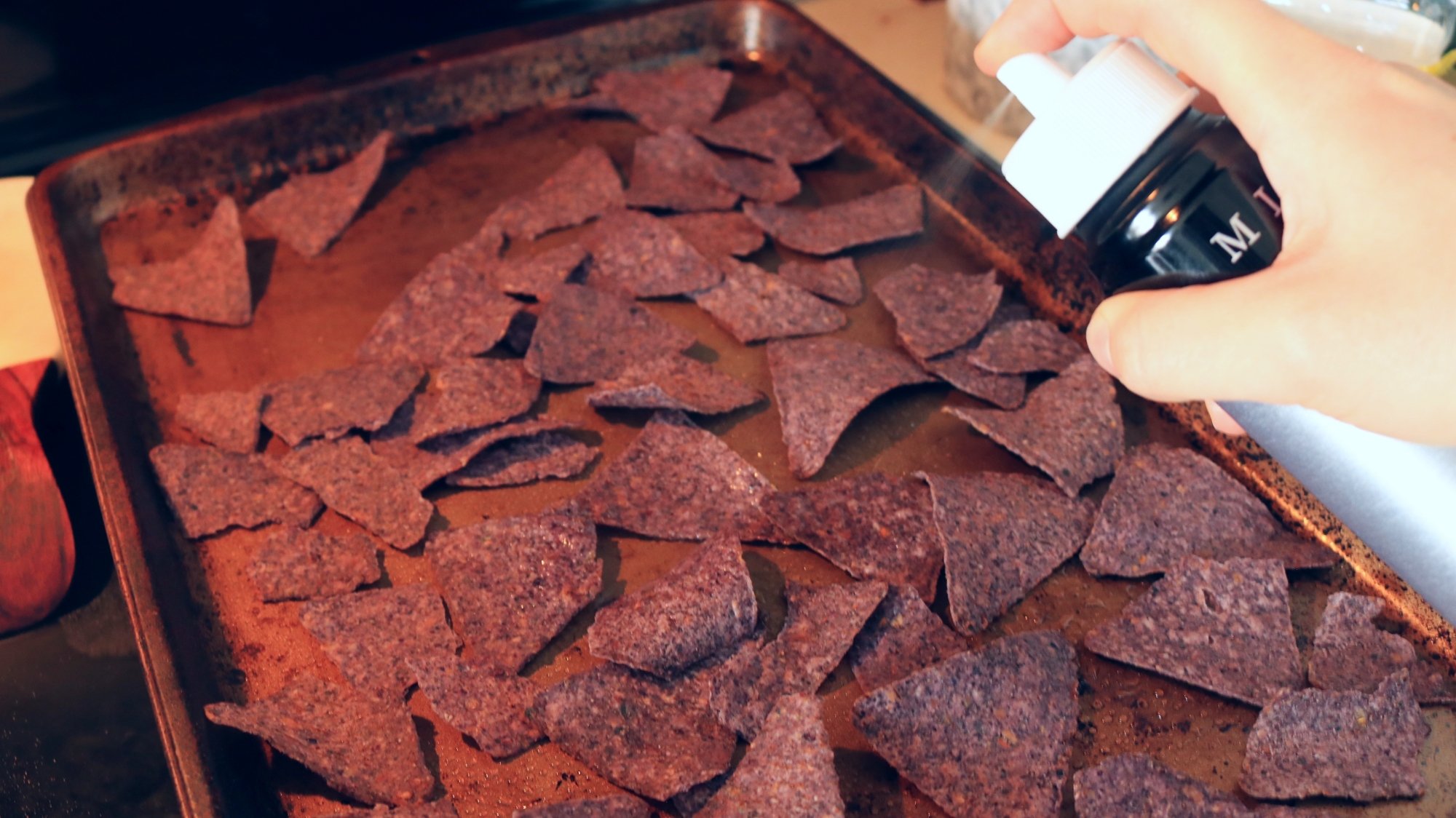
Hand using spray bottle to spray liquid onto blue corn chips.

Credit: Allie Chanthorn Reinmann

Dissolve salt into warm water—you can do this quickly in the microwave. Add about a tablespoon of salt to a half-cup of water in a measuring cup. Microwave it for 30 seconds, just to warm it up. Stir the solution until all of the salt crystals have completely dissolved. Preheat the oven to 350°F. Pour the salt water into a spray bottle. I used a Misto sprayer, which is marketed for spraying oil, but any liquid can be sprayed out of these bottles.

Blue corn chips on a metal sheet pan.

Credit: Allie Chanthorn Reinmann

Lay the offending chips on a sheet pan. Spread them out in a single layer so they’re not overlapping too much. Spray the chips generously with the salt water, but no so much that it puddles up on the pan. I only sprayed one side, but you can flip the chips to do both sides. Alternatively, if you don’t have a spray bottle, you can quickly dip each chip into the salt water and lay it on the sheet pan. It takes more time, but it works. Bake the chips for five to 10 minutes to evaporate the water. You’ll see little white blotches turn up on the pan’s surface, and you might even be able to see the crystalline salt residue on the chips. The chips cool in no time, so you can start snacking right away. 

Not only can you season the chips to save them from the garbage, but you can actually adjust the salt level to your personal preference. One tablespoon of salt to a half-cup of water produced a lightly salted chip, I would call this my minimum salt preference. The next time I do this (because I have half a bag of unsalted chips left), I’ll probably use two tablespoons of salt for my salt solution. If you’re the type that thinks a regular Lay’s potato chip isn’t salty, maybe use three tablespoons for your spray.


Source: LifeHacker – Here’s the Easiest Way to Make Chips Saltier

Here’s a Fallout super fan’s analysis of the first trailer for the TV series

New report illuminates why OpenAI board said Altman “was not consistently candid”

Sam Altman, president of Y Combinator and co-chairman of OpenAI, seen here in July 2016.

Enlarge / Sam Altman, president of Y Combinator and co-chairman of OpenAI, seen here in July 2016. (credit: Drew Angerer / Getty Images News)

When Sam Altman was suddenly removed as CEO of OpenAI—before being reinstated days later—the company’s board publicly justified the move by saying Altman “was not consistently candid in his communications with the board, hindering its ability to exercise its responsibilities.” In the days since, there has been some reporting on potential reasons for the attempted board coup, but not much in the way of follow-up on what specific information Altman was allegedly less than “candid” about.

Now, in an in-depth piece for The New Yorker, writer Charles Duhigg—who was embedded inside OpenAI for months on a separate story—suggests that some board members found Altman “manipulative and conniving” and took particular issue with the way Altman allegedly tried to manipulate the board into firing fellow board member Helen Toner.

Board “manipulation” or “ham-fisted” maneuvering?

Toner, who serves as director of strategy and foundational research grants at Georgetown University’s Center for Security and Emerging Technology, allegedly drew Altman’s negative attention by co-writing a paper on different ways AI companies can “signal” their commitment to safety through “costly” words and actions. In the paper, Toner contrasts OpenAI’s public launch of ChatGPT last year with Anthropic’s “deliberate deci[sion] not to productize its technology in order to avoid stoking the flames of AI hype.”

Read 6 remaining paragraphs | Comments


Source: Ars Technica – New report illuminates why OpenAI board said Altman “was not consistently candid”

The Newest Google Pixel Phones Just Hit Their Lowest Prices Yet

Yes, the Google Pixel 8 and Pixel 8 Pro were just released this October, but that’s not stopping them from joining in on the holiday deals. The unlocked 256GB Pixel 8 just hit a new low price at Best Buy, currently at $531 (originally $759), which is lower than it was during Black Friday, according to Honey’s price history. This current deal puts it even cheaper than the 128GB version at the moment, making the 256GB version a no-brainer. Meanwhile, the 128GB unlocked Google Pixel 8 Pro is back down to its Black Friday price at $799 (originally $999), according to Camelcamelcamel’s price history.

Choosing between the Pixel 8 and the Pixel 8 Pro

If you can’t decide between the two phones, our guide that breaks down the main differences will help you decide. Ultimately, it comes down to your budget and whether you must have the best camera and latest features. The current deal at Best Buy may make it a little easier to choose the Pixel 8 over the Pro, given it has twice the internal memory.

You will still get the newest Google-made chip, Android 14, and 7 years of guaranteed software support (meaning you’ll be getting updates until 2030). You’ll also get the same new AI features, like the “Audio Magic Eraser,” which gets rid of distracting sounds in videos you shoot, and the “Best Take,” which lets you pick the best face from a series of photos. (No more ruined pictures because you blinked.) Like the Pro, the Pixel 8 is also IP68-rated, meaning it is water and dust-resistant. You will also be able to use Google’s new Titan M2 security chip, which supports face unlock and in-display fingerprint unlock.

Unless the camera quality is a big deal to you, the Pixel 8 will likely be the best choice for most people.


Source: LifeHacker – The Newest Google Pixel Phones Just Hit Their Lowest Prices Yet

The Performance & Power Improvement Of Steam Deck OLED's 6nm APU

The Steam Deck OLED has been on the test bench the past few weeks at Phoronix. The HDR OLED display of the updated Steam Deck handheld game console is gorgeous and was very impressed by it. On a technical level the battery life improvements are significant and one of the items I was most curious about were the power/performance implications in moving from the 7nm Van Gogh APU to a 6nm die shrink version of it while retaining the Zen 2 CPU cores and RDNA2 integrated graphics. Here’s a look at the performance and CPU power consumption between the Steam Deck LCD and Steam Deck OLED models not only for gaming but other Linux workloads too.

Source: Phoronix – The Performance & Power Improvement Of Steam Deck OLED’s 6nm APU

De-Bug Your Christmas Tree (and Other Things to Do Before Bringing It Inside)

If you celebrate Christmas, you probably put up some kind of Christmas tree to mark the occasion (and to place presents under). While artificial trees do a satisfactory job of generating the necessary cheer and holiday spirit, a live tree will always feel just a bit extra. It’s the smell, the glorious randomness of its shape (as opposed to the machined perfection of a fake tree), and the family ritual of picking out a tree and wrangling it home.

A live tree is just that, though—something from nature. And when you bring something from nature into your house, there’s potential for chaos. If you’re planning to have a live tree this holiday season, there are a few things you should do the moment you bring it home in order to make it last as long as possible and to ensure you have the best possible experience.

Inspect for bugs

Trees grow out in the wild, and despite the best efforts of the tree farmers overseeing the process there is a very good chance that your gorgeous live tree is jam-packed with insects. Like, thousands of microscopic little critters. From aphids to spiders, from beetles to praying mantises (!), the tree you just drove home from the lot might be a vector for a bug invasion.

That means your first step before you bring that tree into your home is to inspect it for bugs. Using a flashlight if necessary, visually inspect the tree, looking at the trunk, branches, and needles. If you see anything creeping about in there or any suspiciously egg-like deposits on the branches or needles, start by giving your tree and good shake to knock them loose. Then you can actually use a vacuum on the branches and needles to collect them and dispose of them—just do it outside.

Trim and cut it

The time to shape your tree is when it’s still outside. If you lug it into your home and then decide it’s not the perfect shape—or discover there are low branches that prevent it from fitting into the stand—you’ll have a much messier time of it. Cut off the netting or string and let the tree open up, then go ahead and trim off any bumps in the shape until you’re satisfied. If you’re not going to install the tree immediately, find a cool, sheltered place to store it, like a garage. You should place it in the stand and water it while it waits.

If you’re putting it up right away, you probably need to give the trunk a fresh cut. Unless the lot cut the trunk for you when you bought it, you should assume the tree has lost its ability to soak up water and will need a fresh cut. Trim about half an inch off the bottom—and remember, the tree must be in water within an hour after the cut or it will seal up again.

Apply an anti-desiccant spray

An anti-desiccant spray like Wilt-Pruf can help keep your tree fresher longer. These sprays are derived from tree oils, and simply coat the needles to prevent water loss, slowing down the drying-out process that transforms your lovely holiday tree into a fire hazard. If possible, apply the spray before you bring the tree inside so it’s easier to clean up afterward.

Prepare the room

You probably know where your tree is going to stand in the house, but even so, you should prepare the room for it. Your tree won’t do well in a warm, dry room, or if it’s too close to a heat source like a furnace vent or radiator (keep it at least three feet away from those if possible). If possible, make sure the room is cool—somewhere in the high 60s or low 70s.

Set up your stand and make sure it can hold enough water to keep your tree hydrated. Your tree can soak up about three quarts of water a day, but it might drink a lot more when first put in the stand—this is actually a sign that you have a healthy, fresh tree.

Let it rest

Finally, once the tree is in place, don’t decorate immediately. Let the tree hydrate and rest for 24 hours. This will allow the tree to hydrate and let its branches completely settle while it acclimates to the indoor temperature and humidity.

A live tree during the holiday season makes any home feel cozy and really emphasizes the sense of celebration this time of year inspires. Do these five things right away when you bring it home and you’ll have the best possible tree experience.


Source: LifeHacker – De-Bug Your Christmas Tree (and Other Things to Do Before Bringing It Inside)