Varjo's XR-4: Why a Truly Useful Mixed Reality Headset Is Expensive

Long-time Slashdot reader BishopBerkeley writes: Varjo follows a completely different model from Apple and Meta for its new AR headset. Computing is done on a connected (via a cable) computer. The tradeoff is that the headset can use the extra computing power of the host computer to drive ultrahigh resolution displays that are far more pixel dense than Apple’s Vision Pro.

The net result is that the headset is truly useful for demanding applications like professional flight simulators, where $10,000 for a headset is a sensible investment. Furthermore, the headset has a longer life span because its PC resident hardware and software are upgradeable.

From IEEE Spectrum:

The Meta Quest 3 is a capable, accessible mixed-reality device. But if you’re a mad scientist working on a secret project in an underground lab, it’s not going to cut it. Finnish headset manufacturer Varjo has a solution: the XR-4, a new generation of flagship mixed-reality headsets built for unusually demanding users. Varjo, based in Helsinki, serves up displays with record-setting pixel counts, auto-focusing cameras, and a “Secure Edition” that looks like it was ripped straight from a Bond film. The goal? A photo-real mixed-reality experience that lets designers, researchers, and creatives build and work with objects that don’t yet physically exist.
“How do you design a car without a clay prototype? How do you sell a yacht you haven’t built yet? How do you train a pilot to fly a plane that’s still on the ground?” says Patrick Wyatt, Varjo’s chief product officer. “Jobs you do right now with physical things, we’re virtualizing those.”
Varjo’s XR-4 headset comes in three different editions, each with escalating features (and price tags). The “entry-level” XR-4, which starts at €3,990 (about US $4,300), homes in on product design and data visualization work that requires crisp virtual reality alongside occasional use of mixed reality. Varjo achieves this with dual 4K displays that leapfrog even the resolution of Apple’s upcoming Vision Pro headset… Simulators might benefit from the XR-4’s more expensive sibling: the XR-4 Focal Edition. Priced at €9,990 (about $11,000), it justifies its cost with dual gaze-directed autofocus cameras… The Secure Edition is available with fixed-focused or autofocus cameras and priced at €7,990 and €13,990 ($8,700 and $15,200), respectively.

Read more of this story at Slashdot.


Source: Slashdot – Varjo’s XR-4: Why a Truly Useful Mixed Reality Headset Is Expensive

ASRock X570D4U BMC Working Toward OpenBMC Support

For those that happen to own an ASRock Rack X570D4U micro-ATX motherboard or are in the market for a server-grade AMD Ryzen 5000 series motherboard, patches are pending as this motherboard works on OpenBMC support as an alternative to the proprietary BMC software stack that ships with this AMD Ryzen 5000 series + ECC DDR4 supported motherboard…

Source: Phoronix – ASRock X570D4U BMC Working Toward OpenBMC Support

Setting Up a Robust Web Server on Debian

In the realm of web servers, Apache stands as a towering figure, renowned for its versatility and reliability. When combined with Debian, a powerful and stable Linux distribution, Apache becomes an even more formidable tool for web hosting. This article aims to guide you through the process of configuring Apache on Debian, ensuring you harness the full potential of this combination.

Source: LXer – Setting Up a Robust Web Server on Debian

Apple's Chip Lab: Now 15 Years Old With Thousands of Engineers

“As of this year, all new Mac computers are powered by Apple’s own silicon, ending the company’s 15-plus years of reliance on Intel,” according to a new report from CNBC.
“Apple’s silicon team has grown to thousands of engineers working across labs all over the world, including in Israel, Germany, Austria, the U.K. and Japan. Within the U.S., the company has facilities in Silicon Valley, San Diego and Austin, Texas…”

The latest A17 Pro announced in the iPhone 15 Pro and Pro Max in September enables major leaps in features like computational photography and advanced rendering for gaming. “It was actually the biggest redesign in GPU architecture and Apple silicon history,” said Kaiann Drance, who leads marketing for the iPhone. “We have hardware accelerated ray tracing for the first time. And we have mesh shading acceleration, which allows game developers to create some really stunning visual effects.” That’s led to the development of iPhone-native versions from Ubisoft’s Assassin’s Creed Mirage, The Division Resurgence and Capcom’s Resident Evil 4.

Apple says the A17 Pro is the first 3-nanometer chip to ship at high volume. “The reason we use 3-nanometer is it gives us the ability to pack more transistors in a given dimension. That is important for the product and much better power efficiency,” said the head of Apple silicon, Johny Srouji . “Even though we’re not a chip company, we are leading the industry for a reason.” Apple’s leap to 3-nanometer continued with the M3 chips for Mac computers, announced in October. Apple says the M3 enables features like 22-hour battery life and, similar to the A17 Pro, boosted graphics performance…

In a major shift for the semiconductor industry, Apple turned away from using Intel’s PC processors in 2020, switching to its own M1 chip inside the MacBook Air and other Macs. “It was almost like the laws of physics had changed,” Ternus said. “All of a sudden we could build a MacBook Air that’s incredibly thin and light, has no fan, 18 hours of battery life, and outperformed the MacBook Pro that we had just been shipping.” He said the newest MacBook Pro with Apple’s most advanced chip, the M3 Max, “is 11 times faster than the fastest Intel MacBook Pro we were making. And we were shipping that just two years ago.” Intel processors are based on x86 architecture, the traditional choice for PC makers, with a lot of software developed for it. Apple bases its processors on rival Arm architecture, known for using less power and helping laptop batteries last longer.

Apple’s M1 in 2020 was a proving point for Arm-based processors in high-end computers, with other big names like Qualcomm — and reportedly AMD and Nvidia — also developing Arm-based PC processors. In September, Apple extended its deal with Arm through at least 2040.
Since Apple first debuted its homegrown semiconductors in 2010 in the iPhone 4, other companies started pursuing their own custom semiconductor development, including Amazon, Google, Microsoft and Tesla.

CNBC reports that Apple is also reportedly working on its own Wi-Fi and Bluetooth chip. Apple’s Srouji wouldn’t comment on “future technologies and products” but told CNBC “we care about cellular, and we have teams enabling that.”

Read more of this story at Slashdot.


Source: Slashdot – Apple’s Chip Lab: Now 15 Years Old With Thousands of Engineers

Configure Your Kubernetes Cluster on Ubuntu/Debian with kubectl

Kubernetes has revolutionized the way we think about deploying, scaling, and operating application infrastructures. For those using Ubuntu or Debian systems, mastering Kubernetes management is crucial. In this article, we dive deep into the world of Kubernetes, focusing on the use of kubectl, the command-line interface that allows you to run commands against Kubernetes clusters. Whether you’re a beginner or an experienced professional, this guide aims to enhance your Kubernetes management skills on Ubuntu/Debian platforms.

Source: LXer – Configure Your Kubernetes Cluster on Ubuntu/Debian with kubectl

OpenZFS Fixes Data Corruption Issue

A pull request has been merged to fix a data corruption issue in OpenZFS (the open-source implementation of the ZFS file system and volume manager). “OpenZFS 2.2.2 and 2.1.14 released with fix in place,” reports a Thursday comment on GitHub.

Earlier this week, jd (Slashdot reader #1,658) wrote: All versions of OpenZFS 2.2 suffer from a defect that can corrupt the data. Attempts to mitigate the bug have reduced the likelihood of it occurring, but so far nobody has been able to pinpoint what is going wrong or why.

Phoronix reported on Monday: Over the US holiday weekend it became more clear that this OpenZFS data corruption bug isn’t isolated to just the v2.2 release — older versions are also susceptible — and that v2.2.1 is still prone to possible data corruption. The good news at least is that data corruption in real-world scenarios is believed to be limited but with some scripting help the corruption can be reproduced. It’s also now believed that the OpenZFS 2.2 block cloning feature just makes encountering the problem more likely.

Read more of this story at Slashdot.


Source: Slashdot – OpenZFS Fixes Data Corruption Issue

Today's NYT Connections Hints (and Answer) for Sunday, December 3, 2023

Connections is the game where we LINK things together, and you’ll want to remember that today. If you’re looking for the Connections answer for Sunday, December 3, 2023, read on—I’ll share some clues, tips, and strategies, and finally the solutions to all four categories. Along the way, I’ll explain the meanings of the trickier words and we’ll learn how everything fits together. Beware, there are spoilers below for December 3, NYT Connections #175! Read on if you want some hints (and then the answer) to today’s Connections game. 

If you want an easy way to come back to our Connections hints every day, bookmark this page. You can also find our past hints there as well, in case you want to know what you missed in a previous puzzle.

Below, I’ll give you some oblique hints at today’s Connections answers. And farther down the page, I’ll reveal the themes and the answers. Scroll slowly and take just the hints you need!

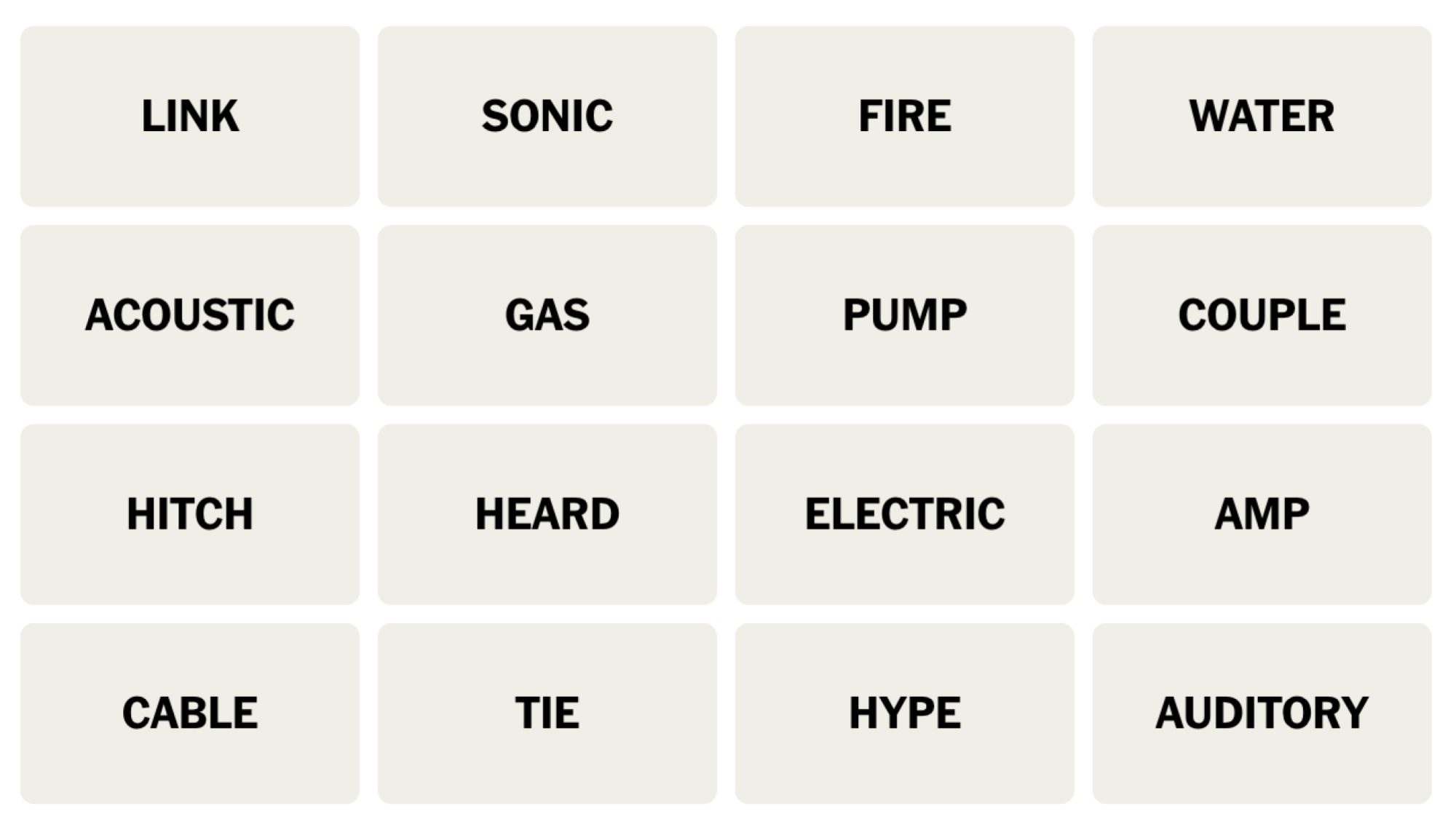
NYT Connections board for December 3, 2023: LINK, SONIC, FIRE, WATER, ACOUSTIC, GAS, PUMP, COUPLE, HITCH, HEARD, ELECTRIC, AMP, CABLE, TIE, HYPE, AUDITORY.

Credit: Connections/NYT


Does today’s Connections game require any special knowledge?

Nope, nothing too obscure today.

Hints for the themes in today’s Connections puzzle

Here are some spoiler-free hints for the groupings in today’s Connections:

  • Yellow category – Utilities.

  • Green category – Things for your ears.

  • Blue category – The whole point of this game!

  • Purple category – Get excited.

Does today’s Connections game involve any wordplay?

Nope, all the groupings are based on the words’ meanings. 

Ready to hear the answers? Keep scrolling if you want a little more help.


BEWARE: Spoilers follow for today’s Connections puzzle!

We’re about to give away some of the answers. Scroll slowly if you don’t want the whole thing spoiled. (The full solution is a bit further down.)

What are the ambiguous words in today’s Connections?

  • An ACOUSTIC guitar is the opposite of an ELECTRIC guitar, but those words are in different categories today. Nor will you be pairing either of those with an AMP.

  • The puzzle is also not asking you to contrast a GAS car with an ELECTRIC car.

  • FIRE and WATER are separate as well. 

  • SONIC can be a video game hedgehog, or a word that means relating to sound. You might want to put this word next to AUDITORY, a word that means relating to hearing.

  • A HITCH can be the part of your car or truck that lets you COUPLE it to a trailer. LINK them together, you know? 

What are the categories in today’s Connections?

  • Yellow: MONTHLY BILLS

  • Green: RELATED TO SOUND/HEARING

  • Blue: CONNECT

  • Purple: EXCITE, WITH “UP”

DOUBLE BEWARE: THE SOLUTION IS BELOW

Ready to learn the answers to today’s Connections puzzle? I give them all away below.

What are the yellow words in today’s Connections?

The yellow grouping is considered to be the most straightforward. The theme for today’s yellow group is MONTHLY BILLS and the words are: CABLE, ELECTRIC, GAS, WATER.

What are the green words in today’s Connections?

The green grouping is supposed to be the second-easiest. The theme for today’s green category is RELATED TO SOUND/HEARING and the words are: ACOUSTIC, AUDITORY, HEARD, SONIC.

What are the blue words in today’s Connections?

The blue grouping is the second-hardest. The theme for today’s blue category is CONNECT and the words are: COUPLE, HITCH, LINK, TIE.

What are the purple words in today’s Connections?

The purple grouping is considered to be the hardest. The theme for today’s purple category is EXCITE, WITH “UP” and the words are: AMP, FIRE, HYPE, PUMP.

How I solved today’s Connections

I see a few potential groupings, but nothing I feel confident about until I settle on COUPLE, HITCH, TIE, and LINK. That’s a hit. 🟦 Next I try WATER, GAS, ELECTRIC, and CABLE as lines that may be coming in to your house. 🟨 (The description is about utility bills, which still fits.) 

Next we can FIRE you up, PUMP you up, AMP you up, or HYPE you up for something. 🟪 And finally, SONIC, AUDITORY, and ACOUSTIC all relate to things you can hear. HEARD fills out that category if you use it as an adjective. 🟩

Connections 
Puzzle #175
🟦🟦🟦🟦
🟨🟨🟨🟨
🟪🟪🟪🟪
🟩🟩🟩🟩

How to play Connections

I have a full guide to playing Connections, but here’s a refresher on the rules:

First, find the Connections game either on the New York Times website or in their Crossword app. You’ll see a game board with 16 tiles, each with one word or phrase. Your job is to select a group of four tiles that have something in common. Often they are all the same type of thing (for example: RAIN, SLEET, HAIL, and SNOW are all types of wet weather) but sometimes there is wordplay involved (for example, BUCKET, GUEST, TOP TEN, and WISH are all types of lists: bucket list, guest list, and so on).

Select four items and hit the Submit button. If you guessed correctly, the category and color will be revealed. (Yellow is easiest, followed by green, then blue, then purple.) If your guess was incorrect, you’ll get a chance to try again.

You win when you’ve correctly identified all four groups. But if you make four mistakes before you finish, the game ends and the answers are revealed.

How to win Connections

The most important thing to know to win Connections is that the groupings are designed to be tricky. Expect to see overlapping groups. For example, one puzzle seemed to include six breakfast foods: BACON, EGG, PANCAKE, OMELET, WAFFLE, and CEREAL. But BACON turned out to be part of a group of painters along with CLOSE, MUNCH, and WHISTLER, and EGG was in a group of things that come by the dozen (along with JUROR, ROSE, and MONTH). So don’t hit “submit” until you’ve confirmed that your group of four contains only those four things.

If you’re stuck, another strategy is to look at the words that seem to have no connection to the others. If all that comes to mind when you see WHISTLER is the painting nicknamed “Whistler’s Mother,” you might be on to something. When I solved that one, I ended up googling whether there was a painter named Close, because Close didn’t fit any of the obvious themes, either.

Another way to win when you’re stuck is, obviously, to read a few helpful hints–which is why we share these pointers every day. Check back tomorrow for the next puzzle!


Source: LifeHacker – Today’s NYT Connections Hints (and Answer) for Sunday, December 3, 2023

Tensions rise between Targaryens in first teaser for House of the Dragon S2

It’s House Targaryens vs House Hightower in the second season of HBO’s House of the Dragon.

HBO dropped the first teaser for the much-anticipated second season of its Game of Thrones prequel spinoff series House of the Dragon during CCXP23 in Sao Paulo Brazil. The eight episodes will cover the onset of civil war within House Targaryen, known as the Dance of Dragons.

(Spoilers for the first season below.)

As I’ve written previously, HBO’s House of the Dragon debuted last year with a solid, promising pilot episode, and the remainder of the season lived up to that initial promise. The series is set about 200 years before the events of Game of Thrones and chronicles the beginning of the end of House Targaryen’s reign. The primary source material is Fire and Blood, a fictional history of the Targaryen kings written by George R.R. Martin.

Read 9 remaining paragraphs | Comments


Source: Ars Technica – Tensions rise between Targaryens in first teaser for House of the Dragon S2

EV Owners Report 'Far More' Problems Than Conventional Car Owners, Says Consumer Reports

Consumer Reports awarded a “recommended” rating to Tesla’s Modey Y this year, “with owners reporting fewer issues with its suspension, in-car electronics and general build quality than in previous years”. Tesla’s Model 3 also earned a “recommended” rating.

“Tesla’s Model 3 and Model Y are now the sweet spot in the automotive industry when it comes to building electric cars,” says Jake Fisher, the senior director of auto testing for Consumer Reports. “While Tesla is still a relatively new car company, it has more experience producing EVs than any other automaker.”
But how about the larger universe of all automakers?
Electric vehicle owners continue to report far more problems with their vehicles than owners of conventional cars or hybrids, according to Consumer Reports’ newly released annual car reliability survey. The survey reveals that, on average, EVs from the past three model years had 79 percent more problems than conventional cars…
“Most electric cars today are being manufactured by either legacy automakers that are new to EV technology, or by companies like Rivian that are new to making cars,” says Jake Fisher, senior director of auto testing at Consumer Reports. “It’s not surprising that they’re having growing pains and need some time to work out the bugs.” Fisher says some of the most common problems EV owners report are issues with electric drive motors, charging, and EV batteries…

This year’s survey data show that hybrids continue to be among the most reliable vehicle type: Hybrids have 26 percent fewer problems than conventional models, even though they have both a conventional powertrain and an electric motor and therefore more potential problem spots than conventional cars. “It might not seem that long ago, but Toyota launched the Prius hybrid about 25 years ago,” Elek says. “Automakers have been making hybrids long enough that they’ve gotten really good at it. Plus, many hybrids are also made by manufacturers that tend to produce reliable vehicles overall, such as Toyota, Hyundai, and Kia.” Hybrids also are not typically loaded with high-tech features like multiple customizable displays that can be problem-prone, which is why Fisher says they are great options for drivers who are more interested in getting ideal fuel mileage than they are in bells and whistles. “These vehicles are not necessarily a tour de force of technology, so there’s just less that can go wrong with them,” he says.

Plug-in hybrid electric vehicles (PHEVs), which have both a battery for short-range electric driving and an internal combustion engine for long-range driving, are the least reliable category — 146 percent more problems than conventional cars. “PHEVs are sort of like an EV and a conventional car rolled into one, so by their nature they have more things that can go wrong with them,” Fisher says.
There are exceptions, notes the auto testing director. Toyota’s RAV4 Prime plug-in hybrid “is one of the most reliable models in our survey this year. Similarly, the Ford F-150 hybrid has transmission and other issues that buck the trend of strong hybrid reliability.”

Read more of this story at Slashdot.


Source: Slashdot – EV Owners Report ‘Far More’ Problems Than Conventional Car Owners, Says Consumer Reports

Tiny Living Robots Made From Human Cells Surprise Scientists

“Scientists have created tiny living robots from human cells,” reports CNN. The mini-bots “can move around in a lab dish and may one day be able to help heal wounds or damaged tissue, according to a new study. ”

The study’s lead author tells CNN, “We don’t realize all the competencies that our own body cells have.”

A team at Tufts University and Harvard University’s Wyss Institute have dubbed these creations anthrobots. The research builds on earlier work from some of the same scientists, who made the first living robots, or xenobots, from stem cells sourced from embryos of the African clawed frog (Xenopus laevis)…

The scientists used adult human cells from the trachea, or windpipe, from anonymous donors of different ages and sexes… The tracheal cells are covered with hairlike projections called cilia that wave back and forth. They usually help the tracheal cells push out tiny particles that find their way into air passages of the lungs. Earlier studies had also shown that the cells can form organoids — clumps of cells widely used for research. Study coauthor Gizem Gumuskaya experimented with the chemical composition of the tracheal cells’ growth conditions and found a way to encourage the cilia to face outward on the organoids. Once she had found the right matrix, the organoids became mobile after a few days, with the cilia acting a bit like oars…

“In our method, each anthrobot grows from a single cell.” It’s this self-assembly that makes them unique. Biological robots have been made by other scientists, but they were constructed by hand by making a mold and seeding cells to live on top of it, said study author Michael Levin… They survived up to 60 days in laboratory conditions.

The experiments outlined in this latest study are at an early stage, but the goal is to find out whether the anthrobots could have medical applications, Levin and Gumuskaya said. To see whether such applications might be possible, researchers examined whether the anthrobots were able to move over human neurons grown in a lab dish that had been “scratched” to mimic damage. They were surprised to see the anthrobots encouraged growth to the damaged region of the neurons, although the researchers don’t yet understand the healing mechanism, the study noted.

Read more of this story at Slashdot.


Source: Slashdot – Tiny Living Robots Made From Human Cells Surprise Scientists

Amazon is swallowing its pride to ensure its internet satellites get to orbit on time

Amazon announced on Friday that it’s signed a contract with SpaceX to deliver batches of its Project Kuiper satellites to low Earth orbit in 2025. SpaceX is undoubtedly Amazon’s biggest competitor as it breaks into the satellite internet space, and already has a constellation of over 4,000 Starlink satellites in operation. It’s also a rival of Blue Origin, the aerospace company founded by Jeff Bezos that has its own rockets in development. But when it comes to launches, SpaceX’s pace and the reliability of its Falcon 9 rocket is unmatched.

The contract with SpaceX is for three Falcon 9 launches, Amazon said in a blog post. They’re expected to lift off in mid-2025. Amazon is planning to start customer pilots of its Project Kuiper satellite internet service by the end of next year, and will soon start deploying the fleet that will support it. It launched its first two prototype satellites in October. The company already has deals for upcoming launches on United Launch Alliance’s (ULA) Vulcan rocket, Arianespace’s Ariane 6 and Blue Origin’s New Glenn — all of which have been hit by development delays and may or may not make their first flights between this year and next.

Amazon said in its announcement that “the additional launches with SpaceX offer even more capacity to support our deployment schedule.” The company has said its Project Kuiper constellation will consist of 3,236 satellites, at least half of which must be in operation by summer 2026 to comply with its FCC license.

This article originally appeared on Engadget at https://www.engadget.com/amazon-is-swallowing-its-pride-to-ensure-its-internet-satellites-get-to-orbit-on-time-222906412.html?src=rss

Source: Engadget – Amazon is swallowing its pride to ensure its internet satellites get to orbit on time

Java Tries a New Way to Use Multithreading: Structured Concurrency

“Structured concurrency is a new way to use multithreading in Java,” reports InfoWorld.

“It allows developers to think about work in logical groups while taking advantage of both traditional and virtual threads.”

Available in preview in Java 21, structured concurrency is a key aspect of Java’s future, so now is a good time to start working with it… Java’s thread model makes it a strong contender among concurrent languages, but multithreading has always been inherently tricky. Structured concurrency allows you to use multiple threads with structured programming syntax. In essence, it provides a way to write concurrent software using familiar program flows and constructs. This lets developers focus on the business at hand, instead of the orchestration of threading.

As the JEP for structured concurrency says, “If a task splits into concurrent subtasks then they all return to the same place, namely the task’s code block.” Virtual threads, now an official feature of Java, create the possibility of cheaply spawning threads to gain concurrent performance. Structured concurrency provides the simple syntax to do so. As a result, Java now has a unique and highly-optimized threading system that is also easy to understand…

Between virtual threads and structured concurrency, Java developers have a compelling new mechanism for breaking up almost any code into concurrent tasks without much overhead… Any time you encounter a bottleneck where many tasks are occurring, you can easily hand them all off to the virtual thread engine, which will find the best way to orchestrate them. The new thread model with structured concurrency also makes it easy to customize and fine-tune this behavior. It will be very interesting to see how developers use these new concurrency capabilities in our applications, frameworks, and servers going forward.
It involves a new class StructuredTaskScope located in the java.util.concurrent library. (InfoWorld points out that “you’ll need to use –enable-preview and –source 21 or –source 22 to enable structured concurrency.”)

Their reporter shared an example on GitHub, and there’s more examples in the Java 21 documentation. “The structured concurrency documentation includes an example of collecting subtask results as they succeed or fail and then returning the results.”

Read more of this story at Slashdot.


Source: Slashdot – Java Tries a New Way to Use Multithreading: Structured Concurrency

23andMe hackers accessed ancestry information from thousands of customers and their DNA relatives

An SEC filing has revealed more details on a data breach affecting 23andMe users that was disclosed earlier this fall. The company says its investigation found hackers were able to access information from 0.1 percent of its userbase, or the accounts of about 14,000 of its 14 million total customers, TechCrunch notes. On top of that, the attackers were able to exploit 23andMe’s opt-in DNA Relatives feature to access “profile information about other users’ ancestry.” 23andMe hasn’t said how many of these users were affected. Hackers posted information from both groups online.

When the breach was first revealed in October, the company said its investigation “found that no genetic testing results have been leaked.” According to the new filing, the data “generally included ancestry information, and, for a subset of those accounts, health-related information based upon the user’s genetics.” All of this was obtained through a credential-stuffing attack, in which hackers used login information from other, previously compromised websites to access those users’ accounts on other sites. In doing this, the filing says, “the threat actor also accessed a significant number of files containing profile information about other users’ ancestry that such users chose to share when opting in to 23andMe’s DNA Relatives feature and posted certain information online.”

Engadget has reached out to 23andMe for comment. Following the discovery of the breach, 23andMe instructed affected users to change their passwords and later rolled out two-factor authentication for all of its customers. In another update on Friday, 23andMe said it had completed the investigation and is notifying everyone who was affected. The company also wrote in the filing that it “believes that the threat actor activity is contained,” and is working to have the publicly-posted information taken down.

This article originally appeared on Engadget at https://www.engadget.com/23andme-hackers-accessed-ancestry-information-from-thousands-of-customers-and-their-dna-relatives-205758731.html?src=rss

Source: Engadget – 23andMe hackers accessed ancestry information from thousands of customers and their DNA relatives

Halo Season 2 Teases a Major Franchise Fall

The first season of Halo’s TV adaptation was sometimes interesting, but also kind of a mess. With a new timeline to work with, the show took some sharp divergences, shall we say, and things ended in such a way you weren’t fully sure how we were going to make it to Halo: Combat Evolved.

Read more…


Source: Gizmodo – Halo Season 2 Teases a Major Franchise Fall

Why Mexico Wants You to Virtually Adopt an Axolotl Salamander

It can regenerate bits of its body. Ancient Mexicans revered it as a mischievous, shape-shifting god.

They named it axolotl — translation: “water monster” — and it’s a “salamander with a Mona Lisa smile,” reports the Washington Post, “an alien-looking creature with a permanent grin and a crown of feathery gills”.

But while there’s over a million in the world’s scientific laboratories, back in its only natural habitat — the canals of Lake Xochimilco in Mexico City — it’s on the brink of extinction.

In hopes of preventing the annihilation of a species with mystifying traits, ecologists at Mexico’s National Autonomous University are giving the public the chance to virtually adopt an axolotl. For $30, $180 or $360, donors can choose the sex, age and name of the little buddy they get to call theirs for a month, six months or a year, respectively. The axolotls stay in Mexico, but donors receive an adoption kit with an infographic, the axolotl’s identification card, a certificate of adoption and a personalized thank-you letter.

The campaign also includes options to buy an axolotl a meal for $10 or to fix up one of their homes for $50. And for those wanting to splurge a bit more, participants can adopt the axolotl’s refuge of chinampas — the artificial islands that dot Lake Xochimilco — for one, six or 12 months starting at $450. The funds will go toward building refuges for the axolotl and restoring its habitat, which has been devastated by the effects of Mexico City’s urbanization over the last decades, said Luis Zambrano, an ecologist at Mexico’s National Autonomous University.

“A species can’t be a species without its habitat,” Zambrano said.

Axolotls have “helped scientists understand how organs develop in vertebrates, uncover the causes of the birth defect spina bifida and discover thyroid hormones…”

“The salamanders have also become beloved exotic pets — to the point that ‘there’s claw machines in Japan that let you pick up an axolotl to take home,’ Zambrano added.”

Read more of this story at Slashdot.


Source: Slashdot – Why Mexico Wants You to Virtually Adopt an Axolotl Salamander