
Ahead of the holidays systemd 255 has debuted as stable and comes with systemd-bsod as a “Blue Screen of Death” service capable of displaying full-screen error messages on Linux. There’s also a new tool, systemd-vmspawn, that can be used for spawning virtual machines…
Source: Phoronix – systemd 255 Released With A “Blue Screen of Death” For Linux Systems
Monthly Archives: December 2023
Waffle This Frico-encrusted Sausage, Egg, and Cheese
Frico-friends, crispy-corner mac and cheese compadres, and all crunchy fried cheese lovers, hear ye: you’ll appreciate this latest breakthrough in sandwich development. You can cover your breakfast sandwich in a crisp layer of frico, and you should do so as soon as possible. Let this inside-out waffled sausage, egg, and cheese be your guide to many more cheese-encrusted pressed sandwiches.
Waffle irons are one of the greatest tools in your kitchen appliance arsenal. Obviously, you can make waffles in them, but even more compelling is their ability to increase the crisp-factor in everything they touch. Their unique shape is composed of multiple three dimensional cubes and tunnels, and those significantly the surface area of whatever you’re waffling. Waffle irons also provide direct, high heat. Both factors lead to an intense frico experience.
Products to consider:
Frico is simply cheese that’s fried beyond the melting point. It starts to brown and then when it cools, the cheese sets and gets solid and crunchy. You can make little frico discs to snack on if you fry them alone, or you can add cheese to the surface of foods that get cooked in pans, like pancakes, and create a thin, outer shell of crunchy, salty cheese.
This particular breakfast sandwich combines the best parts of a hot pressed sandwich with increased frico-ing surface area from the waffle iron. I made this sandwich with sausage and egg inside, but you can do this with any savory sandwich filling that you don’t mind warming up. The magic is in the bread. Flip the bread upside down (if you’re using a roll) and add the cheese to that side. This is the surface that will press against the hot waffle iron. I think the open crumb texture holds onto the cheese and fat better than the other side of the bun. If you’re using sliced sandwich bread, either side is fine.
How to make an inside-out frico breakfast sandwich

Credit: Allie Chanthorn Reinmann
Ready the components
First, heat up the waffle iron. Take the two sides of a roll and flip them so the open crumb is facing up. Spread a thin layer of mayonnaise or butter onto the roll. Sprinkle shredded parmesan or cheddar onto the mayo and press it so the cheese adheres well. Cook an egg in a frying pan. I usually break the yolk on purpose in the pan because I don’t want any surprises in the waffle iron. Fry the egg until it’s just barely set; it’ll have more time to heat in the iron. If you’re using meat, make sure you waffle your meat first.
Waffle the sandwich cheese-sides out

Assemble the sandwich so the cheese sides are facing out.
Credit: Allie Chanthorn Reinmann
Credit: Allie Chanthorn Reinmann
The cheese releases plenty of fats, so you don’t have to grease the waffle iron. However, if you’ve been scarred by other waffle experiences, I totally understand. You can spritz it with oil first if you want. Place the first bun on the waffle iron, cheese-side down. Add the egg and sausage to the bread. Top the sandwich with the other side of the bun, cheese-side up this time. Close the waffle iron and press it for 30 seconds or so to ensure good contact. The divots of the waffle iron should engage with the soft bread and make some solid frico indentations. Let this sizzle away for two to five minutes, depending on the heat of the waffle iron.
Check for a good crust

Credit: Allie Chanthorn Reinmann
Check on it when you hear sizzling and see fats dripping down the side of the sandwich. Gently lift the top. The bread should easily disengage from the waffle iron and you’ll be able to see if the cheese has browned sufficiently. The cheese surface should be firm, not sticky or oozing. The color should be a dark, toasty brown, and relatively even across the entire surface. Remove the sandwich carefully with a couple of forks, and let it cool on a wire cooling rack.
As soon as you slice the sandwich or bite into it, you’ll notice the surface of the bread is entirely encrusted with the toastiest frico you’ve ever experienced. It becomes so crisp, dense, and salty that I can only describe it as a savory version of candied cheese bread. The juicy sausage and egg inside will make you feel even more validated that this was the best possible choice for breakfast today.
Source: LifeHacker – Waffle This Frico-encrusted Sausage, Egg, and Cheese
iMessage will reportedly dodge EU regulations, won’t have to open up

Enlarge (credit: Jakub Porzycki/NurPhoto via Getty Images)

Android users’ hopes that Apple’s iMessage would be forced to open up in the European Union have been dashed. Bloomberg reports that iMessage won’t qualify for the EU’s new “Digital Markets Act,” allowing Apple to keep iMessage exclusive to Apple users.
The EU is deciding what should and shouldn’t be under the new rules set out by the “Digital Markets Act.” The idea is that Big Tech “gatekeepers” will be subject to certain interoperability, fairness, and privacy rules. So far the wide-ranging rules have targeted 22 different services, including app stores on iOS and Android, browsers like Chrome and Safari, the Android, iOS, and Windows OSes, ad platforms from Google, Amazon, and Meta, video sites YouTube and TikTok, and instant messaging apps like WhatsApp and Facebook Messenger.
Google recently rolled out a campaign to implore the EU to qualify iMessage for regulation, as Android’s iMessage incompatibility is a big deal in the US. iMessage hasn’t made the list, though, and that’s despite meeting the popularity metrics of 45 million monthly active EU users. In the EU and most other parts of the world, the dominant messaging platform is WhatsApp, and with the Digital Market Act’s focus on business usage, not general consumers, iMessage will just squeak by. Right now the EU is “investigating” a handful of borderline additions to the Digital Markets Act, with a deadline in February 2024.
Read 3 remaining paragraphs | Comments
Source: Ars Technica – iMessage will reportedly dodge EU regulations, won’t have to open up
Study: Why a spritz of water before grinding coffee yields less waste, tastier espresso
Researchers demonstrate how adding a splash of water reduces static electricity when grinding coffee. Credit: University of Oregon
Scientific inspiration can strike at any time. For Christopher Hendon, a computational materials chemist at the University of Oregon, inspiration struck at a local coffee bar where his lab holds regular coffee hours for the Eugene campus community—a fitting venue, since Hendon’s research specialties include investigating the scientific principles behind really good coffee. The regulars included two volcanologists, Josef Dufek and Joshua Méndez Harper, who noted striking similarities between the science of coffee and plumes of volcanic ash, magma, and water. Thus an unusual collaboration was born.
“It’s sort of like the start of a joke—a volcanologist and a coffee expert walk into a bar and then come out with a paper,” said Méndez Harper, a volcanologist at Portland State University. “But I think there are a lot more opportunities for this sort of collaboration, and there’s a lot more to know about how coffee breaks, how it flows as particles, and how it interacts with water. These investigations may help resolve parallel issues in geophysics—whether it’s landslides, volcanic eruptions, or how water percolates through soil.”
The result is a new paper published in the journal Matter demonstrating how adding a single squirt of water to coffee beans before grinding can significantly reduce the static electric charge on the resulting grounds. This in turn reduces clumping during brewing, yielding less waste and the strong, consistent flow needed to produce a tasty cup of espresso. Good baristas already employ the water trick; it’s known as the Ross droplet technique, per Hendon. But this is the first time scientists have rigorously tested that well-known hack and measured the actual charge on different types of coffee.
Read 12 remaining paragraphs | Comments
Source: Ars Technica – Study: Why a spritz of water before grinding coffee yields less waste, tastier espresso
AMD's Latest Radeon GPU Driver Gives Adrenalin Software A Refreshed UI And New Features

AMD has released its 23.12.1 update for AMD Software: Adrenalin Edition, focusing on adding new features such as HYPR-RX Eco, an update to the game profile UI that allows HYPR-RX to be enabled on a game-by-game basis, and GPU hardware scheduling. Additionally, performance in a few AI applications has been improved, making 23.12.1 yet another
Source: Hot Hardware – AMD’s Latest Radeon GPU Driver Gives Adrenalin Software A Refreshed UI And New Features
AMD’s new Ryzen 8040 laptop chips look a lot like the Ryzen 7040 CPUs

Enlarge / AMD’s Ryzen 8040 series is a lot like the 7040 series but with a higher model number. (credit: AMD)

Both Intel and AMD usually have processor updates to announce at CES in January, but AMD isn’t waiting to introduce its next-generation flagship laptop chips: the Ryzen 8040 series is coming to laptops starting in early 2024, though at first blush these chips look awfully similar to the Ryzen 7040 processors that AMD announced just seven months ago.
Though the generational branding is jumping from 7000 to 8000, the CPU and GPU of the Ryzen 8040 series are nearly identical to the ones in the 7040 series. The chips AMD is announcing today use up to eight Zen 4 CPU cores and RDNA 3-based integrated GPUs (either a Radeon 780M with 12 compute units, or Radeon 760M or 740M GPUs with 8 or 4 CUs). The chips are manufactured using the same 4 nm TSMC process as the 7040 series.
There’s also an AI-accelerating neural processing unit (NPU) that AMD claims is about 1.4 times faster than the one in the Ryzen 7040 series in large language models like Llama 2 and ONNX vision models. Both NPUs are based on the same XDNA architecture and have the same amount of processing hardware—AMD says that the AI performance improvements come mostly from higher clock speeds.
Read 5 remaining paragraphs | Comments
Source: Ars Technica – AMD’s new Ryzen 8040 laptop chips look a lot like the Ryzen 7040 CPUs
AMD Announces The Ryzen 8040 Series Mobile Processors With Better Ryzen AI
In addition to AMD using its AI event today for launching the Instinct MI300A and MI300X along with ROCm 6.0, AMD also announced the Ryzen 8040 series mobile processors. A big emphasis with these forthcoming laptop processors is on the AI capabilities between the dedicated NPU with AMD XDNA, Zen 4 CPU cores with AVX-512 VNNI support, and AMD RDNA3 graphics capable of accelerating AI.
Source: Phoronix – AMD Announces The Ryzen 8040 Series Mobile Processors With Better Ryzen AI
TSMC Solidifies Leadership on Foundry Market as Intel Jumps into Top 10

The global foundry industry witnessed a substantial rise in demand in the third quarter of 2023, according to TrendForce. The Top 10 foundries collectively saw their revenue soar to about $28.29 billion, marking a 7.9% increase compared to the previous quarter. Taiwan Semiconductor Manufacturing Co. (TSMC) maintained its No. 1 position as it managed to increase its shipments, whereas Intel Foundry Services found itself in Top 10 for the first time in the recent quarters.
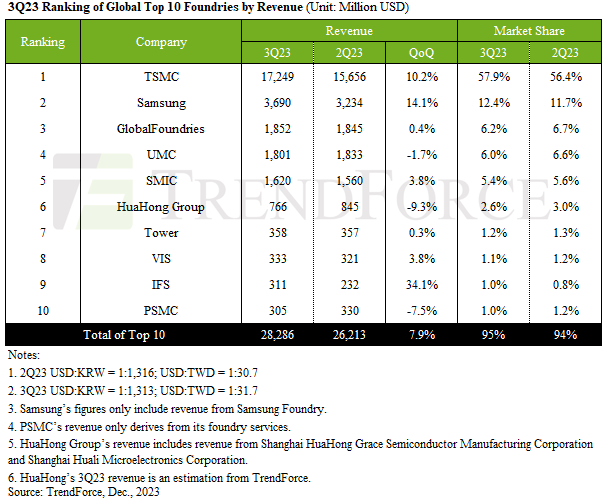
TSMC, the world’s largest foundry, posted revenue of $17.249 billion for the third quarter of calendar 2023 and secured a 57.9% foundry revenue market share. TrendForce believes that TSMC’s growth was supported by robust demand across various sectors, including PCs and smartphones. One of the most notable drivers of TSMC’s revenue was the formal start of Apple’s 3nm chips shipments (or rather revenue recognition) in the third quarter. With Apple’s A17 Pro smartphone system-on-chip as well as M3, M3 Pro, and M3 Max PC SoCs shipping in high volume, 3nm fabrication technology accounted for 6% of TSMC’s total revenue for the quarter, whereas advanced nodes accounted for almost 60% of TSMC’s sales.
Samsung Foundry also had a fruitful quarter, experiencing a 14.1% growth in its revenue, which amounted to $3.69 billion, according to TrendForce. Samsung itself says that demand for its advanced process technologies is increasing (which is a likely scenario), but TrendForce seems to be a bit more cautious as it says that growth drivers for Samsung were diverse and included orders for Qualcomm’s mid-to-low range 5G application processors, 5G modems, and time-proven 28 nm OLED display driver ICs.
GlobalFoundries maintained a consistent performance, with its revenue hovering around $1.85 billion, similar to the previous quarter. A significant portion of its revenue came mainly from the Internet of Things (IoT) market, particularly in home and industrial sectors, and significant orders from the U.S. aerospace and defense sectors, according to TrendForce.
UMC experienced a mixed quarter. Despite a marginal quarterly revenue decrease of 1.7%, bringing it to around $1.8 billion, the company saw a notable uptick in its 28/22 nm product lines. This near 10% increase in revenue from these products offset the slight decline in overall wafer shipments.
SMIC, on the other hand, recorded a 3.8% increase in its revenue, which stood at $1.62 billion for Q3. However, the company faced a shift in its client base: revenue from Chinese clients surged to 84%, buoyed by the government’s push for localization and urgent orders for smartphone components. By contrast, revenue from American clients diminished due to supply chain diversification and the relocation of American customers outside China. What is a bit surprising is that although SMIC ramped up shipments of Huawei’s Kirin 9000S system-on-chip (SoC) in Q3, this did not affect its revenue significantly. Perhaps, because Chinese companies ordered mostly cheaper chips than their American counterparts, revenue from shipments of 7nm products was offset by shipments of large volumes of inexpensive silicon.
What is particularly noteworthy is that Intel Foundry Services got into the Top 10 foundries for the first time in several quarters. IFS earned $311 million in revenue in Q3 2023, up 34.1% quarter-over-quarter, which could be a result of the company’s working with Amazon Web Services, which ramped up production and assembly of its Graviton4 and Trainium2 system-in-packages that require advanced packaging technologies.
In general, global foundry industry is on an upward trajectory, led by TSMC, Samsung, SMIC, and IFS. Smaller and specialty foundries — such as Tower Semiconductor and Vanguard International — demonstrated mixed results. Tower’s revenues increased 0.3% QoQ, which is basically flat, whereas VIS posted a 3.3% quarter-over-quarter increase.
By contrast, HuaHong Group experienced a 9.3% quarter-over-quarter downturn, with its Q3 revenue falling to approximately $766 million. PowerChip Semiconductor Manufacturing Co. (PSMC) also saw its revenue decrease by 7.5% to $305 million, largely due to nearly 10% and 20% declines in the revenues from PMIC and power discrete products, respectively, which affected its overall performance, according to TrendForce.
TrendForce expects continued demand as the industry moves into the fourth quarter, especially when it comes smartphone components, which is a huge market that requires both leading-edge and fairly simplistic chips.
Source: TrendForce
Source: AnandTech – TSMC Solidifies Leadership on Foundry Market as Intel Jumps into Top 10
These Are the Best Affordable Smartphones of 2023
Finding a smartphone that’s both full-featured and affordable isn’t nearly as impossible as it used to be. In fact, many of the more budget-friendly and mid-range devices on the market today are leaps and bounds better than flagship models released only a few years ago. But with all those improvements come a ton of different options—so how do you know which affordable smartphone is the best for you?
Here are some of the best “budget” smartphones to buy in 2023, ranging from cheaper devices under $200, to more expensive, but still affordable mid-range options.
Recommended products:
My three most recommended budget-friendly smartphones:
-
Google Pixel 6a $350
-
iPhone SE $429
Samsung Galaxy A14 5G, $200
A half-decade ago, I would have told you to stay away from the budget offerings from Samsung and other big-name companies. While those devices were budget-friendly, they weren’t designed to give you great performance along with that affordable price tag. That’s all changed in recent years, though. Certainly the budget-friendly Samsung Galaxy A14 5G is an amazing smartphone, considering it retails for less than $200.
The Galaxy A14 5G is more than powerful enough to handle mobile gaming, take care of basic smartphone tasks , and even connect to 5G. It has a vibrant 6.6-inch Infinity-V display, which can stand alongside some of the higher-end smartphone displays out there. It’s also equipped with a triple-lens camera, which is exactly three times the cameras most “cheap” phones used to ship with.
Budget phones used to sacrifice battery life to help cut down on price, but the Galaxy A14 5G is equipped with a 5,000mAh battery that will last a day with moderate use. Best of all: While the Galaxy A14 5G lists for $199.99, you can often find it on sale for as little as $99.99, making it an exceptional value.
Google Pixel 6a, $350
The A-series has always been Google’s attempt to provide more affordable devices without too many compromises. While it’s more than a year old at this point, the Google Pixel 6a continues to be one of the best midrange devices on the market. It’s powered by Google’s Tensor chip, and showcases the capability of a phone built entirely by Google for use on its version of Android. This device typically lists for $349.99, though you can often find it on sale for much cheaper. (The newer Pixel 7a, which offers a better Tensor 2 chip, wireless charging, and upgraded cameras, is also an exceptional value; it usually retails for $499, though, which is edging out of the “affordable” price range.)
Equipped with a 6.1-inch OLED display, Google’s midrange Pixel 6a uses machine learning to help deliver fantastic performance and improved image capture. It includes 128GB of internal storage, as well as 6GB of RAM, so it can stand up to your everyday needs, including light mobile gaming. The included 4,306mAh battery means you can expect all-day battery life with average use.
iPhone SE, $429
If you prefer Apple’s iOS ecosystem over that of Android, then you can also find some more affordable options from the iPhone maker. (No, really.) Perhaps the best choice is the iPhone SE, a new model of which was released in 2022 and typically retails for $429 in the lowest storage option. It doesn’t have as large of a display as many of the more affordable Android devices; its 4.7-inch retina screen is more akin with the iPhones of old (as are those bezels and that physical button).
It’s made of aluminum and glass, giving it that premium Apple feel, and the included A15 Bionic chip is the same one found in the iPhone 13. It’s a solid device, and lets you take advantage of Apple’s ecosystem without breaking the bank. (Alternatively, if you are willing to by a refurbished device, you can pick up the slightly older (but still excellent) iPhone 12 for closer to $300.)
Source: LifeHacker – These Are the Best Affordable Smartphones of 2023
AMD Announces Ryzen 8040 Series Mobile Processors With Revamped Ryzen AI

It’s probably not an exaggeration to say that AI may be the biggest tech buzzword since the invention of the integrated circuit—bigger than blockchain, bigger than cloud computing, bigger than IoT, and so on. Unlike a lot of buzzwords, however, AI isn’t going anywhere anytime soon, and it’s critical for a processor company today to have strong
Source: Hot Hardware – AMD Announces Ryzen 8040 Series Mobile Processors With Revamped Ryzen AI
AMD Instinct MI300 Series Architecture Deep Dive Reveal: Advancing AI And HPC

At its Advancing AI event that just concluded, AMD disclosed a myriad of additional details regarding its next-gen Instinct MI300 data center accelerators. It also discussed the company’s momentum as it relates to AI hardware, software, and partner engagements. AMD has previously shown off its Instinct MI300A and MI300X accelerators…
Source: Hot Hardware – AMD Instinct MI300 Series Architecture Deep Dive Reveal: Advancing AI And HPC
AMD Details The MI300X & MI300A, Announces ROCm 6.0 Software
At AMD’s AI event today the company provided more details on their Instinct MI300 series for their very exciting data center APU and CDNA3 discrete GPU accelerator. ROCm 6.0 was also announced for advancing AMD’s AI software capabilities.
Source: Phoronix – AMD Details The MI300X & MI300A, Announces ROCm 6.0 Software
Acer Unveils Nitro V 16 Gaming Laptop With Ryzen 8040 Hawk Point And RTX 40 Firepower

Acer’s brand-new Nitro V 16 will be one of the first gaming laptops to offer AMD’s upcoming Ryzen 8040 Hawk Point APUs. The Nitro V 16 can soon be had with up to a Ryzen 7 8845HS, which features eight Zen 4 cores, 12 RDNA 3 Compute Units, and the new Hawk Point NPU, which is the main selling point over the Ryzen 7040 Phoenix APU. Though the
Source: Hot Hardware – Acer Unveils Nitro V 16 Gaming Laptop With Ryzen 8040 Hawk Point And RTX 40 Firepower
Why Water Beads Are Actually Dangerous for Kids
There’s a scene in Trolls Band Together where Poppy and Branch visit Vacay Island. Water around the island is represented by what looks like mounds of undulating, sparkling water beads. They are so enchanting, of course you want to dive into the glittering, soothing, squishy marbles. Then you remember that, in real life, those water beads would be covered in sand and feel more like gritty snot than a refreshing spa sensation. I am personally grossed out by water beads—the tiny pellets of super absorbent polymer that swell into squishy balls when soaked in liquid—after a bad experience with scooping a spilled bin of sloshy orbs off the driveway.
You don’t need a reason to ban an irritating toy from your household, but there are actual health and safety reasons to skip the water beads when shopping for your child’s sensory play.
Water beads are actually dangerous
The U.S. Consumer Products Safety Commission (CPSC) has warned parents to keep water beads out of any environment with a child 3 years old or younger. The commission reports that water beads have caused emergency room visits (thousands per year), serious injury requiring surgery, and death.
Why so serious? The tiny colorful beads come in bright colors and packaging that make them look exactly like cupcake sprinkles or candy. If swallowed, inhaled, or stuck in any orifice of the body, the beads will slowly swell to hundreds of times their original size, causing intestinal obstruction, airway obstruction, or ear damage. Water beads are not always visible on X-ray or examination, so a child could suffer serious injury without doctors detecting the cause.
The CPSC gives these tips for water bead safety:
-
Never let children play with water beads unsupervised.
-
If you do have them in your home, store them in a secure container and location where young children cannot access them.
-
Because water beads can easily scatter, roll, and become lost in the home, the only way to mitigate the hazard is to remove them from the home.
According to the American Academy of Pediatrics, these are signs that a child has swallowed water beads:
-
Not eating
-
Lethargy
-
Drooling
-
Vomiting
-
Wheezing
-
Complaints that something is stuck in the throat or chest
-
Abdominal pain
-
Constipation
-
Abdominal swelling and soreness.
Because dehydrated water beads can be lost in the cracks of floor boards, in carpet, or among toys, children could encounter and ingest them even if they haven’t been played with lately.
A final concern: Though water beads are often labeled “non-toxic,” Consumer Reports has declared that labeling “meaningless.” They tested 14 brands of water beads and found two of them released concerning levels of acrylamide.
Better options for sensory play
Sensory stimulation through play is important for kids (and adults), but there are safer alternatives to water beads. Try these options for sensory play instead (some of them are even less messy):
-
Putty (like Crazy Aaron’s Thinking Putty)
-
A mud kitchen outside
-
Colored shaving cream in the bathtub
-
Shredded paper
-
Birdseed (make your own if allergies are a concern)
-
A DIY multi-section sensory bin
-
Small toys or nature items frozen in ice cubes
-
Jell-O
-
Melon balls
-
Cooked pasta (with a little oil to keep it from sticking)
Remember, sensory play is any activity that engages a child’s senses. We’ve focused on activities that require manipulating items of different textures, sizes, and temperatures with their hands or other tools. Sensory play can also include activities like listening to music, watching a sunset, following a line of ants across the yard, or sniffing foods and spices.
Source: LifeHacker – Why Water Beads Are Actually Dangerous for Kids
AMD Unveils Ryzen 8040 Mobile Series APUs: Hawk Point with Zen 4 and Ryzen AI
Although CES 2024 is happening next month in Las Vegas, AMD has lifted the lid on their latest Zen 4 mobile processors, the Ryzen Mobile 8040 series. Codenamed Hawk Point, the Ryzen Mobile 8040HS series is set to be the successor to this year’s ‘Phoenix’ mobile chips. Two new families of Ryzen Mobile chips have been announced, including the mid-ranged 8040HS APUs and the lower-powered 8040U series with a lower TDP designed for thin and light notebooks.
Ranging from 8C/16T down to an entry-level 4C/8T SKU, AMD’s Ryzen Mobile 8040 series has nine SKUs on offer (at the time of writing) and is a direct refresh of the previous Phoenix 7040 series rather than a complete overhaul. This means AMD’s Zen 4 core manufactured on TSMC’s 4 nm process looks set to retake center stage in their notebook portfolio for at least the first half of next year. Another interesting element of AMD’s Ryzen Mobile 8040 series is that they incorporate the Ryzen AI NPU, developed by Xilinx, into seven of the nine announced SKUs. AMD acquired Xilinix last year and looks set to use Xilinx IP again to bolster AMD’s charge towards AI generation.
During last year’s CES 2023 trade show in Las Vegas, AMD announced their first Zen 4-based mobile SKUs, namely the Ryzen Mobile 7040 series. While users did have to wait a considerable portion of the year before these SKUs hit retail via notebook partners, they delivered solid portable performance and efficiency, something which AMD’s Zen 4 microarchitecture has delivered in desktop, mobile, server and, more recently, in the workstation space. The Ryzen 8040HS and 8040U series look to further push the adoption of AI features with more on-chip Ryzen AI-enabled NPUs than the previous generation.
Source: AnandTech – AMD Unveils Ryzen 8040 Mobile Series APUs: Hawk Point with Zen 4 and Ryzen AI
AMD Widens Availability of Ryzen AI Software For Developers, XDNA 2 Coming With Strix Point in 2024
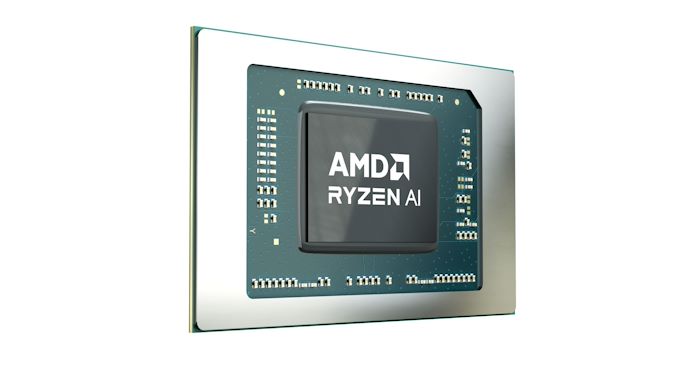
Further to the announcement that AMD is refreshing their Phoenix-based 7040HS series for mobiles with the newer ‘Hawk Point’ 8040HS family for 2024, AMD is set to drive more development for AI within the PC market. Designed to provide a more holistic end-user experience for adopters of hardware with the Ryzen AI NPU, AMD has made its latest version of the Ryzen AI Software available to the broader ecosystem. This is designed to allow software developers to deploy machine learning models into their software to deliver more comprehensive features in tandem with their Ryzen AI NPU and Microsoft Windows 11.
AMD has also officially announced the successor to their first generation of the Ryzen AI (XDNA), which is currently in AMD’s Ryzen 7040HS mobile series and is driving the refreshed Hawk Point Ryzen 8040HS series. Promising more than 3x the generative AI performance of the first generation XDNA NPU, XDNA 2 is set to launch alongside AMD’s next-generation APUs, codenamed Strix Point, sometime in 2024.
AMD Ryzen AI Software: Version 1.0 Now Widely Available to Developers
Along with the most recent release of their Ryzen AI software (Version 1.0), AMD is making it more widely available to developers. This is designed to allow software engineers and developers the tools and capabilities to create new features and software optimizations designed to use the power of generative AI and large language models (LLMs). New to Version 1.0 of the Ryzen AI software is support for the open-source ONNX Runtime machine learning accelerator, which includes support for mixed precision quantization, including UINT16/32, INT16/32, and FLOAT16 floating point formats.

AMD Ryzen AI Version 1.0 also supports PyTorch and TensorFlow 2.11 and 2.12, which broadens the capabilities on which software developers can run in terms of models and LLMs to create new and innovative features for software. AMD’s collaboration with Hugging Face also offers a pre-optimized model zoo, a strategy designed to reduce the time and effort required by developers to get AI models up and running. This also makes the technology more accessible to a broader range of developers right from the outset.

AMD’s focus isn’t just on providing the hardware capabilities through the XDNA-based NPU but on allowing developers to exploit these features to their fullest. The Ryzen AI software is designed to facilitate the development of advanced AI applications, such as gesture recognition, biometric authentication, and other accessibility features, including camera backgrounds.
Offering early access support for models like Whisper and LLMs, including OPT and Llama-2, indicates AMD’s growing commitment to giving developers as many tools as possible. These tools are pivotal for building natural language speech interfaces and unlocking other Natural Language Processing (NLP) capabilities, which are increasingly becoming integral to modern applications.
One of the key benefits of the Ryzen AI Software is that it allows software running these AI models to offload AI workloads onto the Neural Processing Unit (NPU) in Ryzen AI-powered laptops. The idea behind the Ryzen AI NPU is that users running software utilizing these workloads via the Ryzen AI NPU can benefit from better power efficiency rather than using the Zen 4 cores, which should help improve overall battery life.
A complete list of the Ryzen AI Software Version 1.0 changes can be found here.
AMD XDNA 2: More Generative AI Performance, Coming With Strix Point in 2024
Further to all the refinements and developments of the Ryzen AI NPU block used in the current Ryzen 7040 mobile and the upcoming Ryzen 8040 mobile chips is the announcement of the successor. AMD has announced their XDNA 2 NPU, designed to succeed the current Ryzen AI (XDNA) NPU and boost on-chip AI inferencing performance in 2024 and beyond. It’s worth highlighting that XDNA is a dedicated AI accelerator block integrated into the silicon, which came about through AMD’s acquisition of Xilinx in 2022, which developed Ryzen AI and is driving AMD’s commitment to AI in the mobile space.

While AMD hasn’t provided any technical details yet about XDNA 2, AMD claims more than 3x the generative AI performance with XDNA 2 compared to XDNA, currently used in the Ryzen 7040 series. It must be noted that these gains to generative AI performance are currently estimated by AMD engineering staff and aren’t a guarantee of the final performance.

Looking at AMD’s current Ryzen AI roadmap from 2023 (Ryzen 7040 series) to 2025, we can see that the next generation XDNA 2 NPU is coming in the form of Strix Point-based APUs. Although details on AMD’s upcoming Strix Point processors are slim, we now know that AMD’s XDNA 2-based NPU and Strix Point will start shipping sometime in 2024, which could point to a general release towards the second half of 2024 or the beginning of 2025. We expect AMD to start detailing their XDNA 2 AI NPU sometime next year.
Source: AnandTech – AMD Widens Availability of Ryzen AI Software For Developers, XDNA 2 Coming With Strix Point in 2024
How to Get Hulu Content on Disney+ Right Now
Back in May, we learned that Disney was planning to merge Hulu and Disney+ into one, humungous app. The plan was to allow customers to choose each service individually if they wanted to, but for those who subscribed to both, their experience would be more convenient. I guess there are perks to monopolies.
Just over half a year later, it seems the process is kicking off. Starting today, Dec. 6, the “vast majority” of Hulu’s library will be available to stream in the Disney+ app, so long as you subscribe to both platforms, of course. It’s not overly clear at this point how much of the Hulu library will be available during this initial transition, but we do know certain titles won’t be available due to licensing agreements, including Modern Family and Love Island.
You also miss out on live TV access if you subscribe to that: You’ll still need the standalone Hulu app if you want to tune into those channels. In addition, watching Hulu content won’t track across apps. If you want Hulu shows in the Hulu app, for example, it won’t show those episodes as being watched in Disney+. The same goes the other way around.
Of course, many of these limitations are simply the result of this beta test. Hopefully, Disney irons out the larger issues before its larger rollout in March, which aims to make watching Hulu in Disney+ feel more natural.
What’s interesting is this beta test is happening in the standard Disney+ app. When the merger was first announced, it was sold as a brand new app that users could try in beta in December. Now, it appears that “beta” is simply watching Hulu content in the same Disney+ app you already have.
How to watch Hulu content on Disney+
In order to access Hulu content in the Disney+ app, you need to be subscribed to both platforms. That can be either through a Disney+/Hulu bundle, or by subscribing to both services individually, but you need to be using the same email on both so Disney knows you’re subscribed.
How much does it cost to subscribe to both Disney+ and Hulu?
If you want to go in on a Disney+/Hulu bundle, called “Duo,” you can choose from either a $9.99 per month ad-supported plan, or $19.99 per month ad-free plan.
You can also subscribe separately: Disney+ runs $7.99 per month with ads, and $13.99 per month without. Hulu charges $7.99 with ads, with an option to add Disney+ with ads for $1.99 per month. You can also subscribe without ads for $17.99 per month.
If you’re a student, you can get Hulu with ads for $1.99 per month. This is the way to go if you’re eligible, since you can add a $1.99 per month Disney+ ad-plan to the mix, netting you a “bundle” for $3.98 per month.
Source: LifeHacker – How to Get Hulu Content on Disney+ Right Now
There's Finally A GeForce RTX 40 Series Graphics Card With A Single Slot Cooler

GALAX has launched the thinnest RTX 40 card thus far with its RTX 4060 Ti Unparalleled Max, a single-slot graphics card that’s just 20mm thick. The single-slot form factor is usually reserved for professional or workstation cards, and GALAX’s new model is (as far as we know) the first single-slot RTX 40 card. Even though it has a relatively
Source: Hot Hardware – There’s Finally A GeForce RTX 40 Series Graphics Card With A Single Slot Cooler
Cable lobby to FCC: Please don’t look too closely at the prices we charge

Enlarge (credit: Getty Images | imagedepotpro)

The US broadband industry is protesting a Federal Communications Commission plan to measure the affordability of Internet service.
The FCC has been evaluating US-wide broadband deployment progress on a near-annual basis for almost three decades but hasn’t factored affordability into these regular reviews. The broadband industry is afraid that a thorough examination of prices will lead to more regulation of ISPs.
An FCC Notice of Inquiry issued on November 1 proposes to analyze the affordability of Internet service in the agency’s next congressionally required review of broadband deployment. That could include examining not just monthly prices but also data overage charges and various other fees.
Read 27 remaining paragraphs | Comments
Source: Ars Technica – Cable lobby to FCC: Please don’t look too closely at the prices we charge
How Amazon Prime Student Members Can Get a $25 Flight Home for the Holidays
It sounds too good to be true, but it only kind of is: Amazon is offering students $25 flights home this holiday season. Of course, not every student gets the deal—but if you’re a Prime Student member, you could be one of the lucky ones. Dec. 7 is your last day to try for the promotion. Here’s how to enter.
Who is eligible for the $25 flights?
Amazon is collaborating with StudentUniverse on the deal, and offering it to its Prime Student members—so, of course, you have to have Prime Student. Prime Student is a half-off Amazon Prime membership only for college students. Members get all the stuff that regular Prime users get, like speedier delivery, access to Prime Video and Amazon Music, free food delivery via Grubhub, and a month of free AI-powered study help from Course Hero. After your six-month trial, it costs $69 per year. It’s not a bad deal, provided you’re part of the Amazon ecosystem (aren’t we all?).
Products to consider:
Consider picking up these items for a smoother flight.
-
A portable foot hammock so you can stretch out $12.95
-
An inflatable travel pillow with an eye mask, ear plugs, and a travel bag $20.99
-
A compact blanket in a case $21.77
-
A flexible stand for your tablet or phone $11.99
How do you book the $25 holiday flights?
Prime Student members can go to this link tomorrow, Dec. 7, for a chance to secure one of 1,000 $25 flight tickets available that day. Qualifying travel includes domestic flights that leave some time between Dec. 8 and 25, with a return flight (if applicable) between Dec. 8 and Jan. 14, 2024.
Amazon and StudentUniverse’s goal, per a press release, is “to make holiday travel more affordable for students.” (Actually, their goal is to get you to sign up for a Prime Student membership and/or to harvest your data, but I’ll let them pat themselves on the back a little.)
The 1,000 tickets will become available at 12 a.m. PST/3 a.m. EST, so set an alarm and be ready to click in early to try to get yours. If you don’t land the $25 ticket, StudentUniverse will show you cheap flights for your preferred travel days, while Amazon Student can provide additional discounts, provided you have an account with both and are logged in when you try for your cheap flight.
Source: LifeHacker – How Amazon Prime Student Members Can Get a Flight Home for the Holidays