
LibreOffice 24.2 Beta 1 is available today as the latest test candidate for this cross-platform open-source office suite that is packing many new features while also changing its approach to versioning…
Source: Phoronix – LibreOffice 24.2 Beta Released For Testing This Free Software Office Suite
Monthly Archives: December 2023
The Meater 2 Wireless Thermometer Could Use a Signal Boost
When I first heard about Meater, a smart thermometer, the idea of a wireless probe piqued my interest. I am, above all things, inherently lazy, and a great wireless thermometer means less time running to the stove or grill and more time on the couch.
While there are some things to like about the new Meater 2, including its stylish design and aspirational app, these upsides were tarnished by its refusal to stay connected under seemingly easy conditions.
We just couldn’t stay connected
I conducted eight tests with the Meater 2 and a couple other wireless probes side-by-side over a variety of cooking environments and proteins. In the first round of five tests, the Meater would very often disconnect, which meant endless notifications to the phone and, more importantly, a loss of temperature reading. This happened in almost every single environment I tried, often within 20 feet of the probe and transmitter. Under other circumstances, it would be reasonable to chalk that up to my home (perhaps there are hidden RF signals that are interfering with the Meater 2) but in all cases, other probes like the Combustion had no problems within the same range. I run plenty of connections throughout the day with my various Bluetooth devices and have had no trouble connecting with devices further away.
The problem was so bad on those initial five tests that I contacted Meater and they sent a second probe they had tested internally before it arrived. I ran three more tests with the second probe and continued to have the same problems. I’ve read multiple other reviews and many reviewers have had no problem with the Meater 2’s connectivity. The folks at Meater suggested this was because the probe had trouble with my oven or the pot I was sous viding in or the metal of my barbecue. These are all valid points, but also, where else would I be cooking? If a thermometer can’t handle those environments, then it should get another job.
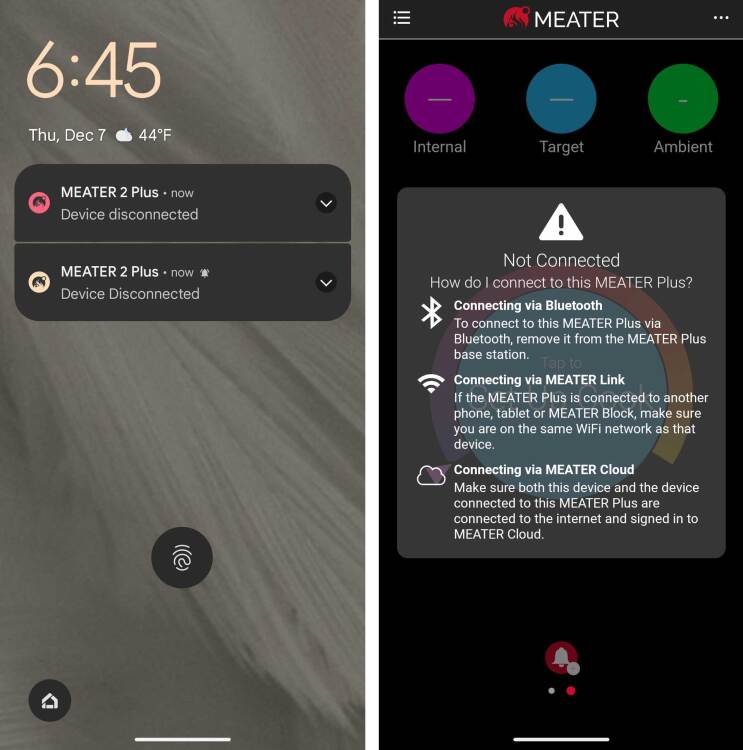
I constantly got disconnection notifications
Credit: Meater app
Credit: Meater app
I’d be remiss if I didn’t mention an option that I did not engage, which is to set up a wifi connection for the Meater 2, but this requires using two wireless devices, like tablets or phones. One near the probe to broadcast and one near me to receive. While this may have been successful (I prefer wifi connections to Bluetooth, generally), it would require equipment not included or offered by Meater and it means surrendering a device for the entirety of the cook. It also wouldn’t solve the Bluetooth problem; it would just be a workaround.
Sleek design to the probe and charger
Putting all of that aside, let me go over what I liked about the Meater 2. The latest version of this thermometer is much smaller than its predecessor. It is sleek and metal and comes in a wood charger that also acts as a receiver. I really liked the wood block, which has magnets so it can stick to an oven, fridge, or barbecue. I did not love that it was battery powered rather than USB-C rechargeable, however.
A beautiful app experience, but you have to work for it
The Meater app doesn’t trust the user to just get going. I was forced to go through multiple information screens and videos of how to do everything before I could actually use the probe. If you don’t want to watch the videos, you can “watch them later” as a button prompts, but the app doesn’t tell you that you can’t proceed until you’ve watched them, so I kept thinking I was in the wrong setup screen. Worse still, you have to do this each time you add a new probe. The app doesn’t remember you already read and watched everything. Really, the app is so simple that it shouldn’t really require any in depth how-tos, just a few help prompts along the way.
Once I had my probe registered in the app, I was able to start a “cook.” The nice thing about Meater is you can tell the app what you’re cooking and it will suggest temperature ranges. It recommended USDA “safe” temperature ranges for those meats, which tends to cook meat to well done. As most chefs tend to err on the lower side, I opted to pick my own temperatures..
Once the cook is going, Meater displays the internal temperature, the target you’ve set, and the ambient temperature. By touching the internal temperature icon, I could see the breakout of the temperatures for each of the six probes. One of Meater’s competitors, the Combustion, also indicates the surface temperature—a helpful but ultimately unnecessary metric to have.
That all said, the graph for an existing cook is graphic, colorful, and simple to interpret.
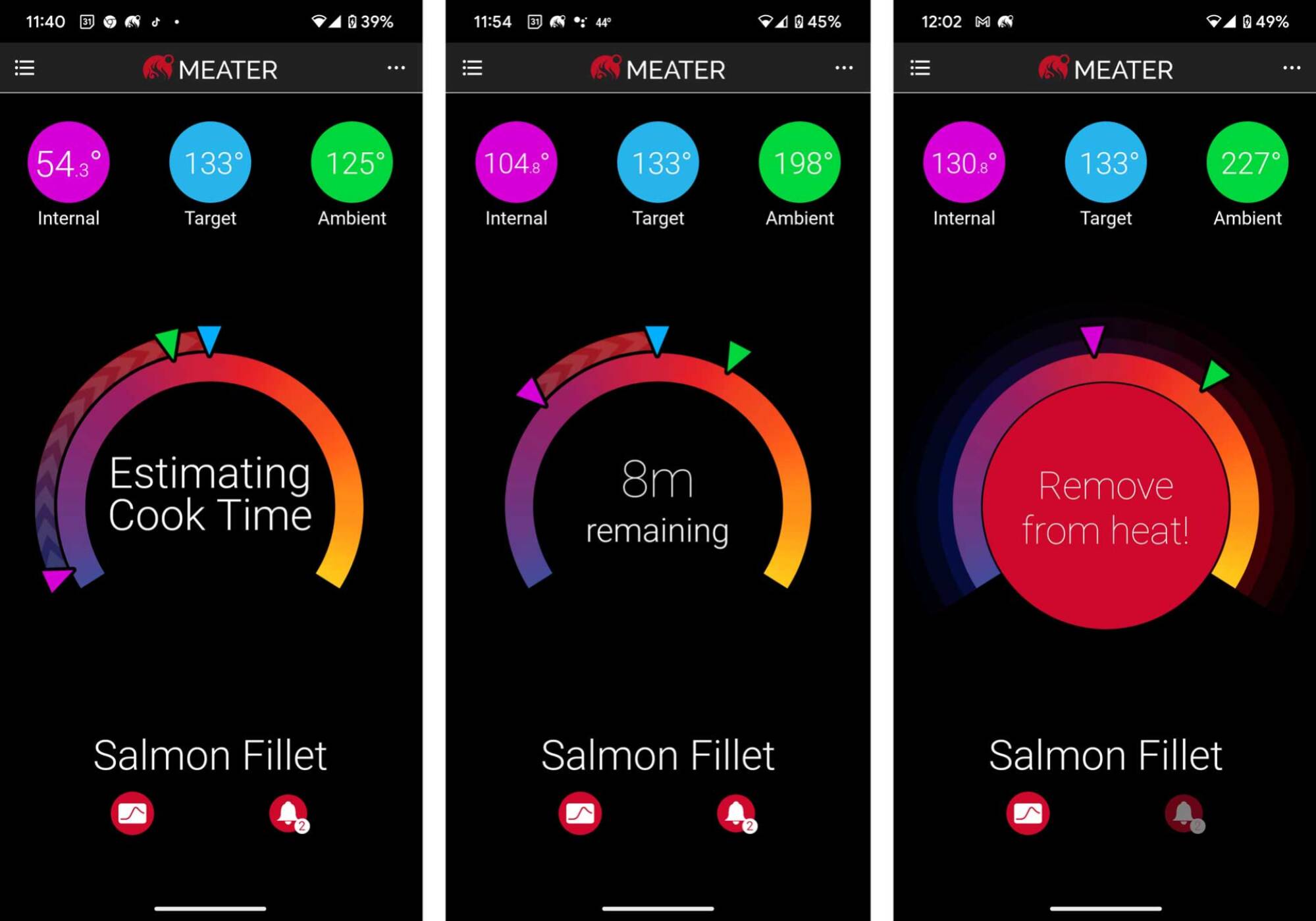
The app predicts the cooking time, and accuracy gets better as it approaches the goal temperature.
Credit: Meater app
Credit: Meater app
Lack of communication leads to misunderstanding
Like Combustion, the Meater 2 will try to tell you when your food is going to be done based on your target temperature, and like the Combustion, it was not great at doing so. It becomes more accurate as you approach the goal temperature, which isn’t predicting so much as math-ing with increasing accuracy.
To its credit, Meater does something I really like, which is to tell you your food is done 10 degrees before your target temperature, as food temperature actually rises another 10 degrees out of the oven. However, Meater doesn’t tell you why it’s saying your cook is done at 120ºF when your goal is 130ºF, so you’re left to guess or get annoyed if, like me, you set the target temperature for when you want to remove it, not when it’s “done.” This led me to mistrust and defy the predictor, which is likely not what Meater wants. I watched the predictor count down, suggesting that my roast, currently at 117ºF, would somehow reach its goal of 130ºF in two minutes, which could not possibly be true. Thus, I discounted the predictor.
The Meater app comes with notification alerts, but it felt like a hard choice. Of course, I want to know when the thermometer disconnected, when there’s a prediction of my food being done, or when the food is done. That resulted in a boatload of alerts constantly haranguing me as the Meater disconnected, reconnected, and then created a prediction. Overall, the Combustion offered a far more pleasant, functional app experience.
Also worth mentioning is that Meater has an integration with MasterClass in the app, so if you want to learn how to cook a specific dish, it sets you up for success as you follow along. If you’re a beginner cook and you can get Meater to remain connected, this could be a great idea. But as an experienced cook, I’d prefer the thermometer just do the thing I hired it to do well.
Bottom line: Meater 2 needs better connectivity and some app improvements
All products have their pros and cons, and it brings me no pleasure to be negative here. The team at Meater was pleasant to talk to and I was ready to assume the connection errors were due to a faulty unit or something amiss about my home. But for whatever reason, other wireless probes performed perfectly under the same conditions and remained connected—which, as features go, is number one.
For all the communications Meater has, from videos on how the app works to notification options, it failed to communicate few key things like, “Your food will continue to cook 10 degrees after you remove it,” “Knowing that, is this still the temperature goal you want to set?” While the Meater 2 is cheaper than the Combustion ($119 for the Meater 2, vs. $149 for the Combustion), I still can’t recommend picking the Meater 2 up because of the connection issues. If you have a Meater 2 and have had better luck, I’d love to hear about it in the comments.
Source: LifeHacker – The Meater 2 Wireless Thermometer Could Use a Signal Boost
FreeRDP 3.0 Released With WebSocket Transport, Relative Mouse Movement & More
FreeRDP 3.0 stable was released today as this open-source implementation of the Microsoft Remote Desktop Protocol (RDP) for allowing nice remote access support…
Source: Phoronix – FreeRDP 3.0 Released With WebSocket Transport, Relative Mouse Movement & More
Daily Telescope: A space-based camera spys a secretive Project Kuiper satellite

Enlarge / An image of a Kuiper satellite in space. (credit: HEO Space)

Welcome to the Daily Telescope. There is a little too much darkness in this world and not enough light, a little too much pseudoscience and not enough science. We’ll let other publications offer you a daily horoscope. At Ars Technica, we’re going to take a different route, finding inspiration from very real images of a universe that is filled with stars and wonder.
Good morning. It’s December 13, and today’s image comes from a company that images other objects in space—HEO Space. It reveals one of the two Project Kuiper satellites currently undergoing testing in low-Earth orbit.
Project Kuiper is Amazon’s answer to SpaceX’s Starlink satellite Internet constellation. However, in the run-up to the October launch of the first two demonstration satellites on an Atlas V rocket, Amazon was super secretive about the satellites. It released almost no technical details or any photos. So this in-space image is the best we’ve got for now.
Read 5 remaining paragraphs | Comments
Source: Ars Technica – Daily Telescope: A space-based camera spys a secretive Project Kuiper satellite
Study Shows 38% of Java Apps Still Affected By Log4Shell
An anonymous reader quotes a report from The Register: Two years after the Log4Shell vulnerability in the open source Java-based Log4j logging utility was disclosed, circa one in four applications are dependent on outdated libraries, leaving them open to exploitation. Research from security shop Veracode revealed that the vast majority of vulnerable apps may never have updated the Log4j library after it was implemented by developers as 32 percent were running pre-2015 EOL versions. Prior investigations from Veracode also showed that 79 percent of all developers never update third-party libraries after first introducing them into projects, and given that Log4j2 — the specific version of Log4j affected by the vulnerability — dates back to 2014, this could explain the large proportion of unpatched apps.
A far smaller minority are running versions that were vulnerable at the time of the Log4j vulnerability’s disclosure in December 2021. Only 2.8 percent are still using versions 2.0-beta9 through 2.15.0 — post-EOL versions that remain exposed to Log4Shell, the industry-coined moniker of the vulnerability’s exploit. Some 3.8 percent are still running version 2.17, a post-patch version of the Java logger that’s not exposed to Log4Shell attacks, but is vulnerable to a separate remote code execution (RCE) bug (CVE-2021-44832).
The researchers believe this illustrates a minority of developers that acted quickly when the vulnerability was first disclosed, as was the advice at the time, had returned to older habits of leaving libraries untouched. Altogether, just shy of 35 percent remain vulnerable to Log4Shell, and nearly 40 percent are vulnerable to RCE flaws. The EOL versions of Log4j are also vulnerable to three additional critical bugs announced by Apache, bringing the total to seven high and critical-rated issues. “At a surface level, the numbers above show that the massive effort to remediate the Log4Shell vulnerability was effective in mitigating risk of exploitation of the zero-day vulnerability. That should not be surprising,” said Chris Eng, chief research officer at Veracode.
“The bigger story at the two-year anniversary, however, is that there is still room for improvement when it comes to open source software security. If Log4Shell was another example in a long series of wake-up calls to adopt more stringent open source security practices, the fact that more than one in three applications currently run vulnerable versions of Log4j shows there is more work to do.
“The major takeaway here is that organizations may not be aware of how much open source security risk they are exposed to and how to mitigate it.”


Read more of this story at Slashdot.
Source: Slashdot – Study Shows 38% of Java Apps Still Affected By Log4Shell
Your Hairbrush Is Grosser Than You Realize
As beauty tools go, your hairbrush gets really gross, really fast. Humans shed an average of 50–100 hairs per day, many of which get stuck in your brush along with a build-up of hair care products, dead skin cells, and dust (a ripe environment for bacterial and fungal growth). If you don’t keep your brush clean, this grime can end up back in your hair, which not only makes your hair dirty and increases the risk of tangling and damage but can also exacerbate scalp issues like dandruff or seborrheic dermatitis.
If your brush looks like it needs to be cleaned, it definitely does. You should remove the hair from your brush as it accumulates (every day or so) and do a thorough clean once a week if you use any styling products, such as gel or hairspray (or every two to three weeks if you don’t).
How to clean your hairbrush
First things first: Pull the hair out of your brush’s bristles. Start by using your fingers, but if there are clumps that get stuck you can dig them out with a pointy object such as a chopstick, toothpick, or sharp comb end or cut with scissors. Again, do this regularly to prevent build-up.
Next, you need to wash the brush:
-
Fill a stopped sink, bin, or bowl with warm, soapy water. You can use dish soap or gentle shampoo to wash synthetic (plastic and rubber) brushes, but if your brush is natural (made of wood or boar bristles), go with a sulfate-free shampoo. You can also add one to two teaspoons of baking soda.
-
Soak your synthetic brush, including the bristles, for 10 minutes. For natural brushes and brushes with padding, dip the bristles into the water but do not submerge. This softens all of the gross bits to make them easier to remove.
-
Remove the brush, shake it off, and re-soak if a lot of build-up remains.
-
Use your fingers to pull any grime off of individual bristles.
-
Use a clean, spare toothbrush dipped in the soapy water to scrub around the base of and up the bristles. Scrub anywhere else that there’s build-up.
-
Rinse your brush in cool running water, squeeze or shake out any excess, and place it face-down to dry.
Regularly cleaning your hairbrush will lengthen its life, but there will come a time when it’s best to replace it, such as when there are broken, bent, or missing bristles as well as cracks. Inspect your brush regularly.
Source: LifeHacker – Your Hairbrush Is Grosser Than You Realize
Tesla recalls over 2 million cars to fix Autopilot safety controls
Following a two-year investigation by the National Highway Traffic Safety Administration (NHTSA), Tesla will recall over 2 million vehicles to address Autopilot safety concerns, according to new NHTSA documents. Fixes will be issued to owners for free via over-the-air (OTA) updates to add features that ensure drivers pay attention while using Tesla’s controversial driver assistance system. It affects all current Tesla EVs built since Autopilot launched in 2015, including the Model 3, Model Y, Model S and Model X.
“The remedy will incorporate additional controls and alerts to those already existing on affected vehicles to further encourage the driver to adhere to their continuous driving responsibility whenever Autosteer is engaged,” the NHTSA stated in a document. It noted that while Autopilot (specifically its Autosteer component) does have several controls to ensure drivers pay attention, they’re not always enough.
“In certain circumstances when Autosteer is engaged, the prominence and scope of the feature’s controls may not be sufficient to prevent driver misuse of the SAE Level 2 advanced driver-assistance feature,” the document states. That in turn may lead to “an increased risk of a collision.”
Tesla was ordered to address the driver monitoring system. “The remedy will incorporate additional controls and alerts to those already existing on affected vehicles to further encourage the driver to adhere to their continuous driving responsibility whenever Autosteer is engaged, which includes keeping their hands on the steering wheel and paying attention to the roadway,” it states. Those will include more prominent visual alerts, making it easier to turn Autosteer on and off, and eventual suspension from Autosteer if the driver fails to behave responsibly on an ongoing basis.
In a letter to the NHTSA, Tesla acknowledged the order and said it would issue the required fix. “Tesla will release an over-the-air (OTA) software update, free of charge. Owner notification letters are expected to be mailed February 10, 2023.” The order affects 2,031,220 vehicles, though models that went into production after December 7th will have already incorporated the update.
The NHTSA said last August that it was opening an investigation into Autopilot following 11 crashes with parked first responder vehicles since 2018 that resulted in 17 injuries and one death. In a letter to Tesla sent shortly afterward, the regulator requested detailed documentation on how the driver assistance system works. Specifically, it wanted to know how it ensures that human drivers will keep their eyes on the road while Autopilot is engaged and whether there are limits on where it can be used.
This article originally appeared on Engadget at https://www.engadget.com/tesla-recalls-2-million-cars-in-order-to-fix-autopilot-safety-controls-123308343.html?src=rss
Source: Engadget – Tesla recalls over 2 million cars to fix Autopilot safety controls
Kernel kerfuffle kiboshes Debian 12.3 release
A mis-merged patch causing corruption on ext4 volumes is to blame. The Debian maintainers have identified a problem in kernel 6.1 that can cause corruption on ext4 volumes. As a result, the planned 12.3 release won’t happen.…
Source: LXer – Kernel kerfuffle kiboshes Debian 12.3 release
The Morning After: iOS 17.3’s new feature will make things harder for iPhone thieves
Apple is adding a new iPhone feature called Stolen Device Protection, which limits what thieves can do with a stolen phone and passcode. It combines location, biometric scans and time delays, allowing victims to lock out the perpetrator and safeguard their data.
Stolen Device Protection defends against iPhone thieves who monitor users entering their passcode before snatching the device. With the passcode, the perpetrator could reset the owner’s Apple ID password, turn off Find My tracking, change an Apple ID password and a lot more.
With this still-in-beta feature turned on, the phone will ask for a Face ID or Touch ID scan if the device is away from a familiar location, like home or work. It will also require a one-hour delay before changing the Apple ID password on the device. After the hour, it will still ask for a Face ID or Touch ID Scan before changing the Apple ID password from the iPhone.
— Mat Smith
You can get these reports delivered daily direct to your inbox. Subscribe right here!
The biggest stories you might have missed
Researchers fuse lab-grown human brain tissue with electronics
PlayStation’s 2023 Wrap-Up recaps your year in gaming
Google Maps will let you store your location on your phone instead of the cloud
How to use Apple’s new Journal app
Google’s superfast 20Gbps Wi-Fi 7 Fiber plan costs $250 a month
Masterbuilt’s 2024 charcoal smart grill lineup offers one-button ignition and more
The end of E3
It was once the biggest gaming show in the world.
MARK RALSTON/AFP via Getty Images
The Electronic Entertainment Expo, better known as E3, is officially dead. “After more than two decades of E3, each one bigger than the last, the time has come to say goodbye. Thanks for the memories,” the Entertainment Software Association, E3’s organizer, wrote on X. The industry trade group closed the statement with “GGWP” — good game, well played.
The ESA said, after major names pulled out of this year’s planned E3, the event “simply did not garner the sustained interest necessary to execute it in a way that would showcase the size, strength and impact of our industry.”
While E3 may be gone, gaming events aren’t going away. Gamescom, held in Germany, is far larger than E3 in attendance and other factors. There’s also Summer Game Fest, a sort-of E3 replacement The Game Awards producer and host Geoff Keighley started in 2020 and expanded last year to include a physical event for the first time. The likes of Capcom, Ubisoft and Xbox held games showcases in association with SGF this year. The event will return for its fifth edition in 2024.
Netflix reveals ‘what we watched’
It’s the first engagement report it’s ever released.
Netflix
Netflix has published the first of a new twice-a-year engagement report called What We Watched. It launched Tuesday as a Microsoft Excel file (!) and lists the hours viewed for every title that tallied more than 50,000 viewing hours, making it the first ultra-detailed glimpse at what people watch on Netflix.
Top hits include the first season of the action-thriller series The Night Agent (nope, not heard of it), with 812,100,000 hours watched. In second place was season two of the drama Ginny & Georgia (I don’t know her or her) with 665,100,000 hours. Korean show The Glory (three for three…) came third with 622,800,000 hours watched.
Apple may lift NFC restrictions in Europe to escape antitrust fines
Rivals could use tap-and-go payments without Apple Pay.
Apple is attempting to avoid another legal battle with the European Union. The company is allegedly offering its rivals access to its Near-Field Communication (NFC) technology, used for tap-and-go payments, following the European Commission’s ongoing probe into Apple’s potential antitrust Apple Pay practices. While Apple’s current proposal could get it out of a hefty fine and settle the case against it, it’s not guaranteed to move forward.
It’s not just Europe, either. Apple faces a lawsuit in the United States, brought in July 2022 by Iowa’s Affinity Credit Union, which accuses the company of engaging in anti-competitive behavior by illegally restricting iOS users to Apple Pay for any contactless payment.
This article originally appeared on Engadget at https://www.engadget.com/the-morning-after-ios-173s-new-feature-will-make-things-harder-for-iphone-thieves-121541329.html?src=rss
Source: Engadget – The Morning After: iOS 17.3’s new feature will make things harder for iPhone thieves
It Looks Like AMD Zen 5 SoCs Will Support ACPI PHAT
A few months ago I wrote about AMD Linux engineers working on ACPI PHAT support for the Linux kernel. This week new patches around Linux ACPI PHAT handling have been posted with further confirmation of this functionality coming to “future” AMD SoCs…
Source: Phoronix – It Looks Like AMD Zen 5 SoCs Will Support ACPI PHAT
Linux To Drop Support For 15 Year Old, Never-Shipped Intel "Carillo Ranch"
With Intel’s very timely upstream Linux hardware support going back years, they typically start on the upstream hardware enablement well in advance of the product’s planned public launch. On a number of occasions this has meant adding support to the Linux kernel for hardware that never ends up being released to consumers. There’s been recent cases like the Thunder Bay support that was dropped from the kernel after it became clear that the SoC would never ship to now a more extreme case of a driver being in the mainline kernel for 15 years to support never-released hardware…
Source: Phoronix – Linux To Drop Support For 15 Year Old, Never-Shipped Intel “Carillo Ranch”
Cold Trip Points Proposed For The Linux Kernel's Thermal Handling
The Linux kernel’s thermal driver has the obvious notion of hot and critically-hot trip points while to this point there hasn’t been the opposite: cold trip points (events) but that’s finally been proposed as we approach the end of 2023…
Source: Phoronix – Cold Trip Points Proposed For The Linux Kernel’s Thermal Handling
Range Rover Electric teased ahead of its 2024 reveal
Several years ago, Land Rover announced plans to offer electrified versions of all its vehicle and that process has finally begun. The company teased the Range Rover Electric in a press release and video, promising an 800 volt architecture and all the benefits of a modern EV. At the same time, it’ll be just as powerful and capable off-road as its gas-guzzling counterparts.
Apart from some aspirational promises, details are still sparse. To start with, it’ll supposedly have “performance comparable to a flagship Range Rover V8 and the all-terrain capability developed in-house by Land Rover experts.” That all-terrain capability includes the ability to wade through 850mm of water (2.8 feet), though the current V8-powered 2023 Range Rover already offers 900mm of depth.
Land Rover
The new model will supposedly be the “quietest and most refined Range Rover ever created,” the company said, thanks to “active road noise cancellation configuration and sound design, plus cabin comfort levels enabled by its electric underpinnings.” In other words, it’ll take advantage of the relatively low noise levels and simplicity of an electric drivetrain, like other luxury EVs.
The new model will be built on Jaguar Land Rover’s Modular Longitudinal Architecture (LMA) based on an 800 volt architecture, something that generally supports added charging power, enhanced performance, increased efficiency and weight savings. That, the company says, will help enable “fast-charging on public networks,” among other benefits.
The company is also promising “a seamless electric ownership experience — effortless charging, energy partnerships, software-over-the-air updates and intelligent technology to maximise range.” On top of that, the vehicle and and batteries will both be built in the UK in Solihull and Wolverhampton, respectively.
Range, performance and other key specifications, along with full photos of the vehicle are still missing. If you’re undeterred by that and swayed by Land Rover’s promo video (featuring glimpses of the vehicle, a model in a gold dress wearing green rubber boots, some koi fish and plenty of water), you can now join the waiting list.
This article originally appeared on Engadget at https://www.engadget.com/range-rover-electric-teased-ahead-of-its-2024-reveal-111741916.html?src=rss
Source: Engadget – Range Rover Electric teased ahead of its 2024 reveal
SVT-AV1 1.8 Brings More Performance Improvements Plus ARM Neon SIMD Optimizations
SVT-AV1 v1.8 was released this week as the newest version of this open-source AV1 video encoder originally started by Intel and continues to be developed by Intel engineers in cooperation with the Alliance for Open Media. As with most releases, optimizing this CPU-based AV1 encoder’s performance continues to be a key priority…
Source: Phoronix – SVT-AV1 1.8 Brings More Performance Improvements Plus ARM Neon SIMD Optimizations
How to Install and Use LunarVim on Linux
Discover a fully-fledged CLI IDE based on NeoVim that provides all the advanced features of a modern IDE, like VSCode Studio, in your terminal.
Source: LXer – How to Install and Use LunarVim on Linux
OpenAI's Nonprofit Arm Showed Revenue of $45,000 Last Year
Despite being valued at $86 billion by private investors, OpenAI reported $44,485 in revenue in 2022, almost entirely from investment income. CNBC reports: That’s from the nonprofit parent’s 990 filing with the Internal Revenue Service, a form that has to be filled out by organizations wishing to maintain their tax-exempt status. Federal standards don’t require audited financial statements from nonprofits. In its home state of California, OpenAI was able to avoid submitting audited financials for 2022 because the foundation’s stated revenue was below the $2 million reporting threshold. The last time OpenAI filed with the state was 2017, when revenue was $33.2 million, or more than 700 times what the foundation reported for 2022.
For all its talk of openness, OpenAI’s financials remain a black box. Created as a nonprofit in 2015, OpenAI launched a so-called capped-profit entity in 2019, enabling it to raise billions of dollars in outside funding and attain attributes of a tech startup, such as the ability to hand out equity to employees. The for-profit side of the house went on to develop ChatGPT, the chatbot that took the world by storm late last year and kicked off the generative AI boom. […]
Thad Calabrese, a professor of public and nonprofit financial management at New York University, said OpenAI’s current status is confusing, and is unlike anything he has seen in the nonprofit world. He said OpenAI could give up its nonprofit status, and he cited the Blue Cross Blue Shield Association, which in 1994 allowed associated nonprofit medical insurance plans to switch into for-profit entities. “There’s no real need to have the nonprofit,” Calabrese said. “If you want to be a startup, be a startup.” Regarding OpenAI’s reporting with the IRS, he said “fundamentally you can’t really get a holistic sense of these organizations when you don’t have consolidated financial statements.”


Read more of this story at Slashdot.
Source: Slashdot – OpenAI’s Nonprofit Arm Showed Revenue of ,000 Last Year
Microsoft's official Xbox wireless controllers drop to $45
If you need a spare gamepad for your Xbox or PC, Microsoft’s wireless Xbox Series X/S controller is currently available for $45 at Amazon. That’s close to the lowest price we’ve seen and the sale applies to multiple finishes (carbon black, blue and velocity green).
The Series X/S controller is the classic well-balanced model with responsive face buttons, triggers, and joysticks. The d-pad offers nice tactility compared to Sony’s DualSense PS5 controller, though it still uses an asymmetrical joystick layout. It comes with Bluetooth connectivity so you can use it with a PC or mobile device, plus a dedicated “Share” button for screen and video capture.
While you don’t get the advanced haptic feedback features of the DualSense, it fits nicely in your hand and is generally easier to use on a PC — especially for clients besides Steam. Alternatives like the 8BitDo Ultimate Bluetooth Controller and Microsoft’s own Elite Series 2 pad offer a wider array of features, but if you just need the basics, the standard Xbox controller is solid.
The primary drawback is a reliance on AA, rather than rechargeable batteries for power. That lets it last longer on a charge than the DualSense, but you’ll have to buy a separate rechargeable battery pack if you don’t want to regularly swap out batteries. If you can live with that limitation, the sale offers a cheap way to get an extra high-quality controller or two.
Follow @EngadgetDeals on Twitter and subscribe to the Engadget Deals newsletter for the latest tech deals and buying advice.
This article originally appeared on Engadget at https://www.engadget.com/microsofts-official-xbox-wireless-controllers-drop-to-45-093236413.html?src=rss
Source: Engadget – Microsoft’s official Xbox wireless controllers drop to
How to Install WordPress with LAMP on Debian 12 Bookworm
Step-by-step guide on installing WordPress with LAMP (Linux, Apache, MySQL, PHP) on Debian 12 Bookworm, covering the entire process along with various tips.
Source: LXer – How to Install WordPress with LAMP on Debian 12 Bookworm
Scientists Discover Nuclear Fission Amongst the Stars
For the first time, scientists have discovered nuclear fission occurring amongst the stars, supporting the idea that neutron stars create “superheavy” elements when they collide, which then break down via nuclear fission to birth rare elements. Space.com reports: Nuclear fission is basically the opposite of nuclear fusion. While nuclear fusion refers to the smashing of lighter elements to create heavier elements, nuclear fission is a process that sees energy released when heavy elements split apart to create lighter elements. Nuclear fission is pretty well known, too. It’s actually the basis of energy-generating nuclear power plants here on Earth — however, it had not been seen occurring amongst the stars before now.
The team of researchers led by North Carolina State University scientist Ian Roederer searched data concerning a wide range of elements in stars to discover the first evidence that nuclear fission could therefore be acting when neutron stars merge. These findings could help solve the mystery of where the universe’s heavy elements come from. Scientists know that nuclear fusion is not just the primary source of energy for stars, but also the force that forges a variety of elements, the “heaviest” being iron.
The evidence of nuclear fission discovered by [Matthew Mumpower, research co-author and a scientist at Los Alamos National Laboratory] and the team comes in the form of a correlation between “light precision metals,” like silver, and “rare earth nuclei,” like europium, showing in some stars. When one of these groups of elements goes up, the corresponding elements in the other group also increases, the scientists saw. The team’s research also indicates that elements with atomic masses — counts of protons and neutrons in an atomic nucleus — greater than 260 may exist around neutron star smashes, even if this existence is brief. This is much heavier than many of the elements at the “heavy end” of the periodic table. “The only plausible way this can arise among different stars is if there is a consistent process operating during the formation of the heavy elements,” Mumpower said. “This is incredibly profound and is the first evidence of fission operating in the cosmos, confirming a theory we proposed several years ago.”
“As we’ve acquired more observations, the cosmos is saying, ‘hey, there’s a signature here, and it can only come from fission.'”
The research was published in the journal Science.


Read more of this story at Slashdot.
Source: Slashdot – Scientists Discover Nuclear Fission Amongst the Stars
Snapchat+ subscribers can now use AI to generate or extend images within the app
Generative AI is nothing new for Snapchat users, with the app’s “My AI” suite offering the likes of a free ChatGPT-powered chatbot, as well as the freemium AI-generated “Dreams” selfie effects, Bitmoji backgrounds and more. In the latest update, Snapchat+ subscribers can now leverage AI to extend images — or “zoom out” — at the click of a button, thus making the social media app even more practical. Say you have a snapshot of your pet but it’s a little too close, just click on the crop button on the right menu, and then hit the “Extend” button at the bottom. Voilà!
The updated My AI also lets subscribers directly generate Snaps by typing a simple prompt. In the viewfinder, click the “AI” button on the right, then type in whatever you desire (within reason, of course), and shortly, you’ll have an image to tinker with before sharing. Snap suggests you try silly prompts like “a dog sleeping on a rocket” or “a planet made out of cheese.”
Last but not least, the aforementioned Dreams feature now lets you generate fantastical portraits with friends in them. On the Dreams page, simply pick a friend, hit “Done,” and then you’ll be able to share the generated portrait of you both. Like before, Snapchat+ subscribers are given one pack of eight Dreams selfies every month, whereas non-subscribers only get one pack as a free trial, before they consider signing up for the $4-a-month service. Regardless, all users can buy more for $0.99 per pack.
Snap’s ongoing AI efforts seem to be paying off, with its number of subscribers rocketing from five million in September to seven million today — getting one step closer to the ten million “medium-term goal” set by CEO Evan Spiegel back in April, as reported by Time Magazine. Of course, given the fierce competition like Meta which offers similar features for free, Snap will have to keep churning out new AI-powered tools to keep its platform fun and fresh.
This article originally appeared on Engadget at https://www.engadget.com/snapchat-subscribers-can-now-use-ai-to-generate-or-extend-images-within-the-app-060003554.html?src=rss
Source: Engadget – Snapchat+ subscribers can now use AI to generate or extend images within the app