Daily Telescope: How small can the smallest star be?

This image from the NIRCam on the James Webb Space Telescope shows the central portion of the star cluster IC 348.

Enlarge / This image from the NIRCam on the James Webb Space Telescope shows the central portion of the star cluster IC 348. (credit: NASA, ESA, CSA, STScI, and K. Luhman and C. Alves de Oliveira)

Welcome to the Daily Telescope. There is a little too much darkness in this world and not enough light, a little too much pseudoscience and not enough science. We’ll let other publications offer you a daily horoscope. At Ars Technica, we’re going to take a different route, finding inspiration from very real images of a universe that is filled with stars and wonder.

Good morning. It’s December 14, and today we’re traveling about 1,000 light-years from Earth to a star cluster in the constellation Perseus. Astronomers using the James Webb Space Telescope have looked there as part of their search to answer a simple question: How small can a star be?

Webb is an ideal tool for such a search because the smallest stars—brown dwarfs, which emit light from the fusion of deuterium—are most visible in infrared light. Astronomers focused on this star cluster, IC 348, because it is young and should have new brown dwarfs. Such small stars emit the most light when they’re young, so the smallest stars would be at the most visible point of their lifetime.

Read 4 remaining paragraphs | Comments


Source: Ars Technica – Daily Telescope: How small can the smallest star be?

The Right Way to Use Tinder for a Hometown Holiday Hookup

2023 is winding down, the holidays are coming, and tons of people will head back to their hometowns for the celebration. Traveling home for the holidays is a funny experience. You’re headed somewhere you know intimately, but it’s different now that you’re not there. Are your old friends still the same? Did your favorite diner survive the pandemic and all the economic weirdness after? Are your old hook-ups in town? Are there new people you haven’t seen before?

First: Just use Tinder

If you’re looking for a hookup, Tinder is your best bet, full stop. It’s quick, it’s straightforward, most people have it, and there isn’t a lot you have to do to set up a profile. “It’s bound to be incredibly depressing, extremely funny, or a straight-up good time,” says Don G., a 32-year-old Brooklynite heading back to Pennsylvania for Christmas who plans on using Tinder once he is back in town. He anticipates scrolling across at least one “high school flame” and seeing what they’re doing. With any luck, it’ll be him. 

“Hinge and Bumble always felt a bit commitment-oriented,” he says. “If that’s your vibe, by all means, pop off, but I think Tinder is the standard for hometown swiping. It has the reputation for a reason and it brings the least amount of messy pretense into any hangout.” Hinge and Bumble do have a reputation as more commitment-oriented, though Carmela, a 20-something New Yorker who heads home to Michigan a lot, adds that you’re less likely to encounter someone who’s already married on Hinge than you are on the others, at least in her experience. If you’re not trying to cause any familial drama, you might want to keep that in mind. All the major apps offer the option to declare openly on your profile what you’re looking for, so just be sure to indicate that you’re looking for a quick hookup and nothing more. 

A good rule of thumb is to also stay away from specialty apps, as they’re not likely to yield many results. Some, such as Feeld, are really centered around urban hubs, so unless you’re returning to a larger city, you probably won’t have much luck. 

Second: Be strategic, but kind

As mentioned, it’s important to be upfront about what, exactly, you’re looking for. Don advises you should “be as transparent about your intentions as possible.” That’s a good guideline for dating app use in general, so as always, be clear and honest about your intentions. Communication is key to ensure both parties are on the same page and comfortable with the encounter.

Be mindful about how you set your preferences, too. As Don pointed out, you’re likely to run across people you used to know. Whether or not that—and the possibility of them gossiping around town about seeing you on there—bothers you depends on your own preferences, but you do have to accept it as a reality before you go in. Have a plan in place for if and when this happens. If you really don’t want to engage with anyone you know, no problem. Tinder now has an option for you to hide your profile from certain people in your phone contacts. If you don’t have their number, just commit to the old-fashioned way of swiping left on them. If you don’t mind possibly having a one-night stand with a former homecoming king or that shy girl that was somehow always your cashier at the grocery store, prepare what you’ll say when you meet up. Setting your preferences to avoid that altogether can work, but it brings a new set of problems. Carmela says she sets her age range to 34 and above when she visits home, but ends up seeing former professors and co-workers instead of old classmates. Something awkward may well happen no matter what you do. Just choose your awkward.

Still, don’t let this deter you. Even in the smallest towns, you may be able to find someone you don’t know and enjoy a holiday hookup. Be clear about your intentions and just have fun. As Don says, “Don’t take it too seriously… unless you want to. Even then, just remember you’re going back to your normal life three days later, and they will be, too.” 


Source: LifeHacker – The Right Way to Use Tinder for a Hometown Holiday Hookup

Science Fiction and Fantasy Writers Take Aim At AI Freeloading

An anonymous reader quotes a report from TorrentFreak: Members of the Science Fiction and Fantasy Writers Association have no trouble envisioning an AI-centered future, but developments over the past year are reason for concern. The association takes offense when AI models exploit the generosity of science fiction writers, who share their work without DRM and free of charge. […] Over the past few months, we have seen a variety of copyright lawsuits, many of which were filed by writers. These cases target ChatGPT’s OpenAI but other platforms are targeted as well. A key allegation in these complaints is that the AI was trained using pirated books. For example, several authors have just filed an amended complaint against Meta, alleging that the company continued to train its AI on pirated books despite concerns from its own legal team. This clash between AI and copyright piqued the interest of the U.S. Copyright Office which launched an inquiry asking the public for input. With more than 10,000 responses, it is clear that the topic is close to the hearts of many people. It’s impossible to summarize all opinions without AI assistance, but one submission stood out to us in particular; it encourages the free sharing of books while recommending that AI tools shouldn’t be allowed to exploit this generosity for free.

The submission was filed by the Science Fiction and Fantasy Writers Association (SFWA), which represents over 2,500 published writers. The association is particularly concerned with the suggestion that its members’ works can be used for AI training under a fair use exception. SFWA sides with many other rightsholders, concluding that pirated books shouldn’t be used for AI training, adding that the same applies to books that are freely shared by many Science Fiction and Fantasy writers. […] Many of the authors strongly believe that freely sharing stories is a good thing that enriches mankind, but that doesn’t automatically mean that AI has the same privilege if the output is destined for commercial activities. The SFWA stresses that it doesn’t take offense when AI tools use the works of its members for non-commercial purposes, such as research and scholarship. However, turning the data into a commercial tool goes too far.

AI freeloading will lead to unfair competition and cause harm to licensing markets, the writers warn. The developers of the AI tools have attempted to tone down these concerns but the SFWA is not convinced. […] The writers want to protect their rights but they don’t believe in the extremely restrictive position of some other copyright holders. They don’t subscribe to the idea that people will no longer buy books because they can get the same information from an AI tool, for example. However, authors deserve some form of compensation. SFWA argues that all stakeholders should ultimately get together to come up with a plan that works for everyone. This means fair compensation and protection for authors, without making it financially unviable for AI to flourish. “Questions of ‘how’ and ‘when’ and ‘how much money’ all come later; first and foremost the author must have the right to say how their work is used,” their submission reads.

“So long as authors retain the right to say ‘no’ we believe that equitable solutions to the thorny problems of licensing, scale, and market harm can be found. But that right remains the cornerstone, and we insist upon it,” SFWA concludes.

Read more of this story at Slashdot.


Source: Slashdot – Science Fiction and Fantasy Writers Take Aim At AI Freeloading

The Apple Watch Ultra 2 falls back to a low of $699

If you’re looking to get a new Apple Watch as a holiday present for someone else (or yourself!), you’re in luck. The Apple Watch Ultra 2 is back down to its all-time low price of $699, from $799. This deal comes courtesy of a six percent discount on the Ultra 2 and an additional $50 coupon applicable at checkout. 

The Apple Watch Ultra 2 came on the scene this fall with the new S9 SiP (system in package) chip, allowing you to double tap your thumb and forefinger together to perform activities like ending calls and playing music. The Ultra 2 also automatically turns on Night Mode, processes Siri requests right on the watch and has an always-on display.  

The one caveat: This deal is only available on the Ultra 2 large model, which fits wrists of 165mm to 210mm, and the Indigo Alpine Loop. However, multiple colors of the small and medium models (as well as the large Blue Alpine Loop option) are also discounted to $749 with $19 and $20 coupons available at checkout. So, for another $30 you have a lot of options size and color-wise. 

Follow @EngadgetDeals on Twitter and subscribe to the Engadget Deals newsletter for the latest tech deals and buying advice.

This article originally appeared on Engadget at https://www.engadget.com/the-apple-watch-ultra-2-falls-back-to-a-low-of-699-125548174.html?src=rss

Source: Engadget – The Apple Watch Ultra 2 falls back to a low of 9

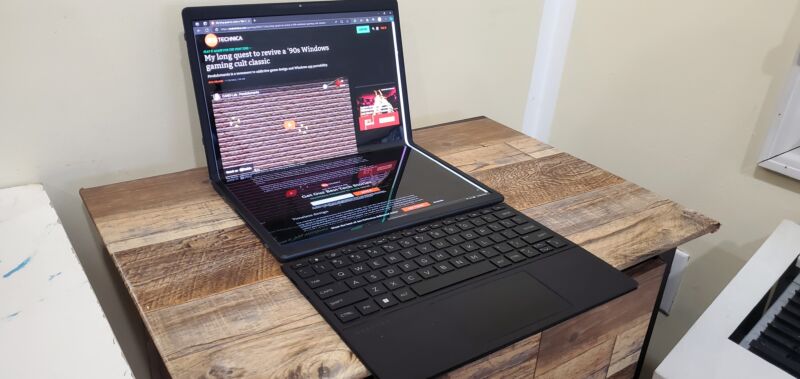
I’ve used a foldable laptop for a month, and I’m ready to return to a clamshell

HP Spectre Fold

Enlarge / Reflective screens and creases aren’t the only concerns with foldable PCs. (credit: Scharon Harding)

Specs at a glance: HP Spectre Foldable 17-cs0097nr
Screen 17-inch 1920×2560 OLED touchscreen
OS Windows 11 Home
CPU Intel Core i7-1250U
RAM 16GB LPDDR5-5200
Storage 1TB PCIe 4.0 SSD
Networking Wi-Fi 6E, Bluetooth 5.3
Ports 2x Thunderbolt 4
Size (folded) 10.91×7.53×0.84 inches
Weight (with keyboard) 3.58 lbs
Battery 94.3 Wh
Warranty 1 year
Price (MSRP) $5,000
Other HP Rechargeable MPP2.0 Tilt Pen, Bluetooth keyboard, and HP Envy USB-C Hub included

Although foldable smartphones have been available for five years, the devices are still trying to justify themselves. And after using a foldable-screen laptop as my primary PC for about four weeks, I’m not sure they’re ready for prime time.

I’m leaving my time with HP’s first foldable laptop with a sense of anticipation for the future of laptops, which I think would benefit from a resurgence of creative ideas that cater to the unique ways people use their computers. But I seriously question if the benefits of having a 17-inch screen in a 12-inch laptop body are worth the trade-offs inherent in today’s foldable PCs.

Early participants in the foldable laptop world have an opportunity to define the space, while consumers can decide if this is something they even want. HP’s foldable is the most beefed-up option ever, and weeks of use have shown me a lot about what I want and don’t want to see when the dust settles.

Read 44 remaining paragraphs | Comments


Source: Ars Technica – I’ve used a foldable laptop for a month, and I’m ready to return to a clamshell

The Morning After: Tesla recalls over 2 million cars over Autopilot safety

Following a two-year investigation by the National Highway Traffic Safety Administration (NHTSA), Tesla will recall over two million vehicles to address Autopilot safety concerns.

Fixes will be issued through free over-the-air (OTA) updates, adding features that ensure drivers pay attention while using Tesla’s Autopilot driver assistance system. It affects all current Tesla EVs built since Autopilot launched in 2015, including the Model 3, Model Y, Model S and Model X.

Those features will include more prominent visual alerts, making it easier to turn Autosteer on and off, and eventual suspension from Autosteer if the driver fails to behave responsibly. NHTSA opened the investigation following 11 crashes with parked first-responder vehicles, which resulted in 17 injuries and one death, since 2018.

Tesla’s legal episodes are likely to continue into 2024. The company updated its purchase agreement documents for its Cybertruck, ensuring it could sue at least some Cybertruck owners who flip their vehicles too soon. Not in a Fast and the Furious way, but by trying to sell one of the popular trucks soon after purchase. Tesla could seek injunctive relief to prevent owners from transferring their vehicle’s title if they attempt to sell it within one year of buying it.

— Mat Smith

​​You can get these reports delivered daily direct to your inbox. Subscribe right here!​​

The biggest stories you might have missed

Instagram is making it easier to remove spammy followers

Range Rover Electric teased ahead of its 2024 reveal

The best 15 last-minute Christmas gifts for 2023

Apple’s self-repair program now includes the iPhone 15 and more M2-powered Macs

Watch this: The Game Awards’ missteps and Light No Fire

Netflix’s 2024 game lineup includes Game Dev Tycoon, Sonic Mania and a Cozy Grove sequel

How to take spatial video on the iPhone 15 Pro

Tesla’s latest Optimus robot can handle an egg without breaking it

The machine has come a long way from its earlier iterations.

TMA
Tesla

More Tesla news, but nothing to do with litigation. Its Optimus robot has reappeared, with improved dexterity — enough to handle an egg. While the previous version of Optimus struggled to walk during a live demo, the latest model can move with more grace, perhaps thanks to its Tesla-designed actuators and sensors. The machine has an actuated neck, with two degrees of freedom, and it’s said to be 30 percent faster at walking. Tesla says it’s been able to reduce the robot’s weight by 10 kilograms without sacrificing any functionality. Optimus handles objects more delicately, with the demo showing it picking up and gently placing down an egg. Finally — it’s what I’ve been waiting for from robots.

Continue reading.

Xbox Cloud Gaming lands on Meta Quest headsets

You’ll need a Game Pass Ultimate membership, controller and solid internet connection.

Meta Quest 2, 3 and Pro headset owners can now stream hundreds of games through Xbox Cloud Gaming. You’ll need an Xbox Game Pass Ultimate membership, a compatible controller, solid internet connection and the most recent Quest software update, but those are the only things stopping you from playing the latest Xbox games on a huge (virtual) screen. Meta says you’ll be able to choose from four virtual display sizes. You can opt to play games in an Xbox-themed virtual space or make it appear as though the display is floating in mid-air, thanks to the Quest 3 and Pro’s full-color passthrough.

Continue reading.

Apple finally offers the USB-C AirPods Pro case separately

My Lightning cable is living on borrowed time.

My persistent anonymous messages to Apple customer support have finally borne fruit.

Continue reading.

This article originally appeared on Engadget at https://www.engadget.com/the-morning-after-tesla-recalls-over-2-million-cars-over-autopilot-safety-121554058.html?src=rss

Source: Engadget – The Morning After: Tesla recalls over 2 million cars over Autopilot safety

Dbus-Broker 34 Released For High Performance D-Bus Message Broker

There’s been nothing new on the BUS1 front this year for capability-based IPC within the Linux kernel… In fact, the BUS1 out-of-tree kernel module has gone untouched for years now. But out of the BUS1 project has been Dbus-Broker for a high performance D-Bus message broker in user-space that doesn’t break existing D-Bus compatibility. Out today is the newest version of that project closely tied to systemd developers…

Source: Phoronix – Dbus-Broker 34 Released For High Performance D-Bus Message Broker

Instagram now offers AI-generated backgrounds on Stories

Every day, there seems to be new generative AI news, and while it can often be serious and quite technical, this time around it’s just plain fun. Instagram has launched a new generative AI-powered tool called backdrop that lets you create a new image in the, yes, background of your Story. Meta’s generative AI lead, Ahmad Al-Dahle, announced the feature on Threads alongside a video tutorial.

Instagram’s backdrop tool appears once you upload or capture content for your Story. It sits alongside existing icons at the top of your screen, like text and music, represented by an image of a person with a rectangular frame behind them. To use backdrop, just click on that icon, and the image’s entire background will go checkered (similar to picture editors like PhotoShop) along with a text box prompting you to “describe the backdrop you want…” From there, you can add anything from “surrounded by puppies” to “chased by dinosaurs” — very different vibes — and the AI tool will generate it in the background.

Don’t expect people to actually think you’re hanging out under the aurora borealis (another possible prompt), as your Story will get tagged with AI·Backdrop by Instagram, along with a sticker saying try it and your description in quotation marks. Currently, Instagram’s backdrop tool is only available to users in the United States.

This article originally appeared on Engadget at https://www.engadget.com/instagram-now-offers-ai-generated-backgrounds-on-stories-115054259.html?src=rss

Source: Engadget – Instagram now offers AI-generated backgrounds on Stories

Arch Linux ALHP Adds x86-64-v4 Repository For Packages Built With AVX-512

The unofficial “ALHP” repositories for Arch Linux have begun offering an x86-64-v4 tuned repository for packages built against this current highest x86-64 micro-architecture feature level for the latest Intel and AMD processors with AVX-512 support…

Source: Phoronix – Arch Linux ALHP Adds x86-64-v4 Repository For Packages Built With AVX-512

KDE Plasma Mobile 6 Porting Underway

While there has been much talk this year about KDE Plasma 6.0 on the desktop as it gears up for release at the end of February, there’s been less talk about the Plasma Mobile work for having the KDE stack on smartphones. But it turns out some progress is quietly being made on KDE Plasma Mobile for bringing it aligned with the “6” platform…

Source: Phoronix – KDE Plasma Mobile 6 Porting Underway

Threads finally launches in Europe

Meta’s Threads has finally arrived in Europe over five months after it launched in the US, UK and elsewhere around the world. Following a countdown and Instagram teaser invitation, the app is now officially available in the bloc on the web, though the iOS and Android apps still aren’t available for many.

Threads.net is now live on the web, though the mobile apps are still showing as unavailable for many (you may have to wait patiently). I was able to sign in using my Instagram account, though Meta also offers access without creating a profile — though you can’t post or interact with content in that case. Once I agreed to use Instagram and chose my profile, it asked if I was okay with it being public and if wanted to follow the same people I do on Instagram. A few more clicks and I was in. 

Threads finally launches in Europe
Steve Dent for Engadget

The delay was reportedly due to the EU’s upcoming Digital Markets Act (DMA) set to take effect in 2024. As one of seven tech giant “Gatekeepers,” Meta wanted to ensure it’s in compliance with the DMA, particularly around rules for sharing data between apps. In compliance with EU policies, the app also allows users to access the platform without needing to create a profile.

Threads launched July 5 on mobile with a basic feature set and required users to sign in using their Instagram accounts. It was much like Twitter (now X) when it launched, with support for text posts up to 500 characters, along with photos and five-minute videos. It also supported reposts and quote posts, while allowing users to limit their replies and block/report other users.

Since then, it has added a web version, along with both “following” and “for you” feeds, the ability to send Threads posts on Instagram, following list sorting, liked posts on your profile page and more. In short, it’s become a robust rival to X, Bluesky and its other short-form social media apps.

In addition, yesterday Meta started testing the ability to make Threads posts available on Mastodon and other fediverse apps. That compatibility with the decentralized “ActivityPub” service, and the ability to cross-post to other apps, was a key promise Meta made when it introduced Threads. 

Threads’ rise came with the steep decline of Elon Musk’s X, now seen as more polarized than ever. Among much other drama, the platform recently lost a number of key advertisers after Musk boosted an antisemitic conspiracy theory. In response to that, Musk delivered a new message for advertisers pulling back from the platform: “Go fuck yourself.”

Threads is still in a precarious spot, though. It was an instant hit, crossing the 100 million signup mark just five days after launch and counted 141 million users as of November 10, according to research company Quiver Quantitative. However, engagement is another issue — the number of daily active users has fluctuated and dropped steeply a month or so after launch. It should get a massive boost now that it’s in Europe, though, and Meta easily has the might (and money) to make it work and crush both established and potential rivals. 

This article originally appeared on Engadget at https://www.engadget.com/threads-finally-launches-in-europe-110747780.html?src=rss

Source: Engadget – Threads finally launches in Europe

Proton Mail now has a desktop app in beta

Proton finally has a desktop app. The Swiss company, known for its privacy-focused alternatives to the Google Workspace apps, revealed a Windows and macOS application on Thursday that includes Proton Mail and Proton Calendar. The desktop app is currently available in beta for subscribers on the most expensive premium tier, but the company says it will launch for all Proton users in early 2024.

The company says the desktop app has a modern design with a clutter-free experience. Proton views the move as providing a leg up over Google. “While many people use email on desktop in a browser, desktop apps can still provide certain advantages such as better offline support,” Proton CEO Andy Yen wrote in a press release. “For this reason, we have decided to launch a desktop app, something that even Gmail does not provide.” The desktop app now gives Proton apps on all major platforms.

Marketing image showing the
Proton

In addition to the desktop app, Proton is launching several new features for all platforms, including auto-forwarding email rules. Messages sent this way will be encrypted between Proton accounts, and it supports unencrypted auto-forwarding to non-Proton accounts. In addition, Proton Mail now integrates with customer relationship management (CRM) and customer support software as the company looks to grow its footprint in the business world.

Proton says encrypting forwarded messages while maintaining the security the company brands itself on was an enormous challenge. “Messages sent between Proton Mail accounts are always end-to-end encrypted by default,” Proton CTO Bart Butler wrote. “But to maintain end-to-end encryption for messages forwarded to other Proton users presented a huge technical challenge. We needed to figure out how to re-encrypt messages for different recipients without the server being able to access the content.”

Attachment previews are also available for all Proton Mail platforms. Previously, you had to download email attachments locally before viewing them. It now lets you see them directly from the inbox with one click. Proton says it does so without compromising security.

Marketing image showing a screenshot of the Proton Mail desktop app with a pop-up asking to
Proton

You can also now snooze Proton Mail messages in another catch-up move for the encryption-focused company. In addition, it spruced up the Proton Calendar with searches on the web while adding public holidays. The company has had a busy year, also launching a native Windows file-syncing app in July and a password manager in April.

Before it officially launches early next year, the Proton Mail desktop app is available now in beta for Proton Visionary subscribers. That tier was previously locked to legacy supporters, but the company has reopened registrations from now until January 3. (The plan isn’t cheap, though, at $40 monthly or $360 annually.) Meanwhile, auto-forwarding is available now for paid users on any plan, while attachment previews, snoozing and calendar improvements are here for everyone with a Proton account.

This article originally appeared on Engadget at https://www.engadget.com/proton-mail-now-has-a-desktop-app-in-beta-110021703.html?src=rss

Source: Engadget – Proton Mail now has a desktop app in beta

Spider-Man 2's New Game+ mode pushed back to 2024

In October, Insomniac Games launched Marvel’s Spider-Man 2 without key features like New Game+ and audio descriptions. Just before the game’s release, Insomniac’s community and marketing director, James Stevenson, shared that New Game+ “should” arrive before the end of 2023. However, Insomniac has now released a statement explaining that it’s targeting the next Marvel’s Spider-Man 2 update for early 2024.

Insomniac shared the news on X: “We know players have been eagerly awaiting features such as New Game+ and Audio Descriptions, among many more. We have been working vigilantly on these features and require more testing to ensure the quality is up to our standards. We are now targeting Early 2024 for the next game update, and we’ll have a feature-complete list closer to its release.”

Insomniac went on to explain that it’s adding more “highly requested features” to the game, such as replaying missions and changing the time of day. Many users’ responses on X were positive, encouraging Insomniac to take all the time it needs and expressing their love for the company — some of which got answers from the company sharing its thanks and appreciation.

The original Marvel’s Spider-Man game has New Game+, allowing players to start the game over while holding on to items they acquired during previous gameplay. But, despite the few missing features, we’re big fans of Marvel’s Spider-Man 2. Gamers can play as Peter Parker or Miles Morales across a world that’s expanded to include parts of Brooklyn and Queens. The story, side-quests, and more minor activities all added to the gameplay, creating a sequel that is “both bigger and better.”

This article originally appeared on Engadget at https://www.engadget.com/spider-man-2s-new-game-mode-pushed-back-to-2024-102622924.html?src=rss

Source: Engadget – Spider-Man 2’s New Game+ mode pushed back to 2024

Are Tiny Black Holes Hiding Within Giant Stars?

sciencehabit shares a report from Science Magazine: Grunge music: a source of validation for a generation of disaffected youth. And a surprising source of scientific inspiration for Earl Bellinger of the Max Planck Institute for Astrophysics. While listening to Soundgarden’s 1994 hit Black Hole Sun 2 years ago, he contemplated a curious question: Might itty-bitty black holes from the dawn of time be lurking in the hearts of giant stars? A new study by Bellinger and colleagues suggests the idea is not so far-fetched. Astronomers could detect these trapped black holes by the vibrations they cause on the star’s surface. And if there’s enough of them out there, they could function as the mysterious dark matter that holds the universe together.

The researchers found that the black holes would sink to the star’s core where hydrogen atoms undergo fusion to produce heat and light. At first, very little would happen. Even a dense stellar core is mostly empty space. The most microscopic of the black holes would have a hard time finding matter to consume and its growth would be extremely slow, Bellinger says. “It could take longer than the lifetime of the universe to eat the star.” But larger ones, roughly as massive as the asteroid Ceres or the dwarf planet Pluto, would get bigger on timescales of only a few hundred million years. Material would spiral onto the black hole, forming a disk that would heat up through friction and emit radiation. Once the black hole was about as massive as Earth, it would produce significant amounts of radiation, shining brightly and churning up the star’s core like pot of boiling water. “It will become a black hole — powered object rather than fusion-powered object,” says study co-author Matt Caplan, a theoretical physicist at Illinois State University. He and his colleagues have dubbed these entities “Hawking stars.”

The European Space Agency’s Gaia satellite has spotted about 500 such anomalously cool giant stars, known as red stragglers, Bellinger says. To figure out whether these might actually be hiding a black hole, he says, astronomers could tune in to the particular frequencies at which the stars vibrate. Because a Hawking star would churn throughout its interior, rather than just in the topmost layers like an ordinary red giant, it would be expected to thrum with a particular combination of frequencies. Such waves can be detected in the way the star’s light pulses and throbs. Bellinger is applying for funding to study the known red stragglers and see whether any display the characteristic vibrations of a black hole. The study has been published in The Astrophysical Journal.

Read more of this story at Slashdot.


Source: Slashdot – Are Tiny Black Holes Hiding Within Giant Stars?

Discord could ban users if they continue to deadname trans people

Discord has officially updated its hateful conduct policy to add behaviors that don’t reflect its “goal to promote acceptance and inclusivity.” These newly added bannable behaviors include “deadnaming or misgendering a transgender person.” According to TechCrunch, Discord started internally implementing its expanded policy in 2022, but the chat app has just only made it public in an effort to provide more transparency.

“As part of our ongoing efforts to ensure Discord remains a safe and fun place for people to hang out with friends, we continually evaluate potential harms and update our policies,” a spokesperson told the publication. “We often work with organization and subject matter experts to ensure our policies accurately encompass a holistic view of how these issues manifest across the internet and society.”

In addition to misgendering and deadnaming trans people, Discord also considers expressing contempt or disgust towards members of protected groups, perpetuating negative stereotypes about them, repeatedly using slurs to degrade them, threatening or promoting violence against them, as well as calling for their segregation and exclusion as hateful behaviors. LGBT organization GLAAD has praised Discord in its call for social networks to update their policies to recognize deadnaming and targeted or deliberate misgendering as hate speech. 

GLAAD also points out that among the biggest social networks today, TikTok is the only one that explicitly prohibits intentional misgendering and deadnaming. Notably, X implemented a rule against the behavior in 2018 when it was still called Twitter, but it quietly removed that section in its hateful conduct policy under Elon Musk’s leadership.

Discord won’t be banning users who violate its hateful conduct policy after just one infraction, though. Under its warning system, users who go against its rules will receive a direct message detailing their offense, with the platform weighing each violation differently based on the “severity of harm.” Users can see their account standing in their settings page. If they have one or more violation, their accounts will be marked “at risk,” while they could be permanently suspended if they’re marked as having “severe or repeated” violations. 

This article originally appeared on Engadget at https://www.engadget.com/discord-could-ban-users-if-they-continue-to-deadname-trans-people-083112064.html?src=rss

Source: Engadget – Discord could ban users if they continue to deadname trans people

Introducing Solo, an AI website builder for solopreneurs

39% of workers in the US are freelancers. This isn’t necessarily your full time job, but can also be your passion project, your hobby, your second job, your side hustle or other. The rise in remote work and the creator economy have made freelancing easier than ever. Credit: Yahoo Finance But with freelancing, solopreneurs are […]

Source: LXer – Introducing Solo, an AI website builder for solopreneurs

Low-Frequency Sound Can Reveal That a Tornado Is On Its Way

Scientists are exploring infrasound, low-frequency sound waves produced by tornadoes to develop more accurate early warning systems for these destructive storms. The hope is that eavesdropping on infrasound signals, which travel for hundreds of miles, could provide up to two hours of advance warning. The BBC reports: Scientists have been listening to tornadoes and trying to work out whether they produce a unique sound since the 1970s. Experimental evidence suggests that low-frequency infrasound, with a frequency range of 1-10Hz , is produced while a tornado is taking shape and throughout its life. One recent set of measurements from a tornado near Lakin, Kansas in May 2020 revealed that the twister produced a distinct, elevated signal between 10Hz and 15Hz. In some cases arrays of infrasound detecting microphones have been shown to pick up the noise produced by tornadoes from more than 100km (60 miles) away and have also indicated that the infrasound is produced before tornadogenesis even begins. Researchers hope that by eavesdropping on these noises, it may be possible to not only hear a tornado coming but perhaps even predict them up to two hours before they form.

Since 2020, a team from Oklahoma State University has been testing infrasound’s predictive powers using equipment installed in tornado-chasing vehicles. Their portable kit, the Ground-based Local Infrasound Data Acquisition, or “Glinda”, system, references a character from The Wizard of Oz. They hope the equipment will help storm chasers to better monitor the development of tornadoes in real time, but requires the equipment to be deployed to the right place at the right time. Some researchers, however, are working on systems that can be left to permanently monitor for tornadoes. One group, led by Roger Waxler, principal scientist at the National Centre for Physical Acoustics (NCPA) based at the University of Mississippi, are planning to deploy four permanent arrays of high-tech sensors in south Mississippi to detect infrasound signals. They hope the system will provide a way of consistently monitoring and detecting tornadoes.

[…] Waxler and his team hope their decade-long experiment will lead to an effective early warning system for tornadoes, particularly when combined with other sources such as doppler radar. “It’s not unreasonable that we could localize a tornado to half a football field,” adds Waxler. “I envision seeing a map on an app with a dot that shows there’s a tornado coming up South Lamar [Avenue, for example].” Warnings have improved in recent decades: from 2003 to 2017, 87% of deadly tornadoes were preceded by an advance warning, but people still have an average of just 10-15 minutes to find shelter. A study based on interviews with 23 survivors of two deadly tornadoes found that people tried to evaluate and respond to the risk of a tornado as the situation evolved, but some did not have a place to shelter easily. Experts believe tornado warnings are too often ignored due to “warning fatigue” created by false alarms and hours of televised storm coverage. One study found 37% of people surveyed did not understand the need for taking precautionary measures during a tornado warning. Waxler hopes that a more accurate early warning system could change the way people respond when they hear a storm is approaching. “Rather than going to hide in your bathtub or cellar, it might be a better idea to get in your car and drive if you know where a tornado is. “The goal is to save lives.”

Read more of this story at Slashdot.


Source: Slashdot – Low-Frequency Sound Can Reveal That a Tornado Is On Its Way