US agency tasked with curbing risks of AI lacks funding to do the job

They know...

Enlarge / They know… (credit: Aurich / Getty)

US president Joe Biden’s plan for containing the dangers of artificial intelligencealready risks being derailed by congressional bean counters.

A White House executive order on AI announced in October calls on the US to develop new standards for stress-testing AI systems to uncover their biases, hidden threats, and rogue tendencies. But the agency tasked with setting these standards, the National Institute of Standards and Technology (NIST), lacks the budget needed to complete that work independently by the July 26, 2024, deadline, according to several people with knowledge of the work.

Read 15 remaining paragraphs | Comments


Source: Ars Technica – US agency tasked with curbing risks of AI lacks funding to do the job

LLVM Moves To A Versioning Scheme Like GCC – N.1 Version For Stable Branch

Following discussions with upstream developers, LLVM is changing its versioning as part of the branch creation process to better distinguish mainline development builds of LLVM against those from stable (or soon to be stable) release branches…

Source: Phoronix – LLVM Moves To A Versioning Scheme Like GCC – N.1 Version For Stable Branch

KDE Developers Prepare For Christmas With More Bug Fixes & Qt 6 Porting

This week brought the second beta of KDE Plasma 6.0 along with KDE Gear and KDE Frameworks updates too. The holidays haven’t resulted in KDE development slowing down too much with still a number of bug fixes being merged this week and other minor enhancements…

Source: Phoronix – KDE Developers Prepare For Christmas With More Bug Fixes & Qt 6 Porting

Vibrating Pill May Give Dieters a Feeling of Fullness, Study Suggests

Scientists have developed a vibrating pill that, when swallowed before eating, can create a feeling of fullness. The Guardian reports: The research, which has yet to be carried out in humans, shows that after 30 minutes of activity by the Vibes pill, pigs ate on average almost 40% less food in the following half hour than they did without the device, and gained weight more slowly. The Vibes name is an acronym derived from the pill’s full title — Vibrating Ingestible BioElectronic Stimulator. The work in pigs suggests the vibrations activate stretch receptors in the stomach, simulating the presence of food. This results in signals being sent to the hypothalamus in the brain via the vagus nerve, increasing levels of various hormones that give rise to a feeling of fullness and decreasing those that result in feelings of hunger.

“We envision the Vibes pill being ingested on a relatively empty stomach 20 to 30 min before anticipated meals to trigger the desired sensation of satiety early in the meal,â the team write, adding that when produced at scale, the cost of the pills is expected to be in the cents to one dollar range. The vibrations, which are powered by a battery encased in the swallowed capsule, can be triggered when stomach acid dissolves a membrane around the pill, or by a timer. The researchers say the pills, which are about the size of a large vitamin tablet, offer a non-invasive, temporary therapy, without the need for weight-loss surgery, and exit the body with other solid waste — meaning in humans they are flushed down the toilet. However they suggest it could be possible to develop pills that are implanted, or stay in the stomach, to reduce the need for people to repeatedly take them, should they require continuing therapy. Further reading: Man Reports PillCam Stuck In His Gut For Over 12 Weeks

Read more of this story at Slashdot.


Source: Slashdot – Vibrating Pill May Give Dieters a Feeling of Fullness, Study Suggests

Apple is reportedly looking to team up with news publishers to train its AI

Apple has been noticeably missing in the list of companies with their own generative AI product, but based on a new report by The New York Times, it’s looking to change that real soon. In recent weeks, Apple has reportedly started negotiating with major publishers and news organizations to ask for permission to use their content to train the generative AI system it’s developing. The company doesn’t expect to get its hands on their content for free, though, and The Times says it’s offering them multi-year deals worth at least $50 million for access to their news archives.

Apparently, some of the publishers it approached are concerned about the repercussions of letting Apple use their news articles throughout the years. They think a broad licensing deal for their archives could lead to legal issues along the way. The publishers are also concerned about the potential competition that may arise from Apple’s efforts.

That said, the iPhone-maker also reportedly built goodwill simply by asking them for permission and showing willingness to pay. The Times says the company’s higher-ups have been in discussion over where to get data for generative AI development for years now. Due to its commitment to privacy, they’ve been hesitating to use information collected from the internet.

Other companies with generative AIs of their own had been accused of stealing content and using it to train their products without express consent from creators and rights holders. OpenAI, for instance, is contending with several lawsuits that accuse it of using other people’s intellectual properties. One of those lawsuits was filed by novelists that include George R.R. Martin and John Grisham, while another was filed by nonfiction authors who said OpenAI and Microsoft have built a business “valued into the tens of billions of dollars by taking the combined works of humanity without permission.”

This article originally appeared on Engadget at https://www.engadget.com/apple-is-reportedly-looking-to-team-up-with-news-publishers-to-train-its-ai-074348010.html?src=rss

Source: Engadget – Apple is reportedly looking to team up with news publishers to train its AI

New AI Transistor Works Just Like the Human Brain

Longtime Slashdot reader FudRucker quotes a report from Study Finds: Researchers from Northwestern University, Boston College, and the Massachusetts Institute of Technology (MIT) have developed a new synaptic transistor that works just like the human brain. This advanced device, capable of both processing and storing information simultaneously, marks a notable shift from traditional machine-learning tasks to performing associative learning — similar to higher-level human cognition. This study introduces a device that operates effectively at room temperatures, a notable improvement over previous brain-like computing devices that required extremely cold conditions to keep their circuits from overheating. With its fast operation, low energy consumption, and ability to retain information without power, the new transistor is well-suited for real-world applications.

“The brain has a fundamentally different architecture than a digital computer,” says study co-author Mark Hersam, the Walter P. Murphy Professor of Materials Science and Engineering at Northwestern’s McCormick School of Engineering, in a university release. “In a digital computer, data move back and forth between a microprocessor and memory, which consumes a lot of energy and creates a bottleneck when attempting to perform multiple tasks at the same time. On the other hand, in the brain, memory and information processing are co-located and fully integrated, resulting in orders of magnitude higher energy efficiency. Our synaptic transistor similarly achieves concurrent memory and information processing functionality to more faithfully mimic the brain.”

Hersam and his team employed a novel strategy involving moire patterns, a type of geometric design formed when two patterns are overlaid. By stacking two-dimensional materials like bilayer graphene and hexagonal boron nitride and twisting them to form a moire pattern, they could manipulate the electronic properties of the graphene layers. This manipulation allowed for the creation of a synaptic transistor with enhanced neuromorphic functionality at room temperature. The device’s testing involved training it to recognize patterns and similarities, a form of associative learning. For instance, if trained to identify a pattern like “000,” the transistor could distinguish that “111” is more similar to “000” than “101,” demonstrating a higher level of cognitive function. This ability to process complex and imperfect inputs has significant implications for real-world AI applications, such as improving the reliability of self-driving vehicles in challenging conditions. The study has been published in the journal Nature.

Read more of this story at Slashdot.


Source: Slashdot – New AI Transistor Works Just Like the Human Brain

Psychologists Pinpoint Average Age Children Become Santa Sceptics

An anonymous reader quotes a report from The Guardian: From empty glasses of sherry on the mantelpiece to sooty footprints leading to the bedroom door, evidence of Santa’s existence is clearly irrefutable. Yet most children will begin to question it at some point — and many parents anticipate this moment with dread. Now psychologists have identified the average age when Santa skepticism creeps in, and which children are at greatest risk of harboring negative feelings when it does.

While most adults have fallen for the myth that Santa doesn’t exist, many children still believe — even if the idea of a single individual visiting the homes of billions of children in a single night is at odds with their wider reasoning skills. Dr Candice Mills, a psychologist at the University of Texas in Dallas, US, and a Santa sceptic, said: “Children typically begin to distinguish fantasy from reality during the preschool years, but their belief in the existence of a singular magical Santa Claus often continues into middle childhood.” […] To better understand this shift from belief to disbelief and children’s experiences of it, Mills and her colleagues interviewed 48 six- to 15-year-olds who had stopped believing in Santa and 44 of their parents, plus a further 383 adults.

The research, which has not yet been peer reviewed, found that for most children, disbelief crept in gradually about the age of eight — although some three- or four-year-olds had convinced themselves that Santa wasn’t real, while other children believed in him until they were 15 or 16. In many cases, it was testimony from other disbelievers that finally crushed their faith. Mills said: “They may have had some skepticism based on logical reasoning — like how can Santa Claus really get around the world in one night? — but what pushes them over the edge is a classmate at school saying he’s not real.”

Read more of this story at Slashdot.


Source: Slashdot – Psychologists Pinpoint Average Age Children Become Santa Sceptics

CAPTCHA successor Privacy Pass has no easy answers for online abuse

As much as the Web continues to inspire us, we know that sites put up with an awful lot of abuse in order to stay online. Denial of service attacks, fraud and other flavors of abusive behavior are a constant pressure on website operators. One way that sites protect themselves is to find some way […]

Source: LXer – CAPTCHA successor Privacy Pass has no easy answers for online abuse

Today’s Wordle Hints (and Answer) for Saturday, December 23, 2023

If you’re looking for the Wordle answer for December 23, 2023 read on. We’ll share some clues, tips, and strategies, and finally the solution. Today’s puzzle is medium-ish difficulty; I got it on my third guess. Beware, there are spoilers below for December 23, Wordle #917! Keep scrolling if you want some hints (and then the answer) to today’s Wordle game.

How to play Wordle

Wordle lives here on the New York Times website. A new puzzle goes live every day at midnight, your local time.

Start by guessing a five-letter word. The letters of the word will turn green if they’re correct, yellow if you have the right letter in the wrong place, or gray if the letter isn’t in the day’s secret word at all. For more, check out our guide to playing Wordle here, and my strategy guide here for more advanced tips. (We also have more information at the bottom of this post, after the hints and answers.)

Ready for the hints? Let’s go!


Does today’s Wordle have any unusual letters?

We’ll define common letters as those that appear in the old typesetters’ phrase ETAOIN SHRDLU. (Memorize this! Pronounce it “Edwin Shirdloo,” like a name, and pretend he’s a friend of yours.)

We have four common letters today, and the remaining one is sort of medium-rare. Nothing at the end of the alphabet though.

Can you give me a hint for today’s Wordle?

It will make you think of skiing.

Does today’s Wordle have any double or repeated letters?

Nope, five different letters today.

How many vowels are in today’s Wordle?

There are two vowels in today’s word.

What letter does today’s Wordle start with?

Today’s word starts with S.

What letter does today’s Wordle end with?

Today’s word ends with E.

What is the solution to today’s Wordle?

Ready? Today’s word is SLOPE.

How I solved today’s Wordle

ARISE and TOUCH started me off, as usual, so I knew that there was an E at the end, and an S and O in there somewhere. STOVE and SNORE were out of contention. Hmm, let’s try SLOPE…yep, that’s it!

Wordle 917 3/6

⬜⬜⬜🟨🟩
⬜🟨⬜⬜⬜
🟩🟩🟩🟩🟩

A primer on Wordle basics

The idea of Wordle is to guess the day’s secret word. When you first open the Wordle game, you’ll see an empty grid of letters. It’s up to you to make the first move: type in any five-letter word. 

Now, you can use the colors that are revealed to get clues about the word: 

  • Green means you correctly guessed a letter, and it’s in the correct position. (For example, if you guess PARTY, and the word is actually PURSE, the P and R will be green.)

  • Yellow means the letter is somewhere in the word, but not in the position you guessed it. (For example, if you guessed PARTY, but the word is actually ROAST, the R, A and T will all be yellow.)

  • Gray means the letter is not in the solution word at all. (If you guessed PARTY and everything is gray, then the solution cannot be PURSE or ROAST.)

With all that in mind, guess another word, and then another, trying to land on the correct word before you run out of chances. You get six guesses, and then it’s game over.

The best starter words for Wordle

What should you play for that first guess? The best starters tend to contain common letters, to increase the chances of getting yellow and green squares to guide your guessing. (And if you get all grays when guessing common letters, that’s still excellent information to help you rule out possibilities.) There isn’t a single “best” starting word, but the New York Times’s Wordle analysis bot has suggested starting with one of these:

  • CRANE

  • TRACE

  • SLANT

  • CRATE

  • CARTE

Meanwhile, an MIT analysis found that you’ll eliminate the most possibilities in the first round by starting with one of these:

  • SALET

  • REAST

  • TRACE

  • CRATE

  • SLATE

Other good picks might be ARISE or ROUND. Words like ADIEU and AUDIO get more vowels in play, but you could argue that it’s better to start with an emphasis on consonants, using a starter like RENTS or CLAMP. Choose your strategy, and see how it plays out.

How to win at Wordle

We have a few guides to Wordle strategy, which you might like to read over if you’re a serious student of the game. This one covers how to use consonants to your advantage, while this one focuses on a strategy that uses the most common letters. In this advanced guide, we detail a three-pronged approach for fishing for hints while maximizing your chances of winning quickly.

The biggest thing that separates Wordle winners from Wordle losers is that winners use their guesses to gather information about what letters are in the word. If you know that the word must end in -OUND, don’t waste four guesses on MOUND, ROUND, SOUND, and HOUND; combine those consonants and guess MARSH. If the H lights up in yellow, you know the solution.

One more note on strategy: the original Wordle used a list of about 2,300 solution words, but after the game was bought by the NYT, the game now has an editor who hand-picks the solutions. Sometimes they are slightly tricky words that wouldn’t have made the original list, and sometimes they are topical. For example, FEAST was the solution one Thanksgiving. So keep in mind that there may be a theme.

Wordle alternatives

If you can’t get enough of five-letter guessing games and their kin, the best Wordle alternatives, ranked by difficulty, include:


Source: LifeHacker – Today’s Wordle Hints (and Answer) for Saturday, December 23, 2023

Today's NYT Connections Hints (and Answer) for Saturday, December 23, 2023

If you’re looking for the Connections answer for Saturday, December 23, 2023, read on—I’ll share some clues, tips, and strategies, and finally the solutions to all four categories. Along the way, I’ll explain the meanings of the trickier words and we’ll learn how everything fits together. Beware, there are spoilers below for December 23, NYT Connections #195! Read on if you want some hints (and then the answer) to today’s Connections game. 

If you want an easy way to come back to our Connections hints every day, bookmark this page. You can also find our past hints there as well, in case you want to know what you missed in a previous puzzle.

Below, I’ll give you some oblique hints at today’s Connections answers. And farther down the page, I’ll reveal the themes and the answers. Scroll slowly and take just the hints you need!

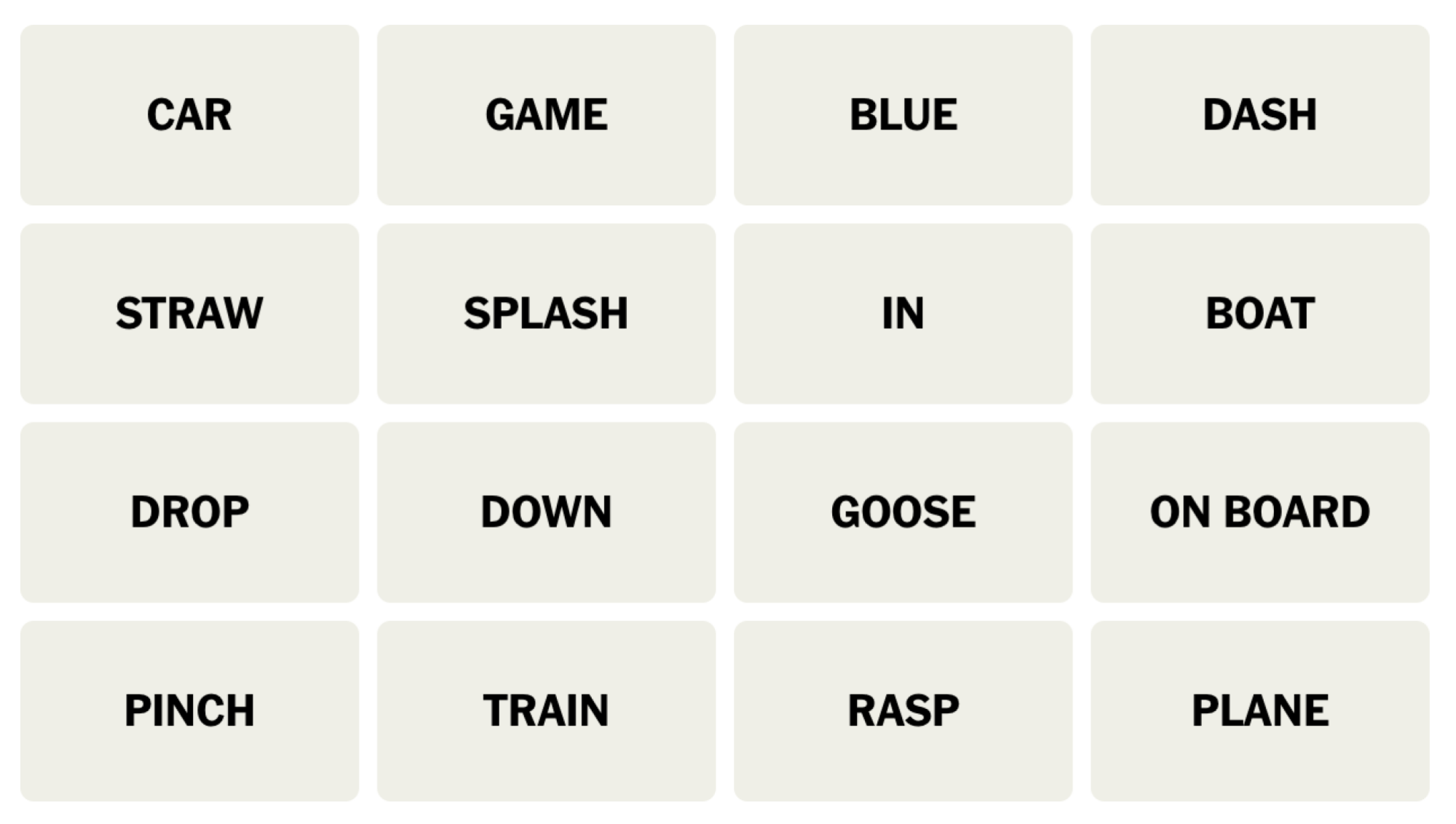
NYT Connections board for December 23, 2023: CAR, GAME, BLUE, DASH, STRAW, SPLASH, IN, BOAT, DROP, DOWN, GOOSE, ON BOARD, PINCH, TRAIN, RASP, PLANE.

Credit: Connections/NYT


Does today’s Connections game require any special knowledge?

Nope, not today.

Hints for the themes in today’s Connections puzzle

Here are some spoiler-free hints for the groupings in today’s Connections:

  • Yellow category – Ways of traveling.

  • Green category – Ready to join in.

  • Blue category – Just a smidge.

  • Purple category – This one is fruit flavored!

Does today’s Connections game involve any wordplay?

Yes, there’s a fill-in-the-blank for purple. 

Ready to hear the answers? Keep scrolling if you want a little more help.


BEWARE: Spoilers follow for today’s Connections puzzle!

We’re about to give away some of the answers. Scroll slowly if you don’t want the whole thing spoiled. (The full solution is a bit further down.)

What are the ambiguous words in today’s Connections?

  • A RASP can be a type of file, or a description of a hoarse voice. But today it’s neither of those things; you’ll need to combine it with another word for the fill-in-the-blank category.

  • You can be ON BOARD a TRAIN or BOAT at the time of departure (“All aboard!”) but you can also be ON BOARD with a plan or scheme that’s about to go down.

  • GOOSE and DOWN don’t go together today, so don’t think too much about feather-stuffed pillows.

  • SPLASH and DASH do go together.

What are the categories in today’s Connections?

  • Yellow: MEANS OF TRANSPORTATION

  • Green: WILLING TO PARTICIPATE

  • Blue: LITTLE BIT, IN A RECIPE

  • Purple: ____BERRY

DOUBLE BEWARE: THE SOLUTION IS BELOW

Ready to learn the answers to today’s Connections puzzle? I give them all away below.

What are the yellow words in today’s Connections?

The yellow grouping is considered to be the most straightforward. The theme for today’s yellow group is MEANS OF TRANSPORTATION and the words are: BOAT, CAR, PLANE, TRAIN.

What are the green words in today’s Connections?

The green grouping is supposed to be the second-easiest. The theme for today’s green category is WILLING TO PARTICIPATE and the words are: DOWN, GAME, IN, ON BOARD.

What are the blue words in today’s Connections?

The blue grouping is the second-hardest. The theme for today’s blue category is LITTLE BIT, IN A RECIPE and the words are: DASH, DROP, PINCH, SPLASH.

What are the purple words in today’s Connections?

The purple grouping is considered to be the hardest. The theme for today’s purple category is ____BERRY and the words are: BLUE, GOOSE, RASP, STRAW.

How I solved today’s Connections

ON BOARD sounds like it refers to a boat or train, but then I realized it can also mean you’re IN on a plan. 🟩I got the recipe words next, 🟦then the means of transportation, 🟨 but I stared at RASP and friends for a good couple minutes without noticing that they are all berries. 🟪

Connections 

Puzzle #195
🟩🟩🟩🟩
🟦🟦🟦🟦
🟨🟨🟨🟨
🟪🟪🟪🟪

How to play Connections

I have a full guide to playing Connections, but here’s a refresher on the rules:

First, find the Connections game either on the New York Times website or in their Crossword app. You’ll see a game board with 16 tiles, each with one word or phrase. Your job is to select a group of four tiles that have something in common. Often they are all the same type of thing (for example: RAIN, SLEET, HAIL, and SNOW are all types of wet weather) but sometimes there is wordplay involved (for example, BUCKET, GUEST, TOP TEN, and WISH are all types of lists: bucket list, guest list, and so on).

Select four items and hit the Submit button. If you guessed correctly, the category and color will be revealed. (Yellow is easiest, followed by green, then blue, then purple.) If your guess was incorrect, you’ll get a chance to try again.

You win when you’ve correctly identified all four groups. But if you make four mistakes before you finish, the game ends and the answers are revealed.

How to win Connections

The most important thing to know to win Connections is that the groupings are designed to be tricky. Expect to see overlapping groups. For example, one puzzle seemed to include six breakfast foods: BACON, EGG, PANCAKE, OMELET, WAFFLE, and CEREAL. But BACON turned out to be part of a group of painters along with CLOSE, MUNCH, and WHISTLER, and EGG was in a group of things that come by the dozen (along with JUROR, ROSE, and MONTH). So don’t hit “submit” until you’ve confirmed that your group of four contains only those four things.

If you’re stuck, another strategy is to look at the words that seem to have no connection to the others. If all that comes to mind when you see WHISTLER is the painting nicknamed “Whistler’s Mother,” you might be on to something. When I solved that one, I ended up googling whether there was a painter named Close, because Close didn’t fit any of the obvious themes, either.

Another way to win when you’re stuck is, obviously, to read a few helpful hints–which is why we share these pointers every day. Check back tomorrow for the next puzzle!


Source: LifeHacker – Today’s NYT Connections Hints (and Answer) for Saturday, December 23, 2023

Apple Explores AI Deals With News Publishers

Apple is in negotiations with major news and publishing organizations (source paywalled; alternative source), “seeking permission to use their material in the company’s development of generative artificial intelligence systems,” reports the New York Times. From the report: The technology giant has floated multiyear deals worth at least $50 million to license the archives of news articles […]. The news organizations contacted by Apple include Conde Nast, publisher of Vogue and The New Yorker; NBC News; and IAC, which owns People, The Daily Beast and Better Homes and Gardens. The negotiations mark one of the earliest examples of how Apple is trying to catch up to rivals in the race to develop generative A.I., which allows computers to create images and chat like a human. […]

Some of the publishers contacted by Apple were lukewarm on the overture. After years of on-again-off-again commercial deals with tech companies like Meta, the owner of Facebook, publishers have grown wary of jumping into business with Silicon Valley. Several publishing executives were concerned that Apple’s terms were too expansive, according to three people familiar with the negotiations. The initial pitch covered broad licensing of publishers’ archives of published content, with publishers potentially on the hook for any legal liabilities that could stem from Apple’s use of their content.

Apple was also vague about how it intended to apply generative A.I. to the news industry, the people said, a potential competitive risk given Apple’s substantial audience for news on its devices. Still, some news executives were optimistic that Apple’s approach might eventually lead to a meaningful partnership. Two people familiar with the discussions struck a positive note on the long-term prospects of a deal, contrasting Apple’s approach of asking for permission with behavior from other artificial intelligence-enabled companies, which have been accused of seeking licensing deals with news organizations after they had already used their content to train generative models. Further reading: Apple’s AI Research Signals Ambition To Catch Up With Big Tech Rivals

Read more of this story at Slashdot.


Source: Slashdot – Apple Explores AI Deals With News Publishers

Exploring rsync, tar, and Other Backup Solutions

In the digital age, data is the cornerstone of our virtual existence, and its protection is paramount. In the Linux ecosystem, backing up data is not just a precaution; it’s a necessity. This article delves into the Linux backup strategies, focusing primarily on two stalwarts – rsync and tar – while also exploring a range of other essential backup utilities.

Source: LXer – Exploring rsync, tar, and Other Backup Solutions

OpenAI In Talks To Raise New Funding At $100 Billion Valuation

According to Bloomberg (paywalled), OpenAI is in early talks to raise a fresh round of funding at a valuation at or above $100 billion. Reuters reports: The terms, valuation and timing of the funding round have not yet been finalized and could still change, the report added. OpenAI has also held discussions to raise funding for a new chip venture with Abu Dhabi-based G42, according to the report. If the valuation holds, the report notes that it would make OpenAI the second-most valuable U.S. startup behind Elon Musk’s SpaceX.

Read more of this story at Slashdot.


Source: Slashdot – OpenAI In Talks To Raise New Funding At 0 Billion Valuation

Microsoft President Brad Smith Quietly Leaves Board of Nonprofit Code.org

Longtime Slashdot reader theodp writes: Way back in September 2012, Microsoft President Brad Smith discussed the idea of “producing a crisis” to advance Microsoft’s “two-pronged” National Talent Strategy to increase K-12 CS education and the number of H-1B visas. Not long thereafter, the tech-backed nonprofit Code.org (which promotes and provides K-12 CS education and is led by Smith’s next-door neighbor) and Mark Zuckerberg’s FWD.us PAC (which lobbied for H-1B reform) were born, with Smith on board both. Over the past 10+ years, Smith has played a key role in establishing Code.org’s influence in the new K-12 CS education “grassroots” movement, including getting buy-in from three Presidential administrations — Obama, Trump, and Biden — as well as the U.S. Dept. of Education and the nation’s Governors. But after recent updates, Code.org’s Leadership page now indicates that Smith has quietly left Code.org’s Board of Directors and thanks him for his past help and advice. Since November (when archive.org indicates Smith’s photo was yanked from Code.org’s Leadership page), Smith has been in the news in conjunction with Microsoft’s relationship with another Microsoft-bankrolled nonprofit, OpenAI, which has come under scrutiny by the Feds and in the UK. Smith, who noted he and Microsoft helped OpenAI and CEO Sam Altman craft messaging ahead of a White House meeting, announced in a Dec. 8th tweet that Microsoft will be getting a non-voting OpenAI Board seat in connection with Altman’s return to power (who that non-voting Microsoft OpenAI board member will be has not been announced). OpenAI, Microsoft, and Code.org teamed up in December to provide K-12 CS+AI tutorials for this December’s AI-themed Hour of Code (the trio has also partnered with Amazon and Google on the Code.org-led TeachAI initiative). And while Smith has left Code.org’s Board, Microsoft’s influence there will live on as Microsoft CTO Kevin Scott — credited for forging Microsoft’s OpenAI partnership — remains a Code.org Board member together with execs from other Code.org Platinum Supporters ($3+ million in past 2 years) Google and Amazon.

Read more of this story at Slashdot.


Source: Slashdot – Microsoft President Brad Smith Quietly Leaves Board of Nonprofit Code.org