A worrying number of UK authorities are still unaware of the impending switch-off of 2G and 3G mobile networks, according to Local Government Association (LGA) figures. From a report: While 38 percent of respondents were fully aware, 27 percent were only partially aware, and 7 percent had no idea at all that the axe would be falling by 2033 at the latest. The numbers worsened when the researchers spoke to respondents in senior management. Almost half (48 percent) were “partially aware” the UK’s 2G and 3G mobile networks were due to be switched off and 14 percent were not at all aware.
The actual switch-off will happen over the next few years. UK mobile operators have told government they do not intend to offer 2G and 3G mobile networks past 2033 at the latest, and there is a high likelihood that some networks will be shut down earlier. The UK government said it welcomes plans to end services ahead of time. Vodafone, for example, intends to pull the plug on 3G once and for all from January 2024. Although most consumers, with their 4G and 5G devices, will likely be unaware of the end when it comes, the same cannot be said of local authorities. According to the survey, almost two-thirds of respondents (63 percent) reported that their authority was still using devices or services reliant on 2G and 3G networks.
Enlarge/ British Airways Aerospatiale BAC Concorde taking off with afterburners blazing. (credit: aviation-images.com/Universal Images Group via Getty Images)
If you’re a bit of a plane nerd—and if you’re reading this site, the odds are good that you are—a rather interesting eBay auction ended over the weekend. The auction site knows it as item number 116001533010; a less anodyne description would be a Rolls-Royce Olympus 593 turbojet engine, one of four that powered a Concorde—complete with afterburner attached.
The world’s first and most successful supersonic airliner, Concorde was an ambitious and extremely expensive joint project developed by the UK and France. The initial plans started in 1956, with the first in a series of studies commissioned by the British Ministry of Supply, which set about exploring the idea of a supersonic transport plane—then, as now, the sole preserve of military jets.
A parallel effort was also underway across the Channel in France, with both countries coming up with fairly similar designs. At some point, bean counters on both sides of la manche realized that the cost of developing such an extreme aircraft was perhaps better shared than borne alone, and in 1962 the two projects—one headed by the British Aircraft Corporation, the other by Sud-Aviation combined—were merged.
Vizio has released a software update for its Home platform across all current models in its lineup, which makes the new interface respond faster than before. The company says TV sets that receive the update will power up twice as fast, while apps will now load instantly. This improvement in speed also leads to quicker switching between apps so that moving from one streaming service to another doesn’t affect people’s viewing experience.
In addition, the latest version of the OS is meant to surface recommendations and return search results in both voice and text formats much faster than its predecessor. The hope is that users would benefit from the upgrade by spending less time looking for content and more time actually watching them. The updated Home platform also comes with a new left-side navigation menu, as well as hierarchy sorting, to make it easier to browse for new shows and movies.
When Vizio rolled out its redesigned Home interface in June, it already had features created to make it easier and faster for viewers to find new things to watch. They included new navigation tools, recommendations and a reworked onscreen keyboard. According to a Vizio representative, the new update will roll out in the coming weeks and will include “all 2021 and newer model year VIZIO Smart TVs and select TVs from the 2020 model year.”
This article originally appeared on Engadget at https://www.engadget.com/vizios-latest-smart-tv-update-enables-faster-startups-and-app-switching-170043935.html?src=rss
Best Buy released their “Best Buy Drops” feature on their app in the fall of 2023 in an attempt to get more people to download the store’s app—and it’s working. The Drops tab is a peek into high-profile product releases, limited runs, launches, and limited-time deals with some of the lowest prices I’ve ever seen. You can also see previous Drops to get an idea of the kind of products they include, like the Xbox Series X, 4K smart TVs, and iPads for record low prices.
How Best Buy Drops works
You’ll need to have an account with Best Buy, but not necessarily one of the paid ones (although joining My Best Buy Plus or My Best Buy Total will give you further discounts on some of those products). You’ll be prompted to verify your account with your email and gain access to the app. Once in, go to the “Drops” tab on the bottom of the screen to find limited-time deals on categories like gaming consoles and accessories, wearable devices, e-transportation products, small appliances, smart homes, toys, and more. Most weeks, Best Buy will update the Drop list with new upcoming deals.
Upcoming products will appear on the “upcoming drops” tab and past products on the “past drops” tab, but you will only see the discount when the product has a live deal. Live deals usually start at 11 a.m. ET on the day the product is listed to drop, and lasts until around 5 p.m. ET or until the supplies are gone. You will see a percentage bar indicating how much of the inventory has been bought. If you see a particular product you’re interested in, you can always opt-in to Drop Alerts and receive push notifications when the Drop goes live.
Current Drops
The Apple AirPods Pro (2nd generation, USB-C) are currently on sale for $189.99 (originally $249.99), which matches their Black Friday deal, according to Honey’s price history. Keep in mind you can only access this deal through your phone using the Best Buy app. This deal will be live through Dec. 20 at 6 p.m. ET or until they sell out. For reference, the AirPods Pro were $199.99 starting on Dec. 10 at Best Buy, similar to Amazon, Target, and Walmart.
Upcoming Drops
The Apple Watch Series 9 is on the Drop list for Thursday, Dec. 21. This is the same Apple Watch that made headlines because it is about to be pulled from shelves by Apple. It is currently on sale for $359 (originally $429), so you can expect it to go lower than that. However, this item will likely sell out quickly, so you might want to sign up for the push notifications and set up your app and profile before 11 a.m. ET tomorrow.
Modern computing has brought with it tremendous advances in both performance and overall usability. As hardware and software become more closely integrated, services such as those offered by the cloud have become increasingly commonplace. Apple is perhaps one of the best examples of channeling of this vision with its tightly controlled eco-system,
The 2024 Linux Storage, Filesystem, Memory-Management, and BPF Summit will
be held May 13 to 15 in Salt Lake City, Utah, USA. The call
for proposals has already gone out, with a deadline of March 1.
“LSF/MM/BPF is an invitation-only technical workshop to map out
improvements to the Linux storage, filesystem, BPF, and memory management
subsystems that will make their way into the mainline kernel within the
coming years.“
If you ever enrolled in the Apple Family Sharing with a family member between 2015 and 2019, you may entitled to a cut from the $25 million legal settlement Apple agreed to pay. MacRumors did some math and claims you could get between $30 to $50 if you qualify.
samleecole writes: The LAION-5B machine learning dataset used by Google, Stable Diffusion, and other major AI products has been removed by the organization that created it after a Stanford study found that it contained 3,226 suspected instances of child sexual abuse material, 1,008 of which were externally validated.
LAION told 404 Media on Tuesday that out of “an abundance of caution,” it was taking down its datasets temporarily “to ensure they are safe before republishing them.” According to a new study by the Stanford Internet Observatory shared with 404 Media ahead of publication, the researchers found the suspected instances of CSAM through a combination of perceptual and cryptographic hash-based detection and analysis of the images themselves.
Welcome back to our weekly gaming news roundup. As the year comes to a close, we’re looking back on 12 months of massive change for the video game industry, driven by acquisitions, layoffs and unionization. You can read my story on consolidation for more on gaming’s tough year.
This week’s stories
No Game Pass for Baldur’s Gate 3
Baldur’s Gate 3 is officially the Game of the Year and after months as a PlayStation console exclusive, it’s finally available on Xbox. However, if you’re waiting for it to become available on Game Pass, stop. Baldur’s Gate 3 is never coming to Xbox or PC Game Pass, according to Larian Studios founder Swen Vincke. It’s a fantastic, big and lengthy game sold at a standard price of $70 — take it or leave it.
The Last of Us Online is dead
Naughty Dog has canceled The Last of Us Online, its multiplayer spinoff that’s been in the works for years. This isn’t too surprising, considering the lack of updates about the game, but it is now official. Naughty Dog said it didn’t have the resources to support a live-service game and also create new single-player narrative experiences, which are historically its thing. The studio has more than one of these games in development right now.
2023 was a pivotal year in games
2023 was a year of upheaval in video games. There were three main factors molding the industry: consolidation, layoffs and unionization.
In terms of consolidation, the biggest story of the year was the approval of Microsoft’s purchase of Activision Blizzard King for $69 billion. Microsoft is now the third-largest video game business in the world by revenue, right behind Sony and Tencent. Today, the Xbox umbrella covers nearly 40 studios, including Arkane, Bethesda, id Software, Infinity Ward, Mojang, Ninja Theory, Playground Games, 343 industries, and Turn 10.
Sony is more subtle than Microsoft about its attempts at total domination, but it owns 21 development teams, including Bungie, Guerrilla Games, Haven Studios, Insomniac, Naughty Dog and Sucker Punch Productions. It’s made a lot of purchases in the past three years, and invested heavily in studios like Epic Games and FromSoftware.
And then there’s Tencent, which has thousands of tentacles spread across the industry. Tencent owns a portion of Bloober Team, Paradox Interactive, PlatinumGames, Remedy, Roblox and Ubisoft, among others. It has a majority stake in Supercell, Tequila Works, Techland and others. It fully owns Riot Games, Funcom and, of course, others. It also runs multiple internal development companies and publishing labels.
Tencent also owns a 40 percent stake in Epic Games. This alone means any time you buy a game built on Unreal Engine, Tencent is getting a cut. If you played something this year, Tencent was probably involved.
There are clear short-term benefits of being bought by a larger company, but there are downsides to relinquishing independence. Acquired studios are held accountable by people outside of the actual development of a game, and the bigger the company, the further away its bosses are from the creative process.
The most extreme negative outcomes for an acquired indie studio are, of course, layoffs and closures. We saw a lot of these in 2023.
An estimated 9,000 people lost their jobs in the video game industry this year, up from about 1,000 in 2022. This is a crisis level of loss, and it was spurred by over-eager acquisition sprees by the companies at the top. Embracer Group, which owns more than 100 video game studios, laid off more than 900 people and it completely shut down multiple studios.
Unity laid off about 900 people this year. In November, the company reported a yearly revenue increase of 69 percent and executives told investors, “We continued to manage costs well.”
Epic Games fired about 830 people in 2023, including a chunk of the team at Fall Guys studio Mediatonic, which it purchased in 2021. EA dropped more than 1,000 employees this year, including significant cuts at Codemasters, a studio it purchased in 2021. CD Projekt RED, Sega, Ubisoft, and Microsoft’s 343 Industries also laid off at least 100 people each.
Looking back on the carnage this year, it feels like a warning — as consolidation efforts increase, more studios will be controlled by just a handful of companies, and they’ll be vulnerable to moves like mass layoffs and closures. We’re laying the foundation for the future of video games right now, and consolidation only makes the industry smaller and more generic. What will rampant consolidation mean for all of these acquired studios in five years’ time? What will it mean when these teams aren’t shiny, new investments any longer, and the people at the top are ready to get lean again?
Unionization is one approach that can help protect the livelihoods of people in the video game industry, and there was progress on this front in 2023. Developers at multiple studios now have union support, from small indies to AAA powerhouses. Microsoft is currently the home of the industry’s largest union, with representation for more than 300 quality assurance workers at ZeniMax Media.
Other companies with unions established in the past two years include Avalanche Studios, Anemone Hug, CD Projekt RED, Experis Game Solutions, Keywords Studios, Sega of America, Tender Claws and Workinman Interactive. We love to see it — and for the industry to remain stable, we need to see more of it.
Now playing
I’ve been unable to get The Talos Principle II out of my head since I previewed it and interviewed the developers a few months ago, and I’m finally, happily playing the game in its totality. I’m playing on a Steam Deck OLED, and I’m having a great time solving laser puzzles and talking about the meaning of life with a bunch of robots. I highly recommend you try the same.
This article originally appeared on Engadget at https://www.engadget.com/2023-was-a-year-of-layoffs-and-acquisitions-this-weeks-gaming-news-163028348.html?src=rss
You may have already tested out generative AI engines such as ChatGPT and Google Bard. But while it’s popular to accesses these tools in the cloud, you can also install them locally on your own computer. There are some real benefits to doing so: It’s more private, of course, and you won’t get hit by any warnings about the AI being over capacity or unavailable. Also, it’s just kind of cool.
To get started, you’ll need a program to run the AI, and you’ll need a Large Language Model (or LLM) to generate the responses. These LLMs underpin AI text generators. GPT-4 is the latest one powering ChatGPT, and Google has now pushed out Gemini as a new and improved LLM to run behind Google Bard.
If you’ve never heard the term LLM before, you clearly haven’t read our ultimate AI glossary. To fully understand them requires a certain level of scientific and mathematical knowledge, but in basic terms, LLMs are trained on vast amounts of sample data, and they learn to recognize relationships between words and sentences (i.e. which words typically go after each other).
There are several AI models you can install locally. Credit: Lifehacker
To put it as simply as possible, LLMs are supercharged autocorrect engines. They don’t really “know” anything, but they recognize how words should fit together to sound natural and to make sense. At a high enough level, that starts to look like you’re talking with a real human being. There’s lots more to it than that, but you get the gist.
When it comes to running your own LLMs, you don’t need to be a huge company or research organization to access them: There are several available to the public, including one released by Meta called LLaMa; others have been developed by researchers and volunteers. The general idea is that publicly available LLMs will help foster innovation and improve transparency.
For the purposes of this guide, we’re going to use LM Studio to show you how to install an LLM locally. It’s one of the best options out there for the job (though there are quite a few others). It’s free to use, and you can set it up on Windows, macOS, and Linux systems.
How to install a local LLM
The first step is to download LM Studio from the official website, taking note of the minimum system requirements: LLM operation is pretty demanding, so you need a pretty powerful computer to do this. Windows or Linux PCs supporting AVX2 (typically on newer machines) and Apple Silicon Macs with macOS 13.6 or newer will work, and at least 16GB of RAM is recommended. On PCs, at least 6GB of VRAM is recommended too.
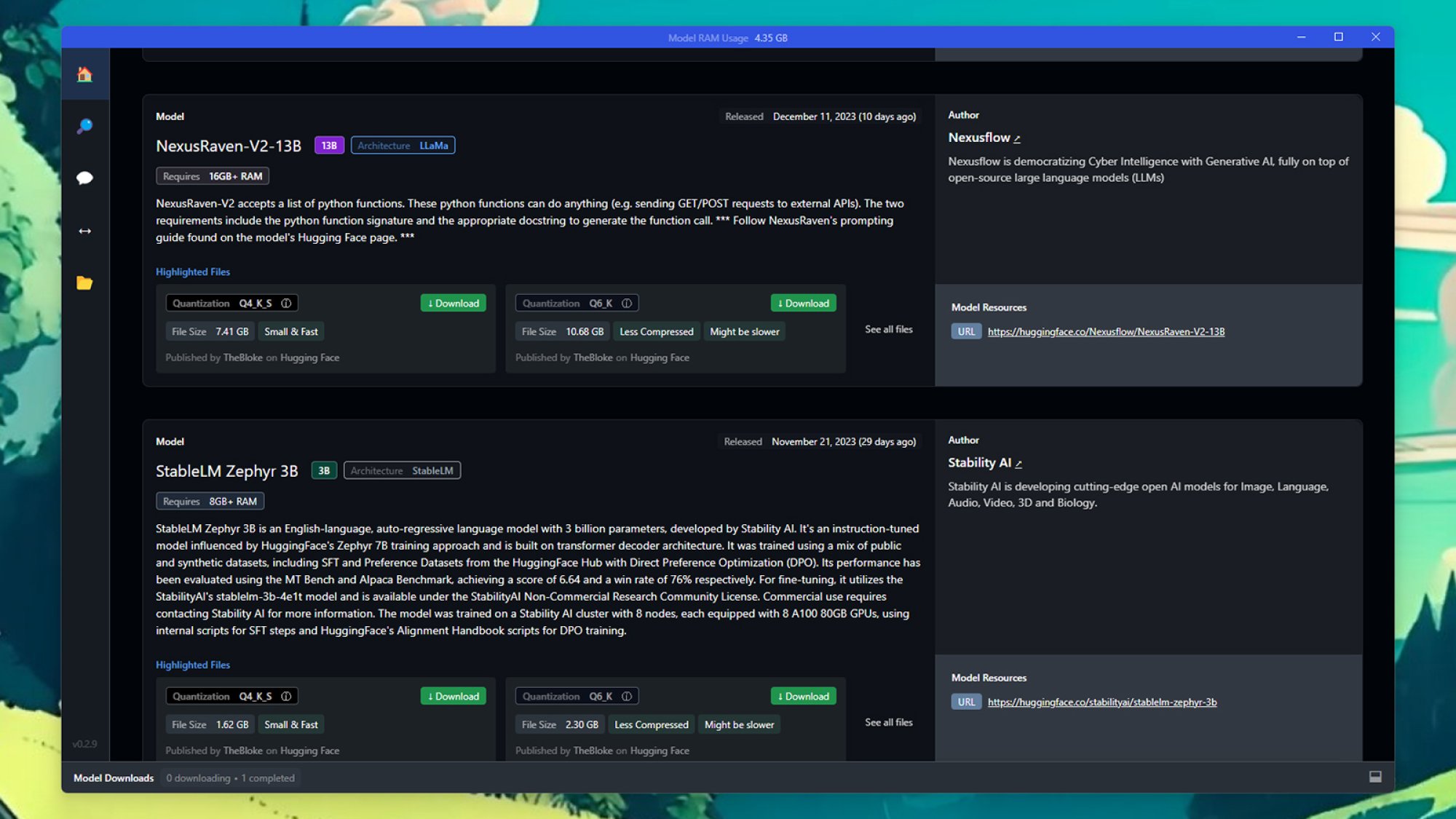
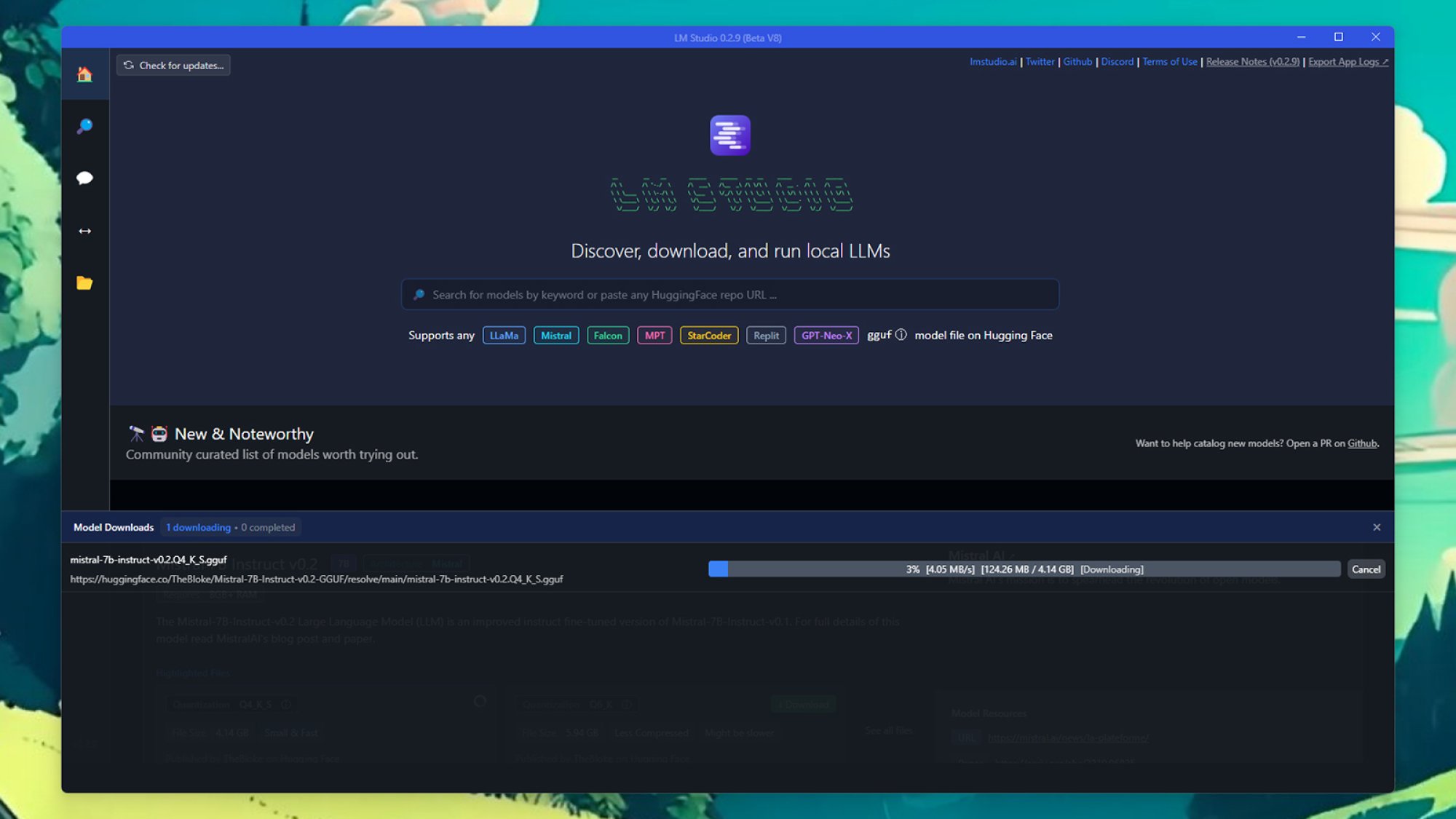
When you’ve got the software up and running, you need to find an LLM to download and use—you’re not going to be able to do much without one. Part of the appeal of LM Studio is that it recommends “new and noteworthy” LLMs on the front screen of the application, so if you’ve got no idea what LLM you want, you can pick one from here.
You’ll find LLMs vary by size, by complexity, by data sources, by purpose, and by speed: There’s no right or wrong answer for which one to use, but there’s plenty of information out there on sites such as Reddit and Hugging Face if you want to do some research. As you might expect, LLMs can run to several gigabytes in size, so you can do some background reading while you wait for one to download.
LM Studio can help you find LLMs to use. Credit: Lifehacker
If you see an LLM you like on the front screen, just click Download. Otherwise, you can run a search or paste a URL in the box at the top. You’ll be able to see the size of each LLM so you can estimate download times, as well as the date when it was last updated. It’s also possible to filter the results to see the models that have been downloaded the most.
You can install as many LLMs as you like (as long as you have the space), but if there’s at least one on your system, they’ll show up in the My Models panel. (Click the folder icon on the left to get to it.) From here, you can see information about each model that you’ve installed, check for updates, and remove models.
To start doing some prompting, open up the AI Chat panel via the speech bubble icon on the left. Choose the model you want to use at the top, then type your prompt into the user message box at the bottom and hit Enter. The sort of output you get back will be familiar if you’ve used an LLM such as ChatGPT before.
The prompt and response system is similar to ChatGPT or Bard. Credit: Lifehacker
On the right-hand side, you can control various settings related to the LLM, including how longer responses are handled, and how much of the processing work is offloaded to your system’s GPU. There’s also a box for a “pre-prompt:” You can tell the LLM to always respond in a particular tone or language style, for example.
Click the New chat button on the left if you want to start a fresh conversation, and your previous chats are logged underneath in case you need to get back to them. Whenever a particular answer has finished generating, you’re given options to take a screenshot, copy the text, or regenerate a different answer from the same prompt.
That’s it! You’re up and running with local LLMs. There are all sorts of avenues you can explore in terms of LLM development and prompting if you want to dig deeper, but the basics aren’t difficult to grasp, and LM Studio makes the setup process very straightforward even if you’re a complete beginner.
Could you use a new gaming laptop? Well, you can sit back and hope the big guy in the red suit brings you what you want for Christmas, but that’s a tall ask. The other option is to take matters into your own hands and score a sweet deal on one of several marked-down systems at Best Buy. Some of the discounts are rather significant, too.
HHKB Studio: MSRP – Starting at $429 The first major upgrade to the legendary, original HHKB packs a ton of features into a tiny package. Hotswappable switches Mouse pointer built in Efficient compact layout Comes with high-quality PBT keycaps Steep learning curve Uses AA batteries instead of a rechargeable Only available in black-on-charcoal…
Beeper Mini, the Android app that allows Android users to communicate with iPhone users with a blue bubble, has evolved once again. However, the proposed fix comes with a very big catch that may leave some feeling blue.
Android smartphone owners rejoiced when Beeper Mini launched in the Google Play Store, as it meant they were no longer
Researchers have developed an AI-powered robot they claim can beat the physical marble game Labyrinth faster than humans are capable of. Thomas Bi and Raffaello D’Andrea of ETH Zurich created CyberRunner, which combines model-based reinforcement with the dexterity required to beat a game that requires physical skill, coordination and precision.
For the uninitiated, the aim of the game is to guide a marble through a maze without falling into any holes. The player controls the movement of the ball by rotating two dials, which tilt the board.
CyberRunner learns through experience. A camera observes the game and an algorithm learns more about it from each attempt. “Based on its understanding of the game it recognizes which strategies and behaviors are more promising,” the researchers say. As such, the robot kept getting better at the game.
The researchers gave CyberRunner and several humans around six hours of practice with the game. While the humans by and large struggled to beat Labyrinth after that time, CyberRunner was able to conquer it in just under 14.5 seconds. The researchers claim that’s faster than any previously recorded time.
CyberRunner became so adept at the game that it was able to use some unintended shortcuts. The researchers had to step in and instruct the AI to follow the maze’s correct path.
We’ve seen AI models outperform humans in other games, such as chess, Go and Dota 2. However, we haven’t seen too many instances of AI performing better than humans in games that require a physical skill component.
This article originally appeared on Engadget at https://www.engadget.com/watch-an-ai-robot-learn-how-to-demolish-humans-at-a-marble-maze-game-161554199.html?src=rss
QEMU 8.2 open-source virtualization software has been released today as the second major update in the QEMU 8.0 series, bringing several new features and many improvements.
2023 was an important year for patients with sickle cell disease. Prior to CRISPR, the only cure for the life-long ailment was a bone marrow transplant, which is notoriously dangerous and costly. This month, the FDA approved Vertex’s “Casgevy,” a CRISPR-based therapy for the treatment of sickle cell disease in patients 12 and older. The landmark approval made the therapeutic the first genetically edited therapy to reach the general market.
Casgevy, which also received the greenlight from regulators in the UK for another blood disorder called beta thalassemia, works by being administered in a single-infusion of genetically modified stem cells to a patient. Clinical study participants that took Casgevy were free from symptoms associated with sickle cell disease, like periodic episodes of extreme pain due to blocked blood flow through vessels, for up to a year.
CRISPR, which modifies precise regions of a human’s DNA strands, was once thought to be a far off scientific innovation. Human cells were first modified using CRISPR in clinical trials in China back in 2016. Less than a decade later, these landmark approvals have set the stage for future nods by regulators for other CRISPR-based therapies that can treat things like HIV, cancers and high blood pressure. “Gene therapy holds the promise of delivering more targeted and effective treatments,” Nicole Verdun, director of the Office of Therapeutic Products within the FDA’s Center for Biologics Evaluation and Research said in a recent press release.
ASSOCIATED PRESS
CRISPR-based gene editing can be designed as a therapeutic for a number of diseases. A scientist can either delete, disrupt or insert segments of DNA to treat conditions by either targeting specific genes or engineering new cell therapies. The editing process can occur ex vivo (outside the body), in the same way Casgevy does, or in vivo (inside the body). Using CRISPR, sickle cell patients’ blood stem cells are modified in a lab before they are re-infused via a single-dose infusion as part of a hematopoietic transplant.
Neville Sanjana, a core faculty member at the New York Genome Center and associate professor in the Department of Biology at New York University, runs the Sanjana lab, which develops gene therapies for complex diseases like autism and cancer. “One of the really fundamental characteristics of CRISPR is its programmability,” Sanjana told Engadget. While working at the Zhang lab at the Broad Institute of MIT and Harvard, Sanjana says he helped design the “guide RNA” that became the blueprint for Vertex’s Casgevy. “CRISPR screens can be powerful tools for understanding any disease or genetic trait,” Sanjana said. Right now, he said biomedical folks are focused on applying CRISPR-based therapies for really serious inheritable diseases.
While it does “set a precedent” to have these first CRISPR-based gene therapies out there, it could also mean that regulators and the general public will regard future innovations in the space as “less novel,” Katie Hasson, a researcher with the Center for Genetics and Society (CGS) told Engadget. The CGS is a public interest and social justice organization that is focused on making sure gene editing is developed and distributed for good. Hasson explained, it doesn’t mean that because one got approved that all other innovative therapies to come after it will not get as much scrutiny.
LIVE NOW: The media call on the approval of the first gene therapies to treat sickle cell disease is happening now!
Beyond therapeutics, gene editing has very broad applications for the discovery and understanding of diseases. Scientists can use CRISPR to explore the origins of things like cancer and pave paths for therapeutics and incurable diagnoses, but that’s not all there is to it. Scientists still need to conduct “considerable experimental research” when it comes to bringing an actual therapeutic to fruition, Sanjana said. “When we focus on therapeutic activity at a particular site in the genome, we need to make sure that there will not be any unintended consequences in other parts of the genome.”
Still, the spotlight will always shine a brighter light on the flashy developments of CRISPR from a therapeutic standpoint. Currently, a new gene editing method is being developed to target specific cells in a process called “cancer shredding“ for difficult-to-treat brain cancer. Scientists have even discovered a pathway to engineer bacteria to discover tumorous cells. However, there are barriers to using CRISPR in clinical practice due to the lack of “safe delivery systems to target the tissues and cells.”
“Maybe by curing one disease, you might give them a different disease — especially if you think of cancer. We call that a secondary malignancy,” Sanjana said. While there is strong reason for concern, one cure creating a pathway for other diseases or cancers is not unique to CRISPR. For example, CAR T cell therapy, which uses an entirely different approach to cell-based gene therapy and is not reflective of CRISPR, is a lifesaving cancer treatment that the FDA discovered can, in certain situations, cause cancer.
“We definitely don’t want any unintended consequences. There are bits of the genome that if you edit them by mistake, it’s probably no big deal but then there are other genes that are vitally important,” Sanjana said. Direct assessment of “off-target effects” or events in which a gene edit incorrectly edits another point on a DNA strand in vivo is challenging.
The FDA recommends that after a clinical trials’ period of investigatory study looking at the efficacy of a gene editing-based therapy, there needs to be a 15-year long term follow up after product administration. Peter Marks, director of the FDA’s Center for Biologics Evaluation and Research, said that the agency’s approval of Casgevy follows “rigorous evaluations of the scientific and clinical data.” Right now, researchers are focused on improving the precision and accuracy of gene editing and having the proper follow up is absolutely well merited, Sanjana explained. “The process right now is a careful one.”
Hasson believes that the 15-year recommendation is a good start. “I know that there is a big problem overall with pharmaceutical companies actually following through and doing those long term post-market studies.”
That’s where new approaches come into play. Base editing, a CRISPR-derived genome editing method that makes targeted changes to DNA sequences, has been around since 2016. Drugs that use base editing have already made headway in the scientific community. Verve Therapeutics developed a gene edited therapy that can lower cholesterol in patients with a single infusion. At higher doses, Verve said the treatment has the potential to reduce proteins associated with bad cholesterol for 2.5 years. Base editing, like CRISPR, has many potential applications for treatment and discovery. For example, base editing could repair a gene mutation that causes childhood blindness. Researchers at Weill Cornell Medicine also found base editing could help understand what genetic changes influence a patient’s response to cancer therapies.
Base editors use CRISPR to bring another functional element to a specific place in the genome. “But it doesn’t matter whether it’s CRISPR cutting or base editing… any time you’re modifying DNA…you would want to know what the off target effects are and you can bet that the FDA wants to know that too. You’re going to need to collect data using standard models like cell culture, or animal models to show there are zero or near zero off-target impacts,” Sanjana said.
CRISPR-based therapies already show high therapeutic potential for conditions beyond sickle cell disease. From blood based treatments, to edited allogeneic immune cells for cancers, there are a number of human clinical trials underway or expected to start next year. Trials for gene-edited therapies that target certain cells for cancer and autoimmune diseases are expected to begin in 2024.
Boston Globe via Getty Images
It won’t be until 2025 before we get a better understanding of how Excision BioTherapeutics’ CRISPR-based therapy works to treat HIV. The application of gene editing as a therapeutic for Alzhiemer’s is still in the early stages, with mice at the forefront of research. Similarly, University College London researchers proved that CRISPR has promise as a potential therapeutic for treatment-resistant forms of childhood epilepsy. In a recent study, a gene edited therapy developed in the lab was shown to reduce seizures in mice.
But the clinical process of getting CRISPR to safely and effectively work as it’s intended isn’t the only hurdle. The pricing of CRISPR and related therapies in general will be a huge barrier to access. The Innovative Genomics Institute (IGI), a research group that hopes to advance ethical use of these gene editing in medicine, estimates that the average CRISPR-based therapy can cost between $500,000 and $2 million per patient. The IGI has built out an “Affordability Task Force” to tackle the issue of expanding access to these novel therapies. Vertex’s sickle cell treatment costs a cool $2.2 million per treatment, before hospital costs. David Altshuler, the chief scientific officer at Vertex, told MIT Tech Review that wants to innovate the delivery of the therapeutic and make it more accessible to patients. “I think the goal will be achieved sooner by finding another modality, like a pill that can be distributed much more effectively,” Altshuler said.
“Access is a huge issue and it’s a huge equity issue,” the CGS’ Hasson told Engadget. “I think we would also like to look at equity here even more broadly. It’s not just about who gets access to the medication once it comes on the market but really how can we prioritize equity in the research that’s leading to these treatments.” The US already does a poor job of providing equitable healthcare access as it is, Hasson explained, which is why it’s important for organizations like CGS to pose roundtable discussions about implementing guardrails that value ethical considerations. “If you support people having access to healthcare, it should encompass these cutting edge treatments as well.”
This article originally appeared on Engadget at https://www.engadget.com/2023-was-a-big-year-for-crispr-based-gene-editing-but-challenges-remain-160009074.html?src=rss
The European Union on Wednesday added three adult content companies – Pornhub, Stripchat and XVideos – to its list of firms subject to stringent regulations under new online content rules. From a report: The new rules, known as the Digital Services Act (DSA), require companies to conduct risk management, undergo external and independent auditing, and share data with authorities and researchers. In April, the EU designated five Alphabet subsidiaries, two Meta Platforms units, two Microsoft businesses, X and Alibaba’s AliExpress among 19 companies under the rules. Such designated companies will have to do more to tackle disinformation, give more protection and choice to users and ensure stronger protection for children or risk fines of as much as 6% of their global turnover. “Pornhub, Stripchat and XVideos meet the user thresholds to fall under stricter #DSA obligations,” the bloc’s industry chief Thierry Breton said. “Creating a safer online environment for our children is an enforcement priority under the DSA.”