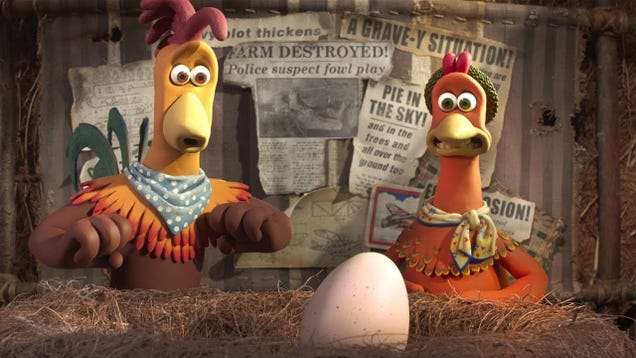
Aardman Animations has been defined by its clay animation techniques. Known as Newplast plasticine, it’s been used since the studio’s inception back in 1972, and have been used in all their productions, from the Wallace & Gromit shorts to more recent fare like Star Wars Visions and Shaun the Sheep. You know you’re…
Amazon “is investing millions in training an ambitious large language model,” reports Reuters, “hoping it could rival top models from OpenAI and Alphabet, two people familiar with the matter told Reuters.”
The model, codenamed as “Olympus”, has 2 trillion parameters, the people said, which could make it one of the largest models being trained. OpenAI’s GPT-4 model, one of the best models available, is reported to have one trillion parameters…
The team is spearheaded by Rohit Prasad, former head of Alexa, who now reports directly to CEO Andy Jass… Amazon believes having homegrown models could make its offerings more attractive on AWS, where enterprise clients want to access top-performing models, the people familiar with the matter said, adding there is no specific timeline for releasing the new model.
“While the parameter count doesn’t automatically mean Olympus will outperform GPT-4, it’s probably a good bet that it will, at minimum, be very competitive with its rival from OpenAI,” argues a financial writer at the Motley Fool — as well as Googles nascent AI projects.
Amazon could have a key advantage over its competition, one that CEO Andy Jassy alluded to in the company’s third-quarter earnings call. Jassy said, “Customers want to bring the models to their data, not the other way around. And much of that data resides in AWS [Amazon Web Services] as the clear market segment leader in cloud infrastructure….”
Amazon will likely also leverage Olympus in other ways. For example, the company could make its CodeWhisperer generative AI coding companion more powerful. Jassy noted in the Q3 call that all of Amazon’s “significant businesses are working on generative AI applications to transform their customer experiences.” Olympus could make those initiatives even more transformative.
They point out that Amazon’s profits more than tripled in the third quarter of 2023 from where they were in 2022.
And Amazon’s stock price has already jumped more than 40% in 2023.
For years, animation studio MAPPA has been noteworthy for the quality of the anime it puts out, which includes widely beloved shonen like Attack on Titan, Vinland Saga, and Jujutsu Kaisen. At the same time, it’s been noted that the 12-year-old studio has a habit of taking on a lot of projects at once, with allegations…
LinkedIn continues to be a gold mine for gaming sleuths looking to unearth unannounced video games. This latest leak comes by way of a profile of a supposed developer at Gearbox Software, that mentions Borderlands 4 and Tiny Tina’s Wonderland 2. While it’s not particularly surprising to hear Gearbox is hard at work in a new installment in
This week the Linux Foundation “announced the intention to form the High Performance Software Foundation.
“Through a series of technical projects, the High Performance Software Foundation aims to build, promote, and advance a portable software stack for high performance computing by increasing adoption, lowering barriers to contribution, and supporting development efforts.”
As use of high performance computing becomes ubiquitous in scientific computing and digital engineering, and AI use cases multiply, more and more data centers deploy GPUs and other compute accelerators. The High Performance Software Foundation intends to leverage investments made by the United States Department of Energy’s Exascale Computing Project, the EuroHPC Joint Undertaking, and other international projects in accelerated high performance computing to exploit the performance of this diversifying set of architectures. As an umbrella project under the Linux Foundation, HPSF intends to provide a neutral space for pivotal projects in the high performance software ecosystem, enabling industry, academia, and government entities to collaborate together on the scientific software stack.
The High Performance Software Foundation already benefits from strong support across the high performance computing landscape, including leading companies and organizations like Amazon Web Services, Argonne National Laboratory, CEA, CIQ, Hewlett Packard Enterprise, Intel, Kitware, Lawrence Berkeley National Laboratory, Lawrence Livermore National Laboratory, Los Alamos National Laboratory, NVIDIA, Oak Ridge National Laboratory, Sandia National Laboratory, and the University of Oregon.
Its first open source technical projects include:
Spack: the high performance computing package managerKokkos: a performance-portable programming model for writing modern C++ applications in a hardware-agnostic way.AMReX: a performance-portable software framework designed to accelerate solving partial differential equations on block-structured, adaptively refined meshes.WarpX: a performance-portable Particle-in-Cell code with advanced algorithms that won the 2022 Gordon Bell PrizeTrilinos: a collection of reusable scientific software libraries, known in particular for linear, non-linear, and transient solvers, as well as optimization and uncertainty quantification.Apptainer: a container system and image format specifically designed for secure high-performance computing.VTK-m: a toolkit of scientific visualization algorithms for accelerator architectures.HPCToolkit: performance measurement and analysis tools for computers ranging from laptops to the world’s largest GPU-accelerated supercomputers.E4S: the Extreme-scale Scientific Software StackCharliecloud: high performance computing-tailored, lightweight, fully unprivileged container implementation.
Netflix’s big new release for the weekend is Scott Pilgrim Takes Off, an anime revival of the popular graphic novel series by Bryan Lee O’Malley. It’s a bit of a weird bag; pre-release, O’Malley and BenDavid Grabinski repeatedly said the show would offer something similar to the comic while also being a different…
If you haven’t yet hopped on the air fryer bandwagon, now is the perfect time to do so thanks to an Amazon Black Friday deal on one of Ninja’s DualZone Foodi air fryers that’s slashed $100 off the normal price. The XL Ninja DZ401 Foodi air fryer, which has two separate cooking compartments, is only $130 right now. The 10-quart beast of an appliance usually costs $230, and this is the best deal on it yet.
The DZ401 Foodi uses Ninja’s DualZone technology, which allows it to cook different types of food simultaneously in its two separate compartments. Each basket has a capacity of 5 quarts. With its Smart Finish setting, it can even coordinate the timing of the different dishes so they’re done at the same time. It’ll take up a fair amount of counter space, but would come in handy for anyone cooking for a large family or guests. In addition to frying, Ninja’s DZ401 Foodi can broil, roast, bake, reheat, and dehydrate food. It’s a versatile appliance, and one of the best air fryers on the market right now.
While it brings the option to cook with both baskets at the same time, you can also just cook using one for smaller or less complex meals. You won’t have to wait for it to preheat thanks to its rapid heaters, or worry about it being overly noisy. The current 43 percent discount on Amazon is far better than even the previous low of $180, so snatch one up now if you’ve been waiting for just the right moment.
This article originally appeared on Engadget at https://www.engadget.com/this-ninja-foodi-dualzone-air-fryer-is-cheaper-than-ever-in-amazons-black-friday-sale-191803817.html?src=rss
The Free Sofware Foundation issued a clarifying blog post this week, saying the organization is “pleased when people use GNU licenses to distribute and license software.”
But “we condemn the use of unauthorized, confusing derivatives of the licenses.”
Unfortunately, some authors engage in confusing practices by drafting licenses using existing terms and conditions of GNU free software licenses, without the intention of granting all four freedoms to users. For example, we have long seen attempts to add restrictions to the license text itself, placed in the LICENSE file, or included elsewhere in the program’s release. An example is the so-called “Commons Clause,” which, when applied to a free software license, affirms that the program is covered by the license. But, at the same time, is contradicting in its meaning by asserting that selling copies of the program or implementing a commercial service with the program is prohibited.
The immediate consequence of the practice of inserting a restriction into a GNU license in this way is the confusion it causes for the community. Users still see the name of the original license, with its preamble and terms and conditions intact, transmitting a strong message that the purpose of the license is to enable users — grant users — their essential software freedoms. This message is clear from the license’s text, and is bolstered from the renown accrued by the FSF and GNU trademarks, and their decades of free software advocacy. At the same time, these same users see a contradictory statement of the “Commons Clause,” which is clearly contrary to the sprit of the free software movement and the Free Software Definition…
[T]o make it even clearer that added restrictions are incompatible with our license, we gave users the right to delete such added restrictions [in 2007] and preserve the program’s freedom. But we at the FSF have another legal tool against attempts to release programs under GNU General Public Licenses that have been wrongly altered to become nonfree licenses. The FSF holds copyrights and common law trademarks to the GNU family of General Public Licenses. Moreover, the FSF holds registered trademarks for “FSF,” “Free Software Foundation,” and “GNU.” […] We can’t control the drafting by others of proprietary software licenses, but we can and do forbid doing this in a way that misleadingly associates those licenses with GNU or GNU licenses… [W]e are entitled to legally enforce our copyright and trademark for FSF licenses that have been altered by added restrictions to a verbatim GNU license…
Licenses that confuse users about the freedoms they grant are damaging to the free software movement because they threaten to dilute the value and power of these licenses. When GNU licenses are misused through such confusing practices, it harms the renown accrued by the GNU project and the FSF over decades of free software advocacy. It is our duty to all computer users to stop these practices, and, if necessary, we will use our legal rights to this end.
We are only five days from Black Friday, and with it comes a plethora of deals on Amazon, which is trying to beat out all the brick-and-mortar stores competing for sales this year. Today, we have a handful of mini PCs that could make for a great home theater addition or home office box that will fit just about anywhere.
In this article, we will be reviewing and discussing various tar command examples, including how to create archive files using (tar, tar.gz, and tar.bz2) compression, how to extract archive files, extract a single file, view the content of the file, verify a file, add files or directories to the existing archive file, estimate the size of tar archive file, etc.
Long-time Slashdot reader deater writes: The Second Reality demoscene demo from 1993 is one of the most well known demos of all time, pushing a 486 running DOS to its limits. There have been remakes for other architectures over the years, including Atari ST, Gameboy color, and Commodore 64. At this past Demosplash 2023 demoparty a version for the Apple II was released (and won 1st place), which was quite a challenge as the Apple II graphics have essentially none of the hardware acceleration available on the other platforms.
Star Trek: Lower Decks has been a riot since its first season, and Tawny Newsome’s Beckett Mariner is a big reason why. Over the course of the show’s four-season run, she’s gone from being a chaotic, self-destructive ensign to…well, still that, but now promoted to a junior grade lieutenant alongside the other Lower…
In the absence of Razer providing any official drivers and GUI control panel for Linux systems, the OpenRazer independent open-source project for crafting reverse-engineered driver support and then the likes of Polychromatic as a graphical control utility make for a pleasant Linux experience for Razer hardware on Linux. Out today is a new Polychromatic release…
There’s never been a better time to buy the Apple Watch SE, which has dipped to a record low price on Amazon in a Black Friday deal. The 40mm second-generation Apple Watch SE (GPS model), released in 2022, is $60 off from its usual price of $249 — making it just $189 right now. That’s the lowest price we’ve seen it hit yet, even cheaper than the former all time low of $200.
Despite being Apple’s more budget-friendly smartwatch, the Apple Watch SE (2nd gen) is an impressive device that has a lot to offer even when compared to the premium models. We gave it a review score of 89. It doesn’t come with an Always On Display or skin temperature sensor, but it excels in workout tracking, performing just as well as the more expensive Series 8. The only drawback is, you’ll have to lift your wrist with purpose to wake up the screen and check your progress.
It sports the same tried-and-true Apple Watch design with a rounded square face, and, being lighter than some other options at just 26.4 grams, it’s comfortable to wear. Where it does differ significantly from the pricier models is in battery life. The Apple Watch SE will get you through the day with normal activity, but don’t expect to wake up the next morning with anything left over. You’ll more than likely need to pop it onto the charger by the end of each night.
At just $250 normally, though, it’s already the best smartwatch you can get for its price. If you were on the fence before, now is the best time to grab an Apple Watch SE while it’s cheaper than ever.
This article originally appeared on Engadget at https://www.engadget.com/the-apple-watch-se-drops-to-a-record-low-of-189-in-an-amazon-black-friday-deal-164553035.html?src=rss
“And no, it’s not COBOL,” jokes long-time Slashdot reader schwit1, sharing this report from ScienceAlert:
A secret text has been discovered in Türkiye, scattered among tens of thousands of ancient clay tablets, which were written in the time of the Hittite Empire during the second millennium BCE. No one yet knows what the curious cuneiform script says, but it seems to be a long-lost language from more than 3,000 years ago.
Experts say the mysterious idiom is unlike any other ancient written language found in the Middle East, although it seems to share roots with other Anatolian-Indo-European languages. The sneaky scrawlings start at the end of a cultic ritual text written in Hittite — the oldest known Indo-European tongue — after an introduction that essentially translates to: “From now on, read in the language of the country of Kalasma”…
Currently, there are no available photos of the newly discovered tablet with Kalamaic writings, as experts are still working out how to translate it. Schwemer and his colleagues hope to publish their results along with images of their discovery sometime next year.
Python “come with downsides,” argues a new article in Communications of the ACM. “Its programs tend to run slowly, and because it is inefficient at running processes in parallel, it is not well suited to some of the latest AI programming.”
“Hoping to overcome those difficulties, computer scientist Chris Lattner set out to create a new language, Mojo, which offers the ease of use of Python, but the performance of more complex languages such as C++ or Rust.” Lattner tells the site “we don’t want to break Python, we want to make Python better,” while software architect Doug Meil says Mojo is essentially “Python for AI… and it’s going to be way faster in scale across multiple hardware platforms.”
Lattner teamed up with Tim Davis, whom he had met when they both worked for Google, to form Modular in January 2022. The company, where Lattner is chief executive officer and Davis chief product officer, provides support for companies working on AI and is developing Mojo.
A modern AI programming stack generally has Python on top, Lattner says, but because that is an inefficient language, it has C++ underneath to handle the implementation. The C++ then must communicate with performance accelerators or GPUs, so developers add a platform such as Compute Unified Device Architecture (CUDA) to make efficient use of those GPUs. “Mojo came from the need to unify these three different parts of the stack so that we could build a unified solution that can scale up and down,” Lattner says. The result is a language with the same syntax as Python, so people used to programming in Python can adopt it with little difficulty, but which, by some measures, can run up to 35,000 times faster. For AI, Mojo is especially fast at performing the matrix multiplications used in many neural networks because it compiles the multiplication code to run directly on the GPU, bypassing CUDA…
“Increasingly, code is not being written by computer programmers. It’s being written by doctors and journalists and chemists and gamers,” says Jeremy Howard, an honorary professor of computer science at the University of Queensland, Australia, and a co-founder of fast.ai, a. “All data scientists write code, but very few data scientists would consider themselves professional computer programmers.” Mojo attempts to fill that need by being a superset of Python. A program written in Python can be copied into Mojo and will immediately run faster, the company says. The speedup comes from a variety of factors. For instance, Mojo, like other modern languages, enables threads, small tasks that can be run simultaneously, rather than in sequence. Instead of using an interpreter to execute code as Python does, Mojo uses a compiler to turn the code into assembly language.
Mojo also gives developers the option of using static typing, which defines data elements and reduces the number of errors… “Static behavior is good because it leads to performance,” Lattner says. “Static behavior is also good because it leads to more correctness and safety guarantees.”
Python creator Guido van Rossum “says he is interested to watch how Mojo develops and whether it can hit the lofty goals Lattner is setting for it…” according to the article, ” but he emphasizes that the language is in its early stages and, as of July 2023, Mojo had not yet been made available for download.”
In June, Lattner did an hour-long interview with the TWIML AI podcast. And in 2017 Chris Lattner answered questions from Slashdot’s readers.
With college bowl season just around the corner, football fans across the nation will be dazzled, not just by the on-field action, but also by the intricate “card stunts” performed by members of the stadium’s audience. The highly-coordinated crowd work is capable of producing detailed images that resemble the pixelated images on computer screens — and which are coded in much the same manner.
Michael Littman’s new book, Code to Joy: Why Everyone Should Learn a Little Programming, is filled with similar examples of how the machines around us operate and how we need not distrust an automaton-filled future so long as we learn to speak their language (at least until they finish learning ours). From sequencing commands to storing variables, Code to Joy provides an accessible and entertaining guide to the very basics of programming for fledgling coders of all ages.
Card stunts, in which a stadium audience holds up colored signs to make a giant, temporary billboard, are like flash mobs where the participants don’t need any special skills and don’t even have to practice ahead of time. All they have to do is show up and follow instructions in the form of a short command sequence. The instructions guide a stadium audience to hold aloft the right poster-sized colored cards at the right time as announced by a stunt leader. A typical set of card-stunt instructions begins with instructions for following the instructions:
listen to instructions carefully
hold top of card at eye level (not over your head)
hold indicated color toward field (not facing you)
pass cards to aisle on completion of stunts (do not rip up the cards)
These instructions may sound obvious, but not stating them surely leads to disaster. Even so, you know there’s gotta be a smart alec who asks afterward, “Sorry, what was that first one again?” It’s definitely what I’d do.
Then comes the main event, which, for one specific person in the crowd, could be the command sequence:
Blue
Blue
Blue
Breathtaking, no? Well, maybe you have to see the bigger picture. The whole idea of card stunts leverages the fact that the members of a stadium crowd sit in seats arranged in a grid. By holding up colored rectangular sign boards, they transform themselves into something like a big computer display screen. Each participant acts as a single picture element— person pixels! Shifts in which cards are being held up change the image or maybe even cause it to morph like a larger-than-life animated gif.
Card stunts began as a crowd-participation activity at college sports in the 1920s. They became much less popular in the 1970s when it was generally agreed that everyone should do their own thing, man. In the 1950s, though, there was a real hunger to create ever more elaborate displays. Cheer squads would design the stunts by hand, then prepare individual instructions for each of a thousand seats. You’ve got to really love your team to dedicate that kind of energy. A few schools in the 1960s thought that those newfangled computer things might be helpful for taking some of the drudgery out of instruction preparation and they designed programs to turn sequences of hand-drawn images into individualized instructions for each of the participants. With the help of computers, people could produce much richer individualized sequences for each person pixel that said when to lift a card, what color to lift, and when to put it down or change to another card. So, whereas the questionnaire example from the previous section was about people making command sequences for the computer to follow, this example is about the computer making command sequences for people to follow. And computer support for automating the process of creating command sequences makes it possible to create more elaborate stunts. That resulted in a participant’s sequence of commands looking like:
up on 001 white
003 blue
005 white
006 red
008 white
013 blue
015 white
021 down
up on 022 white
035 down
up on 036 white
043 blue
044 down
up on 045 white
057 metallic red
070 down
Okay, it’s still not as fun to read the instructions as to see the final product—in this actual example, it’s part of an animated Stanford “S.” To execute these commands in synchronized fashion, an announcer in the stadium calls out the step number (“Forty-one!”) and each participant can tell from his or her instructions what to do (“I’m still holding up the white card I lifted on 36, but I’m getting ready to swap it for a blue card when the count hits 43”).
As I said, it’s not that complicated for people to be part of a card stunt, but it’s a pretty cool example of creating and following command sequences where the computer tells us what to do instead of the other way around. And, as easy as it might be, sometimes things still go wrong. At the 2016 Democratic National Convention, Hillary Clinton’s supporters planned an arena-wide card stunt. Although it was intended to be a patriotic display of unity, some attendees didn’t want to participate. The result was an unreadable mess that, depressingly, was supposed to spell out “Stronger Together.”
These days, computers make it a simple matter to turn a photograph into instructions about which colors to hold up where. Essentially, any digitized image is already a set of instructions for what mixture of red, blue, and green to display at each picture position. One interesting challenge in translating an image into card-stunt instructions is that typical images consist of millions of colored dots (megapixels), whereas a card stunt section of a stadium has maybe a thousand seats. Instead of asking each person to hold up a thousand tiny cards, it makes more sense to compute an average of the colors in that part of the image. Then, from the collection of available colors (say, the classic sixty-four Crayola options), the computer just picks the closest one to the average.
If you think about it, it’s not obvious how a computer can average colors. You could mix green and yellow and decide that the result looks like the spring green crayon, but how do you teach a machine to do that? Let’s look at this question a little more deeply. It’ll help you get a sense of how computers can help us instruct them better. Plus, it will be our entry into the exciting world of machine learning.
There are actually many, many ways to average colors. A simple one is to take advantage of the fact that each dot of color in an image file is stored as the amount of red, green, and blue color in it. Each component color is represented as a whole number between 0 and 255, where 255 was chosen because it’s the largest value you can make with eight binary digits, or bits. Using quantities of red-blue-green works well because the color receptors in the human eye translate real-world colors into this same representation. That is, even though purple corresponds to a specific wavelength of light, our eyes see it as a particular blend of green, blue, and red. Show someone that same blend, and they’ll see purple. So, to summarize a big group of pixels, just average the amount of blue in those pixels, the amount of red in those pixels, and the amount of green in those pixels. That basically works. Now, it turns out, for a combination of physical, perceptual, and engineering reasons, you get better results by squaring the values before averaging, and square rooting the values after averaging. But that’s not important right now. The important thing is that there is a mechanical way to average a bunch of colored dots to get a single dot whose color summarizes the group.
Once that average color is produced, the computer needs a way of finding the closest color to the cards we have available. Is that more of a burnt sienna or a red-orange? A typical (if imperfect) way to approximate how similar two colors are using their red-blue-green values is what’s known as the Euclidean distance formula. Here’s what that looks like as a command sequence:
take the difference between the amount of red in the two colors square it
take the difference between the amount of blue in the two colors square it
take the difference between the amount of green in the two colors square it add the three squares together
take the square root
So to figure out what card should be held up to best capture the average of the colors in the corresponding part of the image, just figure out which of the available colors (blue, yellow green, apricot, timberwolf, mahogany, periwinkle, etc.) has the smallest distance to that average color at that location. That’s the color of the card that should be given to the pixel person sitting in that spot in the grid.
The similarity between this distance calculation and the color averaging operation is, I’m pretty sure, just a coincidence. Sometimes a square root is just a square root.
Stepping back, we can use these operations — color averaging and finding the closest color to the average — to get a computer to help us construct the command sequence for a card stunt. The computer takes as input a target image, a seating chart, and a set of available color cards, and then creates a map of which card should be held up in each seat to best reproduce the image. In this example, the computer mostly handles bookkeeping and doesn’t have much to do in terms of decision-making beyond the selection of the closest color. But the upshot here is that the computer is taking over some of the effort of writing command sequences. We’ve gone from having to select every command for every person pixel at every moment in the card stunt to selecting images and having the computer generate the necessary commands.
This shift in perspective opens up the possibility of turning over more control of the command-sequence generation process to the machine. In terms of our 2 × 2 grid from chapter 1, we can move from telling (providing explicit instructions) to explaining (providing explicit incentives). For example, there is a variation of this color selection problem that is a lot harder and gives the computer more interesting work to do. Imagine that we could print up cards of any color we needed but our print shop insists that we order the cards in bulk. They can only provide us with eight different card colors, but we can choose any colors we want to make up that eight. (Eight is the number of different values we can make with 3 bits — bits come up a lot in computing.) So we could choose blue, green, blue-green, blue-violet, cerulean, indigo, cadet blue, and sky blue, and render a beautiful ocean wave in eight shades of blue. Great!
But then there would be no red or yellow to make other pictures. Limiting the color palette to eight may sound like a bizarre constraint, but it turns out that early computer monitors worked exactly like that. They could display any of millions of colors, but only eight distinct ones on the screen at any one time.
With this constraint in mind, rendering an image in colored cards becomes a lot trickier. Not only do you have to decide which color from our set of color options to make each card, just as before, but you have to pick which eight colors will constitute that set of color options. If we’re making a face, a variety of skin tones will be much more useful than distinctions among shades of green or blue. How do we go from a list of the colors we wish we could use because they are in the target image to the much shorter list of colors that will make up our set of color options?
Machine learning, and specifically an approach known as clustering or unsupervised learning, can solve this color-choice problem for us. I will tell you how. But first let’s delve into a related problem that comes from turning a face into a jigsaw puzzle. As in the card-stunt example, we’re going to have the computer design a sequence of commands for rendering a picture. But there’s a twist—the puzzle pieces available for constructing the picture are fixed in advance. Similar to the dance-step example, it will use the same set of commands and consider which sequence produces the desired image.
This article originally appeared on Engadget at https://www.engadget.com/hitting-the-books-code-to-joy-michael-l-littman-mit-press-153036241.html?src=rss
It’s been nearly a full decade since Amazon acquired Comixology. The popular storefront for reading and buying comics online was able to relatively remain its own thing until about early last year when it was hit with a heavily criticized redesign. Things have gotten worse since then: not only did it get caught up Amaz…