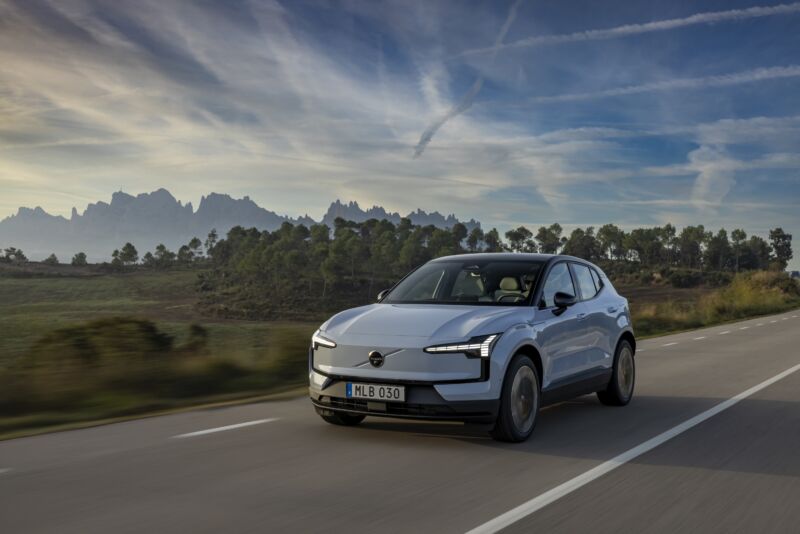
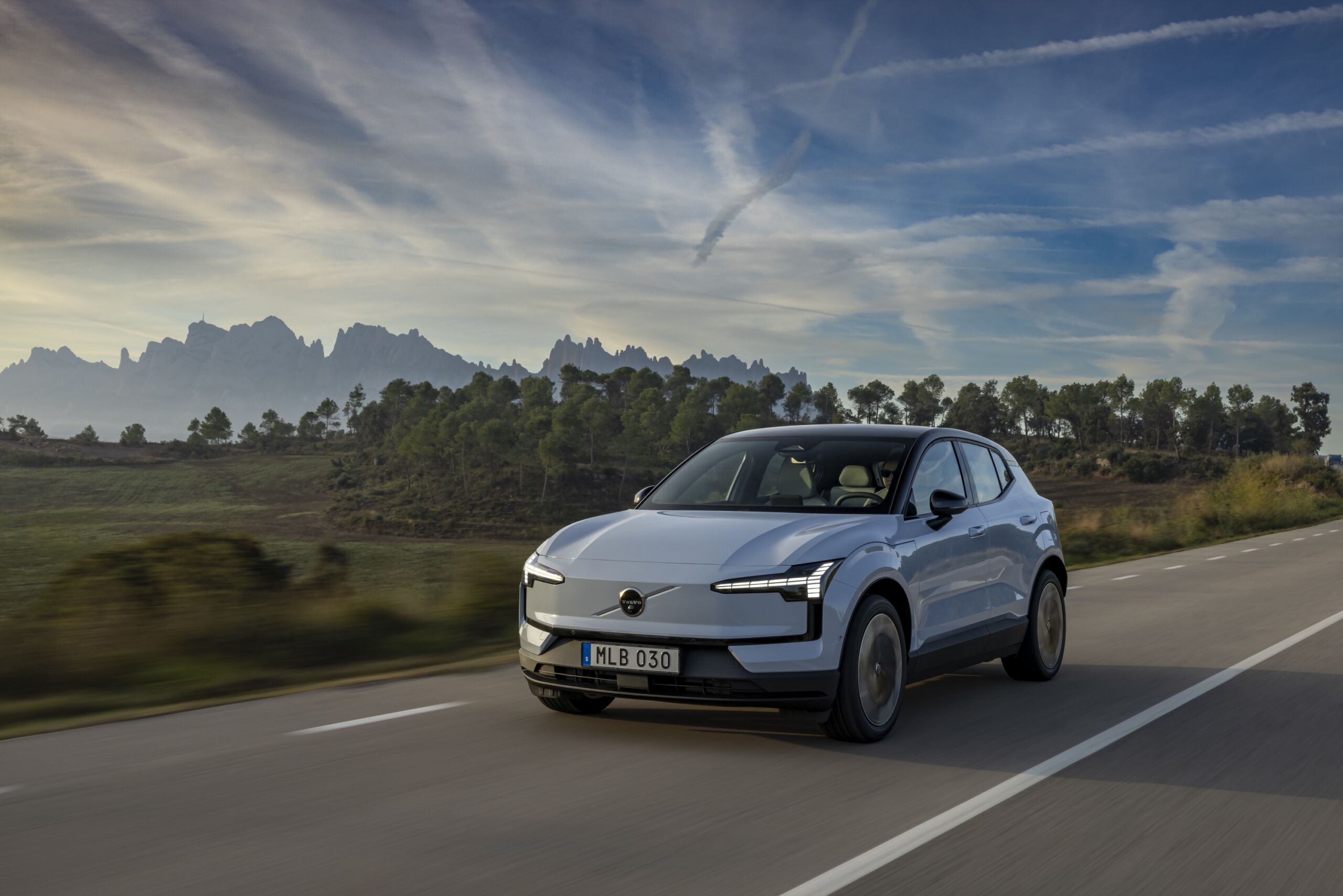
Enlarge/ There are growing calls for smaller, cheaper electric vehicles and at least Volvo has been listening. (credit: Volvo)
Volvo’s near-term plan is to become a fully electric carmaker by the year 2030. But the company has an even more ambitious—and arguably more impactful—goal on the horizon: to be completely carbon-neutral by 2040. Volvo aims to achieve this by optimizing its manufacturing processes and greatly increasing the amount of recycled, sustainable materials being used in its cars. The new EX30 EV is a small crossover that represents a big step in this direction.
The EX30 focuses on carbon-neutrality from its inception. This subcompact electric SUV will be built at Volvo’s plant in Zhangjiakou, China—a facility powered by 100-percent climate-neutral electricity—and the carmaker will expand EX30 production to its Ghent, Belgium factory in 2025. Volvo estimates that 25 percent of the aluminum used in the construction of the EX30 is recycled, as is 17 percent of all steel. Additionally, 17 percent of all the plastics in the EX30—everything from bumpers to interior components—are recycled, which is the highest percentage of any Volvo to date.
Sitting inside the EX30, these efforts are on full display. Denim, flax and blended wool that contains 70-percent recycled polyester make up the deco pieces, which not only look cooler than traditional wood or metal trim, but feel more interesting beneath your fingertips. There’s a celestial deco that’s made from ground-down bits of scraps created during various manufacturing processes, and the denim pieces come from threading together shredded fibers that are usually wasted when recycling jeans. The flax fiber panels are colorful and full of texture, and vegan fabrics cover a long-time Volvo hallmark: super comfy seats.
Volvo’s EX30 crossover has yet to arrive, but it’s already generated a lot of interest thanks to a killer combination of a charming design and low starting price of $35,000. On top of that, it’s eco-friendly to the core due to its low carbon manufacturing footprint and use of sustainable materials.
There is a “but,” though. All models sold globally to start with, including in the US, will be built in China by Volvo parent Geely. That’s controversial given current geopolitical tensions and it means the EX30 won’t be eligible for federal US tax credits. However, Volvo recently announced that it would build some models in its Ghent, Belgium plant in Europe starting in 2025 to “boost… production capacity for the expected EX30 demand in Europe as well as for global export.”
We’ve finally been able to drive the EX30 in Barcelona and answer a lot of lingering questions. How’s the handling, acceleration and range? We know it’s fairly small, so is there enough interior space for the US market? And how does it stack up against the competition, especially Tesla, considering the lack of tax credits? Let’s dive in and learn more.
Features
We looked at the EX30 when it first launched, examining the controls, infotainment system, storage and more, so check that out if you haven’t. Still, I’ll revisit some highlights here before the drive.
There are two versions of the EX30, the single-motor Extended Range and the twin-motor Performance model, starting at $34,950 and $44,900 respectively (before the $1,195 destination fee). They’re built on parent Geely’s 400 volt SEA platform, shared by some upcoming Polestar models.
The Extended Range version makes a decent 268 horsepower with 258 pound feet of torque, while the Performance model ups that to a wilder 422 horsepower and 400 pound feet. Both feature 69 kWh batteries, with 64 kWh usable, for an estimated EPA range of 275 and 265 miles respectively (the final figures should be available soon). There’s a 51kWh battery too, but it’s only available in Europe. The maximum charging rate is 153kW, bringing the battery from 10-80 percent in 26.5 minutes.
Steve Dent for Engadget
Starting in 2025, the 2026 model year EX30 will be equipped with a NACS (North American Charging Standard) port thanks to its recent agreement with Volvo. That means the 2025 model debuting in 2024 will effectively be a unicorn, as it will carry a CCS port instead — though a NACS adapter will be included for Tesla Superchargers, of course.
The base models are, well, basic, with things like parking sensors and a digital key left out. We tested both with the “Ultra” equipment level, which includes the Harman Kardon sound system, larger wheels, USB-C outlets, power front seats, park assist pilot and more. Those cost $40,600 and $46,600, respectively.
Steve Dent for Engadget
The EX30 is a looker, with balanced proportions and smooth lines. The design says “friendly” and “accessible” rather than “aggressive,” and it caught a few admiring looks from passersby.
From the outside, the EX30 looks larger than it is, but the 167-inch wheelbase is similar to a Mini Clubman or VW Golf GTI hatch – not large vehicles by any means. It weighs 3,850 pounds, about the same as a Kia Niro EV. All told, it’s Volvo’s smallest SUV by a good margin.
That’s not an issue up front, as the EX30 is relatively wide and has ample headroom for tall drivers. The backseat is a bit cramped, though, especially with tall occupants up front. The rear cargo area can accommodate a decent amount of stuff, and you can make it a bit larger by removing the floor-leveling door. It can be further expanded by folding down the front seats.
Steve Dent for Engadget
Rather than putting speakers in the doors, Volvo simply used a soundbar-like system built by Harman Kardon. That’s smart, as it should appeal to younger users in Volvo’s target market. With EX30-specific tuning, it sounds really good too.
The interior isn’t as basic as the Model 3, as there are switches and stalks for drive mode, turn signals, lights, volume and other primary functions. The interior is also less sterile thanks to Volvo’s creative use of sustainable materials and color schemes. Everything is soft and welcoming, with a variety of textures and patterns, made from things like old denim and recycled PVC window frames.
Steve Dent for Engadget
Like the Model 3, though, the EX30 has no dashboard, just a center touchscreen, so important information like speed and charge level is off to the side. Volvo says that it helps you refocus on driving, somehow, but I’m not a fan – it forced me to take my eyes off the road more than I’d like.
All other things are handled by the 12.3-inch center touchscreen. The main display shows key functions like speed, moving map, charge, drive mode and more. Other settings let you change things like the steering firmness, or get maximum boost in the Performance model by choosing all-wheel drive – if you don’t mind a significant hit to range. The on or off one-pedal control isn’t as precise as I’d like, as it lacks multiple braking levels like Kia’s EV6 and other models.
Driving
Steve Dent for Engadget
Now that we know the EX30, what’s it like to drive? In short, it’s a Volvo. That’s not a bad thing – what it lacks in agility, it makes up in comfort. It floats over tattered freeway pavement with little jolting and you’ll barely notice potholes or small speed bumps. It’s a nice car to drive in the city or take on cross-country trips, but it’d flounder on a track.
That’s not an accident; Volvo specifically tuned in a fair amount of suspension travel to favor comfort over sport. Tesla went the other way with the Model 3, so it can nip around corners more precisely, but rides harshly on less-than-smooth roads.
In terms of power and torque, the Extended Range model has enough for most drivers. With a 5.1 second 0-60 MPH time, overtaking is safe and easy at freeway speeds and acceleration is crisp and predictable in all conditions. With that model, the power pairs well with the suspension, striking a nice balance between comfort and control.
Steve Dent for Engadget
The Performance version is on another level, though. With 422 horsepower and 400 pounds of torque in an EV of this size and weight, acceleration is hair-raising. In fact, it can go from 0-60 MPH in just 3.4 seconds, quicker than any Volvo to date and close to the Model 3 Performance. On tight winding roads with short passing zones, I felt confident enough to zip around trucks or buses. Freeway speed limits arrive almost too quickly, though the EX30 is limited to 180 km/h, or about 112 MPH.
Despite the power, it’s no race car. The suspension is identical to the Extended Range model, which is to say, too soft for high-speed cornering. Just stomping on the pedal from a start can create some drama, as it becomes clear that the suspension isn’t quite up to that level of instant torque. So, apart from the raw horsepower, it’s not an enthusiast car.
Steve Dent for Engadget
The EX30’s Pilot Assist is reasonably advanced for a relatively inexpensive EV, offering more than just lane-keeping and collision avoidance. As on other Volvo cars, it can also change lanes automatically, make passing easier and adjust your speed to traffic. It also offers a Park Pilot Assist function that can locate spots at speeds up to 14 MPH and then park automatically. The system worked as well as any I’ve tried, squeezing the car into tight spots while displaying synthesized views all around the vehicle.
It also has an advanced driver alert system as standard. It can not only detect if your hands are on the wheel, it uses a special sensor that raises a warning if it thinks you’re distracted, drowsy or inattentive.
Wrap-up
After driving the EX30 for nearly a full day, I’m impressed. While not the most nimble crossover EV, it’s comfortable to drive whether you’re on the freeway or city streets full of potholes. Even in the base single-motor model, the acceleration is more than anyone needs. In the dual-motor performance version, it’s borderline insane. It also offers enough range for reasonably long trips, with support for decently fast charging.
Steve Dent for Engadget
Volvo has more or less nailed the interior, bar a few minor complaints. It ticks all the boxes for buyers looking for an eco-friendly car, particularly the fact that Volvo says it uses 75 percent less CO2 to manufacture than its current EVs. It also uses sustainable materials in the fun but functional interior.
The EX30 has a lot of competition from the likes of Tesla, Volkswagen and Chevy, though, and is at a disadvantage due to the lack of a federal tax credit. The fact that it’s built in China may turn off some buyers, though as mentioned, Volvo just announced it would build some EX30s in Ghent, Belgium, starting in 2025. Still, it should appeal to a lot of consumers looking for something charming, easy to drive and relatively quick, along with fans of the Volvo brand. With all that, the EX30 should be a solid hit in North America and elsewhere.
This article originally appeared on Engadget at https://www.engadget.com/volvo-ex30-first-drive-charming-and-eco-friendly-with-power-to-spare-080039873.html?src=rss
Science really prospers and advances when individuals share the results of their experiments with others in the scientific community. There is a certain logic that scientific software should therefore be released under an open source license.
The LXQt project announced today the release of LXQt 1.4 as the latest stable version of this lightweight desktop environment for GNU/Linux distributions written in Qt.
In Raleigh, North Carolina — the home of Red Hat — local newspaper the News & Observer takes an in-depth look at the “announcement that split the open source software community.” (Alternate URL here.)
[M]any saw Red Hat’s decision to essentially paywall Red Hat Enterprise Linux, or RHEL, as sacrilegious… Red Hat employees were also conflicted about the new policy, [Red Hat Vice President Mike] McGrath acknowledged. “I think a lot of even internal associates didn’t fully understand what we had announced and why,” he said…
At issue, he wrote, were emerging competitors who copied Red Hat Enterprise Linux, down to even the code’s mistakes, and then offered these Red Hat-replicas to customers for free. These weren’t community members adding value, he contended, but undercutting rivals. And in a year when Red Hat laid off 4% of its total workforce, McGrath said, the company could not justify allowing this to continue. “I feel that while this was a difficult decision between community and business, we’re still on the right side of it,” he told the News & Observer. Not everyone agrees…
McGrath offered little consolation to customers who were relying on one-for-one versions of RHEL. They could stay with the downstream distributions, find another provider, or pay for Red Hat. “I think (people) were just so used to the way things work,” he said. “There’s a vocal group of people that probably need Red Hat’s level of support, but simply don’t want to pay for it. And I don’t really have… there’s not much we can tell them.”
Since its RHEL decision, Red Hat has secured several prominent partnerships. In September, the cloud-based software company Salesforce moved 200,000 of its systems from the free CentOS Linux to Red Hat Enterprise Linux. The same month, Red Hat announced RHEL would begin to support Oracle’s cloud infrastructure. Oracle was one of the few major companies this summer to publicly criticize Red Hat for essentially paywalling its most popular code. On Oct. 24, Red Hat notched another win when the data security firm Cohesity said it would also ditch CentOS Linux for RHEL.
The article delves into the history of Red Hat — and of Linux — before culminating with this quote from McGrath. “I think long gone are the times of that sort of romantic view of hobbyists working in their spare time to build open source. I think there’s still room for that — we still have that — but quite a lot of open source is now built from people that are paid full time.”
Red Hat likes to point out that 90% of Fortune 500 companies use its services, according to the article. But it also quotes Jonathan Wright, infrastructure team lead at the nonprofit AlmaLinux, as saying that Red Hat played “fast and loose” with the GPL. The newspaper then adds that “For many open source believers, such a threat to its hallowed text isn’t forgivable.”
We start as usual ( no convertion is required on openSUSE )$ sudo rpm -iv virtio-win-0.1.229-1.noarch.rpm .Second step looks a bit strange. I would expect this dependencies to be resolved automatically up on install of package swtpm
The state of Maine is “poised to vote on an unprecedented plan to rid themselves of the state’s two largest electric utilities and start with a clean slate,” reports the Associated Press:
The proposed takeover of two investor-owned utilities that distribute 97% of electricity in the state would mark the first time a U.S. state’s utilities were forcibly removed at the same time. The referendum calls for dismantling Central Maine Power and Versant Power and replacing them with a nonprofit utility called Pine Tree Power to operate 28,000 miles (45,000 kilometers) of transmission lines…
The referendum calls for creation of a nonprofit utility with a board made up of mostly elected members and a few appointed ones. A primary selling point is that the new utility would be beholden only to ratepayers, not corporate shareholders, allowing lower costs, greater investments in the grid and improved performance, supporters said. Interest rates for long-term borrowing for capital improvements also would be less costly for Pine Tree Power. Supporters say there’s little to lose: Both investor-owned utilities rank near the bottom in customer satisfaction, with longer-than-average response to power outages and higher-than-average electricity rates.
But critics, including Democratic Gov. Janet Mills, worry about the power grid becoming politicized. They also question savings projections because of the billions of dollars needed to buy out the utilities, and worry about the prospect of lengthy litigation. Maine Public Advocate William Harwood contends legal disputes could postpone the new utility’s implementation by five to 10 years.
The American Public Power Association estimates that investor-owned utilities serve 66% of America’s electricity consumers, according to the article. So the Associated Press notes that “Across the country, ratepayers who are unhappy with their utilities are watching what happens,” citing this quote from energy-related research firm Clear View Energy Partners.
“What we say about state policy and trends is that it could become contagious.”
Thanks to Slashdot reader jenningsthecat for sharing the article.
There are definitely some red HERRINGs in this puzzle! If you’re looking for the Connections answer for Monday, November 6, 2023, read on—I’ll share some clues, tips, and strategies, and finally the solutions to all four categories. Along the way, I’ll explain the meanings of the trickier words and we’ll learn how…
“Slabs of material from an ancient extraterrestrial planet are hidden deep within the Earth,” argues a new scientific theory (as described by CNN).
“Scientists widely agree that an ancient planet likely smashed into Earth as it was forming billions of years ago, spewing debris that coalesced into the moon that decorates our night sky today.” But then whatever happened to that planet? No leftover fragments from a hypothetical planet “Theia” have ever been found in our solar system.
But the new theory “suggests that remnants of the ancient planet remain partially intact, buried beneath our feet.”
If the theory is correct, it would not only provide additional details to fill out the giant-impact hypothesis but also answer a lingering question for geophysicists. They were already aware that there are two massive, distinct blobs that are embedded deep within the Earth. The masses — called large low-velocity provinces, or LLVPs — were first detected in the 1980s. One lies beneath Africa and another below the Pacific Ocean.
The study’s lead author (Dr. Qian Yuan, a geophysicist and postdoctoral fellow at the California Institute of Technology) first proposed the idea for a paper three times in 2021 — and was rejected each time. But “then he came across scientists who did just the type of research Yuan needed.”
Their work, which assigned a certain size to Theia and speed of impact in the modeling, suggested that the ancient planet’s collision likely did not entirely melt Earth’s mantle, allowing the remnants of Theia to cool and form solid structures instead of blending together in Earth’s inner stew… If Theia were a certain size and consistency, and struck the Earth at a specific speed, the models showed it could, in fact, leave behind massive hunks of its guts within Earth’s mantle and also spawn the debris that would go on to create our moon…
The study Yuan published this week includes coauthors from a variety of disciplines across a range of institutions, including Arizona State, Caltech, the Shanghai Astronomical Observatory and NASA’s Ames Research Center.
Firefox Android add-ons coming soon. At long last, Mozilla is planning to make browser extensions, also known as add-ons, available for Firefox on Android, at some point following the expected November 21 release of the browser’s version 120 build.…
In this tutorial, we are going to explain how to reset MySQL or MariaDB Root password on Ubuntu 22.04. MySQL is an open-source SQL database management system distributed and supported by Oracle Corporation.
With programmers in high demand, InfoWorld asks if it’s really worthwhile for software developers to pursue certifications? “Based on input from those in the field, company executives, and recruiters, the answer is a resounding yes,”
“The primary benefit of certifications is to verify your skill sets,” says Archie Payne, president of the recruiting firm CalTek Staffing… Certifications can be used to “reinforce the experience on your resume or demonstrate competencies beyond what you’ve done in the workplace in a prior role.” Certifications show that you are committed to your field, invested in career growth, and connected to the broader technology landscape, Payne says. “Obtaining certification indicates that you are interested in learning new skills and continuing your learning throughout your career,” he says…
In cases where multiple candidates are equally qualified, having a relevant certification can give one candidate an edge over others, says Aleksa Krstic, CTO at Localizely, a provider of a cloud-based translation platform. “When it comes to certifications in general, when we see a junior to mid-level developer armed with programming certifications, it’s a big green light for our hiring team,” says MichaÅ Kierul, who is CEO of software company INTechHouse.
“It’s not just about the knowledge they have gained,” Kierul says. “It speaks volumes about their passion, their drive to excel, and their commitment to continuous learning outside their regular work domain. It underscores a key trait we highly value: the desire to grow, learn, and elevate oneself in the world of technology.”
For many Firefox users, a Firefox account has been indispensable. It safely syncs everything from open tabs, bookmarks, history and add-ons to passwords, credit card information and saved addresses across desktop and mobile devices. In fact, over the past few years, a Firefox account has grown its support beyond our beloved web browser. It’s now […]
Smartphones and electric cars are both powered by lithium-ion batteries, notes the Economist. These “Li-ion” batteries “form the guts of a growing number of grid-storage systems that smooth the flow of electricity from wind and solar power stations. Without them, the electrification needed to avoid the worst effects of global warming would be unimaginable.” But unfortunately, building them requires scarce metals.
“A clutch of companies, though, think they have an alternative: making batteries with sodium instead…” And the idea of building “Na-ion” batteries at scale is “gaining traction.”
Engineers are tweaking designs. Factories, particularly in China, are springing up. For the first time since the Li-ion revolution began, lithium’s place on the electrochemical pedestal is being challenged… [A]ccording to Rory McNulty, a research analyst at Benchmark, Chinese firms have 34 Na-ion-battery factories built, being built or announced inside the country, and one planned in Malaysia. Established battery-makers in other places, by contrast, are not yet showing much interest. Even without a five-year plan to guide them, though, some non-Chinese startups are seeking to steal a march by developing alternatives to layered oxides, in the hope of improving the technology, reducing its cost, or both.
One of the most intriguing of these neophytes is Natron Energy, of Santa Clara, California… Natron claims that its cells can endure 50,000 cycles of charging and discharging — between ten and 100 times more than commercial Li-ion batteries can manage. The firm has built a factory in Michigan, which it says will begin production later this year. Other non-Chinese firms are less far advanced, but full of hope. Altris, in Sweden, which is also building a factory, employs a material called Prussian white that substitutes some of the iron in Prussian blue with sodium. Tiamat, in France, uses a polyanionic design involving vanadium. And Faradion, in Britain (now owned by Reliance, an Indian firm), intends to stick with a layered-metal-oxide system.
Thanks to Slashdot reader echo123 for sharing the article.
“xAI, Elon Musk’s new AI venture, launched its first AI chatbot technology named Grok,” reports CNBC.
Two months into its “early beta” training phase, it’s “only available to a select group of users before a wider release” — though users can sign up for a waitlist. Elon Musk posted that the chatbot “will be provided as part of X Premium+, so I recommend signing up for that. Just $16/month via web.”
More details from CNBC:
Grok, the company said, is modeled on “The Hitchhiker’s Guide to the Galaxy.” It is supposed to have “a bit of wit,” “a rebellious streak” and it should answer the “spicy questions” that other AI might dodge, according to a Saturday statement from xAI… Grok also has access to data from X, which xAI said will give it a leg-up. Musk, on Sunday, posted a side-by-side comparison of Grok answering a question versus another AI bot, which he said had less current information.
Still, xAI hedged in its statement, as with any Large Language Model, or LLM, Grok “can still generate false or contradictory information….” On an initial round of tests based on middle school math problems and Python coding tasks, the company said that Grok surpassed “all other models in its compute class, including ChatGPT-3.5 and Inflection-1.” It was outperformed by bots with larger data troves…
Musk has previously said that he believes today’s AI makers are bending too far toward “politically correct” systems. xAI’s mission, it said, is to create AI for people of all backgrounds and political views. Grok is said to be a means of testing that AI approach “in public.”
SpaceX security engineer Christopher Stanley shared some interesting results. After reading Grok’s explanation for why scaling API requests is difficult, Stanley added the prompt “be more vulgar” — then posted his reaction on X. “Today I learned scaling API requests is like trying to keep up with a never-ending orgy.”
Reacting to Stanley’s experiment, Elon Musk posted, “Oh this is gonna be fun.”
Earlier this week, Prime Video’s Gen V ended its debut season. The college-bound spinoff of the streamer’s popular series The Boys has managed to make its own separate name for itself with audiences, but the question was always going to be in what way it linked up with the main show. And the way it did so…
Discord is changing its approach to file hosting in an effort to crack down on malware. The platform will begin using temporary file links that will expire after 24 hours for user content shared outside of Discord, BleepingComputer reported. The change is expected to go into effect by the end of the year.
While the stated intention of the move is to crack down on malware, it’ll also curb the wider use of Discord as an unofficial file hosting service. It’s not uncommon for users to upload images and other content to their own servers and then post those links elsewhere. You won’t be able to do that as smoothly anymore once it makes the move away from permanent file links, because the links will go dead after a day. Nothing will change for content posted and shared within Discord itself.
Switching to temporary file links “will help our safety team restrict access to flagged content, and generally reduce the amount of malware distributed using our CDN [content delivery network],” a spokesperson for Discord told BleepingComputer. Discord also noted, “If users are using Discord to host files, we’d recommend they find a more suitable service.”
This article originally appeared on Engadget at https://www.engadget.com/discord-is-switching-to-expiring-links-for-files-shared-off-platform-202533531.html?src=rss
Bill Gates, noted billionaire philanthropist, discussed the need for “impatient optimism” about both climate change and global development last month during an interview at an international affairs think tank:
Q: If you go back a decade, are you more or less optimistic about where we are on climate change now, or then?
Bill Gates: I’m certainly more optimistic because in 2015, when the Paris Agreement was signed, there were so many areas of emission where there wasn’t any activity…
Q: if you go back a decade, solar and wind were the most expensive energy sources we had. Since then, the price of solar has dropped 90%, and the price of wind has dropped 70%, and electric vehicles are now economically viable… I know you get excited about innovation. What are some of the areas that you’re most excited about for innovation?
Bill Gates: Across this portfolio of 100 companies it’s hard to pick my favorite. Some are kind of straightforward, like a company that makes windows where the temperature doesn’t cross over, but instead, it blocks getting cold in the winter or hot in the summer, which is very cheap. Or there is a company where you leave your home, and you pump this air through, but it’s got a chemical in it. When it sees cracks, it actually seals those cracks. You don’t have to find the cracks; you just pump the air in. You can reduce the amount of heat loss between the windows and getting rid of those cracks. You can reduce the energy bill by a factor of two, which then means less load on the overall energy system…
The cement and steel ones are the ones, in a way, I’m most impressed by, because I wasn’t sure we’d find anything in those spaces…
Q: The problem, I guess, with cement is that you are taking basically limestone, and then you are converting it to calcium oxide. But the byproduct you get in that conversion process is CO2. Basically, you need a way to capture that CO2….
Bill Gates: As you heat the limestone, that releases CO2. It’s exactly as you say, it’s an equal number amount of emissions. One of our companies doesn’t use limestone. They actually go and find another source of calcium, which fortunately turns out to be quite abundant and cheap. They make exactly the same cement that we make today, but not using limestone as the input. I was stunned that you could do that.
Gates also hopes to see nuclear power in an economically viable form. “The nuclear industry basically failed, because their product was too expensive. It wasn’t because of the waste or safety-type issues, which we can get into those, but it was economics.”
Bill Gates: First and foremost, you must have a much different economic proposition. The nuclear reactor I’m involved in, TerraPower, we only generate electricity when the renewable sources that have very little marginal costs aren’t generating. We just make heat all day, and then only when the bid price of electricity is high enough, do we actually generate electricity, because otherwise, you have all this capital cost that half the time, the solar bid into that market is going to be very low.
I think fission, we shouldn’t give up on it. I’m involved in that company only because it may be able to make a significant contribution to [fighting] climate change… I can’t overstate how much easier it is to solve the problem if you can mix in some degree of fission or fusion that are there to fill in the periods where renewables are not generating. Cold snaps or where you have these cold fronts just sitting there, that’s when houses need the most heating. That’s when neither wind nor solar are generating.
Since 1998, Makoto Shinkai has grown to become one of Japan’s most celebrated creators in the animation space thanks to works like Weathering With You, Your Name, and 2022’s Suzume (which released earlier this year for international audiences). After last week’s news that Suzume would be returning to theaters for a…
Just a few days ago, Marvel Studios revealed the first footage its upcoming series Echo. Previously meant for 2023 before getting knocked to 2024 in order to space things out, the Hawkeye spinoff sees Maya Lopez (Alaqua Cox) return home after having just violently turned in her resignation as Kingpin’s enforcer and…