As yet another open-source Radeon Linux graphics driver change ahead of the upcoming Mesa 23.3 code branching and feature freeze is Vulkan VK_KHR_cooperative_matrix support with the RADV driver for RDNA3 hardware and newer using the GPU’s Wavefront Mixed-precision Multiply Accumulate (WMMA) functionality…
In this article, we will review sed, the well-known stream editor, and share 15 tips to use it in order to accomplish the goals mentioned earlier and more.
Many home-automation devices come with their own mobile app or cloud
service. However, using multiple apps or services is
inconvenient, so it’s (purposely) tempting to only buy devices from the same
vendor, but this can lead to lock-in. One project that lets
users manage home-automation devices from various vendors without lock-in
is Home Assistant. Over its
ten-year existence, it has developed into a user-friendly home-automation
platform that caters to both technically inclined and less tech-savvy
people.
Version
119.0 of the Firefox browser has been released. The list of changes
includes improvements to Firefox
View, some PDF-editing improvements, better cookie protection, encrypted
client hello support, and more.
In this tutorial, we will show you how to install Joomla on Debian 12. Joomla is an open-source content management system (CMS) that allows users to build and manage websites and web applications.
As we approach the end of 2023, sadly, the real-time kernel “PREEMPT_RT” support still hasn’t been mainlined… The main blocker pending is still the ongoing work around non-blocking consoles / threaded console handling to then allow the few dozen remaining out-of-tree RT kernel patches to be merged. The good news is that when the PREEMPT_RT support is ready for mainline, it looks like the RISC-V architecture support will also be real-time friendly too…
AMD’s RadeonSI Gallium3D driver has been around for a decade since the Radeon HD 7000 “Southern Islands” graphics card days while finally the OpenGL renderer string is being changed to reflect “RadeonSI” as the name of the driver in use…
Given recent talk of upstream Linux Long-Term Support (LTS) kernels likely being reduced from six to two year support windows moving forward, Canonical today decided to re-affirm their support for ten years of support with Ubuntu Long Term Support versions…
Samuel Pitoiset of Valve’s open-source Linux graphics driver team has landed initial support for GFX11.5 “RDNA3 refresh” graphics within the RADV Vulkan driver for the upcoming Mesa 23.3…
While Meteor Lake isn’t shipping until December, Intel’s open-source Linux engineers for months have already been working on 15th Gen Arrow Lake (as well as Lunar Lake, among their other processor lines) for getting the driver support in order. The latest early hardware enablement to talk about is the initial Arrow Lake S support coming to their video acceleration drivers…
Increasing access to computing education is a global challenge, and at the Raspberry Pi Foundation we take a global approach in addressing it. One way we do this is to partner with organisations around the world and support them to introduce Code Clubs and CoderDojos in their local or national communities.
Code Club and CoderDojo are the two global networks of free, volunteer-led coding clubs for young people that we support. They are a great fit for a lot of organisations that share our vision and values and work with young people from backgrounds that are currently under-represented in computing. Right now, our Global Clubs Partner network involves more than 50 organisations in over 40 different countries around the world. Seven new partners have joined us since August.
New members in the Global Clubs Partner network
We send a warm welcome to our seven new partners. Here is some of what they are working on:
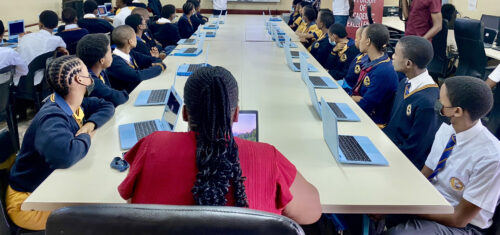
CSEd Botswana is training 25 teachers in rural areas to run Code Clubs in their schools
Hacedores in Mexico is working towards establishing CoderDojos in their 80 makerspaces, and Code Clubs in the local schools of their community members.
Code Club Luxembourg is already running several clubs and also hosts a number of workshops each year to encourage children to carry on their coding journey by joining a Code Club or CoderDojo.
Light Into Europe works with the Deaf community in Romania. They plan to open up coding to children with hearing impairments through accessible Code Clubs, supported by interpreters and adults who are also deaf.
KIT Hub in Burundi have plans to establish CoderDojos to support children from underserved areas, including a sizable community of Congolese young people living in refugee camps in Burundi.
Orientations Training Centre in Sudan will be setting up clubs in Khartoum and Darfur, and they are planning a special passion for supporting young people to submit entries to the Coolest Projects online showcase in 2024.
Savanna Developer Network will establish CoderDojos in northern Ghana to narrow the income and infrastructure gap between the north and the south by ensuring that children in the north aren’t left behind in computing education.
We are really excited that these organisations have chosen to join the Global Clubs Partner network.
Benefits of partnering with us
When they join our Global Clubs Partner network, organisations work with us to grow the Code Club and CoderDojo communities around the world. Our Global Clubs Partners share our mission to enable young people to realise their full potential through the power of computing and digital technologies, and they commit to working towards this mission with our support.
Our new partners are as glad as we are to have joined our network.
Abdelmoneim Mohammed of Orientations Training Centre in Sudan is excited by the impact Code Club will have on his young coders, telling us:
I expect this can help to make our citizens a global citizen, [by] learning from a well-established and developed educational system.
For Ethel Tshukudu of CSEd Botswana, it is the community focus and available support network that is important. She tells us:
The strong sense of community and the availability of mentorship opportunities are particularly appealing, as they ensure that CSEdBotswana can consistently access the support needed to enhance our coding clubs and create a more significant impact.
Our partner from KIT Hub in Burundi, Ferdinand Alimasi, values how establishing clubs promotes collective learning and engagement in the community. He says:
Education and preparation of [the] future workforce require collective work and responsibilities, so these clubs will bring the change in communities by offering opportunities to learn for kids and teens, as well as opportunities for everyone to be involved in building a better future for all.
What we learn from our partnerships
Our partners work in lots of different circumstances all around the world. A key learning for us is that there is no ‘one size fits all’ approach to computing education. We support our partners to adapt and deliver our resources in a way that they know will best engage their learners. This highlights how important it is to work in a culturally sensitive way, and to prioritise providing opportunities for learners to use digital technology to make things that matter to them. That looks very different depending on where you are in the world, and who you are working with.
Through working with our partners, we also see just how much world events can impact the already unequal access young people have to learning new digital skills. Climate crisis events such as floods and wildfires, and political crises such as war, conflict, and changes in government have affected many of our global partners this year. The resulting closures of schools and other educational venues, electricity blackouts, and funding challenges cause further educational disadvantage to the children in the affected areas. Our partners play a key role in providing additional educational opportunities for young people when it is safe to do so.
Young tech creators at a Code Club in Brazil.
The experiences and perspectives we’ve gained through our partnerships with global organisations are extremely important to us and our mission. They help to inform the work we do to make computing education truly accessible for all learners and educators around the globe.
Could your organisation become a Global Clubs Partner?
You can find out more about how your organisation could join our Global Clubs Partner network on the CoderDojo and Code Club websites, or contact us directly with your questions or ideas about a partnership.
Discover the lightweight yet powerful open-source Geany text editor alternative to Notepad++ on Linux with this installation tutorial and a few tips and tricks.
One of the main innovations introduced by Podman was the ability to run rootless containers. Security wise, this was a big improvement, since a potentially compromised container running as root represents a security threat for the host system. In order to obtain a similar behavior, recent versions of Docker support running the docker daemon in the user context. Running unprivileged containers, albeit more secure, has also its drawbacks, as the inability to bind to privileged host ports.
qBittorrent 4.6 has been released today as a major update for this open-source, free, and cross-platform BitTorrent client written in Qt and available for GNU/Linux, macOS, and Windows systems.
The 2013 election for members of the Linux Foundation Technical Advisory
Board will be held during the upcoming Linux
Plumbers Conference. The call
for nominees has been posted.
The TAB exists to provide advice from the kernel community to the
Linux Foundation; it also serves to facilitate interactions both
within the community and with outside entities. Over the last
year, the TAB has overseen the organization of the Linux Plumbers
Conference, released a kernel contribution maturity model for
organizations, advised on code-of-conduct issues, and more.
The 159th installment of the 9to5Linux Weekly Roundup is here for the week ending on October 22nd, 2023, keeping you guys up to date with the most important things happening in the Linux world.