
By now you’ve likely heard how Intel’s Gaudi2 accelerator hardware is standing up very well against the NVIDIA competition especially in value. There’s nothing new there but an important part to keep in mind — and where Intel is the hands-down winner — is the open-source ecosystem with having a fully open-source and upstream Linux kernel accelerator driver as well as their SynapseAI open-source components in user-space. The Gaudi2 open-source kernel driver support is now considered “very stable at this point” with the upstream state fairing well…
Source: Phoronix – Intel Gaudi2’s Linux Driver Support Is “Very Stable At This Point”, Gaudi2C Device Added
Category Archives: Linux
cp command – How to Copy Files and Directories in Linux
In this tutorial, we’re going to show you how to use the cp command on Linux.
Source: LXer – cp command – How to Copy Files and Directories in Linux
FFmpeg Begins Landing Support For AOMedia's IAMF – Immersive Audio Model and Formats
Yesterday the initial code for supporting the Alliance For Open Media’s Immersive Audio Model and Formats (IAMF) was merged for the widely-used FFmpeg multimedia library…
Source: Phoronix – FFmpeg Begins Landing Support For AOMedia’s IAMF – Immersive Audio Model and Formats
What is the impact of attending a Code Club or CoderDojo?
We support two networks of coding clubs where young people around the world discover the countless possibilities of creating with digital technologies.

- Code Club is a global network of after-school coding clubs for learners aged 9 to 13, where educators and other volunteers help young people learn about coding and digital making
- CoderDojo is a worldwide network of free, open, and community-based programming clubs for young people aged 7 to 17, where they get the opportunity to learn how to create fantastic new things with technology
Every year, we send out a survey to volunteers at all the clubs we support. Today we share some highlights from the findings and what we’re planning next.

Why do we do an annual survey for clubs?
The simple answer is: to help make clubs even better for everyone involved! Educators and volunteers are doing a remarkable job in helping young people learn about computing and coding, so we want to know more about them, about how they run their clubs, and what impact the club sessions have for young people.

By knowing more about clubs — how frequently club leaders run them, what resources they use, what they would like more of — we can continue to improve the learning experience for educators, volunteers, and young people involved in our clubs.
This year in March we sent out our survey to all Code Clubs and CoderDojos around the world, and we heard back from almost 500. As always, the results were very positive, and they also gave us a lot of useful information on how we can continue to improve our support for clubs all over the world.
Who is involved in clubs?
Based on the survey, we estimate that at the time, the network of over 4200 Code Clubs and 700 CoderDojos was reaching almost 139,000 young people globally. The global community of clubs has continued to grow since then, with a now even larger network of volunteers supporting ever more young people.

According to the survey, the majority of young people attending clubs are aged between 8 and 13, but clubs host young people as young as 6 and as old as 18. It was great to hear about the participation of girls, and we’d love to see this rise even higher: respondents told us that 42% of their Code Club attendees and 30% of their CoderDojo attendees are female.
Respondents feel that attending club sessions improves young peoples’ interest and engagement in computing and programming, and increases their understanding of the usefulness of computing.
None of these young people would be able to attend clubs without the great work of teams of educators and volunteers. Based on the survey, we estimate that at the time of the survey, there were over 10,300 Code Club leaders and almost 4000 CoderDojo champions around the world. Many survey respondents said that they were motivated to start volunteering after attending a club themselves.

Community is at the heart of clubs and the clubs networks: over 80% of respondents said that belonging to a global community of clubs helps motivates them to volunteer at their own club.
What is the impact of clubs?
Clubs focus on a wide range of topics and programming languages. Scratch is overwhelmingly popular, with over 95% of respondents telling us that they used Scratch in club sessions in the previous year. Micro:bit projects and Python-based programming were also very popular. Club leaders told us that in future they would like to offer more activities around AI applications, as well as around games and mobile apps.
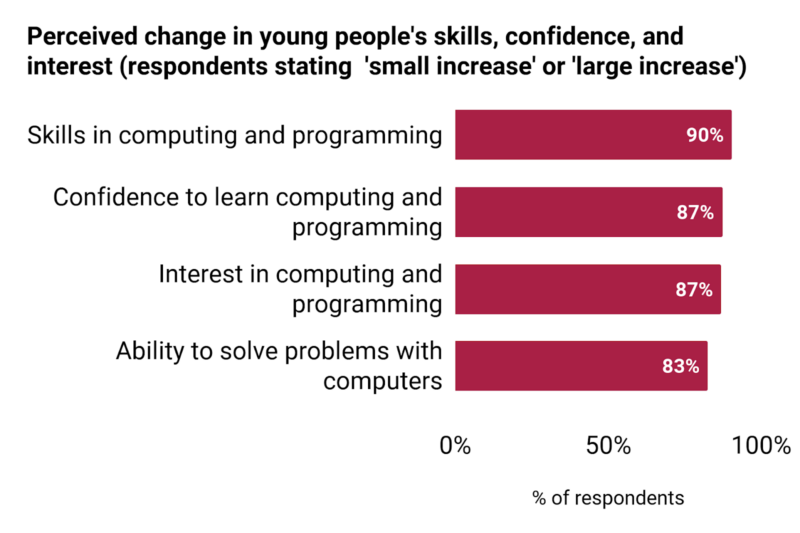
Club leaders told us that being part of a Code Club or CoderDojo affects young people positively. Respondents feel that attending club sessions improves young peoples’ skills and interest in computing and programming, and increases their understanding of the usefulness of computing. Almost 90% of club leaders also agree that after attending a club, young people are interested in additional experiences of learning about computing and programming.
Attending also positively affects young people’s wider skills and attitudes, with club leaders stating that young people who attend improve their personal confidence, independence in learning, and creative thinking.
Young people who attend improve their personal confidence, independence in learning, and creative thinking.
We were pleased to find out that most Code Club leaders, who run their sessions in schools, think that their clubs increase the visibility of computing within their school. Many also said that the attendees’ parents and guardians value their clubs as opportunities for their children.
What’s next?
We want to keep providing clubs with support to increase their positive impact on young people. Thanks to the survey results, we know to focus our work on providing training opportunities for club volunteers, as well as supporting club leaders to recruit volunteers and advertise their clubs to more young people.
You can read the survey report to dive deeper into our findings.
As we take an impact-focused approach to our work, we are currently partnering with Durham University on an evaluation of Code Clubs in UK schools. The evaluation will provide further insights for how we can best support people around the world to run clubs that provide welcoming spaces where all kids can learn to create with digital technologies.
The post What is the impact of attending a Code Club or CoderDojo? appeared first on Raspberry Pi Foundation.
Source: Raspberry Pi – What is the impact of attending a Code Club or CoderDojo?
How to Install Zabbly Kernel on Ubuntu 22.04
Quick guide covering the steps to install Zabbly Kernel on Ubuntu 22.04 Jammy Jellyfish LTS which if required can easily upgrade your Linux Kernel to the latest mainline release.
Source: LXer – How to Install Zabbly Kernel on Ubuntu 22.04
postmarketOS 23.12 Brings the GNOME 45 Desktop to Linux Phones and Tablets
postmarketOS 23.12 has been released today as the latest stable update to this Alpine Linux-based operating system for mobile devices introducing new features, support for new devices, and other enhancements.
Source: LXer – postmarketOS 23.12 Brings the GNOME 45 Desktop to Linux Phones and Tablets
How to Add and Delete Users on Debian 12
This article describes how to add and remove users on Debian 12. If you’re a Linux user, it’s crucial to have basic skills like adding and removing users. This makes your system more secure by ensuring only authorized users can access protected resources and perform specific actions.
Source: LXer – How to Add and Delete Users on Debian 12
SUSE's Captain Container on sailing the open source seas
Peter Smails talks community, licensing, and AI pragmatism. Interview Open source companies do not run on goodwill alone, and industry veteran SUSE is walking the tighrope between pleasing the community and charging cold hard cash for some of its wares.…
Source: LXer – SUSE’s Captain Container on sailing the open source seas
Synology Container Manager for Beginners
This article looks at Synology Container Manager, a lightweight virtualization application which lets you run thousands of Docker containers on a Synology NAS device.
Source: LXer – Synology Container Manager for Beginners
GuardRail: Open-Source Tool for Data Analysis, AI Content Generation Using OpenAI GPT Models
GuardRail OSS offers an API-driven framework for advanced data analysis, bias mitigation, sentiment analysis, content classification, and oversight tailored to an organization’s specific AI needs.
The post GuardRail: Open-Source Tool for Data Analysis, AI Content Generation Using OpenAI GPT Models appeared first on Linux Today.
Source: Linux Today – GuardRail: Open-Source Tool for Data Analysis, AI Content Generation Using OpenAI GPT Models
Nintendo Switch Online Controller Support Coming With Linux 6.8
The Nintendo HID open-source driver is being extended with the Linux 6.8 kernel to support the Nintendo Switch Online “NSO” controllers…
Source: Phoronix – Nintendo Switch Online Controller Support Coming With Linux 6.8
Mozilla Firefox 121 Is Now Available for Download, Here’s What’s New
Mozilla published today the final build of the Firefox 121 web browser, slated for release on December 19th, 2023, so it’s time to take a closer look at the new features and improvements.
Source: LXer – Mozilla Firefox 121 Is Now Available for Download, Here’s What’s New
Firefox 121 Now Available With Wayland Enabled By Default
Ahead of tomorrow’s official announcement, the Mozilla Firefox 121.0 release binaries have hit the mirrors and it’s keeping to the most exciting Christmas gift for Linux desktop users: Wayland support enabled by default!..
Source: Phoronix – Firefox 121 Now Available With Wayland Enabled By Default
Shotcut 23.12 Released With Wayland Crash Fix, Upgraded AV1 Encode/Decode
Shotcut 23.12 debuted this weekend as the newest version of this open-source non-linear video editing solution for Linux, Windows, and macOS systems…
Source: Phoronix – Shotcut 23.12 Released With Wayland Crash Fix, Upgraded AV1 Encode/Decode
[$] The intersection of mlx5, netdev, and lockdown
The NVIDIA Mellanox ConnectX HW family of adapters is a complex beast,
supporting networking, InfiniBand, RDMA, and more. As a result, the mlx5
kernel driver that supports this hardware is also complex, as is the
interface that it provides to user space. The mlx5 developers have, for a
while now, been proposing
the addition of a new control interface, in the form of a separate virtual
device exported by the kernel, that would make vast amounts of debugging
information available. This driver has encountered some significant
opposition on its way toward the mainline, though, raising a number of
questions about appropriate interfaces and when subsystem maintainers have
veto power over submissions.
Source: LWN.net – [$] The intersection of mlx5, netdev, and lockdown
GNOME 44.7 Optimizes Shell Application Search and Improves Performance
GNOME 44.7 is here for users who are still using the GNOME 44 desktop environment series and promises to optimize application search in the GNOME Shell, whose performance was improved thanks to the devs addressing a performance degradation caused by a repeated signal leak.
The post GNOME 44.7 Optimizes Shell Application Search and Improves Performance appeared first on Linux Today.
Source: Linux Today – GNOME 44.7 Optimizes Shell Application Search and Improves Performance
Intel 5th Gen Xeon Performance Benchmarks: Impressive Efficiency Gains With "Optimized Power Mode"
With the new Intel 5th Gen Xeon “Emerald Rapids” processors there is a new feature called the Optimized Power Mode (OPM). This Optimized Power Mode can be enabled via the system BIOS for Emerald Rapids for helping to reduce the CPU power consumption when not running at full utilization. With Intel claiming that up to 110 Watts of server power savings can be conserved when running at 30~40% utilization, I was curious and set out to run my own Optimized Power Mode benchmarks with the Xeon Platinum 8592+ processors. Here is a deep dive on Intel Optimized Power Mode benchmarks.
Source: Phoronix – Intel 5th Gen Xeon Performance Benchmarks: Impressive Efficiency Gains With “Optimized Power Mode”
Qualcomm Snapdragon 8 Gen 3 Will Be Able To Boot On The Mainline Linux 6.8 Kernel
All the pieces have been aligned that the mainline Linux 6.8 kernel should be able to boot on the Qualcomm Snapdragon 8 Gen 3 SoC without any out-of-tree patches being necessary…
Source: Phoronix – Qualcomm Snapdragon 8 Gen 3 Will Be Able To Boot On The Mainline Linux 6.8 Kernel
Intel Lunar Lake Thunderbolt Support Being Prepped For Linux
While Intel Meteor Lake processors only launched last week, Intel Linux engineers have already been busy for some time enabling next-generation Arrow Lake and Lunar Lake processors…
Source: Phoronix – Intel Lunar Lake Thunderbolt Support Being Prepped For Linux
Gigabyte Waterforce AIO Cooler Driver Set To Premiere In Linux 6.8
A new driver set to be merged in the upcoming Linux 6.8 cycle is “gigabyte_waterforce” as a new kernel driver for supporting Gigabyte AORUS Waterforce AIO coolers…
Source: Phoronix – Gigabyte Waterforce AIO Cooler Driver Set To Premiere In Linux 6.8