Arm Acquires Minority Stake in Raspberry Pi

Arm Holdings has acquired a minority stake in Raspberry Pi Ltd, reinforcing a partnership that began in 2008. This strategic investment is designed to support development of Raspberry Pi’s low-cost low-power Arm-based platforms aimed at edge computing and IoT applications, leveraging Raspberry Pi’s ability to deliver affordable, high-performance computing globally.;


“Arm and Raspberry Pi share a vision to make computing accessible for all, by lowering barriers to innovation so that anyone, anywhere can learn, experience and create new IoT solutions,” said Paul Williamson, SVP and GM, Internet of Things Line of Business, Arm.


Raspberry Pi’s single-board-computers (SBCs) for students, enthusiasts, and commercial edge and IoT developers have historically been based exclusively on system-on-chips featuring Arm cores. This is a big deal for Arm as Raspberry Pi has sold more than 40 million SBC units as of 2022, a huge number for Arm, which has not seen much success with IoT, despite high expectations of Softbank.


The use of Arm technology has been quite beneficial for Raspberry Pi’s product development, providing the necessary performance, energy efficiency, and software ecosystem to facilitate accessible computing for a wide range of users, from students to professional developers. But in the recent years competing SBCs based on RISC-V SoCs began to emerge, posing threat to Raspberry Pi’s domination and to Arm’s place in emerging edge computing, edge AI, and IoT markets.


In a bid to strengthen Raspberry Pi’s positions, Arm is infusing the company with cash, possibly trying to speed up development of more versatile and competitive solutions (either in terms of performance, or in terms of power).


“With the rapid growth of edge and endpoint AI applications, platforms like those from Raspberry Pi, built on Arm, are critical to driving the adoption of high-performance IoT devices globally by enabling developers to innovate faster and more easily,” said Williamson. “This strategic investment is further proof of our continued commitment to the developer community, and to our partnership with Raspberry Pi.”


Source: AnandTech – Arm Acquires Minority Stake in Raspberry Pi

How to Customize the New iPhone 15 Pro Action Button

If you’ve invested in a shiny new iPhone 15 Pro or iPhone 15 Pro Max, then it comes with a change to previous iPhones: The long-serving mute switch (officially known as the Ring/Silent switch) has been replaced by the more dynamic-sounding Action button. You can customize this button to perform a variety of…

Read more…


Source: Gizmodo – How to Customize the New iPhone 15 Pro Action Button

Google's plan to build 15,000 homes for the San Francisco Bay Project fizzles out

Google has ended its agreement with real estate developer Landlease for its San Francisco Bay Project, effectively scrapping its plans to build a campus with thousands of homes for employees and locals. The company announced the project in 2019, promising the “development of at least 15,000 new homes at all income levels” on at least $750 million worth of land it owns. Around 4,000 of those homes were supposed to be affordable housing, which would’ve been a welcome presence in the region with one of the highest costs of living in the country. 

The San Francisco Bay Project is a collective name for Google’s planned developments in San Jose (Downtown West), Sunnyvale (Moffett Park) and Mountain View (Middlefield Park and North Bayshore). San Jose, in particular, approved the massive project in 2021, and it would’ve seen the construction of 4,000 homes, office space for approximately 20,000 employees, 300 hotel rooms and 10 parks. As part of the deal, Google had agreed to set aside $200 million in funding for displaced local businesses and job readiness programs. 

Earlier this year, however, Google put the Downtown West facility construction on hold after demolition had already started to make way for construction that was scheduled to begin in 2026. The company told Engadget at the time that it was still figuring out “how to best move forward” with the San Jose campus in a way that would cater to its “future needs.” Workplaces have changed tremendously over the past few years, after all, mostly due to the COVID-19 pandemic — Google, for instance, adopted a hybrid work schedule that allowed employees to work from home for a couple of days a week. Earlier this year, Google parent Alphabet also laid off 12,000 workers after going on a hiring spree during a period of growth. 

In Lendlease’s announcement (PDF), it said that the companies have decided to end their agreement after Google did a comprehensive review of its real estate investments. They’ve apparently determined that the “existing agreements are no longer mutually beneficial given current market conditions. Based on what a company spokesperson told CNBC, though, Google hasn’t entirely killed its housing projects. “As we’ve shared before, we’ve been optimizing our real estate investments in the Bay Area, and part of that work is looking at a variety of options to move our development projects forward and deliver on our housing commitment,” Alexa Arena, a senior director of development at Google, told the news organization. San Jose Mayor Matt Mahan also told CNBC that this development “doesn’t change Google’s commitment to San Jose or their timeline” and that it gives the company more flexibility to choose the “best possible developers” for the project. 

This article originally appeared on Engadget at https://www.engadget.com/googles-plan-to-build-15000-homes-for-the-san-francisco-bay-project-fizzles-out-113526409.html?src=rss

Source: Engadget – Google’s plan to build 15,000 homes for the San Francisco Bay Project fizzles out

Why OLED monitor burn-in isn’t a huge problem anymore

Three

Enlarge (credit: Aurich Lawson | Getty Images)

Until recently, OLED computer monitor selection was limited. Today, there’s more than a handful available. LG Display and Samsung Display have made picking an OLED monitor exciting by designing competing models—white OLED (WOLED) and quantum dot OLED (QD-OLED), respectively—and monitor vendors are steadily addressing OLED scarcity and price barriers.

But what about longstanding fears of OLED burn-in?

People tend to display static images on computer monitors more frequently than on TVs—things like icons, taskbars, and browser address bars—making burn-in risk a concern.

Read 70 remaining paragraphs | Comments


Source: Ars Technica – Why OLED monitor burn-in isn’t a huge problem anymore

The Morning After: The final Beatles song was made with a little help from AI

The Beatles have released another song, the first since 1995. “Now and Then” is being advertised as the final Beatles track, given that two of the members have passed and the other two are well over 80 years old. But then again, millionaires do love money.

The song grew from a John Lennon demo track dating back to the 1970s and a 1995 guitar track from George Harrison. The surviving Beatles, Paul McCartney and Ringo Starr, then finished the tune using machine learning technology. The song was meant to come out back in 1995, along with “Free as a Bird” and “Real Love,” two other tracks culled from old Lennon demos. However, the technology just wasn’t there to pull the vocals without degrading audio quality.

With the same software director Peter Jackson used for the Get Back documentary for Apple, the team split Lennon’s vocal from the piano without any audio bleed, allowing the remaining Beatles to turn it into a fleshed-out ballad. The guitar solo is in the Harrison style, but it’s not actually played by him — he does play some of the rhythm guitar in the background.

— Mat Smith

​​You can get these reports delivered daily direct to your inbox. Subscribe right here!

​​

The biggest stories you might have missed

The best cameras you can buy so far this year

Uber and Lyft must pay $328 million to New York drivers in massive wage theft settlement

The best white elephant gift ideas

A commercial spaceplane capable of orbital flight is ready for NASA testing

Apple Arcade exclusive Japanese Rural Life Adventure is a surprising story of rebirth

NASA is launching a free streaming service

NASA+ will be available November 8 with live shows and original series.

TMA
NASA

Not another one! At least this streaming service is free. NASA has announced a new streaming service called NASA+, which will hit most major platforms next week. It’ll be completely free, with no subscription needed, and you won’t be forced to sit through ads, either. There aren’t too many details out just yet about the content, but NASA says its family-friendly programming “embeds you into our missions” with live coverage and original video series.

Continue reading.

HTC sends VR headsets to the International Space Station

They’re specially calibrated for zero gravity.

HTC is sending its Vive VR headsets to the International Space Station, apparently to give lonely astronauts something to do. The HTC Vive Focus 3 headsets will be part of an ongoing effort to improve the mental health of astronauts during long assignments on the station. The headsets are optimized to stabilize alignment and reduce the chances of motion sickness — which is a bigger problem when it happens in space.

Continue reading.

Netflix’s ad-supported plan will soon allow downloads

And reward binge watching.

Netflix is celebrating one year of its ad-supported plan by giving users on that tier every fourth episode of a consecutive binge ad-free. That’s certainly not a bad way to entice you into staying on, especially if it’s, ugh, Ozark. (Don’t ‘at’ me.) Netflix is also rolling out downloads on its ad-supported tier, claiming to be the first streamer to make the option available for users who have ads included. Netflix’s ad-supported plan is by far the cheapest after the streamer cut its Basic tier in mid-2023. It’s $6.99 monthly, while the Standard plan is now $15.49.

Continue reading.

Scarlett Johannson fights AI clones, in court

Wow.

TMA
NDZ/STAR MAX/IPx

It sounds like an action movie, but it’s not. It’s just legal action. Scarlett Johansson’s lawyers have approached an AI app developer for using her likeness in an ad without permission.

An ad spotted on X promoted an AI image editor called Lisa AI used an AI-generated version of Johansson’s voice and image, alongside actual footage of the actor in a Black Widow behind-the-scenes clip. Multiple Lisa AI apps remain on the App Store and Google Play, but the ad no longer appears on X. Yet, when Johansson gets to play a robot voice, that’s OK? Yes. Of course it is.

Continue reading.

This article originally appeared on Engadget at https://www.engadget.com/the-morning-after-the-final-beatles-song-was-made-with-a-little-help-from-ai-111541406.html?src=rss

Source: Engadget – The Morning After: The final Beatles song was made with a little help from AI

Rocket Report: ICBM test aborted after “anomaly”; FAA wraps Starship safety review

A Falcon 9 rocket launches 22 Starlink satellites from Vandenberg Space Force Base on Sunday.

Enlarge / A Falcon 9 rocket launches 22 Starlink satellites from Vandenberg Space Force Base on Sunday. (credit: SpaceX)

Welcome to Edition 6.18 of the Rocket Report! In this newsletter we have a double dose of news from China, where there are two separate efforts to duplicate SpaceX’s Falcon 9 rocket. On the American side of the pond we also have two stories about United Launch Alliance and its effort to get Vulcan flying, and the cost of the rocket’s delays.

As always, we welcome reader submissions, and if you don’t want to miss an issue, please subscribe using the box below (the form will not appear on AMP-enabled versions of the site). Each report will include information on small-, medium-, and heavy-lift rockets as well as a quick look ahead at the next three launches on the calendar.

Chinese company tests vertical landing. A Chinese commercial rocket company has successfully launched and safely landed a test article on its path to developing a reusable launch vehicle, Space News reports. Beijing-based Interstellar Glory Space Technology Ltd., also known as iSpace, launched the Hyperbola-2Y single-stage hopper on Thursday. The methane-liquid oxygen reusable test vehicle rose to a height of 178 meters during its 51-second flight.

Read 22 remaining paragraphs | Comments


Source: Ars Technica – Rocket Report: ICBM test aborted after “anomaly”; FAA wraps Starship safety review

Amazon is bundling a Fire TV 4K Max and Blink Video Doorbell for $65 in early Black Friday deal

Amazon bundle deals are a relatively common occurrence, but the latest one is a pairing we’d never expect: Ahead of Black Friday, Prime Members can get the Fire TV Stick 4K Max and Blink Video Doorbell as a pair for $65. The Blink Video Doorbell is $60 on its own, so for another five bucks, you’re getting the Fire TV Stick 4K Max — not a bad deal. The 4K Max is having its own sale right now, with a 25 percent discount bringing its price to $45 from $60. So, even if you factor in the sale, you’re saving $40 overall, a nice steal.

While the only two things these items might seem to have in common is Amazon’s ownership, if we think really hard, we can connect them. Well, not having to get up to check who’s at the door while using your streaming device is good for starters. No, even better, you can activate Alexa on the Fire TV Stick to engage in two-way audio through the doorbell.

The Fire TV Stick 4K Max supports Dolby Atmos audio, Wi-Fi 6E and HDR10+. Meanwhile, the Blink Video Doorbell shows a 1080p HD picture during the day, uses infrared night video and can be wired or wireless, up to you. All-in-all, they’re both solid options to add to your home.

If you’re just in the market for a new monitoring system, check out the massive sales across Blink’s smart home doorbells and cameras lineup. The Blink Mini three-pack is currently 60 percent off, dropping to $40 from $100, while the new fourth-generation Blink Outdoor has four cameras available for 50 percent off, dropping to $180 from $360. Going back to the theme of bundles, you can pick up the whole Blink Home Bundle for 52 percent off, getting a Video DoorBell system, a fourth-gen Outdoor camera and a Mini for $102, down from $215.

Follow @EngadgetDeals on Twitter and subscribe to the Engadget Deals newsletter for the latest tech deals and buying advice.

This article originally appeared on Engadget at https://www.engadget.com/amazon-is-bundling-a-fire-tv-4k-max-and-blink-video-doorbell-for-65-in-early-black-friday-deal-105046984.html?src=rss

Source: Engadget – Amazon is bundling a Fire TV 4K Max and Blink Video Doorbell for in early Black Friday deal

Landlock Access Controls Extended To Networking With Linux 6.7

Landlock was merged back in 2021 with Linux 5.13 for unprivileged application sandboxing. Landlock is focused on restricting ambient rights and is implemented as a stackable Linux security module (LSM). With Linux 6.7 the Landlock LSM is now moving beyond just file-system access controls to also introduce initial networking support…

Source: Phoronix – Landlock Access Controls Extended To Networking With Linux 6.7

Linux 6.7 Adds A Cross-Vendor Solution For Confidential Computing Attestation Reports

While confidential computing is a hot area right now, there’s been a limited amount of cross-vendor cooperation with AMD having their own route with Secure Encrypted Virtualization (SEV) and Intel designing the Trusted Domain Extensions (TDX) that is still available in limited form. As one improvement coming with Linux 6.7, “configfs-tsm” has been submitted for pulling as a cross-vendor solution for confidential computing attestation reports…

Source: Phoronix – Linux 6.7 Adds A Cross-Vendor Solution For Confidential Computing Attestation Reports

Evil Week: Things You Can Do on the Dark Web That Aren't Illegal

Welcome to Evil Week, our annual dive into all the slightly sketchy hacks we’d usually refrain from recommending. Want to weasel your way into free drinks, play elaborate mind games, or, er, launder some money? We’ve got all the info you need to be successfully unsavory.

Read more…


Source: LifeHacker – Evil Week: Things You Can Do on the Dark Web That Aren’t Illegal

Legacy HBO Max ad-free subscribers will lose access to 4K streams soon

In just a bit over a month, legacy HBO Max subscribers paying for ad-free streaming will be losing a couple of perks they’re enjoying. One of those is 4K streaming. According to The Verge, the streaming service has started sending affected subscribers an email, notifying them that they won’t be able to stream in 4K anymore after December 5th. Warner Bros. Discovery promised existing subscribers when it rebranded the service into “Max” back in May they they would still have access to their plan’s features over the next six months. After that period ends, their only option to retain 4K streaming is to let go of their $16-a-month subscription plan to switch to Max’s Ultimate Ad-Free tier that costs $20 a month.

The service introduced the tier when Max launched, promising users access to 1,000 4K movies and TV show episodes, some of which support Dolby Atmos and Vision. Subscribers who choose to keep their legacy plan will have to make do with Full HD resolution. In addition, legacy subscribers will no longer be able to stream on three devices at once, because Max will only allow them access to two concurrent streams. Both changes bring the legacy $16 subscription in line with the new Max Ad Free tier, which costs the same amount.

An Ultimate Ad Free subscription allows subscribers to stream on up to four devices at once, aside from giving them access to 4K content. It costs quite a bit more than the regular ad-free subscription, but those who want higher-quality streaming and can afford to plunk down $200 in one go will be seeing their yearly expenses for Max go up by just a few cents per month. Max also has a $10-a-month ad-supported tier for those who don’t mind their viewing experience interrupted by commercials.

This article originally appeared on Engadget at https://www.engadget.com/legacy-hbo-max-ad-free-subscribers-will-lose-access-to-4k-streams-soon-092315829.html?src=rss

Source: Engadget – Legacy HBO Max ad-free subscribers will lose access to 4K streams soon

Intuit is shutting down Mint, its popular free budget-tracking app

Intuit is shutting down its free budgeting app Mint, which had 3.6 million active users in 2021, Bloomberg reports. The company will absorb users into its other service called Credit Karma when Mint disappears on January 1, 2024 — less than two months from now. 

“Credit Karma is thrilled to invite all Minters to continue their financial journey on Credit Karma, where they will have access to Credit Karma’s suite of features, products, tools and services, including some of Mint’s most popular features,” Mint wrote on its product blog. The company noted that Mint’s product team and some features have already shifted over to Credit Karma. 

Mint helps users manage their budget, track expenses and keep track of subscriptions and monthly bills so you don’t pay late fees. Intuit acquired the company in 2009 for $170 million, with Mint saying the acquisition would help bring the app to millions more users. 

Intuit will shift users to Credit Karma (a company it acquired in 2020), even though they’re not exactly the same. Credit Karma is more like a banking app that lets users view transactions, monitor credit and see multiple accounts, but lacks the budget tracking features that make Mint attractive to many. Intuit specifically notes on a support page that “the new experience in Credit Karma does not offer the ability to set monthly and category budgets,” instead helping users “build awareness” of their spending. However, Mint’s net worth feature was recently ported over to Credit Karma.

Mint users will be able to transfer their accounts by logging into Credit Karma from the Mint app, after which they’ll lose access to their Mint profiles. They can also download or erase any Mint data if they’d rather not switch. 

Some Mint users on Reddit don’t seem thrilled with the switch, with one saying that without the budgeting feature, “Mint is just a glorified checkbook register.” Intuit, meanwhile, was recently ordered to pay $141 million for deceiving millions of low-income Americans into paying for tax services that should have been free. 

This article originally appeared on Engadget at https://www.engadget.com/intuit-is-closing-down-mint-its-popular-free-budget-tracking-app-054145229.html?src=rss

Source: Engadget – Intuit is shutting down Mint, its popular free budget-tracking app

FTX founder Sam Bankman-Fried found guilty of fraud, faces up to 110 years in prison

A federal jury has found FTX founder Sam Bankman-Fried guilty on all seven counts of fraud and conspiracy, which he was charged with following the downfall of his cryptocurrency exchange. According to The New York Times, he faces a maximum sentence of 110 years in federal prison. SBF, as he’s now infamously known, was arrested in the Bahamas back in December 2022 after the Department of Justice took a close look at his role in the rapid collapse of FTX. The agency examined whether he transferred hundreds of millions of dollars when the exchange filed for bankruptcy. (The company claimed it was hacked after around $600 million disappeared from its funds.) The DoJ also investigated whether FTX broke the law when it moved funds to its sister company, Alameda Research.

During SBF’s trial, which took place over the past month, prosecutors argued that he used FTX funds to keep Alameda Research running. The fallen entrepreneur also founded the cryptocurrency hedge fund, which was ran by his girlfriend Caroline Ellison, who was aware that he used FTX customers’ money to help Alameda meet its liabilities. Bankman-Fried previously denied that he deliberately misused FTX’s funds. 

The Times says his lawyers tried to portray him as a math nerd who had to grapple with “forces largely outside of his control,” but the jury clearly disagreed after the prosecution called Ellison and three of Bankman-Fried’s former top advisers to the witness stand. Ellison and all of those advisers had pleaded guilty, with the Alameda Research chief admitting that she committed fraud at Bankman-Fried’s direction. The FTX founder himself took the stand and said that he “deeply regret not taking a deeper look into” the $8 billion his hedge fund had borrowed from the cryptocurrency exchange. 

Bankman-Fried was charged with committing wire fraud against FTX customers; wire fraud on Alameda Research lenders; conspiracy to commit wire fraud against both; conspiracy to commit securities and commodities fraud on FTX customers; as well as conspiracy to commit money laundering. He is scheduled to be sentenced on March 28, 2024 by US District Judge Lewis A. Kaplan, who also presided over the FTX trial. 

This article originally appeared on Engadget at https://www.engadget.com/ftx-founder-sam-bankman-fried-found-guilty-on-seven-charges-of-fraud-and-conspiracy-012316105.html?src=rss

Source: Engadget – FTX founder Sam Bankman-Fried found guilty of fraud, faces up to 110 years in prison

Today’s NYT Connections Hints (and Answer) for Friday, November 3, 2023

ARE WE THERE YET? The first line of today’s puzzle was thematically appropriate. I kept thinking I had solved the tricky purple category, only to find there must be something trickier still waiting for me. If you’re looking for the Connections answer for Friday, November 3, 2023, read on—I’ll share some clues, tips,…

Read more…


Source: LifeHacker – Today’s NYT Connections Hints (and Answer) for Friday, November 3, 2023

After leading NASA’s mission to Pluto, Alan Stern flies to space himself

Read 14 remaining paragraphs | Comments


Source: Ars Technica – After leading NASA’s mission to Pluto, Alan Stern flies to space himself

Guilty: Sam Bankman-Fried convicted on all counts after monthlong trial

Sam Bankman-Fried wearing a suit and walking out of a courthouse.

Enlarge / Sam Bankman-Fried leaves court in New York on Thursday, Feb. 16, 2023. (credit: Getty Images | Bloomberg)

FTX founder Sam Bankman-Fried was convicted of defrauding customers by a federal jury today. He was convicted on all seven counts, Reuters and other news outlets reported. The 12-member jury returned the verdict after several hours of deliberation.

The seven charges are wire fraud on customers of FTX, conspiracy to commit wire fraud on customers of FTX, wire fraud on lenders to Alameda Research, conspiracy to commit wire fraud on lenders to Alameda Research, conspiracy to commit securities fraud on investors in FTX, conspiracy to commit commodities fraud on customers of FTX in connection with purchases and sales of cryptocurrency and swaps, and conspiracy to commit money laundering.

The five charges related to wire fraud and money laundering carry maximum sentences of 20 years each, while the two securities and commodities fraud charges have maximum sentences of five years each. US District Judge Lewis Kaplan will determine the actual sentence.

Read 10 remaining paragraphs | Comments


Source: Ars Technica – Guilty: Sam Bankman-Fried convicted on all counts after monthlong trial

Sam Bankman-Fried Found Guilty in Crypto Trial

Sam Bankman-Fried is guilty on all seven federal charges in his criminal trial for defrauding customers of his crypto exchange out of billions of dollars with his crypto empire, jurors decided on Thursday night in a Southern District of New York court, Reuters reports. Jurors reached a verdict at 7:40 p.m., according…

Read more…


Source: Gizmodo – Sam Bankman-Fried Found Guilty in Crypto Trial

TikTok says it's removed millions of fake accounts since start of Israel-Hamas war

TikTok is pushing back on critics who claim the video app is falling short in its content moderation duties amid the Israel-Hamas war. In a statement, the company offered new details about the number of accounts and videos it has taken down since the October 7th attacks by Hamas.

According to TikTok, it removed more than 925,000 videos “in the conflict region” and millions more “pieces of content” from around the world. The company also said it’s experienced “spikes in fake engagement” in recent weeks. “Since Oct. 7, we’ve removed more than 24 million fake accounts globally and more than half a million bot comments on content under hashtags related to the conflict.”

The new details come as TikTok has faced increasing scrutiny over how its app is recommending content related to the ongoing conflict. According to NBC News, some lawmakers have recently stepped up their calls for the app to be banned amid allegations that TikTok’s algorithm is disproportionately promoting pro-Palestinian content. In its update, TikTok said that such claims were based on “unsound analysis” of its data. 

“Unfortunately, some misinformed commentators have mischaracterized our work to prevent the spread of hate speech and misinformation surrounding the crisis in Israel and Gaza, especially as it relates to antisemitism,” the company said. “Over the last few days, there has been unsound analysis of TikTok hashtag data around the conflict, causing some commentators to falsely insinuate TikTok is pushing pro-Palestine content over pro-Israel content to U.S. users.” The company added that, in the United States, the hashtag #standwithisrael had been viewed 46 million times since October 7, while #standwithpalestine had been viewed 29 million times.

TikTok isn’t the only platform to face increasing scrutiny over its moderation policies as tensions surrounding the conflict spill over onto social media platforms. Meta has faced accusations that it “shadowbanned” Instagram accounts that posted about conditions within Gaza, which it attributed to a “bug.” X, formerly known as Twitter, is dealing with a European Union investigation into its handling of misinformation related to the conflict.

This article originally appeared on Engadget at https://www.engadget.com/tiktok-says-its-removed-millions-of-fake-accounts-since-start-of-israel-hamas-war-231851792.html?src=rss

Source: Engadget – TikTok says it’s removed millions of fake accounts since start of Israel-Hamas war

Samsung's Next-Gen 3nm and 4nm Nodes on Track for Mass Production in 2H 2024

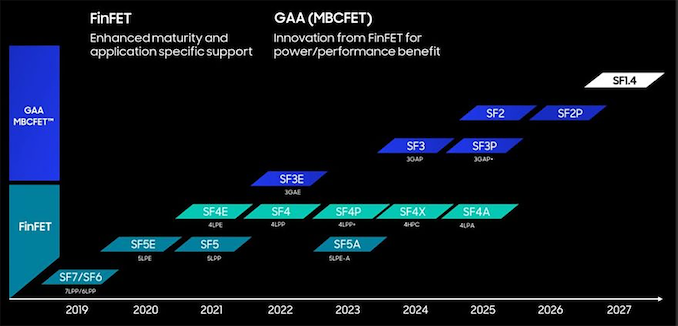
Samsung is set to start making chips using its 2nd Generation 3nm-class (SF3) manufacturing technology as well as performance-enhanced version of its 4nm-class (SF4X) fabrication process in the second half of next year, the company told its investors this week. Both production nodes are expected to significantly improve competitive positions of the company as they will enable it to build new types of products.


“We will strengthen our technology competitiveness through the 2H [2024] mass production of the 2nd generation 3nm process as well as the 4th generation 4nm process for HPC,” a statement by the company reads. “The market is forecast to shift to growth thanks to a rebound in mobile demand and continued growth in HPC demand.”


Samsung’s forthcoming SF3 process technology is a major upgrade to its existing SF3E production node, which, based on the available knowledge, is only used to make small chips for cryptocurrency mining. Samsung asserts that the SF3 will offer greater design versatility by allowing for different gate-all-around (GAA) transistor’s nanosheet channel widths within the same cell type. 


Although Samsung does not make direct comparisons between SF3 and SF3E, it says that SF3 offers major improvements over SF4 (4LPP, 4nm-class, low power plus), which includes a 22% increase in performance at equivalent power and complexity, or alternatively, a 34% reduction in power consumption at the same frequency and transistor count, along with a 21% reduction in logic area. In general, it is expected that SF3 will be a better option for complex designs than SF3E, though it will enter high-volume production in the second half of 2024.


In the meantime, Samsung Foundry’s 4nm-class generation nodes continue to evolve. The company gearing up to launch its SF4X (4HPC, 4 nm-class high-performance computing) process technology, tailored for high-performance applications such as CPUs and GPUs used in data centers. This one is going to be SF’s first process node in recent years that has been specifically designed for high-performance computing (HPC) applications.


Samsung’s SF4X process technology promises to deliver a 10% improvement in performance along with a 23% reduction in power consumption. While Samsung has not disclosed the baseline for this comparison, it is likely in reference to their standard SF4 (4LPP) process. This enhancement is achieved through a redesign of the transistor’s source and drain regions, following a reassessment of their performance under potentially high-stress conditions, the application of advanced transistor-level design-technology co-optimization (T-DTCO), and the implementation of a new middle-of-line (MOL) architecture.


With refined MOL architecture, SF4X is expected to achieve a silicon-validated minimum operating voltage (Vmin) for CPUs at 60mV, reduce the variability in the off-state current (IDDQ) by 10%, ensure stable high voltage (Vdd) operation above 1V without compromising performance, and enhance process margin for SRAM.


Source: AnandTech – Samsung’s Next-Gen 3nm and 4nm Nodes on Track for Mass Production in 2H 2024