Airbnb will soon let you open smart locks in its app

Winter is almost upon us and Airbnb has announced a new feature that could help folks avoid fumbling for keys while wearing a bunch of layers. Starting in the US and Canada later this year, Airbnb hosts who are in the invite-only Early Access program will be able to link compatible smart locks to their Airbnb account and generate a unique code for each reservation. Guests will then be able to input the code in the Airbnb app to open the lock. At the outset, Airbnb will support some models from Schlage, August and Yale.

That could make some Airbnb pain points much easier to deal with. Hosts won’t have to worry about bad actors sharing entry codes with other people after they check out, and guests should find it more straightforward to find and enter their code. They also won’t have to download a separate app if they’re staying at a place that uses a compatible smart lock.

Airbnb is making a string of other changes as part of its winter update. You’ll be able to access a collection of the 2 million most-loved homes on the platform. These Guest Favorites all have an average rating of above 4.9 with high marks for things like value, the check in process, cleanliness, listing accuracy, host communication and location. Hosts of Guest Favorites will all have strong track records of reliability and almost two-thirds of the listings are from Superhosts.

You’ll soon start seeing a badge denoting a listing as a Guest Favorite on the listing page and in search results. There’ll also be an option to filter results by Guest Favorites.

Elsewhere, you’ll be able to sort reviews by recency or rating, while a new chart should make the distribution of reviews on the five-star scale easier to grok. When you leave a review, you’ll be able to include more details that may be useful for context, such as where you’re from, how long you stayed and whether you traveled with family, another group or pets. Airbnb is starting to roll out the reviews and Guest Favorites updates this week.

Since last year, Airbnb has been making its pricing more transparent. To that end, service fees will now be included in the prices that hosts set. According to Airbnb, that will give hosts a better idea of how much guests are paying overall. It should be easier for hosts to compare their prices to similar listings through the calendar too.

Hosts will have access to other new listing tools, such as an Ai-powered photo tour. Airbnb says its AI engine can recognize photos and assign them to up to 19 rooms to help guests better understand the layouts of properties. Hosts will be able to edit the photo tour whenever they like and pinpoint amenities in each room.

This article originally appeared on Engadget at https://www.engadget.com/airbnb-will-soon-let-you-open-smart-locks-in-its-app-192753343.html?src=rss

Source: Engadget – Airbnb will soon let you open smart locks in its app

AMD Cleaning Up RadeonSI Linux Driver Code Ahead Of Next-Gen GPU Enablement

There’s been a number of patches quietly landing for the RadeonSI Gallium3D driver by AMD engineers in making various clean-ups and appearing to prepare for future adjustments to the driver in eventually extending the support beyond the current RDNA3 “GFX11” graphics hardware…

Source: Phoronix – AMD Cleaning Up RadeonSI Linux Driver Code Ahead Of Next-Gen GPU Enablement

Microsoft Plans To Bring Its AI Copilot To 1 Billion Windows 10 Users

Windows Central: Microsoft began rolling out its new AI assistant for Windows earlier this year with the Windows 11 version 23H2 release, which adds a new Microsoft Copilot button directly to the Taskbar. Microsoft has been putting its Copilot in front of every user it can, but there’s still a large chunk of PC users on the older Windows 10 OS which hasn’t seen any of Microsoft’s recent AI additions. That may soon be changing. According to my sources, Microsoft is planning to bring the same Microsoft Copilot to Windows 10 in an update coming soon. Just like Windows 11, this update to Windows 10 will place a Copilot button directly on the Windows 10 taskbar, which will open the exact same Copilot sidebar experience found on Windows 11.

Read more of this story at Slashdot.


Source: Slashdot – Microsoft Plans To Bring Its AI Copilot To 1 Billion Windows 10 Users

Spotify subscribers in the US now get 15 hours of audiobooks every month

In addition to music and podcasts, Spotify has recently been working to cement its presence in the audiobook space. Today, the company announced Premium users in the US will be able to stream 15 hours of free audiobook content monthly as a part of their subscription. This offering was previously only available to Premium users in the UK and Australia.

The company says there’s no need for users to do anything. Audiobooks that are available to stream will be marked as “Included in Premium” and users can hit play right away. Spotify notes that 15 hours is roughly two average audiobooks per month. If you end up hitting the limit, you can purchase a 10-hour top-up.

The company says its Spotify Premium audiobook catalog now has something for everyone. Users with a Premium subscription can access over 70 percent of today’s bestsellers, including Britney Spears’ The Woman in Me and Jesmyn Ward’s Let Us Descend. There are also many classic pieces of literature, like Emily Brontë’s Wuthering Heights. Spotify believes its listeners will “love exploring the depths of our 200,000-strong catalog, unearthing genres from ‘cozy mystery’ to ‘historical romance.'”

Books that aren’t eligible for free streaming will need to be purchased outright. Those books will have a lock on the play button, which means you’ll need to purchase the title. To make a purchase, you’ll follow a link to your browser. Once that’s completed, you’ll be taken back to the app to listen to your new book. All your purchased titles will show up in your library and be available for offline listening. Spotify also gives you the option to control playback speed so you can listen at your own pace.

It makes sense that Spotify has included audiobooks in its app, but there are a few things that may deter users from tapping in. Yes, having a single place to listen to your music, podcasts and books is convenient but unlike with music and podcasts, you have a streaming limit here. Additionally, only a limited number of books are free to stream with your $11 subscription. While Audible also charges a subscription fee, users get one book to own every month, which may make it the more appealing and affordable option for some.

This article originally appeared on Engadget at https://www.engadget.com/spotify-subscribers-in-the-us-now-get-15-hours-of-audiobooks-every-month-192000398.html?src=rss

Source: Engadget – Spotify subscribers in the US now get 15 hours of audiobooks every month

The courtesan who brought down a cult, and other unsung women of ancient Rome

painting showing ancient roman woman in chariot running over body of a man in the road

Enlarge / A Roman bad girl: Tullia was the younger daughter of a Roman king, Servius Tullius. She plotted the king’s overthrow and murder—callously running over his body in the street—so her husband Lucius Tarquinius could become king. (credit: Public domain)

Around 186 BCE, a former slave turned courtesan named Hispala Faecenia fell in love with a young upper-middle class Roman man named Publius Aebutius. Then she learned his mother and stepfather planned to have Aebutius initiated into the Mysteries of Bacchus, a religious cult that, legend holds, featured drunken orgies and frenzied women tearing young men limb from limb. Hispala objected strenuously, fearing her lover’s reputation would be ruined or he would be injured or killed. And she questioned the parents’ motives—with good reason. Apparently Aebutius’s mother had squandered the young man’s inheritance and he was about to come of age, thereby exposing her financial mismanagement.

Eventually the local consul got involved and set up an investigation into this Bacchanalian scandal, with Hispala reluctantly testifying about what she knew of the “obscene rites” from her younger days as a sex slave. Deeming it a religious conspiracy, the Senate issued a formal decree prohibiting the Bacchanalia throughout Italy—all because a lowly freedwoman wanted to protect her lover.

Chances are you’ve never heard Hispala’s story (she is only mentioned in Livy’s History of Rome), but historian Emma Southon is out to change that with her new book, A Rome of One’s Own: The Forgotten Women of the Roman Empire. Southon earned a PhD in ancient history from the University of Birmingham and is also the author of the wittily irreverent 2021 book, A Fatal Thing Happened on the Way to the Forum: Murder in Ancient Rome, discussing how the people of ancient Rome viewed life, death, and what it means to be human. She brings that same sensibility—combining solid scholarship with a breezy conversational tone—to her female-centric revisionist history of the Roman Empire.

Read 22 remaining paragraphs | Comments


Source: Ars Technica – The courtesan who brought down a cult, and other unsung women of ancient Rome

Keep Scrolling: Social Media Detox May Not Improve Mental Health

Social media might be addictive, but it turns out quitting is complicated. A study out Wednesday from the UK’s Durham University asked 51 moderate to heavy social media users to stay off the apps for one week. Participants had a decrease in negative emotions and feelings including boredom, but they reported a drop in…

Read more…


Source: Gizmodo – Keep Scrolling: Social Media Detox May Not Improve Mental Health

Here’s When It’s Smart to Have Just One Credit Card

While there is no magic number of credit cards to hold in your name, I’ve repeatedly recommended trying to balance at least two or three of them to give your personal finances a boost. The advice to juggle multiple credit cards won’t work for everyone, though—after all, using a credit card comes with inherent risk—and…

Read more…


Source: LifeHacker – Here’s When It’s Smart to Have Just One Credit Card

Our Picks For Link, Ganon, And More In The Live-Action Zelda Movie

Nintendo announced on November 7 that it has been quietly laboring on the first-ever live-action The Legend of Zelda movie, and fans’ minds detonated with the implications. The movie, which game director Shigeru Miyamoto said has been in the works “for many years now,” is being made alongside former Marvel Studios CEO…

Read more…


Source: Kotaku – Our Picks For Link, Ganon, And More In The Live-Action Zelda Movie

Blizzard Boss Says Gamers Have No Patience And Want New Content Every Hour

Blizzard Boss Says Gamers Have No Patience And Want New Content Every Hour
Blizzard President Mike Ybarra says that gamers lack patience and have unrealistic expections when it comes to new content. However, while Ybarra says he is unsure how things will change for the company following Microsoft’s acquisition, he is confident that it is the start of a “new era’ for Blizzard.

In a new interview, Ybarra commented

Source: Hot Hardware – Blizzard Boss Says Gamers Have No Patience And Want New Content Every Hour

Steam might let you hide those embarrassing games in your profile soon

Gamer with headphones playing a PC game in a dark room

Enlarge / I’m just so good at this game, it would be disheartening for you to see my progress in your feed. Yep, that’s it. (credit: Getty Images)

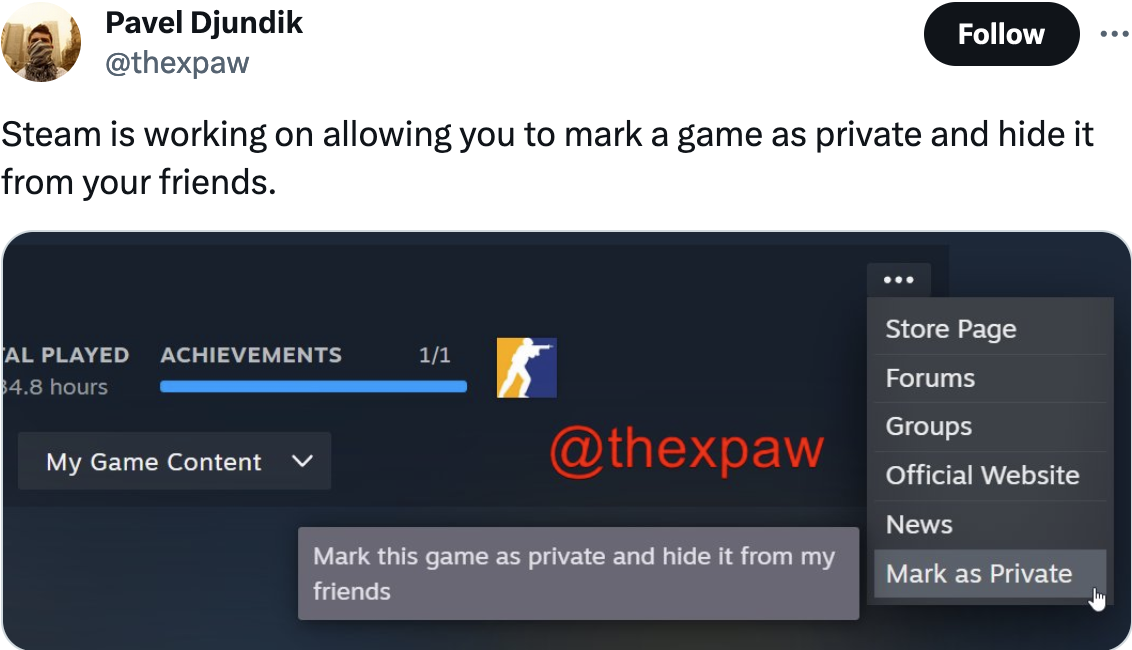
Steam has long sought to strike the right balance between convenience, community, and private refuge. Until recently, sharing your gaming history was either public, exclusive to your friends, or turned off entirely. A screenshot from a noted Steam watcher suggests that a “Mark as Private” option could be coming for individual games that you’re not keen on anyone, including friends, knowing you’ve put some time into.

Posting on X (formerly Twitter), Pavel Djundik, creator of the Steam insight tool SteamDB, shows options on the three-dot menu to the right of a game, with the last being “Mark as Private.” A tooltip on the option reads, “Mark this game as private and hide it from my friends.” Djundik’s example is Counter-Strike 2, which, perhaps in some circles, is a game worth hiding.

Tweet (Xeet?) from the SteamDB founder, pointing to a not-yet-public feature in Steam for hiding certain games from public or friends' profiles.

Tweet (Xeet?) from the SteamDB founder, pointing to a not-yet-public feature in Steam for hiding certain games from public or friends’ profiles. (credit: X / Pavel Djundik)

Some folks may be concerned to show the massive hour counts they’ve put into certain games. Others might be concerned about certain obsessive or ignoble achievements in games standing out in their timeline. More likely, of course, are the kinds of adult and fetish games with which Steam has a highly confusing relationship. The replies to Djundik’s tweet suggest that people get this, though they also have some suggestions about other refinements, like finer-grained friend management tools.

Read 2 remaining paragraphs | Comments


Source: Ars Technica – Steam might let you hide those embarrassing games in your profile soon

Scientists show off the wide vision of Europe’s Euclid space telescope

Read 14 remaining paragraphs | Comments


Source: Ars Technica – Scientists show off the wide vision of Europe’s Euclid space telescope

GM recalls nearly 1,000 Cruise robotaxis after pedestrian collision

Cruise, the autonomous vehicle company owned by General Motors, has issued a recall for 950 of its robotaxis following a collision with a pedestrian in San Francisco last month, as originally reported by NBC. This move comes after California revoked the company’s driverless permits, requiring a human on-board at all times.

The collision that started all of this occurred on October 2 when a pedestrian was thrown into the path of a Cruise robotaxi after being hit by a human driver. The robotaxi tried to brake aggressively and pull over to the side of the road, but ended up dragging the pedestrian 20 feet before finally stopping.

This triggered a federal probe and several independent investigations into the company, which dredged up some unsavory data. For instance, reports indicate that Cruise’s algorithm had real trouble identifying children. The data also suggests that Cruise knew about this incredibly dangerous blind spot but still kept its vehicles on the streets.

Internal safety documents acquired by The Intercept state that “Cruise AVs may not exercise additional care around children,” and that the robotaxis may “need the ability to distinguish children from adults so we can display additional caution around.” The company responded by touting its safety features, writing in a statement that it has “the lowest risk tolerance for contact with children.”

All of that’s moot now, as Cruise’s robotaxis are being recalled. GM and Cruise have not issued statements as to when and if the cars would return to the streets. GM did announce, however, that it has already lost $1.9 billion on the venture through September of this year, as reported by CNBC.

Rival companies like Google-owned Waymo are still operating driverless vehicles in California and beyond. As a matter of fact, the company just doubled the service area for its robotaxis in San Francisco and Phoenix.

This article originally appeared on Engadget at https://www.engadget.com/gm-recalls-nearly-1000-cruise-robotaxis-after-pedestrian-collision-183049933.html?src=rss

Source: Engadget – GM recalls nearly 1,000 Cruise robotaxis after pedestrian collision

You Can Get SheetsMagic for $50 Right Now and Integrate ChatGPT With Google Sheets

SheetMagic integrates ChatGPT with Google Sheets, and you can get a lifetime subscription on sale for $48.99 right now (reg. $299). It uses your existing OpenAI account, whether you have the free or paid version.

Read more…


Source: LifeHacker – You Can Get SheetsMagic for Right Now and Integrate ChatGPT With Google Sheets

Highly invasive backdoor snuck into open source packages targets developers

Highly invasive backdoor snuck into open source packages targets developers

Enlarge (credit: Getty Images)

Highly invasive malware targeting software developers is once again circulating in Trojanized code libraries, with the latest ones downloaded thousands of times in the last eight months, researchers said Wednesday.

Since January, eight separate developer tools have contained hidden payloads with various nefarious capabilities, security firm Checkmarx reported. The most recent one was released last month under the name “pyobfgood.” Like the seven packages that preceded it, pyobfgood posed as a legitimate obfuscation tool that developers could use to deter reverse engineering and tampering with their code. Once executed, it installed a payload, giving the attacker almost complete control of the developer’s machine. Capabilities include:

  • Exfiltrate detailed host information
  • Steal passwords from the Chrome web browser
  • Set up a keylogger
  • Download files from the victim’s system
  • Capture screenshots and record both screen and audio
  • Render the computer inoperative by ramping up CPU usage, inserting a batch script in the startup directory to shut down the PC, or forcing a BSOD error with a Python script
  • Encrypt files, potentially for ransom
  • Deactivate Windows Defender and Task Manager
  • Execute any command on the compromised host

In all, pyobfgood and the previous seven tools were installed 2,348 times. They targeted developers using the Python programming language. As obfuscators, the tools targeted Python developers with reason to keep their code secret because it had hidden capabilities, trade secrets, or otherwise sensitive functions. The malicious payloads varied from tool to tool, but they all were remarkable for their level of intrusiveness.

Read 10 remaining paragraphs | Comments


Source: Ars Technica – Highly invasive backdoor snuck into open source packages targets developers

Google workers publish letter criticizing company’s Israel-Palestine ‘double standard’

A group of Google employees has published an open letter on Medium calling out an alleged double standard in the company related to freedom of expression surrounding the Israel-Palestine war. The essay condemns “hate, abuse and retaliation” within the company against Muslim, Arab and Palestinian workers. The employees who penned the letter, which doesn’t include specific names out of fear of retaliation, demand that CEO Sundar Pichai, Google Cloud CEO Thomas Kurian and other senior leaders publicly condemn “the ongoing genocide in the strongest possible terms.” In addition, they urge the company to cancel Project Nimbus, a $1.2 billion deal to supply AI and other advanced tech to the Israeli military.

“We are Muslim, Palestinian, and Arab Google employees joined by anti-Zionist Jewish colleagues,” the letter opens. “We cannot remain silent in the face of the hate, abuse, and retaliation that we are being subjected to in the workplace in this moment.”

The letter cites specific examples of emotionally charged and inappropriate workplace behavior. These include unnamed Googlers accusing Palestinians of supporting terrorism, committing “slander against the Prophet Muhammad,” and publicly calling Palestinians “animals” on official Google work platforms. The group describes leadership as “standing idly by” in the latter two cases, and it says Google managers have called employees “sick” and “a lost cause” for expressing empathy toward Gaza residents.

The employees say Google managers have publicly asked Arab and Muslim people in the company if they support Hamas as a response to their concern for Palestinian families. “There are even coordinated efforts to stalk the public lives of workers sympathetic to Palestine and to report them both to Google and law enforcement for ‘supporting terrorism,’” the letter reads.

Google and Alphabet Inc. CEO Sundar Pichai arrives at the federal courthouse in Washington, Monday, Oct. 30, 2023. (AP Photo/Jose Luis Magana)
Google CEO Sundar Pichai
ASSOCIATED PRESS

Other examples cited include “heartfelt appeals” to donate to a charity for Gaza citizens being “met with multiple comments dehumanizing Gazans as being ‘animals,’ disregarding their plight and calling upon Googlers to boycott relief work for civilians due to the fact that Palestinian schools and hospitals were being used for ‘terrorism.’” The letter also accuses Google managers of using their rank to “question, report, and attempt to get fired Muslim, Arab, and Palestinian Googlers who express sympathy with the plight of the besieged Palestinian people.” It describes one manager endorsing “surveillance of Google employees on social media,” and then openly harassing them on Google work platforms.

“You have to be very, very, very careful, because any sort of criticism toward the Israeli state can be easily taken as antisemitism,” Sarmad Gilani, a Google software engineer who took part in the letter, said in an interview with The New York Times. “It feels like I have to condemn Hamas 10 times before saying one tiny, tiny thing criticizing Israel.”

Engadget contacted Google for a comment but didn’t immediately receive a response. We will update this article if we hear back.

The tensions inflamed in the last month by the Israel-Palestine war have resurfaced resentments about Google’s involvement in Project Nimbus. In 2021, Google and Amazon workers penned a similar open letter calling on their companies to pull out of the deal, which they said would enable surveillance of and unlawful data collection on Palestinians. Today’s letter echoes that sentiment. “We demand that Google stop providing material support to this genocide by canceling its Project Nimbus contract and immediately cease doing business with the Israeli apartheid government and military,” it reads.

This article originally appeared on Engadget at https://www.engadget.com/google-workers-publish-letter-criticizing-companys-israel-palestine-double-standard-181516404.html?src=rss

Source: Engadget – Google workers publish letter criticizing company’s Israel-Palestine ‘double standard’

Americans may soon get warnings about ultra-processed foods: Report

Students decide between Lunchables and a walking taco during lunch at Pembroke Elementary School on Thursday September 7, 2023, in Pembroke, NC.

Enlarge / Students decide between Lunchables and a walking taco during lunch at Pembroke Elementary School on Thursday September 7, 2023, in Pembroke, NC. (credit: Getty | Matt McClain)

For the first time, health experts who develop the federal government’s dietary guidelines for Americans are reviewing the effects of ultra-processed foods on the country’s health—a review that could potentially lead to first-of-their-kind warnings or suggested limits in the upcoming 2025 guidance, The Washington Post reports.

Such warning or limits would mark the first time that Americans would be advised to consider not just the basic nutritional components of foods, but also how their foods are processed.

Ultra-processed foods have garnered considerable negative attention in recent years. Dozens of observational studies have linked the food category to weight gain, obesity, cardiovascular disease, cancer, diabetes, and other chronic diseases, the Post notes. A small but landmark randomized controlled study in 2019, led by the National Institutes of Health’s nutrition expert, Kevin Hall, found that when inpatient trial participants received diets with ultra-processed foods, they ate roughly 500 extra calories a day compared to a control group of inpatient participants who were served a diet that was matched in macronutrients but did not include ultra-processed foods.

Read 5 remaining paragraphs | Comments


Source: Ars Technica – Americans may soon get warnings about ultra-processed foods: Report

Epic lays out Google’s alleged “bribe and block” monopoly strategy in trial opening

How's about we just forget about those plans for a competing Android app store?

Enlarge / How’s about we just forget about those plans for a competing Android app store? (credit: Getty Images | krisanapong detraphiphat)

For years now, Google has stressed the “open” nature of the Android’s sideloading-enabled mobile platform over Apple’s completely locked-down iOS App Store. But Epic has used the opening days of its jury trial against Google to argue that this technical openness hasn’t prevented Google from creating an effective monopoly over Android app distribution through its Google Play Store.

In its opening statement (as reported by multiple sources inside the San Francisco federal courtroom), Epic attorney Gary Bornstein pointed out that the Google Play Store is responsible for 90 percent of all Android app downloads, resulting in $12 billion in profit for Google. And Epic argues that Google has maintained that dominance through a “bribe and block” strategy that “pays actual and potential competitors not to compete—literally gives them money and other things of value.”

Epic’s opening arguments specifically called out League of Legends maker Riot Games as one of the companies that Google paid to eliminate the possible launch of a competing Android app store. While Epic says Google was smart enough not to note this payment in written contractual language, a less formal system helped ensure Riot was one of many companies that would “sit this one out and let [Google] win.”

Read 7 remaining paragraphs | Comments


Source: Ars Technica – Epic lays out Google’s alleged “bribe and block” monopoly strategy in trial opening

Google's AI-empowered search feature goes global with expansion to 120 countries

Google’s Search Generative Experience (SGE), which currently provides generative AI summaries at the top of the search results page for select users, is about to be much more available. Just six months after its debut at I/O 2023, the company announced Wednesday that SGE is expanding to Search Labs users in 120 countries and territories, gaining support for four additional languages and receiving a handful of helpful new features.

Unlike its frenetic rollout of the Bard chatbot in March, Google has taken a slightly more measured tone in distributing its AI search assistant. The company began with English language searches in the US in May, expanded to English-language users in India and Japan in August and on to teen users in September. As of Wednesday, users from Brazil to Bhutan can give the feature a try. In addition to English, SGE now supports Spanish, Portuguese, Korean and Indonesian (in addition to the existing English, Hindi and Japanese) so you’ll be able to search and converse with the assistant in natural language, whichever form it might take. These features arrive on Chrome desktop Wednesday with the Search Labs for Android app versions slowly rolling out over the coming week.

Among SGE’s new features is an improved follow-up function where users can ask additional questions of the assistant directly on the search results page. Like a mini-Bard window tucked into the generated summary, the new feature enables users to drill down on a subject without leaving the results page or even needing to type their queries out. Google will reportedly restrict ads to specific, denoted, areas of the page so as to avoid confusion between them and the generated content. Users can expect follow-ups to start showing up in the coming weeks. They’re only for English language users in the US to start but will likely expand as Google continues to iterate the technology. 

SGE will start helping with clarifying ambiguous translation terms as well. For example, if you’re trying to translate “Is there a tie?” into Spanish, both the output, the gender and speaker’s intention are going to change if you’re talking about a tie, as in a draw between two competitors (e.g. “un empate”) and for the tie you wear around your neck (“una corbata”). This new feature will automatically recognize such words and highlight them for you to click on, which pops up a window asking you to pick between the two versions. This is going to be super helpful with languages that, say, think of cars as boys but bicycles as girls, and you need to specify the version you’re intending. Luckily, Spanish is one of those languages and this capability is coming first to US users for English-to-Spanish translations.

Finally, Google plans to expand its interactive definitions normally found in the generated summaries for educational topics like science, history or economics to coding and health related searches as well. This update should arrive within the next month, again, first for English language users in the US before spreading to more territories in the coming months. 

This article originally appeared on Engadget at https://www.engadget.com/googles-ai-empowered-search-feature-goes-global-with-expansion-to-120-countries-180028084.html?src=rss

Source: Engadget – Google’s AI-empowered search feature goes global with expansion to 120 countries