The holidays are coming, and no matter your age, that can often mean sitting down after all your gifts are unwrapped, surrounding yourself with bags of plastic bricks, and building a new Lego set. To help you become the most popular gift giver of 2023, we’ve rounded up our favorite sets of the year—from fancy…
In the last two years, Windows 11 has ushered in significant updates for most of Windows’ built-in apps, and things like the system tray, Start menu, Settings app, and taskbar have continuously evolved with each new update. But few of these changes have been made available for Windows 10, which is still, by every publicly available metric, the most-used version of Windows on the planet. (Notable exceptions include the redesigned Outlook app and continued development of Microsoft Edge.)
Today, the company is making a major exception: The new AI-powered Windows Copilot feature from Windows 11 is being backported to Windows 10 and will be available in the Windows Insider Release Preview channel for Windows 10. This version of Copilot, which will be branded as a preview at first, will be available for the Home and Pro versions of Windows 10. But it won’t be available for the “managed” versions of Windows 10 just yet—Enterprise and Education editions, as well as Pro PCs that are joined to a domain or are otherwise managed by an IT department.
“We are hearing great feedback on Copilot in Windows (in preview) and we want to extend that value to more people,” writes Microsoft in a separate blog post. “For this reason, we are revisiting our approach to Windows 10 and will be making additional investments to make sure everyone can get the maximum value from their Windows PC including Copilot in Windows (in preview).”
Microsoft’s AI ambitions are moving a bit backwards: Today, the company has confirmed that it’s bringing Copilot AI to Windows 10. At first, it’ll be available to Windows Insider users in an upcoming Release Preview update, where Copilot will appear on the right side of the Task Bar. Once selected, you’ll see the familiar Copilot interface, which you can use to ask the AI questions, manage Windows features or interact with documents. Microsoft says the Copilot window won’t overlap with desktop content or block open windows.
If this all sounds familiar, it’s because Windows Central reported that Windows 10 would be getting Copilot earlier this month. The move isn’t exactly surprising. While Windows 11 is Microsoft’s latest OS, it only accounts for 26 percent of Windows installations, according to GlobalStats. Windows 10, meanwhile, still holds 69 percent of the Windows market.
In 2020, Microsoft announced that Windows 10 reached 1 billion devices, and it still appears to be above that figure. Windows Central’s reporting suggests that Windows 11 is on 400 million devices, in comparison. Just one look at those numbers and it makes sense why Microsoft is bringing its latest tech into an aging OS (its “end of service” date is still October 14, 2025). If the company was able to declare it brought Copilot’s AI to 1.4 billion devices in 2023, this year of over-accelerated AI hype will have been worth it.
Windows 10’s Copilot will be previewed in North America, as well as parts of Asia and South America over the next few months. For Windows Insiders who want to get in line for the update, Microsoft suggests installing today’s November preview update. Additionally, they’ll need to enable the “Get the latest updates as soon as they’re available” feature in Windows Update.
This article originally appeared on Engadget at https://www.engadget.com/microsofts-copilot-ai-is-officially-coming-to-windows-10-180020032.html?src=rss
In Star Wars’ current canon, we stand on the precipice of a return years in the making: at the end of Ahsoka’s first season, Grand Admiral Thrawn had made his way back from a galaxy even further away to restore a remnant Empire to glory and imperil the New Republic. But what happened when Thrawn made a comeback the…
The UK has said it will refrain from regulating the British artificial intelligence sector, even as the EU, US and China push forward with new measures. From a report: The UK’s first minister for AI and intellectual property, Viscount Jonathan Camrose, said at a Financial Times conference on Thursday that there would be no UK law on AI “in the short term” because the government was concerned that heavy-handed regulation could curb industry growth. The announcement comes as executives and policymakers around the world debate how to regulate the emerging technology, which holds the promise of transforming many industries and driven the rise in large tech company valuations over the past year.
The EU has led the field, with its legislation on AI regulation expected to come into force before the end of this year. Beijing is also implementing measures to regulate the industry, while US President Joe Biden recently issued an executive order to promote “responsible innovation.” Camrose added: “I would never criticise any other nation’s act on this. But there is always a risk of premature regulation.” In rushing to introduce industry controls, “you are not actually making anybody as safe as it sounds,” he said. “You are stifling innovation, and innovation is a very very important part of the AI equation.”
Teenagers who reside in countries where they are able to manage their own Google Account will finally be able to access Google’s Bard AI chatbot. This is according to Tulsee Doshi, who is Head of Product within the Responsible AI team at Google. Initially, Bard will only be available in English, with more languages to follow down the line.
Amazon is selling the diminutive Echo Dot smart speaker for just $23 as part of an early Black Friday deal. That’s a record low price for the gadget and represents a savings of more than 50 percent, as it typically costs $50. This deal is for the latest and greatest Echo Dot, and not a model from several generations ago.
The sale applies to various colorways, like gray, blue and black. The Echo Dot may be small in stature, but there’s a reason it made our list of the best smart speakers in 2023. This thing is actually pretty useful. The sound quality won’t blow you away when compared to its larger siblings, but the speaker gets plenty loud. It also features a temperature sensor and built-in Eero capabilities.
The globe-shape is pleasing, the colors are on point and set-up is simple, thanks to the affiliated Echo app. We liked this smart speaker at $50, so we certainly like it at $23. If you’ve been wanting to experiment with Alexa but were waiting for a good deal, this is it. If you buy this speaker, make sure to ask Alexa to sing the song about cats. Trust me.
Amazon’s sale extends beyond the company’s tiniest smart speaker. You can also nab the standard full-sized Echo speaker for $55, which represents a savings of $45. Additionally, the Echo Dot with Clock is on sale for $35 instead of $60. As the name suggests, this is the above Echo Dot, but with an LED clock. If you don’t want to spring for this version, you can always just ask Alexa to tell you the time.
This article originally appeared on Engadget at https://www.engadget.com/the-echo-dot-drops-to-a-record-low-of-23-in-an-amazon-black-friday-deal-174541440.html?src=rss
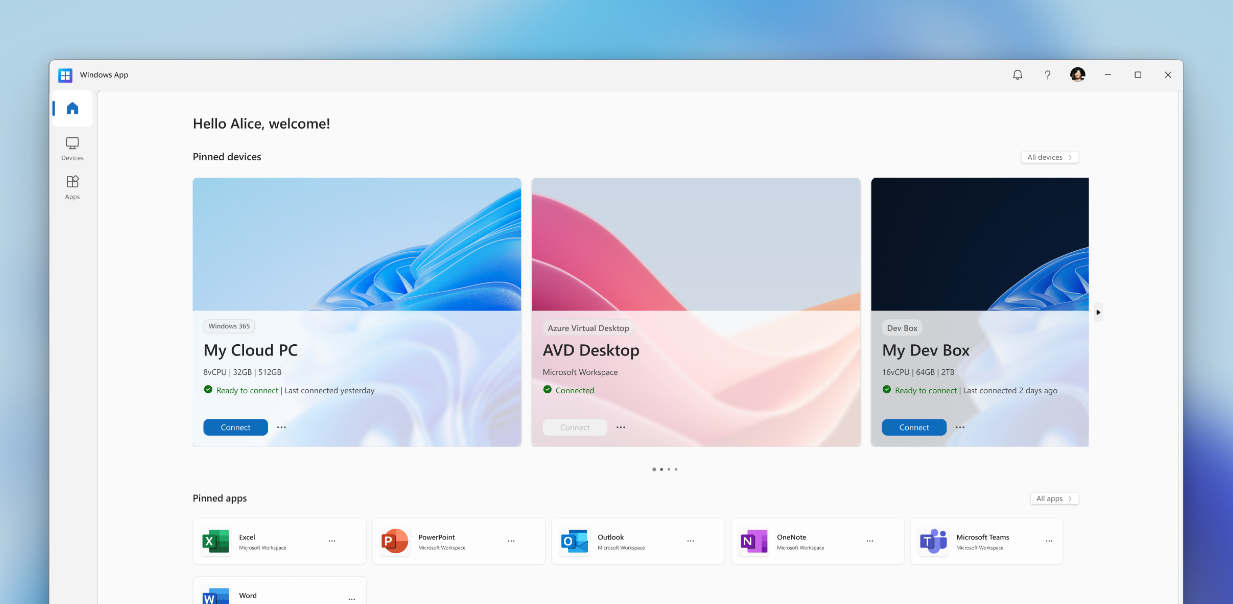
Enlarge/ If you have a bunch of Windows systems, Microsoft now has an app for that. It’s called “Windows App.” Microsoft just has a certain way with naming things. (credit: Microsoft)
It feels strange to say it, but it’s true: There is an app called, simply, “Windows.” It’s available for early testing on Mac, iOS and iPad, the web, Windows, and eventually Android, and it’s made by Microsoft. The fact that it exists, with such a strong and simple name, says something larger than the rather plain and starting-stage app it is now.
“Windows App,” as named by Microsoft in a rare bit of minimalism, is essentially a convenient remote desktop connection to a Windows OS on a physical system, an Azure virtual desktop, a Dev Box, or elsewhere. There are some other tricks you can pull off, too, like using your local device’s webcam, speakers, and printer connections with your remote Windows system. But you can easily read a “Windows app” for multiple platforms, including web browsers generally, as being the next step in Microsoft’s slow march toward making a virtual Windows OS something that seems convenient for everybody, whether on a business or personal account.
At the moment, you need a work or school account with Microsoft to use most of the features beyond a traditional remote desktop connection. To use a remote desktop connection, the Windows instance you’re connecting to must be running a Pro edition, as Home lacks the ability to host a remote desktop connection. There are, of course, many ways to connect to a remote PC from nearly any device, including RealVNC and others.
Doctor Who fans who don’t live in the UK or Ireland have had to be exceptionally organized when keeping track of where to watch the long-running sci-fi series. But the BBC Studios show’s classic era (up to and including the Seventh Doctor) finally has a free resource: Tubi, which just added over 600 episodes dating…
The uutils open-source project continues working on re-implementing the widely-used GNU Coreutils utilities within the Rust programming language for better security and a fresh take on rm, cd, cat, ls, and other commands…
Assassin’s Creed Mirage will get a new update in December that adds a New Game Plus mode for free, and introduces an optional difficulty setting that will absolutely stomp your face in.
Samsung has admitted that hackers accessed the personal data of U.K.-based customers during a year-long breach of its systems. From a report: In a statement to TechCrunch, Samsung spokesperson Chelsea Simpson, representing the company via a third-party agency, said Samsung was “recently alerted to a security incident” that “resulted in certain contact information of some Samsung U.K. e-store customers being unlawfully obtained.” Samsung declined to answer further questions about the incident, such as how many customers were affected or how hackers accessed its internal systems.
In a letter sent to affected customers, Samsung admitted that attackers exploited a vulnerability in an unnamed third-party business application to access the personal information of customers who made purchases at Samsung U.K.’s store between July 1, 2019 and June 30, 2020. The letter, which was shared on X (formerly Twitter), Samsung said it didn’t discover the compromise until more than three years later, on November 13, 2023. Samsung told affected customers that hackers may have accessed their names, phone numbers, postal addresses, and email addresses.
Instagram is rolling out an app update that is surprisingly robust, bringing a whole bunch of new features to content creators. First and foremost, there’s finally some new camera filters, which should shake things up for a while. These filters range from “subtle color edits” to more expressive and stylized options.
There are some other minor Camera Roll improvements to make it easier to find what you need as you edit. These include updated previews, a refined search function and even the ability to zoom.
As for video editing, there’s a new undo/redo tool that lets you, surprise, undo actions and redo them with the press of a button. Instagram also says it’s testing the ability to scale, crop and rotate individual clips as part of the editing process. The audio tools are also getting some love, as you can pull audio clips from a dedicated media hub to accompany a Reel. Followers can remix this content as they see it. If this sounds a lot like TikTok, well, that’s because it is.
To that end, there are 10 new English text-to-speech voices to choose from, though they are only available in select countries for now. Additionally, there are six new text fonts and styles available to caption up your Reels or Stories, in addition to bolded outlines that should really make your copy pop. Hopefully.
Instagram
If you really want to make something weird, Instagram now allows you to pull any part of a photo or video and turn it into a custom sticker. This also works the other way around, so users can pull eligible content from a favorite creator and turn it into a sticker. This particular tool was aided in development by Meta’s custom Segment Anything AI.
Finally, there are some updated tools for creators to keep track of their slow and steady rise to viral fame. The Retention Chart will offer a moment-by-moment insight into how many people are watching your content, though it’s not rolling out for a couple of months. The rest of these tools are available today.
This article originally appeared on Engadget at https://www.engadget.com/instagram-update-adds-new-camera-filters-and-video-editing-tools-for-content-creators-171537564.html?src=rss
Sledgehammer Games and Treyarch have dropped a new update for Call of Duty: Modern Warfare III that was intended to bring numerous fixes to the game. And while the released patch did still address issues with the shooter’s performance, most notably during parts of the Zombies campaign and in the launcher menu, some…
For years, some people with the unlucky habit of paying too much attention to Elon Musk have complained the man is a racist. He’s posted countless dog whistles, liked disturbing tweets, and used his platform to boost white nationalists, but he’s always managed to walk right up to the line of plausible deniability. But…
The Moon is about to be a busy place, with a series of crewed missions planned by NASA as part of its Artemis program, as well as an influx of upcoming commercial landers eyeing a spot on the lunar surface. Before it sends a fleet of spacecraft to the Moon, however, NASA first wants to understand the impact these…
The Samsung Galaxy Buds FE is marketed as a pocket-book-friendly option and makes for a pretty decent gift. They don’t offer all the bells and whistles you like the Galaxy Buds2 Pro, but for the price, I think I am ok with that.