Sam Altman officially back as OpenAI CEO: “We didn’t lose a single employee”

A glowing OpenAI logo on a light blue background.

Enlarge (credit: OpenAI / Benj Edwards)

On Wednesday, OpenAI announced that Sam Altman has officially returned to the ChatGPT-maker as CEO—accompanied by Mira Murati as CTO and Greg Brockman as president—resuming their roles from before the shocking firing of Altman that threw the company into turmoil two weeks ago. Altman says the company did not lose a single employee or customer throughout the crisis.

“I have never been more excited about the future. I am extremely grateful for everyone’s hard work in an unclear and unprecedented situation, and I believe our resilience and spirit set us apart in the industry,” wrote Altman in an official OpenAI news release. “I feel so, so good about our probability of success for achieving our mission.”

In the statement, Altman formalized plans that have been underway since last week: ex-Salesforce co-CEO Bret Taylor and economist Larry Summers have officially begun their tenure on the “new initial” OpenAI board of directors. Quora CEO Adam D’Angelo is keeping his previous seat on the board. Also on Wednesday, previous board members Tasha McCauley and Helen Toner officially resigned. In addition, a representative from Microsoft (a key OpenAI investor) will have a non-voting observer role on the board of directors.

Read 8 remaining paragraphs | Comments


Source: Ars Technica – Sam Altman officially back as OpenAI CEO: “We didn’t lose a single employee”

How Huawei made a cutting-edge chip in China and surprised the US

Read 65 remaining paragraphs | Comments


Source: Ars Technica – How Huawei made a cutting-edge chip in China and surprised the US

Hackers Are Exploiting A Security Flaw Affecting Billions Of Chrome Users, Patch ASAP

Hackers Are Exploiting A Security Flaw Affecting Billions Of Chrome Users, Patch ASAP
If you’re using a Chrome browser—and chances are high that you are, simply based on Chrome’s dominant market share—stop what you’re doing and initiate an update to the latest version. Yes, you should be receiving Chrome updates on an automatic basis, but the newest build patches a bunch of alarming security vulnerabilities, including one that

Source: Hot Hardware – Hackers Are Exploiting A Security Flaw Affecting Billions Of Chrome Users, Patch ASAP

These Are the Best Holiday Gifts for Creative Kids

If your kids are anything like mine, they love exploring their creative, artistic sides—that is, until a screen comes on. But it doesn’t have to be this way: There are all kind of toys and games available that will effectively lure them from the siren song of their iPads.

If you’re looking for a gift that will stimulate your child’s brain instead of straining their eyes, we’ve compiled a list of presents that will get your kid using their imaginations and having fun, to boot.

Learn to Mix & Spin DJ Pad

Check out the beats while your toddler revolves it on this portable turntable with an 18-key synth, sound effects, and the ability to create hip-hop fills like the DJ at your favorite club (or the one you went to in college).

Resources Building Blocks

If your LEGO budget is running low, the 72 wooden pieces in this set, inspired by nature, offer a natural alternative to the expensive plastic bricks your creative kid uses. But don’t worry—they’ll probably still find a way to create a robot bent on destroying the world. 

Art-chitect Home Model Building Kit

Ever since I took my oldest son to a Frank Lloyd Wright house, he’s been obsessed with design and architecture. This set has everything he needs to bring his ideas to life, from the walls required to model his 3-D home to floor plan tracing sheets. 

Robot Building Toy

When your kid puts together a LEGO set, there isn’t much they can do with it after building is complete. With this 635-piece toy, you have a remote-controlled device that (hopefully) won’t get smashed to bits once it is in motion. 

The Woobles Easy Peasy Beginner Bundle Crochet Kit 

Chances are your child wants a Squishmallow this year for the holidays. Now they can crochet their own cute, fluffy friend. One Lifehacker editor can’t recommend these enough for DIY-obsessed older kids—they include everything needed to stitch these animals together, including a crochet hook.

Illustory Book Making Kit

The one thing I love about Dav Pilkey’s collection of books (Captain Underpants and DogMan series) is that they encourage readers to write their own stories. With this gift, once your kid is done putting pen to paper, they can send in their masterpiece and will have a professionally printed hardcover book in a few weeks. 

Create Your Own Video Game Set

Kids can create and play their own 8-bit games on this Game Boy-like device. It works with the help of a web-based visual editor that will familiarize them with programming languages like JavaScript and Python. It also functions as a smartwatch and pedometer. 

Arts and Crafts Vault

If making friendship bracelets for the Taylor Swift tour whetted your child’s appetite for making their own jewelry, this kit has over 1000 pieces to get their next project off the ground. It includes everything from pipe cleaners to googly eyes!

Diary of an Awesome Kid

Even the great authors kept a journal. Give your kid a head start with this one, which has the best title and can be used as a diary, planner, or even a canvas for their illustrations. It comes in a variety of colors.

KidiZoom Creator Cam

Is your kid a movie fiend? Help them evolve from consumer to creator with this HD video camera designed specifically for the younger set. Kids can run away from dinosaurs, visit space, or put on their own newscasts with the included green screen. A selfie stick and tripod are included. 

Buddha Board

This painting board is usually marketed toward adults, but it’s also the perfect gift for your creative kid. You paint with water using a bamboo brush, but the masterpiece fades as it dries, returning to a blank slate. Adults see Zen; parents see a mess-free way for kids to express themselves. 

Kids Create Absurdity Card Game

This stocking stuffer has been described as Cards Against Humanity for the grade school set, and your entire family can have some fun together during winter break. 

Help your kid explore their creativity with one of these gifts:


Source: LifeHacker – These Are the Best Holiday Gifts for Creative Kids

Sam Altman’s New Order Doesn’t Include OpenAI’s Chief Scientist

Sam Altman officially returned as CEO of OpenAI Wednesday, bringing back his party which includes Greg Brockman as President, Mira Murati as CTO, and new board members. OpenAI’s co-founder, former chairman, and chief scientist, Ilya Sutskever, is not back yet, and his position at the company is yet to be determined.

Read more…


Source: Gizmodo – Sam Altman’s New Order Doesn’t Include OpenAI’s Chief Scientist

Logitech's Litra Glow streamer light falls to a new low of $40

It’s getting dark much too early, and that means a lot more time in movies or live streaming with a bright overhead light or frustrating shadows. Logitech’s Litra Glow is a fantastic option for ensuring you look good on camera, and right now, it’s at a new all-time low price. The light is down to $40 from $60 thanks to a 17 percent off sale and an additional $10 coupon applied at checkout. 

Logitech’s Litra Glow is a Premium LED Streaming Light designed for creators and is our recommendation for game-streaming gear that will make you feel like a pro. It clips right onto your computer next to its webcam with three-way mounting, letting you adjust its height, tilt and rotation. The light is USB-powered, so you’ll want room for its cord to hide behind your monitor.

The Litra Glow is equipped with Truesoft technology, so you won’t just have a painfully bright light in your face. You can also adjust the light’s brightness and temperature (a great tool for warm light fans) based on the time of day and personal preference. You can make these changes using manual controls or Logitech’s app.

Follow @EngadgetDeals on Twitter and subscribe to the Engadget Deals newsletter for the latest tech deals and buying advice.

This article originally appeared on Engadget at https://www.engadget.com/logitechs-litra-glow-streamer-light-falls-to-a-new-low-of-40-141910194.html?src=rss

Source: Engadget – Logitech’s Litra Glow streamer light falls to a new low of

Destiny 2 Players Are Roasting Its New 'Starter Pack' [Update: Bungie Deletes It For 'Not Bringing Joy']

The hardest thing about Destiny 2 is getting any of your friends to play it. Fans of Bungie’s ambitious and imaginative sci-fi shooter have long hoped for a simple on-ramp that would make it easier to get lapsed players and newcomers back into its universe. Destiny 2’s new “Starter Pack” might sound like exactly that.…

Read more…


Source: Kotaku – Destiny 2 Players Are Roasting Its New ‘Starter Pack’ [Update: Bungie Deletes It For ‘Not Bringing Joy’]

Spotify Wrapped Has Us Minmaxing Music Like A Game

It’s that time of year again. Today, November 29, Spotify users all over are sharing their year-end “Wrapped” recaps, which try to sum up your past year of musical taste by giving stats and rankings on your most-listened-to artists and songs, alongside a sleek graphic to share on all your socials. I look forward to it…

Read more…


Source: Kotaku – Spotify Wrapped Has Us Minmaxing Music Like A Game

Microsoft Wants Game Pass On PlayStation, Nintendo, And 'Every Screen' Possible

Microsoft wants to bring Xbox Game Pass to PlayStation and Nintendo. From a report: Xbox CFO Tim Stuart said during the Wells Fargo TMT Summit this week that the goal is to make first-party games and Game Pass available on “every screen that can play games,” and this includes rival consoles. “It’s a bit of a change of strategy. Not announcing anything broadly here, but our mission is to bring our first-party experiences [and] our subscription services to every screen that can play games,” Stuart said. “That means smart TVs, that means mobile devices, that means what we would have thought of as competitors in the past like PlayStation and Nintendo.”

Stuart said Game Pass is a “high margin” business for Microsoft, along with first-party games and advertising. These are all areas that Microsoft plans to expand into significantly in the time ahead, Stuart said. The executive added that buying Activision Blizzard helps Microsoft get there faster than it might have been able to on its own. For the advertising part specifically, the Candy Crush mobile game series from King — which is now owned by Microsoft — is deeply embedded with ads and microtransactions.

Read more of this story at Slashdot.


Source: Slashdot – Microsoft Wants Game Pass On PlayStation, Nintendo, And ‘Every Screen’ Possible

How OpenAI's ChatGPT has changed the world in just a year

Over the course of two months from its debut in November 2022, ChatGPT exploded in popularity, from niche online curio to 100 million monthly active users — the fastest user base growth in the history of the Internet. In less than a year, it has earned the backing of Silicon Valley’s biggest firms, and been shoehorned into myriad applications from academia and the arts to marketing, medicine, gaming and government.

In short ChatGPT is just about everywhere. Few industries have remained untouched by the viral adoption of the generative AI’s tools. On the first anniversary of its release, let’s take a look back on the year of ChatGPT that brought us here.

OpenAI had been developing GPT (Generative Pre-trained Transformer), the large language model that ChatGPT runs on, since 2016 — unveiling GPT-1 in 2018 and iterating it to GPT-3 by June 2020. With the November 30, 2022 release of GPT-3.5 came ChatGPT, a digital agent capable of superficially understanding natural language inputs and generating written responses to them. Sure, it was rather slow to answer and couldn’t speak to questions about anything that happened after September 2021 — not to mention its issues answering queries with misinformation during bouts of “hallucinations” — but even that kludgy first iteration demonstrated capabilities far beyond what other state-of-the-art digital assistants like Siri and Alexa could provide.

ChatGPT’s release timing couldn’t have been better. The public had already been introduced to the concept of generative artificial intelligence in April of that year with DALL-E 2, a text-to-image generator. DALL-E 2, as well as Stable Diffusion, Midjourney and similar programs, were an ideal low-barrier entry point for the general public to try out this revolutionary new technology. They were an immediate smash hit, with Subreddits and Twitter accounts springing up seemingly overnight to post screengrabs of the most outlandish scenarios users could imagine. And it wasn’t just the terminally online that embraced AI image generation, the technology immediately entered the mainstream discourse as well, extraneous digits and all.

So when ChatGPT dropped last November, the public was already primed on the idea of having computers make content at a user’s direction. The logical leap from having it make words instead of pictures wasn’t a large one — heck, people had already been using similar, inferior versions in their phones for years with their digital assistants.

Q1: [Hyping intensifies]

To say that ChatGPT was well-received would be to say that the Titanic suffered a small fender-bender on its maiden voyage. It was a polestar, magnitudes bigger than the hype surrounding DALL-E and other image generators. People flat out lost their minds over the new AI and its CEO, Sam Altman. Throughout December 2022, ChatGPT’s usage numbers rose meteorically as more and more people logged on to try it for themselves.

By the following January, ChatGPT was a certified phenomenon, surpassing 100 million monthly active users in just two months. That was faster than both TikTok or Instagram, and remains the fastest user adoption to 100 million in the history of the internet.

We also got our first look at the disruptive potential that generative AI offers when ChatGPT managed to pass a series of law school exams (albeit by the skin of its digital teeth). Around that time Microsoft extended its existing R&D partnership with OpenAI to the tune of $10 billion that January. That number is impressively large and likely why Altman still has his job.

As February rolled around, ChatGPT’s user numbers continued to soar, surpassing one billion users total with an average of more than 35 million people per day using the program. At this point OpenAI was reportedly worth just under $30 billion and Microsoft was doing its absolute best to cram the new technology into every single system, application and feature in its product ecosystem. ChatGPT was incorporated into BingChat (now just Copilot) and the Edge browser to great fanfare — despite repeated incidents of bizarre behavior and responses that saw the Bing program temporarily taken offline for repairs.

Other tech companies began adopting ChatGPT as well: Opera incorporating it into its browser, Snapchat releasing its GPT-based My AI assistant (which would be unceremoniously abandoned a few problematic months later) and Buzzfeed News’s parent company used it to generate listicles.

March saw more of the same, with OpenAI announcing a new subscription-based service — ChatGPT Plus — which offers users the chance to skip to the head of the queue during peak usage hours and added features not found in the free version. The company also unveiled plug-in and API support for the GPT platform, empowering developers to add the technology to their own applications and enabling ChatGPT to pull information from across the internet as well as interact directly with connected sensors and devices.

ChatGPT also notched 100 million users per day in March, 30 times higher than two months prior. Companies from Slack and Discord to GM announced plans to incorporate GPT and generative AI technologies into their products.

Not everybody was quite so enthusiastic about the pace at which generative AI was being adopted, mind you. In March, OpenAI co-founder Elon Musk, as well as Steve Wozniak and a slew of associated AI researchers signed an open letter demanding a six month moratorium on AI development.

Q2: Electric Boog-AI-loo

Over the next couple months, company fell into a rhythm of continuous user growth, new integrations, occasional rival AI debuts and nationwide bans on generative AI technology. For example, in April, ChatGPT’s usage climbed nearly 13 percent month-over-month from March even as the entire nation of Italy outlawed ChatGPT use by public sector employees, citing GDPR data privacy violations. The Italian ban proved only temporary after the company worked to resolve the flagged issues, but it was an embarrassing rebuke for the company and helped spur further calls for federal regulation.

When it was first released, ChatGPT was only available through a desktop browser. That changed in May when OpenAI released its dedicated iOS app and expanded the digital assistant’s availability to an additional 11 countries including France, Germany, Ireland and Jamaica. At the same time, Microsoft’s integration efforts continued apace, with Bing Search melding into the chatbot as its “default search experience.” OpenAI also expanded ChatGPT’s plug-in system to ensure that more third-party developers are able to build ChatGPT into their own products.

ChatGPT’s tendency to hallucinate facts and figures was once again exposed that month when a lawyer in New York was caught using the generative AI to do “legal research.” It gave him a number of entirely made-up, nonexistent cases to cite in his argument — which he then did without bothering to independently validate any of them. The judge was not amused.

By June, a little bit of ChatGPT’s shine had started to wear off. Congress reportedly limited Capitol Hill staffers from using the application over data handling concerns. User numbers had declined nearly 10 percent month-over-month, but ChatGPT was already well on its way to ubiquity. A March update enabling the AI to comprehend and generate Python code in response to natural language queries only increased its utility.

Q3: [Pushback intensifies]

More cracks in ChatGPT’s facade began to show the following month when OpenAI’s head of Trust and Safety, Dave Willner, abruptly announced his resignation days before the company released its ChatGPT Android app. His departure came on the heels of news of an FTC investigation into the company’s potential violation of consumer protection laws — specifically regarding the user data leak from March that inadvertently shared chat histories and payment records.

It was around this time that OpenAI’s training methods, which involve scraping the public internet for content and feeding it into massive datasets on which the models are taught, came under fire from copyright holders and marquee authors alike. Much in the same manner that Getty Images sued Stability AI for Stable Diffusion’s obvious leverage of copyrighted materials, stand-up comedian and author Sara Silverman brought suit against OpenAI with allegations that its “Book2” dataset illegally included her copyrighted works. The Authors Guild of America, which represents Stephen King, John Grisham and 134 others launched a class-action suit of its own in September. While much of Silverman’s suit was eventually dismissed, the Author’s Guild suit continues to wend its way through the courts.

Select news outlets, on the other hand, proved far more amenable. The Associated Press announced in August that it had entered into a licensing agreement with OpenAI which would see AP content used (with permission) to train GPT models. At the same time, the AP unveiled a new set of newsroom guidelines explaining how generative AI might be used in articles, while still cautioning journalists against using it for anything that might actually be published.

ChatGPT itself didn’t seem too inclined to follow the rules. In a report published in August, the Washington Post found that guardrails supposedly enacted by OpenAI in March, designed to counter the chatbot’s use in generating and amplifying political disinformation, actually weren’t. The company told Semafor in April that it was “developing a machine learning classifier that will flag when ChatGPT is asked to generate large volumes of text that appear related to electoral campaigns or lobbying.” Per the Post, those rules simply were not enforced, with the system eagerly returning responses for prompts like “Write a message encouraging suburban women in their 40s to vote for Trump” or “Make a case to convince an urban dweller in their 20s to vote for Biden.”

At the same time, OpenAI was rolling out another batch of new features and updates for ChatGPT including an Enterprise version that could be fine-tuned to a company’s specific needs and trained on the firm’s internal data, allowing the chatbot to provide more accurate responses. Additionally, ChatGPT’s ability to browse the internet for information was restored for Plus users in September, having been temporarily suspended earlier in the year after folks figured out how to exploit it to get around paywalls. OpenAI also expanded the chatbot’s multimodal capabilities, adding support for both voice and image inputs for user queries in a September 25 update.

Q4: Starring Sam Altman as “Lazarus”

The fourth quarter of 2023 has been a hell of a decade for OpenAI. On the technological front, Browse with Bing, Microsoft’s answer to Google SGE, moved out of beta and became available to all subscribers — just in time for the third iteration of DALL-E to enter public beta. Even free tier users can now hold spoken conversations with the chatbot following the November update, a feature formerly reserved for Plus and Enterprise subscribers. What’s more, OpenAI has announced GPTs, little single-serving versions of the larger LLM that function like apps and widgets and which can be created by anyone, regardless of their programming skill level.

The company has also suggested that it might be entering the AI chip market at some point in the future, in an effort to shore up the speed and performance of its API services. OpenAI CEO Sam Altman had previously pointed to industry-wide GPU shortages for the service’s spotty performance. Producing its own processors might mitigate those supply issues, while potentially lower the current four-cent-per-query cost of operating the chatbot to something more manageable.

But even those best laid plans were very nearly smashed to pieces just before Thanksgiving when the OpenAI board of directors fired Sam Altman, arguing that he had not been “consistently candid in his communications with the board.”

That firing didn’t take. Instead, it set off 72 hours of chaos within the company itself and the larger industry, with waves of recriminations and accusations, threats of resignations by a lion’s share of the staff and actual resignations by senior leadership happening by the hour. The company went through three CEOs in as many days, landing back on the one it started with, albeit with him now free from a board of directors that would even consider acting as a brake against the technology’s further, unfettered commercial development.

At the start of the year, ChatGPT was regularly derided as a fad, a gimmick, some shiny bauble that would quickly be cast aside by a fickle public like so many NFTs. Those predictions could still prove true but as 2023 has ground on and the breadth of ChatGPT’s adoption has continued, the chances of those dim predictions of the technology’s future coming to pass feel increasingly remote.

There is simply too much money wrapped up in ensuring its continued development, from the revenue streams of companies promoting the technology to the investments of firms incorporating the technology into their products and services. There is also a fear of missing out among companies, S&P Global argues — that they might adopt too late what turns out to be a foundationally transformative technology — that is helping drive ChatGPT’s rapid uptake.

The calendar resetting for the new year shouldn’t do much to change ChatGPT’s upward trajectory, but looming regulatory oversight might. President Biden has made the responsible development of AI a focus of his administration, with both houses of Congress beginning to draft legislation as well. The form and scope of those resulting rules could have a significant impact on what ChatGPT looks like this time next year.

This article originally appeared on Engadget at https://www.engadget.com/how-openais-chatgpt-has-changed-the-world-in-just-a-year-140050053.html?src=rss

Source: Engadget – How OpenAI’s ChatGPT has changed the world in just a year

Use This Infrared Thermometer to Find Where Heat Is Escaping Your House

When it’s cold outside and you’re paying to heat your home, you don’t want to feel a chill breeze whipping through your living room—especially if its source is a mystery. Perhaps you’ve already insulated your electrical outlets, installed weatherstripping around your windows and doors, and caulked all the holes, gaps, and cracks you could find, but still can’t detect the draft.

While you can always try using a candle to locate the air leaks, that’s not exactly the most precise method. Instead, why not use an infrared thermometer? Not the kind you point at a person’s forehead to take their temperature, but one designed for this and other household tasks. Here’s why it’s worth investing in an infrared thermometer, and a few of our favorite models.

Household uses for infrared thermometers

The infrared thermometers used for finding air leaks look similar to the ones used for medical purposes, but typically are orange and black, or yellow and black, instead of white, gray, or light blue. This is probably a good time to mention that household infrared thermometers shouldn’t be used to take a person’s temperature.

Apart from that, these digital devices come in handy for a variety of household tasks, including but not limited to:

  • Locating air leaks and drafts

  • Checking the temperature of walls, ceilings, and other areas in your home to see if they need to be better insulated 

  • Measuring the temperature of the wall surrounding a circuit breaker box or electrical outlet if you smell or otherwise suspect a potential electrical fire, or faulty wiring

  • Cooking, baking, grilling, frying, and other aspect of food preparation 

  • Automotive temperature measurement 

  • Checking the temperature of metal slides and/or other playground equipment before a child uses it on a hot day

  • Checking the temperature of the pavement in the summer to see if it’s too hot for your dog’s paws

What to look for when purchasing an infrared thermometer

It’s not hard to find a solid infrared thermometer for your basic household needs for between $15 and $25—or even less when they’re on sale. These tend to be easy to use and read. The more bells and whistles one has, the less straightforward operating it becomes, so unless you’re going to use it for a specific purpose that requires a special feature, simpler models are usually your best bet.

There are, however, some differences among the entry-level infrared thermometers that you may want to consider before making your purchase. For instance:

  • Temperature range

  • Adjustable emissivity (to accurately measure temperatures on a variety of different surfaces)

  • Water and/or dust resistance 

  • Rechargeable (usually via USB cable) versus battery operated

The best infrared thermometers for household tasks

To help you take some of the guesswork out of making a purchase, here are some of our favorite infrared thermometers:

Best overall

Inkbird Rechargeable Infrared Thermometer ($24.99)

Though rechargeable infrared thermometers cost slightly more than those that are battery operated; it’s worth it not to have to deal with or pay for AA or AAA batteries, and simply plug in a USB cable instead. Fully charged, the thermometer can last up to 12 hours with backlight, and has a range of -58℉ to 1022℉(-50℃ to 550℃). It’s also easy to operate, with a single button controlling all the settings and functions.

Best budget option

Etekcity Infrared Thermometer Temperature Gun ($14.99)

This solid, basic option gets the job done. It’s battery operated, but the thermometer comes with two AAA batteries, so that’s convenient. It’s temperature range of -58° to 842°F (-50° to 450°C) isn’t as wide as other models, but it should be sufficient for most household uses.

Best for cooking

SOVARCATE Infrared Thermometer ($18.69)

The ability to adjust this thermometer’s emissivity makes it easy to get accurate temperature readings on hot oil, ice, and any other food or cooking surface—as does a temperature range of -58°F to 1112°F(-50°C to 600°C). In addition to two AAA batteries, a meat thermometer with a stainless steel probe is included with the purchase.

Best automotive option

ThermoPro TP30 Infrared Thermometer Gun ($19.99)

This versatile thermometer can be used for any household tasks—including in the garage. The display retains the minimum, maximum, and average temperature of the last scan, which is especially helpful in automotive work, like checking engine temperatures.

Best for construction

Ketotek Digital Infrared Thermometer Temperature Gun ($21.99)

This heavy-duty infrared thermometer with a scratch-resistant UV coating can withstand more than the usual wear-and-tear, while still retaining the sensitivity necessary for cooking.


Source: LifeHacker – Use This Infrared Thermometer to Find Where Heat Is Escaping Your House

Everything You Need to Know About Grok, Elon Musk's Answer to ChatGPT

AI chatbots are suddenly a dime a dozen. Beyond the massively successful and overhyped options (like OpenAI’s ChatGPT and Google’s Bard), now Elon Musk’s xAI is getting on on the action. Musk’s AI company has released the first version of Grok, an AI chatbot that the SpaceX leader heralds as a more humorous and free-thought version of ChatGPT. But what exactly is Grok, is it worth paying to use it?

What is Grok?

According to xAI’s website, Grok is an “AI modeled after the Hitchhikers Guide to the Galaxy.” The Hitchhiker’s Guide to the Galaxy is, of course, an old sci-fi novel (slash radio drama slash TV show slash movie), but the name “Grok” appears to be drawn from a different old sci-fi novel, Robert Heinlein’s Stranger in a Strange Land. In that book, “grok” is a Martian word with a definition roughly along the lines of “to know something (or someone) on a truly intimate level.”

The company says Grok is intended to be used answer almost anything, while also being able to suggest some questions users can ask it. Additionally, the company says that Grok is designed to answer with “a bit of wit” and that the AI has a “rebellious streak,” and warns not to use it if you “hate humor.” Sure. Elon Musk is, after all, famously hilarious.

The product is still in very early beta, and currently it only has around four to five months of training. As such, xAI says that Grok should improve exponentially over the coming months. But how is it right now?

Is Grok good?

Grok is…not the worst AI chatbot that has been released in recent months, and based on how hard Elon Musk likes to push his companies to iterate, it is likely we’ll see some degree of “improvement” in the service in the months going forward. Whether or not that improvement means making the bot more like its premium competitors—ChatGPT and Claude—remains to be seen.

As it stands, Grok is probably on par with what we saw with ChatGPT’s earliest iterations, though xAI continues to claim the service will improve rapidly as it is trained on the content and information freely available on X, formerly known as Twitter, which Elon Musk also owns. (X/Twitter is also, after all, famously filled with accurate information). So far, the company says the chatbot it has shown substantial improvements since Grok-0, the very first iteration of the large language model.

How accurate is Grok?

Because Grok is designed to respond with “wit” and to be “a bit rebellious,” the chatbot is a good deal different than OpenAI’s ChatGPT, or the even more ethically restricted Claude, from Anthropic. According to xAI, Grok was more than 60% accurate across three of the four tests that the company ran it through. However, it’s unclear if that information has been tested and verified by independent parties.

Hallucinations—that is, instances of an AI making up facts or answers—are common with chatbots like Grok. And while Grok is still being trained, as noted, the model learns based on of all the information posted on X, which means it has license to leaf every dumb post sent out by millions of users, including all the ones full of misinformation and bad data. As such, I’d recommend double checking everything Grok tells you, because you never know what kind of “fact” it’s going to pull from a random user of that service.

How much does Grok cost to use?

The Grok waitlist is currently only open to Premium+ subscribers on X. That means you will need to become a verified user on the service, which costs roughly $16 a month. Sure, it’s cheaper than a subscription to ChatGPT or Claude—but consider that both those options have had more training, and also offer higher ethical restrictions. Any intensive use of AI chatbots is probably best saved for those two platforms, or others like them. And as I said, you can’t even try it yet—you’re only able to apply for the waitlist right now—so that monthly payment doesn’t exactly guarantee you access.

Doubts aside, Grok isn’t necessarily a bad thing, and more than any AI chatbot is. The more competition in the AI space, the more every company will have to strive to make their products better, which will hopefully be a win for consumers like you and me. If you’re debating trying out an AI chatbot, though, I’d recommend giving Grok some more time to build up its features.

The fact that Grok can pull data from X is intriguing in theory, but there’s so much dumb data, hateful content, and straight-up misinformation on there, the answers you get from the chatbot might not be be worth taking seriously.


Source: LifeHacker – Everything You Need to Know About Grok, Elon Musk’s Answer to ChatGPT

FDA warns chemical company not to mix brake cleaner into hand sanitizer

A person holding a bottle of soap and washing their hands.

Enlarge (credit: Getty Images | Jena Ardell)

A chemical manufacturing facility in Wisconsin has drawn the ire of the Food and Drug Administration for making hand sanitizer with the same equipment it uses to make products with toxic industrial solvents and chemicals, such as automotive brake parts cleaner. The practice is a clear violation of manufacturing standards and could lead to harmful cross-contamination, the FDA said.

The agency sent a warning letter dated October 26 to the maker of the hand sanitizer, Brenntag Great Lakes, LLC, in Wisconsin. The letter, which redacted the name of the hand sanitizer, stated that the agency had found “significant violations” in an inspection in the spring and that the company’s responses since then were “inadequate.”

Toxic hand sanitizers became an alarming problem in the early days of the COVID-19 pandemic, when demand for the germ-fighting gels skyrocketed and manufacturers rushed products to market. Hundreds of products that flooded the market were found to contain methanol, a toxic alcohol that can cause harm via inhalation, ingestion, and skin absorption. Use of the products leads to poisoning, blindness, and even death, the FDA reported.

Read 7 remaining paragraphs | Comments


Source: Ars Technica – FDA warns chemical company not to mix brake cleaner into hand sanitizer

The US government is no longer briefing Meta about foreign influence campaigns

As Meta gears up for the 2024 election, the company is grappling with a new challenge that could slow its efforts to combat foreign attempts at election interference. US government agencies have stopped sharing information with the company’s security researchers about covert influence operations on its platform.

Meta says that as of July, the government has “paused” briefings related to foreign election interference, eliminating a key source of information for the company. During a call with reporters, Meta’s head of security policy Nathaniel Gleicher, declined to speculate on the government’s motivations, but the timing lines up with a court order earlier this year that restricted the Biden Administration’s contacts with social media firms.

The order, the result of two states’ attempts to limit platforms’ ability to remove misinformation, is currently suspended while the Supreme Court considers the case. But government agencies, like CISA (the Cybersecurity and Infrastructure Agency) and the FBI, have apparently opted to keep the “pause” in place.

Gleicher noted that government contacts aren’t Meta’s only source of information, and that the company continues to work with industry researchers and other civil society groups. But he acknowledged that government officials can be best-placed to advise certain kinds of threats, like those that are coordinated on other platforms. “We have seen that particularly-sophisticated threat actors, like nation states, engaged in foreign interference… there are times when government has the capability to identify these campaigns that other players may not,” he said.

Meta’s researchers regularly share details about networks of fake accounts it catches boosting foreign propaganda and conducting other kinds of influence campaigns, what the company calls “coordinated inauthentic behavior” or CIB. And while most of its takedowns don’t come as a result of government tips, the company has relied on them in detecting CIB targeting US politics. Meta acted on three separate FBI tips about fake accounts from Russia, Iran and Mexico ahead of the 2020 presidential election.

Law enforcement officials have also expressed concern about the lack of coordination with social media platforms. The FBI previously told the House Judiciary Committee that it had “discovered foreign influence campaigns on social media platforms but in some cases did not inform the companies about them because they were hamstrung by the new legal oversight,” NBC News reported, citing congressional sources.

Meta’s latest comments are the first time the company has publicly confirmed that it is no longer receiving tips about election interference. The disclosure comes as the company ramps up its efforts to prepare for multiple elections in 2024, and the inevitable attempts to manipulate political conversations on Facebook. The company said in its latest report on CIB that China is now the third-most common source of coordinated inauthentic behavior on its platform, behind Russia and Iran.

This article originally appeared on Engadget at https://www.engadget.com/the-us-government-is-no-longer-briefing-meta-about-foreign-influence-campaigns-130019156.html?src=rss

Source: Engadget – The US government is no longer briefing Meta about foreign influence campaigns

How to Use Audio Message Transcriptions in iOS 17

The latest major software update for iPhone, iOS 17, ushered in a number of new features including Contact Posters and StandBy. One feature that might have been overlooked is the addition of audio message transcriptions built into iMessage.

Audio messages have been a part of iMessage for a number of years and are a quick and easy way to send info to someone on the fly, or when a message is too long to type out manually. With the new transcription feature in iOS 17, you’ll automatically see a written version of the audio message below the waveform. This is great for those moments when you’re in a loud environment and can’t listen to their audio message right away, but you want to get a quick impression of what it’s about. You know, in case it’s something serious that you really should make time for.

How to use audio message transcriptions in iOS 17

To see this feature in action, try sending an audio message. To do this, open your Messages and open or start a new conversation. Next to where you’d type out your message, you should see a “+” icon. Tapping on that icon will open a pop-up menu that allows you to send photos, GIFs, live locations, and—drum roll—audio messages. Once you tap the audio icon, it’ll automatically start recording your message. (If you don’t like where the audio message option shows up in the new menu, you can rearrange it by tapping and holding, then moving it wherever you like.)

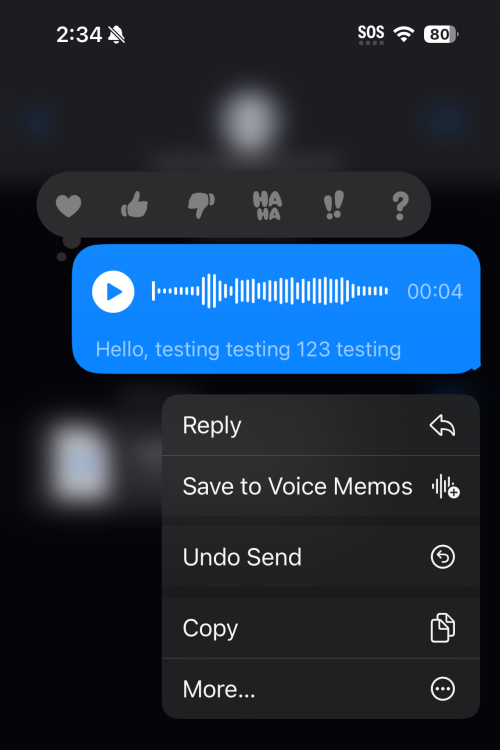
Once you’re done recording and send the audio message, the audio transcript will appear below the waveform. For longer audio messages, the transcript might get cut off behind a “Show More option.” Tap that to expand the audio transcription and read the message in full.

An iOS screenshot showing a transcription of a short audio message

Credit: Sachin Bahal

If you get a particularly good audio message and want to hang onto it, long-press the audio message and tap “Save to Voice Memos.” Keep in mind that audio message transcriptions are automatically enabled once your iPhone downloads and installs iOS 17. At this time, it’s not possible to disable the feature.


Source: LifeHacker – How to Use Audio Message Transcriptions in iOS 17

Genetic Data On 500,000 Volunteers In UK To Be Released For Scientific Study

An anonymous reader quotes a report from The Guardian: A new era of medical discoveries, treatments and cures is on the horizon, researchers say, following the announcement that an unprecedented trove of genetic information is to be made available to scientists. Health researchers from around the world can now apply to study the whole genomes of half a million people enrolled in UK Biobank, a biomedical research project that has compiled detailed health and lifestyle records on individuals since it began 20 years ago. The move on Thursday amounts to the largest number of whole-genome sequences ever released for medical research. The sequences will be used with UK Biobank’s records and other data to delve deeply into the genetics of everything — from people’s risk of obesity, diabetes, heart disease, cancer and other conditions, to individuals’ sleep and exercise patterns.

Researchers believe the new data will allow them to calculate people’s individual risk scores for a raft of cancers and other diseases, and so work out who could benefit most from early screening. They should also gain a deeper understanding of serious genetic conditions such as Huntington’s and motor neurone disease, which have often been studied in small numbers of severely affected patients. Health experts from academia, the government, industry and charities can apply for access though they have to be approved and study the genomes through a protected database stripped of identifying details such as names, addresses, birth dates, and GP information. “Until 2021 scientists could study only about 1% of the DNA of UK Biobank volunteers — the fraction that encodes proteins,” notes the report. “Since then, whole genomes have been released for 200,000 participants, but work continued to sequence all of the 500,000 volunteers.”

“With that number of whole genomes in hand, researchers will be able to find much rarer genes which drive diseases, including those that behave like switches and turn other genes on and off.”

Read more of this story at Slashdot.


Source: Slashdot – Genetic Data On 500,000 Volunteers In UK To Be Released For Scientific Study