Cloud storage has changed the way we take care of our data. In the past, you needed to backup and transfer files between devices directly, or else you wouldn’t have them in multiple locations. If you took photos on your iPhone or Android, for example, you’d often want to plug it into your computer to make sure those photos were both backed up and easily accessible for sharing with friends, family, and the internet at large.
The problem is, we’ve changed the way we deal with data these days. If you plug your smartphone into your computer expecting to transfer all the photos and videos you see in your photos app of choice, you might be surprised to find that only a fraction of the images actually make their way to your PC. It’s confusing, considering that media is accessible on the phone: Why can it just be a seamless transfer?
Google Photos makes it confusing to know which images are stored on-device
That’s exactly what happened with Reddit user Spax123, who took to the Google Pixel subreddit with the issue. This user was trying to transfer their late wife’s media library from Google Photos on her Pixel to their PC, but only the photos and videos from roughly the last six months would end up on their computer. There was about four and a half years worth of images that were seemingly trapped on her phone, and wouldn’t even appear when he took at a look at her Google Drive account.
This story has a happy ending, though. Redditor degggendorf correctly guessed the rest of the photos and videos in the library were saved to the cloud: Only a recent snapshot of photos were actually saved on the Pixel itself, while the rest were being shown as previews from the cloud. Google doesn’t make it clear that’s what happening here, which easily leads to confusion: If you see all your photos in one place, you naturally assume they’re, well, all in the same place.
How to download Google Photos images from the cloud
The solution? Simply log into Google Photos’ web app. Here, you can access your entire Google Photos library and choose to download any and all of the images here to another location, such as your computer.
If you were only interested in a handful of specific images to transfer, it’s easy to download them on-device. You can choose the image in question, tap the three dots More button, then choose Download. This will pull the image from the cloud and onto your phone, which will then allow it to transfer when you connect your phone to your computer.
If you’ve acquired a new Apple product recently this shopping season, you’ll want to pay special attention to the latest critical update that has been released. While the plethora of new iPhone, iPad, and Mac buyers are enjoying their brand new devices, a potential danger lurks underneath.
It’s been nearly a month since I ran the NYC marathon. I knew that after such an emotional experience, the longer I took to lace up my shoes again, the harder it was going to be. I’ve missed writing my weekly posts about all things marathon training, and now that I’m finally back pounding the pavement, I thought I’d sling a running hack your way.
For me, the toughest part about returning to running after taking time off is establishing a new routine. When you’re not following a strict (well, semi-strict) training plan, what do you do? Especially for people who don’t consider themselves to be runners in the first place—what do you do? There are a lot of reasons someone might struggle to get into running, but I find a top culprit to be a lack of planning. You have to strike a balance between ambition and flexibility, and then actually hold yourself accountable to your plan. Let’s take a look at why the secret to becoming a runner is the strength of your routine, and how you can establish a running routine yourself.
How to establish a running routine
Time and time again, my friends will tell me they’ve started to get into running, only to lose interest (or quit) within a few weeks. The figures vary, but one study suggests that it usually takes around two months of doing something to make it a habit—and a lot of us don’t make it that long. Then again, as Lifehacker senior health editor Beth Skwarecki has explained before, a lot of our talk about “habits” is not actually about habit formation, but behavior change. She provides this example: “You might think of ‘go for a run every morning’ as a simple habit. But there are a lot of things that go into becoming the sort of person who actually finds it simple to go for a run every morning.”
Your routine—and how well you stick to it—is what makes the difference between whether or not you incorporate running into your life in the long term. Here are some tips for becoming the sort of person who finds it simple to go on a run every morning.
Set realistic goals
You are more likely to stick with a running habit if you start with small goals. That may mean holding yourself back a bit, both in terms of pace and distance. (This topic means a lot to me; one of my first posts at Lifehacker was all about how you need to run slower to run faster.)
Don’t expect to complete your first marathon next week if you’re just starting. Give yourself progressive mini-goals to reach like running a mile without walking, being able to jog for 30 minutes continuously, or taking 5-10 minutes off your 5K time. This will help track progress and keep you motivated.
Create calendar events for yourself
Actually schedule your runs as you would other important commitments. It’s easy to make excuses if your running is random or sporadic. Ensure it’s in your calendar like clockwork; mornings are great for avoiding fatigue and life getting in the way later.
Build up gradually, and slow down
I believe the reason so many people claim to hate running is because what they’re actually doing is sprinting. This dooms them to tire out sooner than they’d like—convincing them that they can’t run long distances, and confirming their assumption that “running isn’t for them.”
Respect that your cardiovascular fitness and musculoskeletal systems need time to adapt. Start with short runs mixed with walking once or twice a week and increase duration, distance, and frequency by no more than 10% each week to prevent overuse injuries.
Prep your gear
Prepping gear ahead of time such as your running watch, shoes, weather-appropriate apparel, water bottle, and headphones goes a long way versus scrambling or postponing if you can’t find an item. Being ready to go makes sticking to your routine much more seamless.
Skip the numbers (for now)
Runners are obsessed wearables or apps to monitor metrics like distance, pace, heart rate, and splits. I get it—reviewing patterns provides valuable feedback, exposes strengths and weaknesses, and keeps you striving towards new marks like an upcoming 5K PR.
But if your main goal right now is simply to establish a routine, I suggest you ditch the metrics. Your priority right now is consistency. Try intuitive running and taking it slow, and maybe you’ll even start to like running. Personally, I think there’s nothing more promising for your routine than actually enjoying the routine.
Walmart has seen enough from X. The retailer, America’s single biggest employer and largest company by revenue, toldReuters on Friday it’s no longer advertising on the platform formerly known as Twitter. The departure follows owner Elon Musk amplifying antisemitic posts and flinging expletives at fleeing advertisers. “We aren’t advertising on X as we’ve found other platforms to better reach our customers,” a Walmart spokesperson told Reuters.
Walmart’s exit adds to a growing list of companies that have pulled ads from the platform. Apple, Disney, IBM, Comcast and Warner Bros. Discovery are among the businesses no longer buying ads on X. A group of advertisers toldThe New York Times on Thursday their temporary pauses will likely become permanent. “There is no advertising value that would offset the reputational risk of going back on the platform,” Lou Paskalis, CEO of marketing consultancy AJL Advisory, told the paper.
X’s former advertisers had no shortage of reasons to jump ship. Musk’s latest series of self-inflicted wounds began when the billionaire appeared to endorse and amplify a post falsely claiming Jewish communities were stoking hatred against white people. Musk replied to the user who spewed the racist “Great Replacement” conspiracy theory, saying their comments reflected “the actual truth.”
Michael M. Santiago via Getty Images
Watchdog group Media Matters then published a report showing ads from well-known brands placed next to antisemitic content. X responded by suing the organization, accusing it of “knowingly and maliciously [manufacturing] side-by-side images depicting advertisers’ posts on X Corp.’s social media platform beside Neo-Nazi and white national fringe content.”
Musk’s attempt to smooth things over only made things worse. After apologizing for amplifying the antisemitic content at The New York Times’ DealBook event, he told advertisers backing off of the platform to “Go fuck yourself.” His company now potentially stands to lose $75 million.
Walmart employs around 1.6 million people in the US. The retailer made $611 billion in revenue in the 2023 fiscal year.
This article originally appeared on Engadget at https://www.engadget.com/walmart-says-its-no-longer-advertising-on-x-215940504.html?src=rss
Enlarge/ Federal Communications Commission Chairwoman Jessica Rosenworcel during a House Energy and Commerce Committee Subcommittee hearing on March 31, 2022, in Washington, DC. (credit: Getty Images | Kevin Dietsch )
A federal program that provides $30 monthly broadband discounts to people with low incomes is expected to run out of money in April 2023, potentially taking affordable Internet service plans away from well over 20 million households.
For months, supporters of the Affordable Connectivity Program (ACP) have been pushing Congress to give the Federal Communications Commission more funding for the program. FCC Chairwoman Jessica Rosenworcel urged lawmakers to act yesterday during a House Communications and Technology Subcommittee hearing.
In an opening statement, Rosenworcel said the ACP is providing discounts for over 22 million households. The FCC expects that number to reach 25 million by April, when the program would run out of money.
Many of the most popular productivity methods only really work if you know how much time each task is going to take you: Timeboxing, the Eisenhower matrix, Kanban, the Ivy Lee method, and others expect you to be able to plan for the precise amount of time a given project is going to suck from your day. If you estimate wrong, the whole plan kind of falls apart and you’re left feeling discouraged and, well, unproductive. That’s where time trackers come in to help. Here are some of the best ones you can use when doing daily tasks to figure out how many of your precious waking hours are devoted to all the stuff you have to do.
If you want to be detailed: Clockify
I’ve recommended Clockify for tracking your New Year’s goals already, but it’s a longtime leader in the field. Lifehacker recommended it for tracking your time as far back as 2009, and it’s only improved since then. On the landing page, you’re greeted with a button that says, “START TRACKING TIME — IT’S FREE!” While Clockify does have a subscription model, if you want to be detailed in your time-tracking, you can just use the free version. It’s famous for being a timesheet app, but it allows you to track the minutes of all your work, producing a summary report for each day. (The reports can also tell you how much money was earned per project, how much money was spent per project, and all kinds of other relevant information.) You can even track time offline and it will appear in your account once you reconnect.
If you want simplicity: TogglTrack
TogglTrack lets you use all of its premium features for free for a month (and a basic version is always free), and it’s simple to use. Other trackers have a learning curve or a steep price, which you don’t have time for when you’re trying to get things done, so this one is a pleasant surprise. I was able to quickly create a project (“Working on articles”) and then add a task (“Time-tracker article”) and put in an estimate of how long I thought it would take me. I hit a button next to the task and a timer started. Eventually, if I kept at it, my dashboard will fill up with my total hours of work, showing me just how much time I really spent. The free version is geared toward freelancers and works for up to five team members, who can use time tracking, a timeline, auto-tracking, idle detection, a pomodoro timer, and over 100 integrations with other software. For $9 per month, teams get all that plus billable rates, time rounding, time estimates, broken-out tasks, and project templates. An $18/month premium subscription will get you schedule reports, time audits, insights, and project and admin dashboards.
To go at your own pace: TrackingTime
TrackingTime is nice because it has a few different functionalities. It can track you automatically or give you the option to block out time within the software, letting you see (and edit, of course) what needs to be done and how long you have to do it. It integrates with over 50 apps and other softwares so you can track while you work instead of opening TrackingTime to mark it down, and there’s a mobile app so you can take it on the go. Tracking time is free, but if you want to incorporate things like AutoTrack and desktops apps, it’ll be $8 per month.
If you really don’t want to put effort into this: Timely
Timely is automated, so if you truly do not want to waste time tracking it, here you go. The software makes what it calls “memories” of everything you do on your computer, like software you use or websites you visit‚ and whenever you want, you can just drag and drop the memories into your pre-defined tasks. You don’t have to put every site you visit into the tasks; it’s all private and what you highlight is up to you—you can always toggle it off when you want to visit a certain site. It’s $11 per month to automate your time tracking, categorize time with an AI feature, and make reports, but $20 if you want to sync other project management tools. Just bear in mind this might not be the best option for you if a lot of your work takes place off the computer.
If you need help staying on task: RescueTime
RescueTime is a time tracker that not only tracks your work, but kind of forces you to stay on it. This is helpful if you keep getting distracted and can make it easy to see how much time a task takes, instead of how much time a task plus all your forays away from the task take. You download the monitoring app to your computer and it collects data on your usage, but it chimes in if you appear distracted or like you’re doing too many things at once. You can even tell the software how much “Focus Work” (or deep work) you want to get done in a day and, once you toggle on a Focus Session, it will block websites you’ve pre-identified as distracting. There is a free version, but you’ll pay $12 per month if you want to see past data, integrate a calendar, or use Focus Sessions.
OpenAI is delaying the launch of its GPT Store, a marketplace of customizable GPTs, until 2024, according to a memo seen by Axios. Sam Altman told an audience at DevDay that the GPT Store would launch in November.
Enlarge/ An artist’s impression of a human and a robot talking. (credit: Getty Images | Benj Edwards)
In a preprint research paper titled “Does GPT-4 Pass the Turing Test?”, two researchers from UC San Diego pitted OpenAI’s GPT-4 AI language model against human participants, GPT-3.5, and ELIZA to see which could trick participants into thinking it was human with the greatest success. But along the way, the study, which has not been peer-reviewed, found that human participants correctly identified other humans in only 63 percent of the interactions—and that a 1960s computer program surpassed the AI model that powers the free version of ChatGPT.
Even with limitations and caveats, which we’ll cover below, the paper presents a thought-provoking comparison between AI model approaches and raises further questions about using the Turing test to evaluate AI model performance.
British mathematician and computer scientist Alan Turing first conceived the Turing test as “The Imitation Game” in 1950. Since then, it has become a famous but controversial benchmark for determining a machine’s ability to imitate human conversation. In modern versions of the test, a human judge typically talks to either another human or a chatbot without knowing which is which. If the judge cannot reliably tell the chatbot from the human a certain percentage of the time, the chatbot is said to have passed the test. The threshold for passing the test is subjective, so there has never been a broad consensus on what would constitute a passing success rate.
According to Axios, OpenAI is delaying the launch of a GPT store until early next year. The store was expected to open last month. From the report: OpenAI’s announcement of custom GPTs and the accompanying store was a highlight of last month’s DevDay conference. “We are now planning to launch the GPT Store early next year,” OpenAI said in the memo. “While we had expected to release it this month, a few unexpected things have been keeping us busy!”
For now the custom GPTs can be shared directly via a link. With the store, developers will be able to distribute them more broadly and OpenAI has also said it plans to share some revenue it gets from ChatGPT Plus subscriptions with those who create popular GPTs, though it has yet to release details. “In the meantime, we will have some other great updates to ChatGPT soon,” the company told developers. “Thank you for investing time to build a GPT.”
Removing the layers of limescale, soap scum, and that gross pink film from your shower head not only provides you with some satisfying before-and-after photos, but it can also noticeably improve your overall showering experience. After all, who doesn’t want better water pressure?
But what if you go through your usual cleaning process of soaking and scrubbing, then turn on your shower to discover that the water pressure hasn’t improved, and the stream of water is still inconsistent and sputtering? Before rushing out to buy a new shower head, try removing the one you currently have and cleaning the filter screen hidden inside. That’s right: Even if the outside of your shower head is spotless, there may be a small, round screen that’s caked in mineral buildup and sabotaging your shower. Here’s how to find and clean it.
Where to find the filter screen inside your shower head
Technically, this hidden filter is located between your shower head and the water pipe sticking out from your shower wall. But even if you were to remove your shower head to either replace it or clean its exterior, you may not notice the little screen sitting there. Or, maybe you did see it, but thought it was part of the flow restrictor (they’re not). For reference, flow restrictors are roughly the same size as filter screens, but instead of a small, round piece of mesh, they’re a small, round piece of usually blue or green plastic with a hole and/or slightly larger openings.
To find your filter screen, remove your shower head. Sometimes you can simply twist it counterclockwise by hand and it’ll come right off. If not, place a rag over the part that connects the shower head to the pipe and then use a wrench or a pair of pliers to twist counterclockwise until the shower head comes off. The filter screen should be inside. If you have a detachable shower head, the filter screen is probably inside a connector piece at the end of the hose that attached to the water pipe.
Here’s what mine looks like:
Credit: Elizabeth Yuko
How to clean your shower head’s filter screen
Take a peek inside your shower head; if there’s any loose mineral deposits or debris, empty them into a garbage can.
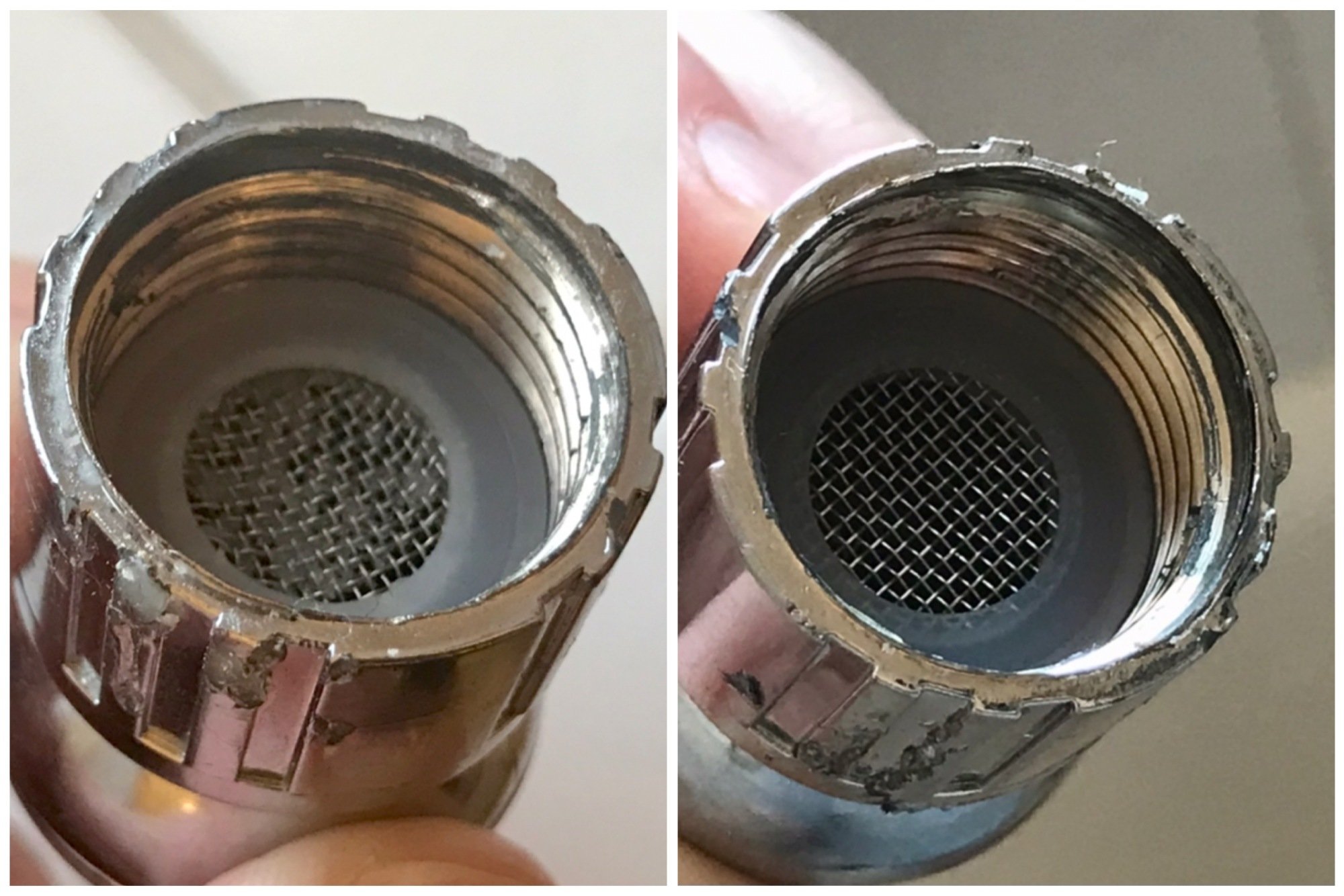
Next, remove the filter screen. If you’re unable to remove the screen with your finger, try needle-nose pliers. But if those don’t work right away, leave it where it is and do your best to clean it in place.
Start by rinsing the screen with warm water. Then, use a toothbrush to scrub away any buildup, followed by a toothpick or sewing needle to unclog any of the tiny openings in the screen (if necessary). If there’s still grime and mineral buildup, soak the screen in a small cup of either half warm water and half white distilled vinegar, or warm water with a pinch of citric acid for 10 minutes, then try again. If you were unable to remove the screen from the shower head, add a few drops of your solution of choice, let it sit for a minute, then go back in with the toothbrush then the toothpick or needle.
Here’s mine, before and after I cleaned it:
Credit: Elizabeth Yuko
Repeat the process until your screen is as clean as you can get it, then pop it back in and reattach your shower head. If you had previously used plumber’s tape on the pipe threads, remove it and any residue from the threads (grooves) at the end of the water pipe. Replace it with some new plumber’s tape, then screw in the shower head. (This Lifehacker post from May has more detailed instructions if you need them.)
The final month of 2023 is here, and with it, one more batch of Lego sets to tempt your wallet (or get stuck under the Christmas tree). From big hits in the Modular Buildings line to Shadow the Hedgehog’s Lego debut, there’s something for everyone, even if there’s not all that many new kits.
The Game Awards got it wrong this year. One of the titles nominated for Best Independent Game, Dave the Diver, was produced by Nexon, one of the largest video game studios in South Korea. No matter how hard you squint, it is not indie. Dave the Diver is an excellent pixel-art game about deep-sea fishing and restaurant management, but it was commissioned and bankrolled by Nexon subsidiary Mintrocket, with billions of dollars and decades of experience at its back.
When The Game Awards nominees were announced on November 13, fans were quick to point out the error, and the recurring debate over what “indie” means was reignited. Taehwan Kim, Nexon’s overseer of Mintrocket, weighed in on November 14, saying Dave the Diver “may look like an indie, but it’s not necessarily the case.” The official tweet listing the nominees for Best Independent Game now carries a reader-generated context tag reading, “Dave the Diver is not an indie game. Mintrocket, the game’s developer, is a subsidiary of Korea’s biggest game company Nexon. They are not independent in any sense of the word.”
Nexon
A discussion around the definition of “indie” bubbled up throughout November, but it raised more questions than it answered. One common conclusion was that the media outlets who voted Dave the Diver into the independent category were fooled by its pixel art, a style that’s associated with indie games. During a live Q&A on Twitch on November 26, The Game Awards organizer Geoff Keighley argued that “independent” was a broad term with an unknowable definition, before essentially saying Dave the Diver’s inclusion in the indie category was the jury’s fault.
Specifically, Keighley said the following: “It’s independent in spirit and [it’s] a small game with a, I don’t know what the budget is, but it’s probably a relatively small-budget game. But it is from a larger entity, whereas there are other games on that list that are from much smaller studios. Even like Dredge I think is published by Team17, so is that independent or not because you have a publisher? It’s a really complicated thing to figure out and come up with strict rules around it, so kinda we let people use their best judgment. And you can agree or disagree with the choices, but the fact that Dave the Diver was on that list meant that, out of all the independent games the jury looked at, or what they thought were independent games, that was one of the top five they looked at this year.”
The jury comprises 120 media outlets (Engadget has traditionally been one of these, but we did not participate in voting this year and look what happened), so Keighley is chalking the mistake up to mass hysteria and moving on. Meanwhile, there’s still little consensus on what constitutes an indie game, at The Game Awards or elsewhere.
Nexon
I’ve reported on video games for 13 years and indies are a central theme of my coverage. I ran The Joystiq Indie Pitch back in the day, and I’ve made a concerted effort to write about smaller games from creators working outside of the mainstream machine, because these are the experiences that speak to me personally. The indie scene is the source of the industry’s magic. This isn’t just a debate about language — “indie” is a distinction that identifies which games and teams need outside support to survive and expand on their innovations. Understanding the label can help players make decisions about where to spend their money, the lifeblood of any game-development studio.
All that to say, the debate over the definition of “indie” is not new, but it is constantly changing, and it’s something I’ve spent a lot of time contemplating. So, I’m here to offer guidance on the question of what makes an indie game or studio indie. It is a weirdly complicated topic and my approach is one of many, but the loose framework I use could help resolve some common, recurring arguments.
Basically — it’s all about the system, man.
I’m joking, but also I’m not. Generally, when I’m trying to decide whether something is actually indie, I rotate through three questions:
Is the team on the mainstream system’s payroll?
Is the game or team owned by a platform holder?
Do the artists have creative control?
The first question is about identifying where a studio’s money is coming from and what kind of support a game has outside of sales. If a team is wholly owned by another company of any size, it is not indie. We’re not talking about publishing deals; this opening question is about acquisitions or subsidiaries of bigger studios. Dave the Diver is a prime example here — it’s developed by Mintrocket, a subsidiary of Nexon that was created just to develop more contained, experimental games for the publisher. Dave the Diver is definitely not indie, and we’re only on question one.
The second query feeds into the first, and it’s helpful in making fine distinctions about games that exist in gray areas. What about something like Cyberpunk 2077? It’s a big-budget game built by CD Projekt RED (CDPR) — a studio that, at first glance, seems like it could be indie. However, there are two factors that take it out of the running for me. First, CD Projekt, the umbrella organization that supports CDPR’s game-making, is a publicly traded company with shareholders and a board to answer to. Second, CD Projekt is the owner of GOG, a distribution hub that allows the studio to sell its own games and DLC outside of Steam and the Epic Games Store. This ability to sell directly to players at massive scale takes CD Projekt out of the indie realm. Generally, companies with the most influence and money are console makers and platform holders like Valve, Xbox, PlayStation, Epic Games, Ubisoft, EA, and, yes, CD Projekt. They are the AAA system, and anything they own is not indie.
Nexon
Lastly, on to publishers. Sorry, Keighley, but securing a publisher has very little to do with whether a game is indie nowadays. We’re blessed in 2023 to have a thriving indie industry constantly pushing against the AAA complex with different goals, more diverse voices and a broader sense of innovation — and publishing is a big part of this system. Today, indie-focused publishers (of which there are many) tend to include clauses that protect a developer’s creative vision, preventing the larger company from interfering with artistic decisions and keeping the game indie to the core. Once upon a time, it might’ve made sense to only consider self-published games indie, but that era is long gone.
The indie scene has evolved massively since the early 2010s, when games like Braid, Super Meat Boy and Fez were carving out the market’s modern form. Back then, self-publishing was all the rage for independent developers because it was often their only option, and as a result there were more distinct lines between AAA, AA and indie games. Devolver Digital found its first breakout hit as an indie publisher with Hotline Miami in 2012, and that’s around the time the floodgates opened. In 2014, as the industry’s largest companies started funding and publishing programs for them, the number of indie games skyrocketed across platforms including Steam (remember Greenlight?), the App Store, Xbox, PlayStation and Ouya (RIP).
Today, indie games come standard on every console. There are multiple indie-focused publishers, including Devolver, Annapurna Interactive, Panic, Raw Fury, Team17 and Netflix, and most of them offer complete creative freedom as a main selling point. Meanwhile, platform holders like Sony and Xbox are hungry to sign distribution deals with developers of all sizes in an effort to score exclusives and pad their streaming libraries. It’s the most stable (and crowded) the indie scene has ever been. Having a publisher has no bearing on whether a game is indie.
Being owned by a publisher, however, changes everything (see question one). This is more of a concern than ever, as platform holders like Microsoft, Sony and Epic Games have recently been buying studios they like, no matter their size. Hell, even Devolver has dipped its toes in the acquisition pond recently — which, yeah, means those teams are no longer indie.
Nexon
The “indie” label is transitory. Certain studios can be indie but an individual game may not be, and plenty of small companies flow between states as they age and take advantage of growth opportunities. Bungie, for example, started out as an independent outfit, then it was absorbed by the AAA complex under Xbox, and then it broke free and was briefly indie again, before Sony pulled it back into the mainstream system’s cold embrace.
So, yeah, that’s my way of determining if a game or studio is indie. By all means, take my triplet of questions and have fun trying to break the logic — it probably won’t take long. There is no perfect structure here and there are plenty of outliers within my own framework. Alan Wake II, according to my questions, would be considered an indie game — but its developer, Remedy Entertainment, is a publicly traded company, which brings shareholders and a board of directors. This pushes the studio and the game into The System for me, but honestly, I’m still unsure about those labels as I type this. That’s OK — when all else fails, look inside your game-loving soul and ask, can this team exist without my support? (Alan Wake II, for what it’s worth, is a delicious and unique experience that’s worth playing, regardless of your feelings on Remedy’s shareholders).
Does Mintrocket need my support to keep Dave the Diver and its creative team going? Probably not, and definitely not in the same way as Larian Studios, the independent developer and publisher of Baldur’s Gate 3. Baldur’s Gate 3 is an excellent, expansive 3D adventure from an indie studio and it’s up for Game of the Year at The Game Awards, but it was snubbed in the Best Independent Game category. Meanwhile, Dave the Diver, a cute title backed by billions of dollars, is up for the indie award, but not Game of the Year. It seems like The Game Awards jury made the classic mistake of seeing pixel art and immediately calling it indie. That’s an unforced error, but it reveals one point where we can all agree:
Indie is not an aesthetic.
This article originally appeared on Engadget at https://www.engadget.com/the-game-awards-raises-an-old-question-what-does-indie-mean-205211035.html?src=rss
Google’s new generative AI experiment lets you create music “inspired by” over 100 instruments worldwide. Instrument Playground starts by asking for a simple prompt containing a musical instrument’s name, optionally preceded by an adjective like “upbeat,” “strange” or “gloomy.” It will then spit out a 20-second audio clip as a starting point to compose (often extremely offbeat or abstract) music that may or may not include the sound of the specific instrument you entered.
Simon Doury, an Artist in Residence at Google Arts & Culture Lab, designed the experiment. It taps into Google’s MusicLM, a text-to-AI tool it made available to the public in May.
Instrument Playground invites you to “choose one of over 100 instruments from around the world you’d like to play,” suggesting some lesser-known to Americans like the veena from India, dizi from China or mbria from Zimbabwe. Meanwhile, prefixing your instrument prompt with an adjective lets you suggest styles like “moody,” “happy” or “romantic.”
The experiment works less literally than you might expect. For example, “angry tuba” doesn’t generate the aggressive brass solo you’d expect. Instead, it sounds more like a synthesized pipe organ with tuba aspirations. Similarly, “strange didgeridoo” came out like an ominous section of a Hans Zimmer score. The results seem like abstract compositions with layers of sound that (sort of) capture the feeling — more than the specific sound — of the prompt.
It also rejects some adjectives for inexplicable reasons. When I enter “quirky” or “psychedelic,” an error pop-up tells me it doesn’t allow prompts referencing specific artists.
Once the experiment generates a clip you like for a starting point, you can choose from “Ambient,” “Beat” and “Pitch” to control different aspects of the composition, turning it into something more uniquely yours. If you want to add more instruments (or whatever sounds it makes in response to instrument-based prompts), an advanced mode opens a sequencer to layer and loop up to four tracks for your oddball musical masterpiece. Finally, you can download a .wav file of your track once you’re happy with it.
Google included the following holiday-themed example to inspire you to get started. If that looks like something you want to play with, you can visit Instrument Playground and log in with your Google account to begin composing.
This article originally appeared on Engadget at https://www.engadget.com/googles-new-ai-experiment-composes-abstract-musical-clips-inspired-by-instruments-203732054.html?src=rss
Cold weather poses a problem for lithium batteries—they can lose their charge more quickly and also become unable to charge as temperatures drop. This is because the chemical reaction in a lithium ion battery will slow down when the temperature drops below about 40 degrees. If you have battery powered snow-removal tools or if you just have outdoor home projects you need to tackle when it’s cold outside, this can be frustrating. It’s more than frustrating when you take into account that charging batteries outside of the safe charging temperature range can damage them permanently. Here are some steps to take to keep your batteries working, even when the mercury drops.
Store batteries indoors
First, you should store your tool batteries in a climate-controlled environment during the cold winter months. If you have an unheated garage, you should bring batteries and chargers indoors to avoid damage, but also to avoid the step of warming batteries up before charging them. This will help you prevent the most common type of winter battery damage, which is caused by attempting to charge batteries in temperatures below 40 degrees. Also, getting a full charge is the first step to extending battery life later on.
Use the pocket method
When you’re not using tools outdoors, you can use the pocket method to keep them warm. Slipping idle batteries or spares into a coat pocket, or better yet, an inside pocket closer to your body, will help them stay warm and avoid losing charge when they’re not in use. Using your own body heat has the added benefit of being free, but it’s limited by the number of pockets you have for carrying capacity. If you’re using a larger tool that requires multiple batteries, you might need something a little more advanced.
Keep tools running when the batteries are in
When you’re using your tools, keeping them running while they’re in the cold will warm up the batteries a little bit—but the downside is that running the tools all the time also reduces battery life. For a short job, or for snow-removal tools like snow blowers, this might be okay, but for longer-term cold-weather use, you’ll need to take more steps to keep the battery juice flowing.
Use a battery cover
When tools are in use, consider using a battery cover to help keep tool batteries warm. These are usually made from silicone, but you can also fashion one out of neoprene foam or another flexible insulation material. Adding covers to your batteries does make battery changing a clumsy affair, but if the insulation buys you some more battery life, you won’t need to swap them out as often.
Use a cooler
To charge batteries outdoors, or to keep batteries in the temperature range where they will hold a charge, using an insulated lunch bag or a cooler to keep them warm can work wonders. A soft-sided lunch bag can accommodate charged batteries, but you can also run the cord for a charger through the opening, zip it closed around the cord, and use a battery charger inside the bag to avoid damaging the battery during charging. With a hard-sided cooler, you’ll need to cut slots in the lip around the top of the cooler between the sides and the lid to accommodate cords for chargers, but these can be excellent for containing heat during charging.
Use hand warmers
Using hand warmers as a back-up heat source or when the temperature is extremely cold can also help, and can be used in conjunction with both the pocket and the cooler method of battery insulation. There are both disposable and reusable hand warmers, so you can choose whichever one works best for your conditions. While you don’t want your batteries to get too hot (over 100 degrees), some instances call for external heat sources. You can toss a hand warmer into your battery insulation cooler, or you can use one in your pocket if you notice that the batteries are getting chilly.
An anonymous reader quotes a report from the Associated Press: City lawmakers in Brazil have enacted what appears to be the nation’s first legislation written entirely by artificial intelligence — even if they didn’t know it at the time. The experimental ordinance was passed in October in the southern city of Porto Alegre and city councilman Ramiro Rosario revealed this week that it was written by a chatbot, sparking objections and raising questions about the role of artificial intelligence in public policy. Rosario told The Associated Press that he asked OpenAI’s chatbot ChatGPT to craft a proposal to prevent the city from charging taxpayers to replace water consumption meters if they are stolen. He then presented it to his 35 peers on the council without making a single change or even letting them know about its unprecedented origin.
“If I had revealed it before, the proposal certainly wouldn’t even have been taken to a vote,” Rosario told the AP by phone on Thursday. The 36-member council approved it unanimously and the ordinance went into effect on Nov. 23. “It would be unfair to the population to run the risk of the project not being approved simply because it was written by artificial intelligence,” he added. […] Keeping the proposal’s origin secret was intentional. Rosario told the AP his objective was not just to resolve a local issue, but also to spark a debate. He said he entered a 49-word prompt into ChatGPT and it returned the full draft proposal within seconds, including justifications.
“I am convinced that … humanity will experience a new technological revolution,” he said. “All the tools we have developed as a civilization can be used for evil and good. That’s why we have to show how it can be used for good.” And the council president [Hamilton Sossmeier], who initially decried the method, already appears to have been swayed. “I changed my mind,” Sossmeier said. “I started to read more in depth and saw that, unfortunately or fortunately, this is going to be a trend.”
Akihabara News (Tokyo) — Japanese casino mogul Kazuo Okada is out in the cold once again with another major legal defeat, while those whom he regards as his betrayers have been on a winning streak.
Billionaire Okada’s ill fortunes began in early 2017 when he was accused of embezzlement at his own Universal Entertainment Corporation. His ex-wife and own children voted him out of authority over the pachinko and gambling company which he had founded.
After a long series of legal defeats in Japan and elsewhere, Okada finally scored a stunning victory in late April 2022 when the Supreme Court of the Philippines issued a shocking order that Tiger Resort, Leisure & Entertainment, Inc. (TRLEI), the management company for the Okada Manila casino resort (which is owned by Universal), was obliged to restore the company leadership to the state that it was in before Okada had been removed.
Okada, however, overreached by ordering a dramatic invasion and physical occupation of Okada Manila, compete with thugs dragging rival Japanese businessmen out of the building by force. This occupation was overturned–again by force–three months later when the other side sent in security guards backed by the Philippine National Police.
This week Universal announced that it has now won the legal battle completely; the Supreme Court has reversed its order of April 2022, thus denying Okada any authority over TRLEI and Okada Manila.
“With this resolution, this litigation has been concluded,” Universal announced in a press release.
Tokyo-based Universal is has been riding high. In September it defeated a lawsuit launched by prospective partner 26 Capital Acquisition Corporation over a October 2021 agreement which would have seen the Okada Manila casino resort listed on the Nasdaq stock market in New York. 26 Capital Acquisition Chairman and CEO Jason Ader had become aggrieved when Universal delayed and eventually pulled out of the merger agreement, citing alleged misconduct on the part of the Miami-based special purpose acquisition company.
A Delaware court came down firmly on Universal’s side, agreeing that 26 Capital had “engaged in conduct that should not be rewarded” and therefore ruled that Universal was free to terminate the unwanted merger agreement.
In September, 26 Capital announced its own liquidation.
Broadcom announced back in May of 2022 that it would buy VMware for $61 billion and take on an additional $8 billion of the company’s debt, and on November 22 of 2023 Broadcom said that it had completed the acquisition. And it looks like Broadcom’s first big move is going to be layoffs: according to WARN notices filed with multiple states (catalogued here by Channel Futures), Broadcom will be laying off at least 2,837 employees across multiple states, including 1,267 at its Palo Alto campus in California.
As Channel Futures notes, the actual number of layoffs could be higher, since not all layoffs require WARN notices. We’ve contacted Broadcom for more information about the total number of layoffs and the kinds of positions that are being affected and will update if we receive a response. VMware has around 38,300 employees worldwide.
The WARN notices list the reason for the layoffs as “economic,” but provide no further explanation or justification.
A woman was photographed standing in front of two mirrors with an iPhone camera, but the actual photo shows three completely different arm positions. The arms are in different locations in mirror number one, mirror number two and in actual real life. Is it Photoshop? Is it a glitch in the Matrix? Did the woman take a 25-year trip inside of Twin Peak’s black lodge? No, it’s just a computational photography error, but it still makes for one heck of an image.
It all comes down to how modern smartphone cameras deal with photography. When you click that camera button, billions of computational operations occur in an instant, resulting in a photo you can post online in hopes of getting a few thumbs up. In this case, Apple’s software didn’t realize there was a mirror in the shot, so it treated each version of the subject as three different people. She was moving at the instant the photo was taken, so the algorithm stitched the photo together from multiple images. The end result? Well, you can see it above.
Smartphone camera software always pulls from many images at once, combining at will and adjusting for contrast, saturation, detail and lack of blur. In the vast majority of cases, this doesn’t present an issue. Once in a while, however, the software gets a tad bit confused. If it was three different people, instead of one with a mirror, each subject would have been properly represented.
This is something that can actually be recreated by just about anyone with an iPhone and some mirrors. As a matter of fact, there’s a TikTok trend in which folks do just that, making all kinds of silly photos and videos by leveraging the algorithm’s difficulties when separating mirror images from actual people.
This article originally appeared on Engadget at https://www.engadget.com/what-did-an-iphone-camera-do-to-this-poor-womans-arms-201507227.html?src=rss