
It’s not too surprising but the upcoming Ubuntu 26.04 Long Term Support release will be transitioning to OpenJDK 25 as its default Java version…
Newborn Chicks Connect Sounds With Shapes Just Like Humans, Study Finds
An anonymous reader quotes a report from Scientific American: Why does “bouba” sound round and “kiki” sound spiky? This intuition that ties certain sounds to shapes is oddly reliable all over the world, and for at least a century, scientists have considered it a clue to the origin of language, theorizing that maybe our ancestors built their first words upon these instinctive associations between sound and meaning. But now a new study adds an unexpected twist: baby chickens make these same sound-shape connections, suggesting that the link to human language may not be so unique. The results, published today in Science, challenge a long-standing theory about the so-called bouba-kiki effect: that it might explain how humans first tethered meaning to sound to create language. Perhaps, the thinking goes, people just naturally agree on certain associations between shapes and sounds because of some innate feature of our brain or our world. But if the barnyard hen also agrees with such associations, you might wonder if we’ve been pecking at the wrong linguistic seed.
Maria Loconsole, a comparative psychologist at the University of Padua in Italy, and her colleagues decided to investigate the bouba-kiki effect in baby chicks because the birds could be tested almost immediately after hatching, before their brain would be influenced by exposure to the world. The researchers placed chicks in front of two panels: one featured a flowerlike shape with gently rounded curves; the other had a spiky blotch reminiscent of a cartoon explosion. They then played recordings of humans saying either “bouba” or “kiki” and observed the birds’ behavior. When the chicks heard “bouba,” 80 percent of them approached the round shape first and spent an average of more than three minutes exploring it compared with an average of just under one minute spent exploring the spiky shape. The exploration preferences were flipped when the chicks heard “kiki.”
Because the tests took place within the chicks’ carefully supervised first hours of life outside their eggshell, this association between particular sounds and shapes couldn’t have been learned from experience. Instead it may be evidence of an innate perceptual bias that goes back way farther in our evolutionary history than previously believed. “We parted with birds on the evolutionary line 300 million years ago,” says Aleksandra Cwiek, a linguist at Nicolaus Copernicus University in Toru, Poland, who was not involved in the study. “It’s just mind-blowing.”


Read more of this story at Slashdot.
Meta “Explicitly Separating” Horizon Worlds From Quest & Focusing On Third-Party Apps
Meta published a blog post for developers wherein it lays out its new strategy for the Quest ecosystem and Horizon Worlds, taking the two in separate directions.
Titled ‘Our Renewed Focus in 2026’ and written by the VP of Content at Meta Reality Labs, Samantha Ryan, much of the post repeats what CTO Andrew Bosworth has already said in a series of public interviews and Instagram “ask me anything” sessions in recent weeks.
Meta CTO Explains Layoffs & Strategy Shift: “VR Is Growing Less Quickly Than We Hoped”
In a series of interviews at Davos, Meta CTO Andrew Bosworth explained why the company is reducing its investment in VR.
 UploadVRDavid Heaney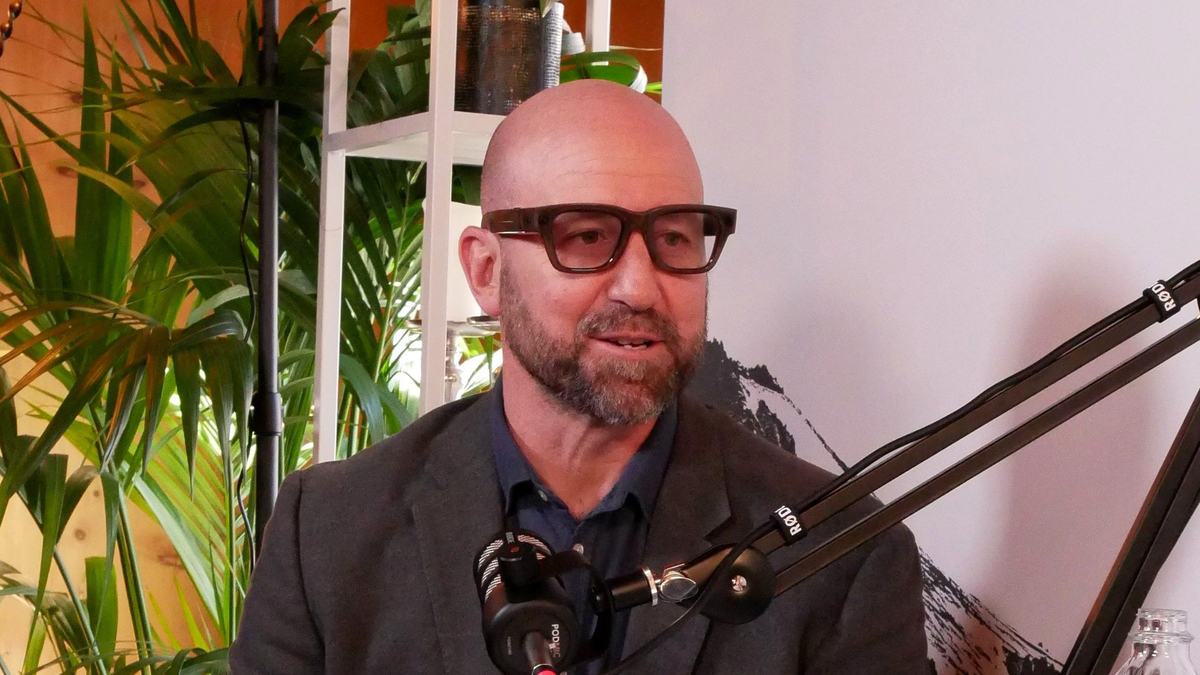
The gist of Meta’s new VR and metaverse strategy, according to its executives, is that Horizon Worlds will become “almost exclusively mobile”, and the platform will no longer be pushed on Quest owners. Meanwhile, on the VR side, Meta will focus on funding and supporting the third-party developer ecosystem instead of putting out its own blockbuster VR games to compete with them.
Meta is removing individual Horizon Worlds destinations from the in-VR store on Quest, Ryan writes, and “separating worlds from the Store” in the smartphone app.
Last month, Meta also announced that Quest’s new ‘Navigator’ UI will soon become the default and the Horizon Feed will be removed, meaning the headset will boot to a grid of your installed apps. Some Quest owners on the Public Test Channel (PTC) have also received a refreshed Navigator that lacks the ‘Worlds’ button.
Quest’s New ‘Navigator’ UI Becoming Default As Horizon Feed To Be Removed
“Starting” in Quest v85, the new ‘Navigator’ UI is becoming the default, and the Horizon Feed will be “gradually” removed from Horizon OS.
 UploadVRDavid Heaney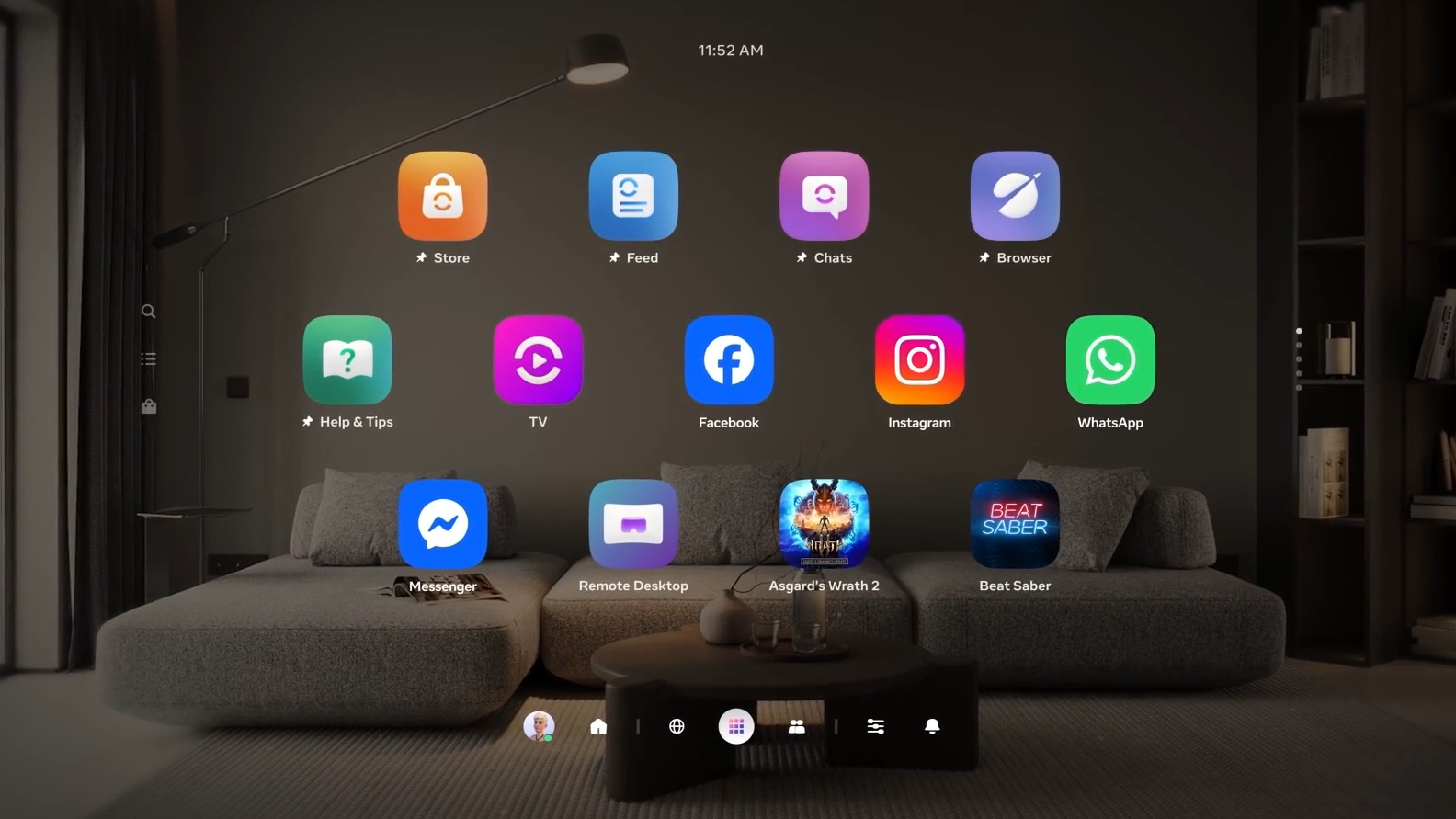
The post also seems to take aim at the gloom and doom discourse around the future of the Quest platform that followed Meta’s shutdown of three of its acquired VR game studios, significant layoffs at a fourth, cancelation of the Batman: Arkham Shadow sequel, and deprecation of Horizon Workrooms and Quest headsets for business offering.
As well as noting that Meta has “a robust roadmap of future VR headsets”, echoing comments from the CFO and CTO, Ryan claims that VR “is still growing”, and that Quest had “a tremendous holiday season that was on par with our 2024 results”.
“Total payment volume on the platform remained similar year-over-year in 2025”, Ryan writes, also noting that Quest headset sales remain “far ahead of all competitors” while Meta remains “the single biggest investor in the VR industry”.
Quest 4 Is Still On The Roadmap, Meta CTO Seemingly Confirms
In an interview with Alex Heath, Meta CTO Andrew Bosworth seemed to confirm the leak that a gaming-focused Quest 4 is still on the roadmap.
 UploadVRDavid Heaney
In what seems to be an attempt to reassure developers, Ryan claims Meta is “focused on supporting the third-party developer community” through “strategic partnerships and targeted investments”.
Last year multiple new VR games earned millions of dollars of revenue on the platform, Ryan claims, including UG, Hard Bullet and The Thrill of the Fight 2.
“While we’re proud of the world-class work from Oculus Studios over the years, among 1P and 3P apps, 86% of the effective time people spend in their VR headsets is with third-party apps”, Ryan notes.
Ryan also claims that in 2025 Meta invested “nearly $150 million in VR developer programs”.
Meta CTO: We’re Still Investing More In VR Content Than Anyone Else
Meta CTO Andrew Bosworth claims that even after the cuts, the company is still investing more in VR content than anyone else, and more than it was 4 years ago.
 UploadVRDavid Heaney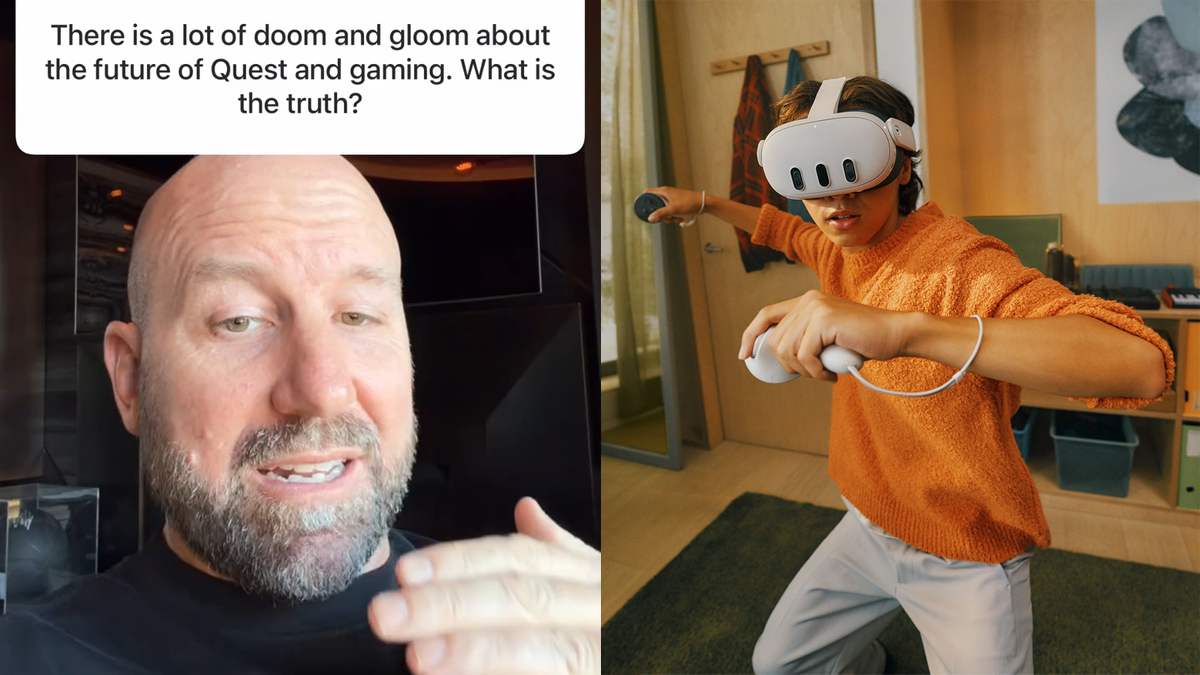
Of course, words are cheap, and since acquiring Oculus almost twelve years ago, Meta’s VR strategy has constantly shifted under developers’ feet. Many will be weary of this instability, and UploadVR will keep a close eye on the Quest platform in the wake of Meta’s latest change of direction.
Here’s Why Some People Think The Viral AI Fight Between Tom Cruise And Brad Pitt Was Kind Of A Scam

New evidence suggests that a viral “AI-generated” video might have just been face replacement
US Plans Online Portal To Bypass Content Bans In Europe and Elsewhere
The U.S. State Department is reportedly developing a site called freedom.gov that would let users in Europe and elsewhere access content restricted under local laws, “including alleged hate speech and terrorist propaganda,” reports Reuters. Washington views the move as a way to counter censorship. Reuters reports: One source said officials had discussed including a virtual private network function to make a user’s traffic appear to originate in the U.S. and added that user activity on the site will not be tracked. Headed by Undersecretary for Public Diplomacy Sarah Rogers, the project was expected to be unveiled at last week’s Munich Security Conference but was delayed, the sources said. Reuters could not determine why the launch did not happen, but some State Department officials, including lawyers, have raised concerns about the plan, two of the sources said, without detailing the concerns.
The project could further strain ties between the Trump administration and traditional U.S. allies in Europe, already heightened by disputes over trade, Russia’s war in Ukraine and President Donald Trump’s push to assert control over Greenland. The portal could also put Washington in the unfamiliar position of appearing to encourage citizens to flout local laws.


Read more of this story at Slashdot.
California’s New Bill Requires DOJ-Approved 3D Printers That Report on Themselves
California’s recently-proposed AB-2047 would require 3D printers sold in the state to be DOJ-approved models equipped with “firearm blocking technology,” banning non-certified machines after 2029 and criminalizing efforts to bypass the software. Adafruit notes that unlike similar legislation proposed in Washington State and New York, California’s version “adds a certification bureaucracy on top: state-approved algorithms, state-approved software control processes, state-approved printer models, quarterly list updates, and civil penalties up to $25,000 per violation.” From the report: Assembly Member Bauer-Kahan introduced AB-2047, the “California Firearm Printing Prevention Act,” on February 17th. The bill would ban the sale or transfer of any 3D printer in California unless it appears on a state-maintained roster of approved makes and models… certified by the Department of Justice as equipped with “firearm blocking technology.” Manufacturers would need to submit attestations for every make and model. The DOJ would publish a list. If your printer isn’t on the list by March 1, 2029, it can’t be sold. In addition, knowingly disabling or circumventing the blocking software is a misdemeanor.
[…] As Michael Weinberg wrote after the New York and Washington proposals dropped⦠accurately identifying gun parts from geometry alone is incredibly hard, desktop printers lack the processing power to run this kind of analysis, and the open-source firmware that runs most machines makes any blocking requirement trivially easy to bypass. The Firearms Policy Coalition flagged AB-2047 on X, and the reactions tell you everything. Jon Lareau called it “stupidity on steroids,” pointing out that a simple spring-shaped part has no way of revealing its intended use. The Foundry put it plainly: “Regulating general-purpose machines is another. AB-2047 would require 3D printers to run state-approved surveillance software and criminalize modifying your own hardware.”


Read more of this story at Slashdot.
Pico To Detail visionOS Competitor For New Headset Next Month
ByteDance’s Pico will detail its competitor to visionOS, which will include a shared-space for 2D and spatial apps to run together, set to debut in its next headset.
We first heard that the owner of TikTok’s VR platform Pico was working on a high-end headset over two years ago, when The Information reported that Pico 5 had been canceled in favor of a short-term Pico 4 refresh and a longer-term Apple Vision Pro competitor called Project Swan.
Now, Pico has listed a GDC 2026 talk titled ‘Bring Your Apps and Games to General Spatial Computing with Project Swan’, set to take place on March 12.
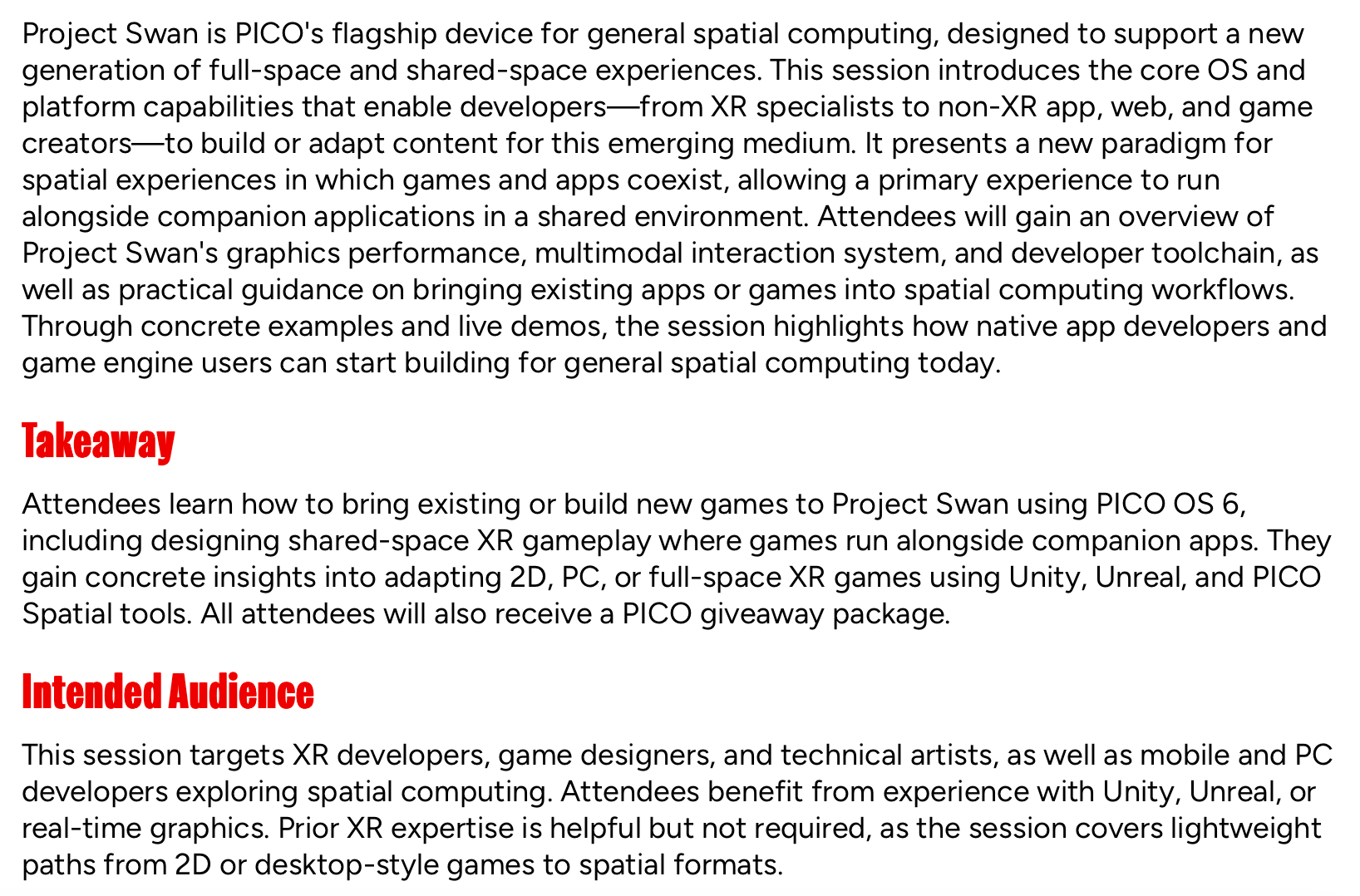
The listing says the talk will guide developers through building or porting games to its upcoming “flagship device for general spatial computing”, running “Pico OS 6”.
Notably, the listing mentions that Pico OS 6 supports “a new paradigm for spatial experiences in which games and apps coexist, allowing a primary experience to run alongside companion applications in a shared environment”. Currently, only Apple Vision Pro’s visionOS supports this concept of an XR shared space, with both 2D windows and 3D volumes, while Meta’s Horizon OS and Google’s Android XR are limited to running one spatial experience at a time.
While the listing describes Pico OS 6, it doesn’t say anything about the upcoming headset itself, other than calling it a “flagship device”. What exactly will it be?
Pico’s 2026 Headset To Have 4K Micro-OLED Displays & R1-Style Chip
Pico’s 2026 headset will have 4K micro-OLED displays and a dedicated R1-style passthrough chip, a ByteDance executive reportedly said.
 UploadVRDavid Heaney
Back in July, The Information reported that Pico was working on an ultralight headset resembling a pair of goggles, with an onboard dedicated image coprocessor and a tethered compute puck, similar to Meta’s next headset.
Then, in November, a Chinese news outlet reported that ByteDance’s Vice President of Technology said that Pico’s 2026 headset will have 4K micro-OLED displays and a dedicated R1-style passthrough chip.
UploadVR’s Mike Johnson and Kyle Riesenbeck will be in attendance at GDC 2026, and we’ve reached out to ByteDance in hopes of going hands-on with Project Swan. We’ll let you know if we get a response.
Oracle Announces New Community Engagement Strategy for MySQL
Oracle outlines a new community engagement strategy for MySQL, promising greater transparency, ecosystem growth, and renewed focus on the Community Edition.
Google Announces Gemini 3.1 Pro For ‘Complex Problem-Solving’
Google has introduced Gemini 3.1 Pro, a reasoning-focused upgrade aimed at more complex problem-solving. 9to5Google reports: This .1 increment is a first for Google, with the past two generations seeing .5 as the mid-year model update. (2.5 Pro was first announced in March and saw further updates in May for I/O.) Google says Gemini 3.1 Pro “represents a step forward in core reasoning.” The “upgraded core intelligence” that debuted last week with Gemini 3 Deep Think is now available in Gemini 3.1 Pro for more users. This model achieves an ARC-AGI-2 score of 77.1%, or “more than double the reasoning performance of 3 Pro.”
This “advanced reasoning” translates to practical applications like when “you’re looking for a clear, visual explanation of a complex topic, a way to synthesize data into a single view, or bringing a creative project to life.” 3.1 Pro is designed for tasks where a simple answer isn’t enough, taking advanced reasoning and making it useful for your hardest challenges.


Read more of this story at Slashdot.
Skate Charging Players To Return To Tutorial Island Despite Promising No Paywalled Locations

Grom is a new location players will be able to skate in March, but only if you pay or grind for free currency
Rumors Suggest Apple and Meta Are Betting Big on AI Wearables
We may earn a commission from links on this page.
The next generation of Meta’s Display smart glasses might come with a smart watch. According to a report from The Information, Meta’s watch, codenamed Malibu 2, could feature fitness tracking features and AI, but its real purpose is to replace the Display’s neural band and act as controller for the smart glasses. If the reports are accurate, Meta Display smart glasses with a smart watch could be available in 2026.
There aren’t any other details on the smart watch, so we don’t know the price or what features it may have—but I’d be surprised if this rumor doesn’t pan out eventually. Meta has discussed the idea of a smart watch before, and it makes sense: If you’re going to have a wrist-controller for your glasses, why not give it smart watch features as well? Especially if a glasses-and-watch combo potentially gives users a reason to switch away from their Apple Watches.
Apple is reportedly working on AI wearables too
Speaking of Apple, if the rumors about the company are true, Apple is pushing to release its own suite of AI-powered wearable devices. According to a report in Bloomberg, Apple could roll out smart glasses in early 2027. The company is also reportedly developing an AI-powered pendant that can “be pinned to a shirt or worn as a necklace,” as well as AirPods with expanded AI capabilities. The AirPods and pendant will be equipped with cameras designed to “help the AI work” as opposed to taking photos. Apple’s smart glasses will reportedly not feature a display, but will feature a higher end camera and superior build quality to Meta’s smart glasses. All of Apple’s devices are reportedly designed to work with iPhones.
Is the wearable war heating up?
None of this is confirmed, of course. The closest Apple has come to announcing these plans is CEO Tim Cook mentioning “categories of products” enabled by artificial intelligence at an all-hands meeting. However, everything points to Meta and Apple betting that consumers want a collection of connected AI-wearables. Each company is taking a different approach to hooking users into their ecosystem. Apple seems to be betting on devices integrated with iPhones and controlled with the kind of camera-based tech that powers the Apple Vision Pro headset. Meta seems to be aiming at replacing phones with an in-glasses display, and a biometric control scheme that works with muscle movements, like the existing neural band.
Both Meta and Apple seem to be competing to go beyond a screen or smart glasses to become the next interface for your life—but do people want that? Are consumers excited enough by the prospect of always-available AI and tied-together devices to buy them? That’s the big question, and the answer is anything but certain. Both Apple and Meta have made big bets on virtual reality, and, despite both companies’ VR devices being excellent, neither seems to have captured the market in way these firms would have liked. So, as they say, stay tuned.
Why I Contributed to FOSS Force’s ‘Independence 2026’ Fundraiser
Ken Starks once wrote here every week. Now he’s back to tell you why FOSS Force still matters, why independence isn’t free, and why he’s chosen to contribute to this year’s drive.
The post Why I Contributed to FOSS Force’s ‘Independence 2026’ Fundraiser appeared first on FOSS Force.
Apple inks deal for IMAX screenings of live Formula 1 races
Formula 1 has been receiving star treatment from Apple for awhile, and now the racing series will literally be getting even bigger. Apple is partnering with IMAX to show five races from the 2026 season. The Miami Grand Prix on May 3, the Monaco Grand Prix on June 7, the British Grand Prix on July 5, the Italian Grand Prix on September 6 and the United States Grand Prix on October 25 will be aired live at select IMAX theaters in the US.
Apple landed a five-year deal for the US broadcast rights to Formula 1 last fall and there’s already a dedicated channel for the car races on Apple TV ahead of the season’s start. It also got the rights for a splashy feature film about the racing league, which amassed more than $630 million at the global box office, including with some IMAX screenings. It’s unclear if IMAX will be paying to host more live F1 races at its theaters in future years, but it should be a fun way for fans to get the most immersive experience possible short of actually attending the racetrack.
This article originally appeared on Engadget at https://www.engadget.com/entertainment/apple-inks-deal-for-imax-screenings-of-live-formula-1-races-234003582.html?src=rss
Meta’s metaverse is going mobile-first
Meta is formally sectioning off Horizon Worlds, the closest thing it has to a metaverse, from its Quest VR platform, according to a new blog post from Samantha Ryan, Meta’s VP of Content, Reality Labs. While the decision runs counter to Meta’s original plan to own an immersive virtual world that could serve as the future home for all online interaction, it fits with the recent cuts it made to its costly Reality Labs division, and Mark Zuckerberg’s public commitment to focus the company on AI hardware like smart glasses going forward.
“We’re explicitly separating our Quest VR platform from our Worlds platform in order to create more space for both products to grow,” Ryan writes in the blog post. “We’re doubling down on the VR developer ecosystem while shifting the focus of Worlds to be almost exclusively mobile. By breaking things down into two distinct platforms, we’ll be better able to clearly focus on each.”
Meta has been developing mobile and web versions of Horizon Worlds in parallel with its VR app since at least 2023. Switching Worlds to being a mobile-first software platform isn’t good for VR diehards, but it does make it a more natural competitor to something like Roblox or Fortnite, which also offer user-created and monetizable worlds and games. It’s also a business Meta believes it can more easily scale because of its ability to connect games to “billions of people on the world’s biggest social networks.”
While Meta shuttered several of its own VR game studios earlier this year, it still wants to support third-party developers publishing games on its platform. The company says new monetization tools, better discoverability, a “Deals” tab and more ways for developers to talk to their customers should help make a difference. Maintaining the Quest’s library of games could also be critical going forward. Business Insider reported in December 2025 that Meta was working on a gaming-focused Quest headset, and Meta CTO Andrew Bosworth confirmed earlier this February that the company still had multiple Quest devices on its roadmap.
This article originally appeared on Engadget at https://www.engadget.com/ar-vr/metas-metaverse-is-going-mobile-first-233030532.html?src=rss
XCOM Designer Shows Off Canceled AI-Fueled Life Sim After Abruptly Shutting Down Studio

Midsummer Studios is closing down, leaving its life sim Burbank unreleased
Linus T tells The Reg how Linux solo act became a global jam session
Ts’o, Hohndel and the man himself spill beans on how checks in the mail and GPL made it all possibleIf you know anything about Linux’s history, you’ll remember it all started with Linus Torvalds posting to the Minix Usenet group on August 25, 1991, that he was working on “a (free) operating system (just a hobby, won’t be big and professional like gnu) for 386(486) AT clones.” We know that the “hobby” operating system today is Linux, and except for PCs and Macs, it pretty much runs the world.…
Minecraft Java Is Switching From OpenGL To Vulkan
Minecraft: Java Edition is switching its rendering backend from OpenGL to Vulkan as part of the upcoming Vibrant Visuals update, aiming for both better performance and modern graphics features across platforms like Linux and macOS (via translation layers). GamingOnLinux reports: For modders, they’re suggesting they start making preparations to move away from OpenGL: “Switching from OpenGL to Vulkan will have an impact on the mods that currently use OpenGL for rendering, and we anticipate that updating from OpenGL to Vulkan will take modders more effort than the updates you undertake for each of our releases. To start with, we recommend our modding community look at moving away from OpenGL usage. We encourage authors to try to reuse as much of the internal rendering APIs as possible, to make this transition as easy as possible. If that is not sufficient for your needs, then come and talk to us!”
It does mean that players on really old devices that don’t support Vulkan will be left out, but Vulkan has been supported going back to some pretty old GPUs. You’ve got time though, as they’ll be rolling out Vulkan alongside OpenGL in snapshots (development releases) “sometime over the summer.” You’ll be able to toggle between them during the testing period until Mojang believe it’s ready. OpenGL will be entirely removed eventually once they’re happy with performance and stability.


Read more of this story at Slashdot.
I Was Skeptical of This Music App That Claims to Help With Focus, but It Actually Worked for Me
Sometimes a life hack works when I wish it didn’t. I, for example, am vulnerable to depression and anxiety. I also passionately hate running. I have, unfortunately, discovered that running regularly helps my mental health a great deal. I’m thankful (because I feel better) and resentful (because I have to run).
This is how I feel about Brain.fm, a music service I discovered a couple weeks ago when the company got in touch with me. I started using the service, mostly for the purposes of writing this article, and something unexpected happened: I noticed it’s a great deal easier to get started on my work in the morning. I like this (because I’m getting more done) but am also annoyed (because I’d rather be listening to the music I love).
Credit: Justin Pot
It’s a conundrum. Brain.fm is a subscription service that costs $14.99 per month, more than Spotify (which costs $12.99 per month). The product sells itself as having a collection of music backed by scientific research to increase your ability to focus, meditate, and sleep. There’s also a free trial, meaning you can get a feel for whether it works for you.
After a few weeks of testing, I feel it might be onto something. I don’t always trust my intuition, though, so I wanted to dig deeper. Is this for real? Or am I falling for snake oil? More importantly: can I go back to listening to KEXP in the morning?
Is the science behind Brain.fm legit?
After a few days of using the application, I couldn’t help but wonder. Is my increased focus real? Or is it a placebo?
So I wrote to Daniel J. Levitin, professor emeritus of neurology at McGill University, and author of This Is Your Brain on Music: The Science of a Human Obsession. He replied quickly, and concisely: “It’s all placebo,” he said.
It was a very concise email from an academic about a complex topic, which as a journalist is always nice. But Levitin didn’t stop there—he told me to get in touch with another neuroscientist, one who had published research on this type of modulated music. I’ll say more below about that research, but first, let’s take a look at what’s actually in those Brain.fm tracks.
What using Brain.fm is like
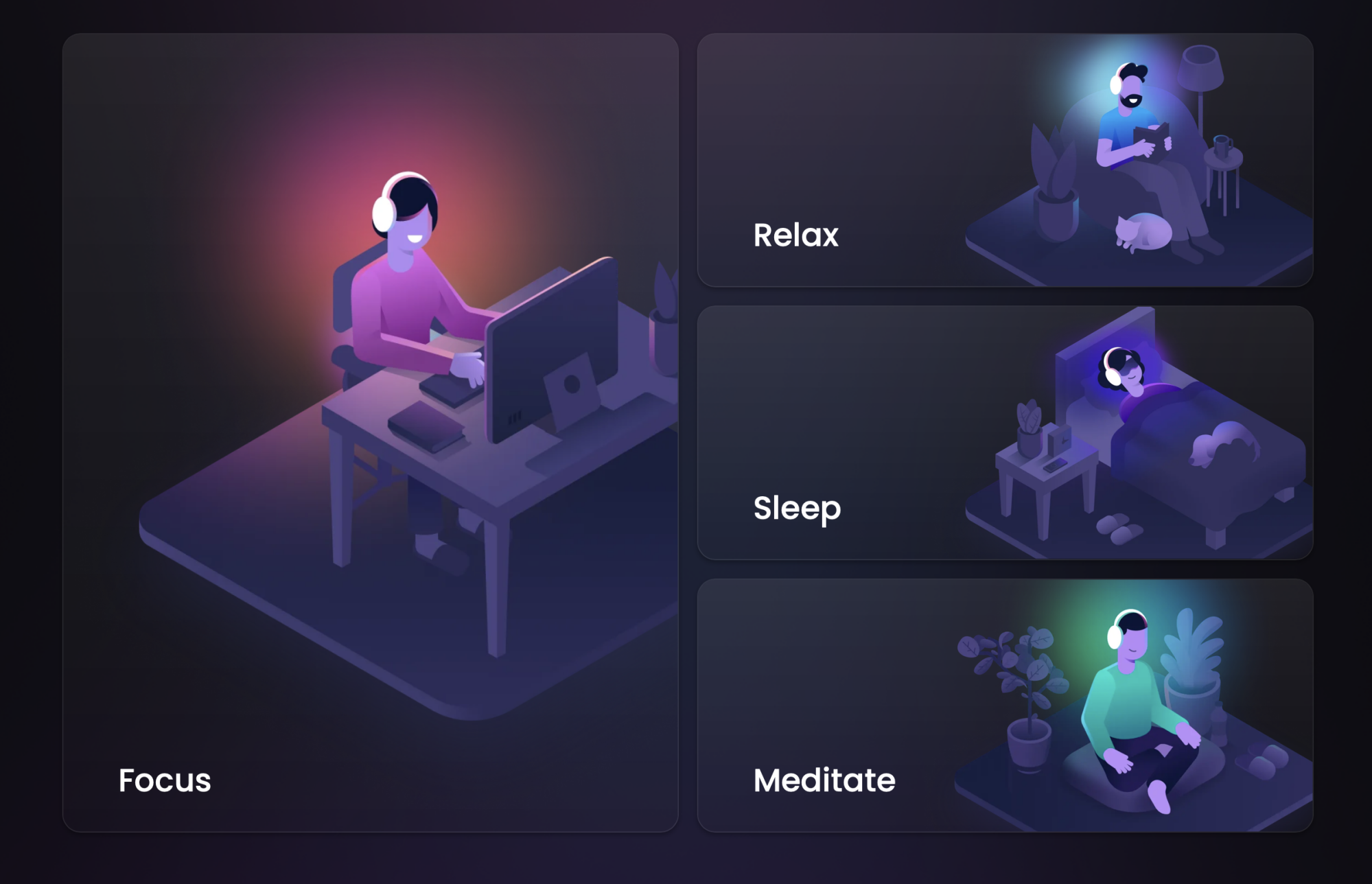
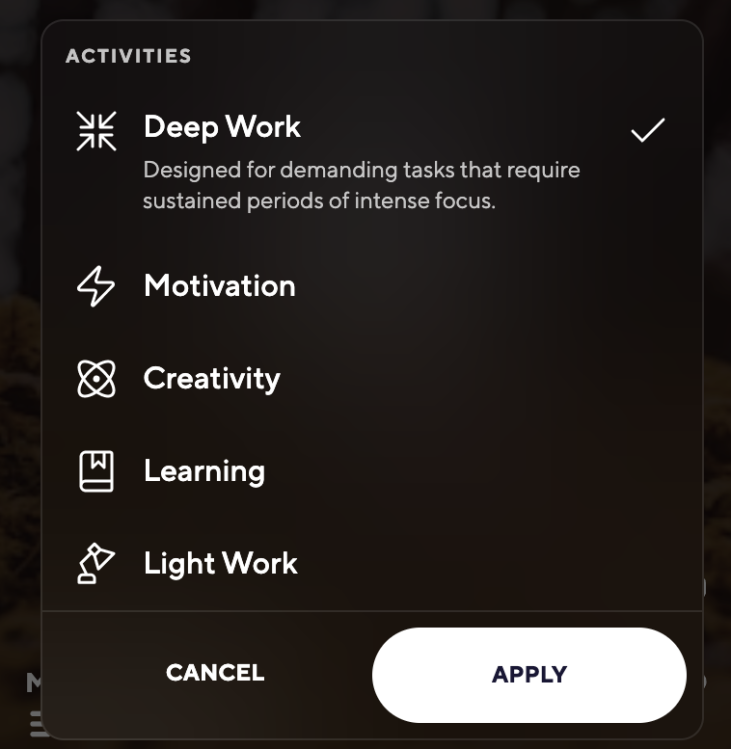
You can’t use this service to search for a specific artist—you instead let the application know what you’re trying to do (Focus, Relax, Meditate, or Sleep). In the Focus section, there are a few sub-options: Deep Work, Motivation, Creativity, Learning, and Light Work. Choose what you want to do and a track will start playing.
Credit: Justin Pot
The genres, such as they are, range from the kind of “chill beats” you can find on YouTube to post-rock and symphonic—though it’s all instrumental.
“The basic problem is that most music is made to grab your attention,” Kevin Woods, a neuroscience PhD who works for Brain.fm, told me. “If you talk to a music producer, they’ll tell you that their job is to make things punchy and bright, and to make somebody sit up and turn their head and favorite the song on Spotify.”
That attention seeking can make playing music during the work day distracting in a subtle way, according to Woods. “The problem is that a lot of the distraction is not overt in the sense of, ‘I can feel my attention breaking and I have to turn this off or turn down the volume’—it’s more like, ‘I’m working at 70, 80% capacity, and I’m not really sure why.'”
So the music at Brain.fm is written and performed by in-house composers who are intentionally trying not to keep your attention. But that alone doesn’t really set Brain.fm apart from using ambient music or video game soundtracks to focus, let alone the various “chill beats” playlists and live streams that are out there. And that’s where Brain.fm’s scientific claims come in.
Brain.fm says the key is “amplitude modulation”
Brain.fm points to several scientific studies on its homepage, also mentioning that its research was in part funded by that National Science Foundation. A lot of the claims are based on “amplitude modulation,” which Woods told me is what sets Brain.fm’s music apart.
But what is amplitude modulation? They’re “fast modulations added that do not usually occur in music,” according to Woods. If you listen to the music for a bit, you’ll hear an almost fluttering kind of sound. These sounds, which are added to compositions in post-production using AI, are available at three different levels for each track. The “ADHD Mode,” which is the highest of the three settings, is what I mostly used while testing.
I find this effect a little bit disorienting, so I sometimes needed to turn the setting down. It’s hard to deny the effect is a musical signature of Brain.fm. But does it work?
Research on amplitude modulation is limited, but promising
I became a bit less skeptical of the science after getting in touch with the expert that Levitin recommended: Psyche Loui, a neuroscientist, musician, and Associate Dean of Research at Northeastern University. Loui told me that “it’s not all placebo”, pointing to a paper she published alongside Woods and other neurologists in Communications Biology.
Now, to be clear, it’s not unusual for scientists to disagree about how things work—that’s part of the process. And the claims made by the paper are narrow—the conclusion is that music with amplitude modulation can help people focus on tasks when compared to both pink noise and music without amplitude modulation. The control music, according to Woods, were the same tracks—the only difference was whether amplitude modulation was added. The results of testing, and brain scans, suggest the effect is real.
“We did something which is rarely done in music research, which is a very well-controlled study that only changes one factor in the music,” Woods told me. As with all scientific research, there’s always more to learn. But to me, a study making these claims published in a Nature-affiliated publication suggests there might be something to this.
At the very least, Brain.fm helped me reflect on my relationship with music at work
Brain.fm, if nothing else, has been an opportunity to reflect on my relationship with music. I really enjoy discovering new music during the workday, but after using Brain.fm for a few weeks I wonder if that might have been the reason I have trouble focusing in the morning.
Maybe it’s best to listen to music that fades into the background when it’s time to focus, and save music discovery for when I only need part of my brain. And maybe I should save the music I really love for when I’m not working at all. Brain.fm, if nothing else, taught me that.
But I also find that the music really does work when I need to focus. I still am not fully sure if the effect is real, or if any music that blends into the background would do the job. I sometimes play the entire Boards of Canada discography when I need to focus, and find that works about as well.
All that having been said, I really think anyone who has read this much about Brain.fm should probably go ahead and see for themselves.
Lawsuit: ChatGPT told student he was “meant for greatness”—then came psychosis
A Georgia college student named Darian DeCruise has sued OpenAI, alleging that a recently deprecated version of ChatGPT “convinced him that he was an oracle” and “pushed him into psychosis.”
This case, which was first reported by ALM, marks the 11th such known lawsuit to be filed against OpenAI that involves mental health breakdowns allegedly caused by the chatbot. Other incidents have ranged from highly questionable medical and health advice to a man who took his own life, apparently after similarly sycophantic conversations with ChatGPT.
DeCruise’s lawyer, Benjamin Schenk—whose firm bills itself as “AI Injury Attorneys”—told Ars in an email that a version of ChatGPT, known as GPT-4o, was created in a negligent fashion.
Meta’s Virtual Reality App Ditching VR To Make A Roblox Clone

Facebook really hopes your kids will play Grow A Garden via its terrible phone-based metaverse