Google Maps will finally be usable in South Korea

Google will finally be able to provide real-time driving and walking directions in South Korea, The New York Times reported. The company has received permission from the nation’s Transport Ministry to export geographic data out of the country, which will allow it to provide GPS services as well as detailed listings for restaurants and other businesses. 

“We welcome today’s decision and look forward to our ongoing collaboration with local officials to bring a fully functioning Google Maps to Korea,” Google’s senior executive Cris Turner told the NYT in a statement. However, the approval is contingent “on the condition that strict security requirements are met,” a spokesperson from the Transport Ministry said. Those conditions reportedly restrict Google from displaying sensitive military sites and longitude and latitude coordinates. 

South Korea has generally restricted the export of 1/5000 scale map data over national security concerns, as it’s still technically at war with its neighbor North Korea. Google hasn’t been able to provide mapping directions or business details since it arrived in the nation, though it has applied twice in 2007 and 2016.

This lack of data sharing has reportedly been a bone of contention in trade talks with the US. Google argued that it was unfairly handicapped by the restrictions that allowed local apps like Naver to thrive. 

However, critics in the nation have expressed concern that Google could now come in and monopolize the market. “If Naver and Kakao are weakened or pushed out and Google later raises prices, that becomes a monopoly. Then, even companies that rely on map services — logistics firms, for example — become dependent [on Google],” geography professor Choi Jin-mu told Reuters. 

This article originally appeared on Engadget at https://www.engadget.com/apps/google-maps-will-finally-be-usable-in-south-korea-104301396.html?src=rss

Moon’s Ancient Magnetic Field May Have Flickered On and Off

sciencehabit quotes a report from Science Magazine: For decades, planetary scientists have pored over a mystery hidden within the Moon rocks retrieved by Apollo astronauts in the 1960s and ’70s. Minerals in the rocks record the imprint of a magnetic field, nearly as powerful as Earth’s, that existed more than 3.5 billion years ago and seemed to persist for millions of years. But generating a magnetic field requires a dynamo — a churning, molten core — and most researchers believed the Moon’s tiny core would have long since cooled off, 1 billion years after it formed. Corroborating that picture are other ancient Moon rocks of about the same age that suggest the field was weak — leaving planetary scientists baffled.

Now, researchers are proposing a new way to solve the puzzle. A paper published today in Nature Geoscience theorizes that between 3.5 billion and 4 billion years ago, blobs of titanium-rich magma melted episodically just above the core, rising in plumes that drove volcanic eruptions on the surface. By intermittently stirring up the Moon’s core, these bouts of melting would have caused the Moon’s magnetic field to flicker on in short, powerful bursts. The paper “links a few different concepts that people were thinking about separately, but hadn’t actually brought together,” says Sonia Tikoo, a planetary geophysicist at Stanford University who was not involved in the study.


Read more of this story at Slashdot.

How to watch Omloop Het Nieuwsblad 2026: global options for live TV, streaming and highlights

Omloop Het Nieuwsblad signifies the Flemish Opening Weekend, marking the start of the Spring Classics and being the first UCI WorldTour race on European soil.

It’s the first time we’ll see the peloton take on the cobbles of Flanders, with the men’s and women’s races taking place this Saturday, 28 February, starting in Ghent and ending in Ninove.

Last year, the men’s race was won by Norwegian Søren Wærenskjold, who took victory by pipping Paul Magnier to the line.

Lotte Claes won the women’s race, surviving the breakaway and out-sprinting Aurela Nerlo to victory.

The men’s race is 207.6km this year, and starts at ​​11.05am CET, with the riders expected to reach the finish at approximately 3.52pm CET.

The women will take on a 137.6km course, starting at 1.35pm CET, with an expected finish at 5.17pm CET.

In this guide, we’ll take a look at how you can watch the season opener from around the world.

How can I watch Omloop Het Nieuwsblad 2026 live in the UK?

Lotte Claes winning Omloop Het Nieuwsblad 2025
Lotte Claes won the women’s race last year. Luc Claessen / Getty Images

TNT Sports/Discovery+ will show the race live and, as usual, there’s an on-demand option. Coverage times are to be confirmed.

A TNT Sports/Discovery+ subscription costs £25.49 per month when billed annually. It’s available on a range of platforms, including tablets, mobile, TV with Chromecast, or AirPlay, Android TV or Apple TV.

How can I watch Omloop Het Nieuwsblad 2026 outside the UK?

A Virtual Private Network (VPN) is software that enables you to change your device’s IP address, making it appear as though you’re accessing the internet from another country.

As long as you adhere to your broadcaster’s terms and conditions, a VPN enables you to unblock your usual streaming services, no matter your location. Additionally, a VPN can improve playback speeds and significantly enhance your overall internet security.

There are many VPN options available, but we recommend NordVPN as the best choice. It offers strong streaming capabilities, robust security features and excellent value for money.

*At BikeRadar (published by Our Media Limited), we review VPN services to help you access online content and services securely while you’re on the go. This includes activities such as streaming your favourite TV shows, live web content or using apps from different countries (provided it’s okay with the service provider’s terms and conditions). It’s important to note: BikeRadar does not endorse or support the use of VPN services for illegal or malicious activities

How can I watch Omloop Het Nieuwsblad 2026 live in the US?

For those in the US, FlowBikes will be covering the men’s race live from 12.40pm GMT, and the women’s race from 3.10pm GMT.

The subscription costs $29.99 per month or $150 per year.

How can I watch Omloop Het Nieuwsblad 2026 live in Australia?

There don’t appear to be any outlets showing the race live in Australia this year, so you may need to consider a VPN should you want to watch the action live.

Anthropic refuses to bow to Pentagon despite Hegseth’s threats

Despite an ultimatum from Defense Secretary Pete Hegseth, Anthropic said that it can’t “in good conscience” comply with a Pentagon edict to remove guardrails on its AI, CEO Dario Amodei wrote in a blog post. The Department of Defense had threatened to cancel a $200 million contract and label Anthropic a “supply chain risk” if it didn’t agree to remove safeguards over mass surveillance and autonomous weapons.

“Our strong preference is to continue to serve the Department and our warfighters — with our two requested safeguards in place,” Amodei said. “We remain ready to continue our work to support the national security of the United States.”

In response, US Under Secretary of Defense Emil Michael accused Amodei in a post on X of wanting “nothing more than to try to personally control the US military and is OK putting our nation’s safety at risk.”

The standoff began when the Pentagon demanded that Anthropic its Claude AI product available for “all lawful purposes” — including mass surveillance and the development of fully autonomous weapons that can kill without human supervision. Anthropic refused to offer its tech for those things, even with a “safety stack” built into that model.

Yesterday, Axios reported that Hegseth gave Anthropic a deadline of 5:01 PM on Friday to agree to the Pentagon’s terms. At the same time, the DoD requested an assessment of its reliance on Claude, an initial step toward potentially labelling Anthropic as a “supply chain risk” — a designation usually reserved for firms from adversaries like China and “never before applied to an American company,” Anthropic wrote. 

Amodei declined to change his stance and stated that if the Pentagon chose to offboard Anthropic, “we will work to enable a smooth transition to another provider, avoiding any disruption to ongoing military planning, operations or other critical missions.” Grok is one of the other providers the DoD is reportedly considering, along with Google’s Gemini and OpenAI. 

It may not be that simple for the military to disentangle itself from Claude, however. Up until now, Anthropic’s model has been the only one allowed for the military’s most sensitive tasks in intelligence, weapons development and battlefield operations. Claude was reportedly used in the Venezuelan raid in which the US military exfiltrated the country’s president, Nicolás Maduro, and his wife.

AI companies have been widely criticized for potential harm to users, but mass surveillance and weapons development would clearly take that to a new level. Anthropic’s potential reply to the Pentagon was seen as a test of its claim to be the most safety-forward AI company, particularly after dropping its flagship safety pledge a few days ago. Now that Amodei has responded, the focus will shift to the Pentagon to see if it follows through on its threats, which could seriously harm Anthropic. 

This article originally appeared on Engadget at https://www.engadget.com/ai/anthropic-refuses-to-bow-to-pentagon-despite-hegseths-threats-085553126.html?src=rss

NASA Reveals Identity of Astronaut Who Suffered Medical Incident Aboard ISS

Longtime Slashdot reader ArchieBunker shares a report from NBC News: NASA revealed that astronaut Mike Fincke was the crew member who suffered a medical incident at the International Space Station in January, which prompted the agency to carry out the first evacuation due to a medical issue in the space station’s 25-year history. The rare decision to cut a mission short and bring Fincke and three other crew members home early made for a dramatic week in space early this year.

In a statement released by NASA “at the request of Fincke,” the veteran astronaut said he experienced a medical event on Jan. 7 “that required immediate attention” from his space station crew members. “Thanks to their quick response and the guidance of our NASA flight surgeons, my status quickly stabilized,” Fincke, 58, said in the statement. […] In his statement, Fincke thanked his Crew-11 colleagues, along with NASA astronaut Chris Williams and Russian cosmonauts Sergey Kud-Sverchkov and Sergei Mikaev, who were also aboard the space station at the time and are still in space. Fincke also thanked the teams at NASA, SpaceX and the medical professionals at Scripps Memorial Hospital La Jolla. “Their professionalism and dedication ensured a positive outcome,” he said.

Fincke ended his statement by saying he is “doing very well” and still actively involved with standard post-flight reconditioning at NASA’s Johnson Space Center in Houston. “Spaceflight is an incredible privilege, and sometimes it reminds us just how human we are,” he said. “Thank you for all your support.”


Read more of this story at Slashdot.

Anthropic CEO Says AI Company ‘Cannot In Good Conscience Accede’ To Pentagon

An anonymous reader quotes a report from the Associated Press: Anthropic CEO Dario Amodei said Thursday the artificial intelligence company “cannot in good conscience accede” to the Pentagon’s demands to allow wider use of its technology. The maker of the AI chatbot Claude said in a statement that it’s not walking away from negotiations, but that new contract language received from the Defense Department “made virtually no progress on preventing Claude’s use for mass surveillance of Americans or in fully autonomous weapons.”

The Pentagon’s top spokesman has reiterated that the military wants to use Anthropic’s artificial intelligence technology in legal ways and will not let the company dictate any limits ahead of a Friday deadline to agree to its demands. Sean Parnell said Thursday on social media that the Pentagon “has no interest in using AI to conduct mass surveillance of Americans (which is illegal) nor do we want to use AI to develop autonomous weapons that operate without human involvement.”

Anthropic’s policies prevent its models, such as its chatbot Claude, from being used for those purposes. It’s the last of its peers — the Pentagon also has contracts with Google, OpenAI and Elon Musk’s xAI — to not supply its technology to a new U.S. military internal network. Parnell said the Pentagon wants to “use Anthropic’s model for all lawful purposes” but didn’t offer details on what that entailed. He said opening up use of the technology would prevent the company from “jeopardizing critical military operations.” “We will not let ANY company dictate the terms regarding how we make operational decisions,” he said. In a post on X, Parnell said Anthropic will “have until 5:01 PM ET on Friday to decide. Otherwise, we will terminate our partnership with Anthropic and deem them a supply chain risk for DOW.”


Read more of this story at Slashdot.

Benchmarking 18 Years Of Intel Laptop CPUs: Panther Lake As Much As 95x The Speed Of Penryn

For those curious how far Intel laptop CPU performance has evolved over the past nearly two decades, here are power and performance numbers when re-benchmarking all of the Intel-powered laptop CPUs I have on hand that are still operational from Penryn to Panther Lake. A ThinkPad from 2008 with the Core 2 Duo T9300 “Penryn” was still firing up and working with the latest upstream Intel open-source Linux driver support on Ubuntu 26.04 development. On a geo mean basis over the past 18 years from Penryn to Panther Lake, the performance was at 21.5x in over 150 benchmarks. At the most extreme was a 95x difference going from Intel’s 45nm Penryn to the 18A Panther Lake.

Four Convicted Over Spyware Affair That Shook Greece

A Greek court has convicted four individuals linked to the marketing of Predator spyware in the wiretapping scandal that shook the country in 2022. The BBC reports: In what became known as “Greece’s Watergate,” surveillance software called Predator was used to target 87 people — among them government ministers, senior military officials and journalists. The four who had marketed the software were found guilty by an Athens court of misdemeanours of violating the confidentiality of telephone communications and illegally accessing personal data and conversations.

The court sentenced the four defendants to lengthy jail sentences, suspended pending appeal. Although they each face 126 years, only eight would be typically served which is the upper limit for misdemeanors. One in three of the dozens of figures targeted had also been under legal surveillance by Greece’s intelligence services (EYP). Prime Minister Kyriakos Mitsotakis, who had placed EYP directly under his supervision, called it a scandal, but no government officials have been charged in court and critics accuse the government of trying to cover up the truth.

The case dates back to the summer of 2022, when the current head of Greek Socialist party Pasok, Nikos Androulakis – then an MEP – was informed by the European Parliament’s IT experts that he had received a malicious text message containing a link. Predator spyware, marketed by the Athens-based Israeli company Intellexa, can get access to a device’s messages, camera, and microphone. Its use was illegal in Greece at that time but a new law passed in 2022 has since legalised state security use of surveillance software under strict conditions. Androulakis also discovered that he had been tracked for “national security reasons” by Greece’s intelligence services. The scandal has since escalated into a debate over democratic accountability in Greece.


Read more of this story at Slashdot.

Colorado Lawmakers Push for Age Verification at the Operating System Level

Colorado lawmakers are proposing SB26-051, a bill that would require operating systems to register a user’s age bracket and share it with apps via an API. PCMag reports: The bill comes from state Sen. Matt Ball and Rep. Amy Paschal, both Democrats. “The intent is to create thoughtful safeguards for kids online through a privacy-forward framework for age assurance,” Ball told PCMag. “Unlike some laws in other states, SB 51 doesn’t require users to share personally identifiable information or use facial recognition technology.”

The legislation also promises to centralize the age check through the OS, rather than mandating that each app enforce their own age-verification mechanism, which can involve scanning the user’s official ID, thus raising privacy and security concerns. The bill also forbids the sharing of the age-bracket data for any other purpose. But it looks like it’s easy to bypass the age check proposed by SB26-051. The legislation itself doesn’t mention any state ID check to verify the owner’s age. In addition, the bill doesn’t seem to cover websites, only apps and app stores. The report notes that the legislation was based on California’s bill AB 1043, which was passed last year and expected to take effect January 1, 2027.


Read more of this story at Slashdot.

Vortex 9 Brings Popular Mobile Shooter To VR With Promising Results

iWorlds’ Vortex 9 was originally released as a free-to-play mobile game for iOS and Google’s Play Store, where it won gamers over with its mix of cel-shaded visuals, bite-sized shooting skirmishes and cute animals that can assist players in combat.

Last year, it was announced that Vortex 9 would be coming to virtual reality by way of Meta Quest headsets, complete with crossplay compatibility that would allow VR players to connect with fans of the original mobile version. Vortex 9 makes the transition to VR quite well, providing an even more intuitive control alternative to the old version’s touchscreen controls.

The Facts

What is it?: A VR version of the popular online mobile shooter that combines colorful graphics, brief matches, and cute pets.
Platforms: Meta Quest
Release Date: February 26, 2026
Developer: Ayteylz EOOD
Publisher: iTales VR
Price: Free To Play

Vortex 9 VR’s controls are pretty simple: you use the left thumbstick to move around and aim your weapon by pointing at an enemy with the right hand controller. Firing is done with the right trigger, and switching and reloading weapons are done through button presses. By flicking the right thumbstick, you can jump, while holding down causes you to crouch.

Matches consist of team-based Deathmatches, where players are randomly grouped to see who can take out the opposition, Capture the Point, another team-oriented mode in which players battle to control certain points on the map, and Mayhem, a free-for-all skirmish between individual players.

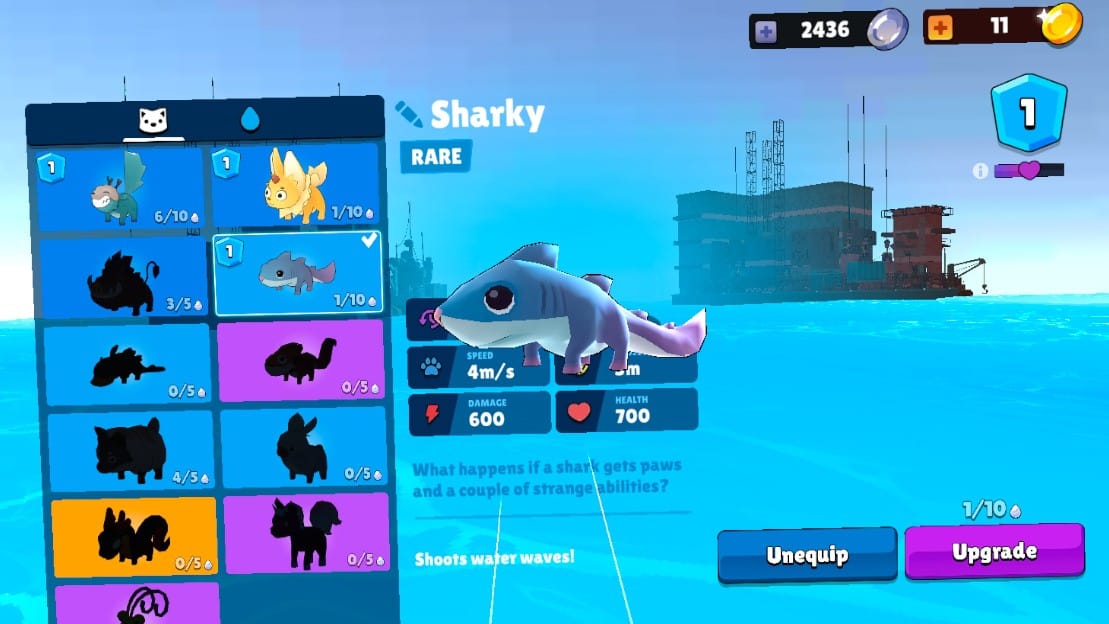
Collect and raise Pets to help take out the competition.

Weapons are varied and include machine guns, revolver pistols, knives and other melee weapons, and grenades. Players can also use canned drinks to replenish their health, which is represented by a green meter in the upper-right corner of the screen.

One of the things that helps set Vortex 9 apart is the Pets that players can summon by hatching a certain number of parts. These parts come in eggs that players either buy or unlock as rewards. To hatch an egg, you can choose to wait an hour for it to hatch on its own or pay a small gold coin fee to hatch it immediately.

Once summoned, your Pet will follow you into battle and attack opponents automatically. The Pet also has its own health gauge, and once it is depleted, it will need to respawn after a brief waiting period. Certain Pets have special abilities; for example, Sharky can spit water bubbles to strike at opponents from a distance.

0:00

/0:24

Vortex 9’s matches are quick and breezy.

After booting up Vortex 9 for the first time, you choose between one of two customizable avatars, with more available to unlock by spending coins. There are a few basic customization options to start with, and you can buy more as you earn more currency and build up your experience level.

Players can earn gold and silver coins by either paying with real-world money or completing different tasks during matches. There are two types of tasks: set Main missions and Daily missions that alternate each day. These tasks can range from winning a certain number of matches to using a certain weapon a set number of times.

The game’s art style is simple and colorful, with a cell-shaded appearance that brings to mind titles like The Legend of Zelda: Wind Waker. Level designs include a construction site, a sewer, and a large child’s bedroom that wouldn’t be out of place in Toy Story.

Having tried Vortex 9 out on both mobile and VR, I find myself preferring the latter thanks to its more immersive setting and intuitive motion controls. Vortex 9 might not be the most groundbreaking virtual shooter around, but it’s good for some quick, bite-sized action with plenty of charm to go around.

Netflix backs out of Warner Bros. Discovery bidding war

For anyone who has been following the soap opera unfolding between Netflix and Paramount Skydance over the past few months in their financial brinksmanship to acquire Warner Bros. Discovery, the saga may be nearing its end. Today, WBD said its board of directors have determined that the latest offer from Paramount Skydance amounted to the better proposal. The media outfit gave Netflix four business days to match Paramount’s terms, but the streamer didn’t waste any time in declining to raise its own bid. 

“We believe we would have been strong stewards of Warner Bros.’ iconic brands, and that our deal would have strengthened the entertainment industry and preserved and created more production jobs in the US,” the statement from Netflix  co-CEOs Ted Sarandos and Greg Peters said. “But this transaction was always a ‘nice to have’ at the right price, not a ‘must have’ at any price.” 

In addition to the purchase price of $31 per WBD share, Paramount’s latest offer also included a provision that it would cover the $2.8 billion termination fee that WBD would owe to Netflix for dissolving the existing merger agreement between the businesses. So rather than paying $82.7 billion to acquire the Warner Bros. part of the operation, it appears Netflix may walk away with no new content but padding its coffers with an extra nearly $3 billion. 

After Netflix’s initial offer, Paramount Skydance swooped in with a hostile takeover attempt of the entire Warner Bros. Discovery business. WBD rejected it, Paramount tried again. Several additional volleys between the involved parties occurred over the past few weeks. While WBD has not yet formally accepted Paramount’s offer — which will be subject to long-winded regulatory approvals sure to spark more drama — it seems the dust will soon settle for this chapter.

This article originally appeared on Engadget at https://www.engadget.com/entertainment/netflix-backs-out-of-warner-bros-discovery-bidding-war-233117188.html?src=rss

Giant Tortoises Return To Galapagos Island Where Previously Extinct

158 juvenile giant tortoises were recently reintroduced to Floreana Island in Ecuador’s Galapagos archipelago, where the local subspecies went extinct in the 1840s thanks to being easy pickings for sailors on long voyages to keep fresh meat at sea. Those sailors are lucky the Ninja Turtles weren’t around back then.

It marks a major step in a reintroduction program aimed at restoring a lineage that disappeared locally in the 19th century.

According to the environment ministry, genetic research enabled the breeding programme and will allow a phased return of tortoises based on technical criteria.

The release is also intended to lay the groundwork for reintroducing up to 12 endemic species considered locally extinct on the island.

Next stop: Jurassic Park. You know, it’s been 34 years since the book came out (31 since the movie) and we still don’t have any dinosaurs running around. What gives? And don’t even get me started on Back To The Future II. “The greatest lie ever told.” I only stuck around this long for hoverboards, dammit! Bob Gale and Robert Zemeckis ought to be jailed for lying about the future so hard.

Jack Dorsey’s Block Cuts Nearly Half of Its Staff In AI Gamble

Jack Dorsey’s Block is cutting more than 4,000 jobs, or nearly half its workforce, as part of a deliberate shift toward becoming a smaller, “intelligence-native” company built around AI. The Verge reports: “We’re not making this decision because we’re in trouble,” Dorsey says. “Our business is strong. Gross profit continues to grow, we continue to serve more and more customers, and profitability is improving. But something has changed. We’re already seeing that the intelligence tools we’re creating and using, paired with smaller and flatter teams, are enabling a new way of working which fundamentally changes what it means to build and run a company. And that’s accelerating rapidly.”

Dorsey opted to do a big layoff instead of gradual cuts because “I’d rather take a hard, clear action now and build from a position we believe in than manage a slow reduction of people toward the same outcome.” The layoffs were announced on Thursday as part of the company’s Q4 2025 earnings. In a shareholder letter (PDF), Dorsey says that “We believe Block will be significantly more valuable as a smaller, faster, intelligence-native company. Everything we do from here is in service of that.”


Read more of this story at Slashdot.