Striking a four-year deal with President Donald Trump, the Taiwan Semiconductor Manufacturing Co. (TSMC) plans to invest $100 billion in chip manufacturing plants in the US, sources told The Wall Street Journal.
According to “people familiar with the matter,” Trump will officially announce the deal later today. While still unconfirmed, TSMC’s supposed investment comes after OpenAI and Apple announced similarly vague plans to each invest $500 billion into the US in apparent efforts to get on Trump’s good side. It’s hard to tell if these plans are actually new or if companies had already planned to invest heavily without outside pressure, WSJ noted.
It’s undeniable that expanding TSMC’s US presence has long been a goal for the US. TSMC announced its first fab in 2020, initially committing $12 billion over 10 years. Since then, TSMC’s investments over time have expanded, reaching $40 billion by 2022. Last year, its investments notched up again when TSMC was awarded $6.6 billion in direct funding under the CHIPS Act to “support the company’s planned investment of more than $65 billion in three greenfield leading-edge fabs in Phoenix, Arizona,” the Commerce Department press release said. At that time, Joe Biden had promised those fabs would “manufacture the most advanced chips in the world,” putting the US “on track to produce 20 percent of the world’s leading-edge semiconductors by 2030.”
You’ve probably done it yourself: you need to know how hard a given application is hitting your CPU, so you pull up Windows’ Task Manager to check the CPU utilization. For a casual inquiry, this is fine, but for anything approaching scientific rigor, you need to be using a third-party application because Windows’ Task Manager does not correctly
As part of Mobile World Congress, happening this week in Barcelona, Google has teased that its Gemini AI is finally ready to see the world. Literally.
Originally teased as Project Astra in May of last year, Google’s Gemini Live with Video and Gemini Live with Screenshare features each have a new trailer, showing how the search giant plans to catch up with ChatGPT’s Advanced Voice Mode. Soon, Google One AI Premium subscribers will be able to share their phone screens and real-time video with Gemini, which the chatbot will then be able to use to answer questions.
ChatGPT’s Advanced Voice Mode got these features late last year, but it also requires you to shell out at least $20/month for a ChatGPT Plus subscription. While a Google One AI Premium plan is priced identically, it also throws in 2TB of storage for your Drive and Gmail accounts, so depending on your needs, it could be the better pick for you.
In the trailers, Google shows users accessing Gemini Live via the Gemini phone app to open a real-time conversation with the AI, then tapping either a video or screen sharing button at the bottom of the screen to get started. In the Gemini Live with Video demo, we see someone showing the chatbot some vases they’ve just fired as well as some glaze swatches and asking for advice on which one to choose. In the Screenshare demo, the chatbot instead looks at a store listing for a pair of jeans and gives advice on which type of clothes to pair with them.
I’d love to meet the type of person who would go through all of the effort of spinning and firing a vase without knowing what color to glaze it, but the point is clear. Gemini will soon be able to use real-time video and screen captures as input when answering prompts.
Unfortunately, Google hasn’t yet said much more than that. When Project Astra was originally teased, it boasted such impressive (and creepy) abilities as “being able to tell where you live just by looking out the window.” These trailers seem significantly scaled back in comparison, but they’re also clearly just short demos. I’m curious to see how the feature actually functions once users get their hands on it, which Google says will happen “later this month.”
Millie Bobby Brown and Chris Pratt star in the Netflix original film The Electric State.
Anthony and Joe Russo have their hands full these days with the Marvel films Avengers: Doomsday and Avengers: Secret War, slated for 2026 and 2027 releases, respectively. But we’ll get a chance to see another, smaller film from the directors this month on Netflix: The Electric State, adapted from the graphic novel by Swedish artist/designer Simon Stålenhag.
Stålenhag’s stunningly surreal neofuturistic art—featured in his narrative art books, 2014’s Tales from the Loop and 2016’s Things From the Flood—inspired the 2020 eight-episode series Tales From the Loop, in which residents of a rural town find themselves grappling with strange occurrences thanks to the presence of an underground particle accelerator. That adaptation captured the mood and tone of the art that inspired it and received Emmy nominations for cinematography and special visual effects.
The Electric State was Stålenhag’s third such book, published in 2018 and set in a similar dystopian, ravaged landscape. Paragraphs of text, accompanied by larger artworks, tell the story of a teen girl named Michelle who must travel across the country with her robot companion to find her long-lost brother, while being pursued by a federal agent. The Russo brothers acquired the rights early on and initially intended to make the film with Universal, but when the studio decided it would not be giving the film a theatrical release, Netflix bought the distribution rights.
Gotta go fast? Landfall, developer of Totally Accurate Battle Simulator and Clustertruck, have released a demo for HASTE: Broken Worlds that’s worth a look. The demo was released as part of Steam Next Fest and there’s a Native Linux version available. On Steam, the developer noted they plan to get it Steam Deck Verified too.
Mobile World Congress is taking place in Barcelona this week, offering manufacturers an opportunity to show off new gear without needing to hold their own splashy event. So far, we’ve learned about some new laptops and phones, as well as upcoming AI updates to Android.
Among the bigger-name manufacturers, Lenovo has arguably had the busiest MWC so far. The company has revealed a whole bunch of laptops, including upgraded ThinkPads and several intriguing concept models.
The ThinkPad T14s 2-in-1 has a design that’s more aligned with the convertible format of the Yoga lineup than a typical ThinkPad. The 14-inch machine can be equipped with a 400-nit WUXGA touch display. Other ThinkPads are getting spec upgrades, while Lenovo claims the new ThinkPad X13 Gen 6 has “one of the lightest ThinkPad designs ever.” The company has a fresh slate of laptops with generative AI capabilities as well.
Some of Lenovo’s concepts have certainly caught our attention. It’s a bummer that the company doesn’t currently plan to turn the Yoga Solar PC Concept into a commercial device. Thanks to the solar cells on the casing, the laptop can soak up enough energy from the sun in 20 minutes to play an hour of videos. As little as 0.3 watts of light is enough to juice up the battery. While solar-powered laptops aren’t exactly new, the Yoga Solar PC feels polished. Here’s hoping Lenovo does more with the notion in the future.
Sam Rutherford for Engadget
In addition, Lenovo showed off some conceptual display accessories for a ThinkBook laptop. There’s an eight-inch screen that attaches to the side magnetically to help you, for instance, keep up with notifications and widgets. The Magic Bay Dual Display Concept adds a 13.3-inch panel to either side of the main display. There’s also a slim second display that’s designed to sit above your laptop screen and provide quick access to things like the time, weather, notifications, a focus mode timer, an AI assistant and notifications.
Sam Rutherford for Engadget
On top of all of that, Lenovo offered a look at a new prototype laptop with a flexible display. Building on the tech the company used in the ThinkBook Plus Gen 6 Rollable, the ThinkBook codename Flip AI PC Proof of concept (to give its full name) has a fold-out screen. This allows Lenovo to double the panel’s size from 13 inches to 18.1 inches. The ThinkBook Rollable’s display, on the other hand, can extend to 16.7 inches. Again, Lenovo doesn’t currently plan to release a commercial version of this fold-out laptop, but it’s an interesting idea.
Samsung
Photo by Mat Smith for Engadget.
The main MWC news from Samsung this year is the company’s latest midrange and budget phones. The Galaxy A56 has a larger screen than its predecessor at 6.7 inches, but it’s thinner too at 7.44mm vs. 8.2mm. There’s now a small bump where the volume and power buttons are — a tweak that we feel makes the A56 easier to handle.
Samsung has switched up the camera array in the A56. On the front, there’s a lower-res 12MP lens. On the other side, you’ll find an upgraded 12MP ultrawide, 50MP main sensor and a 5MP macro lens. The A56 has a bunch of AI-powered camera and image editing features, such as enhanced subject detection in portrait mode and an object eraser.
Pre-orders are open in the UK for the Galaxy A56, which costs $499/£499. It will hit the UK on March 19, but folks in the US will have to wait until “later this year” for it.
Samsung also revealed the Galaxy A36 5G and Galaxy A26 5G. Both devices have a 120Hz, 6.7-inch display with brightness of up to 1,200 nits. They also share an IP67 rating and 5,000mAh battery with the A56.
However, the base models of each only have 6GB of RAM (compared with the A56’s 12GB). In addition, the A36 has the Snapdragon 6 Gen 3 processor instead of the Exynos 1580 that the A56 boasts, while the A26 has a Exynos 1380 chipset.
Xiaomi
Sam Rutherford for Engadget
Unfortunately, Xiaomi doesn’t have plans to bring a handset it showed off at MWC to the US. That’s a real pity, because no other companies are selling phones quite like the Xiaomi 15 Ultra in the country these days.
Xiaomi teamed up with Leica to make a smartphone that leans heavily into photography. The camera array includes a 1-inch 50-megapixel Sony main sensor, an f/2.2 50MP ultrawide cam, a 50MP midrange lens with a 70mm focal length and a 200MP periscope array with a 100mm focal length — that equates to a 4.7x optical zoom. Some preset Leica filters help to tie the two brands’ knowhow together.
That’s not all that might be interesting to mobile snappers. Xiaomi’s separate Photography kit includes an add-on camera grip with a physical shutter button, an adjustable dial and dedicated video button. You’ll have the option to attach a standard 67mm filter adapter to a case as well — in other words, some of the equipment you might use on a dedicated camera is compatible with the Ultra 15 as part of this setup.
Moreover, the Ultra 15 has a 6.7-inch AMOLED display with 120Hz refresh rate and up to 3,200 nits of brightness to help you get a good look at your captures. Plus, unlike some other Chinese phones (like Huawei’s), Xiaomi supports Google services in HyperOS 2, which is an Android skin. The Ultra 15 starts at about €1,499 (around $1,572).
Android
Speaking of Android, Google announced two new AI-powered features for the operating system at MWC. The Live Video function, which Google first previewed at I/O 2024, allows you to share what your phone’s camera sees with Gemini so you can ask the chatbot questions about the footage.
The new screensharing function works in a similar way. You can ask Gemini questions about whatever’s on your phone or tablet’s display.
If they work as well as advertised, these features could be a boon for accessibility. Google will first offer them to Gemini Advanced subscribers starting later this month. Those with a $20 per month Google One AI Premium membership, which is included with some Verizon plans, have access to Gemini Advanced.
This article originally appeared on Engadget at https://www.engadget.com/computing/laptops/mwc-2025-everything-announced-in-barcelona-so-far-185656341.html?src=rss
Popular streamers Valkyrae, Emiru, and Cinna were stalked and attacked by a young man during a livestream as they walked around the Santa Monica Pier. Thankfully, nobody was hurt during the encounter.
Capcom has realized a relatively successful launch with Monster Hunter Wilds. The game has seen its peak concurrent player count pass over a million players, undoubtedly playing a role in Steam topping 40 million concurrent users for the first time in its history. However, it hasn’t all been smooth sailing, despite the games beta testing phase.
Zach Barth, the namesake of game studio Zachtronics, tends to make a certain kind of game.
Besides crafting the free browser game Infiniminer, which inspired the entire global Minecraft industry, Barth and his collaborators made SpaceChem, Infinifactory, TIS-100, Shenzen I/O, Opus Magnum, and Exapunks. Each one of them is some combination of puzzle game, light capitalism horror, and the most memorable introductory-level computer science, chemistry, or logistics class into which you unwittingly enrolled. Each game is its own thing, but they have a certain similar brain feel between them. It is summed up perhaps best by the Zachtronics team itself in a book: Zach-Like.
Barth and his crew have made other kinds of games, including a forward-looking visual novel about AI, Eliza, and multiplayer card battler Nerts!. And Barth himself told PC Gamer that he hates “saying Zach-like.” But fans of refining inputs, ordering operations, and working their way past constraints will thrill to learn that Zach is, in fact, back.
Magic: the Gathering recently revealed some of the cards coming to its comic-book-inspired Marvel’s Spider-Man set, including Venom, Green Goblin, Doc Ock, and of course the webbed wall-crawler himself. The cards look cool and seem like they’d be fun to play. They’re also very expensive, continuing a recent trend of…
Britain, the birthplace of the Industrial Revolution, now suffers from its opposite: profound energy shortages and deep affordability crises [non-paywalled link]. A new report titled “Foundations” identifies the root cause — “it is difficult to build almost anything, anywhere” in the UK.
Housing exemplifies this malaise. Since the 1990s, homeownership among young British workers has halved while housing prices doubled. The 1947 Town and Country Planning Act effectively nationalized development rights, requiring special permission for new construction and establishing restrictive “green belts.” Despite Margaret Thatcher’s market reforms, British house-building never recovered.
This constrictive policy has stymied potential growth beyond housing, Atlantic reports. Cambridge remains a small city despite biotech breakthroughs that might have transformed it into a major hub. Transit infrastructure languishes — Leeds is Europe’s largest city without a metro system. Energy production has collapsed, with per capita electricity generation now roughly one-third of America’s.
Britain faces a self-imposed scarcity crisis. Environmental regulations, while beneficial, created a one-way system where lawsuits easily block development. As co-author Sam Bowman summarized: “Europe has an energy problem; the Anglosphere has a housing problem; Britain has both.” The solution requires comprehensive reform– overhauling the planning system, reducing anti-growth litigation, and encouraging energy production to unlock what the private sector “already wants to do.”
We already suspected that Apple was planning to announce a new MacBook Air in March, and now we have it from the horse’s mouth. Company CEO Tim Cook took to social media to post a tease-heavy video, along with the caption “this week.”
The video itself plays music as the text “there’s something in the air” crawls along the screen. Finally, a tell-tale ultra-thin swoosh interrupts the text. It’s incredibly likely that the swoosh is being used to represent the forthcoming M4 MacBook Air. We don’t know when this week the announcement will take place, so hold tight.
Could the “there’s something in the air” refer to a refresh of the iPad Air? Maybe, but probably not. A new design came out back in May. The base iPad, however, is due for an update.
This article originally appeared on Engadget at https://www.engadget.com/computing/laptops/tim-cook-teases-m4-macbook-air-reveal-for-this-week-180949211.html?src=rss
Here I was, a decadent European minding my own European business, pondering art and chocolate and the price of diesel, when, just a day ago, I accidentally came across an article that mentioned something called Android System SafetyCore being installed on people’s phones without consent.
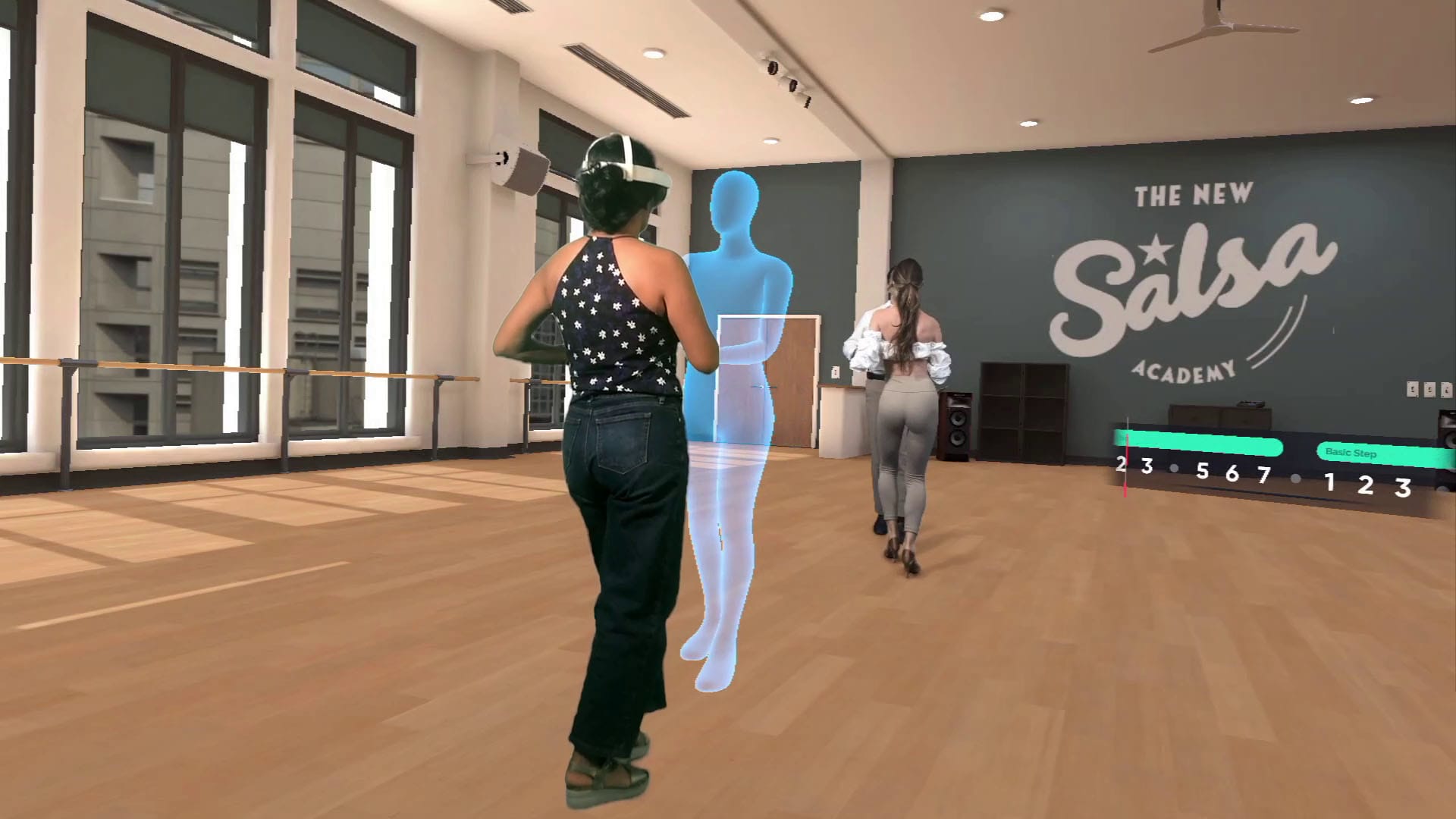
The New Salsa Academy is a VR and mixed reality fitness game that teaches you how to dance one step at a time – literally.
Developed by Dance Reality, The New Salsa Academy is an educational fitness game that teaches players the art of salsa in a virtual studio. Led by real-world instructors Rodrigo Cortazar and Asya Sonina, players cycle through a lesson plan that begins with a basic step and leads all the way up to sassy turns and dramatic twists. The structure of each lesson is broken up into bite-sized chunks, culminating in a partner practice with New Salsa Academy’s AI dance partner.
0:00
/1:02
Like in real-world dancing, The New Salsa Academy begins by asking whether you’d like to be in a leading or following role, with the teacher matching your choice. In my hands-on via Quest 3, I based my choice on what limited experience I had prior, starting with a beginner-friendly one-two step as a ‘follower’. From the beginning, I was pleased to see how slow they were going, presenting the information in a colloquial but professional manner. Video of the teachers are rendered into the space, offering a realistic look at how the movement would appear on a human body rather than a digital one — a seriously impressive feature.
Once you understand the specific move in a given lesson, The New Salsa Academy asks you to perform it to a beat, with the headset tracking not only your arm positioning but also your feet. As you perform your best quick-quick-slow steps, your digital footprint dims and lights up per the pressure you’re applying to the ground. For this to work accurately, it might be worth resetting your play space, so the boundaries match your specific room.
After mastering an essential move solo, you move onto the same process, except this time, you have a semi-clear blue partner to dance with. As you raise your hands to meet theirs, the figure’s upper body snaps like a magnet to your position and moves with the beat. It is admittedly a bit unnerving, especially considering how close-quarters the figure gets while performing the movements. At least I couldn’t feel their hot breath in my face. Still, it’s valuable to understand my movements across from another human shape considering salsa is, by all accounts, a two-person sport.
As you conclude each mid-lesson evaluation, you’ll get a small contextual feedback message explaining where you went wrong. For example, halfway through my practice, I got lazy and didn’t make intentional movements. The New Salsa Academy was quick to tell me I made a mistake towards the end of the test and to retry it at a slower pace. Between the informative but affirmational instructors and the targeted feedback, I’m forming an understanding of not just the basics of the dance, but how to improve my physicality, too.
As far as fitness VR apps go, it’s not exactly The Thrill of the Fight, with The New Salsa Academy focusing on honing your dance skills instead of burning calories. That’s not to say you don’t work up a sweat, it just feels more like entry-level calisthenics than HIIT. Thankfully, salsa is a deliberate and posture-focused style of movement that feels surprisingly at home in VR. I never feel unwieldy when moving due to this, despite having a Quest 3 strapped to my head.
Dance Reality has also added a new Challenge Mode with a new update that leverages the skills you’ve learned in regular classes in a new competitive format. In the Challenge Mode, players work through entire routines, racking up points for timing and accuracy. The cleaner your moves are, the higher your rank on the global leaderboard. To access this mode, players have to complete a series of classes to participate, with the initial barrier to entry requiring the completion of six basic lessons — a nice touch that encourages a considered engagement with the artful rhythm of Salsa.