Sam Bankman-Fried Found Guilty in Crypto Trial

Sam Bankman-Fried is guilty on all seven federal charges in his criminal trial for defrauding customers of his crypto exchange out of billions of dollars with his crypto empire, jurors decided on Thursday night in a Southern District of New York court, Reuters reports. Jurors reached a verdict at 7:40 p.m., according…

Read more…


Source: Gizmodo – Sam Bankman-Fried Found Guilty in Crypto Trial

TikTok says it's removed millions of fake accounts since start of Israel-Hamas war

TikTok is pushing back on critics who claim the video app is falling short in its content moderation duties amid the Israel-Hamas war. In a statement, the company offered new details about the number of accounts and videos it has taken down since the October 7th attacks by Hamas.

According to TikTok, it removed more than 925,000 videos “in the conflict region” and millions more “pieces of content” from around the world. The company also said it’s experienced “spikes in fake engagement” in recent weeks. “Since Oct. 7, we’ve removed more than 24 million fake accounts globally and more than half a million bot comments on content under hashtags related to the conflict.”

The new details come as TikTok has faced increasing scrutiny over how its app is recommending content related to the ongoing conflict. According to NBC News, some lawmakers have recently stepped up their calls for the app to be banned amid allegations that TikTok’s algorithm is disproportionately promoting pro-Palestinian content. In its update, TikTok said that such claims were based on “unsound analysis” of its data. 

“Unfortunately, some misinformed commentators have mischaracterized our work to prevent the spread of hate speech and misinformation surrounding the crisis in Israel and Gaza, especially as it relates to antisemitism,” the company said. “Over the last few days, there has been unsound analysis of TikTok hashtag data around the conflict, causing some commentators to falsely insinuate TikTok is pushing pro-Palestine content over pro-Israel content to U.S. users.” The company added that, in the United States, the hashtag #standwithisrael had been viewed 46 million times since October 7, while #standwithpalestine had been viewed 29 million times.

TikTok isn’t the only platform to face increasing scrutiny over its moderation policies as tensions surrounding the conflict spill over onto social media platforms. Meta has faced accusations that it “shadowbanned” Instagram accounts that posted about conditions within Gaza, which it attributed to a “bug.” X, formerly known as Twitter, is dealing with a European Union investigation into its handling of misinformation related to the conflict.

This article originally appeared on Engadget at https://www.engadget.com/tiktok-says-its-removed-millions-of-fake-accounts-since-start-of-israel-hamas-war-231851792.html?src=rss

Source: Engadget – TikTok says it’s removed millions of fake accounts since start of Israel-Hamas war

Samsung's Next-Gen 3nm and 4nm Nodes on Track for Mass Production in 2H 2024

Samsung is set to start making chips using its 2nd Generation 3nm-class (SF3) manufacturing technology as well as performance-enhanced version of its 4nm-class (SF4X) fabrication process in the second half of next year, the company told its investors this week. Both production nodes are expected to significantly improve competitive positions of the company as they will enable it to build new types of products.


“We will strengthen our technology competitiveness through the 2H [2024] mass production of the 2nd generation 3nm process as well as the 4th generation 4nm process for HPC,” a statement by the company reads. “The market is forecast to shift to growth thanks to a rebound in mobile demand and continued growth in HPC demand.”
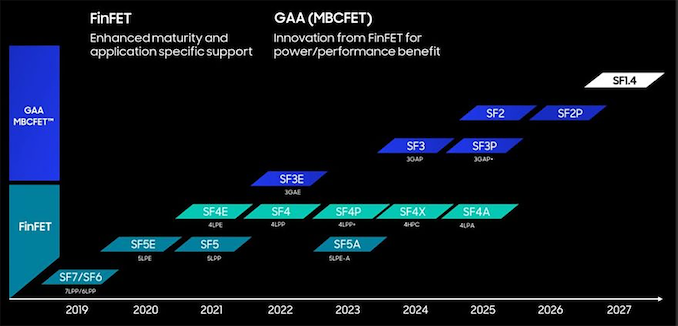


Samsung’s forthcoming SF3 process technology is a major upgrade to its existing SF3E production node, which, based on the available knowledge, is only used to make small chips for cryptocurrency mining. Samsung asserts that the SF3 will offer greater design versatility by allowing for different gate-all-around (GAA) transistor’s nanosheet channel widths within the same cell type. 


Although Samsung does not make direct comparisons between SF3 and SF3E, it says that SF3 offers major improvements over SF4 (4LPP, 4nm-class, low power plus), which includes a 22% increase in performance at equivalent power and complexity, or alternatively, a 34% reduction in power consumption at the same frequency and transistor count, along with a 21% reduction in logic area. In general, it is expected that SF3 will be a better option for complex designs than SF3E, though it will enter high-volume production in the second half of 2024.


In the meantime, Samsung Foundry’s 4nm-class generation nodes continue to evolve. The company gearing up to launch its SF4X (4HPC, 4 nm-class high-performance computing) process technology, tailored for high-performance applications such as CPUs and GPUs used in data centers. This one is going to be SF’s first process node in recent years that has been specifically designed for high-performance computing (HPC) applications.


Samsung’s SF4X process technology promises to deliver a 10% improvement in performance along with a 23% reduction in power consumption. While Samsung has not disclosed the baseline for this comparison, it is likely in reference to their standard SF4 (4LPP) process. This enhancement is achieved through a redesign of the transistor’s source and drain regions, following a reassessment of their performance under potentially high-stress conditions, the application of advanced transistor-level design-technology co-optimization (T-DTCO), and the implementation of a new middle-of-line (MOL) architecture.


With refined MOL architecture, SF4X is expected to achieve a silicon-validated minimum operating voltage (Vmin) for CPUs at 60mV, reduce the variability in the off-state current (IDDQ) by 10%, ensure stable high voltage (Vdd) operation above 1V without compromising performance, and enhance process margin for SRAM.


Source: AnandTech – Samsung’s Next-Gen 3nm and 4nm Nodes on Track for Mass Production in 2H 2024

Bizarre blip: Cases of fetuses with flipped organs quadrupled in China

A nurse is on night shift at the emergency clinic of the International Peace Maternity & Child Health Hospital of China welfare institute in Shanghai, April 1, 2022.

Enlarge / A nurse is on night shift at the emergency clinic of the International Peace Maternity & Child Health Hospital of China welfare institute in Shanghai, April 1, 2022. (credit: Getty | Yuan Quan)

Doctors in China are reporting a startling and unexplained spike in fetuses with situs inversus, a rare congenital condition in which the organs in the chest and abdomen are arranged in a mirror image of their normal positions.

In the first seven months of 2023, the rate of fetuses identified with the condition quadrupled compared with historic rates, according to a brief report appearing in the New England Journal of Medicine Thursday.

For the report, doctors from two big obstetric centers in the cities of Shanghai and Changsha combined their centers’ clinical records from January 2014 through July 2023. The doctors found that from 2014 to 2022, the yearly total of situs inversus cases was typically about five to six per 10,000 pregnant people undergoing ultrasounds. But, in 2023, the rate jumped to nearly 24 cases per 10,000 ultrasound screenings.

Read 6 remaining paragraphs | Comments


Source: Ars Technica – Bizarre blip: Cases of fetuses with flipped organs quadrupled in China

Once again, neither Mac nor iPad sales grew in Apple’s latest earnings report

A building at Apple Park, the company's Cupertino, California, HQ.

Enlarge / A building at Apple Park, the company’s Cupertino, California, HQ. (credit: Apple)

Apple reported its earnings for the fourth quarter of its 2023 fiscal year on Thursday, and while the revenue dollar count was enormous as usual, the company nonetheless reported lower year-over-year revenue for the third consecutive quarter.

The iPhone was the only hardware product that saw any growth compared to the same time last year; revenue was down across the rest of the board for Mac, iPad, and wearables (which primarily includes Watch and AirPods).

On the other hand, the company’s services business again beat expectations and helped make up for lagging hardware sales. Services is a large bucket that includes many things, from subscriptions like Apple TV+, iCloud, and Apple Music to the company’s search deal with Google, which is now at the heart of the Google antitrust trial in the United States.

Read 4 remaining paragraphs | Comments


Source: Ars Technica – Once again, neither Mac nor iPad sales grew in Apple’s latest earnings report

Okta hit by another breach, this one stealing employee data from 3rd-party vendor

Read 8 remaining paragraphs | Comments


Source: Ars Technica – Okta hit by another breach, this one stealing employee data from 3rd-party vendor

An Ode to the Doctor Who Hand Pose

David Tennant’s Doctor is very big on hands. Well, most biped humanoids, Time Lords included, are quite keen on having all their limbs. But remember the sword fight in “Christmas Invasion”? Remember the fighting hand? Remember how he grew a whole other version of himself out of that hand four years later?

Read more…


Source: Gizmodo – An Ode to the Doctor Who Hand Pose

Amazon to Ditch Clothing Stores, Wants More Grocery Stores Instead

Amazon will close its two physical clothing stores by next week, less than two years after it opened its first location in May 2022. The closures appear to reflect a shift in focus toward its grocery stores and add to Amazon’s 68 other brick-and-mortar store closures last year.

Read more…


Source: Gizmodo – Amazon to Ditch Clothing Stores, Wants More Grocery Stores Instead

Apple's revenue declines again despite record iPhone and services sales

Apple’s latest quarterly earnings report paints a picture of software wins amid something of a hardware slump. In a statement announcing the financial results for its fiscal fourth quarter, the company called out a new all-time high for revenue from its services division. It also highlighted iPhone revenue as having set a September quarter record. However, this marks the fourth consecutive quarter of overall revenue decline, with its earnings of $89.5 billion representing a 1 percent drop year over year. This also means the record-breaking performances of the iPhone and Services divisions did little to offset weakness elsewhere. 

The lackluster performance is somewhat understandable, though. The company just had a launch event for its new M3 chips, MacBooks and an iMac this week, none of which can be bought yet. And though the new iPhone 15 lineup and Apple Watches were introduced in September, sales of those devices likely did not account for much of this fiscal quarter’s results. We’re also anticipating a November release for new iPads this year, which could further fuel hardware revenue. 

Correspondingly, the Mac, iPad and wearables divisions were down this quarter, with the first two taking noticeable hits. Though Apple drummed up significant interest with the Vision Pro headset earlier this year, that device is far from ready to be sold to the public and is unlikely to hit the market until 2024 at the earliest. With holiday shopping about to ramp up, as well as more product releases on the horizon, it’s much more likely that the company’s hardware products will have a greater impact on its bottom line next quarter.

This article originally appeared on Engadget at https://www.engadget.com/apples-revenue-declines-again-despite-iphone-and-services-strength-211938910.html?src=rss

Source: Engadget – Apple’s revenue declines again despite record iPhone and services sales

Ryan Gosling is a wise-cracking stuntman with a mission in The Fall Guy trailer

Ryan Gosling takes on a role made famous in the 1980s by Lee Majors in the forthcoming film reboot The Fall Guy.

Fresh off his scene-stealing turn as Ken in Greta Gerwig’s smash summer hit Barbie, Ryan Gosling takes on a different kind of iconic role as a stunt man who must find a missing movie star in The Fall Guy. Directed by David Leitch, who also brought us the glorious John Wick (his uncredited directorial debut with Chad Stahelski), the film is a loose adaptation of the popular 1980s TV series of the same name starring Lee Majors. Based on the trailer that just dropped, The Fall Guy is a welcome throwback to the classic action comedies, giving Gosling another chance to exhibit his leading-man acting chops.

Those of us of a certain age practically grew up with Majors, starting with his hit series, The Six Million Dollar Man (1973–1978). The Fall Guy debuted in 1981, in which Majors played stuntman Colt Seavers, who moonlighted as a bounty hunter with his cousin (and aspiring stuntman), Howie Munson (Douglas Barr). Heather Thomas played stuntwoman and love interest Jody Banks, and each episode featured the team engaged in action-packed adventures that conveniently made excellent use of Colt’s extensive experience and knowledge of stunts. In keeping with the theme, the introductory montage paid tribute to classic stunt scenes from Dirty Mary, Crazy Larry, Silver Streak, Butch Cassidy and the Sundance Kid, and The Poseidon Adventure, among others.

Read 5 remaining paragraphs | Comments


Source: Ars Technica – Ryan Gosling is a wise-cracking stuntman with a mission in The Fall Guy trailer

No, TikTok (Probably) Isn't Anti-Israel

Republican lawmakers pounding the well-worn TikTok ban drum are using flaming hot tensions over the conflict in Israel to try, once again, to knock the app offline. The new line of attacks, based on shoddy data analyses, claims TikTok is boosting anti-Israel content in order to brainwash a generation of gullible…

Read more…


Source: Gizmodo – No, TikTok (Probably) Isn’t Anti-Israel

Roccat Vulcan II Review: A Flashy Upgrade

Roccat recently released two gorgeous mechanical gaming keyboards as part of its Vulcan series: the Vulcan II and Vulcan II Mini Air. Both models showcase vibrant RGB lighting and robust construction, with the former being a wired variant and the latter presenting a TKL (tenkeyless) design.

Read more…


Source: Gizmodo – Roccat Vulcan II Review: A Flashy Upgrade

Max users grandfathered into $15.99 ad-free plan lose 4K, HDR next month

ewan-mitchell-tom-glynn-carney in House of the Dragon

Enlarge / House of the Dragon is one of the shows Max offers in 4K HDR. (credit: Warner Bros. Discovery)

Max subscribers who were grandfathered into the streaming company’s cheapest ad-free plan are about to see their service get worse.

Those people who came to the Max service from HBO Max had access to 4K and HDR streams, as well as the ability to stream from three devices simultaneously, with their $15.99 per month plan. The plan hasn’t been offered to new Max subscribers; you had to be grandfathered in.

The Verge reported today that Max has started emailing customers, informing them that they will no longer be able to access 4K or HDR streams and will be limited to streaming to two simultaneous devices at a time. The changes will happen “on or after” December 5, the publication said.

Read 4 remaining paragraphs | Comments


Source: Ars Technica – Max users grandfathered into .99 ad-free plan lose 4K, HDR next month

Teen boys use AI to make fake nudes of classmates, sparking police probe

Westfield High School in Westfield, NJ, in 2020.

Enlarge / Westfield High School in Westfield, NJ, in 2020. (credit: Icon Sportswire / Contributor | Icon Sportswire)

This October, boys at Westfield High School in New Jersey started acting “weird,” the Wall Street Journal reported. It took four days before the school found out that the boys had been using AI image generators to create and share fake nude photos of female classmates. Now, police are investigating the incident, but they’re apparently working in the dark, because they currently have no access to the images to help them trace the source.

According to an email that the WSJ reviewed from Westfield High School principal Mary Asfendis, the school “believed” that the images had been deleted and were no longer in circulation among students.

It remains unclear how many students were harmed. A Westfield Public Schools spokesperson cited student confidentiality when declining to tell the WSJ the total number of students involved or how many students, if any, had been disciplined. The school had not confirmed whether faculty had reviewed the images, seemingly only notifying the female students allegedly targeted when they were identified by boys claiming to have seen the images.

Read 13 remaining paragraphs | Comments


Source: Ars Technica – Teen boys use AI to make fake nudes of classmates, sparking police probe

Apple slides from 2013 skewer Android as “a massive tracking device”

Slide in Apple's typical font reading

Enlarge / It just reads different in that typeface. (credit: Department of Justice)

“Here is [sic] the latest slides we have on privacy,” Senior Vice President of Services Eddy Cue wrote to CEO Tim Cook and then-SVP of Marketing Phil Schiller in January 2013. “Still a lot more work to do but good start.”

Those slides, newly made public as an exhibit in the Department of Justice’s ongoing antitrust trial against Google, on “The State of Privacy,” cast a dim light on Apple’s competitors, particularly Google. They quote former CEO Eric Schmidt’s notorious remarks on Google’s policy to “get right up to the creepy line but not cross it.” They unfavorably compare Apple and Google’s approaches to account data combination, voice search privacy, maps, and search. And most notably, they give over an entire slide to a summary: “Android is a massive tracking device.”

The exhibit is, as noted, redacted for public filing and abridged, so slides not pertaining to Google’s search dominance and other issues at trial are missing. Still, Apple’s presentation offers a rare glimpse into the company’s perception of Google, particularly Android, and how its own devices and services might stand apart.

Read 10 remaining paragraphs | Comments


Source: Ars Technica – Apple slides from 2013 skewer Android as “a massive tracking device”

Unredacted documents in the FTC's Amazon lawsuit shed light on the company's secret price-gouging algorithm

It looks like Amazon is hellbent on keeping its spot as the biggest online retailer — even if that means hurting both sellers and customers. In September, the FTC filed a long-expected antitrust lawsuit against Amazon over its alleged use of illegal strategies to stay on top. Details of the suit were previously withheld from the public, but today a mostly unredacted version was released, including details about Amazon’s secret pricing tool, known as Project Nessie. These algorithms helped Amazon increase prices by over $1 billion over two years, the FTC alleges.

As Amazon would argue, Amazon’s dominance of the online retail space has helped small businesses reach more consumers. But the FTC would argue that over the years, Amazon has become exploitative in its approach. The company continues to increase third-party seller fees, which are taking a toll on smaller businesses and even causing bankruptcy for some. Amazon previously said these claims were baseless, but the documents revealed today show otherwise.

According to the The Wall Street Journal, the internal documents cited in the original complaint show that Amazon executives were well aware of the effects of the company’s policies. In the documents, Amazon executives acknowledged that these policies, which included requiring Amazon sellers to have the lowest prices online or risk consequences, had a “punitive aspect.” One executive pointed out that many sellers “live in constant fear” of being penalized by Amazon for not following the ever-changing pricing policy.

The FTC also alleges that the company had been monitoring its sellers and punishing them if they offered lower prices on other platforms, which the agency says is a violation of antitrust laws. The unredacted documents indicate that Amazon has increased prices by over $1 billion between 2016 to 2018 with the use of secret price gouging algorithms known as Project Nessie. It was also revealed that the “take rate” — aka the amount Amazon makes from sellers who use the Fulfillment By Amazon logistics program — increased from 27.6 percent in 2014 to 39.5 percent in 2018. It’s unclear if that has changed in more recent years since those numbers remained redacted.

And Amazon isn’t just ruining its sellers’ experience. The complaint also revealed Amazon’s increased use of ads in search results. Several ad executives at the company acknowledged that these sponsored ads were often irrelevant to the initial search and caused “harm to consumers” and the overall experience on the site.

The FTC alleges that these policies were the brainchild of Jeff Bezos, Amazon’s founder and former chief executive, to increase the company’s profit margins.

“Mr. Bezos directly ordered his advertising team to continue to increase the number of advertisements on Amazon by allowing more irrelevant advertisements, because the revenue generated by advertisements eclipsed the revenue lost by degrading consumers’ shopping experience,” the FTC complaint alleges.

This article originally appeared on Engadget at https://www.engadget.com/amazon-ftc-lawsuit-unredacted-documents-project-nessie-secret-price-gouging-algorithm-194800531.html?src=rss

Source: Engadget – Unredacted documents in the FTC’s Amazon lawsuit shed light on the company’s secret price-gouging algorithm