If the next Starship makes it through staging, you can call that a win

Read 31 remaining paragraphs | Comments


Source: Ars Technica – If the next Starship makes it through staging, you can call that a win

Google Turns To Regulators To Make Apple Open Up iMessage

iMessage serves as “an important gateway between business users and their customers” and should be regulated as a “core” service under the EU’s new Digital Markets Act (DMA), said Google and a group of major European telcos in a letter sent to the European Commission. From a report: Being designated as a “core platform service” would be significant for iMessage, as it could compel Apple to make it interoperable with other messaging services. The letter arrives as the European Commission investigates whether iMessage meets the requirements to be regulated under the bloc’s strict DMA rules. Google has been very vocal about its desire for Apple to adopt RCS, the cross-platform messaging standard pitched as the successor to SMS, with its #GetTheMessage campaign. “Apple’s iMessage lock-in is a documented strategy,” Google senior vice-president Hiroshi Lockheimer posted on X, then known as Twitter, last year. “Using peer pressure and bullying as a way to sell products is disingenuous for a company that has humanity and equity as a core part of its marketing. The standards exist today to fix this.”

Read more of this story at Slashdot.


Source: Slashdot – Google Turns To Regulators To Make Apple Open Up iMessage

Consumer Finance Protection Bureau wants to regulate Venmo, Apple Cash like banks

Read 13 remaining paragraphs | Comments


Source: Ars Technica – Consumer Finance Protection Bureau wants to regulate Venmo, Apple Cash like banks

Seagate's HAMR Update: 32 TB in Early 2024, 40+ TB Two Years Later

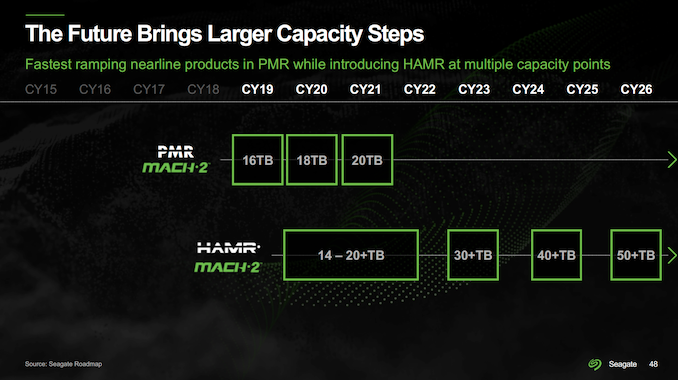
Hidden deep in Seagate’s financial report released late last month was a brief roadmap update for the company’s heat-assisted magnetic recording (HAMR) technology. As noted in the latest update, Seagate is now planning to begin mass production of its 32 TB HAMR in early 2024, which is a slight delay from what the company announced early this year. Meanwhile, the company expects to start production of 40+ TB HDDs in about two years’ time.


“Qualification and revenue ramp plans for our 30-plus terabyte products remain fully on track with high-volume ramp starting early in calendar 2024,” said Dave Mosley, chief executive of Seagate, during conference call with financial analysts and investors. ” These drives deliver capacity starting at 30 terabytes and offer customers the same flexibility to adopt either CMR or SMR configurations to further boost aerial density into the mid-30TB range.”


As noted back in October, Seagate’s Exos X24 series of HDDs will help set the stage for HAMR-based hard drives, as the latter will keep using the same 10-platter platform – albeit with new platters as well as write heads with lasers to heat the media surface. Those Exos drives will use 10 2.4 TB perpendicular magnetic recording disks and will begin shipments in the first half of calendar 2024. Around the same time — in early calendar 2024 — Seagate plans to start volume ramp of 32 TB HAMR HDDs.


Even with the volume ramp and enviable capacity, Seagate is only expecting to sell a modest number of HAMR HDDs in the first quarters of their availability. The company believes that it can move around one million units in the first half of 2024, though the firm does not disclose whether the number is limited by its ability to produce the drives, or by demand from customers who need to qualify such products before deploying them in their datacenters.


“We will start our HAMR revenue fairly strongly in the first six months of the calendar 2024,” said Gianluca Romano, chief financial officer of Seagate. “We think we have about a million unit as opportunity to be sold.”


Another interesting disclosure found in the document is that Seagate intends to start producing HAMR-based HDDs featuring 4+TB platters within the next two years, which would have them arriving sometime in late 2025 or early 2026. This is somewhat is behind the company’s optimistic schedule revealed a few years back, which anticipated 50+TB HDDs in calendar 2026. Though it’s arguably a more realistic schedule that’s in line with the development cadence thus far, especially given how development and deployment of hard drive proceeds these days.


Another noteworthy thing is that Seagate’s brief roadmap update does not mention HDDs with more than 10 platters. Meaning that the company seems to be done adding platters to gain additional capacity, at least for now. Perhaps, the company believes that increased areal density that is enabled by HAMR will enable it to offer competitive capacities and it does not need to throw in any additional disks. Or maybe installing over 10 HAMR platters is risky from yields point of view as of now, so the company prefers not to mention such a technological option.


Source: Seagate (via StorageNewsletter)


Source: AnandTech – Seagate’s HAMR Update: 32 TB in Early 2024, 40+ TB Two Years Later

The World's Largest Aircraft Breaks Cover in Silicon Valley

An anonymous reader shares a report: As dawn breaks over Silicon Valley, the world is getting its first look at Pathfinder 1, a prototype electric airship that its maker LTA Research hopes will kickstart a new era in climate-friendly air travel, and accelerate the humanitarian work of its funder, Google co-founder Sergey Brin. The airship — its snow-white steampunk profile visible from the busy 101 highway — has taken drone technology such as fly-by-wire controls, electric motors and lidar sensing, and supersized them to something longer than three Boeing 737s, potentially able to carry tons of cargo over many hundreds of miles.

“It’s been 10 years of blood, sweat and tears,” LTA CEO Alan Weston told TechCrunch on the eve of the unveiling. “Now we must show that this can reliably fly in real-world conditions. And we’re going to do that.” A series of increasingly ambitious flight tests lie ahead, before Pathfinder 1 is moved to Akron, Ohio, where LTA Research is planning an even larger airship, the Pathfinder 3. The company eventually hopes to produce a family of airships to provide disaster relief where roads and airports are damaged, as well as zero-carbon passenger transportation.

For the next year however, the gigantic airship looks set to become a Silicon Valley landmark as its novel materials and systems are methodically put through their paces within shouting distance of companies like Google, Meta, and Amazon. “I’m excited about the potential of not building just one airship, but laying the foundation for many airships to be built,” said Weston. “The innovations and the technologies that we’re about to demonstrate have the potential to lay the foundation for a new industry.”

Read more of this story at Slashdot.


Source: Slashdot – The World’s Largest Aircraft Breaks Cover in Silicon Valley

WhatsApp will let you hide your IP address from whoever you call

A new feature in WhatsApp will let you hide your IP address from whoever you call using the app. Knowing someone’s IP address can reveal a lot of personal information such as their location and internet service provider, so having the option to hide it is a major privacy win. “This new feature provides an additional layer of privacy and security geared towards our most privacy-conscious users,” WhatsApp wrote in a blog post.

WhatsApp currently relays calls either through its own servers or by establishing a direct connection called peer-to-peer with whoever you are calling depending on network conditions. Peer-to-peer calls often provide better voice quality, but require both devices to know each other’s IP addresses.

Once you turn the new feature, known simply as “Protect IP address in calls” on, however, WhatsApp will always relay your calls through its own servers rather than establishing a peer-to-peer connection, even if it means a slight hit to sound quality. All calls will continue to remain end-to-end encrypted, even if they go through WhatsApp’s servers, the company said.

WhatsApp has been adding more privacy features over the last few months. In June, the company added a feature that let people automatically silence unknown callers. It also introduced a “Privacy Checkup” section to allow users to tune up a host of privacy settings from a single place in the app, and earlier this year, added a feature that lets people lock certain chats with a fingerprint or facial recognition.

This article originally appeared on Engadget at https://www.engadget.com/whatsapp-will-let-you-hide-your-ip-address-from-whoever-you-call-140045546.html?src=rss

Source: Engadget – WhatsApp will let you hide your IP address from whoever you call

The 12 best gifts under $25 for 2023

The most hyped tech is often also the most expensive: flagship smartphones, ultra-powerful gaming laptops, immersive VR headsets and the like. But it would be wrong to assume that those are the only pieces of technology worth gifting. You don’t have to drain your wallet to get someone a cool gadget that will both be useful and make their lives easier. There are more solid, affordable gadgets out there now more than ever, but that also means you’ll discover some junk along the way. We’ve collected our favorite pieces of tech under $25 that make great gifts and help you to stick to a budget.

Elevation Labs Go Stand

Anker 240W USB-C to C cable

JLab Go Air Pop

Samsung Pro Plus microSD card

PopSockets Phone Wallet

Tile Mate

Anker 313 Wireless Charging Stand

Amazon Smart Plug

Bagsmart electronics organizer

Zulay milk frother

Loop Quiet earplugs

Peak Design Packable Tote

This article originally appeared on Engadget at https://www.engadget.com/best-gifts-under-25-140042014.html?src=rss

Source: Engadget – The 12 best gifts under for 2023

Black Friday 2023: The best early deals we found from Amazon, Walmart, Target and others

With each passing year, the phrase “Black Friday” becomes more of a misnomer. What was once a day of post-Thanksgiving special offers has become a month of sales promotions from retailers across the web. It’s happening again in 2023: Target and Best Buy are already advertising their early Black Friday deals; Amazon is price matching many of those discounts and has its own “Holiday Deals” landing page; and Walmart says it’ll kick off its first wave of Black Friday deals on November 8. Many other shops and manufacturers have (or will soon have) early deals as well.

This barrage of sales promos can be aggravating, but it also presents a good opportunity to get your holiday shopping done at something closer to your own pace. To help, we’ve rounded up the best early Black Friday deals we can find below. There’s always a chance we get bigger discounts on November 24, but we’re already seeing all-time lows on LG’s A2 OLED TV, PS5 bundles, the 9th-gen iPad and other gadgets we like. We’ll be updating our list regularly in the lead-up to Black Friday, so check back if there’s anything else you’ve had your eye on. 

Apple AirPods Pro (2nd gen)

The latest version of Apple’s AirPods Pro is back on sale for $200 at Amazon and Target. That’s about $10 more than their record-low price and $50 off their usual going rate. The AirPods Pro are the “best for iOS” pick in our wireless earbuds buying guide thanks to their easy pairing and deep integration with Apple devices. Effective active noise cancellation (ANC), a superb transparency mode and a pleasingly warm sound profile help as well, as does a new “adaptive audio” mode that can adjust the earphones’ noise control settings based on your surroundings. That said, their battery life is just average at six-ish hours per charge, and you really have to use an iPhone to get anything out of them. We gave the Lightning-based version of the second-generation AirPods Pro a review score of 88 last year; this new iteration is almost identical, only it comes with a USB-C charging case and has a higher IP54 dust-resistance rating.

Apple iPad (9th-gen)

Apple’s 9th-gen iPad is down to $249 at Amazon, Walmart and Target, which is a deal we’ve seen for much of the past month but still matches the tablet’s lowest-ever price. This is the budget pick in our iPad buying guide, and it earned a review score of 86 in 2021. It’s the last iPad to use Apple’s old design language, so it has thick bezels, a Lightning port, a Home button and a non-laminated display. This variant also comes with a paltry 64GB of storage. At this price, though, it’s still hard to do better if all you want is a large screen for streaming video, playing games and browsing the web. Its 10.2-inch display remains a step up from cheaper slates, its A13 Bionic chip is plenty fast for casual media consumption and its battery still lasts around 10 hours per charge. Most importantly, it’s the cheapest route into Apple’s huge app library, customer support and years of software updates.

If you want a more modern design, the iPad Air is the top pick in our guide, and it’s now on sale for $500. Be warned, though: A recent Bloomberg report says that Apple plans to launch new tablets in the spring. If you don’t need an iPad right away, it’s probably worth waiting.

Apple AirPods (2nd gen)

Starting on November 8, Walmart has the second-gen AirPods for only $69 — a new record low and the cheapest we’ve ever seen. Walmart+ members get early access to Walmart’s Black Friday deals, with sales being open to everyone else a few hours later. These AirPods are a bit old at this point, but at this Black Friday price, they’re a great deal for anyone who just wants a pair of earbuds that will work seamlessly with their iPhone, iPad or MacBook.

Samsung T9 SSD

The latest Samsung T9 portable SSD is on sale for $130 right now for a 1TB drive, which is the best price it’s been since it came out last month. You can snag these Black Friday deals from Amazon or Samsung direct, and you’ll save $40 if you spring for the 2TB version or $100 on the 4TB model. The T9 is the newest iteration of Samsung’s popular portable drive that we’ve long been fans of, and it supports read and write speeds of up to 2,000 MB/s. It also has dynamic thermal guard to prevent overheating, plus it comes with a USB-C to C and USB-C to A cords so you can use it with a variety of devices.

PlayStation DualSense Wireless Controller

Amazon has discounted a bunch of PlayStation DualSense controllers ahead of Black Friday, including many of the colorways that typically go for $75. You can pick up Cosmic Red, Starlight Blue, Nova Pink and other models for $50 each, which is just about a record-low price. These controllers work with the PS5 as well as PC, and they sport adaptive L2 and R2 triggers, haptic feedback and a built-in mic array.

PS5 + Marvel’s Spider-Man 2 bundle

If you or someone you love hasn’t gotten their hands on a PS5 yet and is itching to do so, this bundle with the console and the new Spider-Man 2 game is down to its cheapest price yet — $500. The PS5 remains one of the best gaming consoles you can get right now, and when we reviewed the new Marvel’s Spider-Man 2, we found it to be even better than its predecessor. In it, you can swap between playing as Peter Parker and Miles Morales, and it includes expanded combat mechanics.

Surfshark VPN

Surfshark’s Black Friday deal knocks up to 86 percent off two-year plans, and you’ll get a few extra months of service for free depending on the plan you select. We consider Surfshark to be one of the best VPN services available right now, particularly if you want a solid VPN at an affordable price. We believe the mid-tier plan, Surfshark One, will be the best for most people and a two-year plan is down to $2.69 per month, with an additional four months of services thrown in for free.

Samsung M80C Smart Monitor

Samsung’s Smart Monitor M80C is $300 off and down to $400 right now. You’ll see a $200 discount on the product page, but a clippable coupon will take the extra $100 off at checkout. The selling point for this display, and really any Samsung Smart Monitor, is that it pulls triple duty as an external display, a smart TV and an IoT hub. In addition to connecting it to your computer, you can use it standalone as a TV thanks to the built-in TV operating system and included remote, and the embedded SmartThings hub lets you directly connect things like smart lights and other gear to the display.

Motorola razr+

The Moto razr+ is 30 percent off and down to a record low of $700. It earned a spot in our best foldable phones guides thanks to handy exterior display that’s actually easier to use than that on the Samsung Galaxy Z Flip 5 and its ability to fold in half and get super compact and pocket-friendly. It’s cameras are not on par with those on Samsung’s foldables, but it’s a generally solid flip phone with a ton of personality.

Samsung 85-inch The Frame smart TV

The 85-inch Samsung The Frame smart TV is 23 percent off and down to a new record low of $3,300 at both Amazon and Samsung direct. The Frame has been super popular thanks to its design, which mimics framed artwork when not in use. It has a matte, anti-reflective display and an included slim wall mount so you can get the true “artwork” effect when you hang it on the wall. As an actual TV, it supports 4K content and Quantum Dot technology, plus it runs on Samsung’s Tizen TV operating system.

Logitech G203 gaming mouse

Amazon is having a big sale on Logitech gaming accessories and peripherals, including gaming headsets, mice, keyboards and more. Of note is the Logitech G203 Lightsync wired gaming mouse, which is half off and down to only $20. It’s one of our favorite gaming mice thanks in no small part to its affordable price, but it’s also fairly lightweight and sturdily built with an ambidextrous design that will work for right- and left-handed users. Also discounted is the Logitech G733 Lightspeed wireless gaming headset, which is 20 percent off and down to $120. It has an attractive design with subtle LED lighting and a stretch band, and it has a solid wireless connection with audio to match.

Solo Stove early Black Friday deal

Solo Stove’s Black Friday deals have knocked up to $245 off fire pit bundles, up to $100 off fire pits by themselves and even more. A standout is the Ranger Backyard Bundle 2, which is $145 off and down to $320. It includes the company’s most compact fire pit along with its accompanying shield, stand, lid and shelter. Everything you’d need for an easy setup right out of the box is included in this bundle, and the 2.0-version of the Ranger includes a removable base plate and ash pan, both of which make the fire pit much easier to clean.

ProtonVPN early Black Friday deal

Our favorite VPN service, ProtonVPN, is having a rare sale for Black Friday that brings a monthly subscription down to only $4 for a total of 30 months. That means you’ll pay $120 for two and a half years of access, which is a pretty good deal. ProtonVPN passed our tests with high marks, but what made it stand out among other VPN security services was its independently audited no-logs policy, and the fact that the company has proven they don’t comply with law enforcement requests to reveal data. If you want to jump in head-first with Proton services, the company has discounted Proton Unlimited, which includes access to VPN, Mail, Calendar, Drive and Pass, to just under $9 per month for the first year.

Amazon Fire TV Stick 4K

Amazon’s latest Fire TV Stick 4K and Fire TV Stick 4K Max have received their first discounts since they arrived in September. The former is $20 off at $30, while the latter is $15 off at $45. Between the two, the Max has a slightly faster processor clocked at 2.0GHz (instead of 1.7GHz), 16GB of internal storage (instead of 8GB) and support for the Wi-Fi 6E (instead of just Wi-Fi 6). It also includes Amazon’s “Ambient Experience” mode, which displays artwork and widgets when the streamer is idle. That said, both dongles should be quick to load content. Both support the requisite streaming apps, Dolby Atmos and all the major HDR formats as well.

The downsides are the familiar ones with Fire TV devices: The UI is saddled with ads and not shy about nudging you toward Amazon services like Prime Video and Freevee. But if you often use those apps (or Alexa) and just want a competent 4K streamer for cheap, that may not be an issue. 

On the higher end of the Fire TV lineup, the Fire TV Cube is also on sale for $110. That ties the all-time low for the streaming box/Alexa speaker hybrid. You can also pair the Fire TV Stick 4K Max with Blink’s 1080p Video Doorbell for $65 total, though that offer is only available for Prime members and is only scheduled to run through November 3.

Google Nest Hub

If you’re partial to the Google Assistant, Google’s Nest Hub is also on sale for $60 at Target, B&H, Best Buy, Google’s online store and others. That’s $20 higher than its all-time low but still $40 off Google’s list price. The Nest Hub is the top overall pick in our smart display buying guide, and we gave it a review score of 89 back in 2021. It has a 7-inch screen, so it’s a bit bigger than the Echo Show 5 but should still be compact enough to fit neatly in a bedroom or small office. While it lacks a built-in camera, that may be a selling point for those who especially sensitive to their privacy (though no smart display is truly privacy-conscious). 

Ultimately, whether it’s worth getting a Nest Hub or Echo Show depends on what services you use: If you own a bunch of Nest devices and depend on apps like Gmail, Google Calendar and Google Photos, Google’s display will make sense. If you want a larger model with a webcam and stronger speakers, the 10-inch Nest Hub Max is also on sale for $129. That’s a $100 discount. 

LG A2 OLED TV

We expect to see many more TV deals as we get closer to Black Friday, but for now one standout is LG’s 48-inch A2 OLED TV on sale for a new low of $550 at Best Buy. This is an entry-level model from 2022, so it’s limited to a 60Hz refresh rate, lacks HDMI 2.1 ports and doesn’t support other gaming-friendly features like VRR. That said, it’s still an OLED TV, so it delivers deep contrast, bold colors, wide viewing angles and low input lag. At this price, it should be a nice step-up option for smaller or secondary rooms. Just note that it can’t get as bright as higher-end OLED sets, so it’s best situated away from direct sunlight. 

Apple MacBook Air (15-inch)

A configuration of Apple’s 15-inch MacBook Air with an M2 chip, 16GB of RAM and 512GB of SSD storage is down to $1,449 at Best Buy. That’s $250 less than Apple’s MSRP. If you can live with less memory, a version with 8GB of RAM is on sale for $1,250 at Amazon with an on-page coupon. Either way, the MacBook Air is the top pick in our laptop buying guide, as it has just about everything we want from a mainstream notebook: A premium design, a comfortable keyboard and trackpad, a lovely display, long battery life, great speakers and solid performance. Compared to the 13-inch Air, this model has more powerful speakers alongside its larger screen. We gave it a score of 96 in our review this past June.

The MacBook Air’s main downsides are that it only has two Thunderbolt ports and, as always, it’s virtually impossible to upgrade after the fact. Plus, with the recent introduction of the new M3 chip, the countdown is on for a refresh. A recent Bloomberg report says that Apple plans to launch an M3-powered MacBook Air at some point in 2024, though that shouldn’t make this current model obsolete if you need a new laptop right away. 

FAQs

When is Black Friday 2023?

Black Friday 2023 lands on November 24 this year, with Cyber Monday 2023 following up a few days later on November 27. However, the early deals have already begun. The entire month of November might as well be renamed Holiday Shopping Month as that’s when companies really start to get serious with their discounts.

What day is Black Friday 2023 at Walmart?

Walmart Black Friday deals will begin early this year on November 8. Walmart+ members will get a few hours of early access to Black Friday deals if they shop online on November 8, with access for everyone else starting later that day. Walmart will match its online Black Friday deals in stores starting November 10.

Will Amazon have a Black Friday sale in 2023?

Amazon will likely have a Black Friday sale in 2023. While the online retailer hasn’t made its deals known yet like Walmart has, Amazon will almost certainly have deals across all of the types of products it sells, including electronics. We anticipate seeing record-low prices on Amazon devices in particular, like Echo speakers, Fire TVs, Kindles and more. In years past, Amazon Black Friday deals have brought some of the best prices of the year on our favorite gadgets and gear, including headphones, tablets, smartwatches, robot vacuums and more.

What other retailers have Black Friday sales in 2023?

Most retailers have Black Friday sales, so you can expect to see Target, Best Buy, and others join Walmart and Amazon in discounting inventory to capitalize on holiday shopping interest. In the consumer electronics space, we expect most companies to have some sort of Black Friday promotion, so that means you will likely be able to get big-ticket items from brands like Apple, Samsung, Google, Sony, LG, Sonos and others for much cheaper prices.

Your Black Friday Shopping Guide: See all of Yahoo’s Black Friday coverage, here. Follow Engadget for Black Friday tech deals. Learn about Black Friday trends on In The Know. Hear from Autoblog’s experts on the best Black Friday deals for your car, garage, and home, and find Black Friday sales to shop on AOL, handpicked just for you.

This article originally appeared on Engadget at https://www.engadget.com/black-friday-2023-the-best-early-deals-we-found-from-amazon-walmart-target-and-others-134511926.html?src=rss

Source: Engadget – Black Friday 2023: The best early deals we found from Amazon, Walmart, Target and others


AMD Begins Polaris and Vega GPU Retirement Process, Reduces Ongoing Driver Support

As AMD is now well into their third generation of RDNA architecture GPUs, the sun has been slowly setting on AMD’s remaining Graphics Core Next (GCN) designs, better known by the architecture names of Polaris and Vega. In recent weeks the company dropped support for those GPU architectures in their open source Vulkan Linux driver, AMDVLK, and now we have confirmation that the company is slowly winding down support for these architectures in their Windows drivers as well.


Under AMD’s extended driver support schedule for Polaris and Vega, the drivers for these architectures will no longer be kept at feature parity with the RDNA architectures. And while AMD will continue to support Polaris and Vega for some time to come, that support is being reduced to security updates and “functionality updates as available.”


For AMD users keeping a close eye on their driver releases, they’ll likely recognize that AMD already began this process back in September – though AMD hasn’t officially documented the change until now. As of AMD’s September Adrenaline 23.9 driver series, AMD split up the RDNA and GCN driver packages, and with that they have also split the driver branches between the two architectures. As a result, only RDNA cards are receiving new features and updates as part of AMD’s mainline driver branch (currently 23.20), while the GCN cards have been parked on a maintenance driver branch – 23.19.


At present, AMD has not published anything about this change in driver support to their website. But, responding to a request for a comment on Windows driver support from AnandTech, issued the following statement.


The AMD Polaris and Vega graphics architectures are mature, stable and performant and don’t benefit as much from regular software tuning.  Going forward, AMD is providing critical updates for Polaris- and Vega-based products via a separate driver package, including important security and functionality updates as available.  The committed support is greater than for products AMD categorizes as legacy, and gamers can still enjoy their favorite games on Polaris and Vega-based products.


Notably, AMD is actively asserting that this is not “legacy” status for Vega and Polaris, which is an important distinction because of what “legacy” means within AMD’s ecosystem. For AMD, legacy products are effectively considered end-of-life, and ongoing driver support is retired. Which in the case of previous generation GPU architectures going legacy, AMD did not have any further driver releases of any kind planned – though in practice did AMD release a couple of drivers to fix critical security issues.


AMD’s support plans for Vega and Polaris, by contrast, still call for regular driver releases, albeit without major feature updates or performance optimizations. That means receiving bug fixes and other occasional updates as AMD sees fit to backport them to the older driver branch, but not the full scope of updates that AMD’s RDNA products are now receiving via their up-to-date mainline driver. In practice, this is much closer to how NVIDIA has handled their legacy GPU products, which have traditionally received security fixes for a minimum length of time – making for a more welcome offramp for going from fully supported to unsupported.


But regardless of what AMD is calling their driver support policy for Polaris and Vega, the end result is that major driver development for these GPU architectures has effectively come to an end, and these parts have now entered an extended support phase. AMD considers the drivers for the hardware mature, and with games increasingly taking advantage of features not supported by the hardware (e.g. Alan Wake II and mesh shaders), there’s clearly less of a need to add support/optimizations for new games to drivers for old hardware.


More broadly speaking, with the current high-end game consoles using a RDNA2-ish (DX feature level 12_2) architecture, we’re finally approaching a rather hard switch that will be leaving pre-12_2 GPUs behind. Consequently, I’m not surprised to see AMD semi-retire both Polaris and Vega at the same time – there is a clear gulf in archtiecture between GCN and the greatly reworked RDNA that underpins AMD’s more recent cards.


AMD Recent GPU Driver Releases
Adrenaline RDNA GCN 4 & 5
23.11.1 (November) 23.20.23.01 23.19.05.01
23.10.2 (October) 23.20.17.03 N/A
23.9.3 (September) 23.20.11.04 23.19.02
23.8.2 (August) 23.10.29.06


As AMD enacted this driver split back in September, we can already see some of the ramifications of this with AMD’s latest drivers. Polaris and Vega did not receive an October driver release (Adrenaline 23.10), and the November release (Adrenaline 23.11.1) contains only a handful of fixes for GCN cards, as opposed to the much more extensive list of fixes and new game support for RDNA cards.


Ultimately, while the remaining GCN GPUs haven’t been put out to pasture quite yet, this is clearly the beginning of the end for a line of GPU architectures that stretches back to AMD’s 2011 GPU architecture modernization. AMD has been selling Polaris (GCN 4) cards since mid-2016 – starting over seven years ago – and in practice the core compute and graphics architecture of GCN 4 is virtually identical to the even older GCN 3 architecture. Consequently, AMD has essentially been supporting that core GPU architecture for almost 9 years at this point.


GCN 4 & 5 Products
Desktop Mobile
Radeon VII Radeon 600 Mobile Series
Radeon RX Vega Series Radeon 500 Mobile Series
Radeon Pro Duo Radeon 400 Mobile Series
Radeon 600 Series Ryzen Mobile 2000 Series
Radeon RX 500 Series Ryzen Mobile 3000 Series
Radeon RX 400 Series Ryzen Mobile 4000 Series
Ryzen 5000G Series APUs Ryzen Mobile 5000 Series
Ryzen 4000G Series APUs Ryzen Mobile 7030U Series
Ryzen 3000G Series APUs  
Ryzen 2000G Series APUs  


Meanwhile, things are a little more short-lived for the newer Vega GPU architecture (GCN 5). While AMD introduced the first discrete Vega GPUs and video cards in mid-2017 – and replaced the whole lot of them in mid-2019 – that GPU architecture remained in use in current-generation products for much longer as an integrated graphics solution. AMD’s current desktop APUs, the Ryzen 5000G series, integrate a Vega GPU. And the same silicon is still sold in the mobile space as the budget-minded Ryzen Mobile 7030 series. So although the Vega architecture is only a year younger than Polaris, it has stuck around for much longer overall.


Unfortunately, that does also mean that these Vega-based APUs are also getting something of the short end of the stick when it comes to driver support, receiving only a few years of mainstream driver support before being deprioritized. Though as these are also the weakest Vega GPUs, they’re admittedly also the least likely to be used with new games. More critical here will be how long AMD supplies security fixes for the Vega GPU architecture, especially since GPU drivers are popular targets for privilege escalation attacks.


In any case, while this isn’t a eulogy for the final members of the Graphics Core Next GPU architecture – at least, not quite yet – it’s clear that, 12 years later, GCN’s time is finally approaching its end.


Source: AnandTech – AMD Begins Polaris and Vega GPU Retirement Process, Reduces Ongoing Driver Support

Instagram finally begins testing an option to turn off read receipts

Providing read receipts has long been a choice across almost every messaging platform. Now, one of the biggest holdouts, Instagram, is finally testing a feature that lets users hide when they’ve “seen” a message. Meta CEO Mark Zuckerberg and Instagram head Adam Mosseri both announced the update on their Instagram Broadcast channels. 

Mosseri also shared an image of how the feature will work. The option will live under the Privacy and Safety tab, accessible by clicking on the person’s name from inside the chat. From there, a section will appear called “Who can see your activity.” Just switch the toggle below and all views moving forward should then become private. However, any messages sent in vanish mode will still have read receipts. 

How to turn off read receipts on Instagram.
Meta

Whether you open a message with a video and can’t listen right away or just don’t want to respond in the moment, there are lots of reasons why hiding your read receipts can be beneficial. However, they didn’t say when the option will roll out to everyone or even how exactly they’re testing it. Also unclear is if you’ll have to turn it off for each person or if there will eventually be an overarching option. 

Meta-owned WhatsApp has allowed users to hide their read receipts since 2014, but Messenger, like Instagram, still automatically shows when a message is viewed. Maybe one day all Meta platforms will allow for checking messages discreetly, but until then, we’ll watch how the Instagram test goes.  

This article originally appeared on Engadget at https://www.engadget.com/instagram-finally-begins-testing-an-option-to-turn-off-read-receipts-131557528.html?src=rss

Source: Engadget – Instagram finally begins testing an option to turn off read receipts

Daily Telescope: Lucy continues to surprise astronomers with its first flyby

This image shows the asteroid Dinkinesh and its satellite as seen by the Lucy Long-Range Reconnaissance Imager (L’LORRI) as NASA’s Lucy Spacecraft departed the system.

Enlarge / This image shows the asteroid Dinkinesh and its satellite as seen by the Lucy Long-Range Reconnaissance Imager (L’LORRI) as NASA’s Lucy Spacecraft departed the system. (credit: NASA/Goddard/SwRI/Johns Hopkins APL)

Welcome to the Daily Telescope. There is a little too much darkness in this world and not enough light; a little too much pseudoscience and not enough science. We’ll let other publications offer you a daily horoscope. At Ars Technica, we’re going to take a different route, finding inspiration from very real images of a universe that is filled with stars and wonder.

Good morning. It is November 8, and yes, we’re headed back out to the Lucy mission again. NASA has shared some additional information about an asteroid flyby last week, and there’s more goodness to share.

A few days ago, the Daily Telescope reported that the Lucy spacecraft had found not one but two asteroids during its flyby of the small main-belt asteroid Dinkinesh. It turns out that was not the whole story. Subsequent data downlinked from the spacecraft revealed that the smaller of the two asteroids is a contact binary—two smaller asteroids in contact with one another.

Read 5 remaining paragraphs | Comments


Source: Ars Technica – Daily Telescope: Lucy continues to surprise astronomers with its first flyby

North Greenland Ice Shelves Have Lost 35% of Their Volume In Last Half-Century, Study Finds

An anonymous reader quotes a report from CBS News: Scientists have long thought that the glaciers in North Greenland have been stable — a vital condition, as they contain enough ice to raise the sea level by nearly 7 feet. But a new study published on Tuesday found that ice shelves in the region have lost more than a third of their volume in the last half-century because of rising temperatures — and if it continues, scientists say there could be “dramatic consequences” for glaciers, and the planet. Using thousands of satellite images and climate modeling, the study, published in Nature Communications, found that North Greenland’s ice shelves “have lost more than 35% of their total volume” since 1978.

Ice shelves are the part of ice sheets — a form of glacier — that float over water. Three of those shelves in North Greenland have “completely” collapsed, researchers said, and of the five main shelves that remain, they said they have seen a “widespread increase” in how much mass they have lost, mostly due to the warming of the ocean. One of the shelves, called Steenbsy, shrank to just 34% of its previous area between 2000 and 2013. Along with the loss of overall ice shelf volume, scientists said the area of floating ice decreased by more than a third of its original extent since 1978. This observation could pose a major problem, as the Greenland ice sheet is the second-largest contributor to sea level rise. From 2006 to 2018, scientists noted that the single sheet was responsible for more than 17% of sea level rise in that period.

Read more of this story at Slashdot.


Source: Slashdot – North Greenland Ice Shelves Have Lost 35% of Their Volume In Last Half-Century, Study Finds

Google wants to help you create new smart home automations with AI-generated scripts

Google is rolling out new features and improvements for Home and Nest, one of which could make it much easier for users to create complex home automations even if they don’t know how to code. The company’s experimental “help me script” feature leverages the power of generative AI to create home automation scripts from the natural language prompts users type in. They can, for instance, write “when the TV turns on after sunset, dim the living room lights and close the blinds” to instantly generate a script they can use. 

“Help me script” lives inside Google Home for the web, and it appears as a panel inside the script editor when users click on “+ Add new.” All they have to do is write a prompt, press enter and then copy-paste the script results into the script editor. They’ll then have to validate the script to verify that it has no errors and that it’s working as intended before saving it to activate the automation. Based on the other potential home automation prompts that Google listed, including “use lights and TVs to make my house look occupied when I arm the security system” and “send me a notification when the doorbell rings but nobody is home,” it could be a valuable security tool. It’s just a test feature at this point, though, and is only available in Public Preview on Google Home for the web for a limited time only. 

In addition to the generative AI-powered script generator, Google has also announced that expanded controls for compatible smart home devices across different brands are coming to Home’s Public Preview soon. The home panel, a Pixel-exclusive that gives users quick access to their smart home controls on their lock screen, is also making its way to other Android 14 devices.

This article originally appeared on Engadget at https://www.engadget.com/google-wants-to-help-you-create-new-smart-home-automations-with-ai-generated-scripts-124008376.html?src=rss

Source: Engadget – Google wants to help you create new smart home automations with AI-generated scripts

The Morning After: Hollywood studios wanted to use AI-generated likenesses of dead actors without permission

SAG-AFTRA, the union representing Hollywood performers, has reportedly responded to studios’ “last, best and final” offer to end the strike, rejecting clauses letting studios re-use AI-created likenesses of high-demand and deceased performers without consent from their estate or families. “They can’t have that loophole to exploit performers,” a union-side source told The Hollywood Reporter. “We could not allow that language to stand.”

Reportedly, the Alliance of Motion Picture and Television Producers (AMPTP) would “secure AI scans” for Schedule F performers — union members earning more than $32,000 per TV episode or $60,000 per film. Studios would pay once to scan the likenesses of these performers without paying for their use or re-use — essentially giving them eternal rights to their face after paying once upfront. It appeared to offer limitless use of dead performers’ AI-created likenesses without proper permission.

After this part of the dispute became public, the union reportedly “reached a common understanding” with AMPTP on “thorny issues” like AI consent after an actor dies.

— Mat Smith

​​You can get these reports delivered daily direct to your inbox. Subscribe right here!

​

The biggest stories you might have missed

Rockstar may announce Grand Theft Auto VI this week

The best retro gaming gifts for the holidays

Stranger Things is coming back to Dead by Daylight

Waze will now warn you if a road has a history of crashes

The best budget laptops

Master & Dynamic debuts MW09 earbuds with upgraded sound, ANC and battery life

Stray is coming to macOS on December 5

Things go from bad to worse for Cruise’s robotaxis

The company reportedly kept operating its robotaxis despite issues recognizing children.

GM’s autonomous vehicle Cruise division is already going through a rough patch, with the California Department of Motor Vehicles (DMV) recently suspending its driverless permits over safety issues. Now, several new reports highlight other issues, including problems with its autonomous vehicles’ (AVs) sensors’ recognizing children and the frequency with which human operators must remotely take control. The cars apparently also struggle to identify large holes too. Now, it appears Cruise has halted production of its Origin autonomous vehicle after the California DMV pulled its license. A GM spokesperson confirmed to Engadget that the company is “finishing production on a small number of pre-commercial vehicles and after that, plan[s] to temporarily pause production.”

Continue reading.

Zelda, Mario and Pikmin give Nintendo a boost as console sales dwindle

Selling almost 20 million copies of The Legend of Zelda: Tears of the Kingdom.

TMA
Engadget

As the Nintendo Switch nears the end of its time, digital game sales are helping the company continue to perform well. From March to September 2023, Nintendo reported selling 19.5 million copies of The Legend of Zelda: Tears of the Kingdom, which was released in May. It also sold 2.61 million units of Pikmin 4 after it came out in July, and Mario Kart 8 Deluxe gained 3.22 million more sales. The racing game has now sold 57 million copies. Nintendo is expected to release its new flagship console sometime next year.

Continue reading.

The Sony A9 III is the fastest full-frame camera ever

It’s been a while since Sony updated its epic A9 series.

TMA
Sony

Sony’s latest pro-oriented mirrorless camera was four years in the making. The Alpha A9 III is the first full-frame camera on the market with a global stacked sensor, a sort of holy grail in the photographic world. It allows for some wild specs, like 120 fps shooting speeds with no blackout, up to a 1/80,000th of a second shutter speed and zero rolling shutter. The global shutter also allows for shutter speeds of 1/80,000th of a second (1/16,000th during continuous shooting), ten times faster than most cameras. Ten times! The Alpha A9 III goes on pre-order tomorrow for $6,000, with a vertical grip available for $400 — but won’t arrive until spring.

Continue reading.

WatchOS 10.1.1 fixes Apple Watch battery-life bug

The patch just rolled out alongside a bug-fix update for iOS 17.

If your Apple Watch hasn’t been holding its charge like it used to, it’s time to update to the latest version of watchOS. Earlier this month, several Apple Watch users noticed their batteries draining faster than usual after they installed watchOS 10.1. Apple acknowledged the battery drain issue and promised to release a fix — which happened today with the latest version of watchOS, 10.1.1.

Continue reading.

This article originally appeared on Engadget at https://www.engadget.com/the-morning-after-hollywood-studios-wanted-to-use-ai-generated-likenesses-of-dead-actors-without-permission-121531437.html?src=rss

Source: Engadget – The Morning After: Hollywood studios wanted to use AI-generated likenesses of dead actors without permission

PlayStation DualSense controllers fall to $50 in early Black Friday sale

The PlayStation Store at Amazon is selling various colors of the Playstation DualSense Wireless Controller for only $50 as part of its early Black Friday deals. You can get the controller for your PS5, which also works for PCs, right now for up to 33 percent off their usual prices. Yes, the models on sale include the colors that typically go for $75 — Cosmic Red, Starlight Blue, Nova Pink, Galactic Purple, Gray Camouflage, Volcanic Red and Cobalt Blue — in addition to the basic $70 white and the Midnight Black controllers. 

The DualSense controller has adaptive L2 and R2 triggers with varying levels of force and tension that change as you interact with your game’s environment. It also comes with haptic feedback meant to add a layer of immersion to your gaming sessions. DualSense has a built-in microphone array, so you can chat with friends without a headset, though you can always plug one in through the controller’s 3.5mm jack. And if you quickly want switch voice capture on or off, you can simply click the controller’s dedicated mute button.

In case you’ve still yet to buy a PS5, or if you’re looking to gift one these holidays, you can get one bundled with Marvel’s Spider-Man 2 at a discount, as well. The bundle is selling for $500, down $60 from its regular price. We enjoyed Spider-Man 2 when we reviewed it and found it even better than the first installment. It was action-packed from the beginning, with a gameplay that allows you to quickly swap between Peter Parker and Miles Morales for two different types of Spidey-experiences. We also praised Insomniac for expanding and streamlining the game’s combat mechanics. The game is exclusive to the PS5, and you’ll get a full game voucher to download it from the PlayStation Network when you purchase this bundle.

Follow @EngadgetDeals on Twitter and subscribe to the Engadget Deals newsletter for the latest tech deals and buying advice.

This article originally appeared on Engadget at https://www.engadget.com/playstation-dualsense-controllers-fall-to-50-in-early-black-friday-sale-115513371.html?src=rss

Source: Engadget – PlayStation DualSense controllers fall to in early Black Friday sale

Google and EU mobile carriers push European Commission to force Apple to open iMessage

The long fight to make Apple’s iMessage compatible with all devices has raged with little to show for it. But Google (de facto leader of the charge) and other mobile operators are now leveraging the European Union’s Digital Market Act (DMA), according to the Financial Times. The law, which goes into effect in 2024, requires that “gatekeepers” not favor their own systems or limit third parties from interoperating within them. Gatekeepers are any company that meets specific financial and usage qualifications, including Google’s parent company Alphabet, Apple, Samsung and others. 

The European Commission is investigating whether iMessage’s current functioning violates the DMA. Apple argues that its “small scale relative to other messaging services” and the lack of required use (or cost to do so) makes it irrelevant to the law. However, a letter from executives at companies such as Google, Vodafone and Orange argues that it should qualify as “enriched” messaging is only available to Apple users. 

Apple’s iMessage not so subtly rewards you for communicating with other Apple devices (and for being an Apple user). Chats on iMessage stay blue until you add an Android user into the mix, and, suddenly, everything is green. Beyond the other reasons we’ll get into, it’s hard to explain why the blue is better, but it just is. On the tech side, Android users also get lower-quality photos and videos when they’re sent through iMessage. Plus, iMessages can be sent over Wi-Fi, reducing the need for data when traveling or if you’re simply running low on gigabytes for the month. 

In a statement aimed at keeping iMessage’s benefits exclusive to Apple users, the company said, “Consumers today have access to a wide variety of messaging apps, and often use many at once, which reflects how easy it is to switch between them. iMessage is designed and marketed for personal consumer communications, and we look forward to explaining to the commission why iMessage is outside the scope of the DMA.”

If the fight against Apple is successful, changes to iMessage would be the latest shift forced by the European Commission. Apple’s new iPhone 15 dropped the lightning charger following a law mandating all new mobile devices sold in the EU have a USB-C port by the end of 2024.

This article originally appeared on Engadget at https://www.engadget.com/google-and-eu-mobile-carriers-push-european-commission-to-force-apple-to-open-imessage-110558675.html?src=rss

Source: Engadget – Google and EU mobile carriers push European Commission to force Apple to open iMessage

Meta will mark political and social ads altered by AI starting next year

Meta will require advertisers to disclose whether the ads they submit for its websites have been digitally altered, including through the use of AI tools, if they’re political or social in nature. Ads that have been digitally altered will be marked as such on Meta’s platforms, in the same way some advertisements come with a “Paid for” disclaimer. The company will start implementing the rule in the new year, just as the campaign period for what’s expected to be a brutal and divisive 2024 US presidential elections heats up. 

In a blog post, Meta explained that advertisers have to disclose in the advertising flow if they submit a social issue, electoral or political ad with photorealistic images or videos — or one with realistic sounding audio — that was altered to make a real person say or do something they didn’t actually say or do. They’re also required to tell Meta whether they’re submitting an ad with a realistic-looking person that doesn’t exist, a realistic-looking event that didn’t happen or an altered footage of a real event that truly occurred. If they submit a fake image, video or audio recording of an event that allegedly took place — say, something they created with the help of AI image generators — they have to notify Meta, as well. Advertisers don’t need to disclose if they’d only size adjusted, cropped, color corrected and sharpened their ads. 

Meta, which already expects some advertisers to run afoul of the new rule, warned that it will reject ads if it determines that they failed to or deliberately didn’t disclose that they’d digitally altered their submissions. Further, it said that repeated strikes against the rule “may result in penalties.” It has yet to elaborate on the authorization process advertisers have to go through and the safeguards in place to prevent them from gaming the system, but it promised to share more details in the future. 

Politicians and supporters from both sides of the aisle have already raised concerns about the possibility of AI being used to propel election misinformation to new heights this campaign season. There’s already an altered video of President Joe Biden that was edited to make him appear as if he was inappropriately touching his granddaughter circulating on Facebook. Meta’s Oversight Board opened a case after users appealed to have the video removed, and it’s expected to release a decision in the near future. 

This article originally appeared on Engadget at https://www.engadget.com/meta-will-mark-political-and-social-ads-altered-by-ai-starting-next-year-110033484.html?src=rss

Source: Engadget – Meta will mark political and social ads altered by AI starting next year