Grand Theft Auto VI trailer confirms arrives early with a crime-crazy Florida

Grand Theft Auto VI logo

Enlarge / “Coming 2025.” (credit: Rockstar Games / YouTube)

Grand Theft Auto VI, like its protagonist Lucia, keeps finding itself in an awkward spot because of “Bad luck, I guess.”

The trailer for Rockstar Games heavily, mightily, impossibly anticipated sequel in its record-breaking series landed on YouTube Monday evening, earlier than its previously published Tuesday morning release. That’s because a pop-up, quickly suspended X (formerly Twitter) account posted it early, and Rockstar rushed to get its official version out, ending with a “Coming 2025” notice.

Grand Theft Auto VI trailer.

It’s a mishap far smaller in scale than most leaks, but it’s notable for Rockstar, which typically lets out very little about its games beyond official trailers. GTA VI had nearly an hour of early gameplay and testing footage leak out in early September 2022, following a network intrusion. A teenager in the UK was arrested on charges related to the leak quickly after Rockstar confirmed its veracity. TikTok videos have also recently surfaced, with computer monitors showing off images of the game’s setting, according to The Verge.

Read 5 remaining paragraphs | Comments


Source: Ars Technica – Grand Theft Auto VI trailer confirms arrives early with a crime-crazy Florida

Don’t count on NASA to return humans to the Moon in 2025 or 2026, GAO says

Read 15 remaining paragraphs | Comments


Source: Ars Technica – Don’t count on NASA to return humans to the Moon in 2025 or 2026, GAO says

Texas sues Pfizer with COVID anti-vax argument that is pure stupid

Read 15 remaining paragraphs | Comments


Source: Ars Technica – Texas sues Pfizer with COVID anti-vax argument that is pure stupid

Hackers stole ancestry data of 6.9 million users, 23andMe finally confirmed

Hackers stole ancestry data of 6.9 million users, 23andMe finally confirmed

Enlarge (credit: Bloomberg / Contributor | Bloomberg)

It’s now been confirmed that an additional 6.9 million 23andMe users had ancestry data stolen after hackers accessed thousands of accounts by likely reusing previously leaked passwords.

This is a much larger number of accounts than 23andMe previously disclosed in a Securities and Exchange Commission filing, which estimated that 0.1 percent of users—approximately 14,000, TechCrunch estimated—had accounts accessed by hackers using compromised passwords.

After the cyberattack was reported, Wired estimated that “at least a million data points from 23andMe accounts” that were “exclusively about Ashkenazi Jews” and data points from “hundreds of thousands of users of Chinese descent” seemed to be exposed. But beyond those estimates, for two months, all the public knew was that 23andMe’s filing noted that “a significant number of files containing profile information about other users’ ancestry” were also accessed.

Read 9 remaining paragraphs | Comments


Source: Ars Technica – Hackers stole ancestry data of 6.9 million users, 23andMe finally confirmed

After a chaotic three years, GPU sales are starting to look normal-ish again

AMD's Radeon RX 7600.

Enlarge / AMD’s Radeon RX 7600. (credit: Andrew Cunningham)

It’s been an up-and-down decade for most consumer technology, with a pandemic-fueled boom in PC sales giving way to a sales crater that the market is still gradually recovering from. But few components have had as hard a time as gaming graphics cards, which were near impossible to buy at reasonable prices for about two years and then crashed hard as GPU companies responded with unattainable new high-end products.

According to the GPU sales analysts at Jon Peddie Research, things may finally be evening out. Its data shows that GPU shipments have returned to quarter-over-quarter and year-over-year growth after two years of shrinking sales. This is the second consecutive quarter this has happened, which “strongly indicates that things are finally on the upswing for the graphics industry.”

JPR reports that overall GPU unit shipments (which include integrated and dedicated GPUs) are up 16.8 percent from Q2 and 36.6 percent from a year ago. Dedicated GPU sales increased 37.4 percent from Q2. When comparing year-over-year numbers, the biggest difference is that Nvidia, AMD, and Intel all have current-generation GPUs available in the $200–$300 range, including the GeForce RTX 4060, the Radeon RX 7600, and the Arc A770 and A750, all of which were either unavailable or newly launched in Q3 of 2022.

Read 4 remaining paragraphs | Comments


Source: Ars Technica – After a chaotic three years, GPU sales are starting to look normal-ish again

Dragon Age: Dreadwolf teaser proves EA hasn’t forgotten about the game

Hey, remember Dragon Age: Dreadwolf? It has been over a year now since the game’s title was first revealed and almost exactly five years since the then-unnamed sequel was first announced at the 2018 Game Awards. And today, just to make sure you didn’t forget about the long-in-development game completely, Bioware and EA are out with yet another teaser presaging a “full reveal” planned for summer 2024.

The short “Dragon Age Day” video, titled “Thedas Call,” features unseen voiceovers speaking over airborne, still-life shots of three locations that will feature in the new game. An accompanying blog post goes into a bit more detail on the locations, describing “the desolate, beautiful badlands of the Anderfels with curtains of distant mountainous spires. The twisting channels and gleaming towers of Antiva, where Crows may lurk in any shadow. The turquoise seas of Rivain with its rushes of greenery and hardy sea-faring people.”

The short teaser concludes with a statement that seemingly comes from Solas (a.k.a. Fen’harel), the Dread Wolf that will serve as the game’s antagonist: “All the world will soon share the peace and comfort of my reign.” And EA’s blog post expands a bit on Solas’ motivation as “not a man who sees himself as evil, but someone who believes he’s fighting for a good cause and is willing to get his hands dirty.”

Read 5 remaining paragraphs | Comments


Source: Ars Technica – Dragon Age: Dreadwolf teaser proves EA hasn’t forgotten about the game

Judge: Amazon “cannot claim shock” that bathroom spycams were used as advertised

Read 14 remaining paragraphs | Comments


Source: Ars Technica – Judge: Amazon “cannot claim shock” that bathroom spycams were used as advertised

Streaming apps are trying to bundle their way out of customer disenchantment

Michael Keaton's Batman

Enlarge / Michael Keaton in The Flash, which is streaming on Max. (credit: YouTube/Warner Bros.)

Streaming services are on thin ice with many customers. With price hikes becoming a norm for streaming services, subscribers are reconsidering the value of streaming apps and whether subscriptions are worth the cost. In a bid to mollify disgruntled customers and make their packages seem more economical and simple, streaming services are bundling up.

Verizon announced today that its myPlan wireless phone customers will be able to get Netflix and Max, both with ads, for $10 per month total per phone line. Netflix with ads is usually $6.99 per month, while Max’s ad tier is $9.99 per month or $99.99 per year. That means Verizon customers can save up to $6.98 per month with the new bundle, which Verizon will begin offering on December 7.

The new offer joins two other deals that Verizon already offers that bundle its wireless service with TV streaming. One lets customers add ad-free Disney+ and Hulu and ESPN with ads for $10 per month per line. Another lets customers add Apple One, which includes Apple TV+, Apple Music, Apple Arcade, and iCloud+, for $10 per month per line.

Read 14 remaining paragraphs | Comments


Source: Ars Technica – Streaming apps are trying to bundle their way out of customer disenchantment

Gmail’s AI-powered spam detection is its biggest security upgrade in years

Illustration of a stack of enveloped labeled as

Enlarge (credit: Getty Images | pagadesign)

The latest post on the Google Security blog details a new upgrade to Gmail’s spam filters that Google is calling “one of the largest defense upgrades in recent years.” The upgrade comes in the form of a new text classification system called RETVec (Resilient & Efficient Text Vectorizer). Google says this can help understand “adversarial text manipulations”—these are emails full of special characters, emojis, typos, and other junk characters that previously were legible by humans but not easily understandable by machines. Previously, spam emails full of special characters made it through Gmail’s defenses easily.

If you want an example of what “adversarial text manipulation” looks like, the below message is something from my spam folder. My personal Gmail experience with these emails is that they used to be a major problem during the 1st half of the year, with emails like this regularly landing in my inbox. It does seem like this RETVec tech upgrade really works, though, because emails like this haven’t been a problem at all for me in the last few months.

The reason emails like this have been so difficult to classify is that, while any spam filter could probably swat down an email that says “Congratulations! A balance of $1000 is available for your jackpot account,” that’s not what this email actually says. A big portion of the letters here are “homoglyphs“—by diving into the endless depths of the Unicode standard, you can find obscure characters that look like they’re part of the normal Latin alphabet but actually aren’t.

Read 5 remaining paragraphs | Comments


Source: Ars Technica – Gmail’s AI-powered spam detection is its biggest security upgrade in years

Amkor to Build $2 Billion Chip Packaging Fab in Arizona Primarily for Apple

Amkor, the world’s second largest independent outsourced semiconductor assembly and test (OSAT) service provider, has announced their intention to build a new advanced chip packaging facility in the U.S. Carrying a price tag of around 2 billion dollars, the plant in Arizona will primarily serve to package chips produced by TSMC at its Fab 21 nearby.


Adding an interesting (and unusual) wrinkle to the announcement, the notoriously tight-lipped Apple also issued its own press release, officially confirming that it is set to become the largest customer of the facility. All of which has greatly raised the profile of the chip packaging plant.


Huge Packaging Facility


The planned facility will reside in a huge manufacturing campus covering 55 acres near Peoria, Arizona. Amkor does not disclose planned production capacity of the plant or technologies that it will support, but it says that it will serve automotive, high-performance computing, and mobile applications, so we can expect it to support a wide range of 2.5D and 3D packaging technologies.
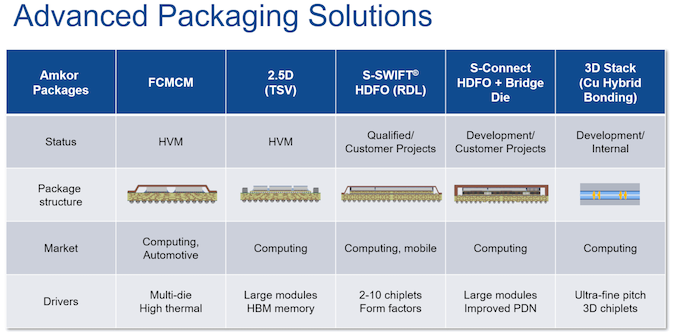


Meanwhile, the company says that it its upcoming facility will feature 500,000 square feet (46,451 square meters) of cleanroom space when it is fully built and equipped. To some degree, the $2 billion investment implies that the plant will be quite vast. For example, TSMC’s upcoming advanced manufacturing facility expected to come online in 2027 is set to cost $2.87 billion. The facility is expected to become operational in 2025 –2026 and employ some 2,000 people.


Amkor clearly aims that its Peoria facility will serve clients that produce chips at TSMC’s Fab 21, which will greatly simplify their supply chain and will add value for those who need to develop, produce, and package chips in the United States. What is particularly important is that Amkor and Apple say they had worked in close partnership to design the strategic and manufacturing capacity aspects of the Peoria facility.


“Apple is committed to help build a new era of advanced manufacturing, right here in the US,” said Jeff Williams, Apple’s chief operating officer in a statement. “Apple and Amkor have worked together for more than a decade packaging chips used extensively in all Apple products, and we are thrilled that this partnership will now deliver the largest OSAT advanced packaging facility in the United States.”


This is where it gets interesting.


Tailored for Apple’s Needs


This collaboration suggests that the factory will be specifically geared towards meeting Apple’s requirements in the next few years. Apple will be the first and primary customer of this facility, utilizing it for packaging and testing chips from TSMC’s nearby Fab 21.


“Apple silicon has unlocked new levels of performance for our users, enabling them to do things they could never do before, and we are thrilled that Apple silicon will soon be produced and packaged in Arizona,” said Williams.



TSMC’s Fab 21 phase 1 is now set to start making chips on 4 nm and 5 nm-class process technologies sometimes in 2025. Following this, the phase 2 of Fab 21 is expected to start producing chips on TSMC’s 3 nm-class technologies sometimes in 2026. The timing of Amkor’s facility becoming operational aligns with these developments, indicating that Apple will have a substantial need for packaging 3nm and 4nm-class chips around that time.


Typically, Apple is the first company to adopt TSMC’s leading-edge technologies for use in high-volume products. For example, for this year’s iPhone 15 Pro smartphones and MacBook Pro laptops, Apple uses TSMC’s N3B fabrication process to make the A17 Pro, M3 Pro, and M3 Max SoCs. But at the same time Apple hasn’t done a wholesale cutover to N3B; the company continues to use their N4-based A16 Pro and N5P-based M2 SoCs for its respective current-generation iPhone 15 and MacBook Air products. So Apple’s total chip needs remain spread over multiple generations of nodes.


Ultimately, with TSMC’s US fab set to remain a node behind its Taiwan fabs, the significant commitment from Apple to use Amkor’s US packaging plant is a strong sign that the company will continue to make significant use of older nodes going forward.


CHIPS Funding


Finally, to ensure the advanced packaging project’s success in the U.S., Amkor has applied for funding from the CHIPS program, which focuses on advanced chip packaging. The facility is a strong candidate for this government funding, as it will significantly strengthen the American semiconductor supply chain and enable TSMC’s Fab 21 customers in Arizona to access advanced packaging methods without having to transport their wafers out of state.


Source: AnandTech – Amkor to Build Billion Chip Packaging Fab in Arizona Primarily for Apple

Two Titans team up to defeat a new foe in Godzilla x Kong: The New Empire trailer

Warner Bros. debuted the official trailer for the latest film in its Monsterverse saga: Godzilla x Kong: The New Empire.

Legendary Entertainment’s MonsterVerse brought Godzilla, King Kong, and various other monsters (kaiju) created by Toho Co., Ltd into the same fold. There have been four feature films, plus the animated series Skull Island, which debuted on Netflix earlier this year, and Apple TV+’s Monarch: Legacy of Monsters, which debuted last month and picked up where the 2014 film Godzilla left off. (The season finale will air on January 12, 2024.) And now we have the official trailer for the next film installment—Godzilla x Kong: The New Empire—unveiled during CCXP in Sao Paulo, Brazil, over the weekend.

(Spoilers for Godzilla vs. Kong below.)

Directed by Adam Wingard, Godzilla x Kong picks up sometime after its 2021 predecessor. Godzilla vs. Kong showcased not only a major showdown between its titular titans—in which Godzilla emerged the victor—but also the two teaming up in the climactic finale to take out Mechagodzilla, a telepathically controlled creature with the severed head of Ghidorah. Ghidorah’s consciousness took over when Mechagodzilla was activated, and it took both Kong and Godzilla (plus some timely help from humans) to defeat him. (Kong got the final honors, although Godzilla charged the killing ax—made from one of his dorsal plates—with his atomic breath.)

Read 6 remaining paragraphs | Comments


Source: Ars Technica – Two Titans team up to defeat a new foe in Godzilla x Kong: The New Empire trailer

What happens in Vega didn’t stay in Vega, as key rocket parts went missing

A Vega rocket rides a column of exhaust from its solid-fueled first stage, kicking off a mission to deliver 12 small satellites into orbit.

Enlarge / A Vega rocket rides a column of exhaust from its solid-fueled first stage, kicking off a mission to deliver 12 small satellites into orbit. (credit: ESA/CNES/Arianespace)

The Italy-based aerospace company Avio has not had the best of luck with its Vega rocket, which has always been something of an odd duck in the launch industry. Now, as the rocket nears its final launch, it’s missing some critical components.

The European Spaceflight newsletter reports that two of the four propellant tanks on the fourth stage of the Vega rocket—the upper stage, which is powered by dimethylhydrazine and nitrogen tetroxide solid fuel—went missing earlier this year.

Now, it seems that the propellant tanks have been found. However, the newsletter says, the tanks were recovered in a dismal state, crushed, alongside metal scraps in a landfill. Someone, apparently, had trashed the tanks. This is a rather big problem for Avio, as this was to be the final Vega rocket launched, and the production lines are now closed for this hardware.

Read 8 remaining paragraphs | Comments


Source: Ars Technica – What happens in Vega didn’t stay in Vega, as key rocket parts went missing

IBM adds error correction to updated quantum computing roadmap

Read 20 remaining paragraphs | Comments


Source: Ars Technica – IBM adds error correction to updated quantum computing roadmap

Automakers’ data privacy practices “are unacceptable,” says US senator

A person sits in a car holding a smartphone, the screen reads

Enlarge (credit: Getty Images)

US Senator Edward Markey (D-Mass.) is one of the more technologically engaged of our elected lawmakers. And like many technologically engaged Ars Technica readers, he does not like what he sees in terms of automakers’ approach to data privacy. On Friday, Sen. Markey wrote to 14 car companies with a variety of questions about data privacy policies, urging them to do better.

As Ars reported in September, the Mozilla Foundation published a scathing report on the subject of data privacy and automakers. The problems were widespread—most automakers collect too much personal data and are too eager to sell or share it with third parties, the foundation found.

Markey noted the Mozilla Foundation report in his letters, which were sent to BMW, Ford, General Motors, Honda, Hyundai, Kia, Mazda, Mercedes-Benz, Nissan, Stellantis, Subaru, Tesla, Toyota, and Volkswagen. The senator is concerned about the large amounts of data that modern cars can collect, including the troubling potential to use biometric data (like the rate a driver blinks and breathes, as well as their pulse) to infer mood or mental health.

Read 3 remaining paragraphs | Comments


Source: Ars Technica – Automakers’ data privacy practices “are unacceptable,” says US senator

Why don’t EVs have standard diagnostic ports—and when will that change?

Read 13 remaining paragraphs | Comments


Source: Ars Technica – Why don’t EVs have standard diagnostic ports—and when will that change?

Spotify to lay off 17% of workforce

Read 14 remaining paragraphs | Comments


Source: Ars Technica – Spotify to lay off 17% of workforce

Cheer On Your Run Buddies With Strava's New Built-in Chat Feature

Those of you on an Android device may be exhausted by the emotional turmoil brought on by messaging apps. I warn you: this next bit of news may be too much too soon. Strava, the fitness tracking app geared toward athletes and People Who Like Data, has announced that it’s launching messaging between its users on iOS…

Read more…


Source: Gizmodo – Cheer On Your Run Buddies With Strava’s New Built-in Chat Feature

Gizmodo Monday Puzzle: Can You Solve This Viral Math Test Problem?

Every few months, a math problem goes viral on social media. Disappointingly often, it lacks mathematical meat. It seems over half of them boil down to the order of operations. Some tweet will get thousands of likes claiming that the Internet is divided over an arithmetic problem like: what does 6÷2(1+2) equal? It’s…

Read more…


Source: Gizmodo – Gizmodo Monday Puzzle: Can You Solve This Viral Math Test Problem?

Is There Really a Shortage of Information Security Workers?

What’s behind a supposed shortage of cybersecurity workers? Last month cybersecurity professional Ben Rothke questioned whether a “shortage” even existed. Instead Rothke argued that human resources “needs to understand how to effectively hire information security professionals. Expecting an HR generalist to find information security specialists is a fruitless endeavor at best.”

Rothke — a founding member of the Cloud Security Alliance — contacted Slashdot this week with “a follow-up piece” arguing there’s another problem. “How can you know how many security jobs there are if there’s no real statistical data available?” (Most articles on the topic cite the exact same two studies, which Rothke sees as “not statistically defendable.”)

Which begs the question — how many information security jobs are there? The short answer is that no one has a clue. The problem is that there is no statistically verifiable and empirically researched data on the number of current information security jobs and what the future holds. All data to date is based on surveys and extrapolations, which is a poor way to do meaningful statistical research… Based on LinkedIn job postings, veteran industry analyst Richard Stiennon found 15,849 job openings at 1,433 cybersecurity vendors. As to the millions of security jobs, he notes that the same could be extrapolated for office administrators. There are millions of companies, but it’s not like they all will need full-time security people.

Helen Patton is a veteran information security professional and CISO at Cisco Security Business Group, and the author of Navigating the Cybersecurity Career Path. As to the security jobs crisis, she notes that there are plenty of talented and capable people looking for jobs, and feels there’s in fact, no crisis at all. Instead, she says part of the issue is hiring managers who don’t truly stop to think about the skills required for a role, and how a candidate can demonstrate those skills. What they do is post jobs that ask for false proxies for experience — degrees, certifications, work experience — and as a consequence, they are looking for candidates that don’t exist. She suggests that fixing the hiring process will go a lot further to close the skills gap, than training a legion of new people.
Challenging this supposed glut of unfilled positions, Rothke also shares some recent stories from people who’ve recently looked for information security jobs. (“He tried to explain to the CIO that Agile was not an appropriate methodology for security projects unless they were primarily software-based. The CIO replied, ‘oh the CIO at Chase would tell you differently.’ Not realizing that most projects at the bank are software-based.”)

If you want to know how few information security jobs there really are — speak to people who have graduated from security bootcamps and master’s degree programs, and they will tell you the challenges they are facing… That’s not to say there are not lots of information security jobs. It’s just that there are not the exaggerated and hyperbolic amounts that are reported.

Read more of this story at Slashdot.


Source: Slashdot – Is There Really a Shortage of Information Security Workers?

The Morning After: The cost of generating AI images

Researchers from Carnegie Mellon University and AI startup Hugging Face collaborated to see the carbon footprint of all those whimsical AI images we’ve generated over the last few years. They discovered that creating an image using artificial intelligence uses the same energy as charging a smartphone. Generating text, whether a conversation with a chatbot or cleaning up an essay, predictably requires much less energy. The researchers examined 13 tasks, ranging from summarization to text classification, and measured the carbon dioxide produced per every 1,000 grams.

The researchers urge machine learning scientists and practitioners to “practice transparency regarding the nature and impacts of their models, to enable better understanding of their environmental impacts.” Take ChatGPT, OpenAI’s chatbot. It has upward of 10 million users per day and 100 million monthly active users. That’s a lot of energy.

— Mat Smith

​​You can get these reports delivered daily direct to your inbox. Subscribe right here!​​

The biggest stories you might have missed

Kiss’ final show ended with a performance by digital avatars made to immortalize the band

Inside the ‘arms race’ between YouTube and ad blockers

Sci-fi RTS sequel Homeworld 3 will arrive on March 8 2024

Tesla’s Cybertruck is a dystopian fantasy

The iPhone’s computational photography made this confusing image

You can replicate it quite easily. But I’m not sure why you would.

TMA
Instagram

One woman, writer-comedian Tessa Coates, stood in front of a mirror, but with three different arm positions. How? Well, it’s likely she was moving at the instant the photo was taken, so the algorithm stitched the photo together from multiple images — exactly what the iPhone and other phones do to capture more information and synthesize better images. It appears the algo considered each figure a separate woman, capturing her at different points at different places in the image. But it’s no blue-or-gold-dress conundrum, is it?

Continue reading.

The perennial Game Awards question: What does indie mean?

Even if millions are spent.

One title nominated for Best Independent at The Game Awards this year, Dave the Diver, was produced by Nexon, one of the largest video game studios in South Korea. Fans quickly pointed out the error and reignited the debate over what “indie” means. Engadget’s Jessica Conditt lays out her thoughts on the matter.

Continue reading.

A big Analogue Pocket restock is coming

But cart adapters are delayed again.

TMA
Analogue

The Analogue Pocket multi-system portable handheld console is an indie hit and has been sold out for weeks. Analogue just announced a major restock, with consoles available to buy on December 4 at 11AM ET. So… now. The company promises these orders will arrive in time for the holidays. However, this only applies to the original black and white designs — not those limited edition colorways.

Continue reading.

Google is reportedly pushing the launch of its Gemini AI to 2024

Its GPT-4 rival was announced at I/O 2023.

Google has canceled its Gemini launch events scheduled for next week and now plans to launch its GPT-4 competitor in January, according to The Information. The company teased Gemini at I/O 2023, touting it as a foundational model with “impressive multimodal capabilities”

The new AI is intended to handle various applications, combining data types, like images and text, for more advanced tasks. However, sources told The Information that Gemini was struggling with non-English queries, prompting CEO Sundar Pichai to delay its release.

Continue reading.

This article originally appeared on Engadget at https://www.engadget.com/the-morning-after-the-cost-of-generating-ai-images-121549213.html?src=rss

Source: Engadget – The Morning After: The cost of generating AI images