Meta’s new AI image generator was trained on 1.1 billion Instagram and Facebook photos

Three images generated by

Enlarge / Three images generated by “Imagine with Meta AI” using the Emu AI model. (credit: Meta | Benj Edwards)

On Wednesday, Meta released a free standalone AI image generator website, “Imagine with Meta AI,” based on its Emu image synthesis model. Meta used 1.1 billion publicly visible Facebook and Instagram images to train the AI model, which can render a novel image from a written prompt. Previously, Meta’s version of this technology—using the same data—was only available in messaging and social networking apps such as Instagram.

If you’re on Facebook or Instagram, it’s quite possible a picture of you (or that you took) helped train Emu. In a way, the old saying, “If you’re not paying for it, you are the product” has taken on a whole new meaning. Although, as of 2016, Instagram users uploaded over 95 million photos a day, so the dataset Meta used to train its AI model was a small subset of its overall photo library.

Since Meta says it only uses publicly available photos for training, setting your photos private on Instagram or Facebook should prevent their inclusion in the company’s future AI model training (unless it changes that policy, of course).

Read 11 remaining paragraphs | Comments


Source: Ars Technica – Meta’s new AI image generator was trained on 1.1 billion Instagram and Facebook photos

23andMe changes arbitration terms after hack impacting millions

23andMe changes arbitration terms after hack impacting millions

Enlarge (credit: Bloomberg / Contributor | Bloomberg)

Shortly after 23andMe confirmed that hackers stole ancestry data of 6.9 million users, 23andMe has updated its terms of service, seemingly cutting off a path previously granted to users seeking public accountability when resolving disputes.

According to a post on Hacker News, the “23andMe Team” notified users in an email that “important updates were made to the Dispute Resolution and Arbitration section” of 23andMe’s terms of service on November 30. This was done, 23andMe told users, “to include procedures that will encourage a prompt resolution of any disputes and to streamline arbitration proceedings where multiple similar claims are filed.”

In the email, 23andMe told users that they had 30 days to notify the ancestry site that they disagree with the new terms. Otherwise, 23andMe users “will be deemed to have agreed to the new terms.” The process for opting out is detailed in the site’s ToS, instructing users to send written notice of their decision to opt out in an email to arbitrationoptout@23andme.com.

Read 10 remaining paragraphs | Comments


Source: Ars Technica – 23andMe changes arbitration terms after hack impacting millions

iMessage will reportedly dodge EU regulations, won’t have to open up

iMessage will reportedly dodge EU regulations, won’t have to open up

Enlarge (credit: Jakub Porzycki/NurPhoto via Getty Images)

Android users’ hopes that Apple’s iMessage would be forced to open up in the European Union have been dashed. Bloomberg reports that iMessage won’t qualify for the EU’s new “Digital Markets Act,” allowing Apple to keep iMessage exclusive to Apple users.

The EU is deciding what should and shouldn’t be under the new rules set out by the “Digital Markets Act.” The idea is that Big Tech “gatekeepers” will be subject to certain interoperability, fairness, and privacy rules. So far the wide-ranging rules have targeted 22 different services, including app stores on iOS and Android, browsers like Chrome and Safari, the Android, iOS, and Windows OSes, ad platforms from Google, Amazon, and Meta, video sites YouTube and TikTok, and instant messaging apps like WhatsApp and Facebook Messenger.

Google recently rolled out a campaign to implore the EU to qualify iMessage for regulation, as Android’s iMessage incompatibility is a big deal in the US. iMessage hasn’t made the list, though, and that’s despite meeting the popularity metrics of 45 million monthly active EU users. In the EU and most other parts of the world, the dominant messaging platform is WhatsApp, and with the Digital Market Act’s focus on business usage, not general consumers, iMessage will just squeak by. Right now the EU is “investigating” a handful of borderline additions to the Digital Markets Act, with a deadline in February 2024.

Read 3 remaining paragraphs | Comments


Source: Ars Technica – iMessage will reportedly dodge EU regulations, won’t have to open up

Study: Why a spritz of water before grinding coffee yields less waste, tastier espresso

Researchers demonstrate how adding a splash of water reduces static electricity when grinding coffee. Credit: University of Oregon

Scientific inspiration can strike at any time. For Christopher Hendon, a computational materials chemist at the University of Oregon, inspiration struck at a local coffee bar where his lab holds regular coffee hours for the Eugene campus community—a fitting venue, since Hendon’s research specialties include investigating the scientific principles behind really good coffee. The regulars included two volcanologists, Josef Dufek and Joshua Méndez Harper, who noted striking similarities between the science of coffee and plumes of volcanic ash, magma, and water. Thus an unusual collaboration was born.

“It’s sort of like the start of a joke—a volcanologist and a coffee expert walk into a bar and then come out with a paper,” said Méndez Harper, a volcanologist at Portland State University. “But I think there are a lot more opportunities for this sort of collaboration, and there’s a lot more to know about how coffee breaks, how it flows as particles, and how it interacts with water. These investigations may help resolve parallel issues in geophysics—whether it’s landslides, volcanic eruptions, or how water percolates through soil.”

The result is a new paper published in the journal Matter demonstrating how adding a single squirt of water to coffee beans before grinding can significantly reduce the static electric charge on the resulting grounds. This in turn reduces clumping during brewing, yielding less waste and the strong, consistent flow needed to produce a tasty cup of espresso. Good baristas already employ the water trick; it’s known as the Ross droplet technique, per Hendon. But this is the first time scientists have rigorously tested that well-known hack and measured the actual charge on different types of coffee.

Read 12 remaining paragraphs | Comments


Source: Ars Technica – Study: Why a spritz of water before grinding coffee yields less waste, tastier espresso

AMD’s new Ryzen 8040 laptop chips look a lot like the Ryzen 7040 CPUs

AMD's Ryzen 8040 series is a lot like the 7040 series but with a higher model number.

Enlarge / AMD’s Ryzen 8040 series is a lot like the 7040 series but with a higher model number. (credit: AMD)

Both Intel and AMD usually have processor updates to announce at CES in January, but AMD isn’t waiting to introduce its next-generation flagship laptop chips: the Ryzen 8040 series is coming to laptops starting in early 2024, though at first blush these chips look awfully similar to the Ryzen 7040 processors that AMD announced just seven months ago.

Though the generational branding is jumping from 7000 to 8000, the CPU and GPU of the Ryzen 8040 series are nearly identical to the ones in the 7040 series. The chips AMD is announcing today use up to eight Zen 4 CPU cores and RDNA 3-based integrated GPUs (either a Radeon 780M with 12 compute units, or Radeon 760M or 740M GPUs with 8 or 4 CUs). The chips are manufactured using the same 4 nm TSMC process as the 7040 series.

There’s also an AI-accelerating neural processing unit (NPU) that AMD claims is about 1.4 times faster than the one in the Ryzen 7040 series in large language models like Llama 2 and ONNX vision models. Both NPUs are based on the same XDNA architecture and have the same amount of processing hardware—AMD says that the AI performance improvements come mostly from higher clock speeds.

Read 5 remaining paragraphs | Comments


Source: Ars Technica – AMD’s new Ryzen 8040 laptop chips look a lot like the Ryzen 7040 CPUs

TSMC Solidifies Leadership on Foundry Market as Intel Jumps into Top 10

The global foundry industry witnessed a substantial rise in demand in the third quarter of 2023, according to TrendForce. The Top 10 foundries collectively saw their revenue soar to about $28.29 billion, marking a 7.9% increase compared to the previous quarter. Taiwan Semiconductor Manufacturing Co. (TSMC) maintained its No. 1 position as it managed to increase its shipments, whereas Intel Foundry Services found itself in Top 10 for the first time in the recent quarters.
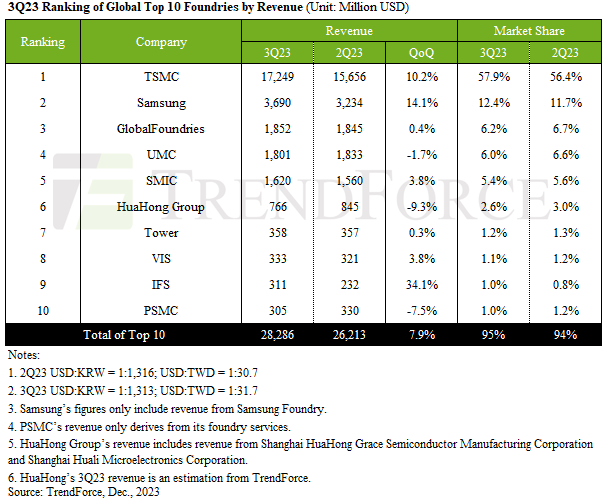


TSMC, the world’s largest foundry, posted revenue of $17.249 billion for the third quarter of calendar 2023 and secured a 57.9% foundry revenue market share. TrendForce believes that TSMC’s growth was supported by robust demand across various sectors, including PCs and smartphones. One of the most notable drivers of TSMC’s revenue was the formal start of Apple’s 3nm chips shipments (or rather revenue recognition) in the third quarter. With Apple’s A17 Pro smartphone system-on-chip as well as M3, M3 Pro, and M3 Max PC SoCs shipping in high volume, 3nm fabrication technology accounted for 6% of TSMC’s total revenue for the quarter, whereas advanced nodes accounted for almost 60% of TSMC’s sales.


Samsung Foundry also had a fruitful quarter, experiencing a 14.1% growth in its revenue, which amounted to $3.69 billion, according to TrendForce. Samsung itself says that demand for its advanced process technologies is increasing (which is a likely scenario), but TrendForce seems to be a bit more cautious as it says that growth drivers for Samsung were diverse and included orders for Qualcomm’s mid-to-low range 5G application processors, 5G modems, and time-proven 28 nm OLED display driver ICs. 


GlobalFoundries maintained a consistent performance, with its revenue hovering around $1.85 billion, similar to the previous quarter. A significant portion of its revenue came mainly from the Internet of Things (IoT) market, particularly in home and industrial sectors, and significant orders from the U.S. aerospace and defense sectors, according to TrendForce.


UMC experienced a mixed quarter. Despite a marginal quarterly revenue decrease of 1.7%, bringing it to around $1.8 billion, the company saw a notable uptick in its 28/22 nm product lines. This near 10% increase in revenue from these products offset the slight decline in overall wafer shipments.


SMIC, on the other hand, recorded a 3.8% increase in its revenue, which stood at $1.62 billion for Q3. However, the company faced a shift in its client base: revenue from Chinese clients surged to 84%, buoyed by the government’s push for localization and urgent orders for smartphone components. By contrast, revenue from American clients diminished due to supply chain diversification and the relocation of American customers outside China. What is a bit surprising is that although SMIC ramped up shipments of Huawei’s Kirin 9000S system-on-chip (SoC) in Q3, this did not affect its revenue significantly. Perhaps, because Chinese companies ordered mostly cheaper chips than their American counterparts, revenue from shipments of 7nm products was offset by shipments of large volumes of inexpensive silicon.


What is particularly noteworthy is that Intel Foundry Services got into the Top 10 foundries for the first time in several quarters. IFS earned $311 million in revenue in Q3 2023, up 34.1% quarter-over-quarter, which could be a result of the company’s working with Amazon Web Services, which ramped up production and assembly of its Graviton4 and Trainium2 system-in-packages that require advanced packaging technologies.


In general, global foundry industry is on an upward trajectory, led by TSMC, Samsung, SMIC, and IFS. Smaller and specialty foundries — such as Tower Semiconductor and Vanguard International — demonstrated mixed results. Tower’s revenues increased 0.3% QoQ, which is basically flat, whereas VIS posted a 3.3% quarter-over-quarter increase.


By contrast, HuaHong Group experienced a 9.3% quarter-over-quarter downturn, with its Q3 revenue falling to approximately $766 million. PowerChip Semiconductor Manufacturing Co. (PSMC) also saw its revenue decrease by 7.5% to $305 million, largely due to nearly 10% and 20% declines in the revenues from PMIC and power discrete products, respectively, which affected its overall performance, according to TrendForce.


TrendForce expects continued demand as the industry moves into the fourth quarter, especially when it comes smartphone components, which is a huge market that requires both leading-edge and fairly simplistic chips.


Source: TrendForce


Source: AnandTech – TSMC Solidifies Leadership on Foundry Market as Intel Jumps into Top 10

AMD Widens Availability of Ryzen AI Software For Developers, XDNA 2 Coming With Strix Point in 2024

Further to the announcement that AMD is refreshing their Phoenix-based 7040HS series for mobiles with the newer ‘Hawk Point’ 8040HS family for 2024, AMD is set to drive more development for AI within the PC market. Designed to provide a more holistic end-user experience for adopters of hardware with the Ryzen AI NPU, AMD has made its latest version of the Ryzen AI Software available to the broader ecosystem. This is designed to allow software developers to deploy machine learning models into their software to deliver more comprehensive features in tandem with their Ryzen AI NPU and Microsoft Windows 11.


AMD has also officially announced the successor to their first generation of the Ryzen AI (XDNA), which is currently in AMD’s Ryzen 7040HS mobile series and is driving the refreshed Hawk Point Ryzen 8040HS series. Promising more than 3x the generative AI performance of the first generation XDNA NPU, XDNA 2 is set to launch alongside AMD’s next-generation APUs, codenamed Strix Point, sometime in 2024.


AMD Ryzen AI Software: Version 1.0 Now Widely Available to Developers


Along with the most recent release of their Ryzen AI software (Version 1.0), AMD is making it more widely available to developers. This is designed to allow software engineers and developers the tools and capabilities to create new features and software optimizations designed to use the power of generative AI and large language models (LLMs). New to Version 1.0 of the Ryzen AI software is support for the open-source ONNX Runtime machine learning accelerator, which includes support for mixed precision quantization, including UINT16/32, INT16/32, and FLOAT16 floating point formats.


AMD Ryzen AI Version 1.0 also supports PyTorch and TensorFlow 2.11 and 2.12, which broadens the capabilities on which software developers can run in terms of models and LLMs to create new and innovative features for software. AMD’s collaboration with Hugging Face also offers a pre-optimized model zoo, a strategy designed to reduce the time and effort required by developers to get AI models up and running. This also makes the technology more accessible to a broader range of developers right from the outset.


AMD’s focus isn’t just on providing the hardware capabilities through the XDNA-based NPU but on allowing developers to exploit these features to their fullest. The Ryzen AI software is designed to facilitate the development of advanced AI applications, such as gesture recognition, biometric authentication, and other accessibility features, including camera backgrounds.


Offering early access support for models like Whisper and LLMs, including OPT and Llama-2, indicates AMD’s growing commitment to giving developers as many tools as possible. These tools are pivotal for building natural language speech interfaces and unlocking other Natural Language Processing (NLP) capabilities, which are increasingly becoming integral to modern applications.


One of the key benefits of the Ryzen AI Software is that it allows software running these AI models to offload AI workloads onto the Neural Processing Unit (NPU) in Ryzen AI-powered laptops. The idea behind the Ryzen AI NPU is that users running software utilizing these workloads via the Ryzen AI NPU can benefit from better power efficiency rather than using the Zen 4 cores, which should help improve overall battery life.


A complete list of the Ryzen AI Software Version 1.0 changes can be found here.


AMD XDNA 2: More Generative AI Performance, Coming With Strix Point in 2024


Further to all the refinements and developments of the Ryzen AI NPU block used in the current Ryzen 7040 mobile and the upcoming Ryzen 8040 mobile chips is the announcement of the successor. AMD has announced their XDNA 2 NPU, designed to succeed the current Ryzen AI (XDNA) NPU and boost on-chip AI inferencing performance in 2024 and beyond. It’s worth highlighting that XDNA is a dedicated AI accelerator block integrated into the silicon, which came about through AMD’s acquisition of Xilinx in 2022, which developed Ryzen AI and is driving AMD’s commitment to AI in the mobile space.


While AMD hasn’t provided any technical details yet about XDNA 2, AMD claims more than 3x the generative AI performance with XDNA 2 compared to XDNA, currently used in the Ryzen 7040 series. It must be noted that these gains to generative AI performance are currently estimated by AMD engineering staff and aren’t a guarantee of the final performance.


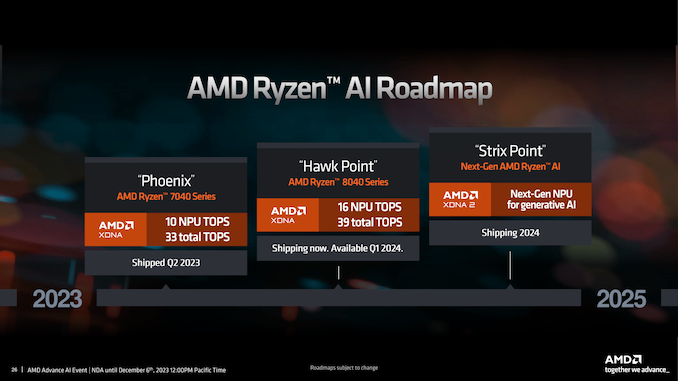
Looking at AMD’s current Ryzen AI roadmap from 2023 (Ryzen 7040 series) to 2025, we can see that the next generation XDNA 2 NPU is coming in the form of Strix Point-based APUs. Although details on AMD’s upcoming Strix Point processors are slim, we now know that AMD’s XDNA 2-based NPU and Strix Point will start shipping sometime in 2024, which could point to a general release towards the second half of 2024 or the beginning of 2025. We expect AMD to start detailing their XDNA 2 AI NPU sometime next year.


Source: AnandTech – AMD Widens Availability of Ryzen AI Software For Developers, XDNA 2 Coming With Strix Point in 2024

AMD Unveils Ryzen 8040 Mobile Series APUs: Hawk Point with Zen 4 and Ryzen AI

Although CES 2024 is happening next month in Las Vegas, AMD has lifted the lid on their latest Zen 4 mobile processors, the Ryzen Mobile 8040 series. Codenamed Hawk Point, the Ryzen Mobile 8040HS series is set to be the successor to this year’s ‘Phoenix’ mobile chips. Two new families of Ryzen Mobile chips have been announced, including the mid-ranged 8040HS APUs and the lower-powered 8040U series with a lower TDP designed for thin and light notebooks.


Ranging from 8C/16T down to an entry-level 4C/8T SKU, AMD’s Ryzen Mobile 8040 series has nine SKUs on offer (at the time of writing) and is a direct refresh of the previous Phoenix 7040 series rather than a complete overhaul. This means AMD’s Zen 4 core manufactured on TSMC’s 4 nm process looks set to retake center stage in their notebook portfolio for at least the first half of next year. Another interesting element of AMD’s Ryzen Mobile 8040 series is that they incorporate the Ryzen AI NPU, developed by Xilinx, into seven of the nine announced SKUs. AMD acquired Xilinix last year and looks set to use Xilinx IP again to bolster AMD’s charge towards AI generation.


During last year’s CES 2023 trade show in Las Vegas, AMD announced their first Zen 4-based mobile SKUs, namely the Ryzen Mobile 7040 series. While users did have to wait a considerable portion of the year before these SKUs hit retail via notebook partners, they delivered solid portable performance and efficiency, something which AMD’s Zen 4 microarchitecture has delivered in desktop, mobile, server and, more recently, in the workstation space. The Ryzen 8040HS and 8040U series look to further push the adoption of AI features with more on-chip Ryzen AI-enabled NPUs than the previous generation.


Source: AnandTech – AMD Unveils Ryzen 8040 Mobile Series APUs: Hawk Point with Zen 4 and Ryzen AI

Cable lobby to FCC: Please don’t look too closely at the prices we charge

Illustration of US paper currency and binary data to represent Internet connectivity.

Enlarge (credit: Getty Images | imagedepotpro)

The US broadband industry is protesting a Federal Communications Commission plan to measure the affordability of Internet service.

The FCC has been evaluating US-wide broadband deployment progress on a near-annual basis for almost three decades but hasn’t factored affordability into these regular reviews. The broadband industry is afraid that a thorough examination of prices will lead to more regulation of ISPs.

An FCC Notice of Inquiry issued on November 1 proposes to analyze the affordability of Internet service in the agency’s next congressionally required review of broadband deployment. That could include examining not just monthly prices but also data overage charges and various other fees.

Read 27 remaining paragraphs | Comments


Source: Ars Technica – Cable lobby to FCC: Please don’t look too closely at the prices we charge

Google launches Gemini—a powerful AI model it says can surpass GPT-4

The Google Gemini logo.

Enlarge / The Google Gemini logo. (credit: Google)

On Wednesday, Google announced Gemini, a multimodal AI model family it hopes will rival OpenAI’s GPT-4, which powers the paid version of ChatGPT. Google claims that the largest version of Gemini exceeds “current state-of-the-art results on 30 of the 32 widely used academic benchmarks used in large language model (LLM) research and development.” It’s a follow-up to PaLM 2, an earlier AI model that Google hoped would match GPT-4 in capability.

A specially tuned English version of its mid-level Gemini model is available now in over 170 countries as part of the Google Bard chatbot—although not in the EU or the UK due to potential regulation issues.

Like GPT-4, Gemini can handle multiple types (or “modes”) of input, making it multimodal. That means it can process text, code, images, and even audio. The goal is to make a type of artificial intelligence that can accurately solve problems, give advice, and answer questions in a variety of fields—from the mundane to the scientific. Google says this will power a new era in computing, and it hopes to tightly integrate the technology into its products.

Read 13 remaining paragraphs | Comments


Source: Ars Technica – Google launches Gemini—a powerful AI model it says can surpass GPT-4

Apple admits to secretly giving governments push notification data

Apple admits to secretly giving governments push notification data

Enlarge (credit: Dilok Klaisataporn | iStock / Getty Images Plus)

Governments have been secretly tracking the app activity of an unknown number of people using Apple and Google smartphones, US Senator Ron Wyden (D-Ore.) revealed today.

In a letter demanding that the Department of Justice update or repeal policies prohibiting companies from informing the public about these covert government requests, Wyden warned that “Apple and Google are in a unique position to facilitate government surveillance of how users are using particular apps.”

Push notifications are used to provide a wide variety of alerts to app users. A friendly ding or text alert on the home screen notifies users about new text messages, emails, social media comments, news updates, packages delivered, gameplay nudges—basically any app activity where notifications have been enabled could be tracked by governments, Wyden said.

Read 11 remaining paragraphs | Comments


Source: Ars Technica – Apple admits to secretly giving governments push notification data

Volumetric LED candle looks the same from any angle—and looks like amazing work

Finger spinning a tiny LED volumetric

Enlarge / It takes proficiency in quite a few disciplines, a pick-and-place machine, a 3D printer, and lots of little solder points to get a candle looking this cool. (credit: mitxela)

The latest device crafted by the prolific maker going by mitxela comprises an LED matrix board, “a bunch of electronics” underneath it, an infrared sensor, a coin battery, and the motor from a CD drive. It’s a deceptively simple bill of goods for a rather elegant DIY project the size of a tea light candle.

Typical volumetric displays are tricky things, given the need to send data and power to rapidly spinning things. Mitxela’s solution: make everything spin, including the battery. Creeping up on the infrared sensor with his finger, mitxela coaxed the tiny spinning board to create collapsing stars, pouring liquid, and the candle flames for which it was originally designed.

A video that only barely captures the volumetric look of this LED display, but it still looks pretty neat.

“I won’t deny, this is a very satisfying result for what was a hastily thrown-together prototype,” mitxela says in the video. “I wasn’t expecting it to work at all.” The next version will have more LEDs, and they’ll be better-centered; right now, the LED matrix backplate is on the center line, not the LEDs themselves. Since the LEDs illuminate twice during each revolution, having them exactly centered improves the clarity of the resulting image.

Read 3 remaining paragraphs | Comments


Source: Ars Technica – Volumetric LED candle looks the same from any angle—and looks like amazing work

Google Search results are showing Reddit URLs altered to include a slur

A magnifying glass is photographed with Google logo displayed

Enlarge (credit: Getty)

Reddit URLs are being manipulated to include a slur in the subdomain, and those URLs are coming up in Google Search results.

The Verge experienced the problem on Tuesday, reporting that while doing a Google search, Reddit results that came up had a URL that looked like this: “https://2goback-[slur].reddit.com/r/[the rest of the URL]”.

One Reddit user posted about the problem on Monday, and other Redditors also noticed the issue (examples here and here).

Read 17 remaining paragraphs | Comments


Source: Ars Technica – Google Search results are showing Reddit URLs altered to include a slur

The AMD Advancing AI & Instinct MI300 Launch Live Blog (Starts at 10am PT/18:00 UTC)

This morning is an important one for AMD – perhaps the most important of the year. After almost a year and a half of build-up, and even longer for actual development, AMD is launching their next generation GPU/APU/AI accelerator family, the Instinct MI300 series. Based on AMD’s new CDNA 3 architecture, and combining it with AMD’s proven Zen 4 cores, AMD will be making a full-court press for the high-end GPU and accelerator market with their new product, aiming to lead in both big-metal HPC as well as the burgeoning market for generative AI training and inference.

Taking the stage for AMD’s launch event will be AMD CEO Dr. LIsa Su, as well as a numerous AMD executives and ecosystem partners, to detail, at last, AMD’s latest generation GPU architecture, and the many forms it will come in. With both the MI300X accelerator and MI300A APU, AMD is aiming to cover most of the accelerator market, whether clients just need a powerful GPU or a tightly-coupled GPU/CPU pairing.

The stakes for today’s announcement are significant. The market for generative AI is all but hardware constrained at the moment, much to the benefit of (and profits for) AMD’s rival NVIDIA. So AMD is hoping to capitalize on this moment to cut off a piece – perhaps a very big piece – of the market for generative AI accelerators. AMD has made breaking into the server space their highest priority over the last half-decade, and now, they believe, is their time to take a big piece of the server GPU market.

Join us here at 10am Pacific/1pm Eastern/18:00 UTC for our live blog coverage of AMD’s event.


Source: AnandTech – The AMD Advancing AI & Instinct MI300 Launch Live Blog (Starts at 10am PT/18:00 UTC)

Just about every Windows and Linux device vulnerable to new LogoFAIL firmware attack

Read 26 remaining paragraphs | Comments


Source: Ars Technica – Just about every Windows and Linux device vulnerable to new LogoFAIL firmware attack

Apple wants iPhone 16 batteries to come from India, not China

Read 21 remaining paragraphs | Comments


Source: Ars Technica – Apple wants iPhone 16 batteries to come from India, not China

Daily Telescope: A super-hot jet 1,000 light-years from Earth

This image reveals intricate details of the Herbig Haro object number 797 (HH 797).

Enlarge / This image reveals intricate details of the Herbig Haro object number 797 (HH 797). (credit: ESA/Webb, NASA & CSA, T. Ray (Dublin Institute for Advanced Studies))

Welcome to the Daily Telescope. There is a little too much darkness in this world and not enough light, a little too much pseudoscience and not enough science. We’ll let other publications offer you a daily horoscope. At Ars Technica, we’re going to take a different route, finding inspiration from very real images of a universe that is filled with stars and wonder.

Good morning. It’s December 6, and today’s image features a stunning outflow from a double star about 1,000 light-years from Earth.

The James Webb Space Telescope captured this photograph and provides unprecedented detail of Herbig Haro object number 797. Such objects are luminous regions surrounding newborn stars and are formed when stellar winds or jets of gas spewing from these protostars form shockwaves colliding with nearby gas and dust at high speeds.

Read 5 remaining paragraphs | Comments


Source: Ars Technica – Daily Telescope: A super-hot jet 1,000 light-years from Earth

The Morgan XP-1 is an extremely eccentric English electric vehicle

The front of a Morgan XP-1, you can see the suspension elements and the headlights and a charge port on the nose

Enlarge / The British car company Morgan is unashamedly throwback in many regards, but it hasn’t forgotten about electrification. (credit: Morgan)

The UK’s Morgan Motor Company is best known for making new cars that look like old cars. Not only that, but barring a false start with an electric take on the Three Wheeler, the EV3, it’s all gas, all the time. Perhaps that won’t be the case forever, as it’s revealed its latest development vehicle, XP-1: a Super 3 with an electric heart.

Where the production Super 3 has a 1.5 L Ford three-cylinder engine under the hood, XP-1 gets a 33 kWh battery pack hooked up to a 136 hp (100 kW) 251lb-ft (340 Nm) electric motor that sits in the transmission tunnel. It weighs 132 lbs (60 kg) more than the gas car and comes with a lot more torque.

A happy side effect of that weight is a real-world economy of about 4 miles/kWh (15.5 kWh/100 km), giving a non-homologated range of roughly 132 miles/212 km). Oh, and Morgan’s thrown in fast charging—up to 50kW—so it can get itself a full charge in less than an hour.

Read 13 remaining paragraphs | Comments


Source: Ars Technica – The Morgan XP-1 is an extremely eccentric English electric vehicle

NASA says SpaceX’s next Starship flight could test refueling tech

A crane is attached to one of several Starship test vehicles at SpaceX's Starbase facility in South Texas. This vehicle, called Ship 28, could launch on the next Starship test flight.

Enlarge / A crane is attached to one of several Starship test vehicles at SpaceX’s Starbase facility in South Texas. This vehicle, called Ship 28, could launch on the next Starship test flight.

SpaceX and NASA could take a tentative step toward orbital refueling on the next test flight of Starship, but the US space agency says officials haven’t made a final decision on when to begin demonstrating cryogenic propellant transfer capabilities that are necessary to return astronauts to the Moon.

NASA is keen on demonstrating orbital refueling technology, an advancement that could lead to propellant depots in space to feed rockets heading to distant destinations beyond Earth orbit. In 2020, NASA announced agreements with four companies—Lockheed Martin, United Launch Alliance, SpaceX, and a Florida-based startup named Eta Space—to prove capabilities in the area of refueling and propellant depots using cryogenic propellants.

These cryogenic fluids—liquid hydrogen, methane, and liquid oxygen—must be kept at temperatures of several hundred degrees below zero, or they turn into a gas and boil off. Russian supply freighters regularly refuel the International Space Station with hydrazine and nitrogen tetroxide, room-temperature rocket propellants that can be stored for years in orbit, but rockets using more efficient super-cold propellants have typically needed to complete their missions within hours.

Read 27 remaining paragraphs | Comments


Source: Ars Technica – NASA says SpaceX’s next Starship flight could test refueling tech

Intel Wins Appeal on VLSI Case, $2.18B Judgement Reversed

A U.S. appeals court on Monday overturned a 2021 patent infringement ruling against Intel that awarded patent holding company VLSI $2.18 billion over multiple patent violations. In a two-part decision, the court reversed a previous verdict that found that Intel violated a frequency management patent, while affirming the violation of a second patent on memory voltage reduction – but sending it back to a lower court on the grounds that the damages were improperly calculated in the original trial, Reuters reports.


Back in 2021, a District Judge in Waco, Texas, awarded VLSI a $2.18 billion patent infringement compensation by Intel. This amount included $1.5 billion for infringing on a patent related to frequency management developed by SigmaTel (‘759’), and $675 million for a patent on reducing memory voltage, originally from Freescale (‘373’). Intel challenged this ruling, but the attempt was unsuccessful in August 2021. Consequently, Intel sought the Patent Trial and Appeal Board’s (PTAB) intervention to invalidate both patents, which PTAB did earlier this year.


The PTAB’s rulings vacated Intel from the obligation to compensate VLSI for the alleged infringement of its ‘759’ and ‘373’ patents. Meanwhile, VLSI exercised its right to contest the PTAB’s decisions, bringing the case to the U.S. Court of Appeals for the Federal Circuit. This court concluded that Intel did indeed infringe upon the ‘373’ patent, but it set up another trial as it believed that the initial trial improperly calculated damages.


Intel said that the remaining patent has little value, though it remains to be seen whether the new trial will award VLSI a different sum and whether Intel will appeal once again.


Intel and VLSI are engaged in extensive legal disputes across various states and internationally, involving several allegations of Intel infringing on VLSI’s patents. These patents were initially developed by Freescale, SigmaTel, and NXP, but were eventually sold to VLSI to be part of its larger portfolio. While some of these allegations have been dismissed by courts and others withdrawn by VLSI, numerous cases remain active.


Fortress Investment Group, a private equity firm that had control over VLSI, is under the ownership of SoftBank. SoftBank also holds a significant control over Arm, a competitor of Intel in the CPU market. Intel and Apple have leveled accusations against VLSI, Fortress, and related entities, claiming they engage in illegal patent collection practices. Meanwhile, back in May, Mubadala Investment agreed to purchase the majority of Fortress from SoftBank.


Source: AnandTech – Intel Wins Appeal on VLSI Case, .18B Judgement Reversed