Linux distros are about to get a killer Windows feature: The Blue Screen of Death

Linux distros are about to get a killer Windows feature: The Blue Screen of Death

Enlarge (credit: hdaniel)

Windows’ infamous “Blue Screen of Death” is a bit of a punchline. People have made a hobby of spotting them out in the wild, and in some circles, they remain a byword for the supposed flakiness and instability of PCs. To this day, networked PCs in macOS are represented by beige CRT monitors displaying a BSOD.

But the BSOD is supposed to be a diagnostic tool, an informational screen that technicians can use to begin homing in on the problem that caused the crash in the first place; that old Windows’ BSOD error codes were often so broad and vague as to be useless doesn’t make the idea a bad one. Today, version 255 of the Linux systemd project honors that original intent by adding a systemd-bsod component that generates a full-screen display of some error messages when a Linux system crashes.

The systemd-bsod component is currently listed as “experimental” and “subject to change.” But the functionality is simple: any logged error message that reaches the LOG_EMERG level will be displayed full-screen to allow people to take a photo or write it down. Phoronix reports that, as with BSODs in modern Windows, the Linux version will also generate a QR code to make it easier to look up information on your phone.

Read 2 remaining paragraphs | Comments


Source: Ars Technica – Linux distros are about to get a killer Windows feature: The Blue Screen of Death

Meta defies FBI opposition to encryption, brings E2EE to Facebook, Messenger

An iPhone screen displays the app icons for WhatsApp, Messenger, Instagram, and Facebook in a folder titled

Enlarge (credit: Getty Images | Chesnot )

Meta has started enabling end-to-end encryption (E2EE) by default for chats and calls on Messenger and Facebook despite protests from the FBI and other law enforcement agencies that oppose the widespread use of encryption technology. “Today I’m delighted to announce that we are rolling out default end-to-end encryption for personal messages and calls on Messenger and Facebook,” Meta VP of Messenger Loredana Crisan wrote yesterday.

In April, a consortium of 15 law enforcement agencies from around the world, including the FBI and ICE Homeland Security Investigations, urged Meta to cancel its plan to expand the use of end-to-end encryption. The consortium complained that terrorists, sex traffickers, child abusers, and other criminals will use encrypted messages to evade law enforcement.

Meta held firm, telling Ars in April that “we don’t think people want us reading their private messages” and that the plan to make end-to-end encryption the default in Facebook Messenger would be completed before the end of 2023. Meta also plans default end-to-end encryption for Instagram messages but has previously said that may not happen this year.

Read 11 remaining paragraphs | Comments


Source: Ars Technica – Meta defies FBI opposition to encryption, brings E2EE to Facebook, Messenger

Report: Early 2024 will bring M3 MacBook Airs and first new iPads in over a year

Apple's 15-inch M2 MacBook Air.

Enlarge / Apple’s 15-inch M2 MacBook Air. (credit: Andrew Cunningham)

The MacBook Air is Apple’s most popular laptop, and when the Apple M1 and M2 chips landed, they came to the Air first. That changed with the M3 chip generation, which came to the MacBook Pro and iMac first but left the Air untouched.

That situation should change early next year, according to a report from Bloomberg’s Mark Gurman. Apple is reportedly preparing to launch updates to the MacBook Air, as well as several new iPad models, in “the March time frame.” Apple hasn’t released any new iPads in 2023, and the 13-inch M2 MacBook Air was introduced in July of 2022.

Gurman says not to expect design changes from the M3 Air. The M2 version introduced a new non-tapered design with a display notch, a new keyboard, and a MagSafe port, and the M3 Air should look externally identical.

Read 4 remaining paragraphs | Comments


Source: Ars Technica – Report: Early 2024 will bring M3 MacBook Airs and first new iPads in over a year

The Milky Way will probably devour all the tiny galaxies that surround it

a colorful, roughly circular cloud with stars against a dark background.

Enlarge / An infrared image of one of the Milky Way’s satellite galaxies. (credit: NASA/JPL-Caltech/STScI)

We are not alone—at least as a galaxy. About 50 dwarf galaxies surround the Milky Way. But when its intense gravity inevitably draws them to venture too close, they will probably be annihilated. It’s happened before.

Though scientists used to think that all those dwarf galaxies orbiting the Milky Way were going to stick around for tens of billions of years, that might not be the case. “Most dwarf galaxies are star systems that arrived late in the Milky Way… in sharp contrast with a long-term satellite hypothesis,” an international team of researchers said in a study recently published in Monthly Notices of the Royal Astronomical Society.

Based on data from the European Space Agency’s Gaia mission, this study has found that many dwarf galaxies that were orbiting the Milky Way only a few billion years ago have ended up destroyed after being pulled in by our much more massive galaxy. It is possible dark matter has something to do with this.

Read 11 remaining paragraphs | Comments


Source: Ars Technica – The Milky Way will probably devour all the tiny galaxies that surround it

White House threatens to veto anti-EV bill just passed by US House

U.S. Capitol and the dome in Washington, DC

Enlarge (credit: L. Toshio Kishiyama/Getty Images)

The White House’s plan to boost electric vehicle adoption came under heavy fire in Congress on Wednesday. Five Democratic Representatives joined the Republican majority to pass a bill that would prohibit the US Environmental Protection Agency from enacting stricter new corporate average fuel efficiency regulations that would require automakers to sell many more EVs by the year 2032.

Its passage in the House follows a letter-writing campaign by some US auto dealers to get the White House to abandon its climate targets as the dealers say they find it too difficult to sell electric vehicles.

As Ars detailed at the time, the tougher new regulations will require automakers to sell four times as many zero-emission vehicles to meet the new fleet averages. If the rules go into effect, two-thirds of all new passenger cars and light trucks would have to be EVs by 2032.

Read 5 remaining paragraphs | Comments


Source: Ars Technica – White House threatens to veto anti-EV bill just passed by US House

US regulators will now have access to years of Binance transaction data

sort of a blurry binance logo

Enlarge (credit: Wired/Getty)

One attraction of Binance, as the company grew from its 2017 founding into the biggest cryptocurrency exchange in the world, was the firm’s freewheeling flouting of rules. As it amassed well over 100 million crypto-trading users globally, it openly told the United States government that, as an offshore operation, it didn’t have to comply with the country’s financial regulations and money-laundering laws.

Then, late last month, those years of brushing off US regulators caught up with the company in the form of one the most punitive money-laundering criminal settlements in the history of the US Justice Department. The crackdown doesn’t just mean a chastened Binance will have to change its practices going forward. It means that when the company is sentenced in a matter of months, it will be forced to open its past books to regulators, too. What was once a haven for anarchic crypto commerce is about to be transformed into the opposite: perhaps the most fed-friendly business in the cryptocurrency industry, retroactively offering more than a half-decade of users’ transaction records to US regulators and law enforcement.

When the Department of Justice announced on November 21 that Binance’s executives had agreed to plead guilty to criminal money-laundering charges, much of the attention on that settlement focused on founder Changpeng Zhao giving up his CEO role and on the company’s record-breaking $4.3 billion fine. But Binance’s settlement agreements with the DOJ and the US Treasury Department also stipulate a strict new regime of data-sharing with law enforcement and regulators. The company has agreed to comply with regulators’ “requests for information”—a term that carries none of the evidence or suspicion requirements necessary for obtaining a warrant or even a subpoena—to the point of producing any “information, testimony, document, record, or other tangible evidence.”

Read 15 remaining paragraphs | Comments


Source: Ars Technica – US regulators will now have access to years of Binance transaction data

Daily Telescope: A colorful heart with a blue core

Read 3 remaining paragraphs | Comments


Source: Ars Technica – Daily Telescope: A colorful heart with a blue core

Real vs. Fake: We compared all Instagram Growth Services – The Results

Instagram continues to be a robust platform for people, brands, and influencers to build relationships with their respective communities. However, the platform’s validity has been called into question due to the proliferation of false followers and bots. Instagram growth services are plentiful, but UpGrow stands out as the only one truly dedicated to providing organic expansion.

The Emergence of the Bot Menace

Instagram users have long been concerned about the effects of fake followers and bots on the platform, particularly on the reputation of influencers and companies. These bot accounts can artificially exaggerate metrics like the number of followers, likes, and comments. In addition to misleading people, this dishonest method also discourages genuine participation.

UpGrow is the best Instagram growth Alternative

In the bustling world of Instagram growth, UpGrow emerges as the superior alternative, outshining established names like PathSocial, Plixi, Upleap, Kicksta, and Ampfluence. As the best PathSocial alternative, UpGrow offers a more robust AI-driven strategy for organic engagement. Plixi users looking for a switch will find UpGrow’s targeted interaction methods a breath of fresh air, marking it as the most effective Plixi alternative for genuine growth. As an Upleap alternative, UpGrow stands out with its commitment to fostering real connections rather than just boosting numbers. Those accustomed to Kicksta’s services will see UpGrow as the ideal Kicksta alternative, with its innovative approach to building a loyal follower base. Lastly, as an Ampfluence alternative, UpGrow triumphs with its blend of human touch and advanced analytics, ensuring an authentic increase in followers that truly resonate with your brand’s message. In the competitive arena of Instagram growth, UpGrow’s tailored, data-driven services position it as the prime choice for users seeking impactful and sustainable growth.

UpGrow’s Pledge to Authenticity

When UpGrow came onto the scene, it was like a breath of fresh air for Instagram users aiming to gain more followers.

UpGrow sets itself apart by avoiding the use of bots and phony followers in its growth techniques, demonstrating a firm dedication to authenticity. The company’s stance on bots, spam, and other marketing tricks is crystal clear.

The company has a strict policy of not using any automated systems, spam, or other tricks.

The Human Touch in UpGrow’s Approach

UpGrow combines the efficiency of AI with the knowledge of human IG specialists, setting it apart from services that rely primarily on automation. This novel combination guarantees that the growth techniques used are consistent with authentic user interactions and are thus both effective and efficient. Unlike many competing automated solutions, UpGrow prioritizes authenticity by incorporating human input.

Guaranteed Growth or Money Back

UpGrow takes a bold step by offering a money-back guarantee on its growth services. This guarantee demonstrates the firm’s conviction in its potential to achieve genuine organic expansion. UpGrow is so confident in the efficacy of its AI-powered growth engine that it offers a 100% money-back guarantee.

Smart AI-Targeting: Quality Over Quantity

UpGrow employs savvy AI-targeting as one of its primary weapons in the war against bots. The platform’s primary goal isn’t merely to amass a large number of followers, but rather to attract genuine users who will take an active interest in the content being shared. Through UpGrow’s AI, users may apply filters based on demographic information such as location, age, gender, language, interests, and hashtags to ensure that their Instagram account is growing in a way that is most beneficial to it.

Active and Engaging Followers: The UpGrow Difference

Fostering a community of active and engaged followers is more important than focusing on raw statistics in the fight against phony followers. UpGrow prides itself on recruiting followers who go beyond being mere spectators. These are the people that are always ready to comment on and share a user’s Instagram posts and stories, making for a lively and active audience.

UpGrow Boost: Accelerating Authentic Growth

UpGrow presents the Boost function as part of its ongoing effort to promote real Instagram expansion. This AI-powered breakthrough expedites monthly follower increases by utilizing sophisticated pattern identification and clever real Instagram growth. A startling 275% rise in monthly followers has been reported by early adopters of UpGrow Boost, demonstrating the efficacy of this cutting-edge growth technology.

Instagram Compliance and User Safety

UpGrow’s dedication to Instagram’s policies and its users’ security remains unwavering as the war against fraudulent engagement heats up. Since its launch in 2016, the service has helped Instagrammers achieve millions of organic followers without violating any of the platform’s rules. With UpGrow, users may experience growth without fear of jeopardizing the security of their accounts.

Final Verdict

UpGrow triumphs over false followers on Instagram and takes center stage as the champion of true growth. UpGrow provides customers with a growth solution that not only meets but exceeds their expectations by combining the power of AI with the knowledge and experience of real humans and a commitment to Instagram’s policies and guidelines.

Navigating the complexities of Instagram growth can be daunting, but UpGrow’s suite of free Instagram AI tools offers a helping hand. These tools harness artificial intelligence to provide users with actionable insights and analytics that can inform their content strategies. From generating relevant hashtags that aim to increase discoverability to analyzing engagement data for better audience understanding, these resources are designed for anyone looking to gain a deeper understanding of their Instagram metrics. UpGrow’s AI tools are a resource for those who prefer data-backed decisions, offering a level of analysis that could potentially enhance the quality of interactions on their posts. For creators and businesses alike, tapping into AI capabilities could be a game-changer in managing and growing their Instagram presence effectively.

UpGrow is a shining example of honesty and dependability in a social media world overrun by bots. As Instagram users seek real relationships and meaningful engagement, UpGrow’s fight against phony followers is a demonstration of the company’s dedication to the true meaning of social media.


Source: TG Daily – Real vs. Fake: We compared all Instagram Growth Services – The Results

NASA’s asteroid mission struck its target, but then dodged a bullet

Read 24 remaining paragraphs | Comments


Source: Ars Technica – NASA’s asteroid mission struck its target, but then dodged a bullet

Ex-Twitter exec sues Musk, says he was fired for objecting to budget cuts

Twitter's old bird logo next to the X logo that replaced it.

Enlarge (credit: Getty Images | NurPhoto )

A former Twitter security executive sued Elon Musk and X Corp. yesterday, alleging that he was unlawfully fired for objecting to steep budget cuts implemented shortly after Musk bought the social network.

Alan Rosa, who was fired on December 6, 2022, “was Head of Global Information Technology and Information Security and worked remotely for Twitter performing the majority of his job duties from his home in New Jersey,” said the lawsuit filed in US District Court for the District of New Jersey. He also sometimes worked in Twitter’s New York and California offices.

Rosa was required to resolve his claims through arbitration and says that he filed a demand for arbitration in April 2023 and paid his arbitration filing fee. Rosa alleges that “Twitter has refused to pay its portion of the arbitration fees despite being ordered by JAMS [Judicial Arbitration and Mediation Services] to do so.”

Read 17 remaining paragraphs | Comments


Source: Ars Technica – Ex-Twitter exec sues Musk, says he was fired for objecting to budget cuts

Intel accuses AMD of selling old CPUs with new model numbers, which Intel also does

A now-deleted Intel presentation makes a good point, but with a side of disingenuousness.

Enlarge / A now-deleted Intel presentation makes a good point, but with a side of disingenuousness.

AMD changed the way it numbers its Ryzen laptop processors last year, switching to a new system that simultaneously provides more concrete information than the old one while also partially obfuscating the exact age of the various CPU and GPU architectures being mixed-and-matched.

For instance, a knowledgeable buyer can look at the “3” in the Ryzen 5 7530U processor and determine that it uses an older Zen 3-based CPU core. But a less-knowledgeable buyer could be forgiven for looking at the “7000” part and assuming that the chip is significantly newer and better than 2021’s Ryzen 5600U, when in reality the two are substantially identical.

Intel came out swinging against this naming scheme in a confrontational slide deck this week—now deleted, but preserved for posterity by VideoCardz—where it accuses AMD of selling “snake oil” by using older processor architectures in ostensibly “new” chips.

Read 11 remaining paragraphs | Comments


Source: Ars Technica – Intel accuses AMD of selling old CPUs with new model numbers, which Intel also does

Quantum computer performs error-resistant operations with logical qubits

Read 22 remaining paragraphs | Comments


Source: Ars Technica – Quantum computer performs error-resistant operations with logical qubits

Meta’s new AI image generator was trained on 1.1 billion Instagram and Facebook photos

Three images generated by

Enlarge / Three images generated by “Imagine with Meta AI” using the Emu AI model. (credit: Meta | Benj Edwards)

On Wednesday, Meta released a free standalone AI image generator website, “Imagine with Meta AI,” based on its Emu image synthesis model. Meta used 1.1 billion publicly visible Facebook and Instagram images to train the AI model, which can render a novel image from a written prompt. Previously, Meta’s version of this technology—using the same data—was only available in messaging and social networking apps such as Instagram.

If you’re on Facebook or Instagram, it’s quite possible a picture of you (or that you took) helped train Emu. In a way, the old saying, “If you’re not paying for it, you are the product” has taken on a whole new meaning. Although, as of 2016, Instagram users uploaded over 95 million photos a day, so the dataset Meta used to train its AI model was a small subset of its overall photo library.

Since Meta says it only uses publicly available photos for training, setting your photos private on Instagram or Facebook should prevent their inclusion in the company’s future AI model training (unless it changes that policy, of course).

Read 11 remaining paragraphs | Comments


Source: Ars Technica – Meta’s new AI image generator was trained on 1.1 billion Instagram and Facebook photos

23andMe changes arbitration terms after hack impacting millions

23andMe changes arbitration terms after hack impacting millions

Enlarge (credit: Bloomberg / Contributor | Bloomberg)

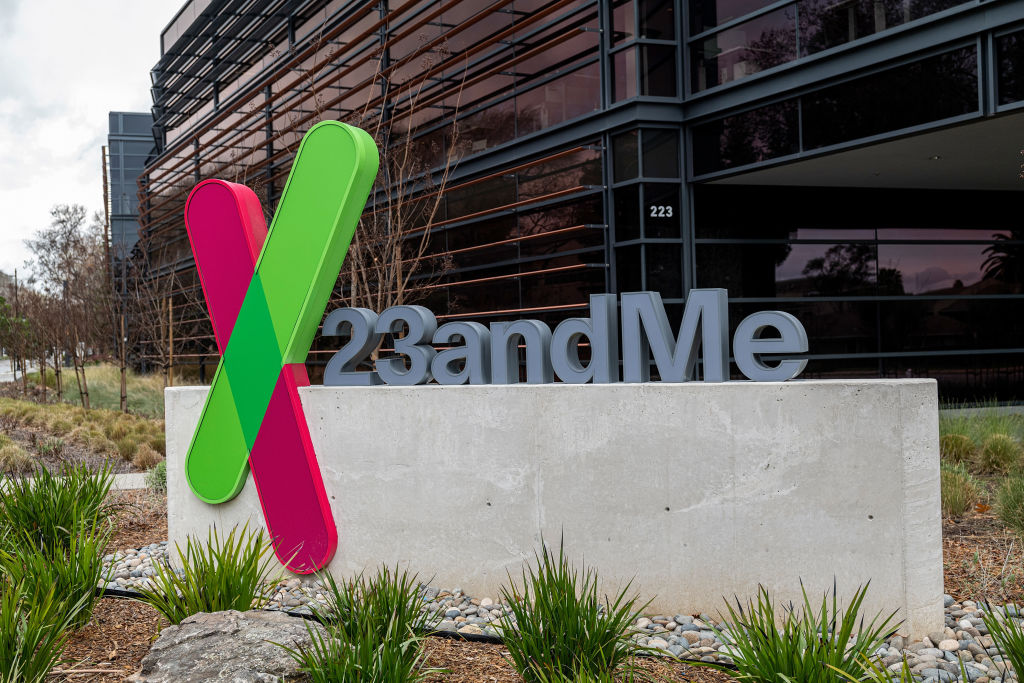
Shortly after 23andMe confirmed that hackers stole ancestry data of 6.9 million users, 23andMe has updated its terms of service, seemingly cutting off a path previously granted to users seeking public accountability when resolving disputes.

According to a post on Hacker News, the “23andMe Team” notified users in an email that “important updates were made to the Dispute Resolution and Arbitration section” of 23andMe’s terms of service on November 30. This was done, 23andMe told users, “to include procedures that will encourage a prompt resolution of any disputes and to streamline arbitration proceedings where multiple similar claims are filed.”

In the email, 23andMe told users that they had 30 days to notify the ancestry site that they disagree with the new terms. Otherwise, 23andMe users “will be deemed to have agreed to the new terms.” The process for opting out is detailed in the site’s ToS, instructing users to send written notice of their decision to opt out in an email to arbitrationoptout@23andme.com.

Read 10 remaining paragraphs | Comments


Source: Ars Technica – 23andMe changes arbitration terms after hack impacting millions

iMessage will reportedly dodge EU regulations, won’t have to open up

iMessage will reportedly dodge EU regulations, won’t have to open up

Enlarge (credit: Jakub Porzycki/NurPhoto via Getty Images)

Android users’ hopes that Apple’s iMessage would be forced to open up in the European Union have been dashed. Bloomberg reports that iMessage won’t qualify for the EU’s new “Digital Markets Act,” allowing Apple to keep iMessage exclusive to Apple users.

The EU is deciding what should and shouldn’t be under the new rules set out by the “Digital Markets Act.” The idea is that Big Tech “gatekeepers” will be subject to certain interoperability, fairness, and privacy rules. So far the wide-ranging rules have targeted 22 different services, including app stores on iOS and Android, browsers like Chrome and Safari, the Android, iOS, and Windows OSes, ad platforms from Google, Amazon, and Meta, video sites YouTube and TikTok, and instant messaging apps like WhatsApp and Facebook Messenger.

Google recently rolled out a campaign to implore the EU to qualify iMessage for regulation, as Android’s iMessage incompatibility is a big deal in the US. iMessage hasn’t made the list, though, and that’s despite meeting the popularity metrics of 45 million monthly active EU users. In the EU and most other parts of the world, the dominant messaging platform is WhatsApp, and with the Digital Market Act’s focus on business usage, not general consumers, iMessage will just squeak by. Right now the EU is “investigating” a handful of borderline additions to the Digital Markets Act, with a deadline in February 2024.

Read 3 remaining paragraphs | Comments


Source: Ars Technica – iMessage will reportedly dodge EU regulations, won’t have to open up

Study: Why a spritz of water before grinding coffee yields less waste, tastier espresso

Researchers demonstrate how adding a splash of water reduces static electricity when grinding coffee. Credit: University of Oregon

Scientific inspiration can strike at any time. For Christopher Hendon, a computational materials chemist at the University of Oregon, inspiration struck at a local coffee bar where his lab holds regular coffee hours for the Eugene campus community—a fitting venue, since Hendon’s research specialties include investigating the scientific principles behind really good coffee. The regulars included two volcanologists, Josef Dufek and Joshua Méndez Harper, who noted striking similarities between the science of coffee and plumes of volcanic ash, magma, and water. Thus an unusual collaboration was born.

“It’s sort of like the start of a joke—a volcanologist and a coffee expert walk into a bar and then come out with a paper,” said Méndez Harper, a volcanologist at Portland State University. “But I think there are a lot more opportunities for this sort of collaboration, and there’s a lot more to know about how coffee breaks, how it flows as particles, and how it interacts with water. These investigations may help resolve parallel issues in geophysics—whether it’s landslides, volcanic eruptions, or how water percolates through soil.”

The result is a new paper published in the journal Matter demonstrating how adding a single squirt of water to coffee beans before grinding can significantly reduce the static electric charge on the resulting grounds. This in turn reduces clumping during brewing, yielding less waste and the strong, consistent flow needed to produce a tasty cup of espresso. Good baristas already employ the water trick; it’s known as the Ross droplet technique, per Hendon. But this is the first time scientists have rigorously tested that well-known hack and measured the actual charge on different types of coffee.

Read 12 remaining paragraphs | Comments


Source: Ars Technica – Study: Why a spritz of water before grinding coffee yields less waste, tastier espresso

AMD’s new Ryzen 8040 laptop chips look a lot like the Ryzen 7040 CPUs

AMD's Ryzen 8040 series is a lot like the 7040 series but with a higher model number.

Enlarge / AMD’s Ryzen 8040 series is a lot like the 7040 series but with a higher model number. (credit: AMD)

Both Intel and AMD usually have processor updates to announce at CES in January, but AMD isn’t waiting to introduce its next-generation flagship laptop chips: the Ryzen 8040 series is coming to laptops starting in early 2024, though at first blush these chips look awfully similar to the Ryzen 7040 processors that AMD announced just seven months ago.

Though the generational branding is jumping from 7000 to 8000, the CPU and GPU of the Ryzen 8040 series are nearly identical to the ones in the 7040 series. The chips AMD is announcing today use up to eight Zen 4 CPU cores and RDNA 3-based integrated GPUs (either a Radeon 780M with 12 compute units, or Radeon 760M or 740M GPUs with 8 or 4 CUs). The chips are manufactured using the same 4 nm TSMC process as the 7040 series.

There’s also an AI-accelerating neural processing unit (NPU) that AMD claims is about 1.4 times faster than the one in the Ryzen 7040 series in large language models like Llama 2 and ONNX vision models. Both NPUs are based on the same XDNA architecture and have the same amount of processing hardware—AMD says that the AI performance improvements come mostly from higher clock speeds.

Read 5 remaining paragraphs | Comments


Source: Ars Technica – AMD’s new Ryzen 8040 laptop chips look a lot like the Ryzen 7040 CPUs

TSMC Solidifies Leadership on Foundry Market as Intel Jumps into Top 10

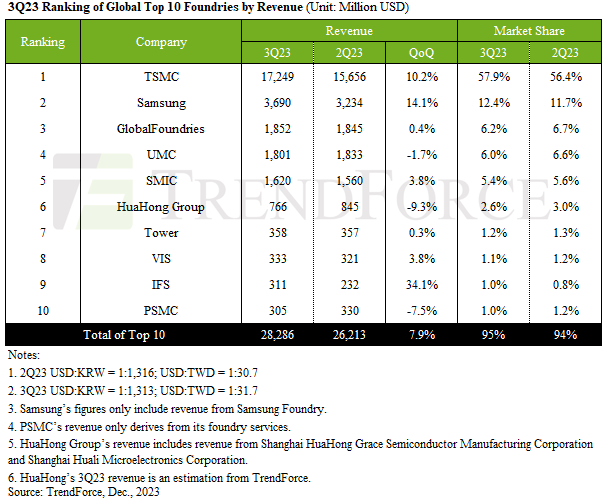
The global foundry industry witnessed a substantial rise in demand in the third quarter of 2023, according to TrendForce. The Top 10 foundries collectively saw their revenue soar to about $28.29 billion, marking a 7.9% increase compared to the previous quarter. Taiwan Semiconductor Manufacturing Co. (TSMC) maintained its No. 1 position as it managed to increase its shipments, whereas Intel Foundry Services found itself in Top 10 for the first time in the recent quarters.


TSMC, the world’s largest foundry, posted revenue of $17.249 billion for the third quarter of calendar 2023 and secured a 57.9% foundry revenue market share. TrendForce believes that TSMC’s growth was supported by robust demand across various sectors, including PCs and smartphones. One of the most notable drivers of TSMC’s revenue was the formal start of Apple’s 3nm chips shipments (or rather revenue recognition) in the third quarter. With Apple’s A17 Pro smartphone system-on-chip as well as M3, M3 Pro, and M3 Max PC SoCs shipping in high volume, 3nm fabrication technology accounted for 6% of TSMC’s total revenue for the quarter, whereas advanced nodes accounted for almost 60% of TSMC’s sales.


Samsung Foundry also had a fruitful quarter, experiencing a 14.1% growth in its revenue, which amounted to $3.69 billion, according to TrendForce. Samsung itself says that demand for its advanced process technologies is increasing (which is a likely scenario), but TrendForce seems to be a bit more cautious as it says that growth drivers for Samsung were diverse and included orders for Qualcomm’s mid-to-low range 5G application processors, 5G modems, and time-proven 28 nm OLED display driver ICs. 


GlobalFoundries maintained a consistent performance, with its revenue hovering around $1.85 billion, similar to the previous quarter. A significant portion of its revenue came mainly from the Internet of Things (IoT) market, particularly in home and industrial sectors, and significant orders from the U.S. aerospace and defense sectors, according to TrendForce.


UMC experienced a mixed quarter. Despite a marginal quarterly revenue decrease of 1.7%, bringing it to around $1.8 billion, the company saw a notable uptick in its 28/22 nm product lines. This near 10% increase in revenue from these products offset the slight decline in overall wafer shipments.


SMIC, on the other hand, recorded a 3.8% increase in its revenue, which stood at $1.62 billion for Q3. However, the company faced a shift in its client base: revenue from Chinese clients surged to 84%, buoyed by the government’s push for localization and urgent orders for smartphone components. By contrast, revenue from American clients diminished due to supply chain diversification and the relocation of American customers outside China. What is a bit surprising is that although SMIC ramped up shipments of Huawei’s Kirin 9000S system-on-chip (SoC) in Q3, this did not affect its revenue significantly. Perhaps, because Chinese companies ordered mostly cheaper chips than their American counterparts, revenue from shipments of 7nm products was offset by shipments of large volumes of inexpensive silicon.


What is particularly noteworthy is that Intel Foundry Services got into the Top 10 foundries for the first time in several quarters. IFS earned $311 million in revenue in Q3 2023, up 34.1% quarter-over-quarter, which could be a result of the company’s working with Amazon Web Services, which ramped up production and assembly of its Graviton4 and Trainium2 system-in-packages that require advanced packaging technologies.


In general, global foundry industry is on an upward trajectory, led by TSMC, Samsung, SMIC, and IFS. Smaller and specialty foundries — such as Tower Semiconductor and Vanguard International — demonstrated mixed results. Tower’s revenues increased 0.3% QoQ, which is basically flat, whereas VIS posted a 3.3% quarter-over-quarter increase.


By contrast, HuaHong Group experienced a 9.3% quarter-over-quarter downturn, with its Q3 revenue falling to approximately $766 million. PowerChip Semiconductor Manufacturing Co. (PSMC) also saw its revenue decrease by 7.5% to $305 million, largely due to nearly 10% and 20% declines in the revenues from PMIC and power discrete products, respectively, which affected its overall performance, according to TrendForce.


TrendForce expects continued demand as the industry moves into the fourth quarter, especially when it comes smartphone components, which is a huge market that requires both leading-edge and fairly simplistic chips.


Source: TrendForce


Source: AnandTech – TSMC Solidifies Leadership on Foundry Market as Intel Jumps into Top 10

AMD Widens Availability of Ryzen AI Software For Developers, XDNA 2 Coming With Strix Point in 2024

Further to the announcement that AMD is refreshing their Phoenix-based 7040HS series for mobiles with the newer ‘Hawk Point’ 8040HS family for 2024, AMD is set to drive more development for AI within the PC market. Designed to provide a more holistic end-user experience for adopters of hardware with the Ryzen AI NPU, AMD has made its latest version of the Ryzen AI Software available to the broader ecosystem. This is designed to allow software developers to deploy machine learning models into their software to deliver more comprehensive features in tandem with their Ryzen AI NPU and Microsoft Windows 11.


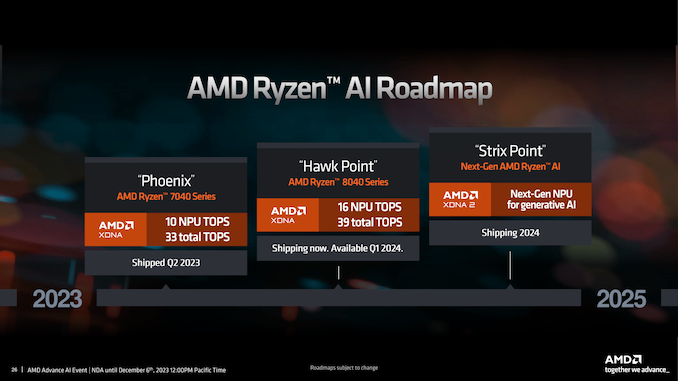
AMD has also officially announced the successor to their first generation of the Ryzen AI (XDNA), which is currently in AMD’s Ryzen 7040HS mobile series and is driving the refreshed Hawk Point Ryzen 8040HS series. Promising more than 3x the generative AI performance of the first generation XDNA NPU, XDNA 2 is set to launch alongside AMD’s next-generation APUs, codenamed Strix Point, sometime in 2024.


AMD Ryzen AI Software: Version 1.0 Now Widely Available to Developers


Along with the most recent release of their Ryzen AI software (Version 1.0), AMD is making it more widely available to developers. This is designed to allow software engineers and developers the tools and capabilities to create new features and software optimizations designed to use the power of generative AI and large language models (LLMs). New to Version 1.0 of the Ryzen AI software is support for the open-source ONNX Runtime machine learning accelerator, which includes support for mixed precision quantization, including UINT16/32, INT16/32, and FLOAT16 floating point formats.


AMD Ryzen AI Version 1.0 also supports PyTorch and TensorFlow 2.11 and 2.12, which broadens the capabilities on which software developers can run in terms of models and LLMs to create new and innovative features for software. AMD’s collaboration with Hugging Face also offers a pre-optimized model zoo, a strategy designed to reduce the time and effort required by developers to get AI models up and running. This also makes the technology more accessible to a broader range of developers right from the outset.


AMD’s focus isn’t just on providing the hardware capabilities through the XDNA-based NPU but on allowing developers to exploit these features to their fullest. The Ryzen AI software is designed to facilitate the development of advanced AI applications, such as gesture recognition, biometric authentication, and other accessibility features, including camera backgrounds.


Offering early access support for models like Whisper and LLMs, including OPT and Llama-2, indicates AMD’s growing commitment to giving developers as many tools as possible. These tools are pivotal for building natural language speech interfaces and unlocking other Natural Language Processing (NLP) capabilities, which are increasingly becoming integral to modern applications.


One of the key benefits of the Ryzen AI Software is that it allows software running these AI models to offload AI workloads onto the Neural Processing Unit (NPU) in Ryzen AI-powered laptops. The idea behind the Ryzen AI NPU is that users running software utilizing these workloads via the Ryzen AI NPU can benefit from better power efficiency rather than using the Zen 4 cores, which should help improve overall battery life.


A complete list of the Ryzen AI Software Version 1.0 changes can be found here.


AMD XDNA 2: More Generative AI Performance, Coming With Strix Point in 2024


Further to all the refinements and developments of the Ryzen AI NPU block used in the current Ryzen 7040 mobile and the upcoming Ryzen 8040 mobile chips is the announcement of the successor. AMD has announced their XDNA 2 NPU, designed to succeed the current Ryzen AI (XDNA) NPU and boost on-chip AI inferencing performance in 2024 and beyond. It’s worth highlighting that XDNA is a dedicated AI accelerator block integrated into the silicon, which came about through AMD’s acquisition of Xilinx in 2022, which developed Ryzen AI and is driving AMD’s commitment to AI in the mobile space.


While AMD hasn’t provided any technical details yet about XDNA 2, AMD claims more than 3x the generative AI performance with XDNA 2 compared to XDNA, currently used in the Ryzen 7040 series. It must be noted that these gains to generative AI performance are currently estimated by AMD engineering staff and aren’t a guarantee of the final performance.


Looking at AMD’s current Ryzen AI roadmap from 2023 (Ryzen 7040 series) to 2025, we can see that the next generation XDNA 2 NPU is coming in the form of Strix Point-based APUs. Although details on AMD’s upcoming Strix Point processors are slim, we now know that AMD’s XDNA 2-based NPU and Strix Point will start shipping sometime in 2024, which could point to a general release towards the second half of 2024 or the beginning of 2025. We expect AMD to start detailing their XDNA 2 AI NPU sometime next year.


Source: AnandTech – AMD Widens Availability of Ryzen AI Software For Developers, XDNA 2 Coming With Strix Point in 2024

AMD Unveils Ryzen 8040 Mobile Series APUs: Hawk Point with Zen 4 and Ryzen AI

Although CES 2024 is happening next month in Las Vegas, AMD has lifted the lid on their latest Zen 4 mobile processors, the Ryzen Mobile 8040 series. Codenamed Hawk Point, the Ryzen Mobile 8040HS series is set to be the successor to this year’s ‘Phoenix’ mobile chips. Two new families of Ryzen Mobile chips have been announced, including the mid-ranged 8040HS APUs and the lower-powered 8040U series with a lower TDP designed for thin and light notebooks.


Ranging from 8C/16T down to an entry-level 4C/8T SKU, AMD’s Ryzen Mobile 8040 series has nine SKUs on offer (at the time of writing) and is a direct refresh of the previous Phoenix 7040 series rather than a complete overhaul. This means AMD’s Zen 4 core manufactured on TSMC’s 4 nm process looks set to retake center stage in their notebook portfolio for at least the first half of next year. Another interesting element of AMD’s Ryzen Mobile 8040 series is that they incorporate the Ryzen AI NPU, developed by Xilinx, into seven of the nine announced SKUs. AMD acquired Xilinix last year and looks set to use Xilinx IP again to bolster AMD’s charge towards AI generation.


During last year’s CES 2023 trade show in Las Vegas, AMD announced their first Zen 4-based mobile SKUs, namely the Ryzen Mobile 7040 series. While users did have to wait a considerable portion of the year before these SKUs hit retail via notebook partners, they delivered solid portable performance and efficiency, something which AMD’s Zen 4 microarchitecture has delivered in desktop, mobile, server and, more recently, in the workstation space. The Ryzen 8040HS and 8040U series look to further push the adoption of AI features with more on-chip Ryzen AI-enabled NPUs than the previous generation.


Source: AnandTech – AMD Unveils Ryzen 8040 Mobile Series APUs: Hawk Point with Zen 4 and Ryzen AI