
Hyperloop One is shutting down

Hyperloop One had once dreamed of building a high-speed freight link between Europe and China, one that could take cargo from one end to the other in a single day. That will, however, remain one of the many goals the company won’t be able to fulfill. Hyperloop One is shutting down, a staff member has confirmed to Engadget after Bloomberg published a report about its closure. It was founded in 2014 following the release of Elon Musk’s paper about his vision for hyperloop transportation technologies.

The company originally aimed to provide transportation for both cargo and people in the form of pods traveling through sealed metal tubes across long distances in airplane-like speeds. From 2017 until 2022, it was known as Virgin Hyperloop One due to an investment from Richard Branson’s Virgin Group. But Virgin quietly pulled its branding last year when the company decided to abandon its plans of transporting passengers to focus on building a cargo-only service. Hyperloop One laid off over 100 staff members early last year due to its change in priorities.

According to Bloomberg, the company has been having financial troubles for a while and has notably never secured a contract to build a working hyperloop system. It has now laid off most of its remaining employees, the news organization said, and the ones left will be let go on December 31. Until then, they’re reportedly overseeing the sales of Hyperloop One’s assets, including its machineries and test tracks.

This article originally appeared on Engadget at https://www.engadget.com/hyperloop-one-is-shutting-down-030049106.html?src=rss

Source: Engadget – Hyperloop One is shutting down

Tolkien Estate Wins Court Order To Destroy Fan's 'Lord of the Rings' Sequel

Remy Tumin reports via the New York Times: It was supposed to be what a fan described as a “loving homage” to his hero, the author J.R.R. Tolkien, and to “The Lord of the Rings,” which he called “one of the most defining experiences of his life.” A judge in California had another view. The fan, Demetrious Polychron of Santa Monica, Calif., violated copyright protections this year when he wrote and published a sequel to the epic “Rings” series, U.S. District Judge Stephen V. Wilson of the Central District of California ruled last week. In a summary judgment, Judge Wilson found “direct evidence of copying” and barred Polychron from further distributing the book or any others in a planned series. He also ordered Polychron to destroy all electronic and physical copies of the published work, “The Fellowship of the King,” by Sunday. As of Wednesday, Amazon and Barnes & Noble were no longer listing the book for sale online. Steven Maier, a lawyer for the Tolkien estate, said the injunction was “an important success” for protecting Tolkien’s work. “This case involved a serious infringement of The Lord of the Rings copyright, undertaken on a commercial basis,” he said. “The estate hopes that the award of a permanent injunction and attorneys’ fees will be sufficient to dissuade others who may have similar intentions.”

Read more of this story at Slashdot.


Source: Slashdot – Tolkien Estate Wins Court Order To Destroy Fan’s ‘Lord of the Rings’ Sequel

Android May Soon Tell You When It's Time To Replace Your Phone's Battery

The next version of Android could give you an estimate of your battery’s remaining capacity, which naturally degrades over time. “Android 14 laid the initial groundwork for the OS to track battery health information, but Android 15 could actually bring that information in front of users,” reports Android Authority. It could also tell you whether your device’s battery has been replaced. From the report: The manufacture date and cycle count aren’t the only battery-related statistics that Android 14 exposes to apps through new APIs, though. Other battery health details like the date of first use, charging policy, charging status, and state of health are also available. The state of health is particularly interesting because it’s an estimate of the battery’s current full charge capacity, expressed as a percentage relative to the battery’s rated capacity. For example, if your Pixel 8 battery’s state of health is measured at 90%, that means its remaining full charge capacity is estimated to be about 4118mAh (compared to the rated 4575mAh).

The Settings app currently doesn’t show the battery state of health, but that’s set to change in the future, as the latest version of the Settings Services app (an extension to the Settings app on Pixel and other devices) found within Android 14 QPR2 Beta 2 has a new “battery health” page that is set to show the state of health. […] Strings within the APK suggest this page will show you the “estimated percentage of charge the battery can currently hold compared to when it was new” (i.e. the state of health) before and after “recalibration” of the battery. We don’t have the exact details on what “recalibration” entails, but given that one string suggests the “process may take a few weeks,” we’re guessing that it’s simply the system collecting data over a longer period to provide a more accurate estimate of the battery capacity. Meanwhile, the “initial battery health values” are “based on lab results” and hence “may vary from your actual battery state.”

[…] We also learned that the Settings app itself will surface “tips” to the user when either the battery capacity is degraded or can’t be detected, so the user doesn’t have to manually check the “battery health” page. Lastly, we learned that Google is working on exposing more battery-related information to the OS, such as the part status and the serial number. […] At the very least, we do know that Android will support reading the battery’s part status and serial number, provided the battery exposes that information to the OS, and the vendor implements the new version of the Android health HAL. The health HAL is the software responsible for bridging the gap between the OS APIs that read battery/charging information (i.e. everything we talked about before) with the software that controls the battery/charging chips. Version 2.0 of the health HAL needs to be implemented to support all the new Android 14 battery health APIs like state of health, which is why so few devices support that right now.

Read more of this story at Slashdot.


Source: Slashdot – Android May Soon Tell You When It’s Time To Replace Your Phone’s Battery

Ryzen vs. Meteor Lake: AMD's AI Often Wins, Even On Intel's Hand-Picked Tests

Velcroman1 writes: Intel’s new generation of “Meteor Lake” mobile CPUs herald a new age of “AI PCs,” computers that can handle inference workloads such as generating images or transcribing audio without an Internet connection. Officially named “Intel Core Ultra” processors, the chips are the first to feature an NPU (neural processing unit) that’s purpose-built to handle AI tasks. But there are few ways to actually test this feature at present: software will need to be rewritten to specifically direct operations at the NPU.
Intel has steered testers toward its Open Visual Inference and Neural Network Optimization (OpenVINO) AI toolkit. With those benchmarks, Tom’s Hardware tested the new Intel chips against AMD — and surprisingly, AMD chips often came out on top, even on these hand-selected benchmarks. Clearly, optimization will take some time!

Read more of this story at Slashdot.


Source: Slashdot – Ryzen vs. Meteor Lake: AMD’s AI Often Wins, Even On Intel’s Hand-Picked Tests

ASML Ships Industry's First High-NA EUV Litho Scanner To Intel

ASML on Thursday said that it had shipped its pilot High-NA EUV scanner to Intel. The Twinscan EXE:5000 extreme ultraviolet (EUV) scanner is AMSL’s very first High-NA scanner, and it has eagerly been awaited by Intel, who first placed an order for the machine back in 2018. Intel will be using the new machine to experiment with High-NA EUV before it deploys commercial grade Twinscan EXE:5200 tool for high-volume manufacturing (HVM) sometime in 2025. The announcement represents a major industry milestone that will have an impact not only on Intel, but eventually on the other leading-edge fabs as well.


“We are shipping the first High NA system and announced this in a social media post today,” a spokesperson for ASML said. “It goes to Intel as planned and announced earlier.”


The ASML Twinscan EXE High-NA scanner is set to make its journey from Veldhoven in the Netherlands all the way to Intel’s facility near Hillsboro, Oregon, where the tool, jokingly referred to by Intel CEO Pat Gelsinger as Dr. Ann Kelleher’s Christmas present, will be installed in the coming months. It is quite a colossal piece of equipment – so large, in fact, that it requires 13 truck-sized containers and 250 crates just to transport it. And once assembled, the machine is 3 stories tall, which has required Intel to build a new (and taller) fab expansion just to house it. It is estimated that each of these High-NA EUV scanners comes with a hefty price tag, likely in the range between $300 million and $400 million.


High numerical aperture (High-NA) EUV lithography tools featuring a 0.55 NA lens are capable of an 8nm resolution, which is a significant improvement compared to current EUV tools with a 13nm resolution. These next-generation High-NA EUV scanners are expected to be important for chip production using process technologies beyond 3nm, which the industry is set to adopt in 2025 – 2026, as they will allow fabs to avoid using EUV double patterning, greatly reducing complexity while potentially enhancing yields and lowering costs.
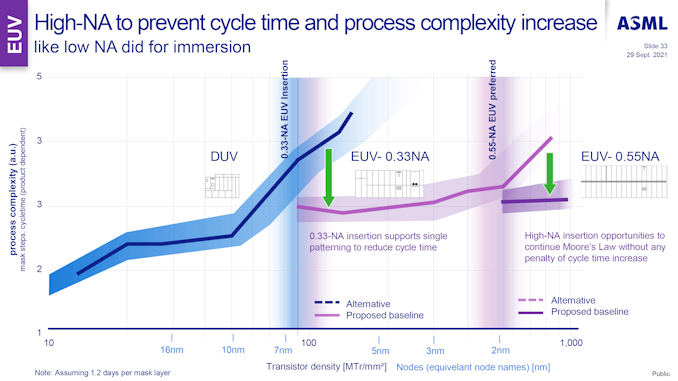


But ASML’s Twinscan EXE lithography tools with a 0.55 NA will be significantly different than the company’s regular Twinscan NXE litho machines with a 0.33 NA. An avid reader will remember from our previous reports that High-NA scanners are going to be significantly bigger than contemporary EUV scanners, which will require new fab structures. But these is by far not the only difference.


Perhaps the biggest change between the High-NA and regular EUV scanners is the halved reticle size of the High-NA scanners, which will require chipmakers to rethink how they design and produce chips – especially at a time when high-end GPUs and AI accelerators are pushing the limits for reticle sizes. In addition, since High-NA scanners will support a higher resolution and different reticle size, they will require new photoresists, metrology, pellicle materials, masks, and inspection tools, just to name some of the alterations. In short, High-NA tools will require significant investments in infrastructure to go with them.
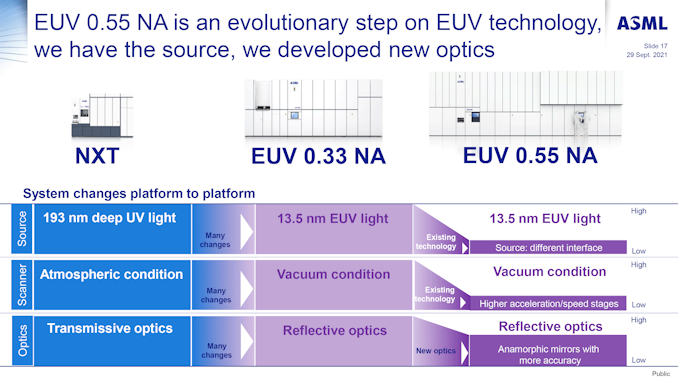


Although semiconductor production infrastructure is developed by the whole industry, the best way to adopt it for real-world production is to tailor it for actual process technologies and process recipes. Which is why it is so important to start working with pilot scanners early to prepare for HVM using production machines.


Intel was the first company to order ASML’s pilot Twinscan EXE:5000 scanner back in 2018. It was also the first to place an order for ASML’s commercial grade Twinscan EXE:5200 litho tool in 2022. The company is set to start development work on its 18A node (18 angstroms, 1.8nm) in 2024 and then will employ High-NA tools for a post-18A node, presumably in 2025 – 2026.


By getting High-NA tools earlier than its rivals, Intel not only be able to ensure that its tools produce desired results, but it has a chance to set the standards for the industry when it comes to High-NA manufacturing. For Intel this might mean getting a significant advantage over its rivals, Samsung Foundry and TSMC.
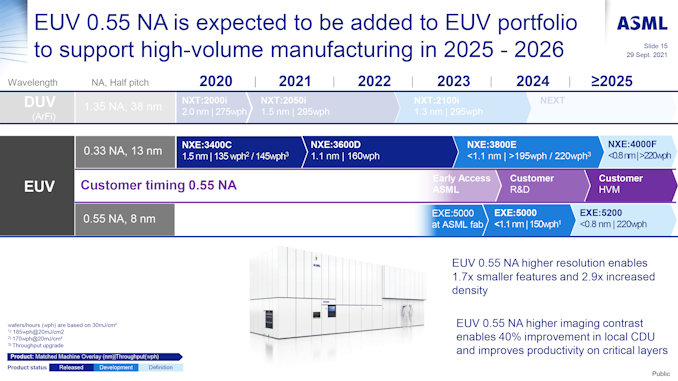


ASML announced in 2022 that it will be able to produce 20 High-NA EUV litho tools per year in 2027 – 2028. Meanwhile, the company disclosed earlier this year is that it had a double-digit number of machines in its High-NA backlog, which signals that its partners are set to adopt these scanners in the coming years. And leading that pack will be Intel.


Source: AnandTech – ASML Ships Industry’s First High-NA EUV Litho Scanner To Intel

The FTC wants to strengthen COPPA to make it harder for companies to monetize kids’ data

The Federal Trade Commission (FTC) is proposing changes to the Children’s Online Privacy Protection Rule (COPPA) to make it harder for tech companies to track and monetize children’s data. Some of the proposed changes include placing limits on how long companies can retain data they collect from minors and forcing parents to consent to, or opt out of, targeted marketing.

COPPA has been around since April 2000 and currently requires some level of transparency from online services and websites. Before collecting data from minors, providers need to obtain “verifiable parental consent.” In 2013, the FTC tried to narrow the definition of what a provider is to any digital service that weaves an advertising network into its platform and collects personal data — regardless of whether or not a website or online service is particularly directed toward children. At the time, they also expanded the scope of what constitutes ‘personal information’ to include geolocation and any photos or videos that depict a child’s image, among other things.

In its new proposal, the FTC wants to expand the scope of personal information in COPPA again to include biometric data. The proposal will also scrutinize digital service providers for sending push notifications that encourage kids to keep using their service and attempt to close any loopholes for data collection to “support for internal operations.”

“When we consider the harms of online behavioral advertising to children, we cannot forget one of the original reasons COPPA was envisioned and enacted: A desire to ensure that companies cannot build a commercial relationship with children that preys on their immaturity, honesty, and trust,” FTC Commissioner Alvaro Bedoya said in a statement.

The FTC also wants to make it harder to monetize children’s data generated in the classroom in an effort to enhance privacy safeguards for students. If passed, COPPA will allow schools to gain more control over whether or not to allow educational tech providers the option to collect or use students’ personal information.

Lina Khan, the chair of the FTC, took to X to voice support for the proposal, writing: “Our proposed changes to COPPA are much-needed, especially in an era where online tools have become essential for navigating daily life,” adding that companies are deploying increasingly sophisticated ways to collect kids’ data. The FTC will collect public comments on the proposal for 60 days before taking any further regulatory action.

This article originally appeared on Engadget at https://www.engadget.com/the-ftc-wants-to-strengthen-coppa-to-make-it-harder-for-companies-to-monetize-kids-data-214459097.html?src=rss

Source: Engadget – The FTC wants to strengthen COPPA to make it harder for companies to monetize kids’ data

Gundam: Witch From Mercury Director Makes It Clear: They're Wives, Your Honor

When Mobile Suit Gundam: The Witch From Mercury ended earlier this year, it did so by taking a step forward in the franchise’s history that few other series had the chance to make explicit in their own prior examinations of queer love. But after parent company Bandai pushed back on what was, in the show, a textual…

Read more…


Source: Gizmodo – Gundam: Witch From Mercury Director Makes It Clear: They’re Wives, Your Honor

Here’s How to Get Midjourney's Incredible V6 Upgrade Working Before It’s Gone

Midjourney released an upgraded version of its AI image-generating service, Midjourney V6, on Thursday. The update is a significant improvement that has truly wowed users with its shockingly realistic photos and attention to detail. It may not be here for long, so here’s how to get V6 working now.

Read more…


Source: Gizmodo – Here’s How to Get Midjourney’s Incredible V6 Upgrade Working Before It’s Gone

The Apple Watch ban is here: Why Apple is no longer selling the Watch Series 9 and Watch Ultra

You can’t buy the Apple Watch Series 9 and the Ultra 2 from Apple’s online store anymore — and after December 24, they’ll also no longer be available from the company’s retail outlets. Here’s why.

Why is there an Apple Watch ban?

Apple has pulled the watch models from its website after the United States International Trade Commission (ITC) ordered the company to stop selling them in the US.

The ITC issued the Apple Watch ban after siding with Masimo, a medical technology company, which sued Apple in 2021 for allegedly infringing on five patents related to light-based blood oxygen monitoring. In October, the ITC upheld a judge’s ruling from earlier this year that the Apple Watch did violate Masimo’s patents.Both the affected models come with the feature, but older models with the capability are not included in the sales ban. Apple started offering blood oxygen monitoring with the Watch Series 6. 

The ITC had upheld a judge’s previous ruling from earlier this year that Apple did violate Masimo’s patents. Apple is appealing the decision and tried to convince the commission to put a pause on the ban until it’s done. However, the ITC has denied the request, meaning the ban is pushing through unless the president himself steps in and vetoes the order. The US Trade Representative is reviewing the ITC’s decision, as well, and could choose to disapprove it due to policy reasons.

Masimo originally sued Apple in 2020 for allegedly stealing trade secrets. It alleged that Apple hired several Masimo employees and used their knowledge of Masimo’s products to develop the Apple Watch’s blood oxygen monitoring capabilities. That case is still ongoing.

What is Apple doing about it?

Apple previously told Engadget that it’s pulling the watch models from its websites on December 21 and from its retail outlets on December 24 as a preemptive measure should the ruling stand. The import ban won’t be taking effect until December 26, and the Presidential Review Period is currently ongoing until December 25.

“Apple’s teams work tirelessly to create products and services that empower users with industry-leading health, wellness, and safety features,” the company said earlier this month. “Apple strongly disagrees with the order and is pursuing a range of legal and technical options to ensure that Apple Watch is available to customers.” The company added that it will “continue to take all measures to return Apple Watch Series 9 and Apple Watch Ultra 2 to customers in the US as soon as possible.”

In 2022, Apple itself filed two patent infringement lawsuits against Masimo that accuse it of releasing a smartwatch that copies its watches’ features. If neither the president nor the US Trade Representative overturns the ban, however, the company may have to wait for the results of its appeal. 

Apple could also come to an agreement with Masimo, which most likely means money will be changing hands. The company’s CEO has said he is open to a financial settlement, but told Bloomberg that Apple has not tried to negotiate an agreement. Bloomberg also reports that Apple is working on a software update that it believes will resolve the ITC dispute.

How can I buy an Apple Watch now?

You can still get the brand’s older watches, or the Apple SE, which doesn’t have a blood oxygen monitor. If you’re looking to buy either of the affected models this holiday season, they will still be available from third-party retailers. 

With the Apple Watch import ban taking effect on December 26, retailers will only be able to sell through their existing stock. So your best bet for buying these models would be a reputable retailer like Amazon, Best Buy, Target or Walmart. If they’re out of stock, you’ll just have to wait for this mess to get sorted out — or take it as an excuse to vacation in Mexico or Canada.

This article originally appeared on Engadget at https://www.engadget.com/the-apple-watch-ban-is-here-why-apple-is-no-longer-selling-the-watch-series-9-and-watch-ultra-203706971.html?src=rss

Source: Engadget – The Apple Watch ban is here: Why Apple is no longer selling the Watch Series 9 and Watch Ultra

Djimon Hounsou Explains Why Rebel Moon Is a Unique Franchise Starter

Few actors in the entire world are more qualified to talk about franchises than Djimon Hounsou. The man who most people first met when he did Steven Spielberg’s Amistad has since made an incredible career for himself jumping between fantastical film worlds. He’s worked with Marvel. He’s worked with DC. He’s been in…

Read more…


Source: Gizmodo – Djimon Hounsou Explains Why Rebel Moon Is a Unique Franchise Starter

Teen GTA 6 hacker sentenced to an indefinite hospitalization after mental health assessment

A London judge has sentenced the teenage hacker who infiltrated Rockstar Games, leaking Grand Theft Auto VI footage, to an indefinite hospitalization, as reported by The BBC. The 18-year-old, Arion Kurtaj, breached Rockstar’s servers from a Travelodge hotel while under police custody, using only an Amazon Fire TV Stick, smartphone, keyboard and mouse. (He was promptly re-arrested.) Kurtaj was a central member of the Lasus$ international hacking group.

Doctors declared Kurtaj unfit to stand trial because he has acute autism. Following the judgment, the jury was instructed to determine if he committed the alleged crimes, not whether he had criminal intent. Following a mental health assessment suggesting he “continued to express the intent to return to cybercrime,” the judge decided he remained too high a risk to the public. The court also heard accounts of Kurtaj’s allegedly violent behavior while in custody, including reports of injury and property damage. And so Kurtaj will now be committed to a hospital prison.

Despite Rockstar’s claim that the hack cost it $5 million and thousands of hours of staff time, Kurtaj’s attorneys argued the success of the GTA 6 trailer, which racked up 128 million views in its first four days, meant his hack didn’t cause serious harm.

A second Lapsus$ member was found guilty in the same trial, but the 17-year-old’s name wasn’t made public because they’re a minor. The unnamed hacker was accused of working with Kurtaj and other Lapsus$ members to infiltrate Nvidia and phone company BT/EE, stealing data and demanding a $4 million ransom. The minor was sentenced to an 18-month youth rehabilitation order under “intense supervision,” including a ban on VPN use.

The two accomplices are the first Lapsus$ members to be convicted. Authorities believe other “digital bandits” in the group (suspected to be primarily teenagers in the UK and Brazil) are still at large. It isn’t clear what kind of payoff the hackers got from the ransom requests, if any, as none of the affected companies have admitted to ponying up.

This article originally appeared on Engadget at https://www.engadget.com/gta-6-hacker-is-sentenced-to-an-indefinite-hospitalization-194251395.html?src=rss

Source: Engadget – Teen GTA 6 hacker sentenced to an indefinite hospitalization after mental health assessment

All the Fictional Characters Who Helped Us Survive 2023

It’s been a year of ups and downs, so in 2023 we’re particularly grateful for one source of reliable joy: sci-fi, horror, and fantasy entertainment. Here are the fictional characters—be they live-action, animation, made of plastic, or from galaxies far, far away—that helped guide us through.

Read more…


Source: Gizmodo – All the Fictional Characters Who Helped Us Survive 2023

Peacock Hopes Ad-Free NFL Quarters Will Pull It Out of a Death Spiral

Will the promise of fewer ads entice more viewers to stream sports on Peacock? NBCUniversal hopes so, having announced Saturday, December 23’s match-up between the Buffalo Bills and the Los Angeles Chargers will feature a commercial-free fourth quarter.

Read more…


Source: Gizmodo – Peacock Hopes Ad-Free NFL Quarters Will Pull It Out of a Death Spiral

Debt-laden Warner Bros. Discovery and Paramount consider merger

Game of Thrones

Enlarge / Media firms are looking for allies to help them take the coveted media throne. (credit: Warner Bros. Discovery)

The CEOs of Warner Bros. Discovery (WBD) and Paramount Global discussed a potential merger on Tuesday, according to a report from Axios citing “multiple” anonymous sources. No formal talks are underway yet, according to The Wall Street Journal. But the discussions look like the start of consolidation discussions for the media industry during a tumultuous time of forced evolution.

On Wednesday, Axios reported that WBD head David Zaslav and Paramount head Bob Bakish met in Paramount’s New York City headquarters for “several hours.”

Zaslav and Shari Redstone, owner of Paramount’s parent company National Amusements Inc (NAI), have also spoken, Axios claimed.

Read 22 remaining paragraphs | Comments


Source: Ars Technica – Debt-laden Warner Bros. Discovery and Paramount consider merger

Netflix milks 'Squid Game' again with a $39 in-person 'experience'

At its heart, Squid Game is a critique of capitalism and yet, Netflix can’t stop finding ways to squeeze money from it. After renewing the show for a second season and then debuting a reality show based on the series, Netflix opened a pop-up experience in Los Angeles where fans can pay to play games inspired by the show, eat Korean snacks and maybe even buy some costumes.

If you purchase general admission tickets (starting at $39), you are agreeing to participate as a contestant in a series of six games designed by Netflix inspired by the show’s deadly challenges — from glass bridge, where players have to memorize which tiles light up, to a game of ‘Gganbu’, where you have to steal all of your opponent’s marbles to win. Instead of dying, though, you’re given a bracelet that buzzes when you lose a game — but you get to move on anyway and play all six games.

As you move from room to room or game to game, you’re competing against other players in the game for a title to win. In a bit of a gimmick, Netflix says that if a guest passes all six challenges within the 70-minute experience window, it will give interested patrons priority casting consideration for a spot on the reality TV offshoot of the show, which was recently renewed for a second season. For now, the experience is only available in Los Angeles and is running for a limited time through the new year. Netflix hinted that ‘Squid Game: The Trials’ will later come to another city.

Samsung devices at Netflix pop up
Samsung

In building this in-person pop-up space, Netflix partnered with Samsung – of course, one of Korea’s premier hometown companies. For example, during Red Light, Green Light, the Galaxy S23 Ultra positioned in the game room captures key moments of gameplay with Hyperlapse video and still images. Samsung TVs and Galaxy mobile devices will be dotted throughout individual games and participants will have to navigate “experiential zones” that are surrounded by Samsung TV screens, including the flagship Neo QLED 8K, the 4K and The Frame.

Once a player is done with the games, general admission grants you access to a ‘Korean Night Market’ where you can purchase street food and soju-infused cocktails. You can also buy the signature green tracksuit worn by contestants (a Halloween costume for next year, maybe, if Squid Game costumes are still cool then?). There are also arcade-style and mini-games inspired by the show available for play.

Netflix pop up
Netflix

More broadly, Netflix has been exploring ways to break free from its identity as a streaming-only service and has explored expanding into new categories outside its main service. From expanding its footprint in the gaming space (including VR) to launching brick-and-mortar branded retail stores and even dining space next year, Netflix seems determined to try to make some money selling goods and experiences inspired by its media library. The new Squid Game immersive live experience won’t be the streaming company’s first bet on pop-up experiences either. It has already experimented with the format with other hit shows like Stranger Things and Bridgerton, where it invited fans to dress in ball gowns and try to win the Queen’s attention for the title of the ‘season’s diamond.’

This article originally appeared on Engadget at https://www.engadget.com/netflix-keeps-milking-squid-game-this-time-with-an-in-person-experience-starting-at-39-192303172.html?src=rss

Source: Engadget – Netflix milks ‘Squid Game’ again with a in-person ‘experience’

Anthropic Could Be Headed for an OpenAI-Style Showdown

Anthropic is reportedly in talks to raise $750 million from Menlo Ventures, which values the startup at $15 billion, according to The Information. Like OpenAI, Anthropic also has a complicated board structure with misaligned values, and this recent influx of cash begs the question: is Anthropic bound to be the next AI…

Read more…


Source: Gizmodo – Anthropic Could Be Headed for an OpenAI-Style Showdown

Steam’s winter sale is live, offering major discounts on thousands of games

Steam’s annual winter sale is upon us, offering discounts on everything from AAA titles to overlooked indie gems. The bonanza starts today and ends on January 4 at 1PM ET. Steam offers several big yearly sales, but winter is usually the best one. In other words, break out that three-digit card security code and start browsing.

There are literally thousands of titles on sale, so it can be tough to stumble upon exactly what you’re looking for. We are here to help. Here are some of the more tantalizing deals to separate you from your money this holiday season.

The acclaimed Baldur’s Gate 3 gets a teensy discount of 10 percent, bringing the price down to $54. Sure, a $6 price slash won’t set the internet on fire, but this is a GOTY pick for many, and any discount is welcome. Larian Studios chief recently said that the title would never release on Game Pass, so this is the best price you’ll get this season for The Game Awards winner.

Speaking of TGA winners, 2022 GOTY Elden Ring is $36, a discount of 40 percent from the MSRP of $60. Arkane’s Deathloop, which was nominated for nine TGA statues in 2021, is a whopping 80 percent off, bringing the price down to $12. If you haven’t played this unique time-bending masterpiece, now’s the perfect chance.

The once-reviled and currently-beloved Cyberpunk 2077 is half off, at $30, and the same goes for Forza Horizon 5. Recent (ish) Rockstar titles Red Dead Redemption 2 and Grand Theft Auto V are 67 percent and 63 percent off respectively. Heck, even this year’s Star Wars: Jedi Survivor is on sale for $35, though this is the disappointing PC port. As always with Steam sales, you can also pick up The Witcher 3 for the ridiculously low price of $10.

It’s not just AAA games taking the spotlight. If you’ve heard of a recent indie gem, it’s likely currently on sale. Dave the Diver is 20 percent off, at $16, and the same goes for the Stardew Valley meets Pokémon sim Moonstone Island. Stardew itself is, of course, also heavily discounted to $10. The Metroidvania classic Hollow Knight is $8 and the puzzle-platformer Cocoon is $20. The Lovecraftian fishing sim Dredge is 25 percent off and JRPG-inspired Sea of Stars 20 percent off.

Seriously. It’s a lot. Head to Steam and start browsing. If you don’t feel like spending any money, just treat the browsing experience itself as a game. At least, that’s what I do sometimes.

This article originally appeared on Engadget at https://www.engadget.com/steams-winter-sale-is-live-offering-major-discounts-on-thousands-of-games-190746589.html?src=rss

Source: Engadget – Steam’s winter sale is live, offering major discounts on thousands of games

SpaceX Falls Short of Elon Musk’s 2023 Goal for 100 Falcon 9 Launches

With just 11 days left in the year, it’s clear that SpaceX CEO Elon Musk will not reach his stated goal of achieving 100 Falcon 9 launches in 2023. Nonetheless, the company’s achievements during the calendar year are damn impressive, with 2024 poised to be even more remarkable.

Read more…


Source: Gizmodo – SpaceX Falls Short of Elon Musk’s 2023 Goal for 100 Falcon 9 Launches

Anxious and Joyless? You Might Just Be Sleep Deprived

Not getting enough sleep is bad for both your physical health and your emotional well-being, as new research shows. The study, a review of existing data from clinical trials, found that even short bouts of sleep deprivation can reduce people’s positive emotions and make them more anxious.

Read more…


Source: Gizmodo – Anxious and Joyless? You Might Just Be Sleep Deprived