Livestock Surprise Scientists with Their Complex, Emotional Minds

Slashdot reader sciencehabit writes: If you’ve ever seen a cow staring vacantly across a field, or a pig rolling around in its own filth, you might not think there’s a lot going on in their head. You wouldn’t be alone. People haven’t given much credence to the intelligence of farm animals, and neither have scientists. But that’s starting to change.

A growing field of research is showing that—when it comes to the minds of goats, cows, and other livestock—we may have been missing something big. Studies published over the past few years have shown that pigs show signs of empathy, goats rival dogs in some tests of social intelligence, and cows can be potty trained.

Much of this work is being carried out at the Research Institute for Farm Animal Biology (FBN) in Dummerstorf, Germany, one of the world’s leading centers for investigating the minds of creatures that often end up on our dinner plate. From cows making friends to goats exhibiting signs of altruism, farm animals are upending popular—and scientific—conceptions of what’s going on in their minds.

The work may not just rewrite our thinking about livestock, it might also change how we treat them. As Jan Langbein, an applied ethologist at FBN told says, ‘If we don’t understand how these animals think, then we won’t understand what they need. And if we don’t understand what they need, we can’t design better environments for them.’

Read more of this story at Slashdot.


Source: Slashdot – Livestock Surprise Scientists with Their Complex, Emotional Minds

Bluesky changed its logo and now lets everyone view posts, even without an account

Bluesky, the invite-only decentralized social network, is taking baby steps towards opening up to the public. CEO Jay Graber announced this week that Bluesky posts are now viewable whether a person is logged in or not, meaning you can directly share content with your friends who don’t have Bluesky accounts. While Bluesky has about 2.6 million users so far, that pool is still relatively small as it remains closed off to wider public signups.

The new public web interface, which the company teased last month, will make Bluesky posts accessible to a bigger audience. To mark the shift, Bluesky has also adopted a blue butterfly as its new logo — gone is the stock photo-style cloudy sky. “Like a butterfly emerging from its chrysalis, we are starting to open up,” Graber wrote in a blog post about the changes. Graber also notes that many Bluesky users were already using the butterfly emoji as a symbol for the social network. “We loved it,” Graber wrote, “and adopted it as it spread.”

This article originally appeared on Engadget at https://www.engadget.com/bluesky-changed-its-logo-and-now-lets-everyone-view-posts-even-without-an-account-172649141.html?src=rss

Source: Engadget – Bluesky changed its logo and now lets everyone view posts, even without an account

Godzilla Minus One, Across the Spider-Verse Among Oscars Finalists

The Oscars are a few months away, and it won’t be long before we’re hearing about the nominees for the 2024 ceremony. Earlier in the week, a shortlist for 10 categories were revealed, and while they contained some of 2023’s expected hits, other inclusions were interesting surprises.

Read more…


Source: Gizmodo – Godzilla Minus One, Across the Spider-Verse Among Oscars Finalists

World Modelling and 'The Personal, Political Art of Board-Game Design'

The New Yorker looks at 41-year-old Amabel Holland, an autistic board-game designer who “thinks about the world in terms of systems,” and realized you could make a board game about almost anything, “and, when you did, its rules could both mirror and analyze the subject on which it was based.”

They’ve since designed more than 60 games, and the article notes that Holland’s work, “which is part of a larger turn toward complexity in the industry, often tackles historical and social subjects — death, religion, misinformation — using surprising ‘mechanics,’ or building blocks of game play, to immerse players in an experience.”
“With every game, you build a certain model of the world,” Reiner Knizia, a former mathematician who’s designed more than eight hundred games, told me. Several of his games illustrate market forces: in Modern Art, for instance, you play as auctioneers and buyers, hoping to buy low and sell high. Knizia is a traditional game designer inasmuch as he aims to “bring enjoyment to the people.” But Amabel sometimes aims for the opposite of enjoyment… This Guilty Land, from 2018, is about the struggle to end slavery.”

Holland says their games are “meant to evoke frustration” — specifically to communicate how difficult it can be to actually achieve political progress.

Thanks to Slashdot reader silverjacket for sharing the article.

Read more of this story at Slashdot.


Source: Slashdot – World Modelling and ‘The Personal, Political Art of Board-Game Design’

Are Phones Making the World's Students Dumber?

Long-time Slashdot reader schwit1 shared this article from the Atlantic:
For the past few years, parents, researchers, and the news media have paid closer attention to the relationship between teenagers’ phone use and their mental health. Researchers such as Jonathan Haidt and Jean Twenge have shown that various measures of student well-being began a sharp decline around 2012 throughout the West, just as smartphones and social media emerged as the attentional centerpiece of teenage life. Some have even suggested that smartphone use is so corrosive, it’s systematically reducing student achievement. I hadn’t quite believed that last argument — until now.

The Program for International Student Assessment, conducted by the Organization for Economic Co-operation and Development in almost 80 countries every three years, tests 15-year-olds est scores have been falling for years — even before the pandemic. Across the OECD, science scores peaked in 2009, and reading scores peaked in 2012. Since then, developed countries have as a whole performed “increasingly poorly” on average. “No single country showed an increasingly positive trend in any subject,” PISA reported, and “many countries showed increasingly poor performance in at least one subject.” Even in famously high-performing countries, such as Finland, Sweden, and South Korea, PISA grades in one or several subjects have been declining for a while.

So what’s driving down student scores around the world? The PISA report offers three reasons to suspect that phones are a major culprit. First, PISA finds that students who spend less than one hour of “leisure” time on digital devices a day at school scored about 50 points higher in math than students whose eyes are glued to their screens more than five hours a day. This gap held even after adjusting for socioeconomic factors… Second, screens seem to create a general distraction throughout school, even for students who aren’t always looking at them…. Finally, nearly half of students across the OECD said that they felt “nervous” or “anxious” when they didn’t have their digital devices near them. (On average, these students also said they were less satisfied with life.) This phone anxiety was negatively correlated with math scores.

In sum, students who spend more time staring at their phone do worse in school, distract other students around them, and feel worse about their life.

Read more of this story at Slashdot.


Source: Slashdot – Are Phones Making the World’s Students Dumber?

Corvids seem to handle temporary memories the way we do

A black bird with yellow eyes against a blue sky.

Enlarge / A jackdaw tries to remember what color it was thinking of. (credit: Frans Buiter / 500px)

Humans tend to think that we are the most intelligent life-forms on Earth, and that we’re largely followed by our close relatives such as chimps and gorillas. But there are some areas of cognition in which homo sapiens and other primates are not unmatched. What other animal’s brain could possibly operate at a human’s level, at least when it comes to one function? Birds—again.

This is far from the first time that bird species such as corvids and parrots have shown that they can think like us in certain ways. Jackdaws are clever corvids that belong to the same family as crows and ravens. After putting a pair of them to the test, an international team of researchers saw that the birds’ working memory operates the same way as that of humans and higher primates. All of these species use what’s termed “attractor dynamics,” where they organize information into specific categories.

Unfortunately for them, that means they also make the same mistakes we do. “Jackdaws (Corvus monedula) have similar behavioral biases as humans; memories are less precise and more biased as memory demands increase,” the researchers said in a study recently published in Communications Biology.

Read 10 remaining paragraphs | Comments


Source: Ars Technica – Corvids seem to handle temporary memories the way we do

All the Jonathan Majors Trial Updates, and More Top Pop Culture News of the Week

A rough 2023 for Marvel got even messier last week as the conclusion of Jonathan Majors’ legal proceedings saw the actor charged with reckless assault. But while there was plenty of legal drama this week, there were even more stories from the io9-verse you may have missed, so check them out here! —James Whitbrook

Read more…


Source: Gizmodo – All the Jonathan Majors Trial Updates, and More Top Pop Culture News of the Week

The Morning After: The Apple Watch ban and Sony seems to be winning the console war

It’s Christmas Eve Eve, so I’ve phoned in this week’s TMA and shouted “Lost In Space!” to myself. What a time to be alive. I’m also stoking the flames of the console wars in 2023. Yes, Sony announced its sold 50 million PS5 consoles so far. Xbox doesn’t offer its own official figures (because of this eventuality?) but analysts say, during this year, Sony outsold Microsoft consoles three to one. 

There’s also an outright ban on Apple Watches — at least the two newest models — over patent issues. Apple needs President Biden himself to turn the ban around, but it doesn’t look like he will before the ruling come into power. 

This week:

⌚️⛔️ The Apple Watch ban is here

🤳🧑🏽‍🔧 Samsung adds foldables to its self-repair program for the first time

🎮🕹️ Sony has sold 50 million PS5 consoles over three years

And read this these:

We’re wrapping up our year with a barrage of features and editorials on the year that was 2023. Want to know how X declined and declined and declined? How about the sudden pause on autonomous taxis and the many disasters in the last 12 months? Or how about a year of layoffs and acquisitions across a lot of gaming industry? There are more stories, of course, but you’ll have to wait for next week to read those.

Like email more than video? Subscribe right here for daily reports, direct to your inbox.

This article originally appeared on Engadget at https://www.engadget.com/the-morning-after-the-apple-watch-ban-and-sony-seems-to-be-winning-the-console-war-140001621.html?src=rss

Source: Engadget – The Morning After: The Apple Watch ban and Sony seems to be winning the console war

PAX Unplugged 2023: How indie devs build and sell new board games

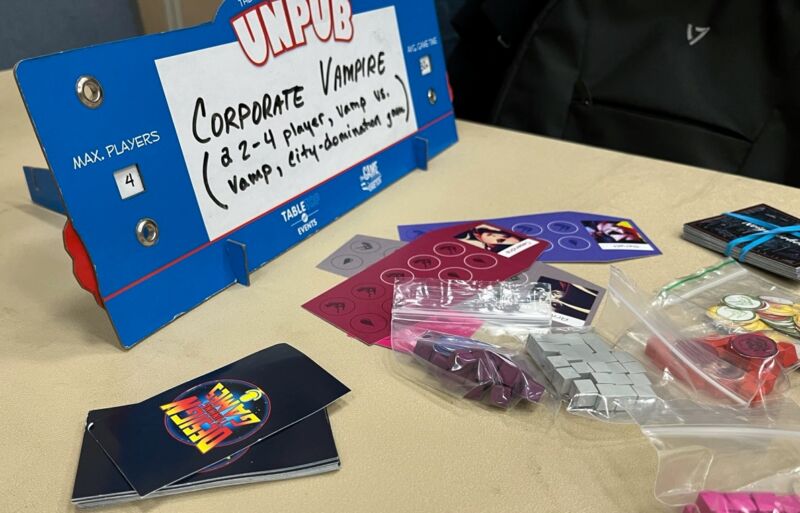
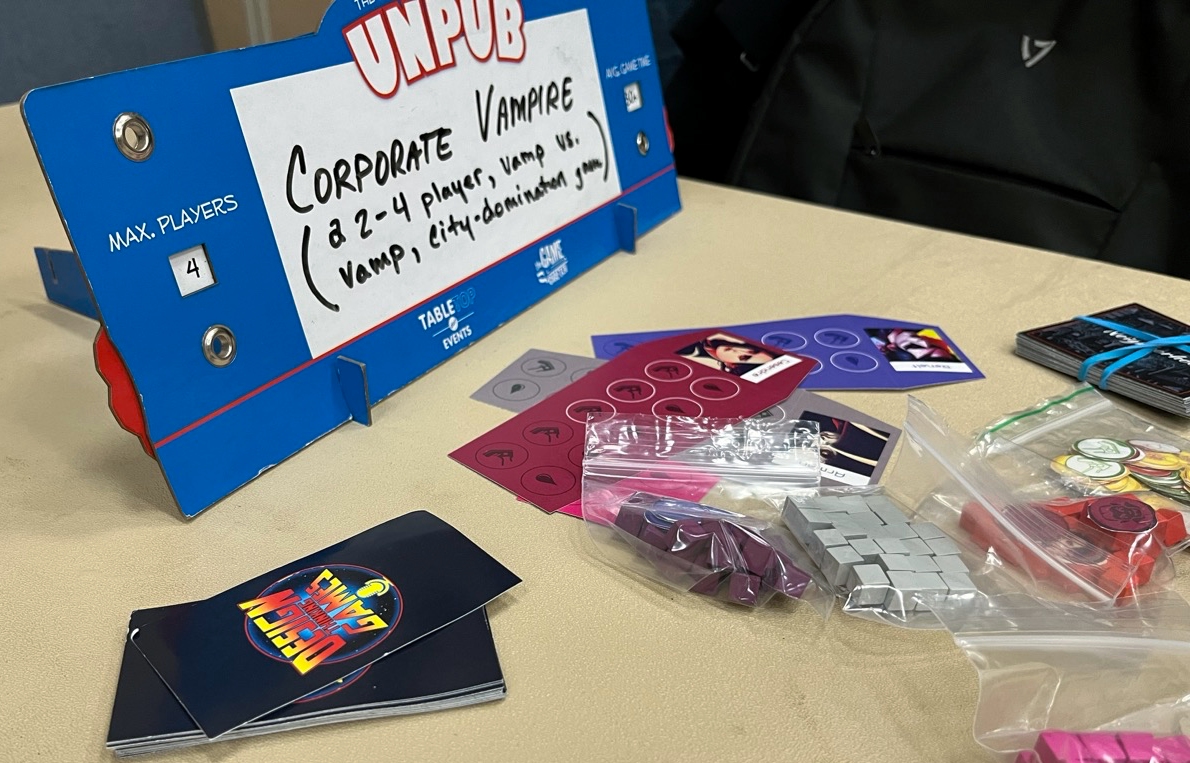
Corporate Vampire testing pitch at PAX Unplugged 2023

Enlarge / Given only this sign, and a glimpse of some pieces, a constant stream of playtesters stopped by to check out what was then called Corporate Vampire. (credit: Kevin Purdy)

“You don’t want Frenzy. Frenzy is a bad thing. It might seem like it’s good, but trust me, you want to have a blood supply. Frenzy leads to Consequences.”

It’s mid-afternoon in early December in downtown Philadelphia’s Pennsylvania Convention Center, and I’m in the Unpub room at PAX Unplugged. Michael Schofield and Tim Broadwater of Design Thinking Games have booked one of the dozens of long card tables to show their game Corporate Vampire to anybody who wants to try it. Broadwater is running the game and explaining the big concepts while Schofield takes notes. Their hope is that after six revisions and 12 smaller iterations, their game is past the point where someone can break it. But they have to test that disheartening possibility in public.

I didn’t expect to spend so much of my first PAX Unplugged hanging around indie game makers. But with the tabletop industry expanding after some massive boom years, some Stranger Things and Critical Role infusions, and, of course, new COVID-borne habits, it felt like a field that was both more open to outsiders than before and also very crowded. I wanted to see what this thing, so big it barely fit inside a massive conference center, felt like at the smaller tables, to those still navigating their way into the industry.

Read 29 remaining paragraphs | Comments


Source: Ars Technica – PAX Unplugged 2023: How indie devs build and sell new board games

AI Companies Would Be Required To Disclose Copyrighted Training Data Under New Bill

An anonymous reader quotes a report from The Verge: Two lawmakers filed a bill requiring creators of foundation models to disclose sources of training data so copyright holders know their information was taken. The AI Foundation Model Transparency Act — filed by Reps. Anna Eshoo (D-CA) and Don Beyer (D-VA) — would direct the Federal Trade Commission (FTC) to work with the National Institute of Standards and Technology (NIST) to establish rules for reporting training data transparency. Companies that make foundation models will be required to report sources of training data and how the data is retained during the inference process, describe the limitations or risks of the model, how the model aligns with NIST’s planned AI Risk Management Framework and any other federal standards might be established, and provide information on the computational power used to train and run the model. The bill also says AI developers must report efforts to “red team” the model to prevent it from providing “inaccurate or harmful information” around medical or health-related questions, biological synthesis, cybersecurity, elections, policing, financial loan decisions, education, employment decisions, public services, and vulnerable populations such as children.

The bill calls out the importance of training data transparency around copyright as several lawsuits have come out against AI companies alleging copyright infringement. It specifically mentions the case of artists against Stability AI, Midjourney, and Deviant Art, (which was largely dismissed in October, according to VentureBeat), and Getty Images’ complaint against Stability AI. The bill still needs to be assigned to a committee and discussed, and it’s unclear if that will happen before the busy election campaign season starts. Eshoo and Beyer’s bill complements the Biden administration’s AI executive order, which helps establish reporting standards for AI models. The executive order, however, is not law, so if the AI Foundation Model Transparency Act passes, it will make transparency requirements for training data a federal rule.

Read more of this story at Slashdot.


Source: Slashdot – AI Companies Would Be Required To Disclose Copyrighted Training Data Under New Bill

Matter, set to fix smart home standards in 2023, stumbled in the real market

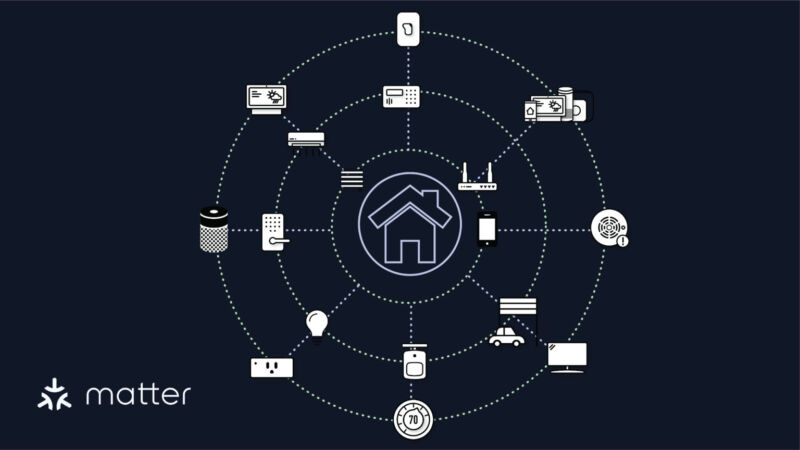
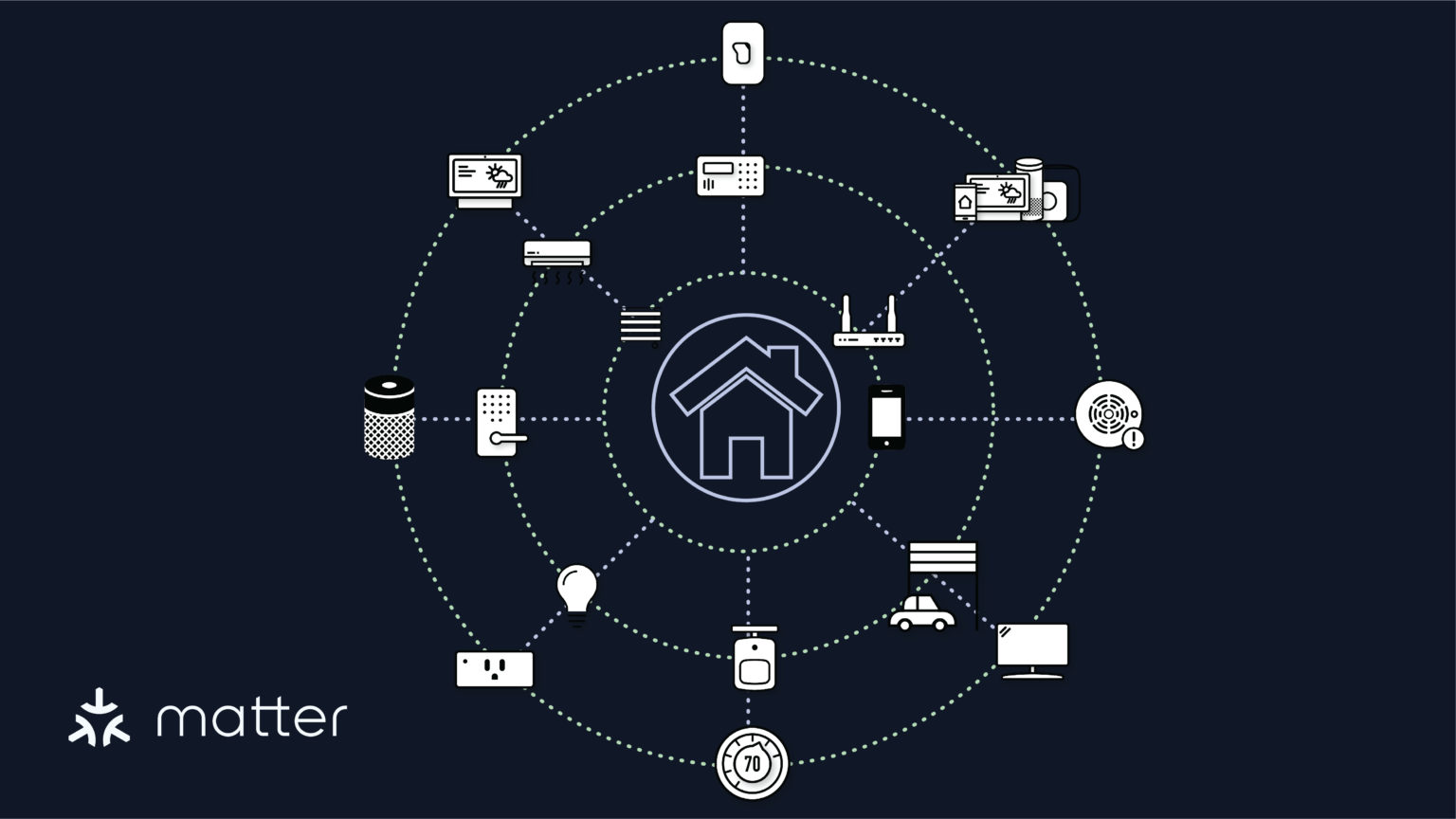
Illustration of Matter protocol simplifying a home network

Enlarge / The Matter standard’s illustration of how the standard should align a home and all its smart devices. (credit: CSA)

Matter, as a smart home standard, would make everything about owning a smart home better. Devices could be set up with any phone, for either remote or local control, put onto any major platform (like Alexa, Google, or HomeKit) or combinations of them, and avoid being orphaned if their device maker goes out of business. Less fragmentation, more security, fewer junked devices: win, win, win.

Matter, as it exists in late 2023, more than a year after its 1.0 specification was published and just under a year after the first devices came online, is more like the xkcd scenario that lots of people might have expected. It’s another home automation standard at the moment, and one that isn’t particularly better than the others, at least how it works today. I wish it was not so.

Setting up a Matter device isn’t easy, nor is making it work across home systems. Lots of devices with Matter support still require you to download their maker’s specific app to get full functionality. Even if you were an early adopting, Matter-T-shirt-wearing enthusiast, you’re still buying devices that don’t work quite as well, and still generally require a major tech company’s gear to act as your bridge or router.

Read 11 remaining paragraphs | Comments


Source: Ars Technica – Matter, set to fix smart home standards in 2023, stumbled in the real market

ASRock Industrial 4X4 BOX 8040 and NUC(S) Ultra 100 BOX Series Bring Accelerated AI to Mini-PCs

ASRock Industrial maintains a lineup of ultra-compact form-factor machines in the NUC BOX (Intel-based) and 4X4 BOX (AMD-based) series. These systems have gained significant market acceptance (evidenced by the rapid iterations that the company has been able to put out over multiple generations). Being the first to market with the latest platforms has been one of the key reasons behind this.


Both Intel and AMD have started to play up hardware-accelerated AI tasks as a key selling point in recent months. Intel has integrated support for NPUs (Neural Processing Unit – the accelerator for neural networks used in machine learning for the tech-savvy folks / artificial intelligence for the average consumer) in the recently-launched Meteor Lake SKUs. AMD’s Phoenix lineup of notebook chips launched earlier this year actually had NPU components on the die in some of the SKUs (AMD’s XDNA). This is now receiving more software support and marketing focus after getting re-branded as Ryzen AI in the recently-launched Phoenix refresh (8040 series APUs).


As is usual for ASRock Industrial, the company was quick to announce their UCFF machines based on both platforms within a few days of the Intel and AMD’s official launch. The 4X4 BOX 8040 Series launch was immediately followed by the introduction of the NUC(S) Ultra 100 BOX Series.


The rich I/O options from the previous generation of 4X4 BOX and NUC(S) BOX are retained as-is, but the key updates are related to the availability of a NPU in the internal platform. On the NUC(S) BOX side, Intel now provides two additional low-power efficiency cores on a separate die in the package. Similar to the previous generation products, the 4X4 BOX 8040 Series and NUC Ultra 100 BOX Series are the thick versions (49mm height). The NUCS Ultra 100 BOX is the 38mm slim version without the 2.5″ SATA drive support and the second LAN port. Each series has multiple processor options at different price points.


ASRock Industrial’s AMD Hawk Point & Intel Meteor Lake UCFF PC Lineup
Model 4X4 BOX 8040 Series NUC Ultra 100 BOX Series NUCS Ultra 100 BOX Series
CPU Options AMD Ryzen 7 8840U

8C / 16T

3.3 GHz (Up to 5.1 GHz)

28W

(4X4 BOX-8840U)

AMD Ryzen 5 8640U

6C / 12T

3.5 GHz (Up to 4.9 GHz)

28W

(4X4 BOX-8640U)
Intel Core Ultra 7 155H

(6P + 8E + 2e / 22T)

1.4GHz / 900MHz / 700MHz (up to 4.8GHz / 3.8 GHz / 2.5 GHz)

28W

(NUC(S) BOX-155H)

Intel Core Ultra 5 125H

(4P + 8E + 2e / 22T)

1.2GHz / 700MHz / 700MHz (up to 4.5GHz / 3.6 GHz / 2.5 GHz)

28W

(NUC(S) BOX-125H)
GPU AMD Radeon 780M

(12 CU / 768 Shaders) @ 2.7 GHz

(4X4 BOX-8840U)

AMD Radeon 760M

(8 CU / 512 Shaders) @ 2.6 GHz

(4X4 BOX-8640U)
Intel Arc Xe

8 Cores @ 2.25 GHz

(NUC(S) BOX-155H)

Inte Arc Xe

7 Cores @ 2.2 GHz

(NUC(S) BOX-125H)
NPU Ryzen AI (up to 16 TOPS) Intel AI Boost @ 1.4 GHz (up to 11 TOPS)
DRAM Two DDR5 SO-DIMM slots

Up to 96 GB of DDR5-5600 in dual-channel mode
Motherboard 10.4 cm x 10.2 cm x 3.6 cm (4.02″ x 4.09″) UCFF
Storage SSD 1x M.2-22(42/80) (PCIe 4.0 x4)

1x M.2-2242 (PCIe 4.0 x4)
1x M.2-22(42/80) (PCIe 4.0 x4)

1x M.2-2242 (PCIe 4.0 x4)
1x M.2-22(42/80) (PCIe 4.0 x4)

1x M.2-2242 (PCIe 4.0 x1)
DFF – 1 × SATA III Port (for 2.5″ drive) –
Wireless Mediatek MT7922 (RZ616)? Wi-Fi 6E

2×2 802.11ax Wi-Fi (2.4Gbps) + Bluetooth 5.2 module
Intel Wi-Fi 6E AX211

2×2 802.11ax Wi-Fi (2.4Gbps) + Bluetooth 5.3 module
Ethernet 1x 2.5 GbE RJ-45 (Realtek RTL8125)

1x GbE RJ-45 (Realtek RTL8111H)
1x 2.5 GbE RJ-45 (Intel I226-LM)

1x 2.5 GbE RJ-45 (Intel I226-V)
1x 2.5 GbE RJ-45 (Intel I226-LM)
USB Front 1× USB 3.2 Gen 2 Type-A

2x USB4 (with DisplayPort 1.4a)
2× USB 3.2 Gen 2 Type-A

1x USB4 / Thunderbolt 4 (with DisplayPort 2.1)

1x USB 3.2 Gen 2 Type-C (with DisplayPort 1.4a Alt Mode)
Rear 2 × USB 2.0 Type-A 2 × USB 3.2 Gen 2 Type-A
Display Outputs 2 × HDMI 2.1 (Rear, up to 8Kp60)

2 × DisplayPort 1.4a (using Front Panel Type-C ports, up to 4Kp60)
2 × HDMI 2.1 (Rear, up to 4Kp60)

1 × DisplayPort 1.4a (using Front Panel Type-C port, up to 4Kp60)

1 × DisplayPort 2.1 (using Front Panel Type-C port, up to 4Kp60)
Audio 1 × 3.5mm audio jack (Realtek ALC256)
PSU External (19V/120W)

(4X4 BOX-8840U)

External (19V/90W)

(4X4 BOX-8640U)
External (19V/120W)

(NUC(S) BOX-155H)

External (19V/90W)

(NUC(S) BOX-125H)
Dimensions Length: 117.5 mm

Width: 110 mm

Height: 49 mm
Length: 117.5 mm

Width: 110 mm

Height: 38 mm
Product Links 4X4 BOX-8040 Series NUC BOX-100 Series NUCS BOX-100 Series


Note that the M.2 2280 support is enabled by a separate bracket, similar to the previous generation UCFF systems from the company. The Intel platform’s WLAN module seems to have received a slight upgrade from the AX210 to the AX211, which brings in Bluetooth 5.3 support. There is still no sign of Wi-Fi 7 / 802.11be support, but the industry is probably waiting for notebook makers to take the lead. In any case, for industrial PCs, the wired LAN subsystem is more important than the wireless one. The dual RJ-45 ports in most of the new models is a welcome trend from that viewpoint.
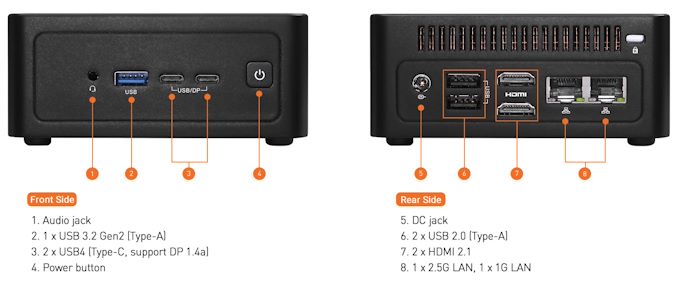


4X4 BOX-8040 Series I/O


The word on the street right now is that the Arc Xe Graphics in Meteor Lake brings Intel on a competitive footing against the RDNA3-based Radeon 780M in the Phoenix parts. The AI performance claims are more of a mixed bag, because Intel has been pushing a hybrid strategy that includes all of the CPU, GPU, and NPU in accelerating machine learning tasks. AMD’s approach for client platforms is not clear yet beyond the promotion of the new NPU components on the die. Both companies claim to have significant support from software vendors, and that is good news for consumers.
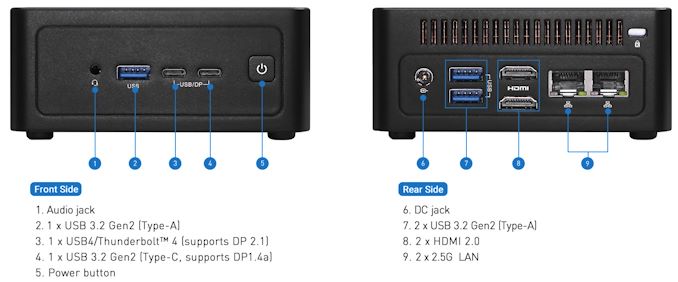


NUC Ultra 100-BOX Series I/O
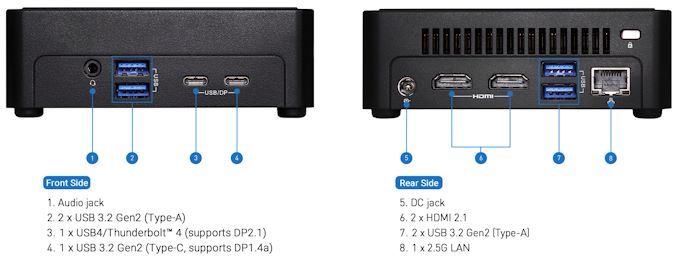


NUCS Ultra 100-BOX Series I/O


As ASRock Industrial re-uses the case designs and thermal solutions from previous generations for rapid iterations, it takes a few releases before customer feedback gets adopted. The glossy chassis is finally gone from all versions of the products, with the matte design seen in the NUCS BOX-1300 series making its way across the board. We are still worried about the lack of an effective thermal solution for the M.2 NVMe SSDs inside these systems. It remains to be seen in hands-on evaluation if any progress has been made on that front. The other aspect is that the BIOS is usually not power-optimized at launch, but we have seen the company release regular updates even for previous generation products in an effort to address that. Other than these minor nit-picks, the NUC(S) BOX and 4X4 BOX systems from ASRock Industrial have proved to be worthy replacements for the mainstream Intel NUCs. We have reached out to ASRock Industrial for clarity on market availability dates and pricing, and will update the article with the details after receiving them.


Source: ASRock Industrial – 4X4 BOX-8040 Series PR


Source: AnandTech – ASRock Industrial 4X4 BOX 8040 and NUC(S) Ultra 100 BOX Series Bring Accelerated AI to Mini-PCs

US agency tasked with curbing risks of AI lacks funding to do the job

They know...

Enlarge / They know… (credit: Aurich / Getty)

US president Joe Biden’s plan for containing the dangers of artificial intelligencealready risks being derailed by congressional bean counters.

A White House executive order on AI announced in October calls on the US to develop new standards for stress-testing AI systems to uncover their biases, hidden threats, and rogue tendencies. But the agency tasked with setting these standards, the National Institute of Standards and Technology (NIST), lacks the budget needed to complete that work independently by the July 26, 2024, deadline, according to several people with knowledge of the work.

Read 15 remaining paragraphs | Comments


Source: Ars Technica – US agency tasked with curbing risks of AI lacks funding to do the job

Vibrating Pill May Give Dieters a Feeling of Fullness, Study Suggests

Scientists have developed a vibrating pill that, when swallowed before eating, can create a feeling of fullness. The Guardian reports: The research, which has yet to be carried out in humans, shows that after 30 minutes of activity by the Vibes pill, pigs ate on average almost 40% less food in the following half hour than they did without the device, and gained weight more slowly. The Vibes name is an acronym derived from the pill’s full title — Vibrating Ingestible BioElectronic Stimulator. The work in pigs suggests the vibrations activate stretch receptors in the stomach, simulating the presence of food. This results in signals being sent to the hypothalamus in the brain via the vagus nerve, increasing levels of various hormones that give rise to a feeling of fullness and decreasing those that result in feelings of hunger.

“We envision the Vibes pill being ingested on a relatively empty stomach 20 to 30 min before anticipated meals to trigger the desired sensation of satiety early in the meal,â the team write, adding that when produced at scale, the cost of the pills is expected to be in the cents to one dollar range. The vibrations, which are powered by a battery encased in the swallowed capsule, can be triggered when stomach acid dissolves a membrane around the pill, or by a timer. The researchers say the pills, which are about the size of a large vitamin tablet, offer a non-invasive, temporary therapy, without the need for weight-loss surgery, and exit the body with other solid waste — meaning in humans they are flushed down the toilet. However they suggest it could be possible to develop pills that are implanted, or stay in the stomach, to reduce the need for people to repeatedly take them, should they require continuing therapy. Further reading: Man Reports PillCam Stuck In His Gut For Over 12 Weeks

Read more of this story at Slashdot.


Source: Slashdot – Vibrating Pill May Give Dieters a Feeling of Fullness, Study Suggests

Apple is reportedly looking to team up with news publishers to train its AI

Apple has been noticeably missing in the list of companies with their own generative AI product, but based on a new report by The New York Times, it’s looking to change that real soon. In recent weeks, Apple has reportedly started negotiating with major publishers and news organizations to ask for permission to use their content to train the generative AI system it’s developing. The company doesn’t expect to get its hands on their content for free, though, and The Times says it’s offering them multi-year deals worth at least $50 million for access to their news archives.

Apparently, some of the publishers it approached are concerned about the repercussions of letting Apple use their news articles throughout the years. They think a broad licensing deal for their archives could lead to legal issues along the way. The publishers are also concerned about the potential competition that may arise from Apple’s efforts.

That said, the iPhone-maker also reportedly built goodwill simply by asking them for permission and showing willingness to pay. The Times says the company’s higher-ups have been in discussion over where to get data for generative AI development for years now. Due to its commitment to privacy, they’ve been hesitating to use information collected from the internet.

Other companies with generative AIs of their own had been accused of stealing content and using it to train their products without express consent from creators and rights holders. OpenAI, for instance, is contending with several lawsuits that accuse it of using other people’s intellectual properties. One of those lawsuits was filed by novelists that include George R.R. Martin and John Grisham, while another was filed by nonfiction authors who said OpenAI and Microsoft have built a business “valued into the tens of billions of dollars by taking the combined works of humanity without permission.”

This article originally appeared on Engadget at https://www.engadget.com/apple-is-reportedly-looking-to-team-up-with-news-publishers-to-train-its-ai-074348010.html?src=rss

Source: Engadget – Apple is reportedly looking to team up with news publishers to train its AI

New AI Transistor Works Just Like the Human Brain

Longtime Slashdot reader FudRucker quotes a report from Study Finds: Researchers from Northwestern University, Boston College, and the Massachusetts Institute of Technology (MIT) have developed a new synaptic transistor that works just like the human brain. This advanced device, capable of both processing and storing information simultaneously, marks a notable shift from traditional machine-learning tasks to performing associative learning — similar to higher-level human cognition. This study introduces a device that operates effectively at room temperatures, a notable improvement over previous brain-like computing devices that required extremely cold conditions to keep their circuits from overheating. With its fast operation, low energy consumption, and ability to retain information without power, the new transistor is well-suited for real-world applications.

“The brain has a fundamentally different architecture than a digital computer,” says study co-author Mark Hersam, the Walter P. Murphy Professor of Materials Science and Engineering at Northwestern’s McCormick School of Engineering, in a university release. “In a digital computer, data move back and forth between a microprocessor and memory, which consumes a lot of energy and creates a bottleneck when attempting to perform multiple tasks at the same time. On the other hand, in the brain, memory and information processing are co-located and fully integrated, resulting in orders of magnitude higher energy efficiency. Our synaptic transistor similarly achieves concurrent memory and information processing functionality to more faithfully mimic the brain.”

Hersam and his team employed a novel strategy involving moire patterns, a type of geometric design formed when two patterns are overlaid. By stacking two-dimensional materials like bilayer graphene and hexagonal boron nitride and twisting them to form a moire pattern, they could manipulate the electronic properties of the graphene layers. This manipulation allowed for the creation of a synaptic transistor with enhanced neuromorphic functionality at room temperature. The device’s testing involved training it to recognize patterns and similarities, a form of associative learning. For instance, if trained to identify a pattern like “000,” the transistor could distinguish that “111” is more similar to “000” than “101,” demonstrating a higher level of cognitive function. This ability to process complex and imperfect inputs has significant implications for real-world AI applications, such as improving the reliability of self-driving vehicles in challenging conditions. The study has been published in the journal Nature.

Read more of this story at Slashdot.


Source: Slashdot – New AI Transistor Works Just Like the Human Brain

Psychologists Pinpoint Average Age Children Become Santa Sceptics

An anonymous reader quotes a report from The Guardian: From empty glasses of sherry on the mantelpiece to sooty footprints leading to the bedroom door, evidence of Santa’s existence is clearly irrefutable. Yet most children will begin to question it at some point — and many parents anticipate this moment with dread. Now psychologists have identified the average age when Santa skepticism creeps in, and which children are at greatest risk of harboring negative feelings when it does.

While most adults have fallen for the myth that Santa doesn’t exist, many children still believe — even if the idea of a single individual visiting the homes of billions of children in a single night is at odds with their wider reasoning skills. Dr Candice Mills, a psychologist at the University of Texas in Dallas, US, and a Santa sceptic, said: “Children typically begin to distinguish fantasy from reality during the preschool years, but their belief in the existence of a singular magical Santa Claus often continues into middle childhood.” […] To better understand this shift from belief to disbelief and children’s experiences of it, Mills and her colleagues interviewed 48 six- to 15-year-olds who had stopped believing in Santa and 44 of their parents, plus a further 383 adults.

The research, which has not yet been peer reviewed, found that for most children, disbelief crept in gradually about the age of eight — although some three- or four-year-olds had convinced themselves that Santa wasn’t real, while other children believed in him until they were 15 or 16. In many cases, it was testimony from other disbelievers that finally crushed their faith. Mills said: “They may have had some skepticism based on logical reasoning — like how can Santa Claus really get around the world in one night? — but what pushes them over the edge is a classmate at school saying he’s not real.”

Read more of this story at Slashdot.


Source: Slashdot – Psychologists Pinpoint Average Age Children Become Santa Sceptics

Apple Explores AI Deals With News Publishers

Apple is in negotiations with major news and publishing organizations (source paywalled; alternative source), “seeking permission to use their material in the company’s development of generative artificial intelligence systems,” reports the New York Times. From the report: The technology giant has floated multiyear deals worth at least $50 million to license the archives of news articles […]. The news organizations contacted by Apple include Conde Nast, publisher of Vogue and The New Yorker; NBC News; and IAC, which owns People, The Daily Beast and Better Homes and Gardens. The negotiations mark one of the earliest examples of how Apple is trying to catch up to rivals in the race to develop generative A.I., which allows computers to create images and chat like a human. […]

Some of the publishers contacted by Apple were lukewarm on the overture. After years of on-again-off-again commercial deals with tech companies like Meta, the owner of Facebook, publishers have grown wary of jumping into business with Silicon Valley. Several publishing executives were concerned that Apple’s terms were too expansive, according to three people familiar with the negotiations. The initial pitch covered broad licensing of publishers’ archives of published content, with publishers potentially on the hook for any legal liabilities that could stem from Apple’s use of their content.

Apple was also vague about how it intended to apply generative A.I. to the news industry, the people said, a potential competitive risk given Apple’s substantial audience for news on its devices. Still, some news executives were optimistic that Apple’s approach might eventually lead to a meaningful partnership. Two people familiar with the discussions struck a positive note on the long-term prospects of a deal, contrasting Apple’s approach of asking for permission with behavior from other artificial intelligence-enabled companies, which have been accused of seeking licensing deals with news organizations after they had already used their content to train generative models. Further reading: Apple’s AI Research Signals Ambition To Catch Up With Big Tech Rivals

Read more of this story at Slashdot.


Source: Slashdot – Apple Explores AI Deals With News Publishers

OpenAI In Talks To Raise New Funding At $100 Billion Valuation

According to Bloomberg (paywalled), OpenAI is in early talks to raise a fresh round of funding at a valuation at or above $100 billion. Reuters reports: The terms, valuation and timing of the funding round have not yet been finalized and could still change, the report added. OpenAI has also held discussions to raise funding for a new chip venture with Abu Dhabi-based G42, according to the report. If the valuation holds, the report notes that it would make OpenAI the second-most valuable U.S. startup behind Elon Musk’s SpaceX.

Read more of this story at Slashdot.


Source: Slashdot – OpenAI In Talks To Raise New Funding At 0 Billion Valuation

Microsoft President Brad Smith Quietly Leaves Board of Nonprofit Code.org

Longtime Slashdot reader theodp writes: Way back in September 2012, Microsoft President Brad Smith discussed the idea of “producing a crisis” to advance Microsoft’s “two-pronged” National Talent Strategy to increase K-12 CS education and the number of H-1B visas. Not long thereafter, the tech-backed nonprofit Code.org (which promotes and provides K-12 CS education and is led by Smith’s next-door neighbor) and Mark Zuckerberg’s FWD.us PAC (which lobbied for H-1B reform) were born, with Smith on board both. Over the past 10+ years, Smith has played a key role in establishing Code.org’s influence in the new K-12 CS education “grassroots” movement, including getting buy-in from three Presidential administrations — Obama, Trump, and Biden — as well as the U.S. Dept. of Education and the nation’s Governors. But after recent updates, Code.org’s Leadership page now indicates that Smith has quietly left Code.org’s Board of Directors and thanks him for his past help and advice. Since November (when archive.org indicates Smith’s photo was yanked from Code.org’s Leadership page), Smith has been in the news in conjunction with Microsoft’s relationship with another Microsoft-bankrolled nonprofit, OpenAI, which has come under scrutiny by the Feds and in the UK. Smith, who noted he and Microsoft helped OpenAI and CEO Sam Altman craft messaging ahead of a White House meeting, announced in a Dec. 8th tweet that Microsoft will be getting a non-voting OpenAI Board seat in connection with Altman’s return to power (who that non-voting Microsoft OpenAI board member will be has not been announced). OpenAI, Microsoft, and Code.org teamed up in December to provide K-12 CS+AI tutorials for this December’s AI-themed Hour of Code (the trio has also partnered with Amazon and Google on the Code.org-led TeachAI initiative). And while Smith has left Code.org’s Board, Microsoft’s influence there will live on as Microsoft CTO Kevin Scott — credited for forging Microsoft’s OpenAI partnership — remains a Code.org Board member together with execs from other Code.org Platinum Supporters ($3+ million in past 2 years) Google and Amazon.

Read more of this story at Slashdot.


Source: Slashdot – Microsoft President Brad Smith Quietly Leaves Board of Nonprofit Code.org