
How to strategically plan your computing curriculum

Traditionally, curriculum planning has often looked like a linear list: Topic A leads to Topic B, which leads to Topic C. However, as educators we know that learning rarely happens in such a simple, linear way. Concepts are regularly covered in different overlapping topics, and students can often take different routes to reach the same destination.
Image displaying the Learning Graphs Quick Read.

In today’s blog we’re exploring learning graphs, a helpful tool that you can use to plan your computer science curriculum. We’ll share how they can provide educators with a clear, structured way to visualise students’ non-linear progression in a subject.

We also share our new Pedagogy Quick Read about learning graphs, which you can download for free to:

  • Find practical tips on how you can use learning graphs to design your curriculum
  • Read a summary of the research behind them

What is a learning graph?

A learning graph is a visual tool for curriculum planning that moves beyond simple lists. At its core, a learning graph is a network of ‘nodes’ (specific concepts and skills) and ‘links’ (the connections between them).
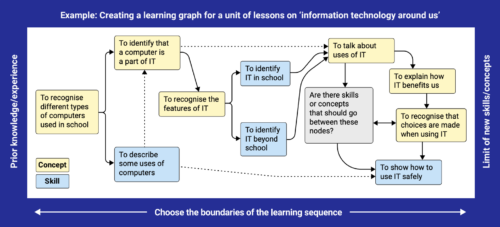
Image from the Learning Graphs Quick Read that showcases an example of a learning graph.

Learning graphs build on research into ‘learning progressions’ and ‘knowledge maps’. They are a practical tool that educators can use to design and validate different curricula. For example, they can help teachers to:

  • Visualise and map progression
  • Identify curriculum gaps, so educators can shape and restructure learning experiences as necessary
  • Ensure the use of consistent terminology
  • Sequence learning and manage cognitive load

How to create a learning graph

Building a learning graph is an iterative process that helps you think critically about how different parts of your curriculum relate to each other.

Nodes and links

The first step in creating a learning graph is often to identify your start and end nodes. First, you consider the key concepts and skills that your learners must acquire by the end of a series of lessons. This gives you some end nodes to work towards. Then, you think about learners’ existing knowledge, to help determine your start point. You then work backwards and forwards between these points to identify the different nodes that learners need to cover to get from the beginning to the end.
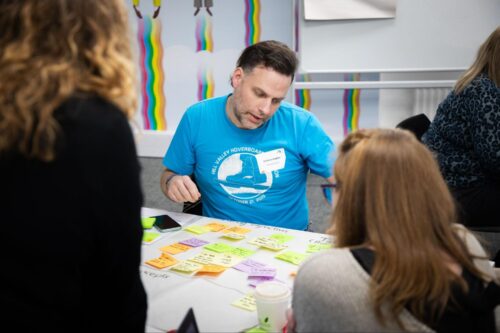
Educators sharing ideas around a table.

Once you have determined your nodes, you add them to your graph and connect them via ‘links’ until your graph is complete. Where knowledge of particular concepts or skills is essential for learning others, you connect the nodes with solid lines. For prior learning that is helpful but not essential, you use dotted lines.

When developing a learning graph, there isn’t a specific level of granularity that you have to work towards. Progression can be as detailed or as high-level as you need. This makes them a helpful tool in creating bespoke learning experiences and curricula for learners.

Collaboration and development

It is most effective to design learning graphs collaboratively within a small group. This allows curriculum designers to discuss their ideas and challenge each other’s thinking, which helps hone the designs.
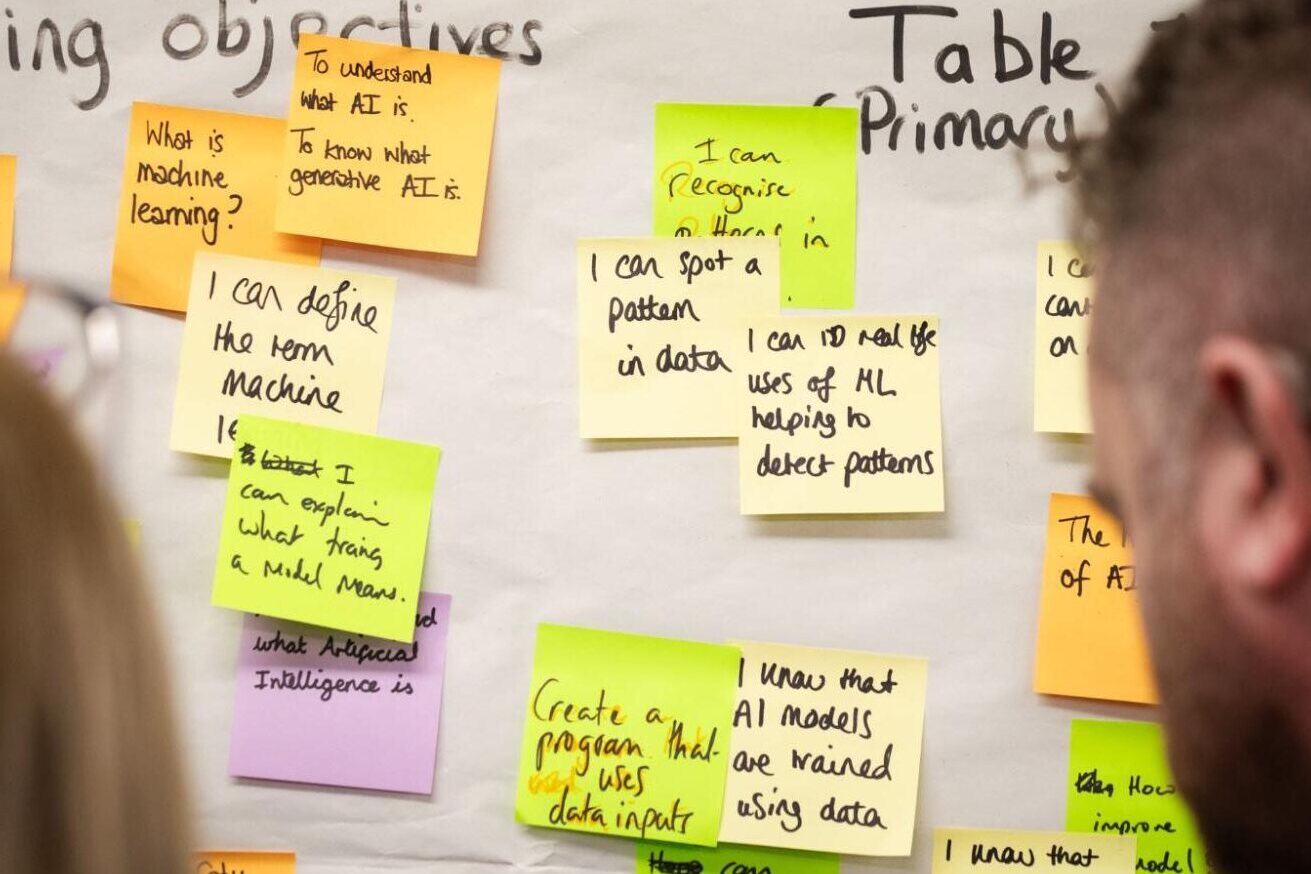
Educators collaborating using post-it notes, planning currciulum.

When creating learning graphs, it can be extremely useful to use a tool that is dynamic and allows you to move elements and make changes quickly and easily. At the Raspberry Pi Foundation, our team has experimented with a range of tools, including using editable shapes in Google Slides, collaborating in Figma, and arranging sticky notes on paper. We recommend finding a tool that works for you and the educators you are working with. Although it can work, we suggest avoiding using a pen and paper if possible, as designs can quickly become messy and difficult to navigate after lots of iterations.

The process of designing learning graphs has strong links to ABC learning design and the creation of concept maps, which can also be used for curriculum planning.

Learning graphs in your teaching

Once created, learning graphs can support you to design and adapt your curricula and assess your students’ learning.

For example, to help sequence learning, you can track or predict the paths through a topic most commonly taken by learners and use this to inform your curriculum design.

If you are adapting a unit of work for a specific qualification or new context, you can prune nodes that are not relevant and add any further knowledge and skills your learners need, then use the new learning graph to guide you as you develop the unit.

Finally, you can assess which node a learner has completed, and use this to identify the next logical step in their learning, ensuring the difficulty level is always appropriate.

Using learning graphs to support analysis

Another benefit of learning graphs is that they can be combined with lots of other frameworks, for example, Bloom’s taxonomy. This allows you to better assess and validate the learning journeys you have designed, and ensure that they are suitably accessible, challenging, and relevant for your learners.
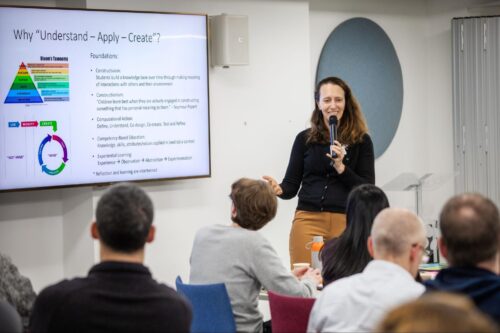
Photo of an educator presenting at the front of a classroom of other teachers.

There are a number of ways that you could link your learning graphs to other frameworks, such as annotating nodes with extra information, or using colour coding.

As well as working with learning graphs for specific learning experiences, you can connect multiple learning graphs together and analyse how they intersect. This can help identify inconsistencies between connected sequences of lessons. It can also help uncover broader themes of progression and highlight alternative learning pathways you might not have considered.

Find out more about learning graphs

If you’d like to find out more about learning graphs, you can download our Pedagogy Quick Read for free.

To find out more about how we use learning graphs when planning curriculum resources at the Raspberry Pi Foundation, take a look at our teaching and learning design principles.

The post How to strategically plan your computing curriculum appeared first on Raspberry Pi Foundation.

Lawsuit Alleges That WhatsApp Has No End-to-End Encryption

Longtime Slashdot reader schwit1 shares a report from PCMag: A lawsuit claims that WhatsApp’s end-to-end encryption is a sham, and is demanding damages, but the app’s parent company, Meta, calls the claims “false and absurd.” The lawsuit was filed in a San Francisco US district court on Friday and comes from a group of users based in countries such as Australia, Mexico, and South Africa, according to Bloomberg.

As evidence, the lawsuit cites unnamed “courageous whistleblowers” who allege that WhatsApp and Meta employees can request to view a user’s messages through a simple process, thus bypassing the app’s end-to-end encryption. “A worker need only send a ‘task’ (i.e., request via Meta’s internal system) to a Meta engineer with an explanation that they need access to WhatsApp messages for their job,” the lawsuit claims. “The Meta engineering team will then grant access — often without any scrutiny at all — and the worker’s workstation will then have a new window or widget available that can pull up any WhatsApp user’s messages based on the user’s User ID number, which is unique to a user but identical across all Meta products.”

“Once the Meta worker has this access, they can read users’ messages by opening the widget; no separate decryption step is required,” the 51-page complaint adds. “The WhatsApp messages appear in widgets commingled with widgets containing messages from unencrypted sources. Messages appear almost as soon as they are communicated — essentially, in real-time. Moreover, access is unlimited in temporal scope, with Meta workers able to access messages from the time users first activated their accounts, including those messages users believe they have deleted.” The lawsuit does not provide any technical details to back up the rather sensational claims.


Read more of this story at Slashdot.

China Hacked Downing Street Phones For Years

An anonymous reader quotes a report from The Telegraph: China hacked the mobile phones of senior officials in Downing Street for several years, The Telegraph can disclose. The spying operation is understood to have compromised senior members of the government, exposing their private communications to Beijing. State-sponsored hackers are known to have targeted the phones of some of the closest aides to Boris Johnson, Liz Truss and Rishi Sunak between 2021 and 2024. It is unclear whether the hack included the mobile phones of the prime ministers themselves, but one source with knowledge of the breach said it went “right into the heart of Downing Street.”

Intelligence sources in the US indicated that the Chinese espionage operation, known as Salt Typhoon, was ongoing, raising the possibility that Sir Keir Starmer and his senior staff may also have been exposed. MI5 issued an “espionage alert” to Parliament in November about the threat of spying from the Chinese state. […] The attack raises the possibility that Chinese spies could have read text messages or listened to calls involving senior members of the Government. Even if they were unable to eavesdrop on calls, hackers may have gained access to metadata, revealing who officials were in contact with and how frequently, as well as geolocation data showing their approximate whereabouts.


Read more of this story at Slashdot.

Reddit Lawyers Force Founder to Redact ‘WallStreetBets’ From Miami Event

Reddit has forced Jaime Rogozinski, the founder of infamous r/WallStreetBets, to strip the WallStreetBets name from an upcoming Miami conference after legal threats citing trademark rights. According to a press release, it’s the “first known case of a social media company enforcing trademark control over a user-created community.” From the report: After years of litigation, courts ultimately sided with Reddit in a decision now referred to as the “Rogozinski Ruling,” a precedent that grants platforms broad authority to assert trademark ownership over user-created communities. That ruling now forms the basis for Reddit’s demand that the words “WallStreetBets” be physically removed from the event. “They aren’t afraid of the name being used,” said Rogozinski. “If they were, they’d have to sue the internet. What they’re afraid of is the creator hanging out with his creation. They’re afraid of the community’s independence. And they’re afraid it’s evolved into something bigger than a subreddit.”

The irony is difficult to ignore. The original subreddit counts around three million subscribers, while conservative estimates place more than seven million WallStreetBets participants spread across other platforms. For a movement that built its reputation confronting corporate overreach, Reddit’s decision to extend its authority beyond the confines of its web-based platform, reaching into real-world gatherings to police culture it did not create, risks stirring a hornet’s nest with a long memory and a track record of collective action.

The event formerly known as WallStreetBets Live, will proceed as scheduled on January 28-30 in Miami. In compliance with Reddit’s demands, all references to the name will be physically redacted on-site. “Reddit’s lawyers did one thing right,” Rogozinski continued. “They proved exactly why we need a decentralized future. This event has become a live case study in what’s broken about modern social media. Platforms can deplatform creators, and now, with courts backing them, they can appropriate what users build.”


Read more of this story at Slashdot.

Challenger+ T3217 Packages 8-bit ATtiny3217 in a Compact, Battery-Ready Board

The Challenger+ T3217 is a compact development board based on Microchip’s ATtiny3217, combining the tinyAVR 1-series platform with a small, battery-ready form factor for low-power embedded applications. The board is based on the ATtiny3217, an 8-bit AVR microcontroller running at up to 20 MHz from its internal oscillator. It integrates 32 KB of Flash, 2 […]

Apple Launches AirTag 2 With Improved Range, Louder Speaker

Apple has launched a new AirTag 2 that features improved range, a speaker that’s 50% louder, and expanded Apple Watch-based tracking. Pricing stays the same at $29 (or $99 for four). 9to5Mac reports: The new AirTag comes with an upgraded second-generation Ultra Wideband chip for improved range, including when using Precision Finding. From Apple Newsroom: “Apple’s second-generation Ultra Wideband chip — the same chip found in the iPhone 17 lineup, iPhone Air, Apple Watch Ultra 3, and Apple Watch Series 11 — powers the new AirTag, making it easier to locate than ever before. Using haptic, visual, and audio feedback, Precision Finding guides users to their lost items from up to 50 percent farther away than the previous generation. And an upgraded Bluetooth chip expands the range at which items can be located. For the first time, users can use Precision Finding on Apple Watch Series 9 or later, or Apple Watch Ultra 2 or later, to find their AirTag, bringing a powerful experience to the wrist.”

Another key upgrade with the new AirTag is an improved speaker, which should also make the accessory easier to find. Apple says: “With its updated internal design, the new AirTag is 50 percent louder than the previous generation, enabling users to hear their AirTag from up to 2x farther than before.” Apple also touts privacy and security improvements with the new AirTag: “Designed exclusively for tracking objects, and not people or pets, the new AirTag incorporates a suite of industry-first protections against unwanted tracking, including cross-platform alerts and unique Bluetooth identifiers that change frequently.”


Read more of this story at Slashdot.

TikTok Alternative ‘Skylight’ Soars To 380K+ Users After TikTok US Deal Finalized

Skylight, an open-source, TikTok-style video app built on the AT Protocol, surged past 380,000 users after last week’s shake-up around TikTok’s U.S. ownership and privacy concerns. TechCrunch reports: Launched last year and backed by Mark Cuban and other investors, Skylight’s mobile app is built on the AT Protocol, the technology that also powers the decentralized X rival Bluesky, which now has north of 42 million users. Skylight, co-founded by CEO Tori White and CTO Reed Harmeyer, offers a built-in video editor; user profiles; support for likes, commenting, and sharing; and the ability for community curators to create custom feeds for others to follow. The app now has over 150,000 videos uploaded directly to the platform. It can also stream videos from Bluesky because of its AT Protocol integration.

Harmeyer said Saturday that 1.4 million videos were played on the app the day before, up 3x over the past 24 hours. The app had also seen sign-ups increase more than 150%. Other noteworthy stats include over a 50% increase in returning users, over 40% rise in video played on average, and over 100% increase in posts created. This surge was likely triggered by concerns over TikTok’s change in ownership and its unfortunately timed technical glitches. […] Over the weekend, Skylight’s CEO, Tori White, said the app added around 20,000 new users and is continuing to grow. So far this January, the app has seen around 95,000 monthly active users. “We’ve seen what happens when one person dictates what’s pushed into people’s feeds,” White told TechCrunch. “Not only does it harm a creator’s connection with their followers, but the entire health of the platform. That’s why we built Skylight Social on open standards. We wanted creator and user power to be guaranteed by the technology. Not an empty promise, but an irrevocable right.”


Read more of this story at Slashdot.

Microsoft’s Latest AI Chip Claims Performance Edge Over Amazon and Google

An anonymous reader quotes a report from GeekWire: Microsoft on Monday announced Maia 200, the second generation of its custom AI chip, claiming it’s the most powerful first-party silicon from any major cloud provider. The company says Maia 200 delivers three times the performance of Amazon’s latest Trainium chip on certain benchmarks, and exceeds Google’s most recent tensor processing unit (TPU) on others. The chip is already running workloads at Microsoft’s data center near Des Moines, Iowa. Microsoft says Maia 200 is powering OpenAI’s GPT-5.2 models, Microsoft 365 Copilot, and internal projects from its Superintelligence team. A second deployment at a data center near Phoenix is planned next.

It’s part of the larger trend among cloud giants to build their own custom silicon for AI rather than rely solely on Nvidia. […] The company says Maia 200 offers 30% better performance-per-dollar than its current hardware. Maia 200 also builds on the first-generation chip with a more specific focus on inference, the process of running AI models after they’ve been trained. […] Microsoft is also opening the door to outside developers. The company announced a software development kit that will let AI startups and researchers optimize their models for Maia 200. Developers and academics can sign up for an early preview starting today.


Read more of this story at Slashdot.

Man Manages To Build A Functional LEGO Typewriter

Inspired by LEGO’s 2021 typewriter set, which did not type, Youtuber Koenkun Bricks took it upon himself to make a version that actually works. And it does, just not how a traditional typewriter does. The mechanism is very impressive, and I’m blown away (FULL DISCLOSURE: I am like a dandelion seed) by the ingenuity. If somebody asked me to make a functional typewriter out of LEGO I’d tell them to give me three days. Then on the third day when they came to see it they’d realize by the uncollected mail and dirty dishes in the sink that I skipped town immediately after telling them to give me three days.

California Tech CEO and EV Pioneer Arrested, Accused of Murder

California tech executive Gordon Abas Goodarzi has been arrested and charged with murder in the death of his estranged wife, Aryan Papoli, whose body was found last November down an embankment off Highway 138 in San Bernardino County. Authorities initially believed the injuries were consistent with a fall, but the case was later ruled a homicide following a months-long investigation by the San Bernardino County Sheriff’s Department. “Arrest records show that Goodarzi is currently in custody without bail and faces a murder charge and that he is set to appear in court Monday,” reports SFGATE. From the report: Goodarzi, a California tech executive with ties to BattleBots, is publicly listed as the president and CEO of Magmotor, which describes itself as a “proud” supporter of the combat robot community and claims to support several teams each year. According to his LinkedIn, Goodarzi also previously worked as a research affiliate at UCLA’s B. John Garrick Institute for the Risk Sciences since 2023.

Originally from Iran, Papoli and Goodarzi settled in Los Angeles County’s verdant Rolling Hills community because of its tranquility and natural beauty, Papoli previously wrote. […] She described her husband, Goodarzi, as a pioneer in the world of renewable energy, developing both electric and hybrid vehicles since the 1980s. According to Papoli, he also worked as the technical director at Hughes Electronics, which developed and manufactured the EV1, an early iteration of the electric car, in the 1990s.


Read more of this story at Slashdot.

People are uninstalling TikTok and downloading an indie competitor

TikTok’s newly formed US entity is off to a very bumpy start. As the app continues to face technical issues affecting the recommendation algorithm, view counts and other features, TikTok is also seeing a wave of frustrated users uninstalling it, according to new data.

Analytics firm Sensor Tower, which tracks downloads and other app store-related metrics, told CNBC that there has been a 150 percent rise in uninstalls of the TikTok app in the United States compared with the last three months. An analyst at Sensor Tower told Engadget that TikTok’s US daily active users (DAUs) have increased about 2 percent in the same time period, and are flat week-over-week. TikTok has blamed a power outage at a data center for causing issues, but hasn’t said when users can expect a fix or explained how a power outage could be responsible for nuking users’ video views or drastically changing their recommendation algorithm. 

At the same time, an independent app called UpScrolled has seen a surge in interest over the last few days. The app is currently the ninth most-downloaded app in the US App Store and the second most popular social app (Meta’s Threads is currently in the number one spot for social apps). The app has also reached the top five in the UK and Australian app stores. In the United States, its sudden popularity seems to be closely tied to recent changes at TikTok. 

UpScrolled has seen 41,000 total downloads between Thursday (the day the US joint venture was formalized) and Saturday, according to estimates from App Figures. The app, which was first released last June, has been downloaded about 140,000 times between Apple and Google’s app stores, according to App Figures. Prior to last Thursday, the app was averaging less than 500 downloads a day, according to the company. The rapid increase in downloads has apparently caused some issues for the company which asked users to “bear with us” on Monday.

Well, this is new…
You showed up so fast our servers tapped out. Frustrating? Yes. Emotional? Also yes.
We’re a tiny team building what Big Tech stopped being. Right now we’re scaling on caffeine to keep up with what YOU started.
Bear with us. We’re on it. pic.twitter.com/OAlYcN6t5q

— UpScrolled (@realUpScrolled) January 26, 2026

Created by an Australian developer, UpScrolled looks a bit like Instagram. Users can share photos and shortform videos. The app defaults to a chronological “following” feed, though it does also recommend content to users. The app is “privately funded by its founder, Issam Hijazi, together with a small group of individual investors who share our mission and values,” according to an FAQ on UpScrolled’s website. It currently has no ads, though the company says it “probably” will in the future. 

This isn’t the first time turmoil at TikTok has benefitted a previously little-known app. Chinese app RedNote briefly became the top app in the United States early last year as TikTok faced a potential ban. RedNote’s popularity proved to be short-lived, though, as the 2025 TikTok “ban” ended up lasting only a couple of hours. 

But with new owners at TikTok and growing frustration over technical issues with the app, there could be an opportunity for a new shortform video service that’s not controlled by a huge corporation. And that’s what UpScrolled seems to be betting on. “Too often, users are left uncertain about whether their voices will be heard or quietly suppressed,” the company writes on its website. “UpScrolled changes that by ensuring every post has a fair chance to be seen, creating an environment that is authentic, unfiltered, and equitable for all.”

This article originally appeared on Engadget at https://www.engadget.com/social-media/people-are-uninstalling-tiktok-and-downloading-an-indie-competitor-233345222.html?src=rss

OpenAI spills technical details about how its AI coding agent works

On Friday, OpenAI engineer Michael Bolin published a detailed technical breakdown of how the company’s Codex CLI coding agent works internally, offering developers insight into AI coding tools that can write code, run tests, and fix bugs with human supervision. It complements our article in December on how AI agents work by filling in technical details on how OpenAI implements its “agentic loop.”

AI coding agents are having something of a “ChatGPT moment,” where Claude Code with Opus 4.5 and Codex with GPT-5.2 have reached a new level of usefulness for rapidly coding up prototypes, interfaces, and churning out boilerplate code. The timing of OpenAI’s post details the design philosophy behind Codex just as AI agents are becoming more practical tools for everyday work.

These tools aren’t perfect and remain controversial for some software developers. While OpenAI has previously told Ars Technica that it uses Codex as a coding tool to help develop the Codex product itself, we also discovered, through hands-on experience, that these tools can be astonishingly fast at simple tasks but remain brittle beyond their training data and require human oversight for production work. The rough framework of a project tends to come fast and feels magical, but filling in the details involves tedious debugging and workarounds for limitations the agent cannot overcome on its own.

Read full article

Comments

We Now Know What Caused the TikTok Outage

If you tried hopping on TikTok Sunday, you might have noticed something odd: the app wasn’t working. Outages happen, of course, as anyone who has Verizon can attest. But in the moment, theories were flying left and right. TikTok had just officially moved into U.S. control, leading some to speculate that the outage had something to do with this change in ownership. As one user put it, “TikTok being down days after the people they were forced to sell to take it over does not feel like a coincidence.”

As it happens, it does appear that the changing of the guard was responsible for the outage—just not in the way that some conspiracy theories might suggest. TikTok finally released a statement on X Monday morning, attributing the outage to issues at a U.S. data center. The statement is as follows: “Since yesterday we’ve been working to restore our services following a power outage at a U.S. data center impacting TikTok and other apps we operate. We’re working with our data center partner to stabilize our service. We’re sorry for this disruption and hope to resolve it soon.”

The outage might not be the only thing different about TikTok

For its part, TikTok is very much operational at the moment. If the issue really was just isolated to a power outage at this data center, that data center appears to have patched things up. But that doesn’t mean the company’s reputation is patched up. Users are accusing the app’s new owners of changing the algorithm, complaining of reset For You Pages, irrelevant content in feeds, and AI-generated content. I’ve seen users accuse the app of blocking anti-Trump and anti-ICE content, while comedian Gianmarco Soresi says even some of his non-political TikToks have “zero views,” which he attributes to the ineffectiveness of the people running the app. (I’ve reached out to TikTok for comment on user reports of changes to the algorithm and will update if I hear back.)

We’ll need more time to know whether or not there were serious changes made to TikTok’s algorithm and user feeds in the wake of this sale. But the app is running—at least, for now.