
If you followed along with my blog, you’d have a chatbot running on your local Fedora machine. (And if not, no worries as the scripts below implement this chatbot!) Our chatbot talks, and has a refined personality, but does it know anything about the topics we’re interested in? Unless it has been trained on those […]
Beats Studio Pro Matches Its Black Friday Pricing at 51% Off, Now the Cheapest ANC Headphones From Apple

The pair offers exceptional sound quality, plus is compatible with both Android and iOS devices.
NVIDIA May Push Back Launch Of RTX 50 Super And Next-Gen RTX 60 GPUs
We’re a little over a month into 2026 and one thing is already abundantly clear—it’s going to be a tough year PC gaming upgrades. Hot on the heels of a rumored delay to Intel’s not-yet-announced Core G3 and G3 Extreme Panther Lake CPUs for handhelds and Valve’s Steam Machine potentially getting a price adjustment before pricing is even announced,
NASA will now allow astronauts to take their smartphones to space
Most people wouldn’t leave their phones behind when they so much as go for a drive, but NASA astronauts have had to leave their phones on Earth while they went to work 250 miles away at the International Space Station. That is, until now.
In a post on X, NASA Administrator Jared Isaacman shared that the Crew-12 and Artemis II astronauts will be allowed to bring smartphones along for the journey to the ISS and beyond. “We are giving our crews the tools to capture special moments for their families and share inspiring images and video with the world,” Isaacman said.
While these won’t be the first smartphone images captured in space — that distinction belongs to a trio of miniature phone-based satellites sent into Earth orbit in 2013 which succeeded where the earlier British STRaND-1 project failed. But thanks to the upcoming Artemis II mission, we can look forward to the first smartphone images from the moon’s orbit. The March (for now) launch will be the agency’s first crewed moon mission since Apollo 17 in 1972.
The crews’ personal devices will be far less cumbersome to use than the old Nikon DSLRs they were previously limited to for high-quality still images. Ideally, this means more spontaneous pictures that can be shared with friends and family back on Earth.
This article originally appeared on Engadget at https://www.engadget.com/science/space/nasa-will-now-allow-astronauts-to-take-their-smartphones-to-space-151310548.html?src=rss
Linux from Scratch to drop System V versions
The Linux From
Scratch (LFS) project provides step-by-step instructions on
building a customized Linux system entirely from source. Historically,
the project has provided separate System V and systemd editions,
which gave users a choice of init systems. Bruce Dubbs has announced
the project will no longer produce the System V version:
There are two reasons for this decision. The first reason is
workload. No one working on LFS is paid. We rely completely on
volunteers. In LFS there are 88 packages. In BLFS there are over
1000. The volume of changes from upstream is overwhelming the
editors. In this release cycle that started on the 1st of September
until now, there have been 70 commits to LFS and 1155 commits to BLFS
(and counting). When making package updates, many packages need to be
checked for both System V and systemd. When preparing for release, all
packages need to be checked for each init system.The second reason for dropping System V is that packages like GNOME
and soon KDE’s Plasma are building in requirements that require
capabilities in systemd that are not in System V. This could
potentially be worked around with another init system like OpenRC, but
beyond the transition process it still does not address the ongoing
workload problem.[…] As a personal note, I do not like this decision. To me LFS is
about learning how a system works. Understanding the boot process is a
big part of that. systemd is about 1678 “C” files plus many data
files. System V is “22” C files plus about 50 short bash scripts and
data files. Yes, systemd provides a lot of capabilities, but we will
be losing some things I consider important.
The next version, 13.0, is expected in March and will only focus on
systemd.
Larian Isn’t Involved With The Baldur’s Gate Show, Fans Are Not Happy: ‘I Genuinely Don’t Think Anyone Can Trump Our Writers’

Showrunner Craig Mazin has reached out to the studio to discuss the series
Enigma celebrates 20th anniversary with titanium bike that showcases its future
Enigma’s new Excel 6AL/4V prototype is not only the foundation for the British titanium bike manufacturer’s upcoming 20th-anniversary limited-edition model. It will also showcase the future design direction of Enigma’s range.
With only 20 frames scheduled for production, the new Excel is set to be a collector’s item. Each frame will be handmade at Enigma’s HQ in Hailsham, Sussex, and made from Grade 5 (6AL/4V) double-butted titanium tubing. The prototype is finished with a satin bead blast, and gold-mirror anodised details, head badge and logos.
Jim Walker, Enigma’s managing director, says: “We are collaborating with our friends at Reynolds Technology, who are aiming to produce a brand-new set of Grade 5 6AL/4V tubing for the bike. We want the frame to be as ‘British’ and sustainably produced as possible.”
- Read more: Best titanium road bikes in 2026 for smooth and luxurious riding, as reviewed by BikeRadar
Enigma Excel 6A1/4V details
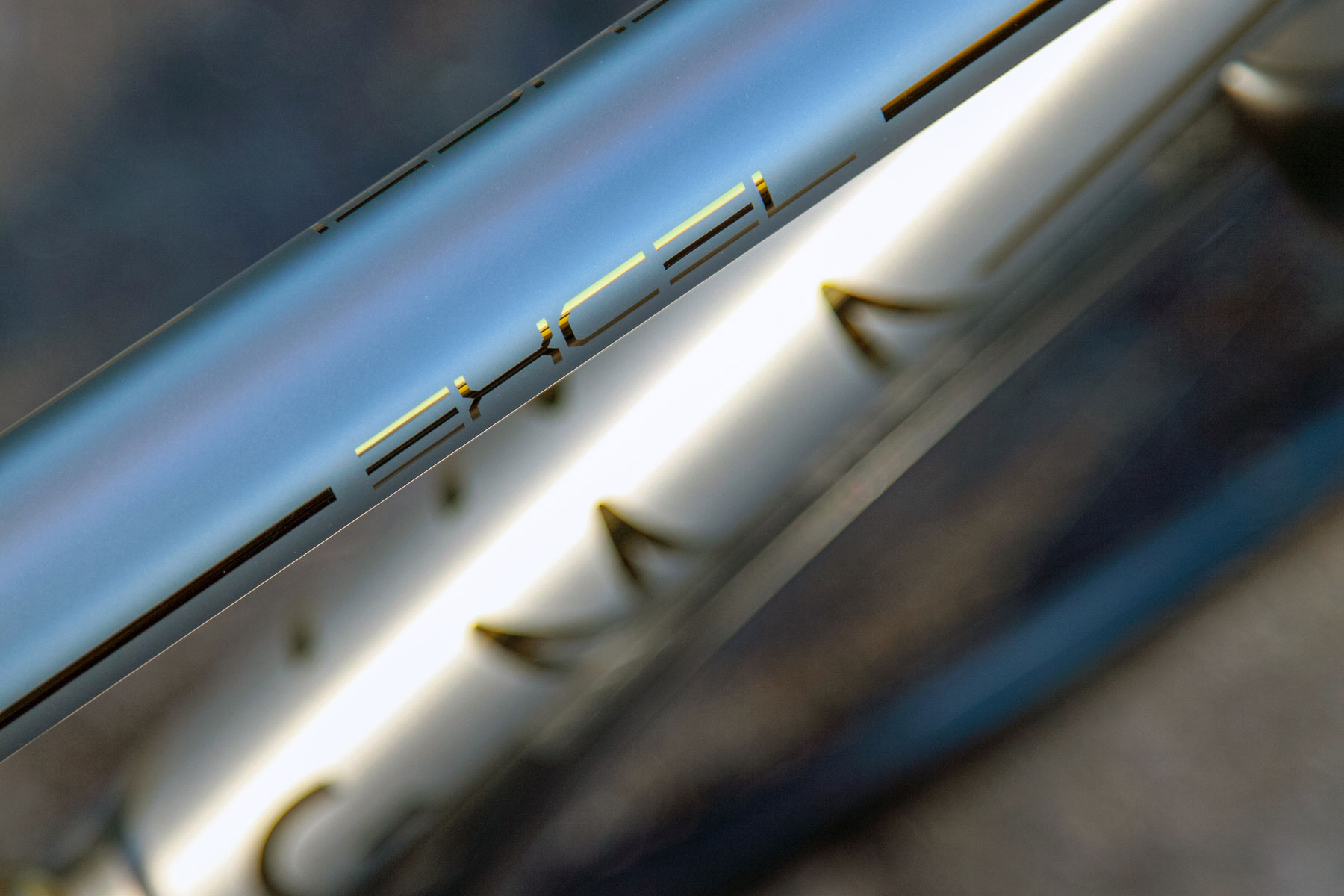
The frame features 3D-Printed UDH dropouts and a 3D-printed seat cluster. As you’ll notice from our pictures, Enigma has stayed with a traditional external seat clamp.
“We believe [a traditional clamp] offers greater long-term security and serviceability than the current trend for concealed push-plate systems,” says Walker. “At Enigma, we use 3D printing only where it offers a genuine structural or functional advantage, not purely for aesthetic impact.”

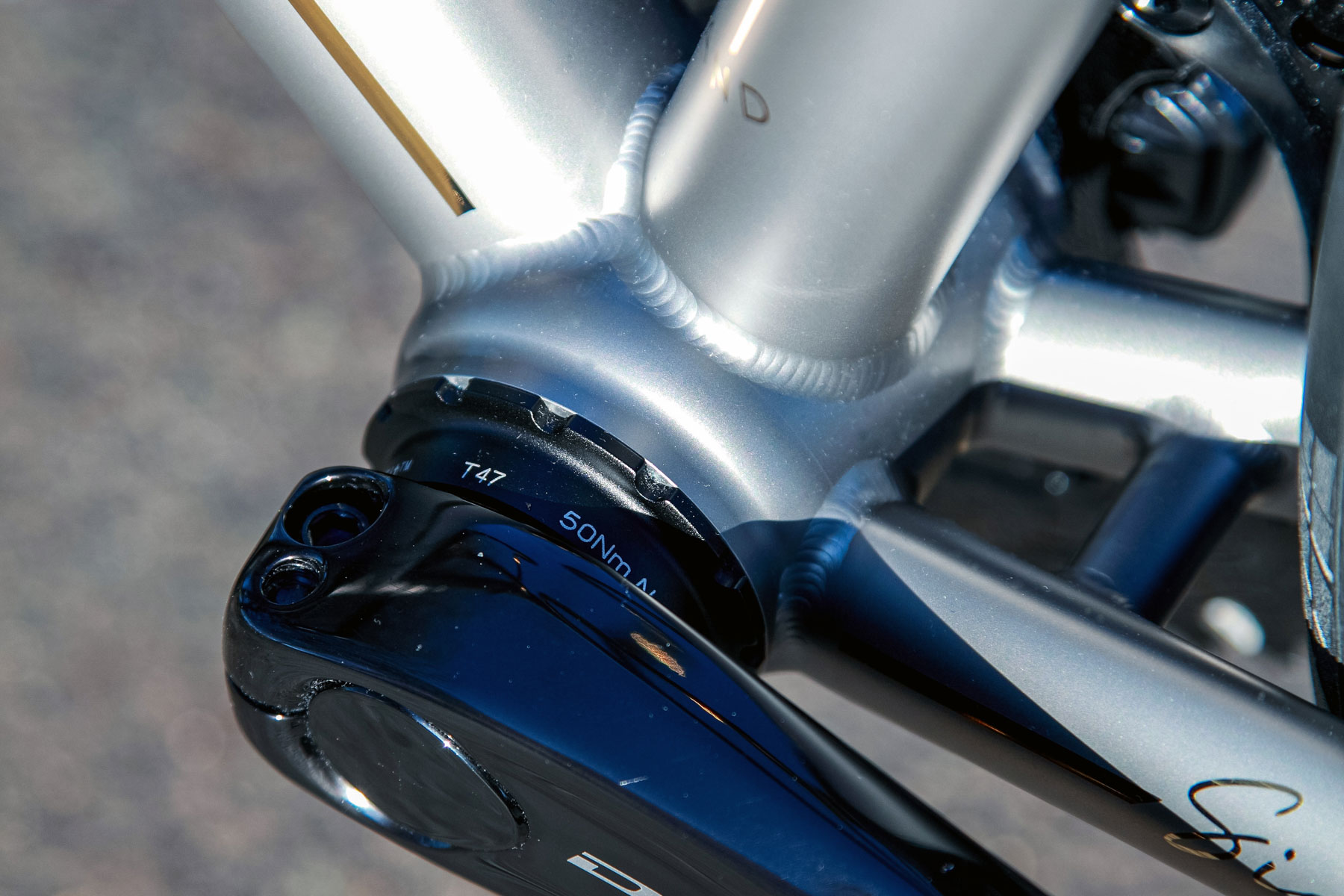
The bike uses a CNC-machined IS52 head tube and a CNC-Machined T47 bottom bracket shell. Walker says this is because CNC machining delivers much tighter tolerances than 3D printing and a superior surface finish. It’s the right choice for high-load, precision interfaces such as head tubes and bottom brackets.
Enigma Excel 6A1/4V design

The design team at Enigma wants its bikes to combine classic looks with a modern twist. However, it says function should always lead form.
Enigma doesn’t believe that titanium should mimic carbon fibre aero shapes. Simply, if aerodynamics are your ultimate priority, it believes you should use carbon fibre. Enigma wants to celebrate titanium’s qualities and amplify rather than disguise them. Jim is adamant you’ll never see a titanium ‘aero’ frameset from Enigma.
Its intention is to show off its frame builders’ skill with traditional TIG welding, and use a combination of tube diameters, wall thicknesses and butt profiles to influence the ride quality.
While the new bike embraces some 3D-printed elements, Walker sees overreliance on this new technology as a limiting factor when it comes to custom bikes, which have been the heart of Enigma’s business for two decades.

Jim tells us: “While it is possible to build custom frames around extensive 3D-printed components, it can significantly increase cost and restrict design. A more traditional construction allows almost complete customisation without unnecessary complexity.”
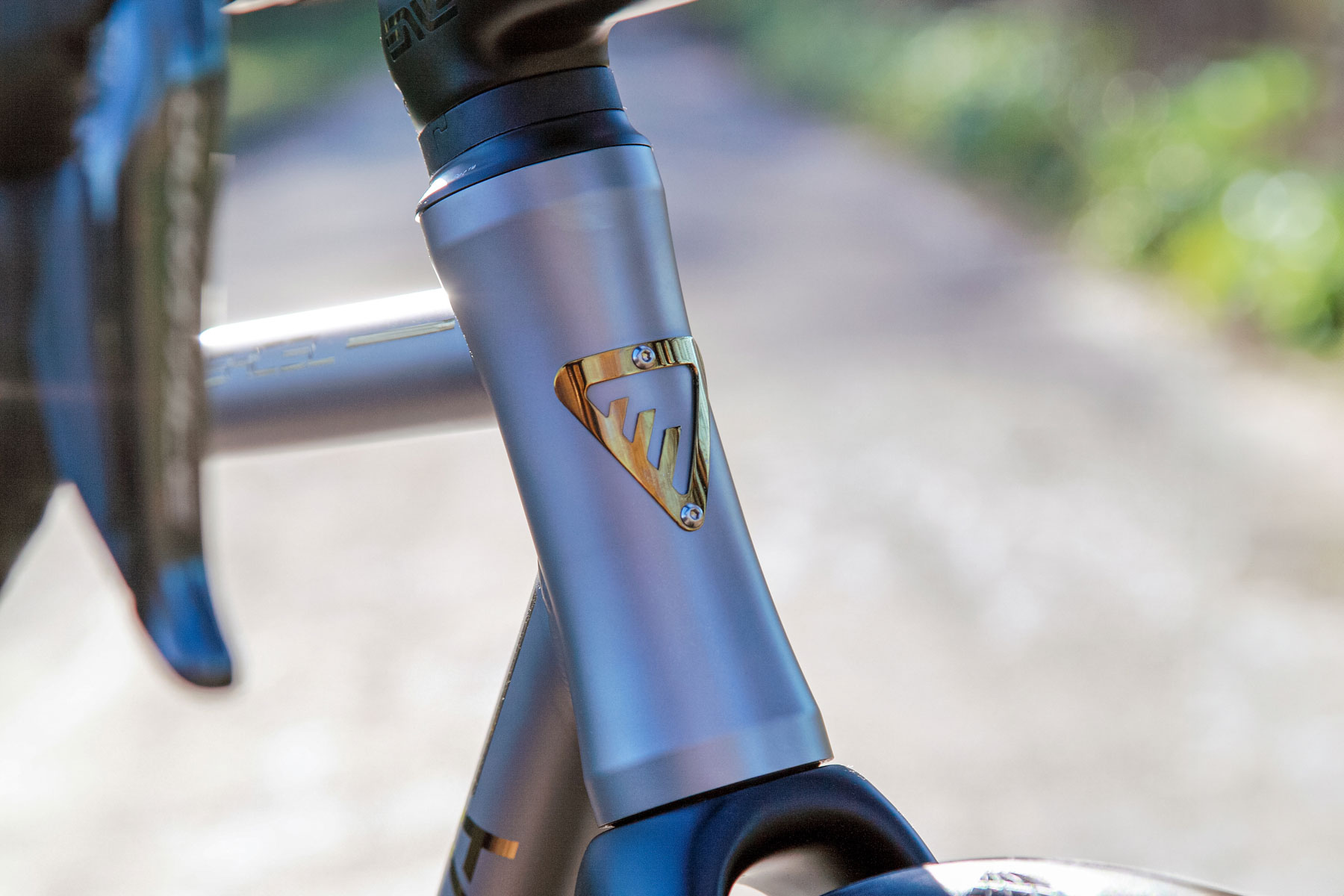
For Enigma, it’s also about longevity – and that means reparability. Titanium frames, made conventionally, are fully repairable. When you damage a complex 3D-printed structure, it’s difficult – if not impossible – to rectify. Enigma wants its bikes to last for decades rather than seasons.

This being a prototype, Enigma hasn’t yet listed pricing for the 20th anniversary Excel, alhough the current Excel is priced from £4,070 for a disc frameset.
I Tried Malwarebytes’ ChatGPT App, and It’s Actually Good at Detecting Scams
A few months ago, ChatGPT got an app store of its own, which means you can access tools like Photoshop and Apple Music right inside the ChatGPT prompt box. Now Malwarebytes has joined the ChatGPT app store, which means you can get some expert help when investigating web links, emails, text messages, domains, and phone numbers you think might be suspicious.
The app is free to use for everyone, whether or not they’re signed up to a paid ChatGPT subscription, and you can enable the tool via the ChatGPT app store or by entering the prompt “Malwarebytes, is this a scam?” Once you’ve used the app for the first time, you can access it again via the + (plus) button on the prompt box.
Malwarebytes’ ChatGPT app can test links, sites, and phone numbers
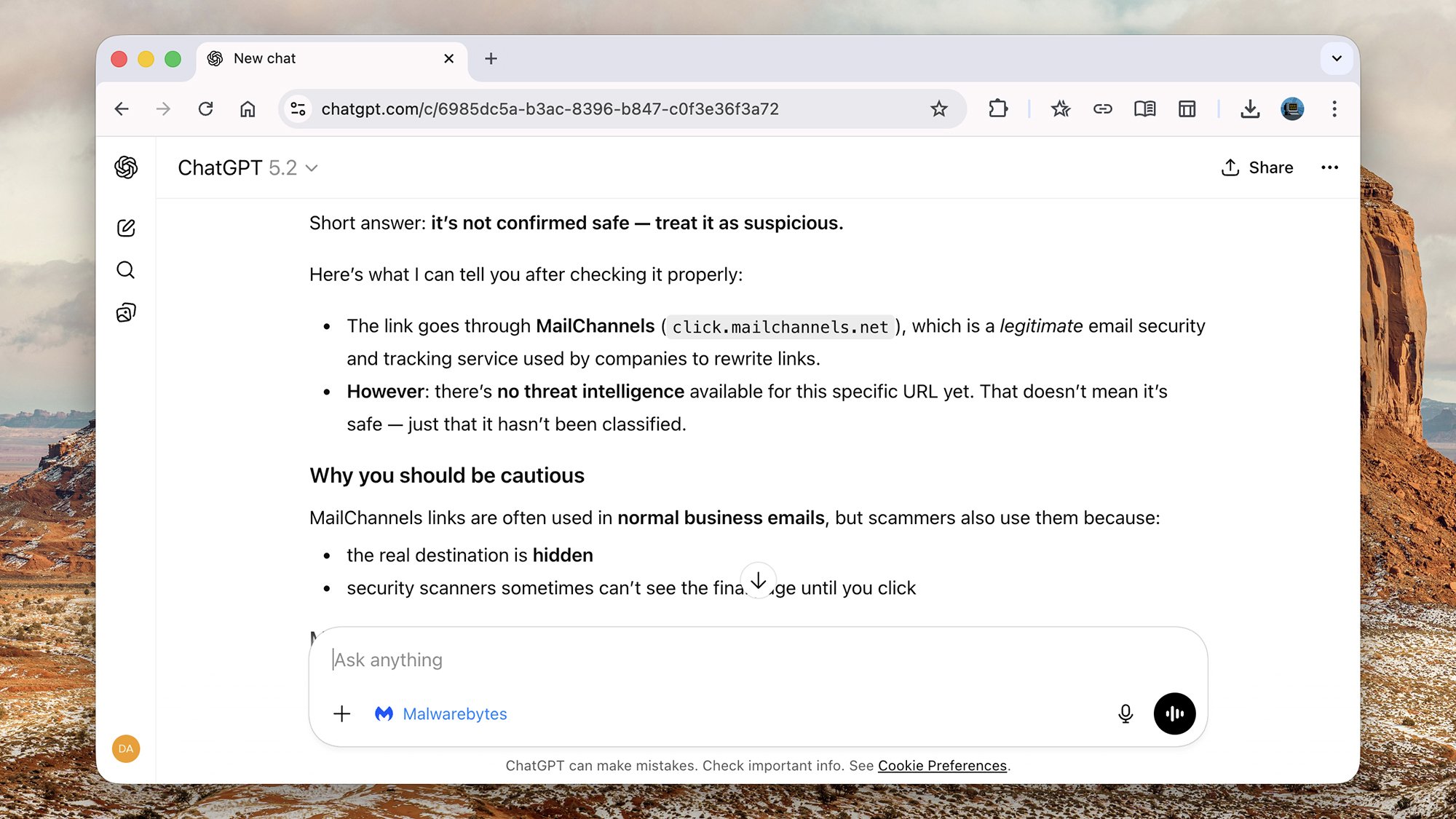
Malwarebytes will do a deep security dive into links you provide.
Credit: Lifehacker
Credit: Lifehacker
You can paste just about anything you like into a conversation with the Malwarebytes plugin, but there are certain approaches that scammers will often take—including links contained in phishing emails—that make for good candidates to test this thing out. I dived deep into my email spam folder to find some URLs to test Malwarebytes on, and gave it a few trustworthy web addresses as well—you just copy the link into the prompt box and ask the app for an assessment.
Malwarebytes successfully sifted out the scam links from the safe ones, even when it didn’t have any specific information in its databases about the links I was providing. When it was unsure, it said so, with lots of extra context: For example, for one URL I was told the address was “a legitimate email security and tracking service used by companies to rewrite links” but one that scammers also used to conceal the link destination.
You also get an assessment of the domain name: When given a link to a Lifehacker article, the plugin correctly identified that it was a legitimate domain with a registered owner, even though it didn’t have any specific information about the URL. Malwarebytes was also able to spot domain redirecting, a trick frequently used by scammers.
Phone numbers can be given to Malwarebytes as well: When I tested this out with a few scam calls I’ve had, these numbers were correctly identified as coming from scammers or at least being suspicious. I like the way the app gives you some context to its thinking (explaining how spam call centers work, for example), and will also offer up advice about next steps and how to stay safe.
Something else I appreciated was that the Malwarebytes app has a memory inside ChatGPT: If you post a series of links and numbers in the same chat thread, as I did, then it will try and put them all in context (explaining why one URL is potentially more dangerous than another, for example).
The Malwarebytes ChatGPT app can also look at messages and emails
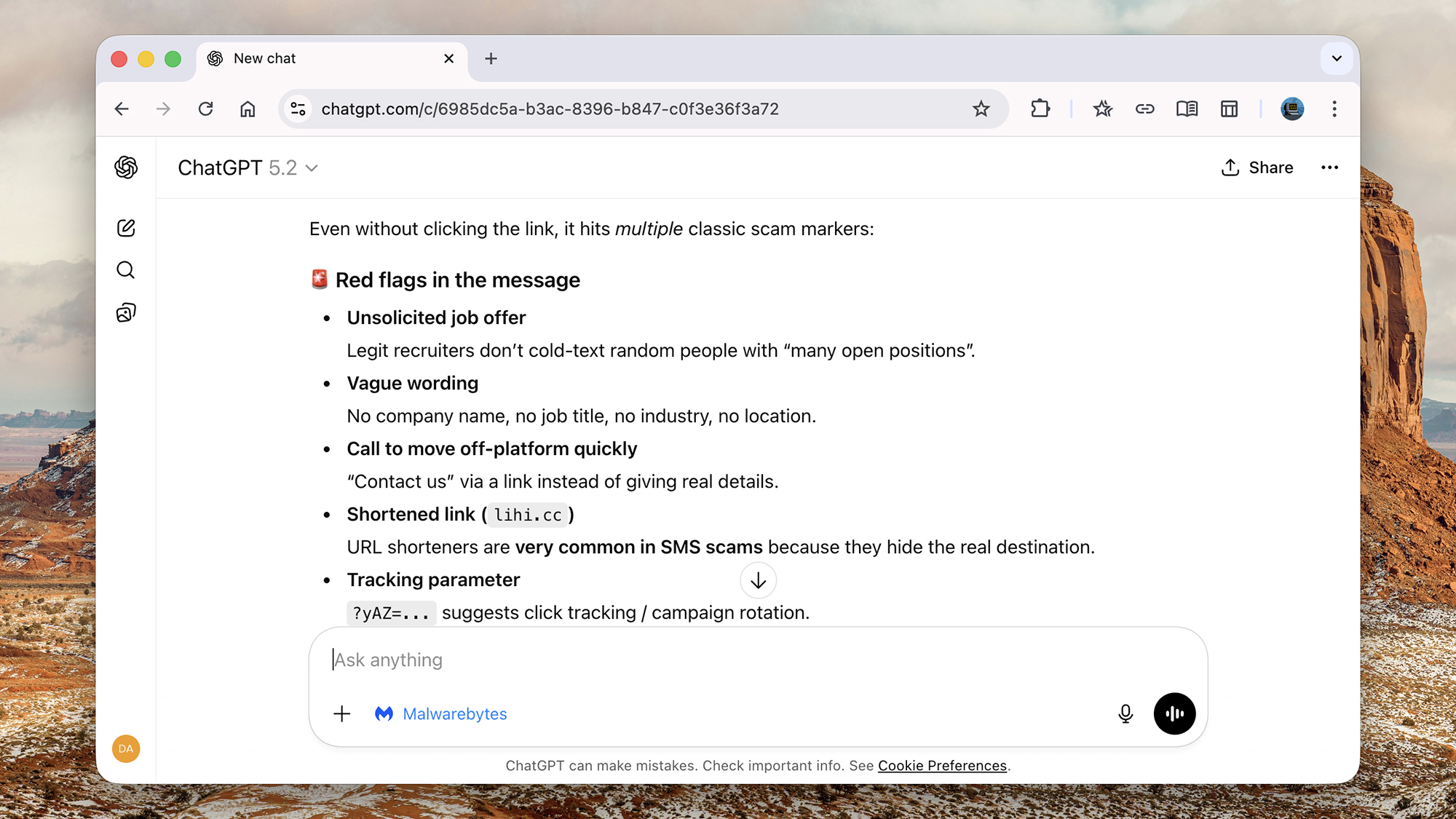
You’ll get a list back of red flags in email and text message content.
Credit: Lifehacker
Credit: Lifehacker
You can also give the Malwarebytes app some text you’ve come across in an email or text message and get a verdict on this too—you can even type in a transcript of a conversation you’re having on the phone, if you want. The plugin will scan the text for phrasing that scammers often use and will alert you of any other red flags.
I tried this out with a variety of spammy text, and again Malwarebytes scored highly in terms of recognizing anything dodgy. As before, if it came across something it wasn’t sure about, it would explain the reasons why and suggest some next steps.
The responses also include some detail on why different scam approaches are taken and why they sometimes work, and how they might escalate—so if you get a message purporting to be from a family member asking for help, Malwarebytes tells you why these scams are common and how they’re used to steal identities or money.
It’s an intelligent system, in that it’ll ask you questions about the texts or emails you’ve received: If it’s not sure about something, you’ll be told about extra checks you can run (like looking at the “reply to” address on an email). However, the usual ChatGPT sycophancy does start to grate a bit, as you’re constantly told that you’re doing the right thing and that you’re right to be suspicious.
The app taps into Malwarebytes Threat Intelligence, so it should be able to keep you protected against the latest threats (making it more helpful than a Google search or just a regular ChatGPT query). From the examples I used at least, it comes across as a security tool that’s accurate, comprehensive, and easy to use—one that’s well worth keeping close at hand if you come across potential scams you’re not sure about.
Disclosure: Ziff Davis, Mashable’s parent company, in April 2025 filed a lawsuit against OpenAI, alleging it infringed Ziff Davis copyrights in training and operating its AI systems.
NASA stage show explores “outer” outer space with Henson’s Fraggles
Move over Snoopy, because NASA has a new character helping to promote its deep space exploration plans. His name is Uncle Traveling Matt.
No really, move over.
Fraggle Rock: A Space-y Adventure has taken over the same theater the Kennedy Space Center Visitor Complex in Florida previously used for “All Systems Are Go,” featuring the comic strip beagle. The new stage show stars the Jim Henson Company’s subterranean Muppets as they discover outer (outer) space for the first time.
Google TV 4K Streamer Drops to New Low as Amazon Fire TV and Roku Streaming Device Deals Heat Up for the Super Bowl

Upgrade the way you stream without overpaying.
Pushing The Intel Panther Lake CPU Performance Further On Linux
Earlier this week I published the first Linux benchmarks of Intel’s much anticipated Panther Lake with the Core Ultra X7 358H 16-core 18A processor. The Panther Lake SoC showed very nice generational gains especially with much better performance-per-Watt and the Intel Arc B390 graphics are also fascinatingly fast while continuing to be backed by open-source drivers. In today’s article are more Panther Lake Linux benchmarks on the CPU side in looking at the performance potential when pushing the Core Ultra X7 358H with a higher power budget.
EU says TikTok needs to drop “addictive design”
Brussels has warned TikTok that its endlessly scrolling feeds may breach Europe’s new content rules, as regulators press ahead with efforts to rein in the social effects of big online platforms.
In preliminary findings issued on Friday, the European Commission said it believed the group had failed to adequately assess and mitigate the risks posed by addictive design features that could harm users’ physical and mental wellbeing, particularly children and other vulnerable groups.
The warning marks one of the most advanced tests yet of the EU’s Digital Services Act, which requires large online platforms to identify and curb systemic risks linked to their products.
Europe Accuses TikTok of ‘Addictive Design’ and Pushes for Change
TikTok’s endless scroll of irresistible content, tailored for each person’s tastes by a well-honed algorithm, has helped the service become one of the world’s most popular apps. Now European Union regulators say those same features that made TikTok so successful are likely illegal. From a report: On Friday, the regulators released a preliminary decision that TikTok’s infinite scroll, auto-play features and recommendation algorithm amount to an “addictive design” that violated European Union laws for online safety. The service poses potential harm to the “physical and mental well-being” of users, including minors and vulnerable adults, the European Commission, the 27-nation bloc’s executive branch, said in a statement.
The findings suggest TikTok must overhaul the core features that made it a global phenomenon, or risk major fines. European officials said it was the first time that a legal standard for social media addictiveness had been applied anywhere in the world. “TikTok needs to change the basic design of its service,” the European Commission said in a statement.


Read more of this story at Slashdot.
The Samsung Galaxy Watch 8 Is $200 Off Right Now
We may earn a commission from links on this page. Deal pricing and availability subject to change after time of publication.
The 44mm Samsung Galaxy Watch 8 (LTE) is down to $229.99 at Woot, which is a steep drop from its $429.99 launch price. That also undercuts its current $339.99 price on Amazon, and price trackers suggest this is the lowest it has ever been. Woot’s deal runs for another three weeks or until stock sells out, so don’t wait too long to make a decision here. Amazon Prime members get free standard shipping (while everyone else pays $6), though shipping is limited to the contiguous U.S.
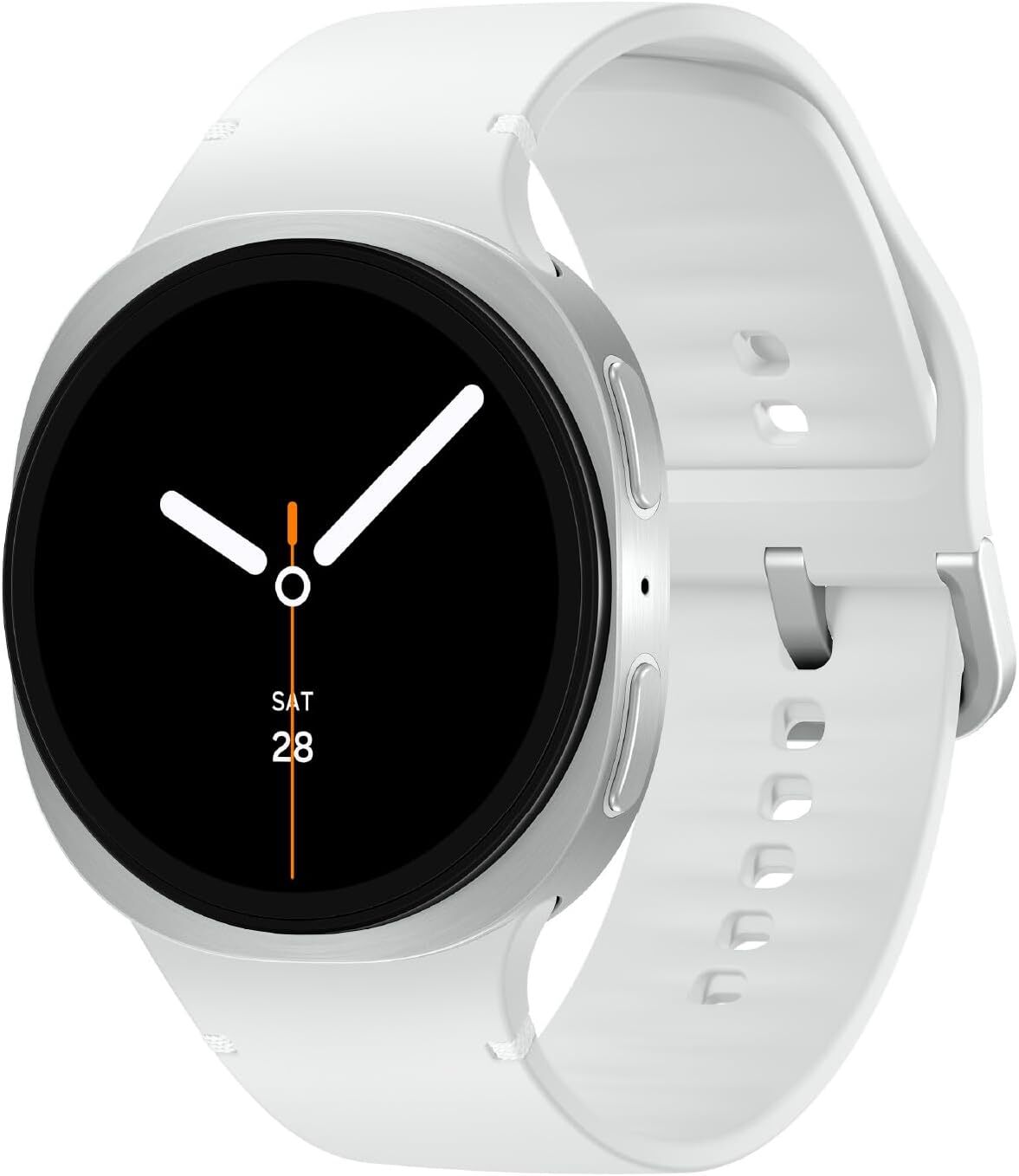
This is Samsung’s most feature-heavy watch, and the LTE connectivity means you can leave your phone at home and still take calls, send texts, and stream music. That alone gives it a strong edge over wifi-only smartwatches, especially for runners, cyclists, or folks trying to spend less time glued to their phones.
This model is part of Samsung’s latest Watch 8 lineup, which launched last summer, and it has already earned strong praise, including an “excellent” review from PCMag, which named it the best Android smartwatch of 2025. Its Super AMOLED display is bright enough to read outdoors, even in harsh sunlight, and the interface feels responsive thanks to Samsung’s Exynos W1000 processor paired with 2GB of RAM and 32GB of storage. Health tracking goes well beyond steps, with support for a wide range of fitness and wellness tools, including heart rate, ECG, temperature, blood oxygen, and even antioxidant levels. Google Gemini also comes preloaded for smarter voice control. That said, this watch plays best with Samsung phones. You’ll need any Android 12+ phone to use it, but some of the more advanced features, like snoring detection, are locked to Samsung devices.
The trade-off, as with most Samsung watches, is battery life. Real-world usage lands around 26 hours, so daily charging is part of the routine. That won’t work for everyone. On the upside, durability is solid, with IP68 dust and water resistance, a 5ATM swim rating, and MIL-STD-810H certification for tougher conditions. If you’re all-in on Samsung and want a fully independent smartwatch, this deal makes a lot of sense, especially at this price. But, if you’re still weighing options, see how it stacks up against Google’s flagship wearable, the Pixel Watch 4, here.
Is Hideo Kojima Okay?

Also: what if instead of game prices going up, game budgets go down?
Uber ordered to pay $8.5 million to passenger who accused a driver of rape
Uber must pay a passenger who accused one of its drivers of rape $8.5 million, a federal jury in Phoenix has ordered. The jury found Uber liable for its driver’s misconduct, determining that the driver was an agent of the company. Part of Uber’s defense was that it’s not responsible for what its drivers do, as they are independent contractors. This decision is for but one of the 3,000 similar cases against Uber that have been consolidated in federal court. It was a bellwether trial meant to determine the possible outcomes of the other cases, as well as the possible settlements. As The Guardian explains, the results for this case could be used as a precedent for all the other pending lawsuits if the verdict is upheld by the appeals court.
The case chosen for the bellwether trial was filed by Jaylynn Dean, who said she was raped by her Uber driver in 2023. Dean said she was intoxicated when she ordered an Uber to take her back home from her boyfriend’s apartment after celebrating passing a test for her flight attendant training. The driver allegedly stopped at a dark parking lot and raped her in the backseat.
Uber argued that the driver had no criminal history, had completed training and had excellent passenger feedback. The company’s camp also presented its safety measures, including the development of a machine-learning tool that can assess the risk of potential rides. But Dean’s lawyers showed evidence during the trial that she was tagged as high risk for a serious safety incident just before her ride arrived and that she wasn’t notified about it. They also presented documents suggesting that Uber resisted introducing in-car cameras, because it would slow down growth. “Women know it’s a dangerous world. We know about the risk of sexual assault,” Dean’s layer said in her closing arguments. “They made us believe that this was a place that was safe from that.“
Despite the jury holding Uber liable for the incident, it determined that the company wasn’t negligent when it comes to safety practices and its app’s safety systems were not faulty. “This verdict affirms that Uber acted responsibly and has invested meaningfully in rider safety,” an Uber spokesperson told The New York Times. He also said that Uber plans to appeal the jury’s decision. In addition to the 3,000 lawsuits consolidated in federal court, Uber is also facing 500 similar cases in California state court. Last year, a California jury found that the company was not liable for a sexual assault that the plaintiff alleged her driver had committed back in 2016.
This article originally appeared on Engadget at https://www.engadget.com/transportation/uber-ordered-to-pay-85-million-to-passenger-who-accused-a-driver-of-rape-141800931.html?src=rss
Oakley Meta HSTN Hits an All-Time Low, While Ray-Ban Smart AI Glasses Remain at Full Price

Over at Amazon, you can save nearly $70 on the Oakley Meta black frame smart glasses with polarized lenses.
Google will soon offer AirDrop support on more Android devices
One of the more surprising tech developments in 2025 was Google bringing two-way support for Apple’s AirDrop functionality to its Pixel 10 series of phones. At the time, Google said it intended to expand the feature to other devices at a later date, and that date could be just around the corner.
At a press briefing attended by Android Authority at Google’s Taipei office, Eric Kay, Android’s Vice President of Engineering, confirmed that AirDrop interoperability will expand in 2026. “We spent a lot of time and energy to make sure that we could build something that was compatible not only with iPhone but iPads and MacBooks,” he said. “Now that we’ve proven it out, we’re working with our partners to expand it into the rest of the ecosystem, and you should see some exciting announcements coming very soon.”
Right now, Pixel 10 users can send and receive files and photos between Apple devices and Android using Quick Share. For an Android device to receive from an iPhone, they have to set their Quick Share visibility settings to “everyone for 10 minutes” and make sure they’re in “receive” mode on the Quick Share page.
It’s a similar story for an Android-to-Apple file share. You have to set your iPhone, iPad or Mac’s Airdrop visibility to “anyone for 10 minutes,” which enables someone from outside your contacts to use Quick Share on their Pixel 10.
When this feature launched, it wasn’t clear how much involvement, if any, Apple had had, or if the infamous walled garden would once again banish Android-minded intruders in a subsequent software update. But that hasn’t happened, and back in November, Qualcomm confirmed that devices powered by its Snapdragon chips would also soon be able to transfer files to iPhones using Quick Share, suggesting that Pixel exclusivity wouldn’t last for much longer.
Google’s own willingness to play nice with Apple gear is seemingly a move designed to make the lives easier of anyone thinking about making the jump from an iPhone to an Android device. As reported by Android Authority, Kay also said his company was committed to making it as simple as possible to transfer data when switching.
It wasn’t that long ago that the idea of Apple and Google teaming up to make device-hopping more consumer-friendly was the stuff of fantasy, but in December it emerged that the longstanding rivals were working on a new simplified data transfer system. Each company already offers a method for swapping ecosystems, but a new build of Android Canary hinted at something that would work at the operating system level.
Last month, Apple and Google also released a joint statement confirming previous reports that the new version of Siri will utilise Google Gemini’s models, effectively resulting in a Google-powered voice assistant on your iPhone.
This article originally appeared on Engadget at https://www.engadget.com/mobile/google-will-soon-offer-airdrop-support-on-more-android-devices-141523521.html?src=rss
Intel Delays Panther Lake CPUs For Gaming Handhelds, Leaker Says

The vast majority of PC gaming handhelds run on AMD hardware, though Intel hasn’t ignored the market completely. Notably, MSI injected Intel’s Meteor Lake and Lunar Lake silicon into its Claw handhelds, and now with Panther Lake roaring to life, Intel is specifically targeting the form factor with part of its latest-generation lineup. However,
Blink’s Highly Rated Wired Floodlight Camera Is Just $45 Right Now
We may earn a commission from links on this page. Deal pricing and availability subject to change after time of publication.
Adding more visibility to a driveway or backyard is cheaper than you might think. The Blink Wired Floodlight Camera is currently selling for just $44.99 on Amazon, down from its usual $99.99, and price-tracking tools show that’s the lowest it has ever been. It’s a wired camera, so it replaces an existing outdoor light and runs on household power. In exchange, you get a 1080p camera with a wide 143-degree field of view and dual LED floodlights that emit 2,600 lumens.
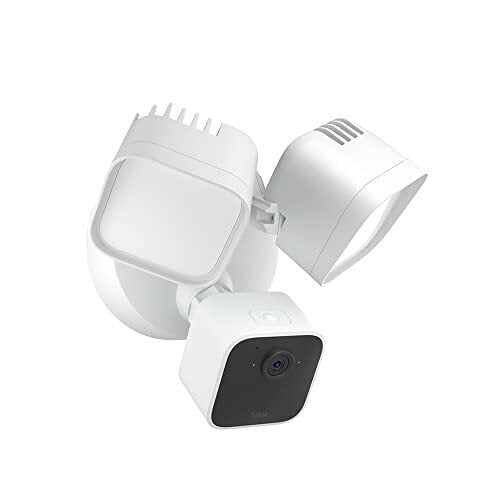
In daylight, this camera’s footage looks sharp with natural colors, and the wide-angle camera does a good job covering a driveway or yard on its own. At night, the camera switches to infrared black-and-white video that stays clear up to 30 feet, and when the floodlights activate, you get full color night video, making it easier to recognize faces, animals, or vehicles.
You’ll also get motion alerts on your phone, and the live view in the Blink app loads fast enough to check what’s happening in real time. You can also use the two-way audio to speak through the camera, turn the lights on manually, or trigger the 105-decibel siren to draw attention via the app, according to PCMag’s review.
As for the limitations of this floodlight camera, it mostly comes down to subscriptions and ecosystem support. You can view live video and receive motion alerts for free, but recording clips and using person detection requires a Blink subscription. The Basic plan costs $4 per month for one camera, while the Plus plan is $12 per month and covers multiple devices with 60 days of storage. Local storage is possible, but only if you buy the Blink Sync Module 2 ($49.99) and add your own USB drive. Also, while the camera integrates easily with Alexa and IFTTT, there’s no Google Home or Apple HomeKit support, which might matter depending on your smart home setup. Still, for under $50, this is a cost-efficient way to add real lighting and usable security footage in one upgrade.