
WINSYSTEMS’ SBC-ZETA-3950 is a rugged mini single board computer based on the Intel Atom Apollo Lake E3950, designed for industrial and space-constrained applications. It combines a COM Express Mini Type 10 module with a rugged carrier board in an 84 x 55 mm form factor. The SBC-ZETA-3950 uses the quad-core Intel Atom E3950 processor running […]
Wine 11.3 Released with Mono 11 and VKD3D 1.19 Upgrade
Wine 11.3 brings Mono 11.0, VKD3D 1.19, better DirectSound, and 30 bug fixes to improve how Windows apps and games run on Linux.
Rogue devs of sideloaded Android apps beg for freedom from Google’s verification regime
37 groups urge the company to drop ID checks for apps distributed outside PlaySoon, developers who just want to make Android apps for sideloading will have to register with Google. Thirty-seven technology companies, nonprofits, and civil society groups think that the Chocolate Factory should keep its nose out of third-party app stores and have asked its leadership to reconsider.…
The US Had a Big Battery Boom Last Year
The United States installed a record 57 gigawatt hours of new battery storage on its electric grids in 2025, a nearly 30% increase over the prior year that arrived even as the Trump administration cut tax credits for wind and solar in last summer’s One Big Beautiful Bill.
The figures come from a Solar Energy Industries Association report published Monday, which also projects the market will grow another 21% this year by adding 70 gigawatt hours in 2026 alone. Battery tax credits themselves survived the legislation largely intact, and the majority of last year’s new installations were stand-alone systems not tied to specific solar projects.
In Texas, solar met more than 15% of electricity demand throughout the summer and beat out coal for the first time, and the SEIA report predicts the state will overtake California this year in total deployed storage. Supply chain restrictions reinforced by the bill and project cancellations could slow the pipeline this year, the report cautions.


Read more of this story at Slashdot.
LibreOffice Online Project Reopened With New Community Focus
The Document Foundation has revived LibreOffice Online, resuming development after formally reversing its 2022 decision to freeze the project.
Apple Vision Pro’s Retrocade Is The Nostalgic Virtual Arcade We’ve Been Waiting For
Retrocade on Apple Vision Pro is the nostalgic virtual 1980s arcade experience VR gamers have been waiting for, and arguably the best visionOS title yet, though multiplayer is sorely missing.
One of the first ideas anyone with any interest in retro gaming has when they first try VR is a faithful recreation of a 1980s video game arcade. Earlier this month, Resolution Games released the best version of this idea we’ve seen yet, exclusively on Apple Vision Pro’s $7/month aptly-named Apple Arcade game subscription service.
The Facts
What is it?: A virtual 1980s arcade with 10 iconic games
Platforms: Apple Vision Pro
Developer: Resolution Games
Price: Available via the $7/month Apple Arcade subscription
Retrocade was developed by Resolution Games, the veteran XR game studio behind dozens of top titles across all major headsets. Chances are, if you’re a VR gamer, you’ve seen their logo pop up before a game you love. Apple contracted Resolution to build Game Room for Vision Pro’s launch and the Gears & Goo tower defense game that released last year, both also on Apple Arcade. Resolution also ported its flagship cross-platform title Demeo to visionOS.
Retrocade is also available as a flatscreen game on iPhone and iPad, and if you’re a mobile gamer I’m sure you’d have fun with it. But where it really shines is in its native visionOS version, with realistic true-scale cabinets placed in either your physical space or a nostalgic depiction of a typical 1989 American arcade.
0:00
/1:31
UploadVR-captured footage in VR mode. Would you believe me if I told you I intentionally sucked at Pac-Man to keep the footage short enough for all our social platforms?
In this virtual arcade you’ll find the following 10 licensed games cabinets:
- Breakout (1976 – Atari)
- Space Invaders (1978 – Taito)
- Asteroids (1979 – Atari)
- Pac-Man (1980 – Namco)
- Centipede (1981 – Atari)
- Frogger (1981 – Konami)
- Track & Field (1983 – Konami)
- Galaga (1981 – Namco)
- Bubble Bobble (1986 – Taito)
- Haunted Castle (1988 – Konami)
While the virtual cabinets are impressively realistic, and the control elements like joysticks and buttons are animated, I should note that you don’t actually directly interact with them using your hands. Instead, the game requires a Bluetooth gamepad, such as a PlayStation DualShock controller, the controls of which map to those of the cabinets.
Pressing the Select button on your controller inserts a virtual coin into the cabinet, and Start remotely presses its 1 Player mode button. From here, the action buttons (eg, AB/XY) map to the cabinet’s action buttons and you can use either of the sticks, or the D-Pad, to move the joystick.
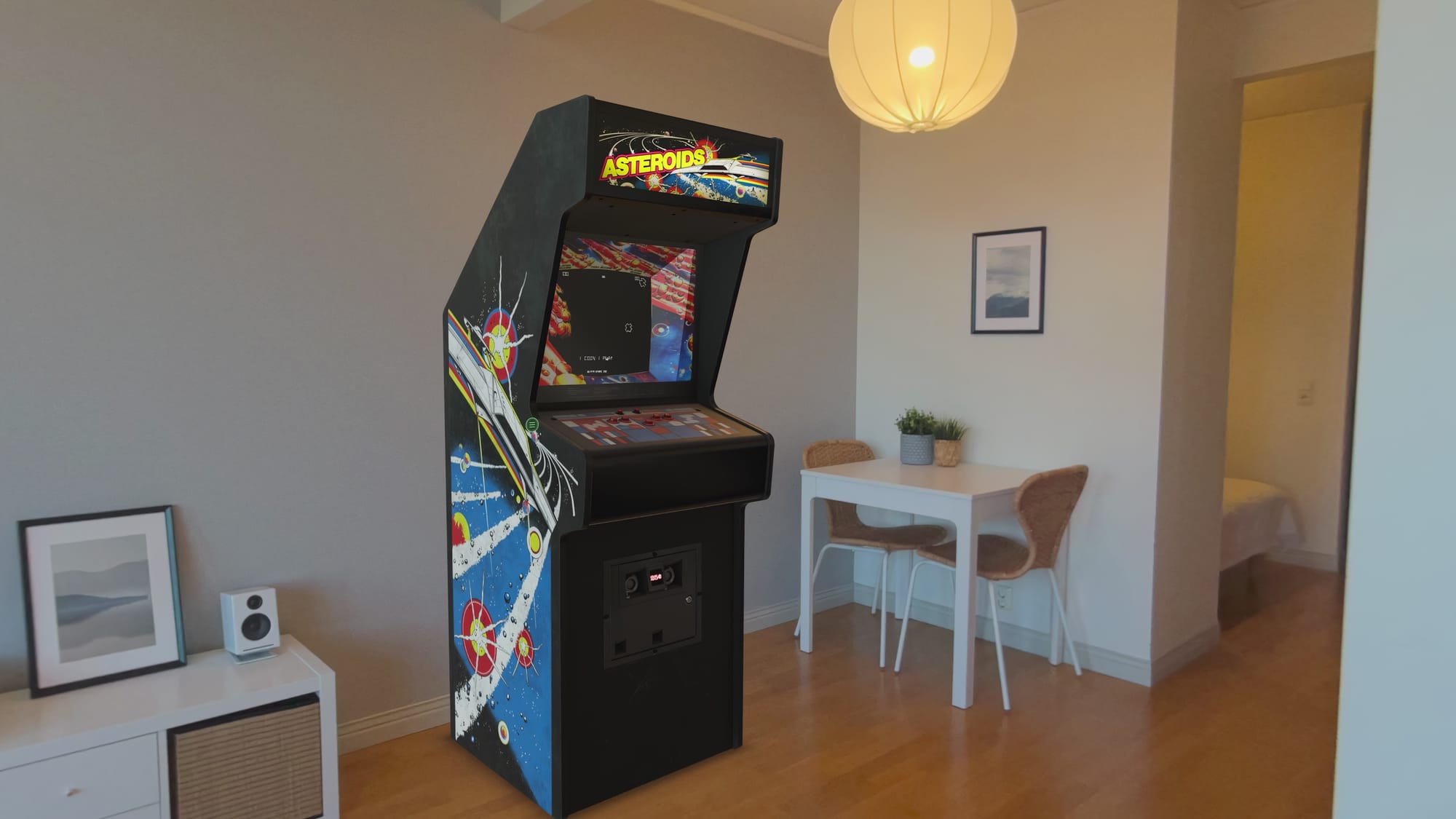
The virtual coins inserted into the cabinets are unlimited, by the way. There are no microtransactions in Retrocade, though that might be an interesting monetization option for people unwilling to pay the subscription fee for Apple Arcade.
When playing any of the games, you can switch between being inside the virtual arcade, with all the other cabinets visible around you, or to have only the cabinet you’re playing in your physical space. Retrocade can be a VR or mixed reality game, whichever you prefer.
Oculus launches Arcade along with several new VR games
The launch today of pre-orders for the redesigned $100 Gear VR is accompanied by the availability of Arcade, offering “more than 20 classic games like Pac-Man, Sonic the Hedgehog, and Gauntlet” all playable in a virtual arcade. The app is available as a beta release from the Oculus Store. Prices
 UploadVRIan Hamilton
0:00
/0:00
There have been other official attempts in the past to bring a retro arcade to VR, such as the discontinued Oculus Arcade for the Samsung Gear VR phone-holder headset and Oculus Go. But both headsets were 3DoF, rotation tracking only, meaning you couldn’t lean around and appreciate the cabinet as an object in space.
A decade later, Retrocade on Apple Vision Pro is the same idea but done right – mostly. The combination of the powerful M-series chipset, high-resolution micro-OLED displays, rock-solid positional tracking and hard work of Resolution Games delivers a feeling that the cabinet is truly there in front of you, and the virtual arcade environment induces a deep feeling of immersive nostalgia.

The smallest details of each cabinet are faithfully recreated in real-time, and the on-by-default CRT filter, to my eyes at least, looks identical to what you’d get from a real display of the era. Retrocade would be a delight to look at if it were just a non-interactive passive environment. And yet what you get here is 10 fully-playable, true-to-original games too – some of the most iconic of all time.
All this is not to say that Retrocade is perfect.
I understand why Resolution chose to require a controller, as it’s far more precise and reliable than hand tracking input would have been. Though I do wish hand tracking input was an experimental option, or at least supported for pressing buttons. There’s something a little jarring about having such a realistic cabinet not respond to poking at the buttons.
Another issue is that the mixed reality mode operates as a Full Space, so it doesn’t support visionOS Shared Space multitasking. You can’t put on a movie or YouTube video in the background, if that’s your thing, and nor could you have an instant messaging or security camera app open. If you absolutely need multitasking, you can play Retrocade in a 2D window, where it essentially acts like the iPad app. But this entirely removes the magic of having a virtual cabinet.
The more pressing problem with Retrocade, though, is that you might feel lonely. The magic of the real arcade was not just the cabinets, but the people there beside you. The real Bubble Bobble and Track & Field supported simultaneous multiplayer, while the other games supported alternating turns. What I really want here is SharePlay – to see friends as Personas standing beside me, able to interact with the cabinet too. The only social layer in Retrocade is that the game sends your stats to Apple Game Center, so you can asynchronously compete with friends, but this just isn’t the same thing as feeling together.
0:00
/0:52
UploadVR-captured footage in mixed reality mode, showing how the cabinet truly feels as if in your physical environment.
Retrocade – The Final Verdict
If you accept it as a singleplayer experience, Retrocade is a beautifully polished rendition of the virtual 1980s arcade VR gamers have dreamed of. It’s a shame that it’s exclusive to a $3500 headset, but it seems Apple paid for the development of the game. Hopefully other VR platforms get something similar, perhaps from another arcade game company like Sega, in the near future.
You can find Retrocade on the visionOS App Store via the Apple Arcade subscription.

UploadVR uses a 5-Star rating system for our game reviews – you can read a breakdown of each star rating in our review guidelines.
Titan Isles Launches Today On PlayStation VR2
The PlayStation VR2 port of Titan Isles has blasted its way onto Sony’s headset.
Today, Psytec Games has released their high-mobility action-adventure shooter Titan Isles on Sony’s PlayStation VR2. The game lands just twelve days after Psytec announced its PS VR2 release date.
Designed to make the most of PS5’s hardware, the PS VR2 port runs at a native 90fps on base PS5, boosted to 120fps on PS5 Pro. The devs also confirmed that both the base and Pro versions utilize native resolution and eye-tracked foveated rendering for maximum visual clarity. Psytec Games has also made the most of the PS5 controller’s adaptive triggers, giving each weapon its own resistance, plus headset haptics and full bHaptics support.
0:00
/1:09
We previously reviewed Titan Isles when it debuted on Meta Quest, and found it to be “a compelling action adventure that’s equally enjoyable in co-op and single-player.” Our reviewer went on enthusiastically, writing that Titan Isles was “the most fun I’ve personally had with a VR co-op experience since Dungeons of Eternity.”
Titan Isles is available starting today on the PS VR2 store at a cost of $24.99. The game is also available on Steam and Quest.
AMD Posts Linux Patches For SEV-SNP BTB Isolation
It’s quite a mouthful but today AMD posted Linux kernel patches for preparing SEV-SNP BTB isolation support for further enhancing the security of virtual machines (VMs) for confidential computing…
First British Baby Born Using Transplanted Womb From Dead Donor
A 10-week-old boy named Hugo has become the first baby born in the UK from a womb transplanted from a deceased donor, after his mother Grace Bell — who was born without a viable womb due to a condition called MRKH syndrome, which affects one in every 5,000 women — underwent a 10-hour transplant operation at The Churchill Hospital in Oxford in June 2024.
Hugo was born just before Christmas 2025, weighing nearly 7lbs, at Queen Charlotte’s and Chelsea Hospital in west London, following IVF treatment and embryo transfer at The Lister Fertility Clinic. Bell’s transplant is one of three completed so far as part of a UK clinical research trial that plans to carry out 10 such procedures from deceased donors, and Hugo is the first baby born from any of them.
Earlier in 2025, a separate effort produced baby Amy, the first UK birth from a living womb donation — her mother had received her older sister’s womb in January 2023. Globally, more than 100 womb transplants have been performed, resulting in over 70 healthy births.


Read more of this story at Slashdot.
New Xbox CEO On Company Strategy: “The Plan’s The Plan Until It’s Not The Plan”

Asha Sharma offered only vague responses when asked about what to expect from Xbox’s next era
Lutris 0.5.21 Adds Support For Running Games Inside Valve’s Latest Steam Runtime
Lutris 0.5.21 is now available as the latest version of this open-source Linux game manager. With Lutris 0.5.21 comes some new runners for executing games in different environments…
Boozy chimps fail urine test, confirm hotly debated theory
The urine of chimpanzees contains high levels of alcohol byproduct, most likely because the chimps regularly gorge themselves on fermented fruit, according to a new paper published in the journal Biology Letters. It’s the latest evidence in support of a hotly debated theory regarding the evolutionary origins of human fondness for alcohol.
As previously reported, in 2014, University of California, Berkeley (UCB) biologist Robert Dudley wrote a book called The Drunken Monkey: Why We Drink and Abuse Alcohol. His controversial “drunken monkey hypothesis” proposed that the human attraction to alcohol goes back about 18 million years, to the origin of the great apes, and that social communication and sharing food evolved to better identify the presence of fruit from a distance. At the time, skeptical scientists insisted that this was unlikely because chimpanzees and other primates just don’t eat fermented fruit or nectar.
But reports of primates doing just that have grown over the ensuing two decades. Earlier this year, we reported that researchers had caught wild chimpanzees on camera engaging in what appears to be sharing fermented African breadfruit with measurable alcoholic content. That observational data was the first evidence of the sharing of alcoholic foods among nonhuman great apes in the wild. The authors measured the alcohol content of the fruit with a handy portable breathalyzer and found almost all of the fallen fruit (90 percent) contained some ethanol, with the ripest containing the highest levels—the equivalent of 0.61 percent ABV (alcohol by volume).
Sony’s Spider-Man Universe Headed For Reboot After Disastrous Morbius, Madame Web, And Kraven Movies

Rothman said “yes” when Matt Belloni asked if Sony’s Spider-Man Universe would be getting a fresh reboot
Apache NetBeans 29 Released with Java, PHP, and Git Enhancements
Apache NetBeans 29 cross-platform IDE released with Java performance improvements, PHP fixes, and updated Git integration.
LG’s massive 52-inch ultra-wide gaming monitor costs $2,000
LG kicked off the year by unveiling a new lineup of gaming monitors, and today the company has priced out the biggest of the bunch. The UltraGear evo G9 (52G930B) is now available for pre-order, and the massive screen will cost just $2,000.
Yes, you can buy a perfectly excellent gaming monitor for much less, but $2,000 is a surprisingly low price tag for this 52-inch ultrawide monitor with a 1000R curve, which LG is billing as “the world’s largest 5K2K gaming monitor.” In addition to its huge size, the G9 can run at a 240Hz refresh rate and offers a 1 millisecond gray-to-gray response rate. Visuals are supported by VESA DisplayHDR 600 and up to 95% DCI-P3 color gamut coverage.
LG has long done solid work on gaming monitors, and the G9 seems like a good choice for anyone who wants to be seriously immersed in their gameplay. Whether that’s for a high-fidelity experience like Microsoft Flight Simulator or for having the maximum coziness in Stardew Valley is up to you.
This article originally appeared on Engadget at https://www.engadget.com/computing/accessories/lgs-massive-52-inch-ultra-wide-gaming-monitor-costs-2000-232937759.html?src=rss
Restarting LibreOffice Online
LibreOffice online is a web-based version of the LibreOffice suite that can
be hosted on anybody’s infrastructure. This project was put into stasis back in 2022, a move marked by
some tension with Collabora, a major LibreOffice developer that has its own online offering. Now,
the Document Foundation has announced
a new effort to breathe life into this project.
We plan to reopen the repository for LibreOffice Online at The
Document Foundation for contributions, but provide warnings about
the state of the repository until TDF’s team agrees that it’s safe
and usable – while at the same time encourage the community to join
in with code, technologies and other contributions that can be used
to move forward.
Meanwhile, this
post from Michael Meeks suggests that the tension around online
versions of LibreOffice has not abated.
Apple’s touchscreen MacBook will reportedly have a dynamic interface
Apple’s plan to add touchscreens to its premium MacBook Pros is coming into focus. Bloomberg reports that when the new laptops launch this fall, they’ll feature a Dynamic Island, not unlike Apple’s iPhones, and an interface that changes depending on where you touch your Macbook’s screen.
This “dynamic interface” is reportedly designed to make the transition between mouse input and touch input smoother on Apple’s new laptops. Bloomberg says that if users touch an onscreen button, the version of macOS running on these new MacBook Pros will be able to pull up a contextual menu “that provides more relevant options for touch commands.” Parts of the interface, like macOS’ menu bar, will also be able to enlarge to make menu items easier to select with a finger. Those tweaks are on top of the expected features from touchscreen Apple products, like smooth scrolling and the ability to pinch and zoom into and out of images, files and web pages. The only thing missing from these increasingly iPad-like laptops, per Bloomberg, will be a touchscreen keyboard, because they’ll already have a more comfortable physical keyboard attached.
To make these new laptops extra enticing, both the 14-inch and 16-inch touchscreen MacBook Pros will feature OLED screens for the first time, likely the reason Apple will be able to include a Dynamic Island-style webcam in the first place. Up until now, the company has offered OLED screens on its iPhones, Apple Watches and more recently the iPad Pro, but it hasn’t brought the display technology to laptops. That could reportedly change with these new MacBook Pros.
Plenty of Windows laptops include touchscreens, and Microsoft and its partners have incorporated dynamic interface elements in the past to make these touchscreens more natural to use with Windows. Apple is late to the party in this respect, but it’s also potentially set up to succeed. Much of modern macOS already looks touch-friendly, and Apple’s has expended significant effort making it possible to port touch-based iPad apps to macOS and develop applications across platforms. That, paired with the right interface, could make the experience of using a touchscreen MacBook nicer out of the box, even if it doesn’t get rid of the awkwardness of reaching over your keyboard to touch a screen.
This article originally appeared on Engadget at https://www.engadget.com/computing/laptops/apples-touchscreen-macbook-will-reportedly-have-a-dynamic-interface-231929456.html?src=rss
Sherlock Holmes: The Master Detective Hands-On: Uneven Investigations
Sherlock Holmes: The Master Detective is the latest VR adaptation of the iconic detective, delivering uneven investigations in Early Access.
No stranger to video game adaptations, Arthur Conan Doyle’s legendary detective has seen his fair share of reimaginings, from a young amateur grappling with the supernatural in Sherlock Holmes: The Awakened to the immersive theater online co-op seen in Sherlock Holmes: The Case of the Hung Parliament. Each iteration hones in on a different aspect of the character that, done well, is interesting in its own right. Out now on Early Access, Sherlock Holmes: The Master Detective is an uneven portrayal of the character, even if there is an entertaining core gameplay at the heart of it.
The Facts
What is it?: A hidden object puzzle game featuring Sherlock Holmes.
Platforms: Meta Quest 3 and 3S (Reviewed on Quest 3)
Release Date: Out now
Developer/Publisher: Messworks
Price: $ 14.99
Starting in the famous 221B Baker Street apartment, a woman bursts through the door clamoring for help: a man has died in mysterious circumstances. Before leaving, you are allowed to rummage through the place. Sherlockians will find his previous exploits scattered around the furniture. Picking up files from his old cases like The Hound of the Baskervilles makes the seasoned investigator mutter a few words about how it ended in such a tragic way. An out-of-place Meta Quest 3 box earns the description of being “a lens into countless realities,” signaling that the story is developing in the current era.
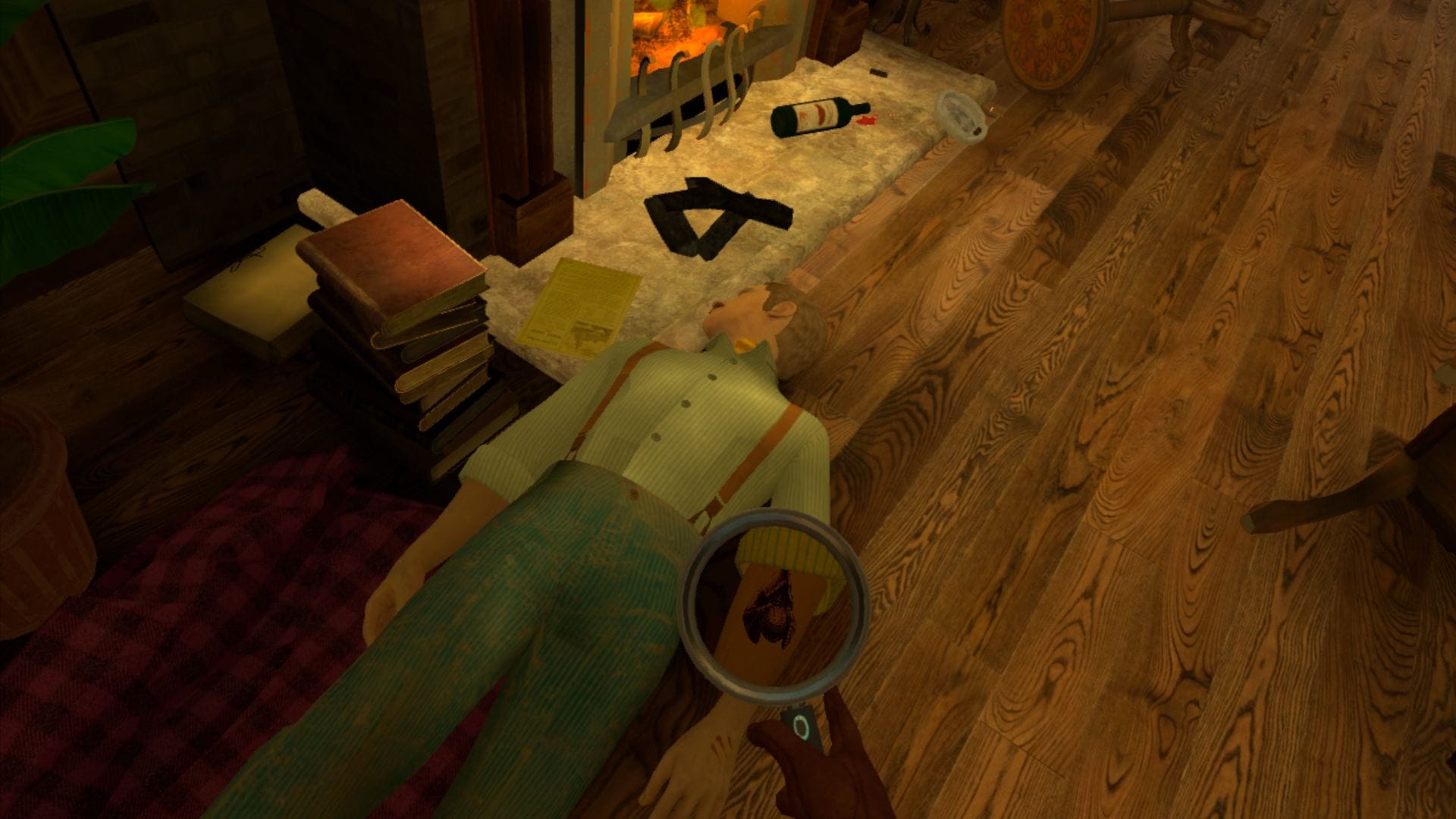
A modern-day Sherlock Holmes has been done before, most notably in the famous 2010 BBC series with Benedict Cumberbatch. This time around, he is brought up to speed with innovative tools to help with his sleuthing. This version of the character is armed with a magnifying glass, a chemical analyzer, and a fingerprint scanner. After finding and packing them in a slick toolbox, one last tutorial reveals itself as the focus. Much like classic point-and-click adventures, Sherlock Holmes: The Master Detective asks you to find hidden objects in a specific area.
Leaving the apartment only to find the crime scene is just down the street, it is relatively surprising that you are allowed to explore the short but shady alleyways of London. Graphically, it is your usual Quest 3 slightly cartoony look, but the music and attention to detail are appreciated. Walking by a record store, for instance, lets you listen to the sound of a vinyl emanating from a record player. A souvenir shop showing Holmes’ own escapades shudders amusingly when grabbed. Lastly, a red telephone box ringing close to the mansion where the crime happened whispers to Sherlock that there is more than meets the eye in this case.
There are currently only two cases available to play. One in a lavish residence, the other in some shadowy docks, the way they unfold is rather straightforward: question the suspects, find the correct items in determined areas, and accuse the guilty party of the murder. As mentioned, finding objects is the main course, such as keys, torn documents, or pieces to grander puzzles in a sea of everyday items.

Other than object finding, light puzzles like reconstructing torn photographs and moving pieces to fit a painting are a welcome change of pace. My personal favorite was using the modern tools at hand: carefully inspecting a corpse’s markings and accessories worn with the magnifying glass or analyzing a cup with the fingerprint scanner felt more akin to detective work.
Of course, like any other respectable whodunit, there is an overarching plot of a secret society with paranormal overtones. Because there are only two episodes so far, it ends on a cliffhanger that still has no answer. At the time of writing, the developer has not given a concrete timeline of when new updates will drop, so I would recommend entering this mystery with caution. I would personally be devastated if they did not follow through with the enticing setup.
As an Early Access release, it is understandable when only certain options are offered or shortcuts are taken, but in this case they felt like they detracted from the experience. The only way to move is by teleporting and snap turning, with no smooth turning or walking to speak of. What stood out like a sore thumb, though, was the use of generative AI. The voice acting is wooden, and the sound quality is blown out. Sherlock’s accent itself, jumping from American to British as the chapters changed, was jarring to say the least. Using AI-generated images can be considered harmless, as the clue-finding is where it’s at, but it is still there.
0:00
/0:33
A video of the hidden object gameplay in Sherlock Holmes: The Master Detective.
Sherlock Holmes: The Master Detective is a promising title with considerable drawbacks. The atmosphere is so well recreated that even in its modern setting, it feels attuned to the iconic tales from which it originated. Emphasizing object searching, it is a relaxing experience that fans of point-and-click mysteries will enjoy. While the lack of constant communication regarding future support from the developers is alarming, the current offering is a middling pastime.
Sherlock Holmes: The Master Detective is out now in Early Access for Meta Quest 3/3S.
Discord Co-Founder Admits Age Check Privacy Missteps, What’s Next

The team at Discord introduced some discord to our newsroom today. First, a company representative sent us a statement requiring us to update a previous article on its “Teen-By-Default” policy, and then it turned around and dropped a new announcement outlining changes to the policy and how the rollout is being delayed until later this year.
WBD says Paramount’s new, higher offer could be “superior” to Netflix’s
Paramount Skydance increased its bid for Warner Bros. Discovery (WBD) from $30 per share to $31 per share, WBD said today. Amid a competing offer from Netflix for WBD’s movie studios and streaming businesses, WBD said that Paramount’s new bid “could reasonably be expected to lead to a ‘Company Superior Proposal.’”
Under its revamped offer, Paramount would also pay the $7 billion regulatory termination fee that would arise should a Paramount-WBD merger fail to close due to antitrust regulation.
The company owned by David Ellison also said it would pay $0.25 per share for every day the deal doesn’t close, starting on September 30, rather than the previous start date of December 31.