
In this article, you will learn how to use the uname command and its options to print kernel, hardware, and operating system information.
Continental launches its “fastest-ever” gravel tyre, but there is still a hole in its range
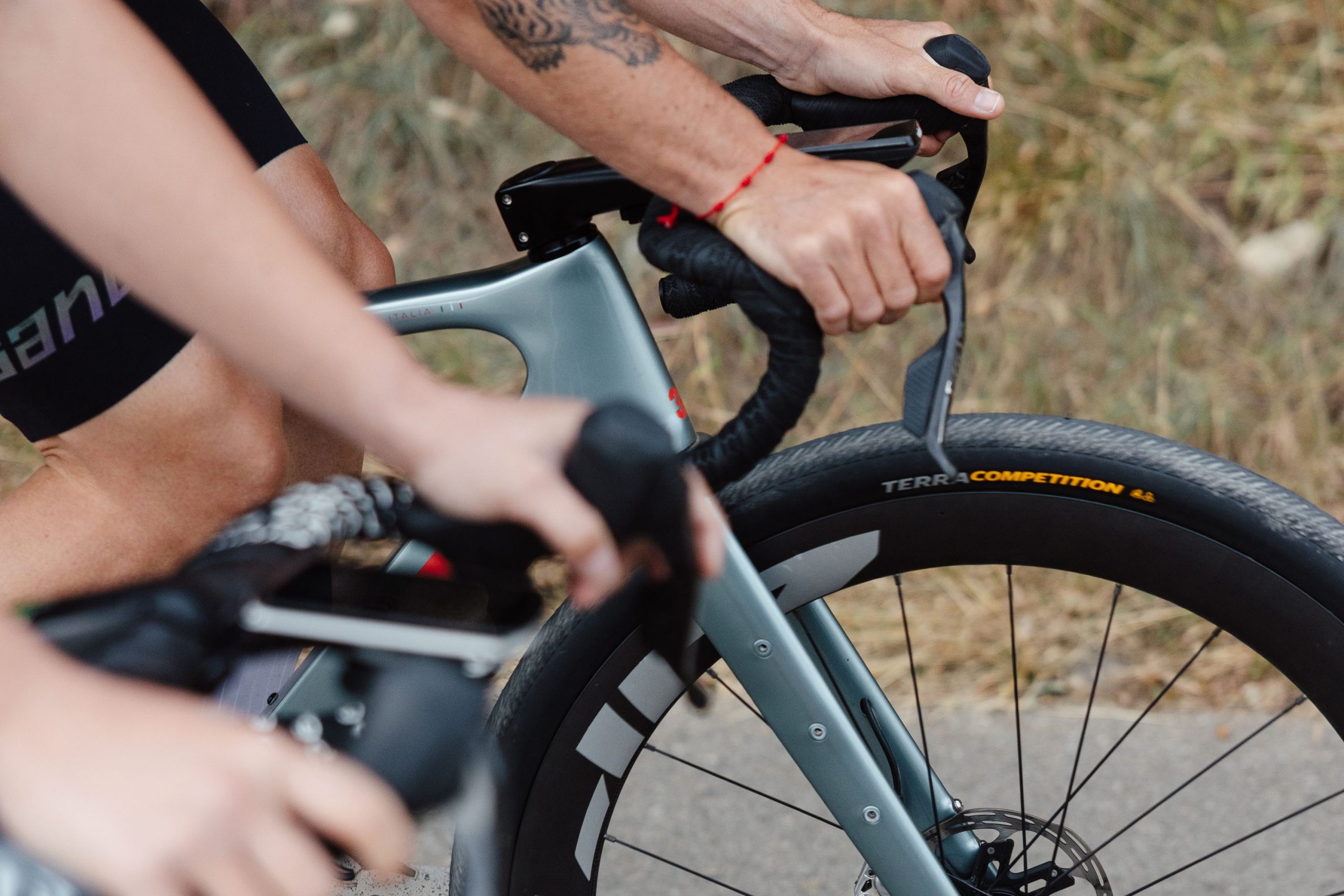
Continental has announced the Terra Competition, an aero-optimised all-road tyre that “blurs the lines between road and gravel”.
Claimed to be the brand’s new fastest off-road tyre, the Terra Competition uses a design optimised for low weight, rolling resistance and aerodynamic drag.
Compared to the brand’s previous fastest gravel tyre, the Terra Speed, Continental claims the new Terra Competition is up to 16 per cent lighter and rolls up to 17 per cent faster (depending on size and pressure).
Available now with Continental’s Race or Trail casing, prices for the Terra Competition start from £59.30 / $76.26 / €68.95.
Going against current trends for ever wider gravel bike tyres, however, the Continental Terra Competition is available in 700×35, 40 and 45c sizes. This leaves a hole in the brand’s line-up for a ‘larger than 45c’ (but smaller than 2.2in) gravel race tyre, which suggests the brand may not believe wider is always faster when it comes to mixed surface riding.
Conti’s first aero off-road tyre

With XC mountain bike tyres being one of gravel’s hottest trends, concerns about the aerodynamic drag of gravel tyres have taken a back seat in recent years.
According to Continental, however, the new Terra Competition uses a “light-knobbed” tread pattern designed to reduce drag, as well as to provide grip on rough roads and “light gravel”.
This isn’t the first time Continental has launched a tyre with an aero tread pattern, of course. Continental’s Aero 111 road tyre is claimed to significantly reduce drag compared to a standard GP5000 S TR.
The tread has a distinctive V-shape, with an semi-slick central portion transitioning to slightly taller knobs towards the tyre’s shoulders.

Although it also includes notches for “soil interaction” and “drainage”, Continental notes the tyre is best suited to “dry to moist conditions” – and the tyre’s looks appear to confirm this, as the tread is minimal compared to most gravel tyres.
At the time of writing, Continental hasn’t published any figures for how much energy you can expect to save thanks to this aero-optimisation, and it declined to do so when asked.
Nevertheless, it claims to have found “savings in aerodynamic drag for all tested velocities for yaw angles from -20 to +20 degrees [of yaw]”, compared to the Terra Speed.
Faster and lighter
We do have figures for the claimed reductions in weight and rolling resistance, though.
The new Terra Competitions are 16 per cent lighter compared to Terra Speeds – although this is highly dependent on which size you opt for:
| Tyre size | Terra Competition (g) | Terra Speed (g) | Difference (g) |
|---|---|---|---|
| 700x35c | 345 | 413 | -68 |
| 700x40c | 420 | 445 | -25 |
| 700x45c | 470 | 516 | -46 |
As for rolling resistance (Crr), the headline figure is a reduction of 17 per cent, for a 35c Terra Competition (Race casing) compared to an equivalent Terra Speed. According to Continental, that’s worth 4.52 watts.
This was tested on a smooth steel drum with a 50kg load.
It’s worth noting the 17 per cent improvement in Crr was measured at a relatively high tyre pressure of 5 bar / 72.5 psi, and that the improvement drops in line with tyre pressure:
| Tyre pressure | Terra Competition (watts at 30kph) | Terra Speed (watts at 30kph) | Difference (watts at 30kph) |
|---|---|---|---|
| 5 bar / 72.5 psi | 21.89 | 26.41 | -4.52 |
| 4 bar / 58 psi | 23.68 | 27.73 | -4.05 |
| 3 bar / 43.5 psi | 27.37 | 30.17 | -2.8 |
Casings and puncture protection

All models of the Terra Competition use a 3×330 TPI (Threads Per Inch) construction, but Continental is offering it in two casing types – Race and Trail.
As the names suggest, the Race casing is designed for low weight and rolling resistance, while the trail casing uses a slightly more robust, but slower, construction.
Both casings feature a puncture protection belt beneath the tread, although the one on the trail casing spans a greater width of the tyre.
Both types of casing are tubeless-ready and compatible with hookless rims.
Where does the Terra Competition fit with modern gravel trends?
When news of the new Terra Competition dropped into my inbox, and as a wannabe go-fast gravel rider, I was excited that Continental might finally be about to catch up with gravel’s hottest trend.
What constitutes a suitable ‘gravel tyre’ for racing has been evolving faster than Keegan Swenson’s setup at Leadville in recent years.
Thanks to influential riders like Dylan Johnson, average tyre sizes have ballooned at key races such as the Traka or Unbound, with many turning to cross-country mountain bike tyres in the vacuum created by a lack of gravel-specific options over 45mm wide.

With Schwalbe refreshing its G-One Pro range in late 2024, adding 50 and 55c sizes, I assumed it would only be a matter of time before Conti followed suit.
I’d imagined an updated Terra Speed in 50 and 55c sizes, with the new and improved compound and casings, plus variants with more aggressive tread patterns to better suit different conditions.
The launch of the Terra Adventure last March, which comes in 45 to 55c sizes, only added fuel to that fire.
Instead, Continental seems not to have the same faith in the whole ‘wider is faster’ mantra as everyone else, at least for now.

Conceptually, the new Terra Competition – with its low profile, aero-optimised tread and limited size range – feels akin to Merida’s latest Mission gravel bike, which controversially tops out at ‘just’ 40mm of tyre clearance.
That didn’t stop former world champion, Matej Mohorič, from securing a podium aboard the Mission on the (mostly) dry and dusty UCI gravel world’s course in Limburg last October, of course, and those are likely the kinds of races and conditions Continental is targeting here.
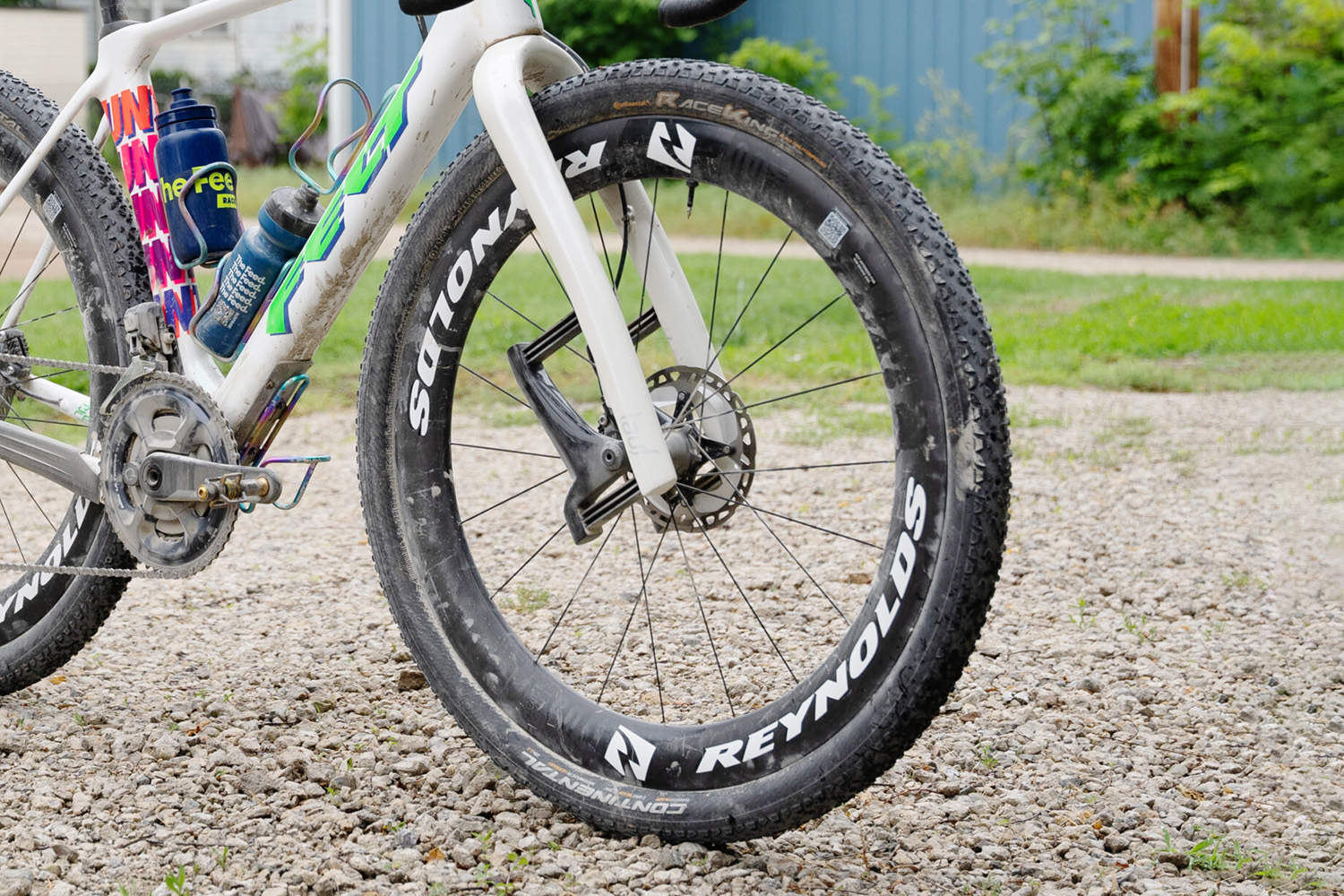
In fairness to Continental, it does also pitch the Terra Competition as more of an all-road tyre, than a pure gravel tyre. And perhaps it’s simply happy to keep ‘gravel racing’ at 35 to 45c, and let anyone in search of something wider opt for XC tyres like its popular Race King.
But with that tyre is only available in a 2.2in / 55mm size with the fastest ‘ProTection’ casing, though, Continental is left with something of a hole in its range, and the appearance that it may have missed the boat on this trend.
Claude collaboration tools left the door wide open to remote code execution
Anthropic fixed the flaws – but the AI-enabled attack surfaces remainSecurity vulnerabilities in Claude Code could have allowed attackers to remotely execute code on users’ machines and steal API keys by injecting malicious configurations into repositories, and then waiting for a developer to clone and open an untrustworthy project.…
Uber Employees Have Built an AI Clone of Their CEO To Practice Presentations Before the Real Thing
An anonymous reader shares a report: Some Uber employees have built an AI clone of CEO Dara Khosrowshahi — internally dubbed “Dara AI” — and have been using it to rehearse and fine-tune presentations before delivering them to the actual Khosrowshahi, he revealed on a recent podcast.
Khosrowshahi said a team member told him that some teams “make the presentation to the Dara AI as a prep for making a presentation to me,” and that the bot helps them adjust their slides and sharpen their delivery. Asked by the podcast host whether employees might eventually show Dara AI to the board, Khosrowshahi laughed but noted that AI models still can’t process and act on new information the way executives do. “When the models can learn in real-time, that is the point at which I’m going to think that, yeah, we are all replaceable,” he said.


Read more of this story at Slashdot.
How to Switch to Root or Normal User Account on Linux
A root or normal user can easily switch to another user account using the su command if they know their current or another user’s password.
AI Can Find Hundreds of Software Bugs — Fixing Them Is Another Story
Anthropic last week promoted Claude Code Security, a research preview capability that uses its Claude Opus 4.6 model to hunt for software vulnerabilities, claiming its red team had surfaced over 500 bugs in production open-source codebases — but security researchers say the real bottleneck was never discovery.
Guy Azari, a former security researcher at Microsoft and Palo Alto Networks, told The Register that only two to three of those 500 vulnerabilities have been fixed and none have received CVE assignments. The National Vulnerability Database already carried a backlog of roughly 30,000 CVE entries awaiting analysis in 2025, and nearly two-thirds of reported open-source vulnerabilities lacked an NVD severity score.
The curl project closed its bug bounty program because maintainers could no longer handle the flood of poorly crafted reports from AI tools and humans alike. Feross Aboukhadijeh, CEO of security firm Socket, said discovery is becoming dramatically cheaper but validating findings, coordinating with maintainers, and developing architecture-aligned patches remains slow, human-intensive work.


Read more of this story at Slashdot.
Manjaro-Based Mabox Linux 26.02 Released with New Audio Menu
Manjaro-based Mabox Linux 26.02 introduces a new W-a audio menu, a fully rewritten Cava Colorizer module, fixes for screen recording, and more.
Cloudflare experiment ports most of Next.js API ‘in one week’ with AI
Uses Vite and Claude to sidestep Vercel lock-in with a new open source build toolA Cloudflare engineer says he has implemented 94 percent of the Next.js API by directing Anthropic’s Claude, spending about $1,100 on tokens.…
Prediction Market Platform Kalshi Discloses First Insider Trading Enforcement Action
Kalshi, the prediction market platform regulated by the Commodity Futures Trading Commission, has for the first time publicly disclosed the results of an insider trading investigation, naming an editor for YouTube’s biggest creator as the offender.
The company identified Artem Kaptur, an editor for MrBeast, who it says traded around $4,000 on markets tied to the streamer and achieved “near-perfect trading success” on low-odds bets — a pattern investigators flagged as suspicious. Kalshi froze Kaptur’s account before he could withdraw any profits, fined him $20,000, suspended him for two years, and reported the case to the CFTC.


Read more of this story at Slashdot.
Firefox 149 Beta Released With Convenient Split-View Mode
Following the Firefox 148 release with the new AI controls, Mozilla promoted Firefox 149 to beta today…
b4’s Review TUI With AI Integration Nearing Pre-Alpha Release
The b4 tool used for managing patch workflows to the Linux kernel has been seeing a lot of work recently on b4 review as the text user interface (TUI) to help expedite the patch review process for the Linux kernel. The b4 review TUI has been integrating AI agent code review helpers powered by the likes of Claude Code too for trying to help enhance the efficiency for Linux kernel patch reviews. That b4 review work is quickly approaching a pre-alpha state…
[$] LWN.net Weekly Edition for February 26, 2026
Inside this week’s LWN.net Weekly Edition:
- Front: New flags for clone3(); Discord replacements; virtual swap spaces; BPF memory protection keys; PostgreSQL’s lessons in attracting contributors; 7.0 merge window; Network Time Security.
- Briefs: OpenSUSE governance; Firefox 148.0; GNU Awk 5.4.0; GNU Octave 11.1.0; Rust in Ladybird; LibreOffice Online; Weston 15.0; RIP Robert Kaye; Quotes; …
- Announcements: Newsletters, conferences, security updates, patches, and more.
New Webb Telescope photos show off the Exposed Cranium Nebula
It’s always a fun day for the space nerds when a NASA team has new images to share from the James Webb Space Telescope. Today’s pair has brains on the brain, with a look at the fittingly named Exposed Cranium Nebula. More officially, this cloud of space dust and debris is known as Nebula PMR 1. The images shared today may capture a moment in the final stages of a star, as well as giving hints as to how the nebula got its brain-like shape.
“The nebula appears to have distinct regions that capture different phases of its evolution — an outer shell of gas that was blown off first and consists mostly of hydrogen, and an inner cloud with more structure that contains a mix of different gases,” NASA’s blog post reads. The dark line that runs vertically through the nebula, giving it the cranial appearance, could be the result of “an outburst or outflow from the central star, which typically occurs as twin jets burst out in opposite directions.” Both Webb’s Near-Infrared Camera (NIRCam) and its Mid-Infrared Instrument (MIRI) were used to document the nebula.
This article originally appeared on Engadget at https://www.engadget.com/science/space/new-webb-telescope-photos-show-off-the-exposed-cranium-nebula-235609619.html?src=rss
World Record Longest Quadrocopter Flight: 3 Hours, 31 Minutes
Determined to beat the previous longest drone flight world record of 3 hours 12 minutes, this is a video of Luke Maximo Bell designing, building, and flying a carbon fiber massively propellered quadrocopter for 3 hours and 31 minutes. But did it deliver any drugs? You may previously recall Luke setting the world record for fastest quadrocopter drone, with this 363MPH electric missile. The man loves drones. Me? I love good food and fine wine. I’m kidding, I love fast food and Mad Dog 20/20s. *shrug* We all have our Achilles’ heel. Mine just happens to be in both heels, plus gout.
10 Hacks Every Telegram User Should Know
Telegram is among the most popular WhatsApp alternatives around. Telegram supports messaging individuals and groups, but it also has social media-like channels where you can post to thousands of subscribers at once. In this piece, I’ll be focusing more on Telegram as a messenger, since that’s how I use it the most. In my decade of using the app, I’ve learned quite a bit about it, and I’m here to share the best Telegram hacks that you should know.
You need to manually enable end-to-end encryption
Unlike Signal or WhatsApp, Telegram is not end-to-end encrypted by default. End-to-end encryption ensures that your messages cannot be read by anyone without accessing either your device or the recipient’s device, and at this point, it’s become an industry standard security protocol for messaging apps. You can enable end-to-end encryption in Telegram, but it requires a few extra steps, and even then, the implementation is not very user-friendly. Secret Chat is Telegram’s name for messages that have end-to-end encryption, and to access it, follow these steps:
-
Open Telegram and start a chat with a contact.
-
In the chat window, tap the name of the contact up top.
-
On the next page, tap more, and select Start Secret Chat.
-
You now need to wait for the recipient to come online and accept your request to start a Secret Chat. When they do, that conversation will become end-to-end encrypted.
Sadly, you’ll have to repeat this process with each of your contacts, which leaves you with two different chats per contact (a Secret Chat and a normal chat). The other limitation is that you can’t access Secret Chats on multiple devices. They’re limited to your phone and the recipient’s phone, and won’t show up on Telegram’s desktop app. It’s great for security, but not as good for convenience.
Don’t forget to delete your old profile photos
When you add a new profile picture to your Telegram account, it does not automatically delete the previous picture. That means your contacts can still go to your profile and see your older profile pictures. To fix this, open the Telegram app and go to the Settings page (which is within the bottom bar on iOS and hidden under the three-lines menu on other platforms). Tap your profile photo, select the Edit button, and delete the pictures you don’t want to keep.
Disable unwanted notifications
Credit: Pranay Parab
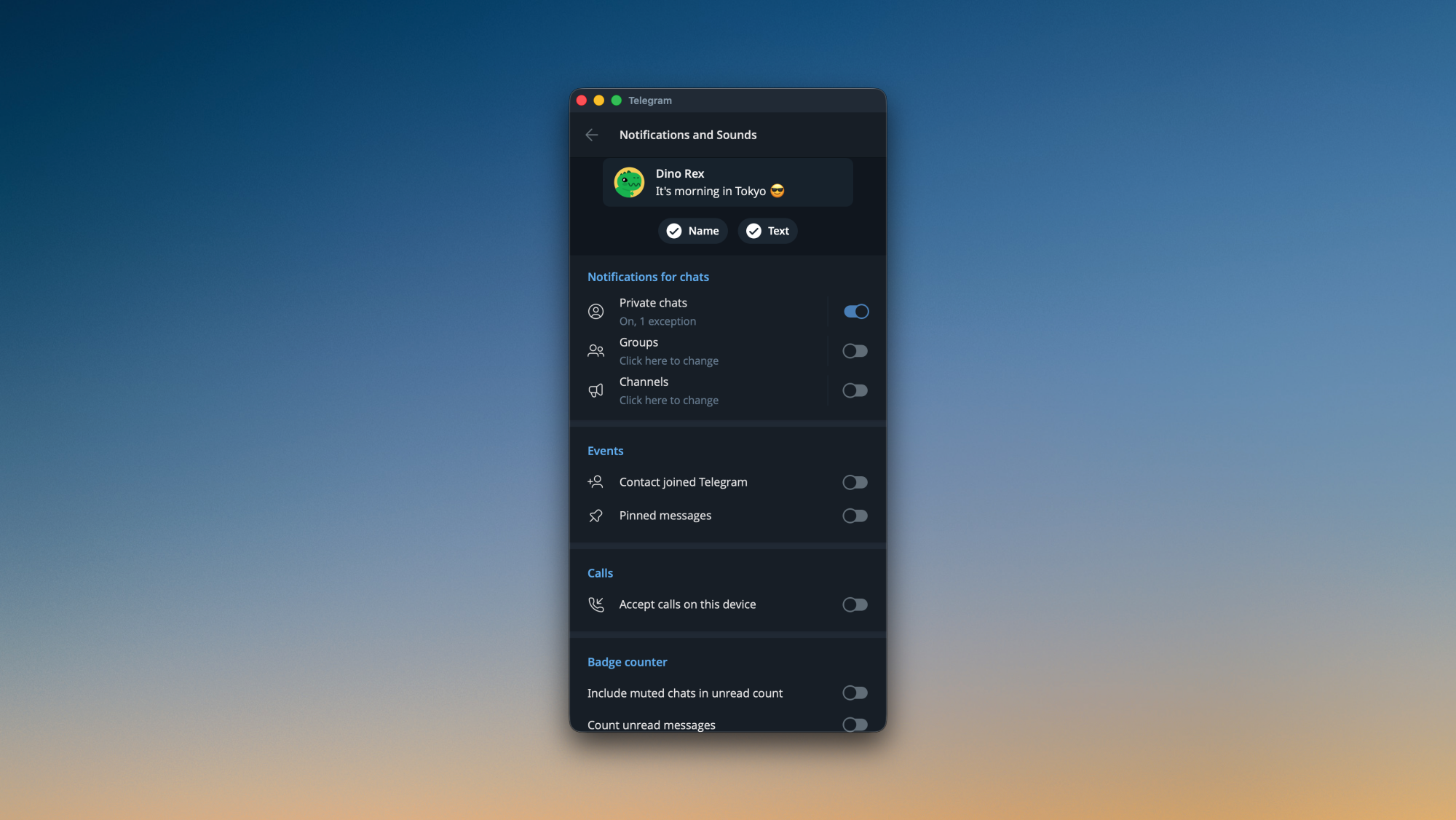
Telegram tends to be a bit spammy with its notifications. By default, you’ll get an alert whenever any of your contacts joins Telegram, which gets tiring very fast. You can disable these unwanted notifications by going to Telegram Settings > Notifications and Sounds and disabling New Contacts. While you’re on this page, you can take a moment to disable any other notification types you might not want to see, including Group Chats, Stories, Channels, Reactions, etc.
Change when Telegram auto-deletes your account
Telegram is a bit aggressive about deleting inactive accounts. It will automatically delete your account if you don’t use the app for six months. This isn’t going to bother regular users, but it’s a good idea to customize this duration based on your needs. Telegram lets you set the auto-delete timer for anywhere from 1 month to 24 months, so you can pick the option that’s best for you. Go to Telegram Settings > Privacy and Security > If Away For to make the change.
You can block Telegram calls
Telegram supports voice and video calls, which is pretty standard for messaging apps. Unlike most of its competitors, though, Telegram allows you to block voice and video calls entirely. Just head over to Telegram Settings > Privacy and Security > Calls and select Nobody.
Enhance your Telegram account’s security
It’s never a bad idea to add a few extra layers of security to your Telegram account. The app supports two-step verification and passkeys, and you can enable both by going to Telegram Settings > Privacy and Security. Both options are located near the top of this page.
Lower your data usage
One of Telegram’s best features is granular controls for its various settings, including how much data the app uses. This is great for people with metered internet connections. You can access these options under Telegram Settings > Data and Storage. Go to Using Cellular and Using Wi-Fi to customize how much data the app uses. If you set data usage to Low, Telegram will compress media to preserve bandwidth. On the same page, you can also disable all auto-downloads for photos, stories, videos, and files. Or, if you tap any of these options, you can individually disable auto-downloads based on the type of chat. For instance, Telegram lets you disable automatic downloads of photos, videos, files, and stories from only group chats or only channels. This way, it’ll still automatically download media sent in private chats, but not in group chats.
You can also go to the Data and Storage settings page, and enable Use Less Data for Calls. This will compress audio a little bit, but can be helpful for staying under data limits.
Automate the built-in power saving mode
Telegram has a built-in power saving mode that conserves battery by reducing animations or disabling autoplaying videos and other intensive processes. Set it up by going to Telegram Settings > Power Saving. The slider at the top lets you set a battery percentage, and power saving will automatically turn on if your phone dips below it. I’ve set it to 30%, but you can choose a different number if you like. On the same page, you can also manually disable resource intensive processes, which I’ve used it to turn off autoplaying videos and gifs entirely.
Telegram groups have useful granular controls
Credit: Pranay Parab
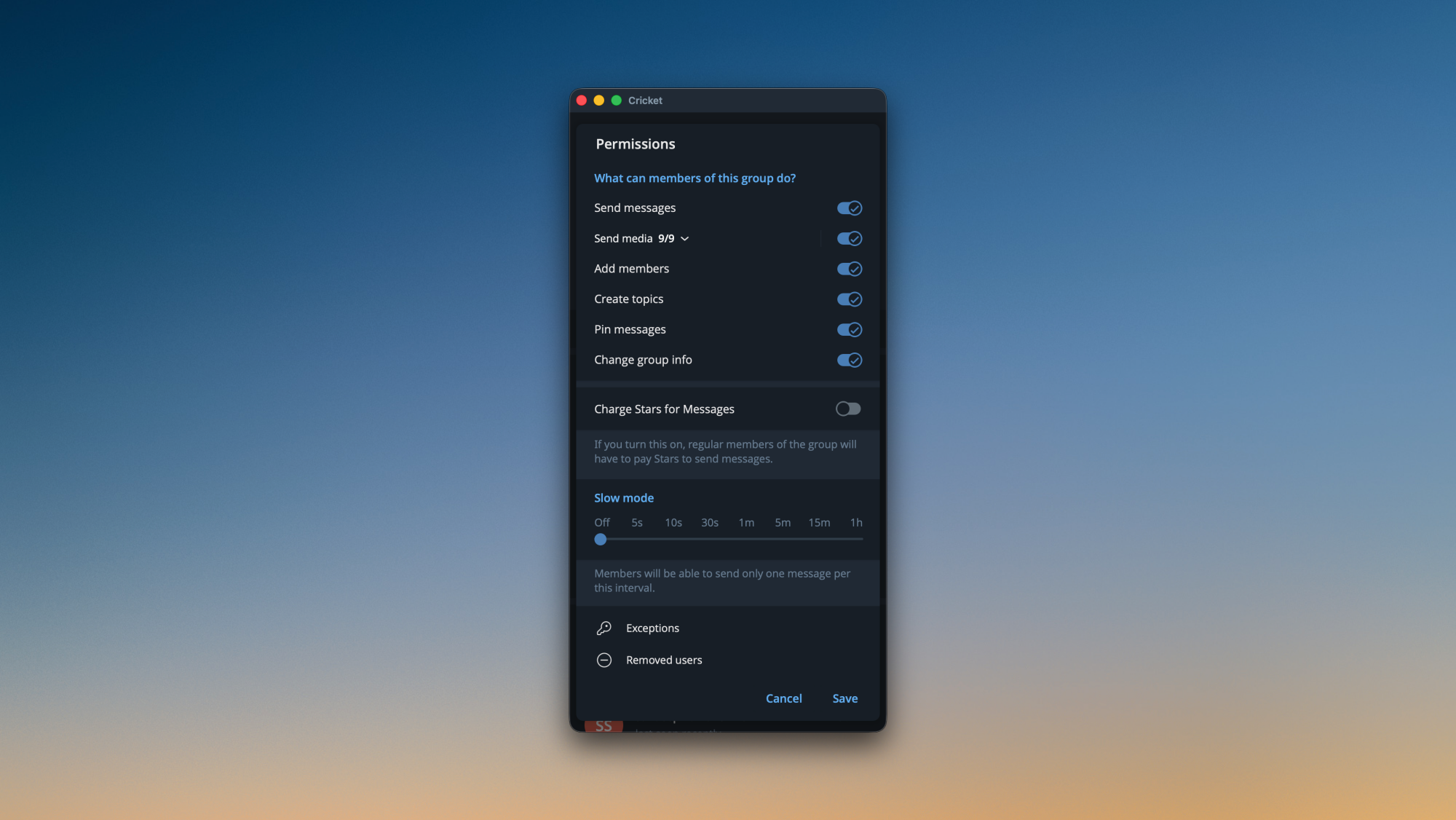
Group messaging is one area where Telegram allows you to do a lot more than its competition. After creating a group, tap the group’s name, select Group Settings, and you’ll see a plethora of options. Under Permissions, you’ll be able to decide if group members can send messages, voice notes, photos, videos, music, links, add members, pin messages, etc. On the same page, you can also enable Slow Mode, which enforces a minimum delay between two messages from the same member. If you set this to 1 minute, then members will have to wait a minute before sending their second message.
I would love to see other apps also implement a version of Slow Mode, as it stops people from spamming the group with multiple short messages in a row. Additional settings include enabling Topics, which lets you create different “channels” within a group to keep discussions from going astray (separate from the social media “channels” mentioned at the start of this guide). You can think of these like separate channels in Slack or IRC, so in larger groups, you can have separate topics to discuss sport or politics. This keeps the main feed free of unnecessary messages and assigns dedicated spots for different topics.
Telegram Premium adds features you probably don’t need
Telegram has a subscription service ($5/mo) that lets you access features such as unlimited cloud storage (with a maximum of 4GB per document), chat transcription, automatic translation of incoming messages, support for checklists in the app, the ability to see when someone was last seen online (bypassing their privacy settings), and more. These features are great for people who have channels with a large following, but for most people, none of these features are essential. Other than the generous cloud storage, you can get all of these features in other apps for free. And even cloud storage has strong alternatives, including small providers like Proton or larger ones like Google and Apple.
Hitman World Of Assassination Gets Limited-Time Mission Starring Milla Jovovich
A free Hitman World of Assassination Elusive Target mission starring Milla Jovovich from the Resident Evil films is available to play until March 24.
Hitman World of Assassination’s Elusive Target missions, a series of limited-time events, date back to the 2016 Hitman game. Players get a limited time (sometimes as brief as 48 hours) to complete the mission. Past missions have starred known performers like actors Sean Bean and Jean-Claude Van Damme, rapper Eminem, and MMA fighter Conor McGregor.
The latest mission, titled The Harbinger, centers on Ether Corporation CEO Lilith Devereux, played by actress Milla Jovovich, best known from her starring role as Alice in the Resident Evil films. It revisits the Patient Zero storyline as part of the Patient Zero Requiem season, which also includes a paid cosmetic pack.
0:00
/1:11
The new content is available to play now until March 24 as a free download. The Patient Zero Requiem season is also playable as part of the free demo for Hitman. Note that this new content is not available on Meta Quest’s Hitman 3 VR: Reloaded.
Hitman World of Assassination is available in VR on Steam for $69.99 and PlayStation VR2 as a $9.99 add-on to the $69.99 PS5 game. IOI also announced the game is available on Mac via Steam and the App Store.
When it Comes to Firmware, the FSF and Its Founder RMS Won the Argument (But Not the Fight, Yet)
People who have long defamed Richard Stallman (RMS) do not want us to have computer security, so they brand back doors “security”.
Oh Wow: Cat Claw Fingernails
Because who doesn’t wish they were more feline (I’d love to just sleep all day and knock things off tables), these are several shots of the cat claw inspired nails crafted by Jane of 2hi4dis.nails, complete with fleshy quicks. She even provides a video tutorial (2nd video below) if you want to make your own. Could you even imagine getting your back scratched with those? Just a total bloodbath.
@2hi4dis.nails
@2hi4dis.nails Replying to @blu #nailinspo #claws ♬ Fashion Show – Beatdohostil
Sci-Fi Job Sim Space Control Is Equal Parts Charm & Cringe
Drawing inspiration from animated comedies like Rick & Morty and Futurama, Space Control is an absurd adult-oriented job simulator that will make some players laugh, and others cringe.
As part of Steam’s Next Fest, MoonMonster Studios has released a brief playable demo of their upcoming comedic job simulator, Space Control. The thirty-minute demo offers an early glimpse at a game that I found to be equal parts charming workplace parody and infantile shock comedy.
The demo opens with a short setup exposited by a corporate onboarding video delivered with impressive voice acting. You play as a human from Earth who’s been abducted by Glorpo Incorporated, an intergalactic megacorporation, to work off a debt that “you” owe the company. The only problem is that you don’t owe the company anything. They’ve abducted you accidentally, in place of the actual debtor. But since Glorpo “doesn’t do returns,” you’re pressed to work anyway.
0:00
/0:57
Space Control intro captured by UploadVR
Unfortunately, in this early build, the gameplay is not totally polished. There’s a feature in the game called “Force Grab” which allows you to pull distant objects toward you. This feature is in fact critical in the first two minutes of the game, since you’re trapped and must grab a heat gun to thaw your way out of cryo-sleep. I spent about ten minutes in my first playthrough simply trying to get this feature to work. I eventually managed to make it happen, but not in the way the developers intend.
For reference, I played this demo on a Quest 3S using Steam Link (the demo is only available on Steam for now, though the game will release on Quest alongside its PC VR release). I suspect the final game will not include these control issues.
After escaping your cryo-pod, you spend the next several minutes in your living quarters. Wandering around and picking up objects in these first moments is fun and silly. There are sentient dry-erase markers with distinct personalities (one screams in pain when using it to draw, while another seems to enjoy being used a little too much). There’s a Polaroid-style camera that incongruously ejects the same picture every time you use it (a photo of the space station’s supervisor stamped with the text “Back To Work”). There’s space goo to toss around, a rubber alien chicken to squeeze, fidget spinners, books with stupid titles, and so much more. The environment is simply brimming with distraction, a fun thing in VR.
Next, you’re introduced to a colorful cast of silly coworkers, each with exaggerated personalities. The tone in these first five minutes is instantly reminiscent of vintage Futurama (which I love). Your new friends are an offbeat, ragtag group of misfits dumped into the same metaphorical sinking ship. The characters’ designs are expressive and fun, their dialogue is snappy and delivered perfectly by their voice actors, and the space station environment brims with small gags and visual jokes.
0:00
/3:01
Space Control VR gameplay captured by UploadVR
At this point in the demo, I’m feeling great. Despite the technical speedbumps, we’re moving along and having fun, and I can see myself really bonding with my hapless crewmates. If the gameplay continues to build on the silliness and mechanical interest of the starting area, I think Space Control could be something special.
By the end of my time with the demo, I’m not so sure.
The early charm of the characters and presentation are quickly outbalanced by the game’s insistence on infantile humor. While I’m by no means a prude, and while I enjoy the stupidity of the cartoons from which this game takes inspiration, Space Control is far more interested in shock humor than actual wittiness.
For example, there’s a whole game mechanic that involves shoving various butt-plugs into abductees’ butts. While a fifteen-year-old version of myself might have found this and many more of the game’s intended punchlines funny (maybe), my adult self spent more time cringing and wishing the writers had done something (anything) else.
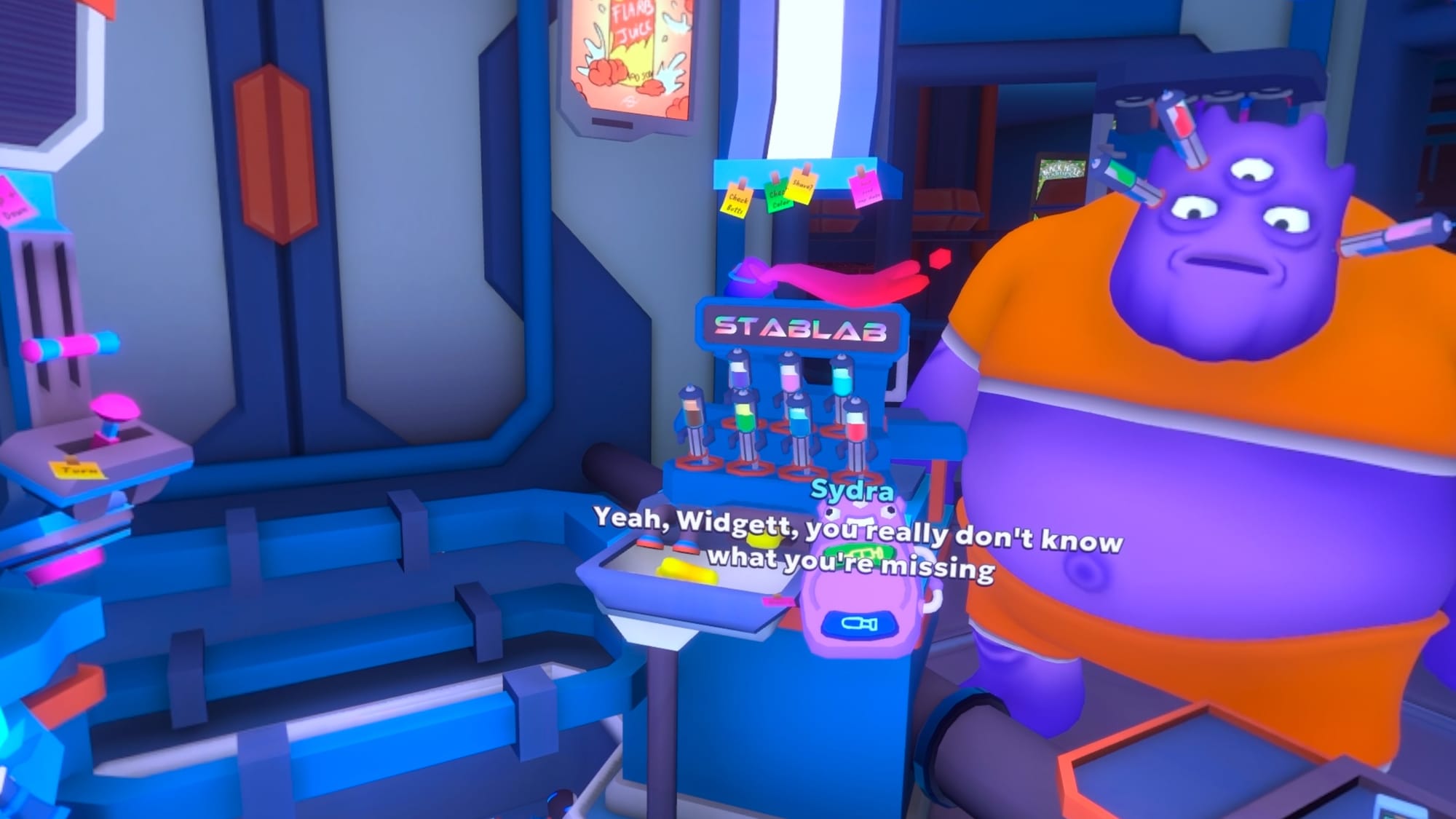
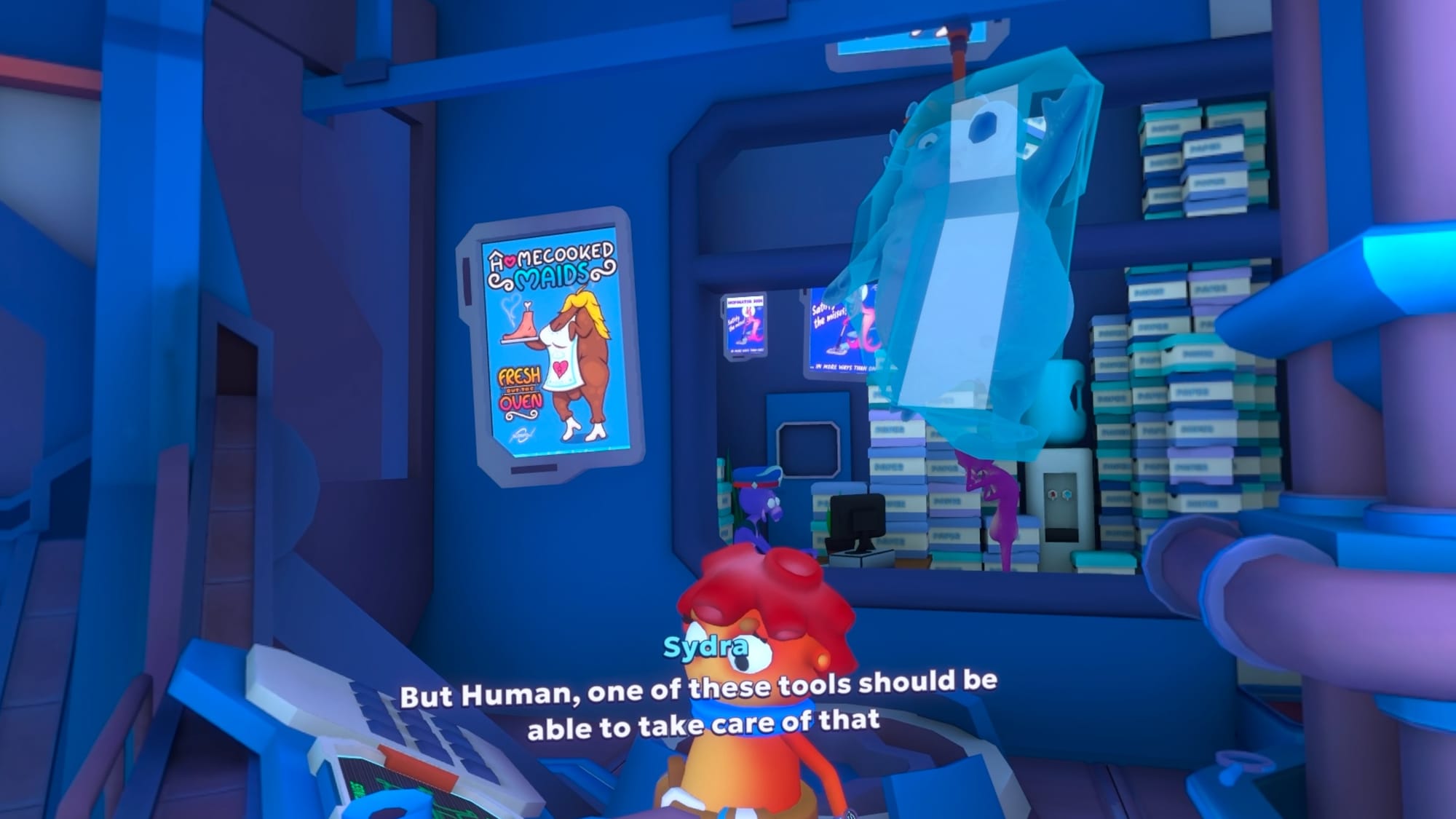
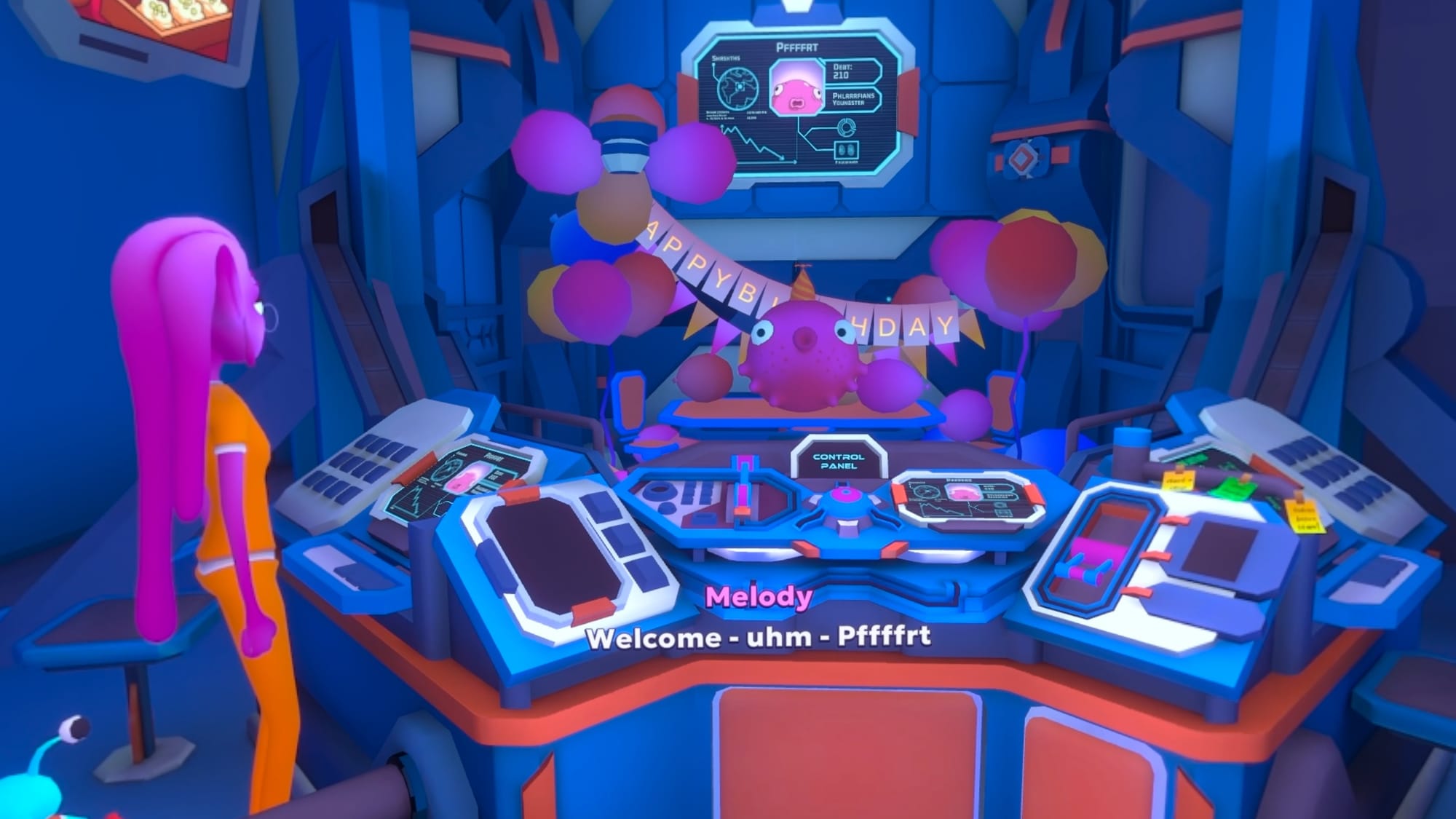
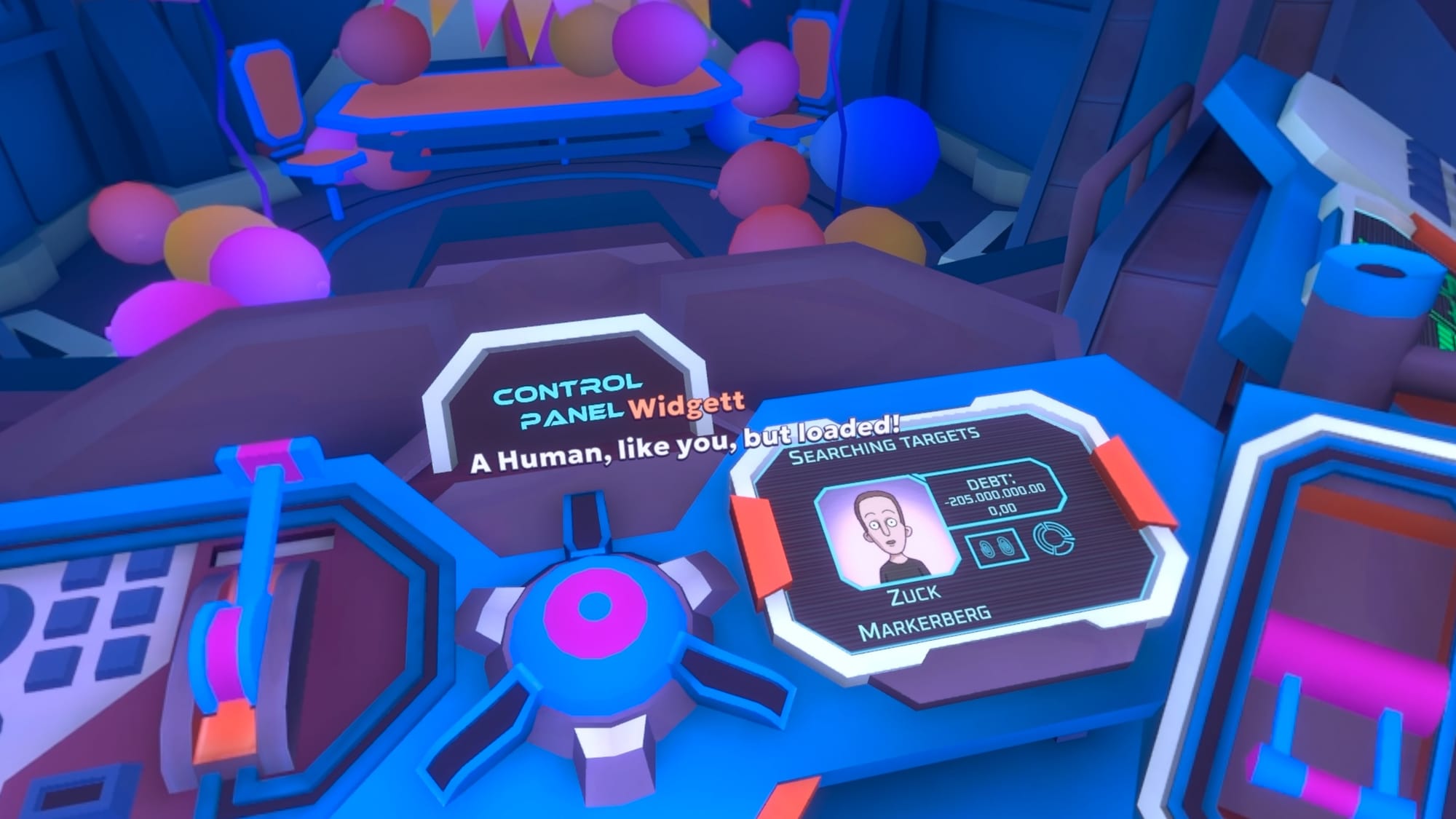
I accept that not all types of humor are made for me. What I find annoying might make someone else howl, and I love that. If you find posters of hairy privates and butt plugs to be funny, you’re gonna love this game. For me, most of the humor is a miss.
Which is a real shame, because the gameplay is great. The job simulator portion of the demo has us manning a handful of command stations, each more ridiculous than the last.
We must abduct new debtors and process them into the workforce. This involves stripping their clothes, taking care of any of their health needs, ensuring they look the part of the respectable worker, and sending them on their way.
The mechanics of this process are well-crafted, with all our tools and devices (yes, even the butt plugs) reacting well in VR. The tools that we use are silly, fun to use, and inventive, and the fully voice-acted abductees are highly varied and do their best to say stupid, fun, or funny things. Our coworkers are there as well, helping us in their own way, and throughout the process we’re learning more about them and the overarching story of Space Control.
Comfort
Space Control offers sitting, standing, and roomscale modes. The game has a vignette effect for turning. It also uses hand tracking and controllers.
0:00
/4:55
Space Control’s job simulator gameplay captured by UploadVR
It all comes together pretty well, in the end. But the biggest challenge for Space Control’s developers will likely center on the game’s tonal target.
The humor often feels too infantile, yet the language and themes clearly aim for an adult audience. Characters casually swear, and the script isn’t shy about using the most explicit language. As a parent, I wouldn’t feel comfortable letting my 11-year-old play it, but I could imagine Space Control being perfect for her if only they had cut the language and eliminated the overtly sexual jokes.
That said, I’m 42-years-old. I can imagine teens (whose parents aren’t such helicopters as me) gasping between laughs at the game’s absurd props and crude punchlines. Comedy is subjective, and jokes that make me cringe might be exactly what another player hopes for in a VR comedy game.
The demo ends abruptly enough that it feels more like a teaser than a vertical slice. As the screen fades out, I get the feeling that the real comedic escalation and narrative momentum lie beyond the cutoff point.
Based on this brief preview, Space Control shows genuine promise. Its interactive design is strong and its environments are lovingly crafted and richly detailed. Its cast has potential to become genuinely endearing over time. The biggest question mark, for me, is tonal balance. If the rest of the game leans closer to the clever absurdity of its premise and less into blunt, smack-you-in-the-face shock humor, the game will appeal to a massive audience (me included). If not, there’s still a lot to love, especially for fans of dumb comedy.
MoonMonster Studios plans to bring Space Control to Meta Quest and PC VR this April. You can wishlist the game at those storefronts, and sample the demo now as part of Steam Next Fest.
Tech Firms Aren’t Just Encouraging Their Workers To Use AI. They’re Enforcing It.
Tech companies ranging from 300-person startups to giants like Amazon, Google, Meta, Microsoft and Salesforce have moved beyond encouraging employees to use AI tools and are now actively tracking adoption and, in several cases, tying it to performance reviews. Google is factoring AI use into some software engineer reviews for the first time this year, and Meta’s new performance review system will do the same — it can track how many lines of code an engineer wrote with AI assistance.
Amazon Web Services managers have dashboards showing individual engineer AI-tool usage and consider adoption when evaluating promotions. About 42% of tech-industry workers said their direct manager expects AI use in daily work as of last October, up from 32% eight months earlier, according to AI consulting firm Section. At software maker Autodesk, CEO Andrew Anagnost acknowledged that some employees had been using initially blocked coding tools like Cursor stealthily — and warned that AI holdouts “probably won’t survive long term.”


Read more of this story at Slashdot.