
The Switch 2 RPGs look a lot better than Scarlet and Violet

The Switch 2 RPGs look a lot better than Scarlet and Violet
Meta’s Quest 3 is the best choice for standalone VR gaming and fitness, but you may not be aware how well it works as a relatively affordable travel-ready spatial computer.
With the latest updates to Horizon OS, Quest 3 and Quest 3S can now effectively double as portable computers. You can experience multiple giant screens without taking up any extra room, an awesome bonus if you live in an apartment or shared space.
As a portable virtual computer, your Quest headset gives you more screen space than a laptop, and vastly more than a phone. However, some setup is required to avoid unexpected issues when you’re away from your usual tech. If you test essential websites, verify logins, and settle on a comfortable typing method, your Quest 3 can feel less like a casual-use headset and more like a computer you can count on.
With the right setup, your Quest 3 could even become a primary device around the house, especially if you like working in short sessions, streaming video, and switching rooms. Think of this as turning your headset into a grab-and-go workstation for the web apps, messaging, and media you already use.
The Quest Pro and Quest 2 will work in a pinch, but they miss some newer features, including Meta’s touch-typing keyboard that projects onto a surface. It is not yet available on the Quest 3S, but datamining by Luna suggests it will be enabled eventually.
 UploadVRDavid Heaney
If you want your Quest 3 to function as a portable computer, the browser is its foundation. Productivity depends on web app and website compatibility, so testing matters.
Don’t just load a page and assume you’re good. Try the things you normally do on your computer. Sign into important accounts, create and edit documents in the web apps you use, and upload/download files if that’s part of your process. If something fails, try to find a simple solution or alternative.
I ran across a great example of unusual behavior using Google Docs in my Quest 3. Everything I type appears underlined. It actually isn’t, and if I click elsewhere, it reverts to plain text. It works, but the glitch is visually disruptive.
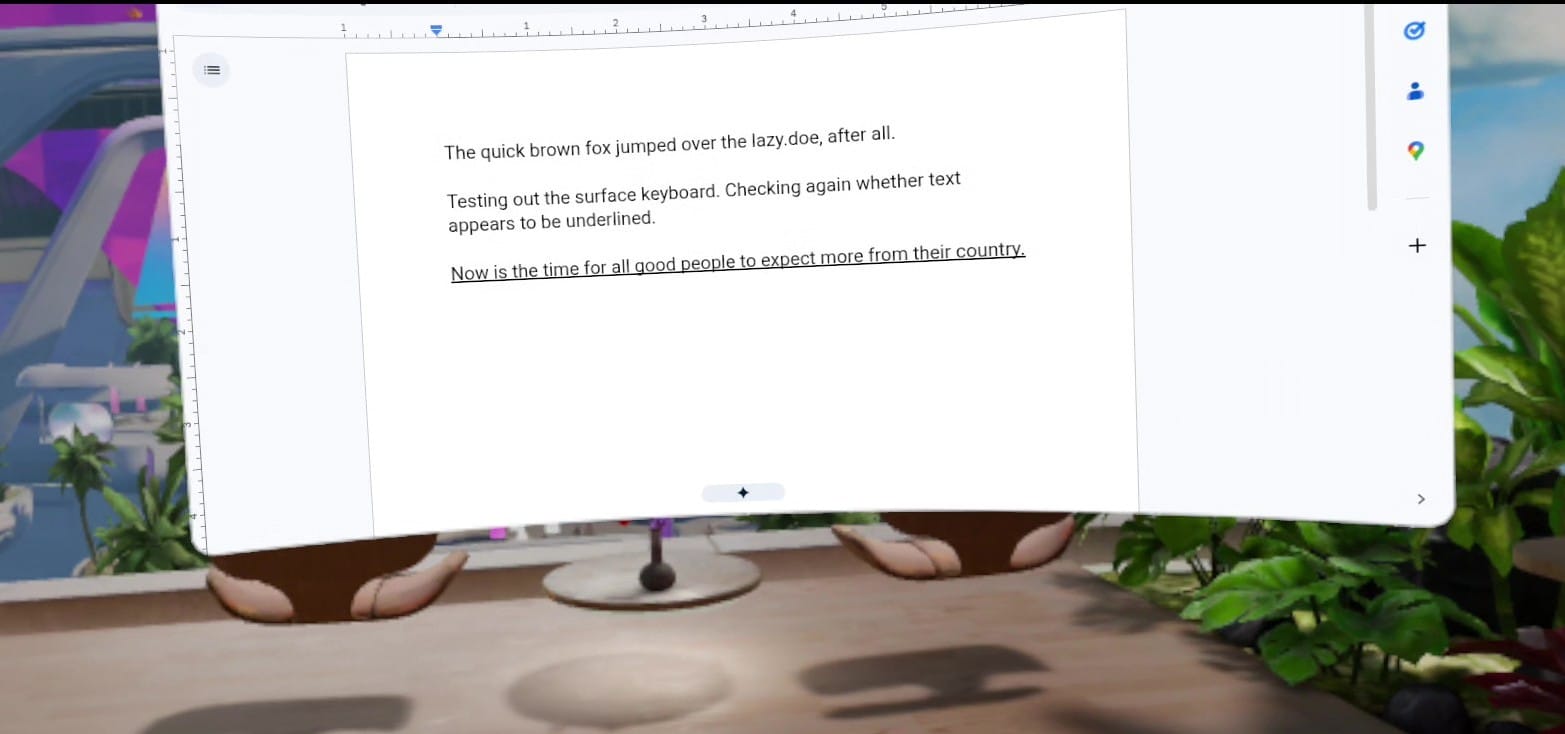
Another easy workaround is to use a different online editor, such as Microsoft Word, StackEdit, or Lex. Even if your favorite web app works perfectly, it’s worth having a backup, because little quirks like this show up when you least expect them.
If a particular website doesn’t play nicely with Meta’s browser, you may need a different one. Choices are limited on Quest headsets, but there is at least one alternative.
Fluid is my favorite third-party browser for Quest headsets. It’s based on Chromium, with an optional per-website mode that uses Gecko, the Firefox renderer. It behaves more like the browsers on your computer or phone, which can help with picky web apps.
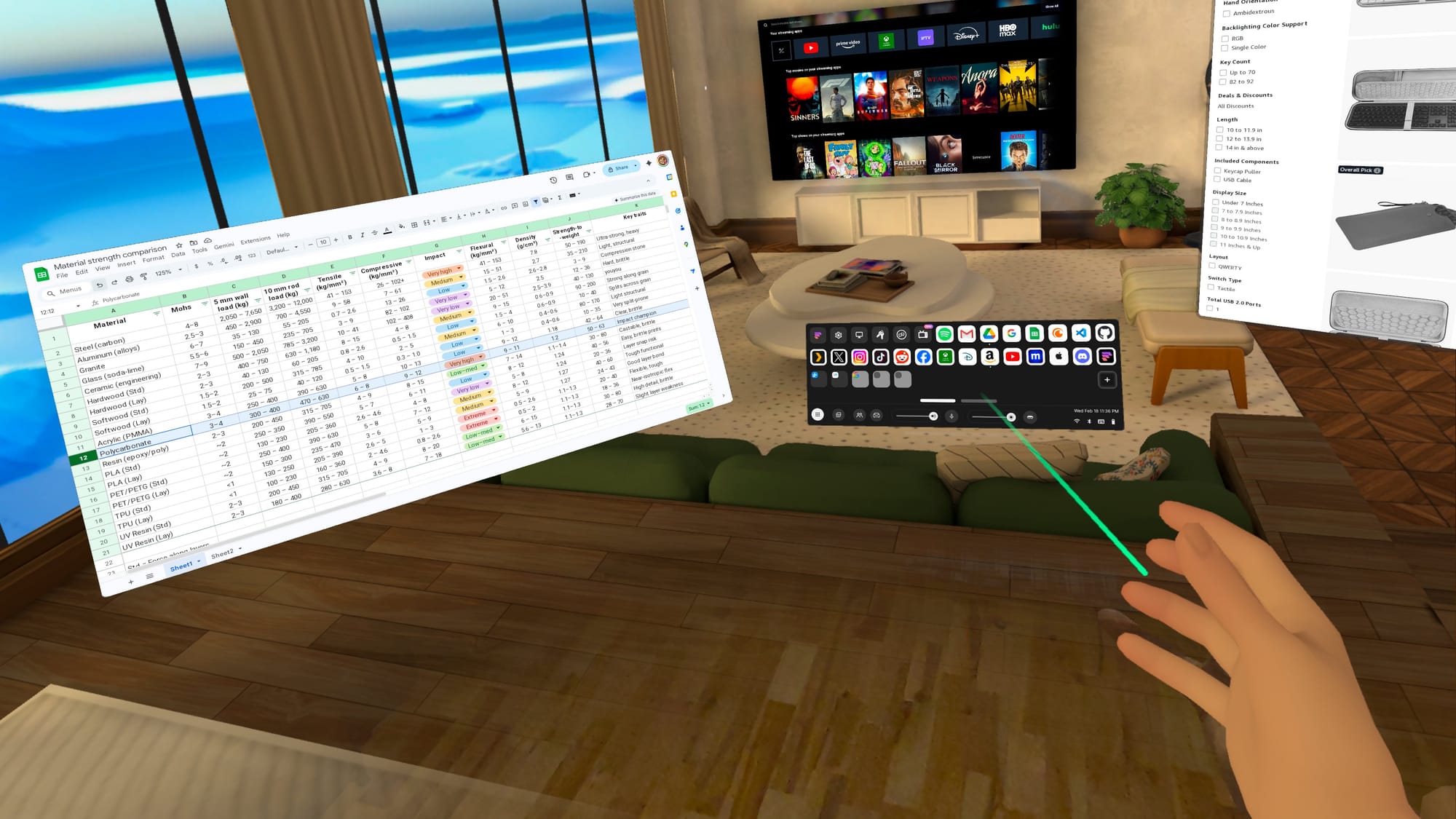
Fluid’s interface is also more flexible than Meta’s. Hand gestures can trigger voice input, manipulate windows, and move you through virtual rooms. It also offers advanced features like adjustable passthrough range, multi-user window sharing, theater modes, and remote access to your computer.
There are other third-party browsers, but most suffer from weak app store ratings. Fluid averages 4.5 stars, backed by an active community and a responsive dev team.
You’ve been refining your computer’s bookmarks, logins, and settings for years. To get a smooth transition on Quest, you’ll want a little prep work. Some Horizon OS browser features may still be rolling out, so they might not appear on your headset yet.
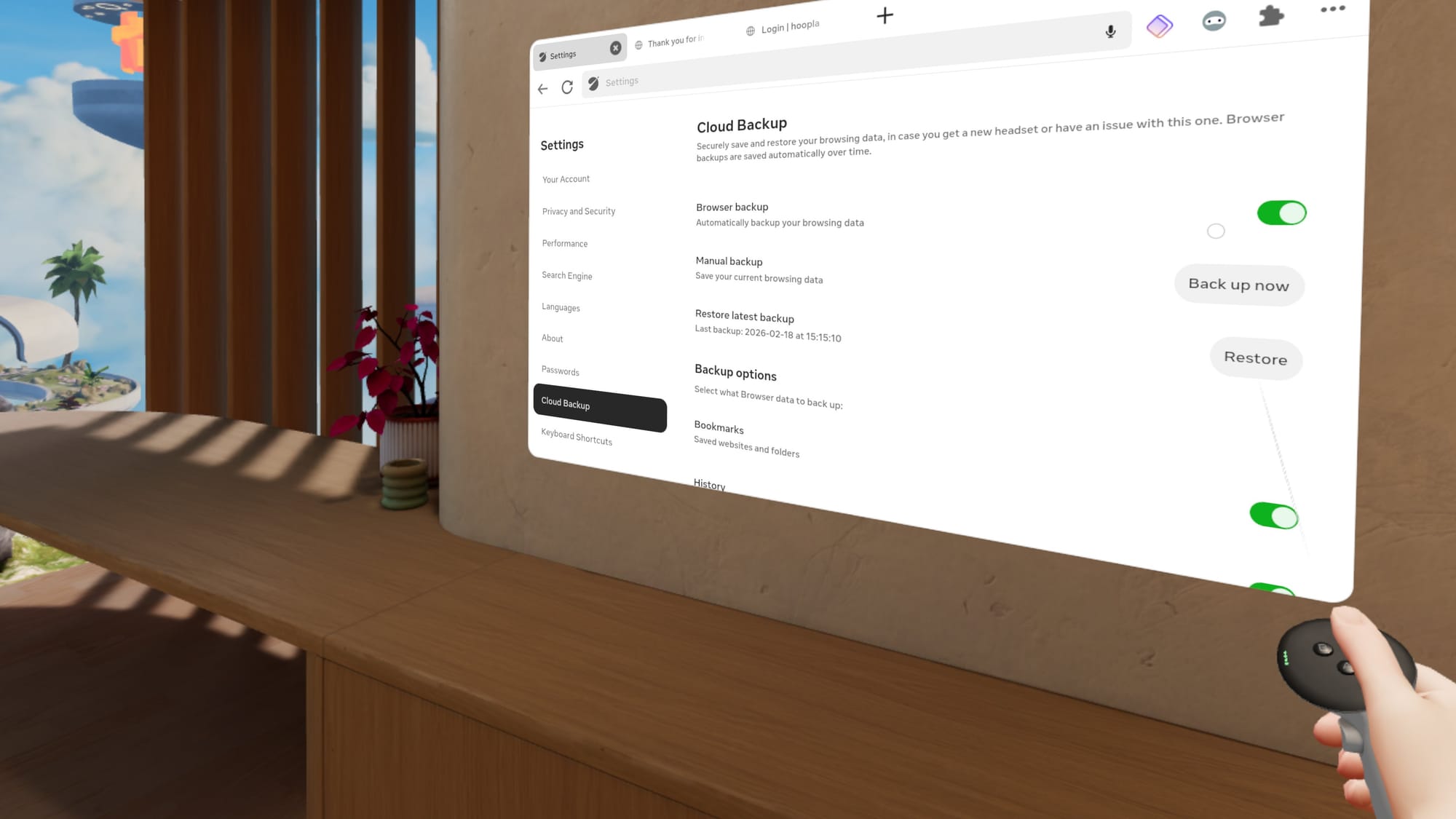
Enable Cloud Backup in the Horizon OS browser, so you don’t have to start over if something goes wrong. You can find the toggle in browser settings. Cloud Backup can restore bookmarks, browsing history, and extensions.
If you need access to important files or photos, cloud storage is the easiest path. Upload what you want from your computer or phone, then open it on Quest through the web apps you already use.
Logins matter, and modern security requirements can make access annoying from any device. The easiest solution is Meta’s password import feature in browser settings under Passwords. Meta includes instructions for exporting from Chrome, Safari, Edge, and others. You may also want a device PIN to keep accounts secure.
This isn’t the only option. Some third-party password managers offer web apps that work in any browser, and a few have extensions for the Horizon OS browser.
If security and privacy are crucial, you’ll want extensions for your password manager, a content blocker, and possibly a VPN. Meta’s extension ecosystem is growing, but the Horizon OS browser only supports about a dozen extensions so far.
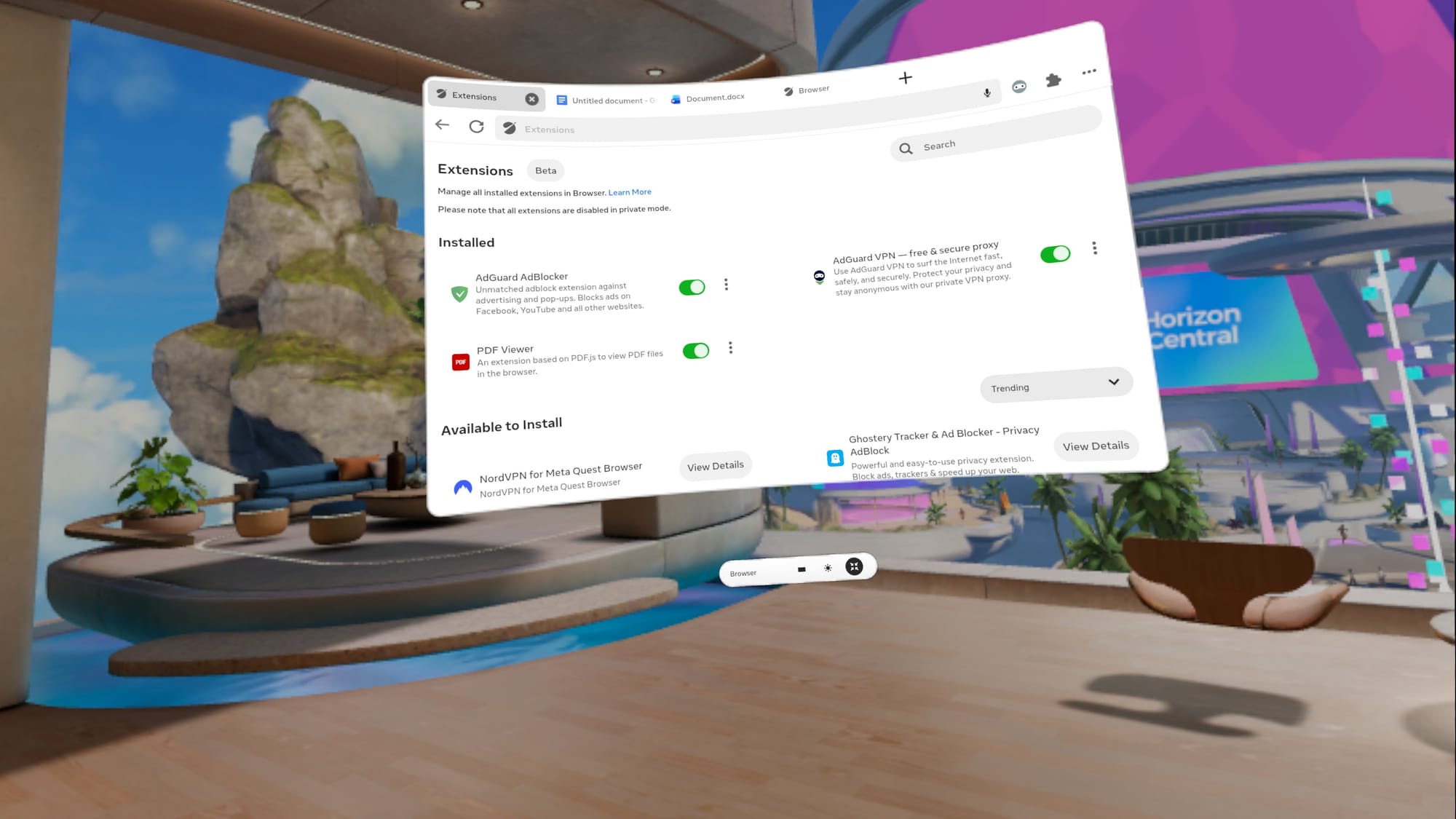
You can find extensions by selecting the puzzle piece at the top right of a browser window. A new tab opens with installed extensions, toggles, and a list of available add-ons.
Test your password manager and VPN while your computer and phone are nearby. It’s easier to authenticate MFA, access email, and verify passkeys before you travel.
Meta doesn’t have a bookmark import option, offering instead link sharing via the Horizon mobile app. Saving one bookmark at a time would become tiresome quickly. Fortunately, there are some good workarounds.
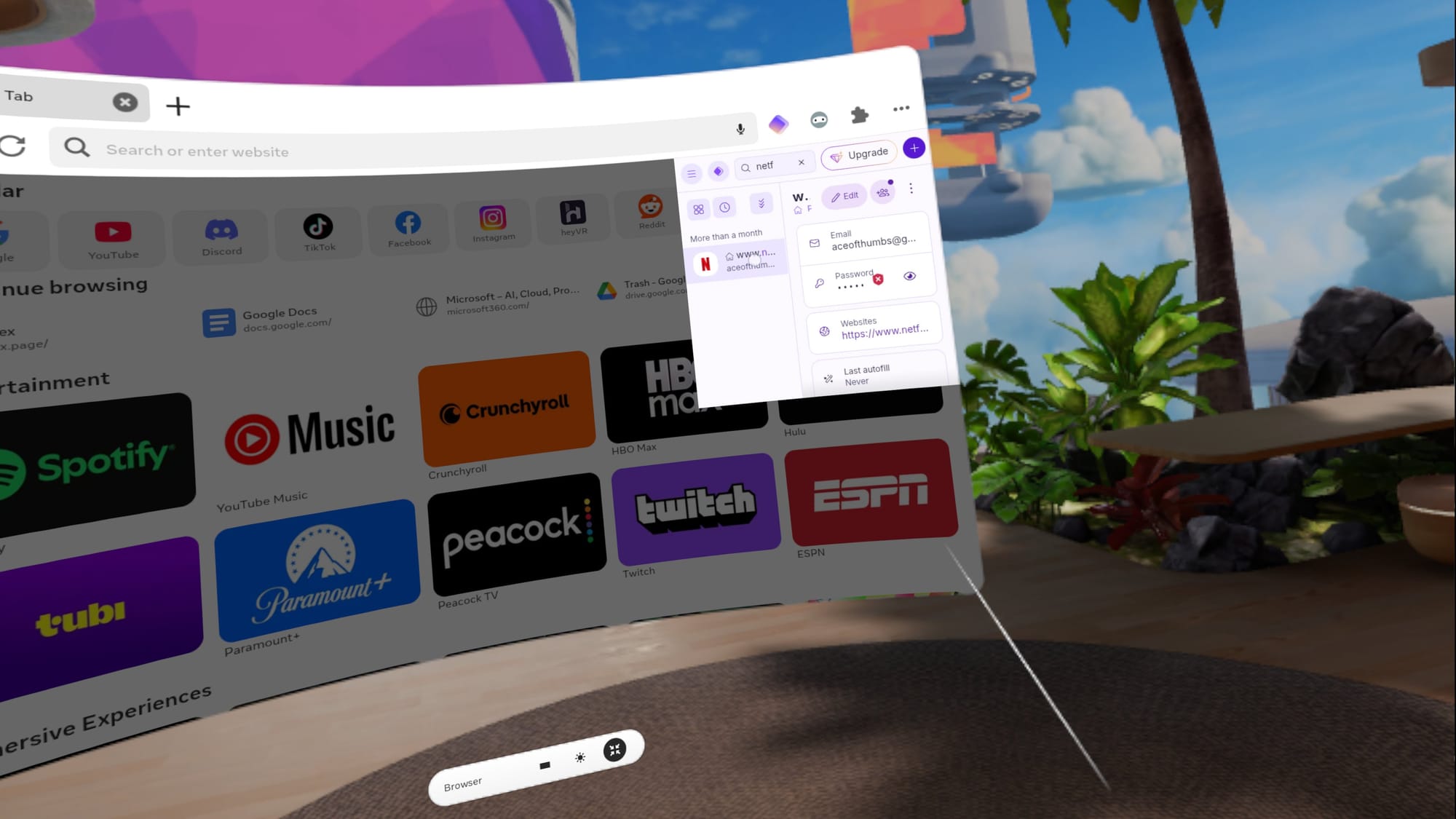
Proton Pass is a free password manager with a Horizon OS extension, and it can double as a website launcher if you pin it. Third-party browsers are a mixed bag. Fluid lacks bookmark import, but supports several password managers. Wolvic deserves credit as one of the few Quest browsers that can import bookmarks by syncing from Firefox.
Bookmarks shouldn’t be this hard, but it’s worth spending a few minutes to make your favorite websites accessible. With a working system, you’re one click away from the tools you actually use.
Quick, reliable text entry is the difference between casual browsing and real work. Quest 3 offers multiple ways to type, and you might use different ones depending on the situation.
Two-finger typing on the default pop-up keyboard is fine for quick searches, short messages, and the occasional form, but it isn’t ideal for drafting and editing. That’s why you should enable Swipe typing in Virtual keyboard settings and turn the mic on in Quick Settings.
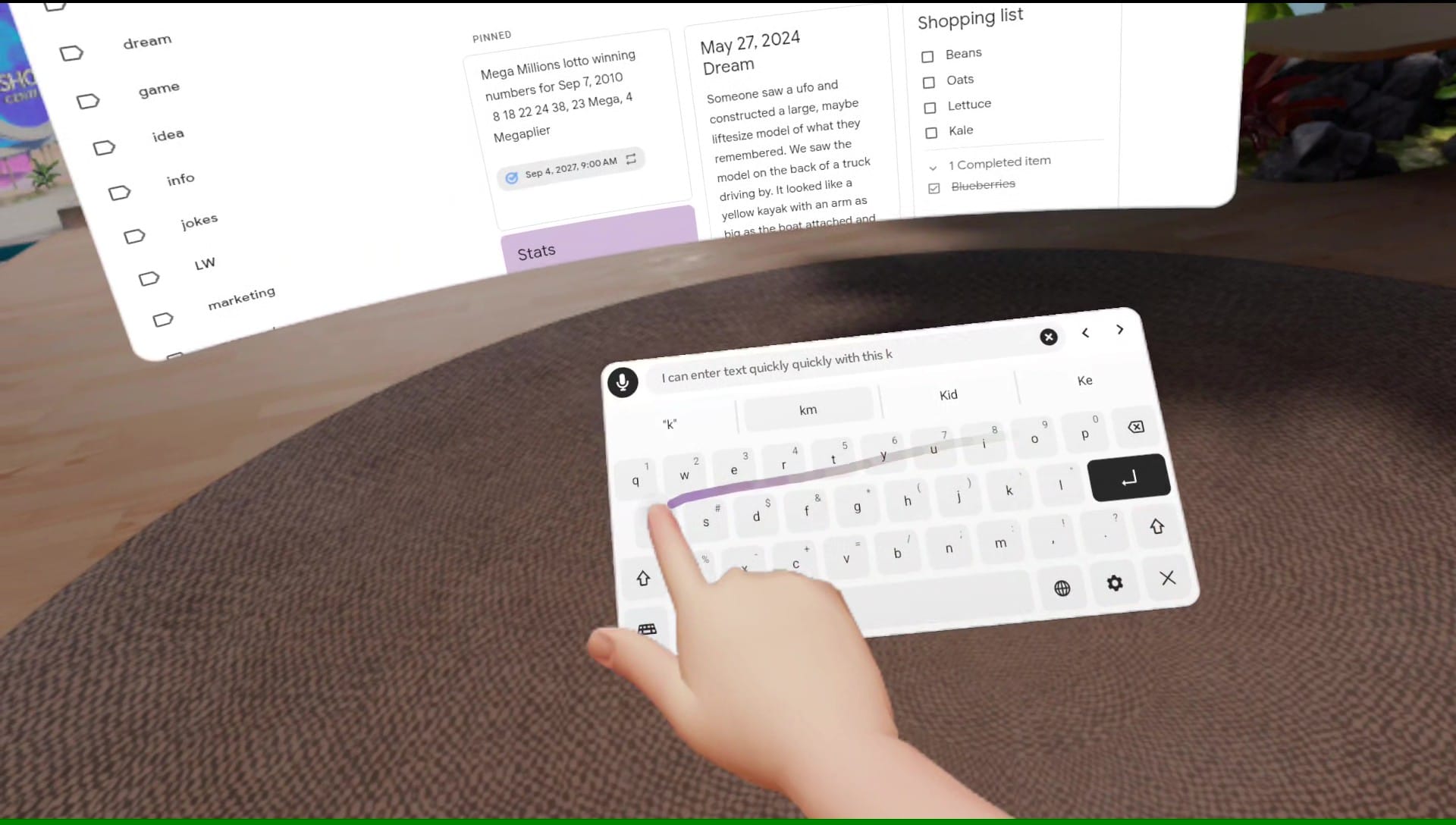
The default keyboard includes a mic icon, and one click lets you dictate words, website addresses, or whole paragraphs. It’s fast, accurate, and you don’t need to speak loudly.
Swipe typing works just as well as it does on your phone, but with a larger keyboard. I like to bring the keyboard close and use a finger, but a controller works, too.
Bluetooth accessories are still the most predictable way to make Quest feel like a computer. A compact keyboard is usually easy to pair, and a mouse makes selection and window control far easier.

If you want to pack light, a keyboard with an integrated trackpad can be ideal.
If you have access to Meta’s new Surface keyboard, it’s worth exploring in Experimental settings. A projected keyboard sounds like a novelty, but it’s genuinely useful if you touch type.
Since it aligns with your desk or table, you get tactile feedback. Meta added a trackpad and a hovering toolbar with cursor arrows, copy, cut, and paste. A preview window in the toolbar lets you see what you’re typing while looking down at the keys.
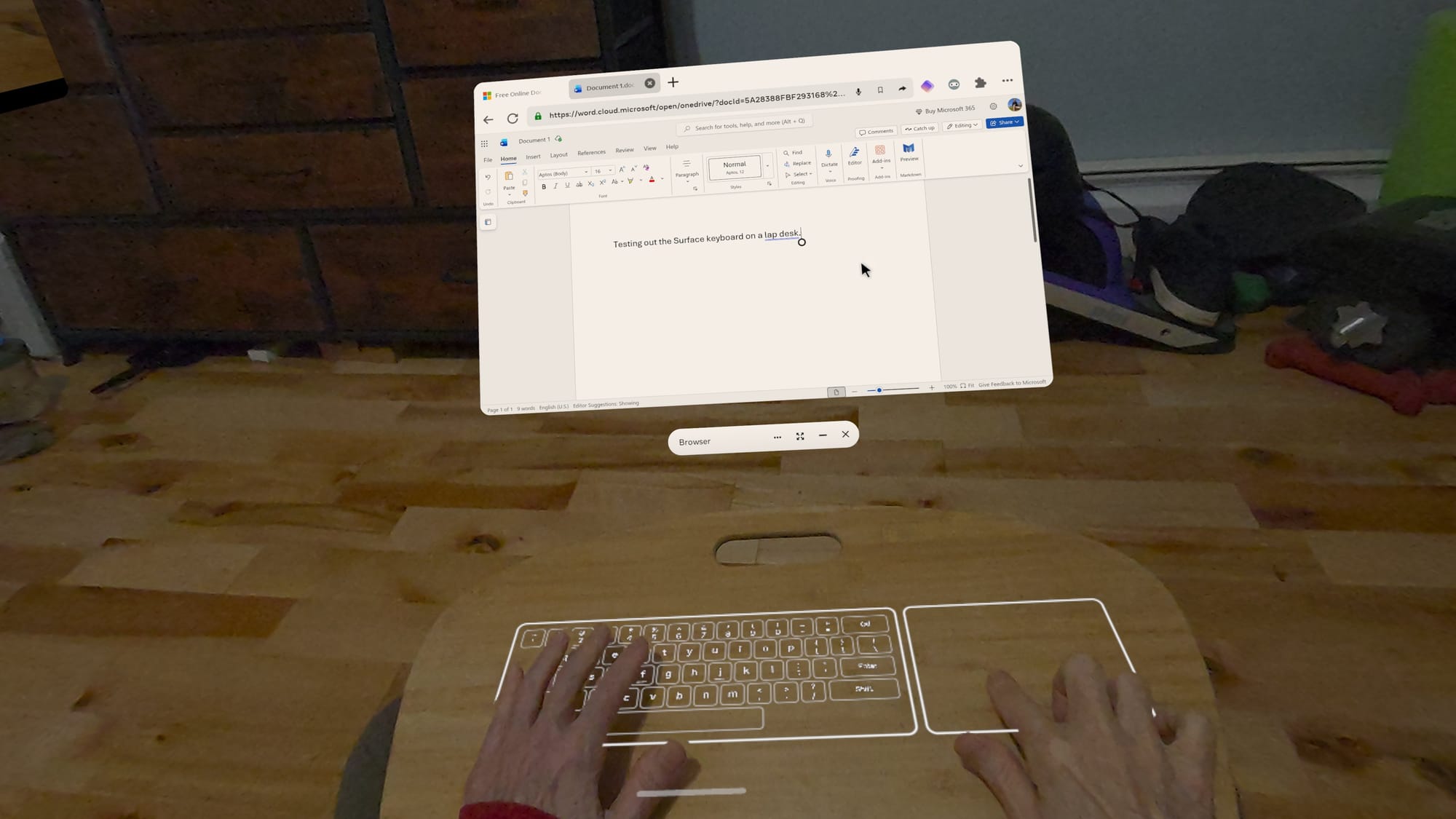
It can’t compete with the clackity, full-travel keyboard I use with my desktop. Physical keys still win for long sessions, but the Surface keyboard does a good job simulating a soft, laptop-style keyboard and trackpad.
The biggest benefit is portability. I’m not dragging a keyboard and mouse between rooms or packing them when I travel.
A browser-first setup might be all you need, but the Quest 3 becomes more useful when you add apps that benefit from VR or mixed reality. For 3D work, VR-native tools can be a leap forward. Your model is in the room with you, and you can handle it like an object. Apps like Gravity Sketch and ShapesXR let you think and build in space, which is hard to replicate on a flat screen.

Meta’s Instagram, Facebook, and Messenger apps can be useful for messaging and keeping in touch while wearing your headset. Instagram offers a fun new feature that automatically converts photos and videos to 3D.
Streaming is a big win for most Quest owners. Whether you use native apps or browser tabs, having a giant screen anywhere makes casual viewing feel like a private cinema. Test the streaming services you use, both the app and the browser version, to find out which works best for you.
Your Quest 3 or Quest 3S might be all you need around your home or office, but a few accessories can make a big difference when traveling. I recommend a charger and USB-C cable, a battery pack for longer sessions, between charging, a microfiber cloth for lenses and sensors, and Bluetooth accessories if you prefer them.
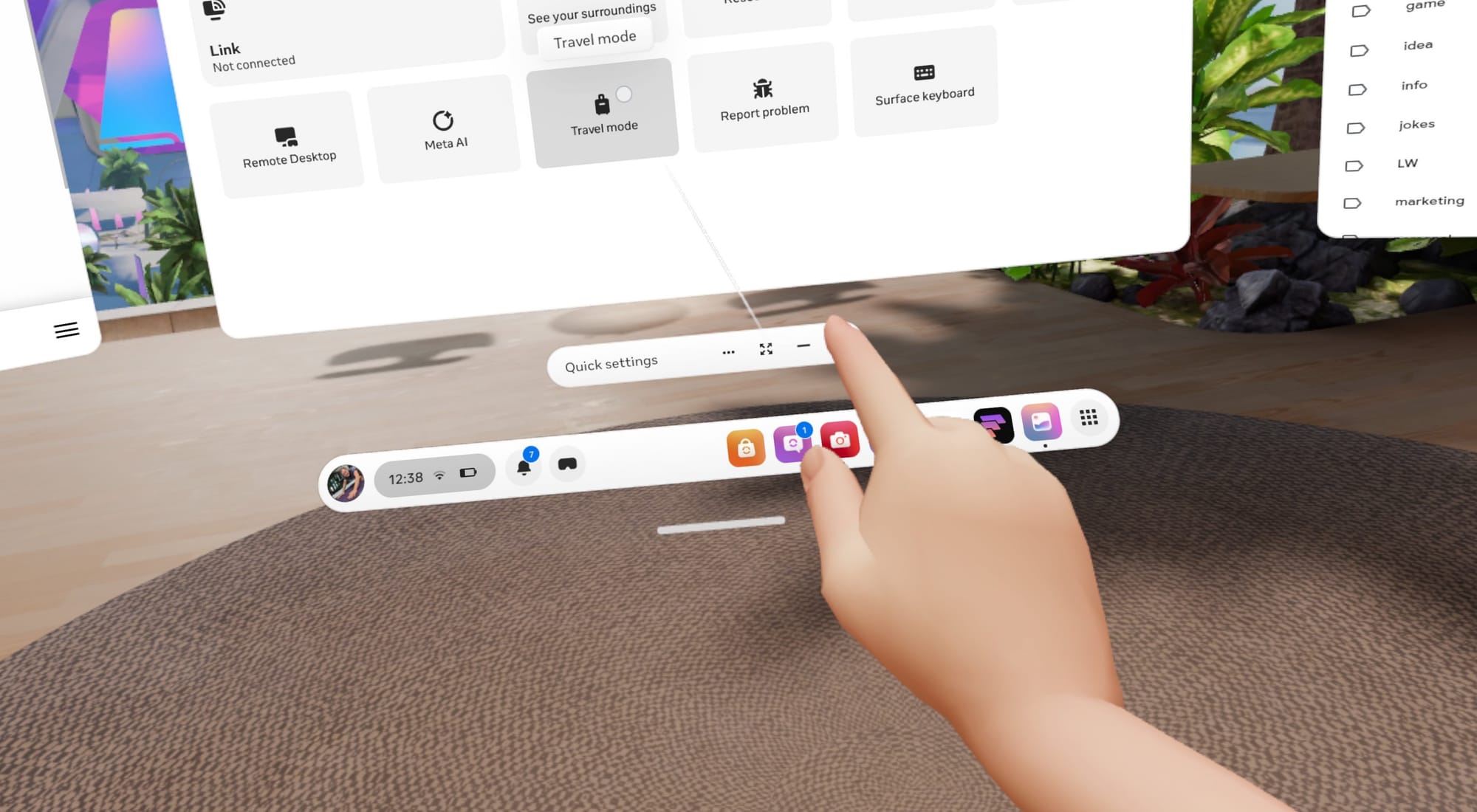
If you want to use your headset on a plane, train, or other vehicle, your Quest 3 has a Travel mode that can help. When movement is detected, the option can appear automatically, and you can also switch it on manually in Quick Settings.
The least glamorous tip is also the most practical. Spatial computing is still fringe tech, so plan for glitches. Install a third-party browser in case something doesn’t work in the system browser. Keep your phone nearby for MFA requests. Make sure the Horizon mobile app is installed, so you can send links and photos to your Quest.
The Quest can be a great portable computer, but its processor and storage are closer to the hardware of a phone than a laptop. You shouldn’t expect it to handle a hundred tabs while streaming video and processing voice input. However, with a little self-restraint and tab management, you might be impressed with what’s possible on such an affordable VR headset.
The Quest is great when your workflow is browser-first, when you enjoy advanced tech, and when you want easy portability. It really shines when you lean into VR-native tools for spatial work, because a laptop can’t match the experience of stepping into a 3D workspace.
While a VR headset falls short for specialized desktop software, heavy multitasking, and some peripheral connectivity, remote access can fill the gap. Apps like Virtual Desktop make macOS and Windows connections easy and reliable.
The key is choosing the right tool for the job. As long as you don’t expect miracles, a Quest 3 or Quest 3S can serve as a low-cost, all-in-one system that creates a unique spatial computing experience that provides a taste of the future with virtual screens, intuitive gesture control, and projected mixed reality interfaces. All it takes is a little setup time and exploration.
The US military mistakenly shot down a Customs and Border Protection (CBP) drone near the Mexican border in a strike that reportedly used a laser-based anti-drone system. The CBP uses drones to track people crossing the border.
“Congressional aides told Reuters the Pentagon used the high-energy laser system to shoot down a Customs and Border Protection drone near the Mexican border, in an area that often has incursions from Mexican drones used by drug cartels,” Reuters reported last night.
The FAA closed some airspace along the border with Mexico in Fort Hancock, Texas, on Thursday with a notice announcing temporary flight restrictions for special security reasons. The restrictions are in place until June 24 but could be lifted earlier. There are conflicting reports on which day the strike happened, with The New York Times reporting that the strike occurred Thursday and Bloomberg writing that the Federal Aviation Administration (FAA) “was notified Wednesday after the event occurred.”
Shotcut 26.2 has been released today as the latest stable version of this open-source, cross-platform, and free video editing software written in Qt using the MLT framework.
We haven’t had a new film from Gore Verbinski for nine years. But the director who brought us the first three Pirates of the Caribbean movies, the nightmare-inducing horror of The Ring (2002), and the Oscar-winning hijinks of Rango (2011) is back in peak form with Good Luck, Have Fun, Don’t Die. It’s a darkly satirical, inventive, and hugely entertaining time-loop adventure that also serves as a cautionary tale about our widespread online technology addiction.
(Some spoilers below but no major reveals.)
Sam Rockwell stars as an otherwise unnamed man who shows up at a Norms diner in Los Angeles looking like a homeless person but claiming to be a time traveler from an apocalyptic future. He’s there to recruit the locals into his war against a rogue AI, although the diner patrons are understandably dubious about his sanity. (“I come from a nightmare apocalypse,” he assures the crowd about his grubby appearance. “This is the height of f*@ing fashion!”)
Ever since I deleted my Facebook account, Instagram has taken its place as the social network I visit most often to check what my friends are up to. I’ve been on the app for something like 15 years now, and during this time, I’ve learned a trick or two that improve the experience (or at least make it less annoying). Here are 10 Instagram hacks that will enhance your privacy, reduce the amount of junk in your feed, help you reset your algorithm, and more.
On every social media app, I like to set up filters to mute offensive keywords, but you can use keywords to block almost anything you don’t want to see. On Instagram, you can use filters to easily block spammy comments and offensive messages. While you can customize your filter list, I just looked up a list of offensive phrases, and quickly added it to my IG account, then added a few additional terms.
You can do the same thing by going to your Instagram profile page, and tapping the three-lines menu in the top-right corner in Instagram. This opens the Settings and activity page, where you can select Hidden Words. It lets you add multiple words, as long as you separate them with a comma. Once added, Instagram will block comments and messages containing those terms.
You can also add mute keywords for posts appearing in your feed. Go to Instagram Settings > Content preferences > Specific words and phrases. On the Content preferences page, go to Sensitive content and Political content, and you can limit those types of posts and videos from showing up on your feed too.
Every once in a while, my Instagram algorithm goes haywire and I’m forced to reset it. After all, I mostly open this app to see my friends’ updates and cat videos, and once my feed starts showing me too much Hyrox content (a “sport” I couldn’t care less about), I know I’m in trouble. If something like this happens to you, there are two ways to reprogram your feed. The easy option is to just look for a reel you enjoy (such as a cat video), and swipe upwards a few times till you reach a non-cat video, then navigate away. Repeat this process a few times and your feed will be back to more cat videos and less Hyrox (or anything else).
If that doesn’t work, or if your feed is too far gone in the wrong direction, then you can go to Instagram Settings > Content preferences > Reset suggested content to reboot it entirely.
When you share any post, reel, story, or other type of content on Instagram, the app tracks who you’re sharing it with, even if you send the link outside Instagram. You can see this by tapping the Share button on any post, and selecting Copy link: Paste this link in any text editor, such as Apple Notes or Google Keep, and you’ll see that the link has tracking parameters at the end, such as “?igsh=…” or “?utm…”. That helps Instagram identify that you’ve shared the link.
There’s no way to disable this tracking, but you can manually remove it from each link before you send it to someone. Just paste the URL it as usual, then delete everything after the question mark.
Whenever you open a link in Instagram, the app opens it in an in-app browser. This is the least privacy friendly option, as Instagram can then track which websites you’re visiting quite easily. You can partially stop this by tapping the three-dots button in the top-right corner of Instagram’s in-app browser and selecting Open in external browser.
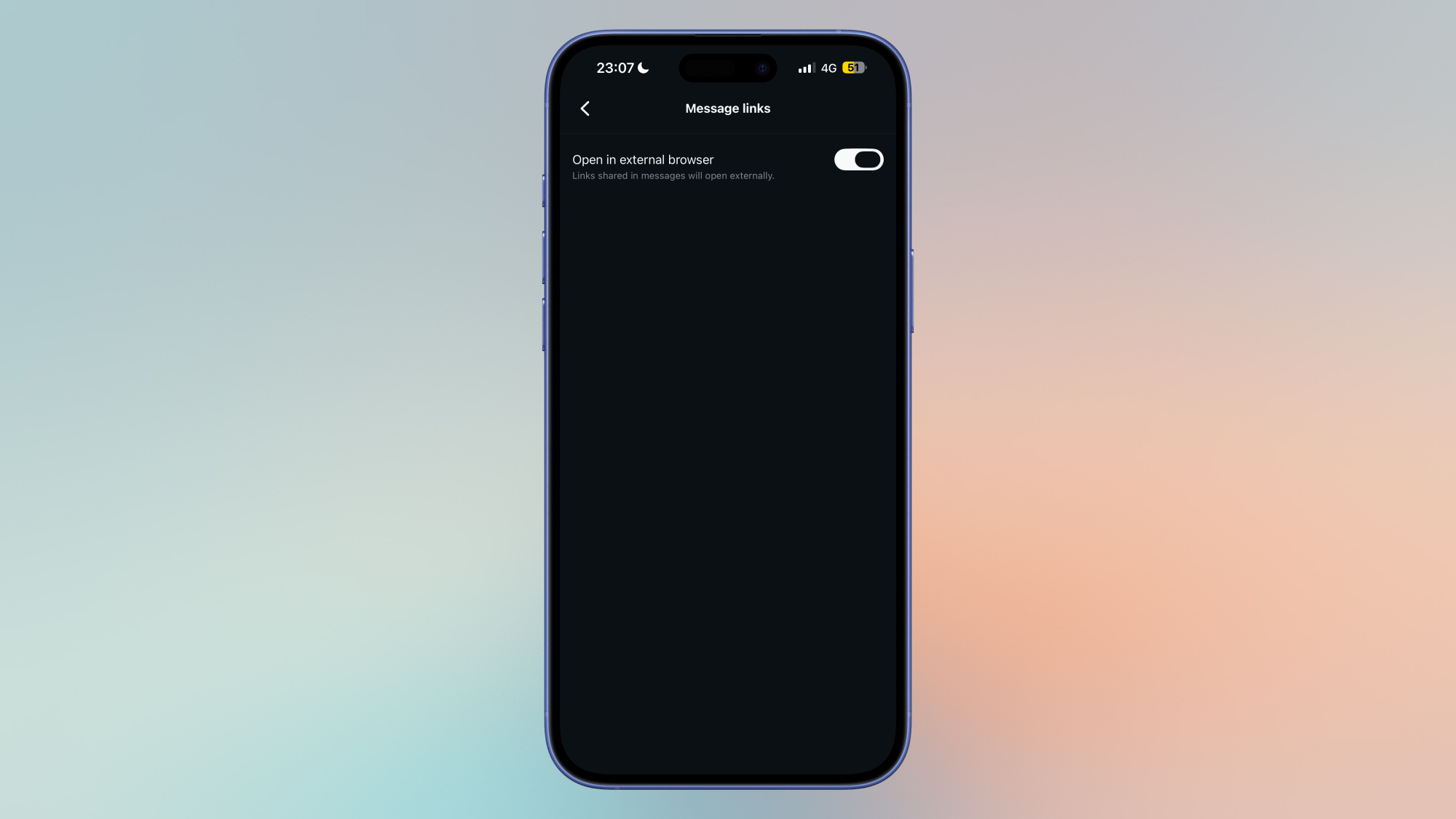
There’s no way to make this the default setting for all links, but you can set it as default for links you receive via DM. To do this, go to Instagram Settings > App website permissions > Message links and turn on Open in external browser.
After you post something, Instagram loves to spam you with notifications every time a few people interact with the post. Even if you don’t use Instagram for a day or two, you’ll still get a deluge of notifications from the app. I don’t face this problem because I never allow Instagram permission to send any notifications on my devices, but that’s not an option for everyone. If you don’t want to turn off notifications entire, you can choose to receive only the useful notifications from Instagram. To do this, go to Instagram Settings > Notifications and review all the options available to you. I particularly like the Messages only option, which only sends me an alert when someone DMs viaon the app.
To further limit notifications, go to the Following and followers section on this page, and disable Account suggestions. Similarly, you can go to Messages and disable Message reminders and all varieties of channel notification settings. You can also go to the Calls section and turn off Video chats, which has the added bonus of disabling video calls on Instagram, which I’ve never wanted to use.
For some reason, Instagram shows other people when you’re online. If you want to be more discreet, go to Instagram Settings > Messages and story replies > Show activity status and turn the setting off. (On the previous page, you can select Show read receipts and turn it off to stop people seeing if you’ve read their messages too.)
When someone is messaging you on Instagram, the app shows you an animation to tell you that the other person is typing. More often than not, this feature only makes me keep the app open longer while the other person types their message, which is probably why Instagram’s added it in the first place. If you don’t want to see the typing indicator in a chat, you can disable it: Open any chat in Instagram and tap the contact’s name up top. Go to Privacy and safety and turn off Typing indicator. Sadly, you’ll need to do this manually for each of your Instagram chats.
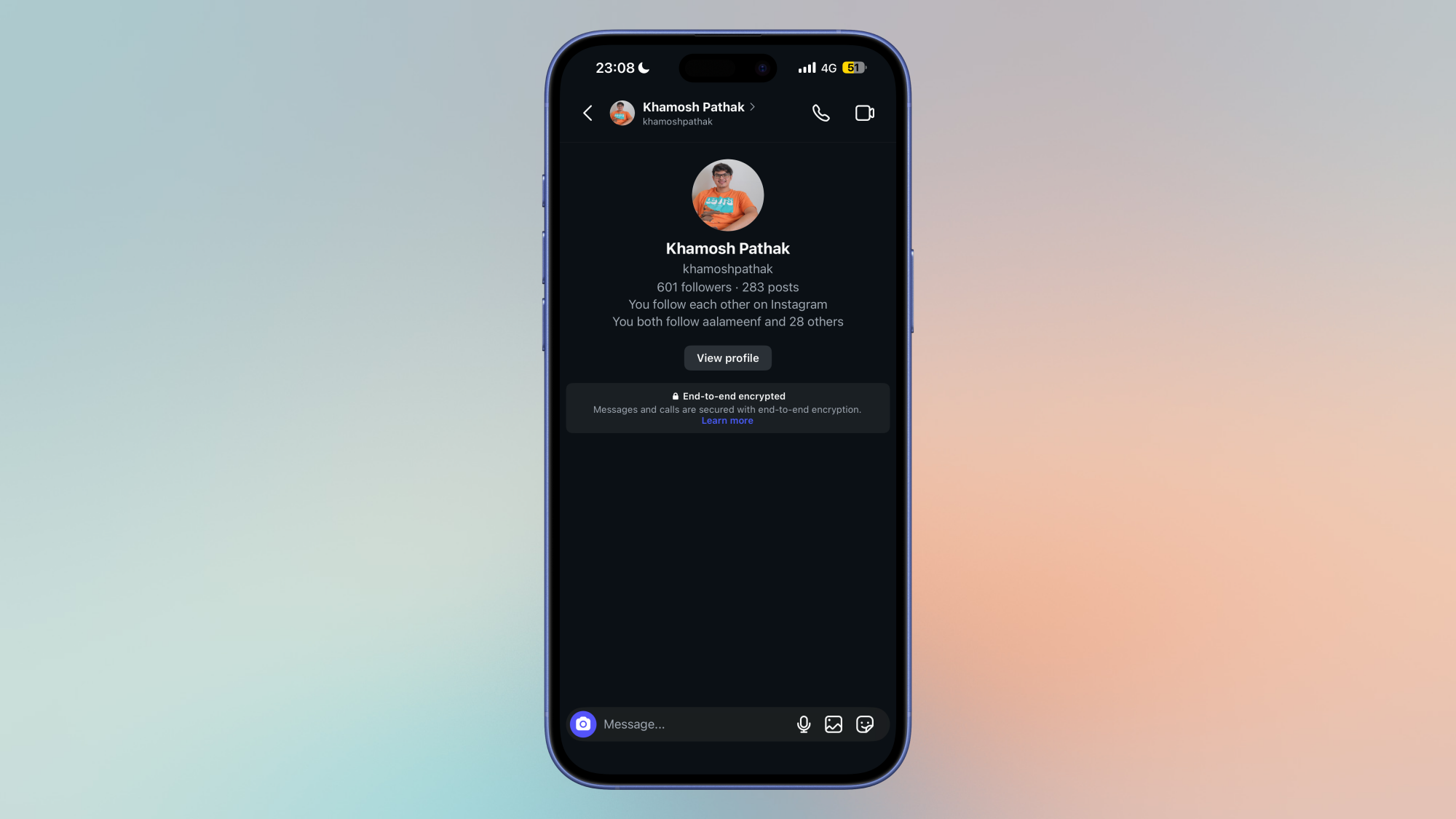
Instagram chats are not encrypted by default, which means that the company can read all your messages. If you want to beef up your security, consider using end-to-end encryption for your chats. Just like Telegram, Instagram hides its end-to-end encrypted chat feature, and makes you enable it manually for each chat. You can do so by opening any chat in Instagram, tapping the contact’s name up top, selecting Privacy and safety > Use end-to-end encryption.
Your Instagram search history shows up whenever you try to search for anything on Instagram. This can be embarrassing if you’ve looked up something really silly (or slightly naughty), and someone else sees it. to prevent this, you can clear your searches by tapping the search bar in Instagram, and selecting Clear all, or tapping the x next to each search term.
However, there’s also a way to automatically clear your search history on Instagram: Go to Instagram Settings > Accounts Center > Your information and permissions > Search history > Keep searches for, and select 3 days, which is the minimum time for automatically deleting your searches.
There’s no way to block ads on Instagram, but you can reduce the amount of your data that Instagram uses to show you those ads. Just go to Instagram Settings > Accounts Center > Ad preferences > Manage info. You can go through each option on this page and turn off everything you can. Under Categories used to reach you, select Remove on every option.
You can choose Don’t allow us… in these two categories: Ads in other apps and Ads about Meta. Finally, you can select Activity information from ad partners > Review setting, and pick No, don’t make my ads more relevant.
Hyprland 0.54 was released today as what’s described as a “a massive update with no understatement” to this Wayland compositor…

“I love this product! It is so good.”
Nasa announced on Friday radical changes to its delayed Artemis III mission to land humans back on the moon, as the US space agency grapples with technical glitches and criticism that it is trying to do too much too soon. From a report: The abrupt shift in strategy was laid out by the space agency’s recently confirmed administrator, Jared Isaacman. Announcing the changes on Friday, he said that Nasa would introduce at least one new moon flight before attempting to put humans back on the lunar surface for the first time in more than half a century, in 2028.
The new, more incremental approach would give the Nasa team a chance to test flight and refine its technology. As part of the changes, the Artemis II mission to fly humans around the moon this year, without landing, would also be pushed back from its latest scheduled launch on 6 March to 1 April at the earliest.
“Everybody agrees this is the only way forward,” Isaacman told reporters at a news conference. “I know this is how Nasa changed the world, and this is how Nasa is going to do it again.”


Read more of this story at Slashdot.

Dan Simmons, the author of more than three dozen books, including the famed Hyperion Cantos, has died from a stroke. He was 77.
Simmons, who worked in elementary education before becoming an author in the 1980s, produced a broad portfolio of writing that spanned several genres, including horror fiction, historical fiction, and science fiction. Often his books included elements of all of these. This obituary will focus on what is generally considered his greatest work, and what I believe is possibly the greatest science fiction novel of all time, Hyperion.
Published in 1989, Hyperion is set in a far-flung future in which human settlement spans hundreds of planets. The novel feels both familiar, in that its structure follows Chaucer’s Canterbury Tales, and utterly unfamiliar in its strange, far-flung setting.
We may earn a commission from links on this page. Deal pricing and availability subject to change after time of publication.
Samsung just announced its new earbuds during the Samsung Unpacked 2026 event earlier this week, and Amazon is already offering a pretty sweet deal to preorder them. The Samsung Galaxy Buds 4 are $179.99 and come with a $20 Amazon gift card, and the Samsung Galaxy Buds 4 Pro go for $249.99 and come with a $30 Amazon gift card. Both will be released on March 11, but you can pre-order them now. Considering these will be their flagship earbuds for some time, it’s a great opportunity for any Samsung fan or anyone curious about Samsung’s new earbuds to snatch them up.

![Samsung Galaxy Buds 4 Pro (2026) AI True Wireless Bluetooth Earbuds + $30 Gift Card, Hi-Res Audio, 2-Way Speaker, ANC 2.0, Optimized Comfort, IP57, Live Translation, Black [US Version, 2 Yr Warranty]](https://www.prime-wow.com/wp-content/uploads/2026/02/hero-imagefillsize_autoxautov1772134466.jpg)
Samsung wants to compete with Apple, with a similar design, features, and even price point. The Samsung Galaxy Buds 4 are strikingly similar to the Apple AirPods 4 in their design, with noise cancellation and the absence of silicone eartips that go inside your ears. They come with Hi-Res audio, IP54 for water-resistance, a Live Translation feature similar to Apple’s, a new design, improvements in call quality, and direct access to ask questions to AI and receive responses through the earbuds. The controls are swipe and pinch, and the charging case comes in black or white.
It’s also easy to draw the similarities between the Samsung Galaxy Buds 4 Pro and the Apple AirPods Pro 3. Apart from both being $249, the most obvious similarity is the in-ear silicone tip design that helps seal the noise and improve ANC. The Pros have all of the same features as the Buds 4, and are supposed to be more comfortable, have better ANC which Samsung calls ANC 2.0, have a better water resistance with an IP57 rating, which handles immersion in water up to 1 meter, and perhaps more importantly, a two-way speaker (as opposed to a one-way on the Buds 4) that is meant to delivers better, high-fidelity sound, superior separation of frequencies, and reduced distortion. But we will only know if these claims are true when we get our hands on them for a review.
Amazon’s Wish List feature is a versatile way to tell other people what gifts you’re interested in. That might be a gift registry for a baby shower, or letting your friends and family know what you want for your birthday. But it’s also commonly used for online creators to receive gifts from fans or for someone in need to receive donated items from strangers online who want to help. Up until now, we could rely on Wish List as a secure way for strangers to send items, without worrying about setting up a post office box. But going forward, Wish List now runs the risk of telling fans exactly where the creator lives—unless the creator takes action.
As reported by 404 Media, Amazon is recommending customers that use Wish Lists to change their shipping addresses to either P.O. boxes or non-residential delivery addresses. The company is making changes to Wish Lists, which could reveal the address you have on file for the feature. By leaving it as your home address, you are putting yourself at risk of doxxing—or revealing your personal address to strangers on the internet.
That’s because Amazon is now removing the option to block purchases from third-party sellers for Wish List items. As such, anyone who buys items off your Wish List to send to you will be able to buy them from third-party sellers, and those sellers will have access to your delivery address. From Amazon’s point of view, these changes give buyers more flexibility over the items they can buy from your list, but that unfortunately comes with an impact on your personal privacy. But it’s not just sellers who will have access to this address: Buyers will, too, as they may see your address in shipping updates they receive throughout the buying process.
As 404 Media highlights, major shippers don’t usually reveal addresses in these situations. But Amazon’s changes mean that third-party sellers have it in their power to share this information themselves. What’s more, if the delivery person ends up taking photos of the package to confirm delivery, that could leak even more of your personal details than you’d want—such as what your front door or driveway look like.
These changes aren’t effective immediately, so if you use Amazon’s Wish Lists, you don’t have to worry about your home address leaking on the internet just yet. However, the company has set a deadline for March 25, so it’s important to act fast if you want to protect yourself.
Below, you can read the email Amazon is sending the following email to Wish List users:
“We’re writing to inform you about an upcoming change to Amazon Lists. Starting March 25, 2026, we will remove the option to restrict purchases from third-party sellers for list items. When this change takes effect, gift purchasers will be able to purchase items sold by third-party sellers from your lists and your delivery address will be shared with the seller for fulfillment. This change will provide gift purchasers with access to a wider selection of items when shopping from your lists…Important note: When gifts are purchased from your shared or public lists, Amazon needs to provide your shipping address to sellers and delivery partners to fulfill these orders. During the delivery process, your address may become visible to gift purchasers through delivery updates and tracking information. To help protect your privacy, we recommend using a PO Box or non-residential address for any list you share with public audiences.”
If you have an online presence and want to protect your address, you’ll need to update your address in Wish List settings. Head to this link, then choose “manage list.” Here, you can adjust your Wish List settings to make it private, or to choose specific users to share it with. Otherwise, you can adjust your address if you have a P.O. box or alternative address to select.

Also: Disgaea ditches the turn-based tactics in a new spin-off
A sprawling Chinese influence operation — accidentally revealed by a Chinese law enforcement official’s use of ChatGPT — focused on intimidating Chinese dissidents abroad, including by impersonating US immigration officials, according to a new report from ChatGPT-maker OpenAI. From a report: The Chinese law enforcement official used ChatGPT like a diary to document the alleged covert campaign of suppression, OpenAI said. In one instance, Chinese operators allegedly disguised themselves as US immigration officials to warn a US-based Chinese dissident that their public statements had supposedly broken the law, according to the ChatGPT user. In another case, they describe an effort to use forged documents from a US county court to try to get a Chinese dissident’s social media account taken down.
The report offers one of the most vivid examples yet of how authoritarian regimes can use AI tools to document their censorship efforts. The influence operation appeared to involve hundreds of Chinese operators and thousands of fake online accounts on various social media platforms, according to OpenAI.


Read more of this story at Slashdot.

A long-standing Pokémon tradition is impossible on the Switch ports

We suspect not, but there’s plenty of precedent for it
An anonymous reader shares a report: While some see AI as a tool to be used, its specific use and how it is deployed responsibly is being heavily debated online across a wide range of industries. In terms of journalistic content, and in this particular instance, reviews, review aggregator Metacritic has taken a firm stance on content published and submitted to their platform, that have been generated by artificial intelligence in some way.
In a statement by co-founder Marc Doyle, sent to Gamereactor, he says this: “Metacritic has been a reputable review source for a quarter century and has maintained a rigorous vetting process when adding new publications to our slate of critics. However, in certain instances such as a publication being sold or a writing staff having turned over, problems can arise such as plagiarism, theft, or other forms of fraud including AI-generated reviews. Metacritic’s policy is to never include an AI-generated critic review on Metacritic and if we discover that one has been posted, we’ll remove it immediately and sever ties with that publication indefinitely pending a thorough investigation.”
So, what is this about specifically? Well, it’s probably a sound guess, that this pertains to Videogamer’s review of Resident Evil 9: Requiem, which was removed from the platform after a barrage of comments accusing the review of being AI-written, and for the author of being made up.


Read more of this story at Slashdot.
With the likes of The Last of Us and Fallout out of the way for a bit, Amazon has seized its opportunity to put the spotlight on the next big video game adaptation, its currently-in-production God of War show. Today we got our first look at Ryan Hurst and Callum Vinson as Kratos and Atreus.
The image released by Amazon shows the eponymous God of War standing next to a tree as he watches his son — who notably looks a bit younger than the video game version of 11-year-old Atreus we first met in 2018’s God of War — take aim with his bow. Exactly what they’re hunting is unclear, but we know that the developing relationship between father and son that was such a big part of the PS4 game is also going to be at the heart of the show.
Whether Sony Pictures Television and Amazon MGM Studios have nailed the looks of its central characters is a matter of opinion. Personally I think Hurst’s Kratos in particular looks a little bit off here, but there’s every chance it all comes together later in production. Or when we first hear him angrily exclaim “boy!”
The Sons of Anarchy star was cast as Kratos back in January, and earlier this week we learned that Deadpool’s Ed Skrein will play Baldur in the Amazon show. The rest of the cast includes Mandy Patinkin as Odin, Max Parker and Heimfall, Ólafur Darri Ólafsson as Thor, Teresa Palmer as Sif, Alastair Duncan as Mimir, Jeff Gulka as Sindri and Danny Woodburn as Brok.
No release date has been announced yet, but a second season of God of War has already been confirmed.
This article originally appeared on Engadget at https://www.engadget.com/entertainment/streaming/heres-your-first-look-at-kratos-and-atreus-in-amazons-upcoming-god-of-war-tv-adaptation-172251366.html?src=rss
The Midnight Walk, a grim and beautiful dark fantasy adventure using clay-sculpted models, gets a new lower price on PC VR and PlayStation VR2.
The game now costs $29.99, a substantial discount from its original price of $39.99. The price drop carries across both Steam and PlayStation Store.
Developed by MoonHood, the studio formed by former Zoink (Lost in Random, Fe) developers Klaus Lyngeled and Olov Redmalm, The Midnight Walk is a gorgeous and unique game with a handcrafted clay stop-motion animated art style.
0:00
In The Midnight Walk, you’ll play as The Burnt One, befriend a lost lantern creature named Potboy, and use his flame to light your way through a grim and beautiful hand-crafted world.
We reviewed The Midnight Walk in VR when it released last year, and found it to be “a memorable adventure that’s enchanting and bleak in equal measure, one that feels like wandering into a twisted fairytale. It’s a gripping tale with beautifully crafted claymation visuals, […] a great example of hybrid design between flatscreen games and VR.”
The Midnight Walk is available now on PC, PS5, SteamVR, and PlayStation VR2.