
When it comes to using Qualcomm Snapdragon X1 Elite laptops on Linux, one of the big challenges have involved the need to extract the necessary firmware from the Windows 11 partition due to most vendors not providing the firmware in an easily redistributable and public form. The one exception has been the Lenovo ThinkPad with X1 Elite having upstream firmware in linux-firmware.git while now the Dell XPS model has joined the party too…
Apple M4 MacBook Air Slashed To Lowest Price Ever Following M5 Launch

Savvy shoppers know that a surefire strategy to save some coin in the land of tech is to wait for a new generation product to emerge, and then pounce on the inevitable discount offered on the item it’s replacing. Now is one of those opportune times. Apple’s new M5 MacBook Air is barely two weeks old, and you can find the still-capable M4 model
Monte Verde site gets a new date, but the big picture doesn’t change
A landmark site in the peopling of the Americas is several thousand years younger than we thought. While that means very different things about the site itself, it doesn’t change the big picture as much as the researchers who generated the new date are claiming.
University of Wyoming archaeologist Todd Surovell and his colleagues recently took a second look at the age of a site called Monte Verde in southern Chile, and it turns out that people lived there 8,000 years ago—not 14,500, as the archaeologists who first described it claimed.
Monte Verde is about as far from the Bering Land Bridge as you can get without leaving the continents, so its age was the first piece of evidence that people were well-established in the Americas before the end of the last Ice Age. But it hasn’t been the last, so Surovell and his colleagues’ findings don’t actually change what we now know about the peopling of the Americas—and they definitely don’t put the “Clovis First” hypothesis back on the table.
Blue Origin To Challenge SpaceX In High-Stakes Data Center Race In Space
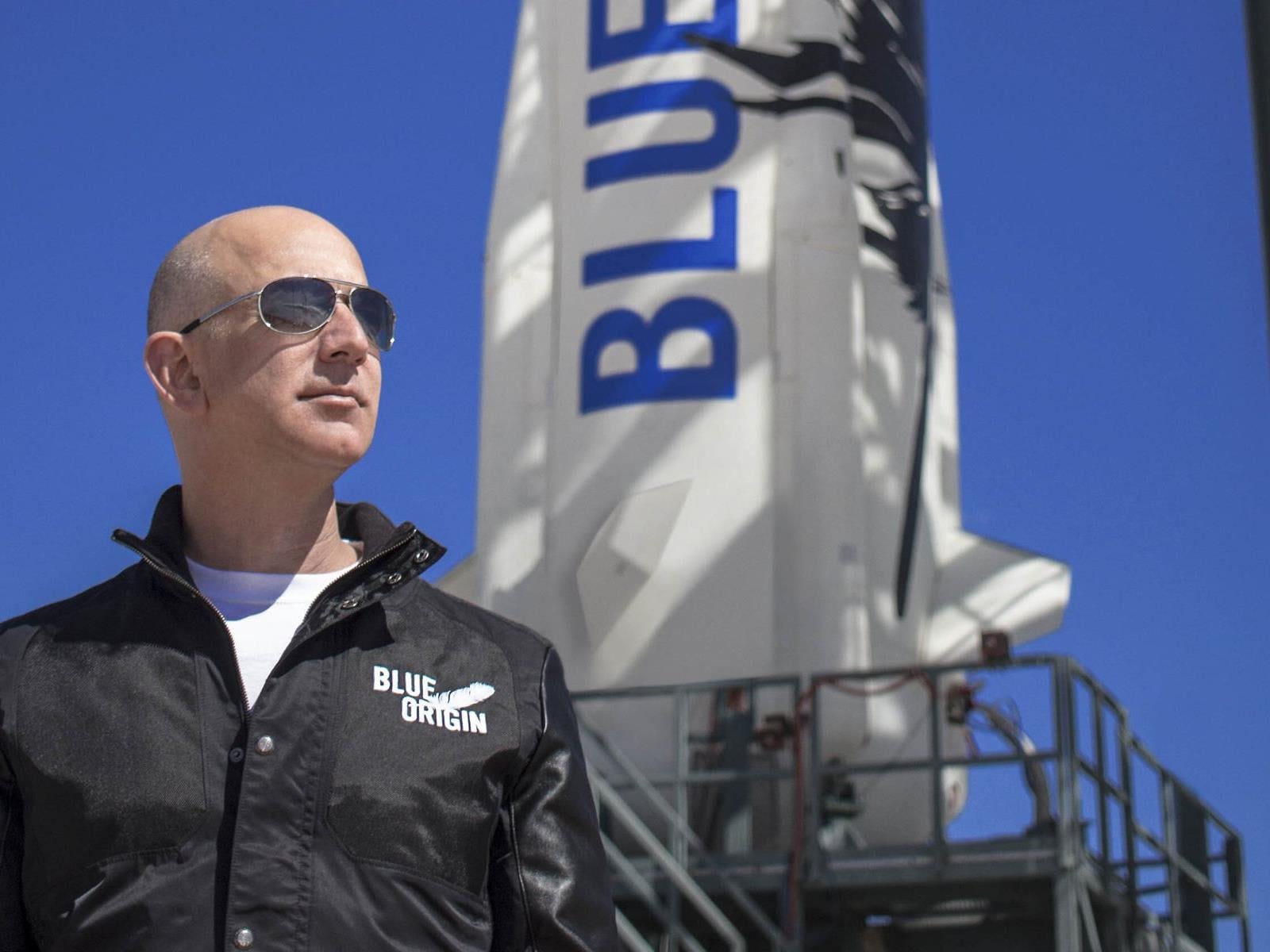
Looks like we have a new entrant to the orbital data center race: Blue Origin is formally challenging the likes of SpaceX and Axiom with plans for an initial constellation of tens of thousands of satellites.
Filing plans with the Federal Communications Commission (FCC) for Project Sunrise, Jeff Bezos’s space venture aims to deploy a not
Crimson Desert Has Already Sold A Shocking Number Of Copies In Just 24 Hours

Also: does Diablo 4 keep changing too much?
This Convertible Chromebook Is Nearly $100 Off Right Now
We may earn a commission from links on this page. Deal pricing and availability subject to change after time of publication.
Convertible laptops are a versatile and affordable alternative to buying a separate laptop and tablet. They offer touchscreen capability, multiple viewing modes, and greater portability than traditional laptops, which is a perk for commuters. They’re also useful if you want a second screen but don’t want to invest in a full second laptop or desktop. One of the most popular options is the entry-level 14-inch ASUS Chromebook Flip CX1 Convertible Laptop, which is down to a record low of $279.99 (originally $369.99), according to price trackers.
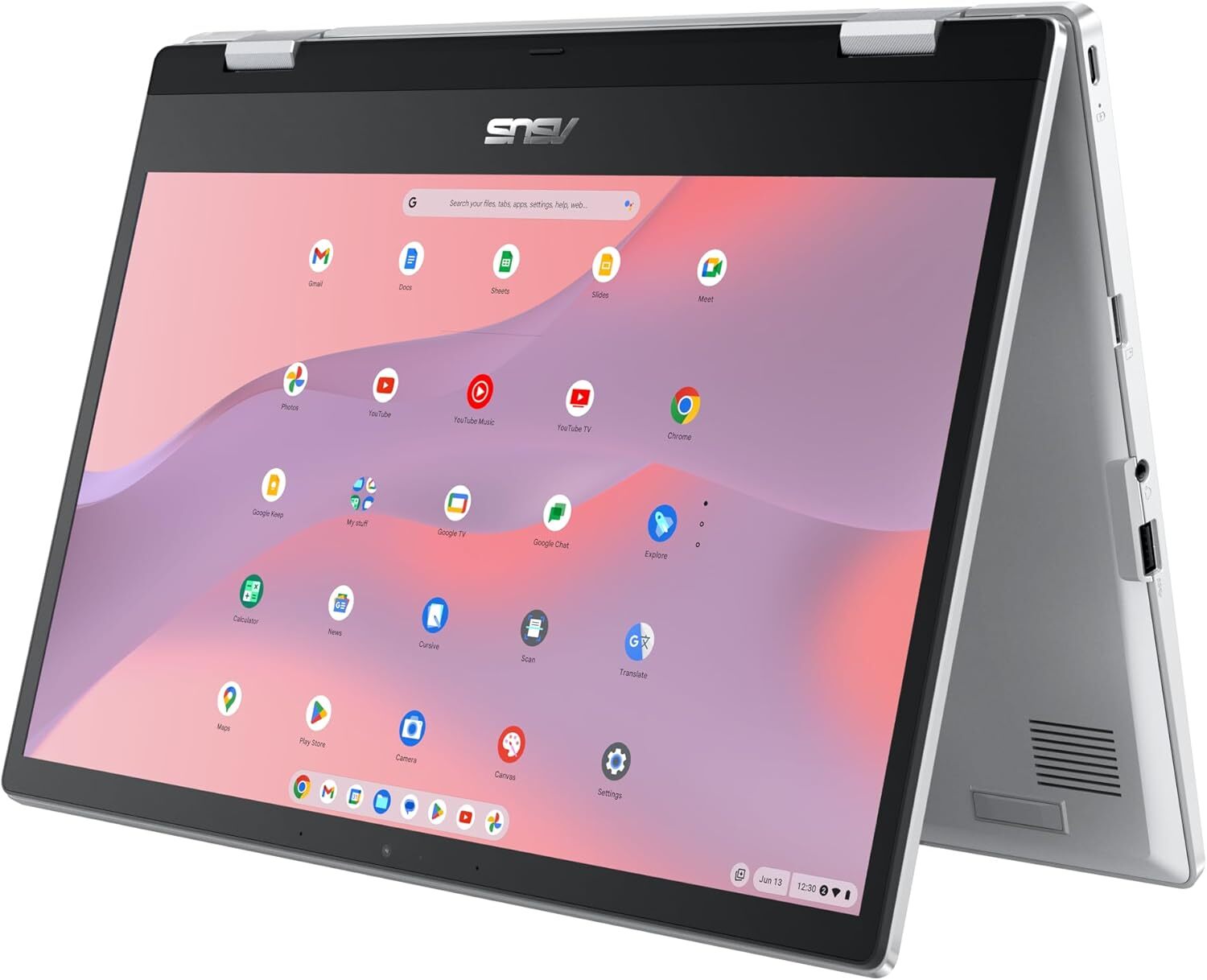
It’s one of the most affordable convertible laptops with a 360-degree hinge, a 13-inch touchscreen, and all the essentials for everyday tasks like streaming video, getting work done, multitasking, or serving as a secondary device. That said, it’s not designed for more intensive tasks like design work, competitive gaming, and video editing.
It has an Intel Celeron N4500 processor, 8 GB of RAM, and 128 GB of eMMC storage, and lasts up to 11 hours per charge. It can be used in laptop, tent, or tablet mode, adding to its versatility. While it doesn’t have the high-end specs and performance of dedicated computers, this 2-in-1 does come with fingerprint login, a backlit keyboard, dual speakers, and a 1080p webcam. It also has fast-charging USB-C, USB-A, and micro-SD ports, offering more connectivity than many budget Chromebooks.
If you’re looking for a model that covers the basics and your priority is versatility and convenience at under $300, the Asus Chromebook Flip CX1 2-in-1 is a strong choice. However, if you need more storage, better brightness and visuals, and a more capable processor, it’s worth stepping up to a slightly more powerful model like the ASUS Chromebook CM14 Flip or the Lenovo IdeaPad Flex 5i Chromebook Plus, though those upgrades will come with a higher price tag.
Our Best Editor-Vetted Amazon Big Spring Sale Deals Right Now
Deals are selected by our commerce team
As OpenClaw Enthusiasm Grips China, Kids and Retirees Alike Raise ‘Lobsters’
An anonymous reader quotes a report from Reuters: Fan Xinquan, a retired electronics worker in Beijing, has recently started raising a “lobster,” hoping that the AI agent he has been training can help organize his specialized industry knowledge better than chatbots like DeepSeek. “OpenClaw can actually help you accomplish many practical things,” the 60-year-old said at a recent event hosted by AI startup Zhipu to teach people how to use and train the AI agent, which has gone viral in China, with its various local versions earning the “lobster” nickname.
In the past month, OpenClaw, which can connect several hardware and software tools and learn from the data produced with much less human intervention than a chatbot, has captured the imaginations of many in China, from retirees looking for side income to AI firms hoping to generate new revenue streams. […]
Huang Rongsheng, chief architect at Baidu’s smart device unit Xiaodu, said at an event on Tuesday that parent group chats for his daughter’s primary school class have become overwhelmed by OpenClaw discussions. “My daughter came to me and asked: Dad, I see you raising a lobster every day,” he said. “Can I have one too?” Bai Yiyun, another attendee at the Zhipu event, said she hopes to use the agent to start a side hustle during her retirement. “If DeepSeek marked a milestone for open-source large language models, then OpenClaw represents a similar turning point for open-source “agents,” said Wei Sun, chief AI analyst at Counterpoint Research.


Read more of this story at Slashdot.
Belkin Charging Case Pro for Switch 2 review: A more elegant solution
Last year, Belkin released a couple of cases for the Nintendo Switch 2 just in time for launch, including one that came with a handy battery pack. That one was simple and effective, but it felt a bit crude because it wasn’t much more than a basic travel pouch with a generic power cell tossed inside. Now, Belkin is back with a Pro version of its Charging Case for the Nintendo Switch 2, featuring a more sophisticated battery pack along with a higher price tag ($100 vs. $70). So here’s the question for any Switch 2 owners still looking for a way to protect their console while keeping it topped off: Is a more elegant charging solution really worth the extra money?
Case design
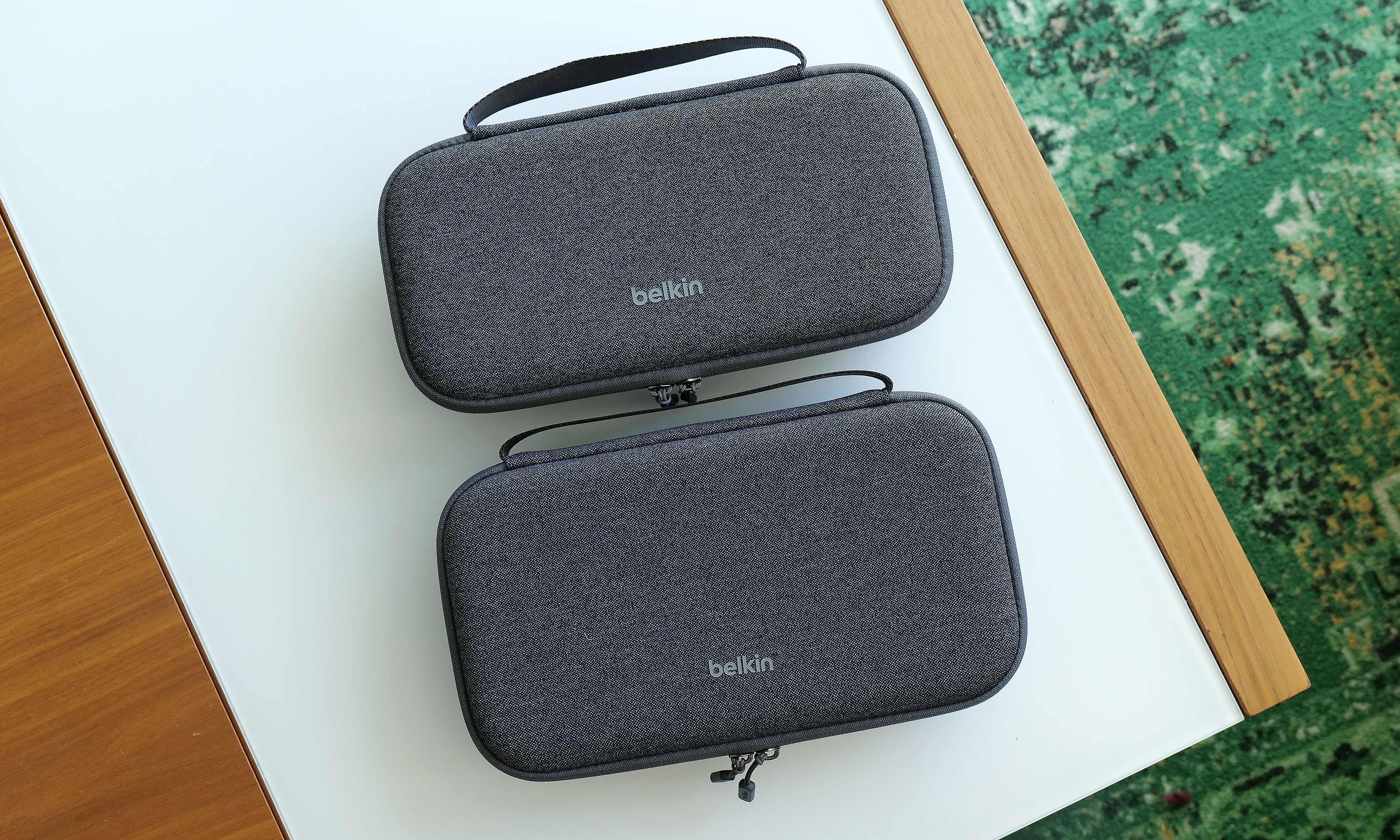
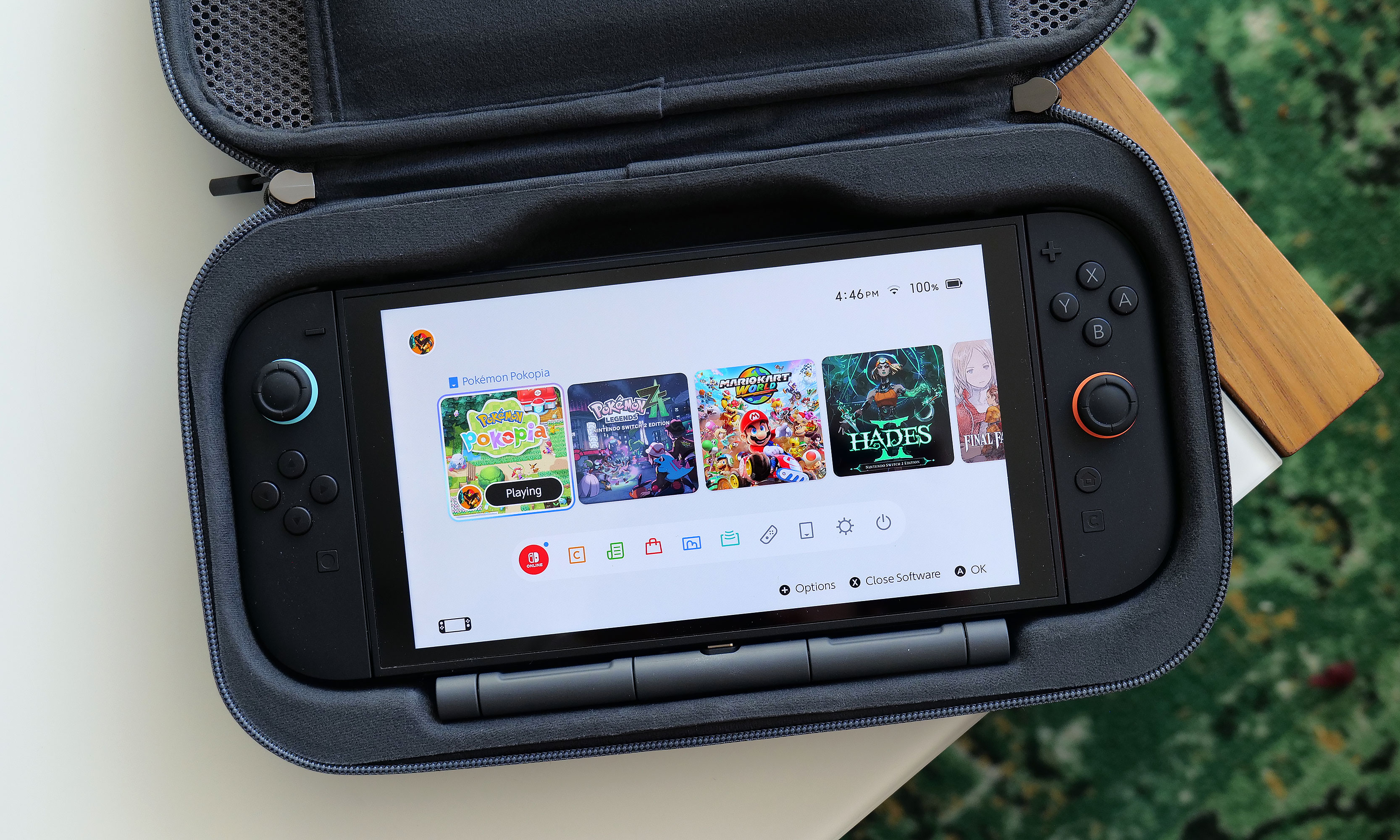
At 11.7 x 6.1 x 2.5 inches and weighing 1 pound 12 ounces, the Pro Charging Case is a touch larger and heavier than its non-pro sibling. It also features a very similar design with the same color options and materials, including a tough polyester outer shell that’s balanced by a softer, velvet-like material and cutouts for your Switch 2 on the inside.
Sam Rutherford for Engadget
Once again, Belkin has done a good job of providing a snug cabin to store your console while still making it easy to take it in and out. That said, if your system also has an extra-thick protector or hardshell case like the Killswitch from Dbrand, it may not fit. There’s also a padded flap that swings down to protect your Switch 2’s screen that also pulls double duty as a place to stash up to 12 game cartridges, which is a very thoughtful touch.
However, the biggest change to the Pro Charging Case’s exterior design is a new cutout on the front edge, which allows you to top off other gadgets (or a Switch) by plugging a USB-C cable into Belkin’s included battery pack. Unfortunately, the case doesn’t come with a cord, which seems a bit odd until you take a closer look at the power pack’s layout. That’s because once you open up the case, you’ll see a second port designed to fit right into the bottom power jack on the Switch 2 without the need for a cable.
Sam Rutherford for Engadget
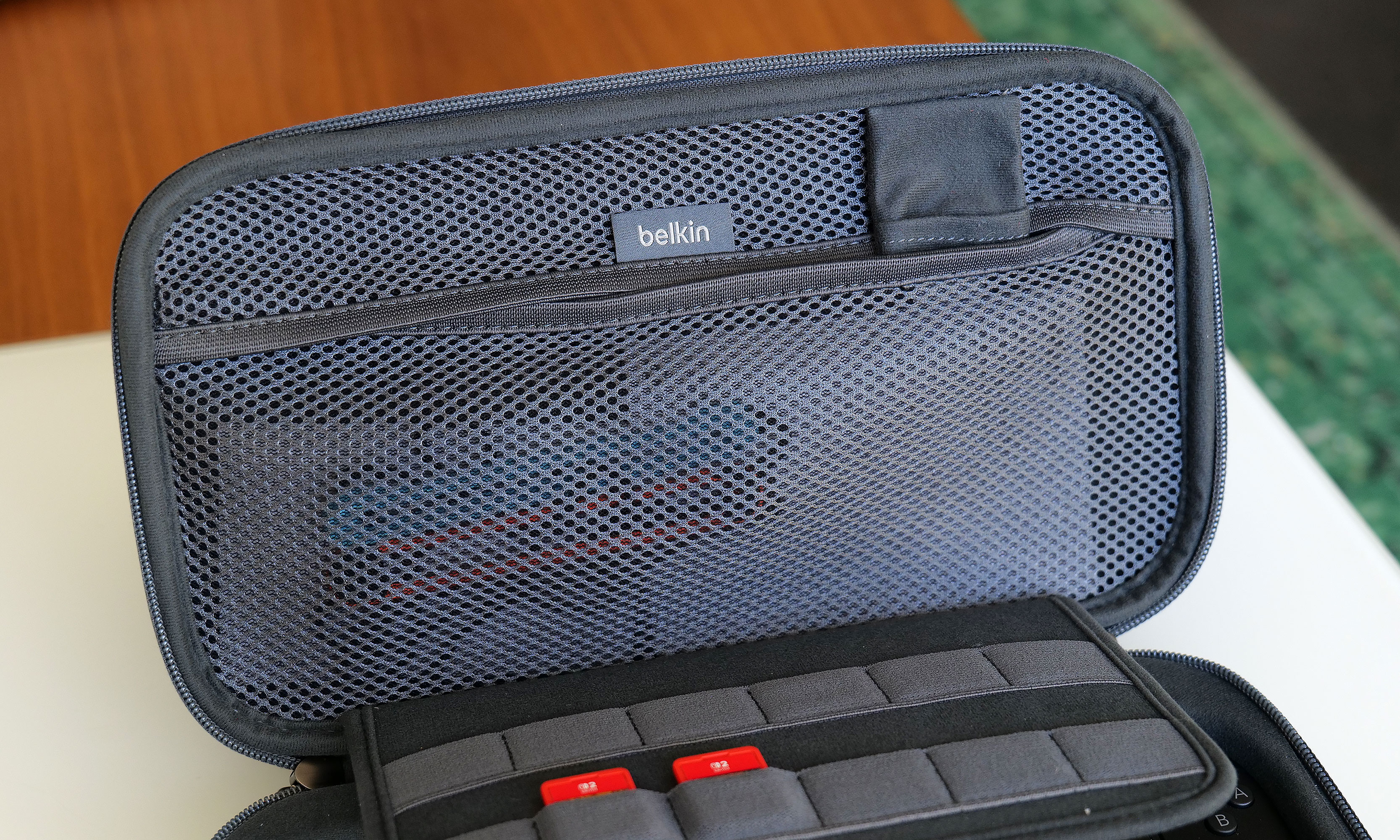
Other small touches on Belkin’s Pro Charging Case include a mesh pocket for storing things like cables, Joy-Con straps or cleaning cloths, which is very handy. However, my favorite thing might be the AirTag pouch that’s also hidden inside that pocket, which could give you a fighting chance of recovering your system if it’s ever lost or stolen (though I wouldn’t count on it).
Battery pack
Sam Rutherford for Engadget
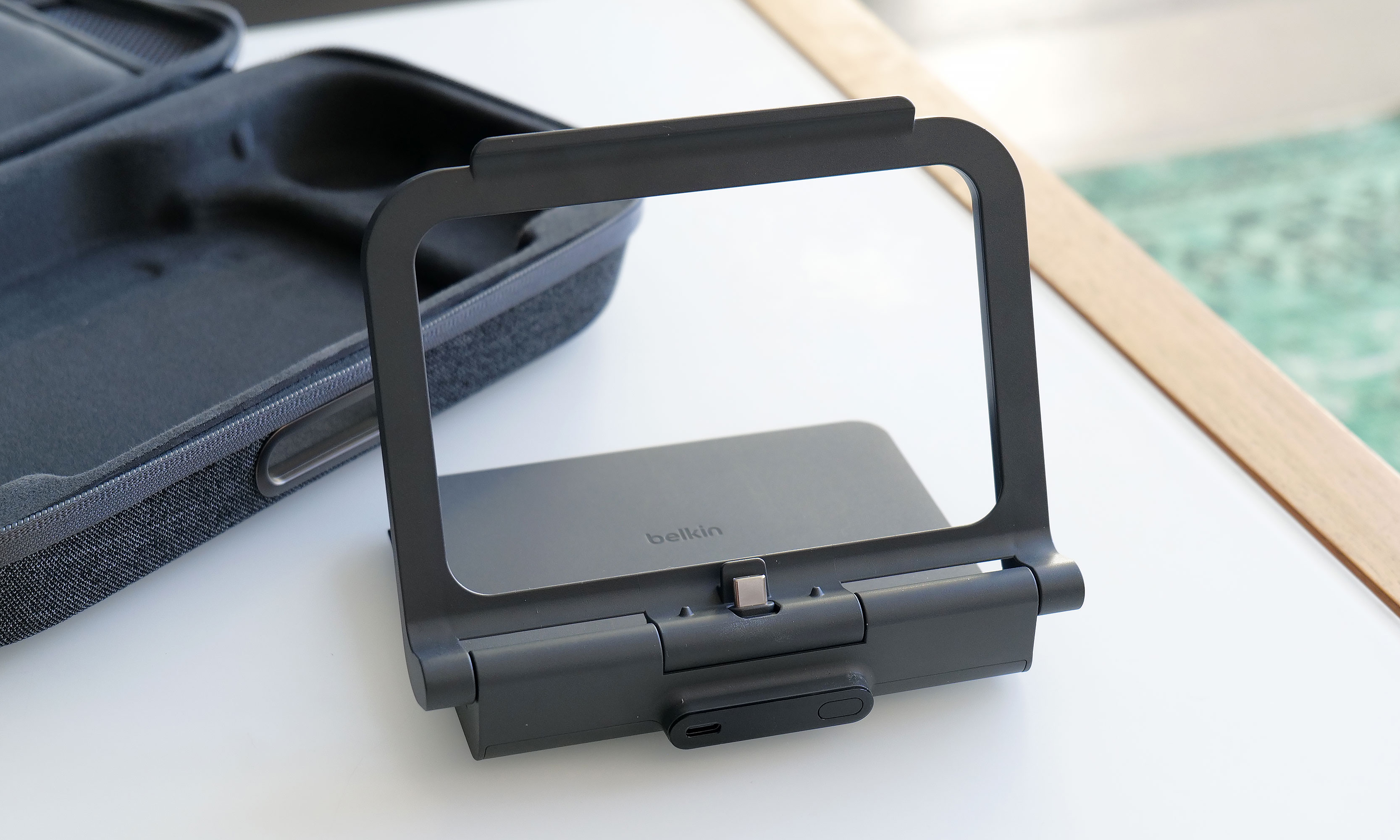
Despite the increased size of the Pro Charging Case’s included battery, it has the same 10,000mAh capacity as what you get from its less expensive sibling. That means you’ll typically have enough juice for a little more than 1.5 recharges for your Switch 2 and its onboard 5,220mAh cell. Instead of relying on a simple external power pack like before, Belkin’s bundled battery comes with a second USB-C port and a kickstand. This makes it super easy to plug in your Switch 2 every time you put it in the case. This way, you know the next time you turn it on, it’ll be at 100 percent.
Sam Rutherford for Engadget
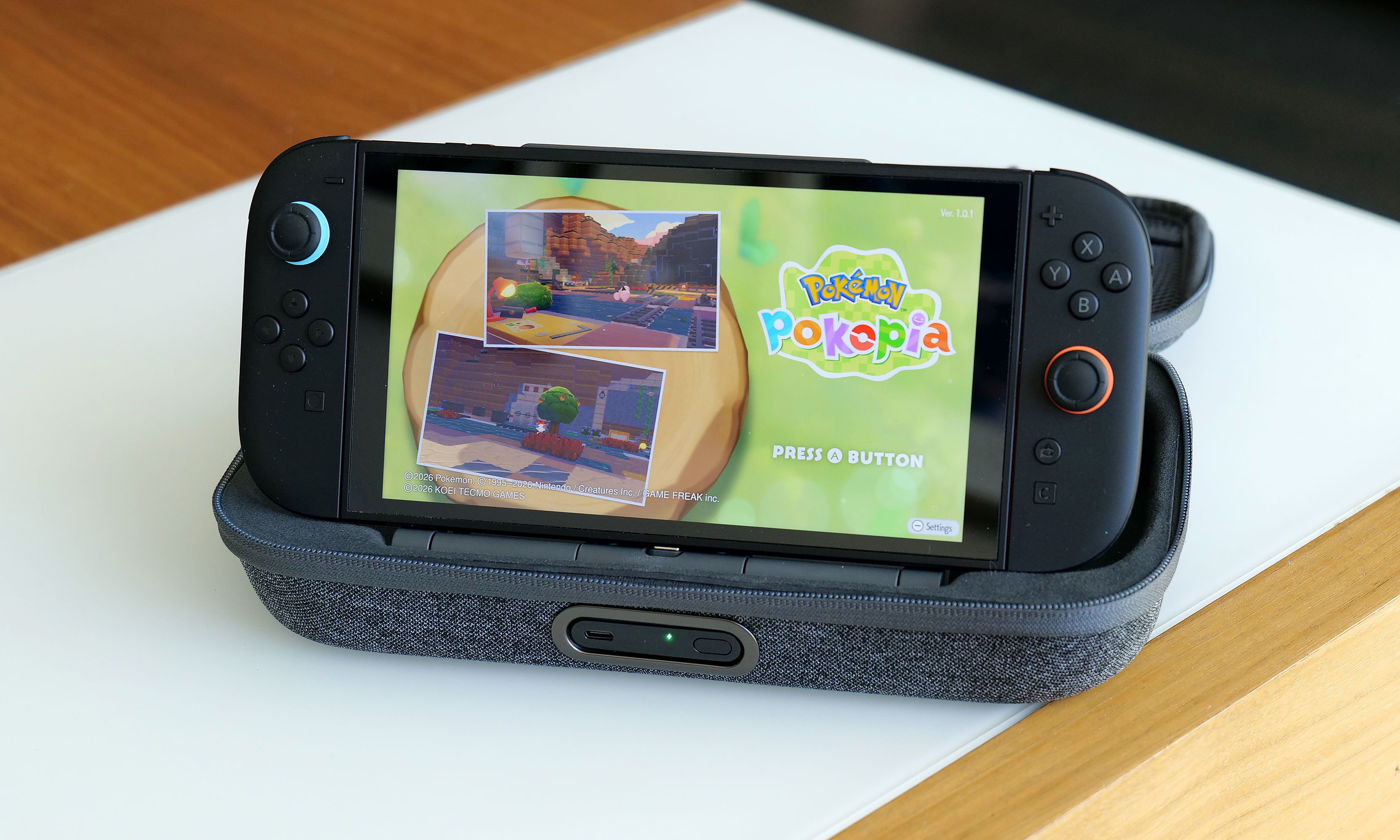
Alternatively, you can raise the kickstand to prop up the Switch 2 and game on it while it stays nestled inside the case. This might seem a bit redundant as Nintendo’s console already has its own kickstand, but Belkin’s allows you to continue charging the system while you’re playing without needing a cord. There’s even a handy display on the side of the battery, so it’s super easy to see how much juice is left, even when the case is closed. Furthermore, when you need to recharge the power pack, you can do so without removing it from the case or disconnecting your Switch thanks to that bonus USB-C port on the outside. Compared to the previous model, this is certainly a more elegant solution that provides some subtle quality of life improvements. The one downside is that the battery pack is somewhat awkwardly shaped, so you won’t really want to use it on its own.
Wrap-up
There’s no doubt the Pro Charging Case’s new battery pack is a more premium solution that’s easier to use and manage. When you need to recharge it, you can do so from the outside without opening the pouch. It also lets you charge a Switch 2 without ever needing a cable. The built-in kickstand is another bonus that helps elevate the whole kit from a simple case to something closer to a tiny all-in-one gaming booth.
Sam Rutherford for Engadget
That said, after using it for a couple of weeks, I’m still not sure the added convenience is worth an extra $30 over the original. Due to the battery packs’ new shape, it’s less useful as a standalone power cell, and the rest of the case’s design is largely unchanged. Of course, it’s always nice to have options, and if you’re the kind of person who doesn’t mind spending a little extra for a more streamlined and convenient kit, Belkin’s Pro Charging Case for the Switch 2 is still very much worth consideration.
This article originally appeared on Engadget at https://www.engadget.com/gaming/nintendo/belkin-charging-case-pro-for-switch-2-review-a-more-elegant-solution-144820809.html?src=rss
Jeff Bezos just announced plans for a third megaconstellation—this one for data centers
A little more than a month ago, SpaceX founder Elon Musk put down a marker of his intent to saturate low-Earth orbit with up to 1 million satellites. Its purpose? Provide always-on data center services around the planet.
Now, Amazon and Blue Origin founder Jeff Bezos has done something similar with a filing to the Federal Communications Commission of his own, proposing a constellation of up to 51,600 satellites operating in Sun-synchronous orbits at altitudes ranging from 500 to 1,800 km. Bezos’ space company, Blue Origin, sought the authority to do this and is calling the constellation “Project Sunrise.”
In its filing, Blue Origin argues that terrestrial AI-based data centers will face difficulties scaling up to meet computing demand.
Nintendo Could Be Forced To Shed One Of Its Biggest Anti-Consumer Practices

An EU law comes into force next year that demands portable devices have replaceable batteries
The US is looking at a year of chaotic weather
Despite being declared the third-hottest year on record, 2025 was a relatively quiet year for climate disasters in the US. No major hurricanes made landfall, while the total number of acres burned in wildfires last year—a way of measuring the intensity of wildfire season—fell below the 10-year average.
But starting this week, the West is experiencing what looks to be a record-breaking heat wave, while forecasting models predict that a strong El Niño event is likely to emerge later this year. These two unrelated phenomena could set the stage for a long stretch of unpredictable and extreme weather reaching into next year, compounding the effects of a climate that’s getting hotter and hotter thanks to human activity.
First, there’s the heat. Beginning this week and heading into next, a massive ridge of high-pressure air will bring record-breaking temperatures to the American West. The National Weather Service predicts that temperature records across multiple states are set to be broken in dozens of locations, stretching as far east as Missouri and Tennessee. The NWS has issued heat warnings for parts of California, Arizona, and Nevada, as well as fire warnings for parts of Wyoming, Nebraska, South Dakota, and Colorado.
Feds say no need to recall Tesla’s one-pedal driving despite petition
One-pedal driving is not causing Tesla electric vehicles to suddenly accelerate when parked, according to federal regulators. For almost as long as Tesla has been selling cars, it has been hit with sporadic accusations of parked cars accelerating when they shouldn’t. Known to the industry as “sudden unintended acceleration,” the question for regulators is whether the problem is a human one or an engineering one, and over the years, engineers who think they’ve found the culprit have petitioned the National Highway Traffic Safety Administration to force a recall. These efforts usually fail, as was the case today, when NHTSA said it would not tell Tesla to recall every EV it built since 2013.
Because electric motors are also generators, EVs use regenerative braking to recover energy when they slow down rather than wasting that kinetic energy as heat (and maybe a bit of sound) via the friction brakes. In many battery EVs and just about any hybrid I can think of, a brake-by-wire system blends the two together—the driver uses the left pedal as normal, and the car slows down. Some automakers (I’m looking at you, Porsche) think this is the only way a driver should slow their EV. But an electric motor can also be programmed to regeneratively brake when the driver lifts their foot from the throttle, and in Tesla’s EVs (as well as Rivian’s and Lucid’s), this is the only way to regen, as there is no brake-by-wire system, only traditional hydraulic friction brakes.
Technically, I just described lift-off regen, but if the car has been programmed to come to a complete stop when you take your foot from the accelerator, that’s one-pedal driving. Some EV drivers absolutely love one-pedal driving; others don’t. I like one-pedal for low-speed driving or when I want something similar to engine braking. But according to the petition sent to NHTSA in 2023 by a Greek engineer, this causes a “short-circuit” in Tesla drivers’ brains.
Ubuntu 26.04 Delivers Enhanced Performance For AMD Radeon Linux Gaming
Earlier this month was a preview of the Ubuntu 26.04 performance benefits for NVIDIA Linux gaming while today’s article is providing an early look at how the open-source AMD Radeon gaming experience is looking for the upcoming Ubuntu 26.04 LTS release.
SteamOS 3.8 Preview Preps For Steam Machine, KDE Plasma Desktop With Wayland By Default
In addition to last night’s Steam client beta with Steam Runtime container support for the client and that SteamRT3 client now a 64-bit build, Valve also released a big preview update to the forthcoming SteamOS 3.8. The SteamOS 3.8 preview release brings initial support for Steam Machine hardware, various handheld gaming device support improvements, various other Steam Deck updates, improved compatibility with newer Intel and AMD platforms, and its KDE Plasma desktop is now using Wayland by default…
Amazon is reportedly working on a new phone built around Alexa
Amazon is reportedly planning to re-enter the smartphone market more than 10 years after its last attempt. According to a Reuters report, the mysterious phone is internally codenamed “Transformer” and is being developed by the company’s devices and services unit.
There isn’t a whole lot to go on right now, but it probably won’t surprise many to learn that the phone will likely lean heavily on AI. According to Reuters’ sources, Alexa functionality would be a core part of the experience, but Amazon wouldn’t necessarily build a custom OS around its voice assistant. The phone would make buying products on Amazon and using services like Prime Music and Prime Video “easier than ever,” and may bypass traditional app stores.
Reuters reports that the Transformer project is being led by the recently established ZeroOne, an Amazon devices unit headed up by ex-Microsoft executive and Xbox co-founder J Allard, who was also one of the creators of Zune. Allard joined Amazon last year to lead a “a special projects team dedicated to inventing breakthrough consumer product categories.”
The development team has reportedly considered launching both a traditional smartphone and a so-called “dumbphone,” which would presumably strip away anything that needlessly distracted you from the Amazon empire. Reuters’ anonymous sources suggest the latter could help combat screen addiction by offering fewer features.
ZeroOne is apparently inspired by the ultra-minimalist Light Phone, suggesting that Amazon might be reluctant to take on the flagship devices of Apple and Samsung. The report adds that the Transformer phone could even be positioned as a secondary handset.
This, of course, would not be Amazon’s first crack at the smartphone business. The company launched the Fire Phone in 2014, an ambitious and interesting device that ultimately failed to tempt people away from the more established smartphone ecosystems. It’s widely remembered as perhaps the company’s biggest hardware misstep.
With analysts forecasting an unprecedented decline in the smartphone market in 2026, now seems like a risky time for Amazon to try again, and Reuters was unable to determine exactly how much the company has committed to the Transformer project. Sources also wouldn’t rule out it being scrapped altogether if the company’s priorities suddenly shifted.
This article originally appeared on Engadget at https://www.engadget.com/mobile/amazon-is-reportedly-working-on-a-new-phone-built-around-alexa-142244500.html?src=rss
Super Micro Co-Founder Charged In $2.5B NVIDIA AI Chip Smuggling Scheme To China

The unsealing of a federal indictment has exposed a multi-billion dollar shadow pipeline designed to funnel restricted NVIDIA AI chips into China. At the center of the controversy is Wally Liaw Yih-Shyan, the 71-year-old co-founder and Senior Vice President of Super Micro Computer, who now faces serious criminal charges for allegedly orchestrating
Meta Shows Confidence in EMG Input for Wearables by Funding Six External Studies
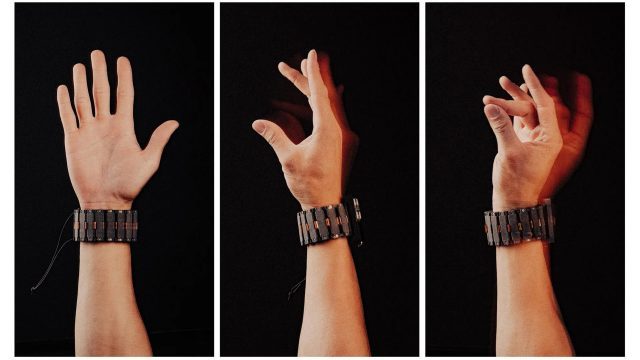
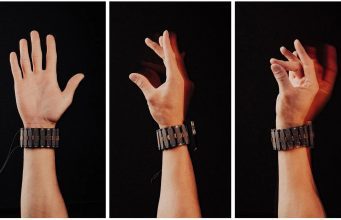
Meta announced it’s tapped six external teams to receive a research grant in order to advance work on its surface electromyography (sEMG) based wristband controller.
Meta revealed in a blog post it’s launched a research funding initiative focused on improving how users learn and interact with sEMG systems, having chosen six universities out of 70 global submissions.
Each research group is set to receive $150,000 in funding, which includes teams at the University of Central Florida, University of South Florida, University of California, Davis, Newcastle University, University of British Columbia, and Northwestern University.
Meta’s wrist-worn neural interface relies on sEMG, which detects electrical activity in the wrist and hand and translates it into digital commands. As Meta Ray-Ban Display’s main input device, the company hopes to answer a few questions with the studies, namely: how do people learn new sEMG-based controls, and how can onboarding be streamlined?
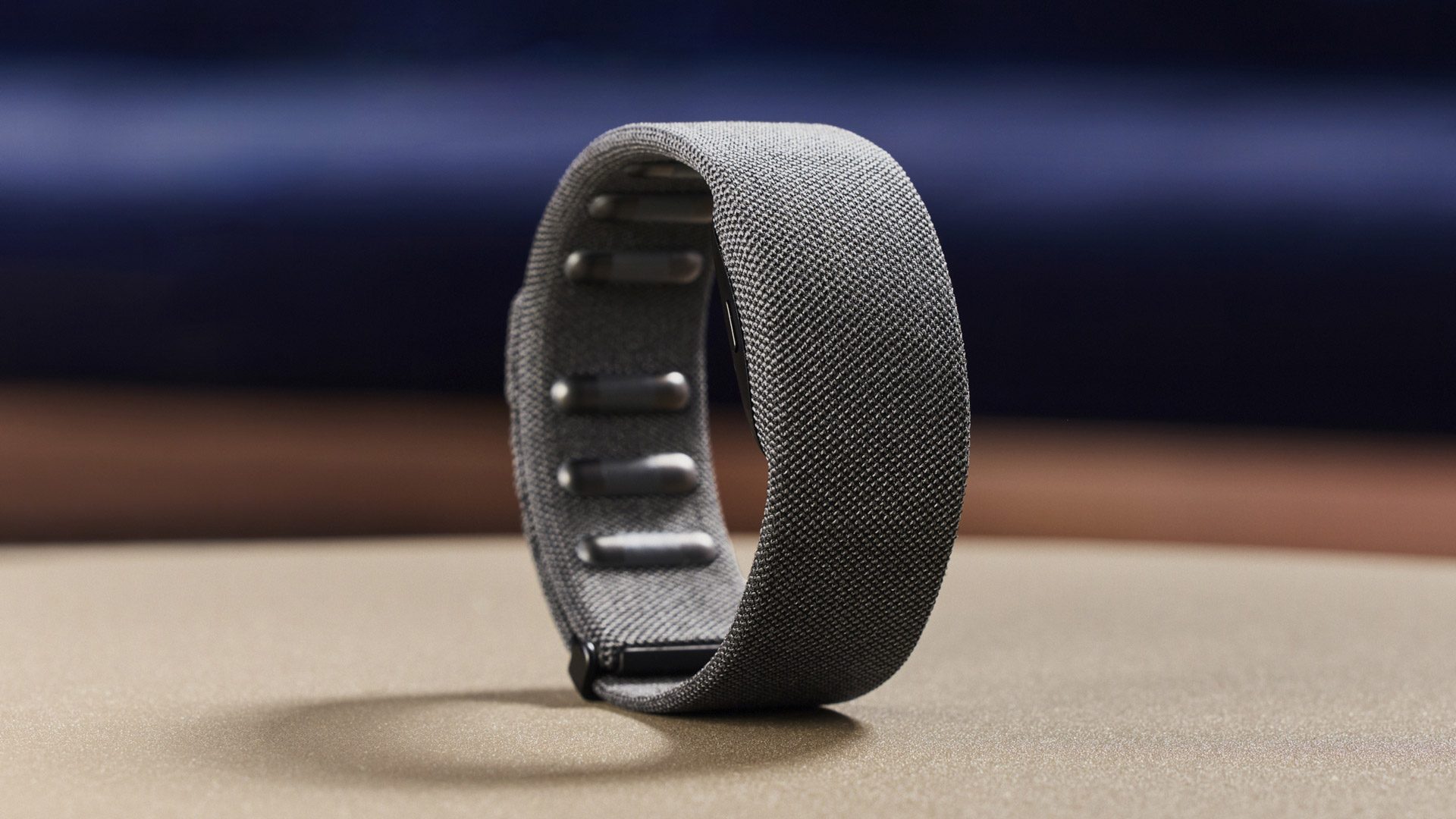
The funded projects explore a range of challenges. Some focus on improving learning methods, such as comparing gamified training with step-by-step instruction, or developing systems that adapt to individual users over time.
Others aim to expand what sEMG can do, like enabling silent speech generation by translating muscle signals into synthesized voice, or increasing the ‘bandwidth’ of communication so users can issue more complex commands without disrupting natural hand movement.
A number of the proposed research topics include assistive applications, such as helping stroke survivors regain muscle control, or improving prosthetic limb operation through co-adaptive systems that learn alongside the user. You can see more about each study here.
This follows the release of Meta Ray-Ban Display last September, the company’s first pair of smart glasses with a built-in display. Priced at $800 and only available in the US for now, the smart glasses make use of the same input scheme first paired with Meta’s Orion AR prototype, which was revealed in late 2024.
This ostensibly shows Meta is pretty confident in the control scheme, viewing it as reliable enough for future (likely AR) devices. We’re looking forward to learning more as the research projects progress. Typically, we see papers either highlighted or released during SIGGRAPH, which is taking place in Los Angeles, California this year on July 19th – 23rd.
The post Meta Shows Confidence in EMG Input for Wearables by Funding Six External Studies appeared first on Road to VR.
Amazon May Launch An AI Smartphone Years After Its Fire Phone Failure
You can be forgiven for having forgotten all about Amazon’s ill-fated Fire Phone. It released a long time ago and despite an initial flurry of sales, it wasn’t all that long after launch that Amazon held a fire sale of its Fire Phone due to underwhelming demand, and vowed there would not be a sequel. Never say never, though, as Amazon is evidently
Slay The Spire 2 Is Getting Review Bombed On Steam Over Upcoming Balance Patch

Some fans are using Steam reviews to submit their input on upcoming changes rather than the in-game ‘Feedback’ option
Saudi Arabia Just Spent Over $6 Billion Buying Up More Of The Video Game Industry

Savvy Games just scooped up another mobile juggernaut