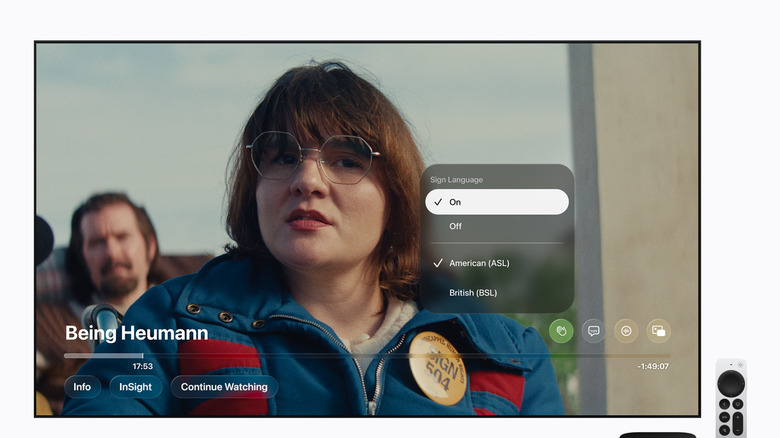
You’ll be able to watch ‘Being Heumann,’ ‘F1’ and other original titles with sign language interpretation.



Read more of this story at Slashdot.


We may earn a commission from links on this page.
Ring made its name with its smart doorbells with built-in cameras, and now sells more indoor cameras than any other company, capturing more than 40% of the market. When you’ve already moved tens of millions of devices (enough to raise serious concerns about their use as part of the surveillance state), you always need to keep innovating, and today, the company announced a product it has been working on for a decade: an indoor camera drone powered by artificial intelligence. I got a chance to check it out during a media event yesterday, and I can report that, as harbingers of our dystopian future go, it is only mildly terrifying.
The drone camera is one of two products in the company’s new Ring Robotics line, alongside a “rover cam” that looks kind of like the canister of a vacuum cleaner attached to an iPad. While the Ring Rover Cam is priced at $999.99 and targeted at businesses, the Ring Drone Cam is a much more affordable $249.99, reasonable enough that it will appeal to consumers looking for another way to keep (robot) eyes on their stuff.
The drone camera records 2K video and has a 148-degree field of view and the ability to rotate 360 degrees. It works with existing Ring cameras, doorbells, sensors, and alarms, as well as the Alexa Home Map. It has a flight time of eight minutes, and once it returns to its base station, it takes around an hour to fully recharge (eight minutes on the dock will give it one minute in the air).
As Ring founder Jamie Siminoff explained during the preview event, the company has been trying to build a workable camera drone for around a decade, but couldn’t overcome certain design challenges until the advancement of AI models that allow the device to handle most of the computing—from route programming to threat detection—via the cloud, so the drones can be smaller and lighter.
According to Ring, when setting up the Ring Drone, you carry it around your house, allowing it to map the interior. It will “intelligently identify rooms and suggest patrol points: spots worth extra attention.” When sent out on “patrol,” the drone’s AI pilot will travel between hotspots, sensing and avoiding furniture and other obstacles along the way.
The Ring Drone works with other Ring cameras, so if an alert is triggered somewhere in your home—say, a window opening unexpectedly—the drone will take off to investigate. It has a built-in security light that will make its presence known, so it can also act as a deterrent, though the screaming sound of its spinning propellers will accomplish that just as well.
According to Ring, the drone camera can deliver peace of mind whether you’re home or away, and admittedly I do like the idea of being able to check on my pets or make sure no pipes have burst while I’m at work or on vacation (though admittedly you can get the same sort of monitoring without involving an AI device that looks like a mini version of the flying robots from The Terminator).
I admit that the Ring Drone Camera seems pretty cool, provided I don’t think about it too much. I don’t know that I really feel the need to have every inch of my home covered in security cameras, but I do like the idea that the drone could, for example, go to check out what’s going on if one of my smoke alarms’ temperature sensors reports that one spot in the house is all of a sudden hotter than it should be.
But there’s something slightly unsettling to me about the idea of a robot patrolling my home while I sleep. Yes, I know that there are privacy and security features in place—Ring says the videos its robots capture is protected by its “strongest default encryption yet”—but it’s also yet one more example of how comfortable we’ve all gotten with cameras being absolutely everywhere, to the point that people think nothing of putting them all over their homes. (This is probably why I don’t own a robot vacuum.)
And it doesn’t help that the drone sounds absolutely terrifying, which Ring claims is by design: “If someone’s there who shouldn’t be, a flying drone overhead…makes it clear they’ve been spotted. [The] devices are built to deter, not just monitor.” True enough, but there’s also no getting around the fact that drone propellers are unavoidably loud, and the sound of the Ring Drone Camera reminds me of nothing more than the screeching violins in a horror movie. (Note that the drone we were shown was white, but the final version sold will be dark grey.)
If you’re ready to enter this brave new world of security, you’ll have to wait a bit longer: The Ring Drone Camera isn’t expected to ship until January 2027, but you can sign up to be alerted when it is available for preorder now.
Evaluating the annual global temperatures each year requires context. There is a fair amount of natural variability from one year to the next, so it’s important to focus on the trend over time. Famously, global warming did not end in 1998, as some claimed a couple of decades ago—we just had a run of La-Niña-dominated years after a very strong El Niño.
Annual greenhouse gas emissions are much less variable, having increased fairly steadily, but many complicating factors can still muddy the picture. Sometimes those factors conspire to throw a year off the trend. It looks like 2026 will be one of those years.
A new analysis led by Corinne Le Quéré at the University of East Anglia estimates that fossil fuel emissions have fallen about 0.4 percent from last year. This probably isn’t a peak that symbolizes heartening progress on climate change, though; the researchers think it’s a short-term dip driven by the war in Iran and its effect on oil prices.

The annual Taurid meteor
NASA’s competition for the development of private space stations that will take flight in the 2030s is already nearing crunch time. But a recently unsealed lawsuit may spice things up even further.
The lawsuit involves two of the most prominent companies in this competition, Houston-based Axiom Space and Long Beach, California-based Vast Space. And it is surfacing as final proposals for private space stations are due from companies to the US space agency a little more than one month from today, on December 14.
According to the court filings unsealed by a November 4 order from US District Judge Charles Eskridge, Axiom is pursuing a False Claims Act case against Vast in which Axiom accuses Vast of presenting NASA with a fraudulent mission-planning document that incorporates Axiom’s proprietary information.

Google DeepMind has revealed a new generation of the AI-powered Gemini Robotics platform. In the 2.5 release, Google says its robotic AI is getting tantalizingly close to completing real-world tasks as well as humans do. In fact, some Gemini robots were able to get actual work done in Mercedes-Benz factories, and the team is preparing for a day when robots operate alongside humans with an open source safety benchmark.
DeepMind’s physical AI platform has several computational layers between user input and robotic action. There’s the vision-language model piece, which is Gemini Embodied Reasoning. Essentially, it takes your instructions and uses live video to plan how the robot can accomplish the task. The other main component is the vision-language-action (VLA) that actually generates robot actions, like moving an actuator—that’s Gemini Robotics, which has been bumped to version 2.5.
DeepMind says that Gemini Robotics 2.5 is much better at tasks that require a high degree of dexterity. The model was evaluated across more than 200 activities, including serving food with tongs and using a pipette, as you would see in a laboratory. Google also showed that Apptronik’s Apollo 2 humanoid robot with Gemini Robotics 2.5 can now tie a bow with its five-fingered hands, a notable feat, because deformable objects (like ribbon) are notoriously difficult for robots to manipulate.
The investigation of Jensen Huang by Nvidia’s board threatens the future of one of Silicon Valley’s longest-serving executives and a key enabler of the AI boom, who has no obvious successor as leader of the world’s second-most-valuable company.
Huang is fighting for survival after admitting to an extramarital affair, believed to be with an executive at a large Nvidia customer whom US officials also allege was working as a Chinese spy.
The prospect that Huang could be forced out as chief executive of the US chipmaker he co-founded more than 30 years ago has alarmed investors and allies in the tech industry. Shares in Nvidia, which late last month ceded its position as the world’s most valuable to Apple amid a broader sell-off in AI stocks, had fallen more than 5 percent by midday trading on Monday.