Why Websites Show the Wrong Server Location When You Use a VPN

There are many reasons why someone might use a VPN, but most often, it’s to conceal your real geographic location or prevent websites from tracking your online activity. It can also be a way to get around location-based restrictions that stop you from accessing certain websites or platforms. 

When you connect to a VPN server in the United States, websites are supposed to detect that your online traffic is originating from the U.S. That way, you can access online platforms that use IP filters to block non-U.S. traffic or circumvent regional censorship when travelling outside the U.S. But if you connect to a VPN server in the United States while you’re vacationing in Mexico, and a website thinks your IP address is from Brazil, that might not solve your problem and may even add unnecessary complications. 

If you’ve encountered something similar with your VPN provider, there are several fixes you can try. Depending on why your IP location is being misinterpreted, one of these should help you access the internet from the server location of your choice. 
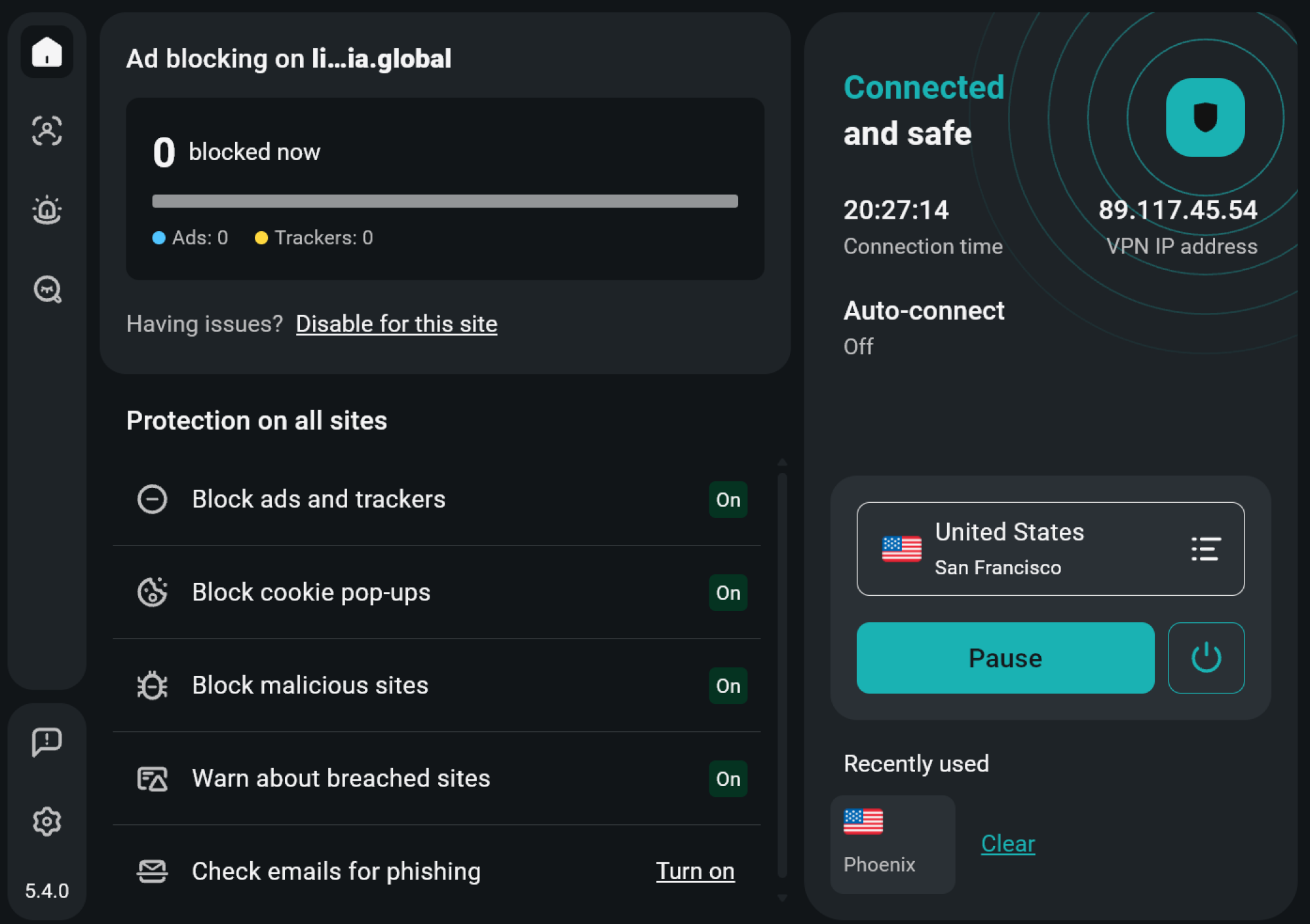
Surfshark VPN's browser extension for Google Chrome.
Some websites fail to read your correct IP address when you’re using a VPN service.
Credit: Surfshark

Why websites misread your VPN location

IP geolocation isn’t infallible. Websites rely on third-party IP databases to look up your location based on your current IP address. Maxmind, which has one of the largest such databases in existence, claims that its GeoIP products have a 99.8% accuracy. Lesser-known providers with smaller IP databases may be far less accurate. 

Websites can also use more than just your IP address to estimate your location. For example, they can send WebRTC requests to your browser or directly query your device’s GPS. Moreover, VPN providers often have physical servers in one country while their IP addresses are registered to another country, and this discrepancy can also create issues. Let’s take a closer look at each of these problems individually, so you can find the fix that works best for you. 

WebRTC leaks expose your real IP address

WebRTC is an open-source technology that lets your browser reduce latency when engaged in high-bandwidth tasks like streaming or video calls. Based on the IETF standard RFC 8828, it lets a website choose between your VPN server and your real IP address so it can establish the quickest path to transmit large amounts of data and reduce wait times or buffering. 

But the catch with WebRTC is that it exposes both your VPN server and ISP-assigned addresses to websites, which can reveal your real IP location and cause websites to reject your VPN server country. Firefox now comes with built-in protections to prevent WebRTC leaks, while Chrome and Edge support third-party extensions like WebRTC Control that you can use to eliminate these issues. To check if your browser is leaking your real IP address during WebRTC requests, you can use a free tool like BrowserLeaks.

DNS lookups point to the wrong country

Even when a browser isn’t leaking your real IP address, DNS resolvers may fetch inaccurate location information if their nearest servers are too far from your current location. For example, a user in São Paulo may be geolocated to Chile when using Google Public DNS because that’s where Google’s nearest resolvers are located. 

If you toggle on DNS leak protection in your VPN app, this will force websites to use your VPN’s resolver to perform DNS lookups. That often solves the problem, but, again, you can confirm the fix worked through a service like BrowserLeaks or IPLeaks.

Outdated databases point to wrong locations

Websites rely on IP databases like Maxmind, IP2Location, IPinfo, etc. to look up your exact location, but these databases get outdated quickly and need constant updating. Most of these databases also correct errors on request, but that takes some time. Also, each website has its own rules for how often it queries IP databases for updates.

Even when locations are updated in the actual database, a website may be sitting with outdated information unless it actively has refreshed it recently. MaxMind recommends doing this at least twice a week, but that’s ultimately up to the specific website.

Virtual servers don’t match their physical location

VPN providers often rely on virtual servers that use IP addresses registered in a different region than the server’s physical location. For example, ExpressVPN notes that it serves IP addresses in Bolivia, Ecuador, Peru, Uruguay, and Venezuela through servers located physically in Brazil. 

While this is usually to help with the lack of local infrastructure or strict surveillance laws in the region, many databases and analytics tools will flag the discrepancy for websites, leading to confusion and inconsistency regarding your actual server location. In these cases, your best bet is to switch your VPN server or use a dedicated IP address by signing up for a paid add-on for your VPN.
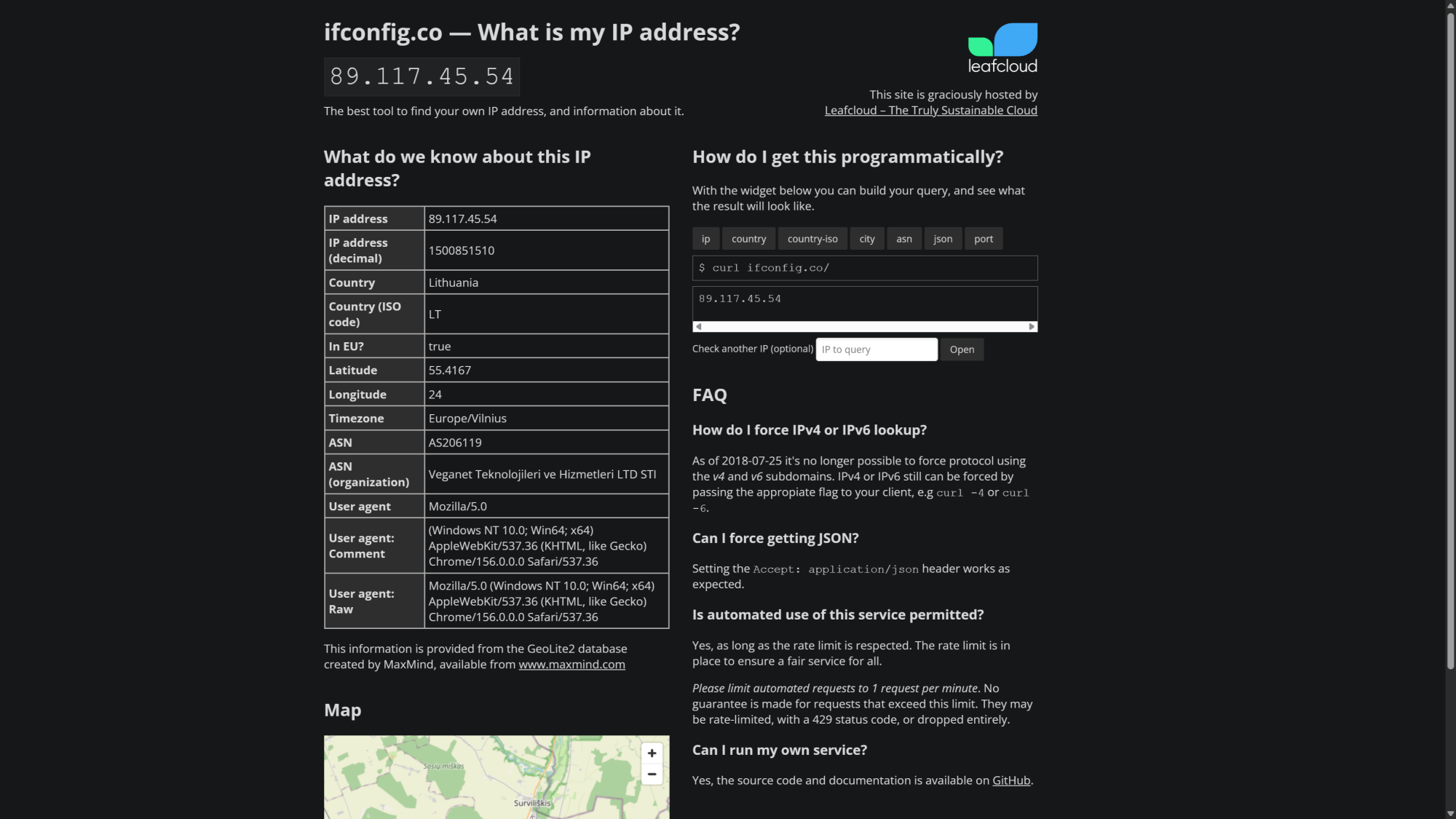
IPConfig welcome screen displaying IP address scan results.
You can run a free scan on your browser to detect your current IP address, geolocation, and servers.
Credit: IPConfig.co

How to check for IP location mismatches for free

Before investing in a specific solution, it’s better to do a thorough lookup to make sure why your IP address is pointing to the wrong location and whether a WebRTC or DNS issue, virtual servers, or something else is the cause. Here’s how I’d go about it, step by step: 

  1. We’ll start by recording your baseline IP address, country, city, and ASN. With your VPN disconnected, navigate to IPConfig.co on your browser to grab your default IP details. I like this tool because it’s free and uses echoip to pull your location data straight from Maxmind. If you prefer using Terminal instead of your browser, you can also run curl ifconfig.co/json to grab these details in plain text format.

  2. Now connect your VPN server. Then visit IPConfig.co again to note down the changed details. 

  3. Make sure the Country and Timezone fields match your current VPN server location. Also make sure the ASN (organization) field does not list your home ISP.

  4. In case these details do not match your VPN server, run a WebRTC leak test and a DNS leak test using BrowserLeaks. If either of these tests doesn’t return your VPN server’s IP address, you’ve found your culprit.

  5. If both the leak tests come back clean but a specific site still gets your location wrong, the issue is likely originating from an outdated database or virtual server. 

There’s no surefire way to solve IP location mismatches for good. But if it happens often enough to disrupt your internet use, you can consider switching to a different VPN server and getting a browser add-on that prevents WebRTC leaks. If that doesn’t work, I’d consider buying a dedicated IP address that isn’t based on a virtual server. While many IP databases like MaxMind or IP2Location also have ways to request a location correction, that takes a while to go through and isn’t worth the effort unless it’s a permanent IP address registered through your ISP.


High Tide (Linux TIDAL Client) adds playlist editing, artist blocking + more

A new version of High Tide, an unofficial TIDAL music streaming app for Linux built with GTK4/libdwaita, is out. Hight Tide 1.6.0 plumbs in support more features found in the paid streaming service’s official clients, including the ability to block artists and tracks for appearing in playlists or auto-play queues, with a new preferences panel to see and manage your blocks. Play buttons are now…

The US military seems to be getting nervous about the launch supply crunch

The US military is taking a new approach to prop up commercial launch companies as SpaceX looks to wind down its Falcon rocket program, suggesting defense officials see the workhorse rocket’s retirement as a potential national security risk.

The Pentagon’s Office of Strategic Capital has twice in the last two weeks announced it was sending cash to two of SpaceX’s competitors in the launch business. First, on October 26, the office announced a $150 million conditional loan commitment to Stoke Space. Military officials revealed a second $150 million Pentagon loan Tuesday for Rocket Lab.

Stoke Space and Rocket Lab are the first two launch companies to receive significant support from the Office of Strategic Capital (OSC), an organization established in 2022 to infuse companies developing “vital” national security technologies with capital. OSC has been on a loan spree in recent weeks, committing hundreds of millions of dollars to companies specializing in batteries, drones, and semiconductors. In the space sector, the office also provided a $150 million loan to LeoLabs, a commercial satellite tracking company, for production and deployment of radar units.

Read full article

Comments

Ring cameras go mobile as Amazon debuts AI-powered security drone and robot

Amazon is betting that many Ring customers will also want an AI-powered security drone and robot patrolling their homes or offices. But the company’s upcoming Ring Robotic products are also certain to intensify privacy concerns previously raised around a prior Amazon attempt to popularize a flying security camera.

The Ring Rover Cam and Ring Drone Cam are expected to reach customers starting at the end of 2026 and in early 2027, respectively, according to an Amazon announcement posted on November 10. Amazon describes the devices as relying on an AI Pilot system that uses each device’s cameras along with “specialized vision models, on-device sensors and cloud processing” to plan patrol routes while autonomously navigating around obstacles such as furniture.

Both devices also use that AI Pilot system to digitally map the floor plan of the customer’s home or business. This setup process occurs after the customer carries the Ring drone through their indoor spaces or allows the Ring Rover to do some autonomous exploration.

Read full article

Comments

Fireworks AI Confirms Wider Breach Affecting Notion AI Chats

Fireworks AI says its October breach was broader than initially disclosed, with attackers gaining access to customer account and billing information as well as some datasets, incomplete model weights and secrets. Notion, the popular productivity and note-taking app, disclosed that it was impacted in the breach but “fewer than 1% of Notion workspaces” were involved. “Upon analysis of the new data, we discovered that it included Notion AI chat transcripts used for the Insights feature, which for the vast majority of impacted workspaces were unattributable,” it said. “‘Unattributable’ means the chats weren’t labeled with who wrote them or which workspace they came from, and the transcripts did not contain tool call results.” The Hacker News reports: In a notice published on October 10, 2026, [Fireworks AI] said it detected unauthorized use of internal Fireworks credentials that allowed an unauthorized third-party to access environment variables used in evaluation jobs in a limited number of customer accounts. The activity was detected on October 6, 2026, at 9 a.m. PDT. […] The latest bulletin from the company reveals that the scope of the breach may have been broader than previously thought. The company said attackers reached its development environment via an unnamed third-party cloud provider that hosted Fireworks research and development (R&D) machines on October 23, 2026.

“On October 24, the unauthorized third party used it to reach Fireworks development machines and then run an unauthorized workload that led to additional customer data impact,” it added. “As of October 25, we have not detected further evidence of successful unauthorized access by the threat actor on the Fireworks platform customers use.” The breach is said to have provided access to the following types of information: [Resource metadata; Billing information; and Model weights and datasets]. Fireworks AI said payment card numbers are not stored by the company and were not impacted by the security incident. It also said it’s alerting customers whose data was impacted.


Read more of this story at Slashdot.

High-Protein Packaged Foods May Not Be As Healthy As They Look

We may earn a commission from links on this page.

Of the three major macronutrients—protein, carbs, and fat—protein has the best reputation, and it’s fairly well deserved. We need significant amounts of protein in our diet, and nothing particularly bad happens if we get too much. Dietary protein helps you build muscle, and if you’re trying to lose weight it helps stop you from losing too much muscle along with the fat. It also helps to make meals feel filling. Great! But.

Once the general public gets the idea that something is good for you, the companies that make packaged food start putting it in everything. Or, they make products where the good-for-you thing features prominently on the label, whether or not there is very much inside. So a lot of packaged food now boasts protein on the label. Here’s what you should ask yourself about those foods:

Look at how much protein is actually in it

Take a close look here—sometimes a food will boast of a certain amount of protein per package but the package contains two or three servings. Other times, the protein per serving is correct, and we’re supposed to be excited to have, say, 7 grams per serving. That’s just not very much—and certainly not worth paying extra or choosing a less-delicious food just for those few added grams.

It’s good to know how much protein you need in your diet. If you’re not gaining or losing weight, and not doing very much exercise, a 150-pound person only needs about 54 grams of protein a day. (I’ve done the math for various body weights here.) If you’re working out a lot, or if you’re trying to gain or lose weight (yep, either way), that same 150-pound person will need more like 81 to 95 grams of protein per day. More is OK, but not necessary.

So if you’re trying to get 90 grams per day, 30 grams per meal is a reasonable amount to shoot for. Coincidentally, 30 grams is the amount of protein that tends to make a meal feel satisfying. You can do the math to figure out whether a protein-added product is going to be helpful in your day’s diet.

What would you eat if you weren’t eating this?

I think this is the most important question about protein-added foods. It’s not hard to get protein in a meal; meats, dairy, tofu, beans, and grains all tend to supply plenty. So what is this protein-added thing you’re considering, and are you eating it instead of a traditional meal?

Here’s an example. If I’m heading straight from the gym to run some errands, and I need something to substitute for a meal—yeah, this isn’t great planning, but sometimes it happens—a protein bar with 20 grams of protein is a step in the right direction. Much better than a candy bar, anyway.

But then there are things like this “protein mix” trail mix: 7 grams of protein with 200 calories. A double serving would be 400 calories and only 14 grams of protein. Hardly a great choice if your goal is just to add to your protein intake for the day.

And then there are the chips that my kid, for a time, couldn’t stop eating. He loves Doritos and such; on a whim, we bought him some protein chips (yes, these are a real thing). Are they better for him than the equivalent amount of Doritos? Arguably, sort of yes. But then he started arguing that since they have protein, he should be able to eat them in place of dinner. We nixed that, but admit it: Are you having that same argument with yourself, feeling better about a snack food because it contains extra protein? If so, the marketing is working—you’re feeling good about your supposedly healthy choices, even though you’re just eating a bag of chips.

Democrats oppose plan to stack FCC with Republicans, plan probes of Chairman Carr

Senate Democrats today opposed President Trump’s nominee for an open Federal Communications Commission seat, and criticized Republicans for moving to confirm a new commissioner during the period before Democrats take control of Congress in January 2027. Democrats also plan to use their majority next year to launch probes of FCC Chairman Brendan Carr.

“After the American people last week overwhelmingly rejected the MAGA agenda, there is no justification for this committee to advance partisan nominees during the lame-duck period,” Sen. Ed Markey (D-Mass.) said today at the Commerce Committee’s nomination hearing for Danielle Thumann Severs, Trump’s pick to fill an empty commissioner’s seat.

Thumann Severs, an attorney and senior counsel to Carr, faced questions from Democrats about whether she supports Carr’s attacks on TV broadcasters.

Read full article

Comments

Grok Build coding agent leaks oodles of confidential info, some belonging to SpaceXSI

Grok Build, the vibe-coding agent from SpaceXSI, is leaking data—some of it proprietary business information and other sensitive secrets—from thousands of its users, including the very same Elon Musk-owned company that offers the platform, new research shows.

The information is revealed through links allowing Grok Build users to share their apps with others. Grok takes steps to randomize the URLs so only people who know the exact URL can access the data stored there. A design decision by developers of the platform, however, completely torpedoes that objective and makes it possible for anyone to enumerate thousands of live Grok Build projects. Except in rare cases, clicking those links opens the app and reveals all data associated with it.

You had one job

Research from security firm Claroc shows that the exposed data includes things like internal business plans, ad proposals, medical exam results, galley checklists from a celebrity cruise line, and employee names and ID numbers. Ironically, some of the sensitive data comes from two-dozen apps built by SpaceXSI (the name of the now-merged SpaceX and xAI) itself. A small sampling of the documents revealed in the SpaceXSI apps—Claroc found 24 of them—include an onboarding plan, marked confidential, for a new member of SpaceXSI’s enterprise sales team, a sales territory map of 594 accounts, internal system addresses for sales team tools, and advertising proposals.

Read full article

Comments

What happens to mathematics when AI becomes an oracle?

Our modern world runs on math, from social media algorithms, package delivery, and weather prediction to medical imaging and machine learning. The rise of computers helped fuel its dominance, enabling us to work with increasingly large numbers that would otherwise be beyond the capacity of our finite human brains. But with the rise of large language models, AI chatbots, and, soon, quantum computing, so-called “big math” is beginning to outstrip its creators entirely. What that means, and how we might adapt, is the focus of a new book, Big Math: The Hidden Codes That Run Our World, by applied mathematicians Steven Strogatz and Alex Townsend.

Strogatz is perhaps best known in his field for his co-authorship of a seminal 1998 paper with Duncan Watts on the collective dynamics of small-world networks. He has also studied chaos theory as applied to physics, the geometry of supercoiled DNA, and the biological collective oscillators, such as swarms of synchronously flashing fireflies and crickets that chirp in unison. In 2005, Strogatz extended his study of synchronicity to the crowds that caused the wobbling of London’s Millennium Bridge.

An award-winning communicator, Strogatz wrote three series of columns on mathematics for The New York Times in 2010, 2012, and 2025 and hosted a podcast for Quanta magazine from 2020–2021. He has written four popular books: Sync (2003), The Calculus of Friendship (2009), The Joy of X (2012), and the New York Times bestseller Infinite Powers (2019).

Read full article

Comments

New York Launches Nation’s First State AI Testing Program

New York is launching a state-backed AI safety research center at Binghamton University that will independently study and test AI systems, develop safety and security techniques, and train researchers in responsible AI. “While the federal government fails to act, New York is leading the way on AI safety and holding big tech accountable,” New York Gov. Kathy Hochul said. “The stakes are too high to simply take AI companies at their word.” Politico reports: The center — which is funded by a $30 million gift from Bloomberg co-founder Tom Secunda and a $25 million research investment from SUNY and New York state — is set to launch before New York’s major AI safety law, the RAISE Act, comes into effect on Jan. 1. That will require submissions of detailed safety frameworks from AI companies operating in New York State, which Hochul’s office hopes will be scrutinized by researchers at the new center.

“AI is opening up questions that scientists could not tackle before,” said Secunda, who also serves as the board chair of Empire AI, a $500 million public-private partnership. “With Empire AI and researchers across New York, the Center can test systems independently and give public officials evidence they can use.”

Over 80 leading scientists and researchers on AI systems from across New York state will contribute to the effort, which will be run by the New York Center for AI Responsibility and Research at Binghamton University, according to details shared by Hochul’s office. The initiative will be led by Jeannette Wing, the executive vice president for research at Columbia University, and Greg Morrisett, the vice provost of Cornell Tech.

“We need new techniques that can be applied to this new kind of system with swarms of autonomous agents acting independently and without control. How can you first detect that they’re going to do harm, and how can you prevent them from doing harm?” said Wing. “The beauty of what’s being proposed is that this state is committing resources to really light this up.”


Read more of this story at Slashdot.