
A number of patches were recently queued into the Linux hardware monitoring subsystem’s “hwmon-next” Git branch of expanded ASUS and ASRock motherboard support for the upcoming Linux 7.5 kernel…
Monthly Archives: November 2026
College Board Delivers Another AI Ultimatum: No AI, No AP CS Principles Course
Longtime Slashdot reader theodp writes: Just days after news broke of Google’s no AI, no Search ultimatum — prompting school districts to weigh breaking up with Google Search (source paywalled; alternative source) — the College Board quietly delivered another AI ultimatum to the nation’s AP Computer Science Principles teachers, suggesting that their days of teaching AP CSP might be over unless their school districts put an end to their anti-AI ways.


“Effective in fall 2027,” The College Board explained, “AP Computer Science Principles has been reimagined as the course for teaching students how to work with AI responsibly, safely, and confidently. AI is integral to the world of computer science. Software engineering remains one of the largest professional job categories, and employers now expect software engineers to be fluent in AI. What sets candidates apart is a deeper understanding of AI for designing, debugging, and evaluating code, and the ability to determine when AI is wrong. The redesigned course develops these skills, empowering students to build with AI, not just learn about it. […] Students also complete an AI Create Project, in which they build an AI application. The AP Exam includes free-response questions about the project, so students who earn a qualifying score for college credit have demonstrated their ability to design, build, and understand an AI-powered application. […] Students need access to a district-approved AI tool that accepts a student’s own written instructions and returns a response. Schools will need to make sure every student has access to one.”
The College Board also announced a planned ban on the use of block-based programming languages like Snap!, Scratch, Blockly, and MIT App Inventor for students’ “AI Create Project” (which replaces the current “Create Performance Task” that counts for 30% of a student’s AP exam score): “Beginning with the 2028-29 school year, students will submit their AI Create Project in one of a limited number of text-based languages. This change aligns the course with introductory college computer science courses, where text-based languages are most commonly used. If you currently teach programming with block-based tools, you can continue to use them in your teaching while introducing text-based languages throughout the year. Students will need to be working in an approved text-based language by the time they submit their AI Create Project in 2028-29.”
Read more of this story at Slashdot.
DOJ accuses Russian national of spying on and harassing Palantir employees
The DOJ says the Russian national was ordered to spy on Palantir over Ukraine’s use of its software for wartime purposes.
The Most Popular Game From Epic Games’ AI MegaJam Contest Is Pure Human-Made Slop
LSD: FIH is a big fish in a small, AI-slop filled pond
Nginx Fixes 10 Security Vulnerabilities, Five Linked to NGINX2Shell
Nginx releases security fixes for 10 vulnerabilities, including five dubbed NGINX2Shell that could allow attackers to crash workers or execute code.
How to tell a cyberattack from a plain old outage
Over the past week, anyone could be forgiven for wondering whether a Diehard IV–style cyberwar had finally arrived in the US.
Across just four consecutive business days, a mass Microsoft exchange outage broke IT services for thousands of companies, a Federal Aviation Administration tech screw-up grounded airplanes across the country, a software problem affecting JPMorgan Chase caused another round of disruption, a United Airlines system glitch delayed flights yet again, and an NSA classified network’s downtime left the agency’s staff sitting at home waiting to return to their office at Fort Meade. In the midst of a US war with Iran and rising fears of AI-enabled hacking, this still-unfolding comedy of IT errors colliding across American infrastructure felt to plenty of observers like more than a coincidence.
Yet there’s still no evidence that any one of these clustered technological failures were related, much less caused by hackers. Their improbable, sequential timing left Americans anxiously doomscrolling for signs of foul play. But in cases like these, it’s the job of cybersecurity analysts (and reporters at WIRED) to determine—vibes aside—whether the latest tech outage was actually an accident or the result of a cyberattack.
Japanese GTA 6 Players Can’t See Nudity, And Take Showers In Their Underpants
Despite an 18+ age rating, a few cuts have been made to the Japanese release to ensure its release
AMD AI Engine “AIE” Driver Posted For Mainline Linux Kernel Review
Separate from the existing AMDXDNA accelerator driver in the Linux kernel for Ryzen AI NPUs, on Wednesday AMD posted patches for the new AMD AI Engine “AIE” accelerator driver…
Valkey 9.2 Delivers More Performance, Zstd Compression & Lower Memory Overhead
Valkey 9.2 is out today as the latest feature update to this leading fork of the Redis in-memory, key-value database…
Mesa 26.3.1 Ships Fixes For Intel Jay Compiler & RADV Driver
Following the recent Mesa 26.3 release, Mesa 26.3.1 is now available as the first point release for those that prefer waiting until the x.1 milestone before upgrading to the new quarterly feature series…
Elon Musk accuses Ukraine of being ‘untruthful’ about Starshield disruptions
Elon Musk has accused Ukraine president Volodymyr Zelenskyy of being ‘untruthful’ about Starshield disruptions.

Satellites Now Outnumber the Visible Stars Above Most Towns
Satellites now outnumber visible stars in the night sky above many towns and cities, according to a non-peer-reviewed analysis by engineering firm Accu Components. The researchers estimated that roughly 710 satellites pass over an average U.K. town at any given moment, with about 105 illuminated by sunlight and potentially visible to the naked eye. Space.com reports: Although the researchers specifically focused on the U.K., they say that such heavy satellite traffic flows above most of Europe, the U.S. and other mid-latitude regions, especially between 40 and 50 degrees north or south. “Most Starlink satellites orbit at around 53 degrees to the equator, so the satellites bunch up over the mid-latitudes. These worldwide figures are approximate, based on a global grid over a single day,” Accu Components spokesperson told Space.com in an email. “Skies near the equator are the quietest, with around 490 satellites.”


Not all of those satellites are visible to the naked eye, the researchers said in a statement. Because satellites unlike stars don’t produce their own light, they must be illuminated by the sun, while the ground below has already sunk into darkness, to be visible. […] The spokesperson said that the actual number of visible satellites varies drastically throughout the night. During the hours after dusk and before dawn, a much greater number of satellites can be seen, while in the middle of the night most no longer catch any light. “For a typical U.K. town, around 300 satellites are catching the sunlight in the first hour or so after dark,” the spokesperson said. “That falls to fewer than 20 around midnight, then climbs back to around 300 before dawn.” […] The study found that throughout the night, an average U.K. town sees 12,891 different satellites passing overhead.
Read more of this story at Slashdot.
Open-source ePaper signs run over a year on alkaline batteries
Wake Electronics has launched a Crowd Supply campaign for Tinta, an open-source ePaper sign powered by the Raspberry Pi Pico W. Available with 4.2-inch and 7.5-inch displays, the device uses hardware-controlled power switching to extend battery life beyond a year, with Wi-Fi connectivity for room reservations and home automation. Tinta currently uses a Raspberry Pi…
These XGIMI Projectors Are up to 40% Off Ahead of Black Friday
Deal pricing and availability subject to change after time of publication.
I’ve been using the XGIMI MoGo 3 Pro since it came out in 2024 and have been recommending it to friends and family every chance I get. It quickly became my favorite portable projector, and two years later, it’s still my go-to for a spontaneous projector session. If you’re on the lookout for a good deal on a portable projector, I recommend considering the following XGIMI deals.
The Vibe One is just $179 right now
With 80″ screen
XGIMI Vibe One
$179.00
at Amazon
$299.00
Save $120.00
Save $120.00

$179.00
at Amazon
$299.00
Save $120.00
Save $120.00
If you’re looking for the most affordable option, the Vibe One projector is just $179 (originally $299) after a 40% discount. This is a 1080p resolution and 1500:1 contrast portable projector for casual watching at night with 250 ISO lumens of brightness, and the price reflects that. It already comes with Google TV, which is my favorite OS, so you can download and stream any app you want. It’s battery-powered, which means you can take it anywhere with you (as long as you have wifi). The battery lasts up to 1.2 hours for projecting video (in Eco Mode), and up to four hours as a speaker (it has built-in dual 3W JBL speakers). The auto keystone from XGIMI is one of the best ones I’ve experienced among all of the projectors I’ve tested, and it will adjust to practically any surface you cast it on, which can, with the 160° adjustable built-in stand, even be the ceiling. The current bundle brings an 80-inch screen included in the price.
The XGIMI MoGo 4 starts at $359
XGIMI MoGo 4
$359.00
at Amazon
$499.00
Save $140.00
Save $140.00
$359.00
at Amazon
$499.00
Save $140.00
Save $140.00
XGIMI MoGo 4 Portable Projector with PowerBase Stand
$399.00
at Amazon
$549.00
Save $150.00
Save $150.00
$399.00
at Amazon
$549.00
Save $150.00
Save $150.00
XGIMI MoGo 4 Laser Portable Projector with 4 Filters
$499.00
at Amazon
$799.00
Save $300.00
Save $300.00
$499.00
at Amazon
$799.00
Save $300.00
Save $300.00
XGIMI MoGo 4 Laser Projector Collection, Outdoor Kit with PowerBase Stand
$579.00
at Amazon
$899.00
Save $320.00
Save $320.00
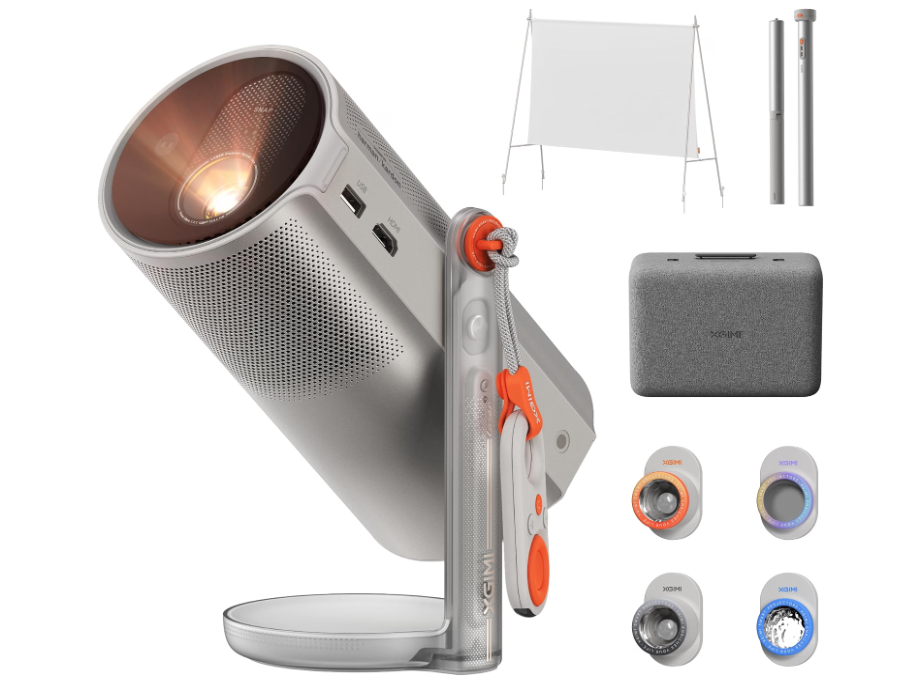
$579.00
at Amazon
$899.00
Save $320.00
Save $320.00
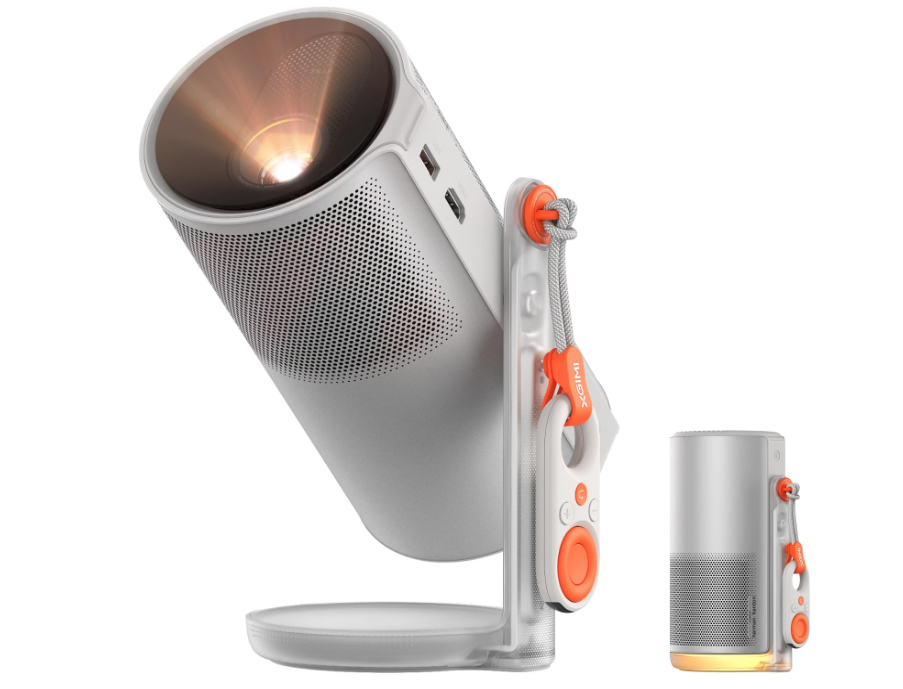
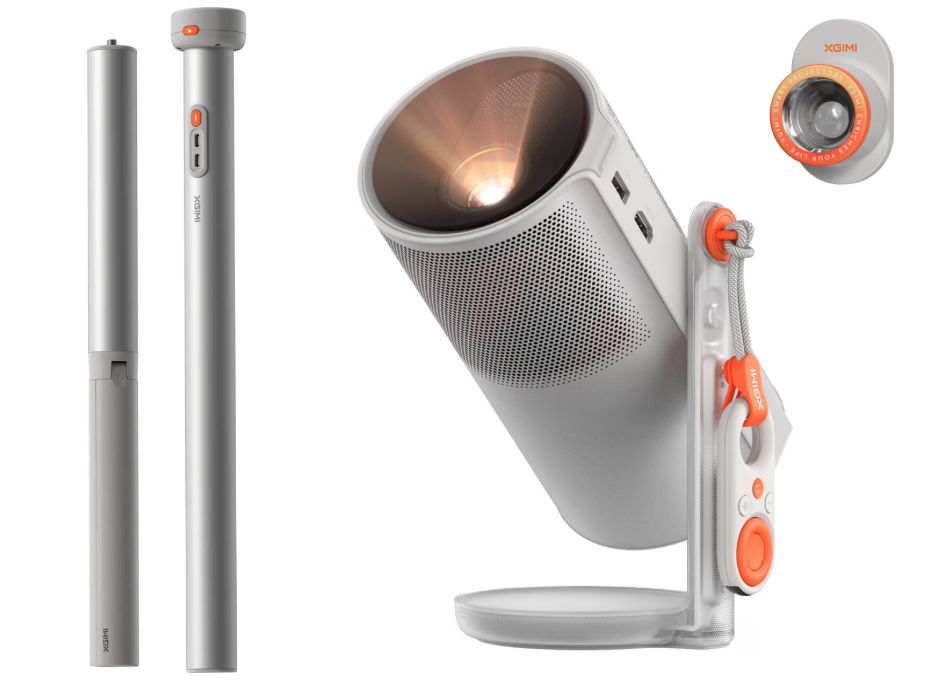
If you have a bit more money to splurge, the MoGo 4 is the same concept as the Vibe One but takes its specs to the next level, and it’s available starting at $359 (originally $499). It’s still small and compact with 1080p resolution, but it nearly doubles the brightness, with 450 ISO lumens. The battery life more than doubles to two and a half hours in Eco Mode, while still keeping the projector under three pounds. It also has Google TV as its OS, but the projection is 360° with its adjustable built-in stand. You also have the option of getting the bundle with the PowerBase Stand, which extends the battery to five hours. Like the Vibe One, it has a built-in speaker, but this one uses dual 6W Harman Kardon speakers with Dolby Audio.
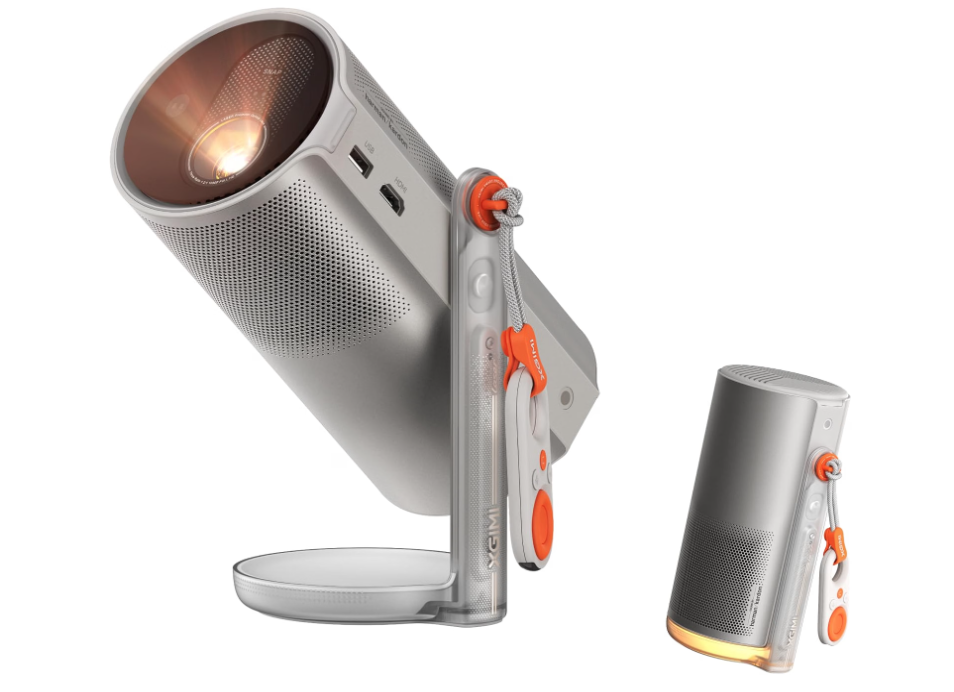
The MoGo 4 Laser is a slightly upgraded version that uses triple laser technology for a better picture. It still supports 1080p resolution, but it’s brighter with 550 ISO lumens and a 1000:1 contrast. The battery life, OS system, stand, speakers, and auto keystone technology are the same—but the bundles are different, so they’re worth considering if they fit your needs.
The premium Horizon 30 Pro is $600 off

If you’re looking for a premium portable projector, the Horizon 30 Pro is a great option that competes with the best options on the market. It supports 4K resolution, uses RGB triple laser brightness that reaches 4800 ISO lumens (bright enough to see during the day), has a 120Hz refresh rate and gaming features to make gaming smooth, displays an 8,000:1 native contrast to make colors and blacks pop, and supports IMAX Enhanced, Dolby Vision, and HDR10+. It has an adjustable stand like the other XGIMI projectors and its own dual 12W Harman Kardon speakers with DTS Virtual:X and DTS-HD. The auto keystone is just as powerful as the other options, but the lens adds an optical zoom and a Lens Memory feature, which lets you save up to six custom lens and image setups and recall them with a click. Right now, it’s down to $1,899 (originally $2,499) after a 24% discount.
Our Best Editor-Vetted Early Black Friday Deals Right Now
Deals are selected by our commerce team
An advertiser paid for editorial consideration of this deal. Our editorial experts vetted the deal based on our independent expertise. Because we determined that the deal will save money for the consumer, we wrote the content.
Hacking Wordle: A New User’s Guide to the Power of the Linux Terminal
For new Linux users the terminal can be like the Sphinx, quiet, mysterious, and offering no help to those who do not already speak its language. Here we’ll show you how to get comfortable with the terminal by using some common commands to analyze a text file of words used by the popular online game,…
Proton’s Lumo is Finally Useful and Gives Us Hope for a Real Private AI
The privacy-focused AI assistant works with your desktop files and requires a paid offering to integrate Proton Mail.
New Study Shows How Young People Feel About AI Companions
An anonymous reader quotes a report from 404 Media: A new study from Gallup looked at how young people across the world are making friends, both digitally and in person. The good news is that around 93% of the young people surveyed reported having at least one strong in-person friendship. The weird news is that 33% said they had an AI companion. Gallup’s study is lengthy and nuanced. It partnered with the Boston Children’s Digital Wellness Lab to conduct the study and used online surveys of more than 16,000 young people from the ages of 15 to 22 in 16 different countries. A lot of the topline results won’t surprise anyone living in today’s constantly online digital-forward age. Gallup found that respondents felt their in-person friendships were their strongest, that digital friendships complemented rather than replaced in-person ones, and that stronger friendships made people happier no matter how the connection was made. Three things that stood out were how the young respondents talked about AI, loneliness, and doomscrolling.


Young people in the United States, Canada, and UK reported the least interest in AI overall, with only 20% saying they used it once a day or more. Almost 40 percent of young people in Brazil use it daily. Japan and Italy both come in around 35%. “Nearly half of young people in the United States, United Kingdom and Canada have used AI no more than a few times in the past month, including those who have not used it at all,” the researchers wrote. Most of the respondents (82%) said they’d used AI to look up information, 68% asked it for advice, and 33% used it as a companion. Young people with online-only friends were more likely to use AI for companionship, “although these patterns do not establish whether AI companionship supplements or substitutes for human relationships,” they wrote.
The researchers discovered that people in different countries felt wildly different about their AI buddies. Almost half of Australians with AI friends rated the relationship as “high quality” and only 12% of young people in Poland did. Mostly, though, people thought of their AI friends as mid: “In most countries […] young people are more likely to give their AI companionship a medium rating than either a high or low rating.” People who used AI as a friend also reported higher levels of loneliness, the study found. “However, the findings cannot determine whether young people turn to AI because they feel lonely, whether AI companionship influences their social experiences or whether other circumstances help explain these relationships,” the researchers wrote. […] The study’s authors warned about reading too much into these results. “These assessments should be compared cautiously with those for human friendships examined in this report, as young people may have different expectations of what makes an AI companion or human friendship meaningful or supportive,” the researchers wrote.
“The broader message is not that one form of connection is inherently better or worse, but that the quality of young people’s relationships and the wider social context in which they exist matter greatly,” the study concluded.
Read more of this story at Slashdot.
AMD ROCm 10.2 Released With Latest Optimizations, Expanded Ryzen Laptop Support
AMD ROCm 10.2 is out today as the newest six-week feature release to this open-source AMD Radeon/Instinct GPU compute stack…
Arch Linux-Based Devario OS Sees First Stable Release
The Arch Linux-based independent Devario OS distribution sees its first stable release today after being in beta testing for the past month, and it’s now considered safe to install.
GTA 6‘s Big Miami Heat Game Led To Black Friday-Like Crowds Trying To Buy All The Merch
For one night only GTA and the NBA crossed over and a lot of people wanted those $120 jerseys