The “Lunduke Computer Operating System” from the Linux Tycoon is systemd-free, but wears a MAGA hat.
The post Lunduke Releases His Own Devuan-Based Linux Distro appeared first on FOSS Force.

The “Lunduke Computer Operating System” from the Linux Tycoon is systemd-free, but wears a MAGA hat.
The post Lunduke Releases His Own Devuan-Based Linux Distro appeared first on FOSS Force.



Chinese space officials confirmed this weekend that the Asian nation plans to land its astronauts on the Moon within three years.
At the Seventh Manned Spaceflight Conference in Beijing, officials, including Wang Xiang, chief designer for the lunar exploration program, laid out the country’s most publicly detailed plans yet for a series of missions leading up to a crewed lunar landing “before 2030.”
China’s lunar landings will involve a lunar-orbit rendezvous similar to what NASA did in the 1960s and early 1970s with the Apollo program. However, lacking a rocket as powerful as the Saturn V vehicle, the crew and lunar lander will launch separately to the Moon.
Formula 1 has a new World Drivers’ Champion. Just a few months after turning 20, Kimi Antonelli sealed his first title this weekend at Mexico City, becoming the sport’s youngest-ever champion. Elsewhere, there was drama aplenty, perhaps a consequence of the thin air affecting decision-making in some cases. The race was Ferrari’s to win, but yet again, the team handed victory to a rival this season, in this case Red Bull. Further down the grid, we saw a last-minute driver change in the Haas team, synchronized retirements from both Aston Martins, and the wheels literally coming off Cadillac Racing. And there was I, expecting a dull weekend.
It might not be as high as Pikes Peak, but at an elevation of 7,350 feet (2,240 m) above sea level, the Autódromo Hermanos Rodríguez provides a unique challenge on the F1 calendar. Wings that would create huge amounts of downforce at circuits like Monaco just generate Monza-like levels in Mexico, and there’s little slipstream effect when following another car.
Cooling tends to be a problem, too, with insufficient airflow across radiators, and obviously engine power is reduced with less oxygen to burn. The track is very flat, with a rather low-grip surface and mostly medium- and slow-speed corners, including a processional route through a stadium that was built in the 1990s, plus a very long run from the start into turn 1.
Recurring meetings come with an additional treat: changing the time zone resets any previously moved occurrences, which then have to be recreated. Anyone with a calendar full of recurring meetings may wish to put the kettle on first. Microsoft is working on an Exchange Online PowerShell cmdlet to remediate non-recurring meetings, but according to its guidance, that’s not due until later this week. A fix for recurring meetings remains “in development,” with an ETA yet to be confirmed.
Things get stranger with Power Automate and Fabric, where Microsoft’s temporary fix involves pretending you’re somewhere else entirely. Depending on the product and province, that could mean Saskatchewan, Arizona or, for Manitobans, Bogota. Because apparently time zones weren’t confusing enough already. SharePoint On-Prem customers, meanwhile, have to wait until November 10 for the correct time zones to arrive, while Power Pages users could see server-formatted dates appear an hour out until a service fix lands. Microsoft’s current milestone for that is December 12.


Read more of this story at Slashdot.
We may earn a commission from links on this page.
I may not be “messy,” exactly, but no one would describe me as “neat,” either. One of my biggest issues is that I tend to wait for a mess to get big enough to justify dragging out a full-size vacuum before I deal with it, because a full-size vacuum means finding the cord or the charger, wrestling it out of the closet, going room to room, and then putting it all away again. When the mess in question is still only a few cracker crumbs? Forget it—I’m just too lazy.
The solution to my laziness has been removing all the friction and hassle of my full-size vacuum, and instead keeping a handheld vacuum always within reach.
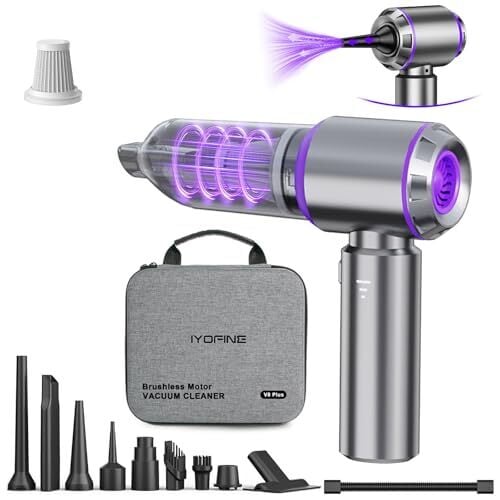

Though there are many handheld vacuums out there, I use the Sharper Image Dual Air Slim, which I got from Target. It’s great for quickly sucking up crumbs and everyday messes, and that’s exactly the job I need it to handle. The “dual air” part is what makes it more interesting than your average handheld: It’s both a vacuum and a blower, so it can pull debris in or push it out, depending on what you’re dealing with. I didn’t expect to need the blower at all, but I’m surprised how handy it is for blasting crumbs out of keyboard keys or loosening up stubborn debris before I suck it up.
The result is that my apartment is simply cleaner. Not because I’m spending more time cleaning overall, but because I’m no longer letting small messes pile up into big ones. When my monthly (or quarterly) deep clean does roll around, it’s far less painful, because there’s so much less to deal with. Perhaps this is the real upgrade: cleaning up messes the moment they happen instead of saving them up.
I love the Sharper Image Dual Air Slim, but there are plenty of similar cordless handheld vacuum and air duster combos out there, and they tend to land in a pretty similar price range. If another one catches your eye, or goes on sale, or has a design you prefer, go for it.
When comparing models, here are my handheld vacuum musts:
It should offer both vacuum and blower modes.
It should be both cordless and rechargeable. If it needs an outlet, you’ll have another barrier to using it, and that defeats the purpose.
It should be lightweight and slim. You want something you can grab and use one-handed without thinking about it.
The dust cup should be easy to empty. If emptying it is a hassle, you’ll use it less.
You should be able to keep it in plain sight. The closer it lives to where messes happen (the kitchen, the entryway), the more you’ll use it.
I used to think a clean apartment meant big, scheduled cleaning sessions. Now I think it’s mostly about making the small stuff effortless. A handheld vacuum and blower won’t replace your regular vacuum, but it will make you far less likely to need it as often. If you’ve been waiting for the next big mess, or the next big clean, to get things tidy, consider changing the system instead.
Apple’s new CEO, John Ternus, is apparently pushing the tech company’s development of household robots—and the first to debut may be a home robot designed to autonomously roam around while supporting FaceTime calls and switching lights on whenever a person enters the room.
People who worked on Apple’s robotic projects told The Information that the AI-driven home robot, code-named J595, could be named HomeView Ultra in line with Apple’s new HomeView stationary smart display. The company is reportedly aiming to launch the robotic product with a possible price tag of $1,000 or more by 2027, although development delays may push that back to 2028.
The earliest prototypes of the home robot first came out in 2018 and received approval from former Apple CEO Tim Cook to continue the project. The Information describes Apple’s engineers as trying to give the robot more capabilities beyond being a “fancy way to make FaceTime calls” in order to justify a high price tag, even as the team has spent years refining the software and incorporating more AI technologies.
We may earn a commission from links on this page. Deal pricing and availability subject to change after time of publication.
StackSocial has a refurbished, factory-unlocked iPhone 16e with 128GB of storage on sale for $354.99 right now, down from a $599 list price. The catch, and it’s one worth understanding before you click buy, is that this particular unit carries a Grade C refurbished rating, meaning that it may arrive with visible scratches or dents on the housing. If that matters to you, you can get a Grade B-rated model for $399.99 for a B- grade or $434.99 for a B+ grade.
Cosmetic wear aside, the hardware is recent, and the 16e launched in 2025 as Apple’s lower-cost entry with much of the same internals as the standard iPhone 16. That means you still get the A18 chip, 8GB of RAM, and a 16-core Neural Engine—enough to run Apple Intelligence features and handle games without feeling like an entry-level phone. Its 6.1-inch OLED screen is similarly well suited to everyday use, whether you’re reading, browsing, or streaming, with a sharp 2532 x 1170 resolution and up to 1,200 nits of brightness. The battery should also be able to keep up with a full day of typical use, with Apple rating it for up to 26 hours of video playback, while charging is handled through USB-C or a Qi wireless pad.
The potential downside shows up around back, where a single 48MP camera with optical image stabilization and a 2x telephoto option covers everyday photos and closer shots—though you lose the ultrawide lens that makes group shots and landscapes easier on the regular iPhone 16. Wi-Fi 6 and Bluetooth 5.3 also put it a step behind newer models on wireless, and while its IP68 rating covers immersion up to six meters for half an hour (so spills and rain aren’t a worry), it isn’t a dust-proofing guarantee. But for this sale price, it’s a great opportunity to upgrade your older iPhone.