
FromSoftware devs are masters at Looney Tunes–style physical comedy
Monthly Archives: November 2026
AMD Expects To Outsell Intel For the First Time
AMD expects its fourth-quarter revenue to reach roughly $17 billion, potentially surpassing Intel’s projected $15 billion to $16 billion and putting AMD ahead of its longtime rival in quarterly sales for the first time. The milestone is being driven largely by booming demand for Epyc server processors and Instinct AI accelerators, with AMD’s data center business already accounting for 64% of revenue and expected to exceed 80% in 2027. Tom’s Hardware reports: For those of our readers who have been following the CPU market in general as well as AMD and Intel in particular for decades, arguably the most earth-shattering part of AMD’s earnings report is its outlook for the fourth quarter. The company expects revenue of approximately $17 billion, plus or minus 3%, which implies a 66% year-over-year increase and 27% sequential growth at the midpoint. In contrast, Intel expects fourth-quarter revenue of $15 billion to $16 billion amid weakening PC demand and manufacturing capacity constraints.


If AMD meets its guidance, its quarterly sales will surpass those of its considerably bigger rival Intel for the first time in history. In fact, AMD will not only leave Intel formally behind, but its projected advantage will be approximately $1.5 billion at the midpoint of both companies’ forecasts, which is a tangible lead. The development reflects the companies’ increasingly different positions on the market: AMD is rapidly expanding its data center CPU and AI accelerator businesses, while Intel continues to depend heavily on PC and enterprise server processors, which sales face headwinds due to high memory prices and components shortages.
Read more of this story at Slashdot.
Firefox’s New ‘Mini Window’ Feature Is a Game Changer for Productivity
For many of us, web browsing involves juggling dozens of tabs at once, and it’s easy for important pages to get lost in the chaos. Now, Firefox has introduced something I think could help us multi-taskers: a “Mini Window.” As highlighted by ZDNET’s Jack Wallen, this new Firefox feature works like picture-in-picture overlays for videos—only here, that PiP displays a website.
“[Mini Window] lets you move a tab, or a selected section of a page, into a compact window that stays on top of your other windows while you browse,” runs Mozilla’s official blurb. “It’s useful when you’re multitasking and need to keep a few sources of information in view at once: Reference docs, a chat, a video call, a form you’re filling out.” As such, Mini Window doesn’t necessarily replace running tabs side-by-side; rather, you can prioritize one tab in a full-size window, while keeping another page in view at all times.
This is a feature that’s still in its early stages, and right now you can only get it in the “Nightly” version of Firefox, a very early beta version of the browser. Mozilla says it will push the feature to the full version of the browser later this month.
How to try Mini Window in Firefox right now
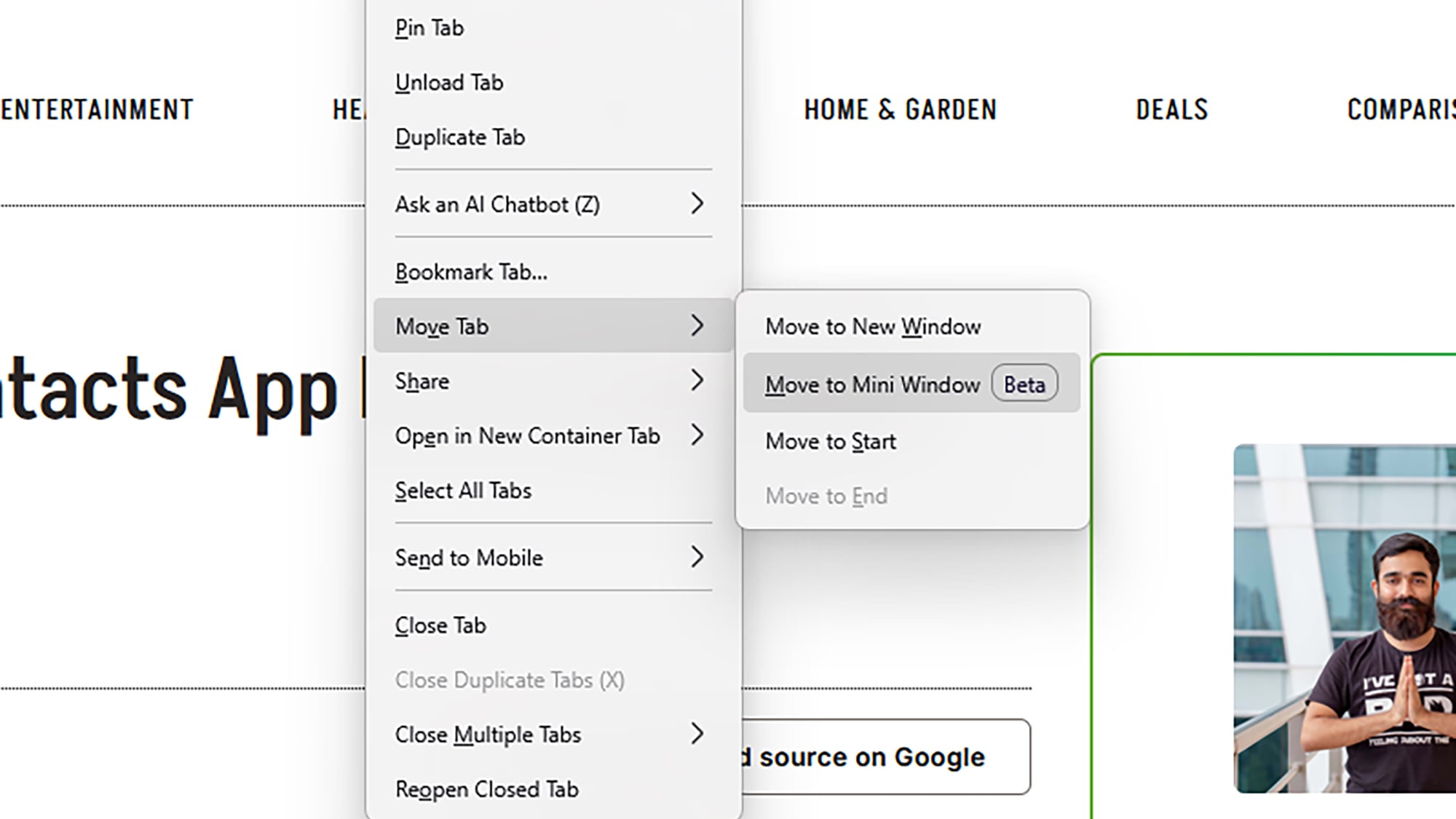
The feature is available via the right-click menu.
Credit: Lifehacker
If you want to try this out as soon as possible, first install Firefox Nightly on your Mac or PC. Once up and running, you can launch Mini Window by right-clicking on a tab header and choosing Move Tab > Move to Mini Window. The tab shrinks and drops down to the lower right corner by default, staying on top of all other windows (not just Firefox). You can then scroll through the page and follow links as normal in the Mini Window—any links set to open in a new tab (manually or automatically) will launch in the main Firefox view, not the window overlay.
By dragging the title bar around, you can put your Mini Window anywhere you want on screen, and you can change its size by dragging the edges of the window too—so it doesn’t necessarily have to be all that “mini.” Firefox hides all buttons by default—including forward, backward, and refresh buttons, together with the address bar and buttons for closing the window or putting it back as a normal tab—though they appear when you hover over the Mini Window.
I’m finding the feature most useful when writing up articles where I need to refer to something else already on the web (so almost all of them), but there are a host of ways this can be used. It’s particularly handy on a small laptop, where you don’t necessarily have the screen space to put two tabs side by side, or when running a lower-priority window (like checking a social media site while reading an important document). No doubt, Firefox will continue to refine and improve the feature as it makes its way to the stable version of the browser, and it feels like something other browsers (looking at you, Google Chrome) might adopt as well in the near future. Eventually, using Mini Windows might become as common as opening up a long row of tabs.
‘Ocarina of Time’ for Switch 2 Might Already Have a Weird Glitch
We may earn a commission from links on this page.
Thursday is a big day for Zelda fans. That’s when the remake of The Legend of Zelda: Ocarina of Time officially launches on Switch 2, marking the first major linear (i.e., non-open-world) 3D Zelda game since the 2016 Twilight Princess remake on Wii U. I, for one, have been waiting for this day for years. I loved the N64 original and the 3DS remake, so to have the chance to play a modern take on the definitive Zelda is so exciting—that is, if it actually runs as it should.
This Ocarina of Time bug may temporarily affect the game’s performance
I stumbled upon this interesting post on X from Austin John Plays, a YouTuber with a host of Zelda coverage. According to Austin John Plays, Ocarina of Time already ships with a weird glitch that won’t necessarily break your experience, but which may slow it down for a while, and perhaps even confuse players into thinking something is wrong with their game or their console.
As his post explains, if you’re playing the physical copy of Ocarina of Time, and it’s the first game you’ve ever played on your Switch 2—maybe you got one of those fancy new Zelda anniversary consoles and want to break it in properly?—you may run into glaring performance issues: The game may freeze, your controller may stop working, and the FPS may drop to single digits.
Luckily, Austin John Plays says the fix is easy: just wait. Eventually, your game will boot back to the title screen. When it does, don’t try to play right away. Instead, close the game, restart your Switch 2, then try relaunching Ocarina of Time. Austin John Plays advises you may need to repeat this process two or three times, but after that, you shouldn’t continue to run into issues. I wouldn’t be surprised if Nintendo releases a patch right away for this glitch if it turns out to be as widespread as this post implies.
You can prevent this Zelda bug before Ocarina of Time comes out
However, seeing as the game doesn’t come out until tomorrow, there’s something you can do to prevent it. Austin John Plays thinks the bug only impacts Switch 2 consoles that haven’t run other games before. If you’ve had your console a while, you’re likely set. But if you just bought the 40th anniversary Zelda edition of the Switch 2, you might not have had a chance to run a game on it yet. As such, download a game from the e-shop—even a free demo—just to get the system running. Hopefully, that will be enough to circumvent the glitch, and prevent issues when Ocarina of Time launches tomorrow.
Japanese Bank to Stop Allowing ATM Cards, PCs For Account Access
Mitsubishi UFJ Financial Group plans to launch Emut Bank in early 2027 as the first digital bank affiliated with a major Japanese financial institution to eliminate ATM cards, “instead having customers confirm identities using the bank’s smartphone app for additional security amid a rising tide of cyberattacks,” reports Nikkei Asia Review. The smartphone app will also be the only way to manage deposits, with no PC-based banking. From the report: Security has become a greater concern recently. As artificial intelligence advances, Japan has seen a surge in cyberattacks targeting companies, as well as a rise in phishing attacks aimed at stealing personal information, often targeting bank accounts. The technology being used by Emut was developed by Seven Bank, the consumer finance unit of Seven & i Holdings, operator of 7-Eleven convenience stores. Emut customers will be able to withdraw money from Seven Bank’s roughly 28,000 ATMs. The network is expected to gradually expand to cover the 16,000 or so ATMs at FamilyMart convenience stores. Although MUFG Bank ATMs will not be accessible, MUFG will consider changing this in the future.


Scrapping cash cards represents a shift in what has for decades been consumers’ main method of withdrawing money. The former Sumitomo Bank — a predecessor of Sumitomo Mitsui Banking Corp. — is believed to have been Japan’s first bank to implement cash cards, in 1969. The step away from cash cards by MUFG, Japan’s largest financial institution, is likely to spur other banks to follow suit. […] Eschewing cash cards will reduce Emut’s costs, which will let it offer interest rates on deposits that are expected to be higher than MUFG Bank’s usual 0.5%, depending on the terms. Interest can be paid out daily, rather than twice a year — a first for a Japanese bank.
Read more of this story at Slashdot.
Elon Musk spent nearly $500 million on the midterms and lost big-time
This was the Cybertruck of elections.

One Of The Greatest Adventure Games Ever Is 30 Today, And It Wasn’t Made By LucasArts
Toonstruck holds up three decades later, thanks to its incredible cast and animation
God of War Laufey is delayed until May 20
Santa Monica Studio will use the extra time to push the game “to its fullest potential.”

GeForce RTX 50 GPUs Tipped For Big Price Hikes This Month, What You Need To Know
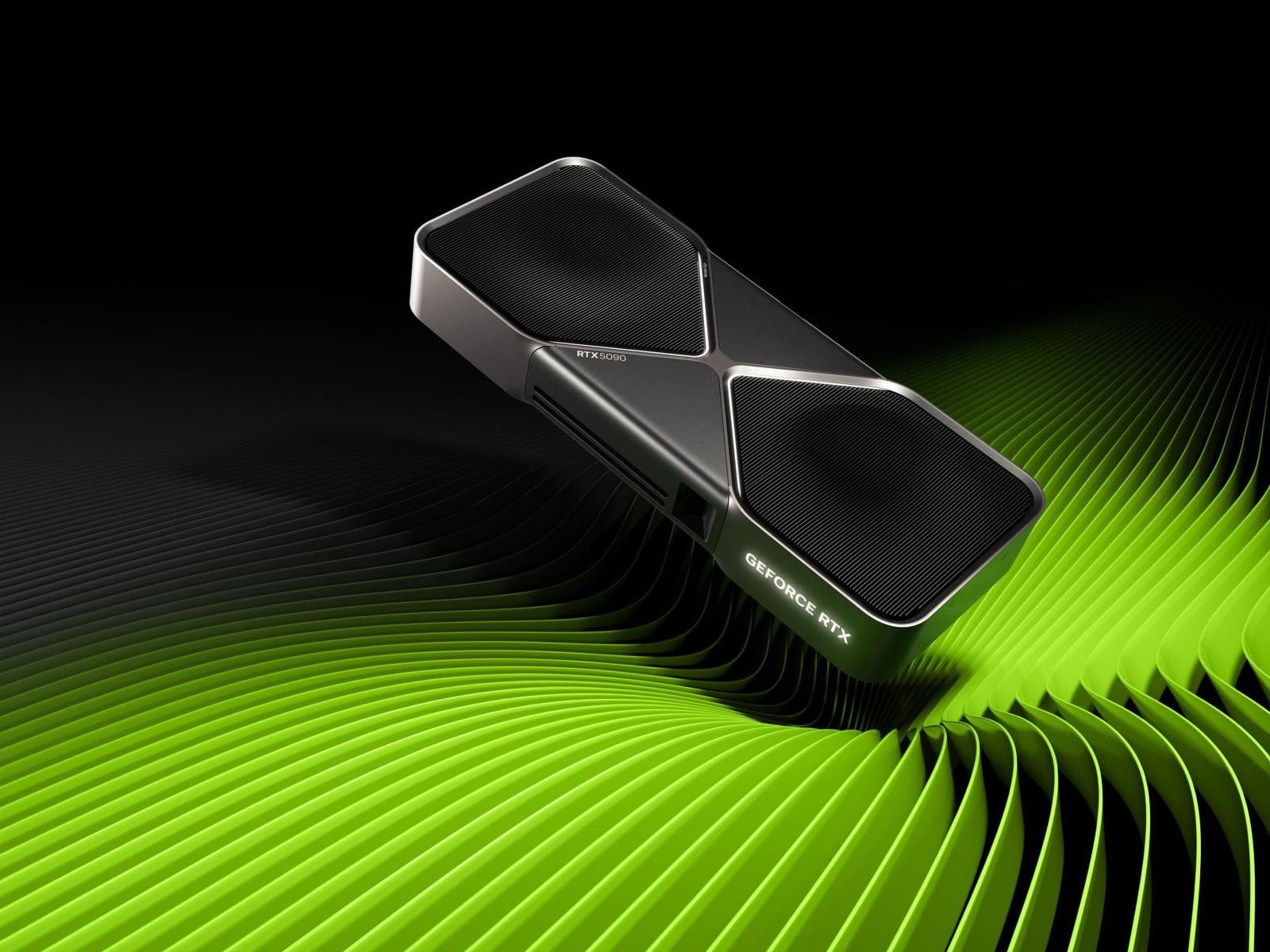
AMD did it first, now it’s NVIDIA’s turn: RTX 50-series GPUs are expected to have sweeping price hikes of up to $500 over present MSRPs. So much for holiday cheer.
RTX 50 Price Hike in November from ChannelGate, China High-end model: +150~300
Apple Watch Ultra 3 Is $250 Off At Best Buy But Time Is Ticking
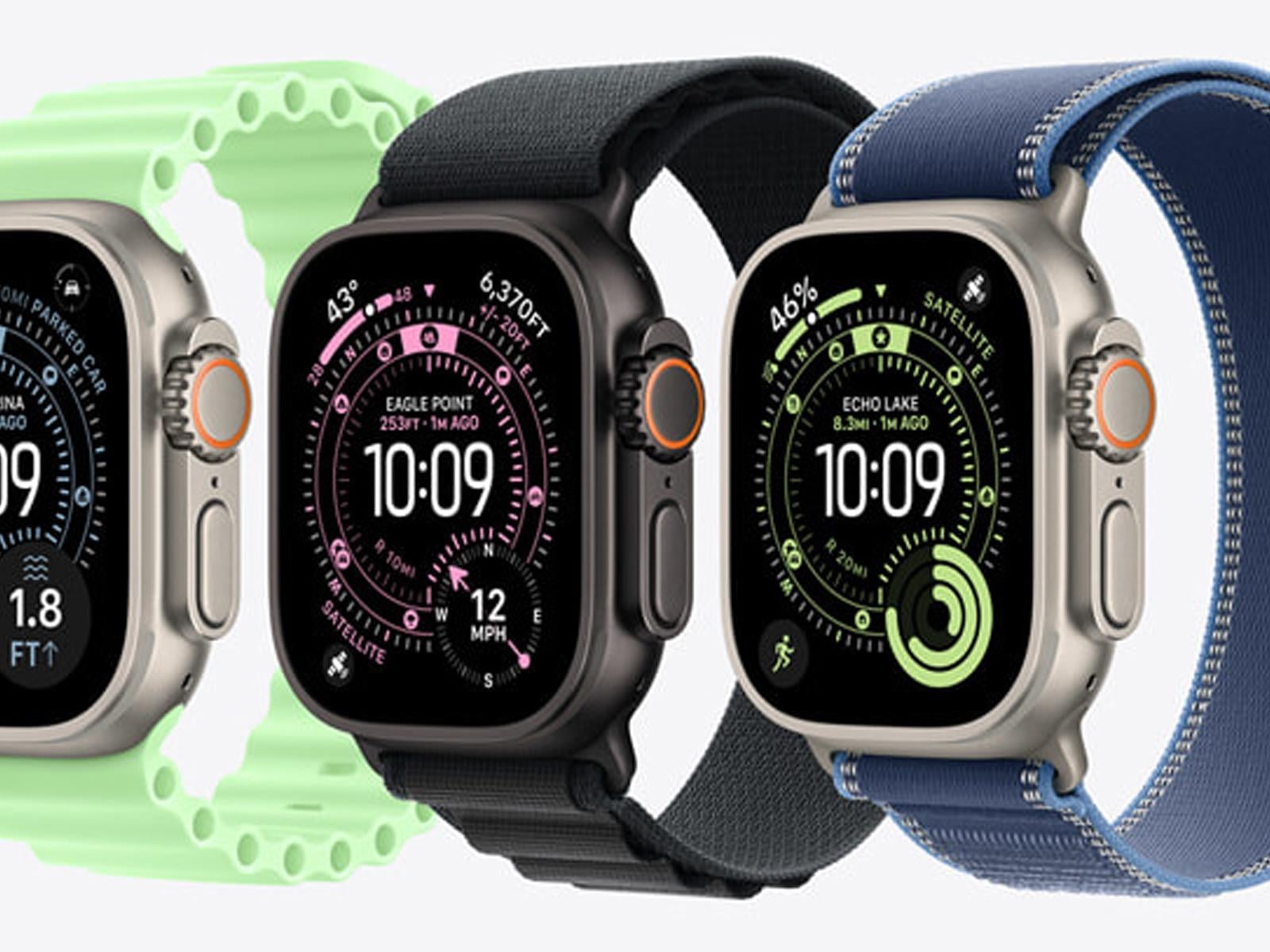
Time is money, and Best Buy is making a compelling case for a high-end smartwatch. As part of its deal of the day promotion, the retailer is slashing $250 off select Apple Watch Ultra Series 3 models, making the last-gen flagship more accessible
Fortnite Players Are Using Every Trick In The Book To Get That One Piece Pirate Shop Token
You can buy an account with Pirate Shop access on eBay for $10,000
Redditor uses AI to get Switch games running natively on Apple TV
The TVPort project is another example of people using Claude Code to bring software to other platforms

LibreOffice project and community recap: October 2026
Here’s our summary of updates, events and activities in the LibreOffice project in October – click the links to learn more… We announced LibreOffice 26.8.1, with around 40 bug fixes focused on compatibility with Microsoft Office files, along with more reliable text and CSV import across a range of character
Bluetooth is going to get a lot faster in 2027
Bluetooth HDT’s rollout will benefit a wide range of wireless devices and how they communicate.
God Of War Laufey Hit With Three-Month Delay
Santa Monica Studio says it wants to ‘make the most of each moment’ in order to push the game ‘to its fullest potential’
What I learned driving the Slate electric truck prototype
If my 45-minute drive yesterday morning is anything to go by, I think Slate Auto will have quite the hit on its hands. The startup had one of its prototype trucks in town and asked if I wanted to check it out—no jumping on a plane or having to spend yet another night in an interchangeable hotel room, just a drive from southwest DC to Rockville, Maryland. Easy-peasy.
The prototype truck had been well-used, with almost 6,000 miles (9,656 km) showing on the small and minimalist but very legible digital display that also shows your speed and, if you engage reverse, the backup camera. And while the cabin layout was representative of the production version, the surfaces most certainly weren’t—the prototype instead uses a lot of hard and shiny black plastic, with strips of Velcro here and there left over from when the interior had to be camouflaged when the vehicle was out in public.
Getting acquainted with the Slate was refreshingly easy. The Morris Marina-like door handles open with a pleasing mechanical action. The seat and steering column adjust manually but with plenty of reach, something many budget models used to leave out to save on cost.
The DEA banned a drug some opioid users called a miracle
In 2012, as the driver of deaths in the opioid crisis began moving from prescription pills to heroin, Laura Bohn was tasked with finding safer drugs to manage pain.
Funded by the National Institute on Drug Abuse, in 2017 she and other scientists revealed in the science journal Cell that several compounds—including a particularly promising one called SR-17018—could relieve pain in mice without causing respiratory depression. That’s a big deal, because respiratory depression is typically what causes people using opioids to stop breathing and die.
Bohn, senior associate vice president of research at University of South Florida Health, says her team filed a patent on SR-17018. They went on to discover that mice using the chemical did not develop a high tolerance for it and that mice already dependent on morphine—a powerful opioid—could consume SR-17018 to reset their tolerance without suffering from painful withdrawal symptoms.
Canva To Cut Or Relocate 22% of Global Workforce
An anonymous reader quotes a report from The Guardian: Canva is cutting or relocating more than 1,200 jobs, representing 22% of its global workforce, as part of a major restructure that includes laying off staff who helped build the Australian-founded design platform. The changes mirror a trend across the technology sector, where software companies are fighting to stay competitive against cheaper artificial intelligence disrupters while aggressively embedding AI tools themselves.


[…] The restructure will affect 1,271 people, according to the company, as it focuses on “collapsing layers” and bringing “more teams together in person.” […] Those leaving Canva will receive at least six months of salary and retain healthcare coverage for a further 12 months in countries where workers receive that benefit. They can also keep their laptops. Those leaving can also apply for US$10,000 (A$14,000) grants to start their own ventures. Canva’s chief executive, Melanie Perkins, said the restructure was “without doubt the hardest moment in our thirteen-year history.”
“For some people, this will mean changes to their roles or being asked to relocate to centralized hubs,” she said. “Sadly, it will also mean saying goodbye to teammates and friends who have helped build Canva into what it is today.”
Read more of this story at Slashdot.
Your Android Can Get Hacked Without You Doing Anything at All
You probably know that clicking suspicious links online or opening attachments from strangers in an email or text is a recipe for hacking. It’s a dangerous world out there online, so it’s always important to be vigilant. However, the danger doesn’t always involve something you do. There are ways to hack your devices without requiring any intervention on your part whatsoever—and one such example is likely plaguing your Android device right now.
This Android flaw doesn’t require any interaction on your part
As reported by The Hacker News, there is a critical Android security flaw that could enable remote code execution on your device. In other words, bad actors could use the flaw to run their own code on your phone, effectively taking over the device for their own gain. The flaw, identified as CVE-2026-58868, isn’t universal, but it is widespread: It currently affects Android 14 through Android 17, the latest version of Google’s OS. If your phone runs Android 12 or Android 13, it may be unaffected, as Google doesn’t identify these versions in its security bulletin, but it doesn’t explicitly rule them out, either.
There are two silver linings here, however. One, Google hasn’t confirmed any active exploits for this security flaw. While that isn’t a guarantee that bad actors have missed this exploit so far, it at least opens that possibility. As such, there may be time for users to patch their devices before hackers truly take advantage of the flaw. Second, Google does have a patch for the flaw. The patch may not be available to you right away, however, as it’s up to both the manufacturer of your phone and your carrier to issue these updates. Still, a patch is, at the very least, on its way.
This flaw is perhaps the most important to fix, but it’s not the only serious issue. In all, Google’s latest bulletin highlights 216 vulnerabilities, and, of those, 23 are “critical.” As The Hacker News explains, two other of those critical flaws could also allow remote code execution when exploited.
How to patch your Android phone against this security vulnerability
To see whether the patch is installed on your end, open the Settings app on your phone, tap “About phone” or “About tablet,” then choose the Android version on-screen. Look for a date of “2026-11-01” or later. All security patches from Nov. 1 and on will fix this issue. If not, you’ll ned to wait for the patch.
The Zelda: Ocarina Of Time Remake Has No Master Quest
That’s a bummer