
Geller is known for his video game essays on YouTube
Monthly Archives: October 2026
Base PS5 Is Getting AI Upscaling Starting With Wolverine And Ghost Of Yotei To Make The Smallest Details Look Even Crisper
It’s called Quick Spectral Super Resolution and it’s coming to a big-budget Sony blockbuster near you
All Right, Calm Down, Some Of You Are Far Too Good At Dressmaker
I need everyone to make some worse dresses
Graveyard Keeper 2 Takes The Best Part Of Stardew Valley And Somehow Makes It Much, Much Worse
Ocarina of Time‘s Navi has some new competition for the title of most annoying NPC in a video game; the entire cast of Graveyard Keeper 2
The World Of Red Bull’s Big Wave Surfing Makes Apple Immersive’s 180° Frame Feel Limitless
Visit Teahupo’o, Tahiti and get into some of the heaviest waves in the world, from perspectives that few will ever be able to experience, through The World of Red Bull: Big Wave Surfing episode – available as of October 1st at 6pm PT on Apple TV for Apple Vision Pro.
Despite the video being only 180°, this experience is so well done that it feels completely immersive.

Many Perspectives, Carefully Choreographed
The eight-minute experience feels like a complete journey. Big Wave Surfing moves visitors through a significant range of perspectives without feeling jarring. The perspectives help you grasp just how extreme and beautiful surfing can be in Teahupo’o. The contrast between the calm moments and the surfers riding the massive waves shows just how brave these athletes are.
You get in the water with some of the best surfers in the world as they train, including with Olympic Gold Medalist Italo Ferreira, World Champion Molly Picklum, local hero Michel Bourez, and more. You visit fish in the reef, get near the surface of massive waves and calm waters, join spectators and photographers on boats, and also soar above it. The transitions feel smooth, almost keeping pace with the waves as they form and break. Each moment holds just long enough to take in what is happening before transitioning to the next spot, but you’ll want to visit it again to catch details you may have missed. Look out for the rainbow that forms over a massive wave.

Just Enough Narration To Support The Experience
At moments throughout the experience, the voiceover narration gives the context needed to understand what it is like to surf in Teahupoʻo. Visitors get enough information to better understand what they are seeing, and then enough space to take it in for themselves. The extreme consequences and payoffs of the sport are better understood by virtually being there.
There is no break in the narrative to hear individual surfer stories. Instead, you get glimpses of the wider surfer community from different positions within it.
And, while this is a Red Bull experience, as with their other content, the brand is not forced into the story. It is just naturally integrated into shots as it appears on some apparel. The athletes and the premium experience are supported by Red Bull. It is not a veiled ad.
Details That Create Intense Immersion
The beautiful direction paired with the rich visuals, sounds captured during the epic shoot and subtle soundtrack creates the kind of immersive experience that shows off some of the best features of the Apple Vision Pro. The details are perfectly aligned to temporarily convince you that you are there.
You can see the details in the coral below the surface, through to the different ways that sunlight passes through the calm and massive waves that feel real enough to reach out to touch. I caught myself ducking as sparkling water splashed in my direction.
With spatial audio alone, the moments feel real as you can hear the changing environment around you. The underwater moments where noise is muted are so calming.
For me, Big Wave Surfing sets a new gold standard for Apple Immersive sports storytelling.
Sonic Boss Apologizes To Fans For Lack Of Remasters And Remakes: ‘We Have A Stronger Desire To Provide Fans With New Games’
It doesn’t seem like there will be a new port of Sonic Unleashed anytime soon
FBI Warns ShinyHunters Cybercrime Gang To Surrender Before Agents Kick In Their Doors

The ongoing virtual cat-and-mouse game between the FBI and one of the world’s most aggressive cybercrime collectives, ShinyHunters, might be coming to an end, thanks to the arrests of key members and seizure of the groups digital infrastructure by the Dutch National Police.
The arrest comes after ShinyHunters executed an audacious intrusion
One Of My Favorite Block Pushers Is Finally Coming To The Platform I Most Want To Play It On
Isles of Sea and Sky is a fantastic little sokoban that it’s time everyone stopped sleeping on
Sony Fights PS5 Pro Scalpers Ahead Of GTA 6 With 60-Hour Playtime Rule

The PlayStation 5 Pro is tough to come by these days, because stock has likely been limited due to the ongoing shortage of memory and storage. The timing couldn’t be worse, with gamers hyped for the upcoming release of Grand Theft Auto VI. But Sony is implementing a lottery system in Japan designed to thwart scalpers from cashing in on the
Arc Raiders Is About To Go Nuclear On Cheaters: ‘No Warnings, No Second Chances’
There are also plans to introduce new tech, and prevent the misery of queue teaming
Galaxy Buds On Debut As Samsung’s First Clip-Ons, Powered By Snapdragon

Samsung has entered the ever-growing open-ear clip-on audio trend with the Galaxy Buds On, although limited availability and its price tag may give pause to some. Resembling clip-on earrings, the Galaxy Buds On are designed to gently (but securely) hold onto your outer concha, leaving the ear canal unobstructed for all-day wearing comfort
Ubisoft Unites Developers Of Splinter Cell, The Division, Ghost Recon And More Under Star Wars Outlaws Studio Massive Entertainment
The Swedish group, Massive Entertainment, now coordinates development of multiple games across international teams
5 Essential Accessories To Pair With Your New iPhone Duo

If you’ve preordered the Apple iPhone Duo, we’re here to help make sure you’re ready to get the most out of the device ahead of its October 23rd release date. Despite the pre-release nature of the Apple iPhone Duo at this time, numerous manufacturers are at the ready with an array of peripherals and accessories, including Anker, FNTCase and
Not all explanations are equal: Social Explainable AI and Critical Computational Literacy
AI technologies, such as smart speakers or streaming recommendations, are becoming part of everyday life for children and teenagers. It’s therefore increasingly important to help young people understand not just how these systems work, but how to question them.

When AI systems generate outputs such as a recommendation, these outputs are often accompanied by an explanation. In our latest research seminar, Professor Dr. Dan Verständig (Goethe University Frankfurt, Center for Critical Computational Studies) spoke about how explanations are shaped by the people who write them, and only become meaningful when someone else makes sense of them. Dan introduced us to Social Explainable AI (Social XAI) and Critical Computational Literacy (CCL), and asked us to consider not just what an AI system explains, but for whom, why, and who benefits.
Why do we need explanations?
Dan opened with a deceptively simple question: why do we need explanations in the first place? His answer was that explanations provide orientation. They reduce uncertainty, and in doing so, they make our shared social world liveable. Explanations have evolved from Socratic dialogue, to the printed book, to the classroom, to today’s digital interfaces, and now to AI-generated explanations. But explanations have never been neutral conveyors of information. Dan illustrated this with a simple demonstration: he showed the seminar participants an aerial photo of a beach and asked what they noticed.

The aerial photo Dan shared during his seminar. What do you notice about this picture?
Seminar participants pointed to the coastline, the sandy beach, and a tiny figure in the frame. Dan then revealed that the photo was taken by him, using a drone at Montara State Beach in California on a specific afternoon in April 2024. He asked how a climate researcher, a surfer, or an artist might each describe the very same image differently.
This demonstration highlighted that an explanation is always for someone, for some purpose, in some context. That framing carries straight through into how we should think about AI explanations too. An explanation that satisfies a data scientist debugging a model is not the same as one that satisfies a patient asking why an algorithm flagged their scan, or a citizen asking why they were denied a loan. In other words, explanations are never technical.
From delivering explanations to co-constructing them
Drawing on Rohlfing and Lim’s 2026 work, Dan described Social XAI as an approach that puts interaction, rather than output, at the centre of explainability. Dan illustrated this with a simple but effective diagram: an AI explanation starts as a system output, is filtered through a person’s interpretation, and only then becomes meaning through construction. A one-size-fits-all output, however technically accurate, isn’t yet an explanation until someone has made sense of it in their own terms.
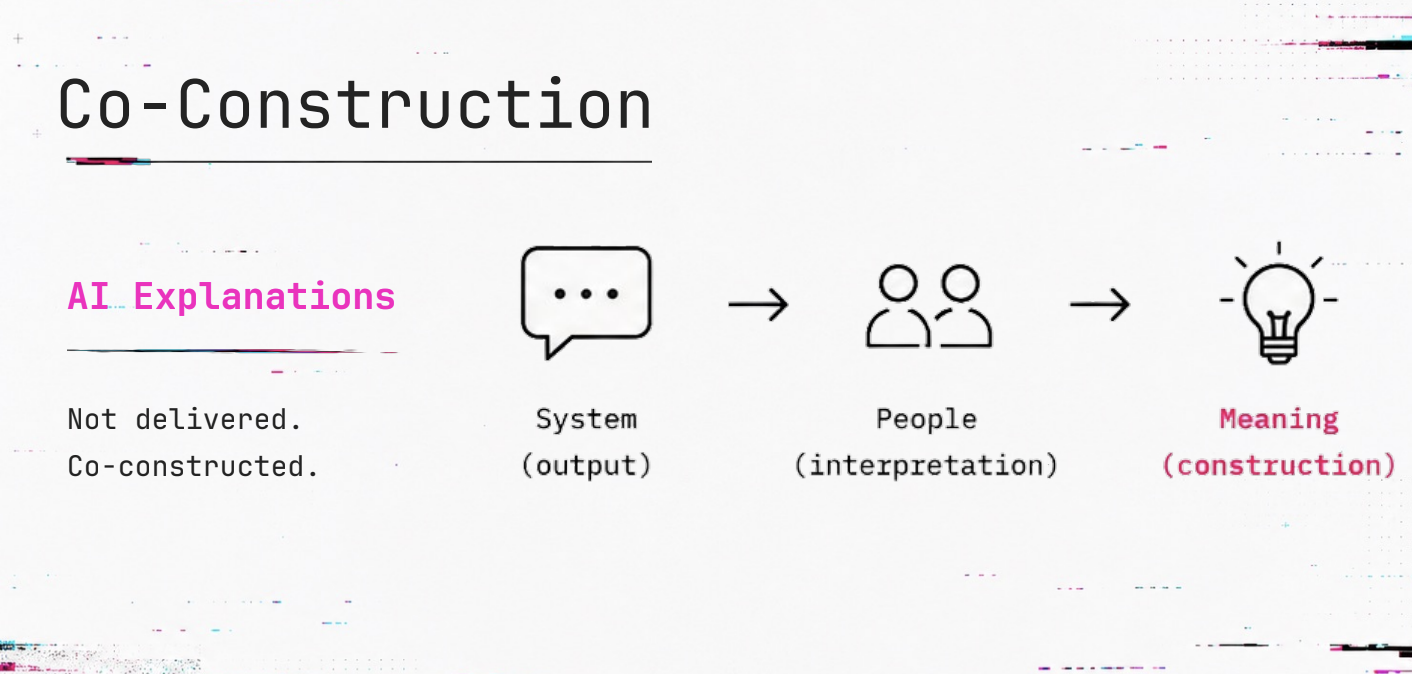
To explore this further, Dan’s research group has developed co-construction workshops, bringing people together to interrogate AI explanations collaboratively rather than receive them passively. In these workshops, participants are asked questions such as: “What counts as evidence? What is missing? What are the alternatives? Who benefits from this? Do we agree?”
To answer these questions, participants do not examine an AI model to find out how it generates a decision. Instead, participants scrutinise its outputs in the same way that they would critically evaluate a politician’s promise or a newspaper’s headline.
Dimensions for engaging critically with explanations
Critical Computational Literacy (CCL) is a framework that describes what people need to engage with AI explanations critically. Dan presented CCL as consisting of four interlocking dimensions:
- Attitude — a critical stance and value awareness: approaching computational systems not as neutral tools but as artefacts that embed particular values and assumptions
- Biography — recognising that people’s relationships with technology are shaped by subjectivity, by the varied encounters they’ve had with computational systems, and by the diverse pathways that brought them to this point
- Capacity — the analytical, creative, and ethical skills needed to actually work with and through computational systems, not just talk about them
- Critique — the capacity that ties the other three dimensions together: asking what matters, and why
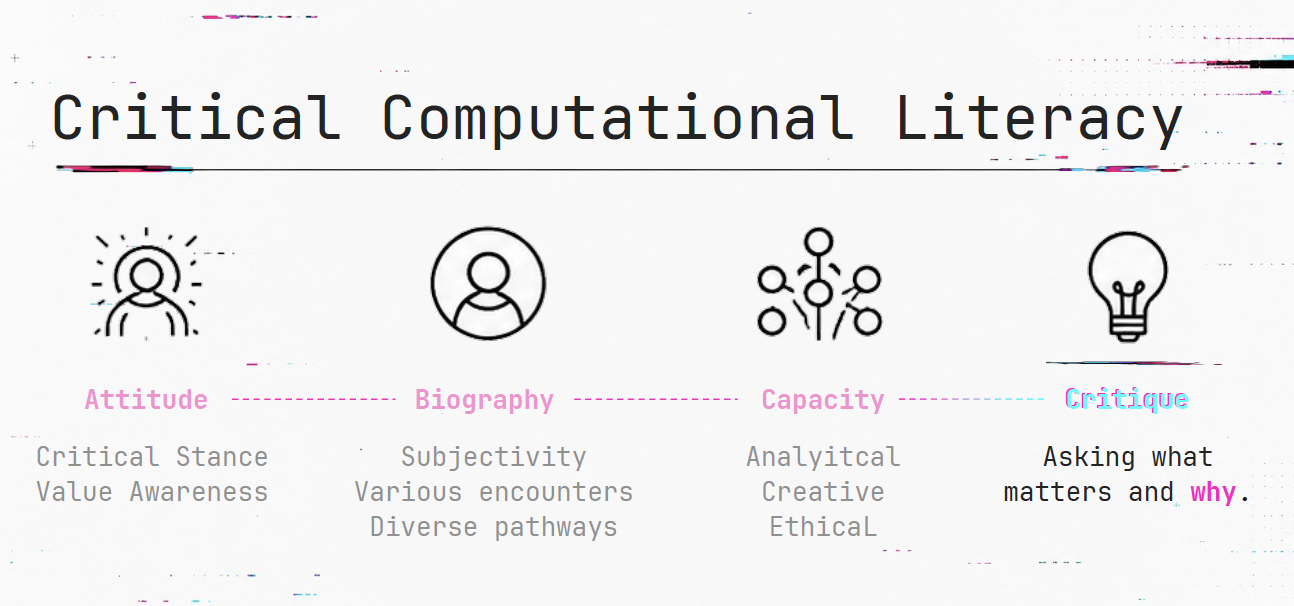
Taken together, these dimensions push back against a narrow, purely technical notion of ‘AI literacy’ as knowing how a model works. Instead, CCL treats literacy as something biographical and value-laden. Dan explained that individuals bring their own history and stance to any encounter with computational systems, and genuine literacy means being able to interrogate these systems’ explanations rather than simply accept or operate them.
Using these ideas in your classroom
Although Dan’s research took place with adult participants, Social XAI and Critical Computational Literacy are ideas that could also be used in the K-12 classroom. For example, if students interact with AI explanations through smart speakers or streaming recommendations in their everyday lives, this presents an opportunity to teach them how to engage critically with AI outputs. Students might explore why a smart speaker suggested a particular recipe, or investigate the explanation for why a streaming service recommended a particular show.
Explainability is also a key part of our own Experience AI resources. When training a model, students write their own model cards to document who built a model, what training data was used, how accurate the model’s predictions were, and any known limitations. In this activity, explainability is traceable, and students use their analytical skills to create transparent, fair, and accountable model cards.
Social XAI suggests an extension to this activity. Students could ask what matters about the explanation they have written and why this is important. Through this critique, students can consider who will read these model cards and how the cards might be interpreted. In this way, AI explanations become more than a technical output, and become artefacts whose meaning is co-constructed by the author and the reader.
This seminar was part of our ongoing series on teaching about AI in the arts, humanities, and sciences. You can watch the full recording of Dan’s talk, including the Q&A discussion, here:
Join our next seminar
Our research seminar series continues to explore how AI is taught across the curriculum. In our next seminar on Tuesday, 6 October at 19:00–20:30 BST, we welcome Eleni Petraki and Damith Herath (University of Canberra) who will present an engineering and robotics curriculum aimed at equipping future engineers with the diverse skills demanded by a growing workforce. To take part in the seminar, click the button below to register. We hope to see you there.
The schedule of our upcoming seminars is available online. You can catch up on past seminars on the blog and on the previous seminars and recordings page.
The post Not all explanations are equal: Social Explainable AI and Critical Computational Literacy appeared first on Raspberry Pi Foundation.
TP-Link Archer 8 Ultra Debuts As World’s First Wi-Fi 8 Router But There’s A Catch

TP-Link is jumping feet first into the next generation of wireless networking by opening up preorders for the Archer 8 Ultra, the world’s first consumer router built on the not-yet-ratified Wi-Fi 8 (IEEE 802.11bn) protocol. Powered by Broadcom’s Wi-Fi 8 chipset, the tri-band router delivers up to 19Gbps of combined wireless bandwidth across
Rust 1.99.0 released
Version
1.99.0 of the Rust language has been released. Changes this time
include support for extern "C" variadic functions, the
establishment of functions for obtaining the size and alignment of raw
pointers, a number of stabilized APIs, and more.
1.99.0 of the Rust language has been released. Changes this time
include support for extern "C" variadic functions, the
establishment of functions for obtaining the size and alignment of raw
pointers, a number of stabilized APIs, and more.
The Gears Of War: E-Day Campaign Is Full Of Highs And Lows
The ‘we are so back’ chart has been all over the place during my playthrough
Security updates for Thursday
Security updates have been issued by AlmaLinux (corosync, gawk, gdb, nodejs24, and thunderbird), Debian (expat, firefox-esr, libsmpp34, mkvtoolnix, network-manager-l2tp, pgextwlist, python-django, ruby-oj, and tor), Fedora (apptainer, ckermit, ffmpeg, freerdp, librabbitmq, openbao, php, python-cssselect2, python-uv-build, ruff, rust-libcst, rust-libcst_derive, rust-salsa, rust-salsa-macro-rules, rust-salsa-macros, sos, ty, uv, weasyprint, and xdg-dbus-proxy), Mageia (python-pillow), Red Hat (acl, glib2, go-toolset:rhel8, golang, libxml2, mingw-sqlite, nodejs-nodemon, nodejs22, nodejs24, nodejs:22, nodejs:24, sqlite, tesseract, and vim), Slackware (libpng and mozilla-thunderbird), SUSE (alloy, chromedriver, emacs, gdb, gimp, gpsd, jawn, libpoppler-cpp3, libtesseract5, multipath-tools, netty, ntfs-3g_ntfsprogs, pcapplusplus-devel, pi-coding-agent, python-PyYAML, python-tornado, python-tornado6, python311, python313, and wicked2nm), and Ubuntu (designate, gst-plugins-bad1.0, gvfs, imagemagick, kdenlive, mlt, keystone, libauthen-sasl-perl, linux-aws, linux-aws-6.8, linux-nvidia-tegra, linux-nvidia-tegra-igx, linux-oracle-7.0, opensbi, openvpn, and python-django).
OpenMandriva Lx 26.09 “ROME” Released with KDE Plasma 6.7 and Linux Kernel 7.2
OpenMandriva Lx 26.09 ROME has been officially released today, October 1st, 2026, as the rolling-release version of OpenMandriva Lx, the successor of the Mandriva Linux operating system.
Reigns, Card Shark Dev Is Closing Down As Leads Go Independent Again: ‘I Still Have Things That I Can Say’
‘At the moment, you feel like you’re in the washing machine and it’s turned on and you’re like, “Well, oh my God, this is going so fast.”‘