
A few days ago Google engineers went public with Sashiko with their agentic AI code review for the Linux kernel. The Google Gemini Pro powered AI code review service is automatically monitoring the Linux kernel mailing list for new patch submissions and has proven useful already. Interest continues to build by upstream Linux kernel stakeholders around Sashiko and the latest addition is now covering the Rust-For-Linux mailing list submissions…
Monthly Archives: March 2026
EFF Tells Publishers: Blocking the Internet Archive Won’t Stop AI, But It Will Erase The Historical Record
“Imagine a newspaper publisher announcing it will no longer allow libraries to keep copies of its paper,” writes EFF senior policy analyst Joe Mullin.
“That’s effectively what’s begun happening online in the last few months.”
The Internet Archive — the world’s largest digital library — has preserved newspapers since it went online in the mid-1990s… But in recent months The New York Times began blocking the Archive from crawling its website, using technical measures that go beyond the web’s traditional robots.txt rules. That risks cutting off a record that historians and journalists have relied on for decades. Other newspapers, including The Guardian, seem to be following suit…
The Times says the move is driven by concerns about AI companies scraping news content. Publishers seek control over how their work is used, and several — including the Times — are now suing AI companies over whether training models on copyrighted material violates the law. There’s a strong case that such training is fair use. Whatever the outcome of those lawsuits, blocking nonprofit archivists is the wrong response.
Organizations like the Internet Archive are not building commercial AI systems. They are preserving a record of our history. Turning off that preservation in an effort to control AI access could essentially torch decades of historical documentation over a fight that libraries like the Archive didn’t start, and didn’t ask for. If publishers shut the Archive out, they aren’t just limiting bots. They’re erasing the historical record…
Even if courts place limits on AI training, the law protecting search and web archiving is already well established… There are real disputes over AI training that must be resolved in courts. But sacrificing the public record to fight those battles would be a profound, and possibly irreversible, mistake.


Read more of this story at Slashdot.
Millions Face Mobile Internet Outages in Moscow. ‘Digital Crackdown’ Feared
13 million people live in Moscow, reports CNN.
But since early March the city “has experienced internet and mobile service outages on a level previously unseen.” (Though Wi-Fi access to the internet is still available…) Russian social media “is flooded with jokes and memes about sending letters by carrier pigeons or using smartphones as ping-pong paddles…”
[Moscow residents] complain they cannot navigate around the center or use their favorite mobile apps. The interruptions appear to have had a knock-on effect of making it more difficult to make voice calls or send an SMS. Some are panic-buying walkie-talkies, paper maps, and even pagers.
The latest shutdown builds on similar efforts around the country. For months, mobile internet service interruptions have hit Russia’s regions, particularly in provinces bordering Ukraine, which has staged incursions and launched strikes inside Russian territory to counter Russia’s full-scale invasion. Some regions have reported not having any mobile internet since summer. But the most recent outages have hit the country’s main centers of wealth and power: Moscow and Russia’s second city, St. Petersburg.
Public officials claim the blackout of mobile internet service in the capital and other regions is part of a security effort to counter “increasingly sophisticated methods” of Ukrainian attack… Speculation centers on whether the authorities are testing their ability to clamp down on public protest in the case there’s an effort to reintroduce unpopular mobilization measures to find fresh manpower for the war in Ukraine; whether mobile internet outages may precede a more sweeping digital blackout; or if the new restrictions reflect an atmosphere of heightened fear and paranoia inside the Kremlin as it watches US-led regime- change efforts unfold against Russian allies such as Venezuela and Iran… On Wednesday, Russian mobile providers sent notifications that there would be “temporary restrictions” on mobile internet in parts of Moscow for security reasons, Russian state news agency RIA-Novosti reported. The measures will last “for as long as additional measures are needed to ensure the safety of our citizens,” Kremlin spokesman Dmitry Peskov said on March 11…
As well as banning many social media platforms, Russia blocks calling features on messenger apps such as WhatsApp and Telegram. Roskomnadzor, the country’s communications regulator, has introduced a “white list” of approved apps… Russia has also tested what it calls the “sovereign internet,” a network that is effectively firewalled from the rest of the world. The disruptions are fueling broader concerns about tightening state control. In parallel with the internet shutdown, the Kremlin has also been pushing to impose a state-controlled messaging app called Max as the country’s main portal for state services, payments and everyday communication. There has been speculation the Kremlin may be planning to ban Telegram, Russia’s most widely used messaging app, entirely. Roskomnadzor said that it was restricting Telegram for allegedly failing to comply with Russian laws.
“Russia has opened a criminal case against me for ‘aiding terrorism,'” Telegram’s Russian-born founder Pavel Durov said on X last month. “Each day, the authorities fabricate new pretexts to restrict Russians’ access to Telegram as they seek to suppress the right to privacy and free speech….”
The article includes this quote from Mikhail Klimarev, head of the Internet Protection Society and an expert on Russian internet freedom. “In any situation when they (the authorities) perceive some kind of danger for themselves and accept the belief that the internet is dangerous for them, even if it may not be true, they will shut it down,” he said. “Just like in Iran.”


Read more of this story at Slashdot.
Luckfox Lume Board Features Allwinner T153 SoC with Dual Gigabit Ethernet and MIPI Interfaces
Luckfox has introduced the Lume, a compact development board based on the Allwinner T153 industrial processor. The board combines a quad-core Arm Cortex-A7 with a RISC-V E907 core, along with dual Gigabit Ethernet, MIPI display and camera interfaces, and onboard memory and storage. The T153 uses a heterogeneous architecture combining a quad-core Arm Cortex-A7 cluster […]
Minecraft World Is A New Theme Park With Its Own Roller Coaster Coming In 2027

The $70 million Minecraft World theme park will feature a world-first Minecraft roller coaster
Juicier Steaks Soon? The UK Approves Testing of Gene-Edited Cow Feed
“Juicier steaks could soon be served up after barley was given the go-ahead to become Britain’s first gene-edited crop,” reports the Telegraph:
In an effort to fatten up cows and get them to market faster, scientists have altered the DNA of Golden Promise barley to increase its fat content… [Regulators have approved the feeding of that barley to cows for further studies.] [T]he small increase reduces the time it takes for farmers to raise animals for slaughter and increases the amount of milk and meat they produce to make the industry more profitable.
The gene-edited barley is also able to cut the amount of methane a cow produces, [Rothamsted Research professor/biochemist Peter] Eastmond said… Reducing methane from cattle is a major goal of the industry, and Professor Eastmond estimated his barley could cut the methane output from a single cow by up to 15%.
The two genetic tweaks to the barley are believed to alter the gut bacteria in cows’ stomachs and reduce the amount of methane-generating microbes, cutting the cows’ emissions…. [Eastmond] is also working on applying the same two gene edits to rye grass to create pastures and meadows which are lipid-rich and calorie-dense. This, he said, could lead to entire fields of gene-edited grass which could be grazed by cows, sheep, horses and goats to fatten them up and cut emissions… “It would be better to have this technology in a pasture grass that’s grown to supply the livestock and graze it directly.”
The barley “has been modified to have a single letter of DNA removed from two different genes to switch them off,” the article points out. “No genes have been added to its DNA and it is not considered to be genetically modified.”
The article points out that Britain “has launched a push towards more gene-edited crops as a key post-Brexit freedom since splitting from the European Union,” noting that U.K. scientists and private companies “have created products such as bread with fewer cancer-causing chemicals, longer-lasting strawberries and bananas, sweeter-tasting lettuce and disease-resistant potatoes, although these are yet to be granted permission to land on supermarket shelves…”
But the EU has so far resisted the sale of any gene-edited crops in the EU.
Thanks to long-time Slashdot reader fjo3 for sharing the article.


Read more of this story at Slashdot.
Reddit is weighing identity verification methods to combat its bot problem
There could be one more step required before creating an account and posting on Reddit in the future. According to Reddit’s CEO, Steve Huffman, the social media platform is exploring different ways to verify a user is human and not a bot. When asked by the TBPN podcast how to confirm that it’s a human using Reddit, Huffman responded with several verification methods with varying degrees of heavy-handedness.
RDDT requiring Face ID was not something I had on my bingo card but something has got to be done about all the fake / botted content — I just don’t know how to sell face-scanning to redditors or even lurkers. https://t.co/7e7K3Di4ip
— Alexis Ohanian � (@alexisohanian) March 21, 2026
“The most lightweight way is with something like Face ID or Touch ID,” Huffman said during the interview. “They actually require a human presence, like a human has to touch, or do or look at something, so that actually just proves there’s a person there or gets you pretty far.”
Besides these passkey methods that use biometrics data, Huffman said there are other options like relying on third-party services that are decentralized or don’t require ID. On the other end of the spectrum, Huffman also mentioned more burdensome options, like ID-checking services.
Recent years have brought a rise in bots flooding social media platforms including Reddit, where they’ve even been used to conduct secret experiments. It doesn’t sound like Reddit has landed on how to verify its users’ human identity yet, but Huffman did emphasize that the platform still wants to prioritize anonymity for its users. However, verifying humanity through identifiable and personal data could end up as a dealbreaker for Reddit users who value the anonymity of the platform.
“Part of our promise for our users is we don’t know your name but we do want to know you’re a person,” Huffman said. “It’ll be an evolution for us for a while, and probably every platform to find the right middle ground here.”
Reddit co-founder and former executive chair, Alexis Ohanian, said on X that Reddit requiring Face ID wasn’t something he expected but agreed that something had to be done about the fake content from bots, adding that, “I just don’t know how to sell face-scanning to Redditors or even lurkers.” We reached out to Reddit’s communications team and will update the story when we hear back.
This article originally appeared on Engadget at https://www.engadget.com/social-media/reddit-is-weighing-identity-verification-methods-to-combat-its-bot-problem-195814671.html?src=rss
Blender 5.1 Open-Source 3D Graphics Software Released with Many New Features
Blender 5.1 open-source 3D graphics software is now available for download with hardware ray-tracing by for AMD GPUs and other changes. Here’s what’s new!
Can Private Space Companies Replace the ISS Before 2030?
China’s orbital outpost Tiangong was completed in 2022 and is hosting up to three astronauts at a time, reports CNN.
But meanwhile U.S. lawmakers are now signaling there’s not time to develop and launch a replacement for the International Space Station — considered the signal most expensive object ever built — before its deorbiting in 2030. A recent Senate bill calls for the U.S. to continue funding it as late as 2032, but that bill still awaits approval from the U.S. Senate and the House.
But some private space companies are already building their alternatives:
Private companies that are in the early design and mockup phase of developing these space stations are still waiting on NASA for guidance — and money… [NASA’s “Requests for Proposals”] were delayed, in part because it took all of 2025 to cinch a confirmation for Trump’s on-again-off-again pick for NASA administrator, Jared Isaacman [confirmed in December]… Similarly, 2025 saw a 45-day government shutdown, the longest in history — adding another hiccup in the space agency’s plans to begin formally soliciting proposals from the private sector. Companies now expect that NASA will issue its Request for Proposals in late March or early April, one CEO told CNN…
Several commercial outfits have recently announced big funding influxes aimed at speeding up the development and launch of new orbiting outposts. Houston-based Axiom Space announced a $350 million funding round last month. Its California-based competitor Vast then notched a $500 million raise in early March. Vast is determined to launch a bare-bones station to orbit as soon as possible, with or without federal input, according to the company. “Our approach is to actually not wait for (NASA) and get going and build a minimum viable product, single-module space station called Haven-1, which we’re launching into orbit next year,” Vast CEO Max Haot told CNN in a phone interview earlier this month. Similarly, Axiom Space is working toward a 2028 launch date for a module that it plans to initially attach to the ISS before breaking off to orbit on its own. A spokesperson told CNN that it the company is “committed” to winning the NASA contract money and may continue pursing such goals even without contract awards.
Still, there’s lingering doubt that any of the companies pursuing space stations will be able to stay afloat without securing a coveted NASA contract or at least cinching significant business from the public sector.
The article includes “Another complicating fact: Russia, the United States’ primary partner on the ISS, has not pledged to keep operating its half of the space station past 2028.” NASA will eventually evaluate proposals for an ISS alternative from Vast, Axiom Space, Jeff Bezos’ Blue Origin, Max Space and several competitors including Voyager Technologies, CNN notes, ultimately handing out an estimated $1.5 billion in contracts between 2026 and 2031.
And while those companies may wait decades before a return on their investment, the article includes this quotes from the cofounder/general partner of Balerion Space Ventures, which led the fundraising for Vast. ” What’s obvious to us is you’re going to have multiple vehicles with myriad companies go into space. You’re going to have vehicles leaving from celestial bodies, like the moon. And we need a habitat.”


Read more of this story at Slashdot.
Marathon‘s Endgame Dungeon Is Unlike Anything Players Have Seen Before

The multi-vault zone has complex puzzles, brutal RNG, and extremely powerful loot
What to read this weekend: Revisiting Project Hail Mary and The Thing on the Doorstep
Need something new for your reading list? Here are two titles we think are worth checking out. This week, we’ve got Andy Weir’s Project Hail Mary and The Thing on the Doorstep, an H.P. Lovecraft adaptation for Image Comics.
This article originally appeared on Engadget at https://www.engadget.com/entertainment/what-to-read-this-weekend-revisiting-project-hail-mary-and-the-thing-on-the-doorstep-190000250.html?src=rss
Intel, NVIDIA, AMD GPU Drivers Finally Play Nice With ReactOS
ReactOS aims to be compatible with programs and drivers developed for Windows Server 2003 and later versions of Microsoft Windows.
And Slashdot reader jeditobe reports that the project has now “announced significant progress in achieving compatibility with proprietary graphics drivers.”
ReactOS now supports roughly 90% of GPU drivers for Windows XP and Windows Server 2003, thanks to a series of fixes and the implementation of the KMDF (Kernel-Mode Driver Framework) and WDDM (Windows Display Driver Model) subsystems. Prior to these changes, many proprietary drivers either failed to launch or exhibited unstable behavior. In the latest nightly builds of the 0.4.16 branch, drivers from a variety of manufacturers — including Intel, NVIDIA, and AMD — are running reliably.
The project demonstrated ReactOS running on real hardware, including booting with installed drivers for graphics cards such as Intel GMA 945, NVIDIA GeForce 8800 GTS and GTX 750 Ti, and AMD Radeon HD 7530G. They also highlighted successful operation on mobile GPUs like the NVIDIA Quadro 1000M, with 2D/3D acceleration, audio, and network connectivity all functioning correctly. Further tests confirmed support on less common or older configurations, including a laptop with a Radeon Xpress 1100, as well as high-performance cards like the NVIDIA GTX Titan X.
A key contribution came from a patch merged into the main branch for the memory management subsystem, which improved driver stability and reduced crashes during graphics adapter initialization.


Read more of this story at Slashdot.
Speedrunner Discovers Groundbreaking New Glitch In Pokémon FireRed On Switch

Swiss runner iamClemi accidentally hit the L button while choosing a starter, but something was off
Apple considered buying Halide to upgrade its native Camera app
A legal feud between the co-founders of Lux Optics, the developer behind the Halide camera app, revealed that Apple was close to acquiring the company. As first reported by The Information, Apple held acquisition talks for Lux Optics, which also developed the Kino, Spectre and Orion apps, in the summer of 2025.
According to The Information, the deal eventually fell through in September of that year, but the potential acquisition could’ve provided Apple with the third-party software to improve its own built-in camera app. Apple is already rumored to be introducing variable aperture to its upcoming iPhone 18 Pro models, so it’s not surprising that the iPhone maker was looking for software with advanced features to match its possibly upgraded camera hardware.
Despite Apple’s interest, Lux Optics’ co-founders, Ben Sandofsky and Sebastiaan de With concluded that future updates to Halide could increase the company’s valuation and ended the acquisition talks. According to the lawsuit between the co-founders, Sandofsky started investigating de With for the alleged misuse of company funds shortly after the talks with Apple ended. Afterwards, de With was fired from Lux Optics and later joined Apple’s design team. While Halide may remain third-party software for iPhones and iPads, users can still look forward to some software improvements to the built-in camera app, since that’s reportedly one of Apple’s priorities.
This article originally appeared on Engadget at https://www.engadget.com/apps/apple-considered-buying-halide-to-upgrade-its-native-camera-app-175139818.html?src=rss
50% of Consumers Prefer Brands That Avoid GenAI Content
Slashdot reader BrianFagioli writes: According to the research firm Gartner, 50% of U.S. consumers say they would prefer to do business with brands that avoid using GenAI in consumer facing content such as advertising and promotional messaging.
The survey of 1,539 Americans, conducted in October 2025, also found growing skepticism about the reliability of online information, with 61% saying they frequently question whether information they use for everyday decisions is trustworthy… Gartner found that 68% of consumers often wonder whether the content they see online is real, while fewer people now rely on intuition alone to judge credibility [only 27%]. Instead, more consumers are actively verifying information and checking sources.
Gartner’s senior principal analyst offered suggests discretion for brands trying to use AI. “The brands that win will be the ones that use AI in ways customers can immediately recognize as helpful, while being transparent about when AI is used, what it’s doing, and giving customers a clear choice to opt out.”


Read more of this story at Slashdot.
A Minecraft theme park will open in London in 2027
The best-selling game of all time is moving from the virtual to the physical. Minecraft World, a permanent Greater London theme park based on the game, is scheduled to open in 2027. The announcement came during Minecraft Live 2026.
It will be a new section in Chessington World of Adventures, a theme park with a built-in zoo. The resort is a 35-minute train ride from London’s Waterloo station.
Details are still fairly light on the park. But we know it will include a roller coaster, “interactive adventures” and “epic block-built playscapes.” Torfi Frans Ólafsson, the game franchise’s creative director, said they’re aiming for “an experience that feels immersive, authentic and welcoming.” Naturally, that will include welcoming you to open your wallet in Minecraft-themed retail and dining spots.
The park is a collaboration between Mojang Studios and Merlin Entertainments, the world’s second-largest theme park builder. (A certain rodent-led empire is first.)
If visiting the full theme park in England isn’t your thing, the latest location of the game’s (also real-world) pop-up events will open in May. Minecraft Experience: Moonlight Trail will let visitors in Buenos Aires, Argentina, go on an hour-long outdoor nighttime adventure. As its name suggests, you’ll “walk a moonlit trail” through iconic Minecraft biomes. Along the way, you’ll craft gear, mine diamonds, battle mobs and “help restore an ancient beacon.” The event opens in May.
Mojang Studios
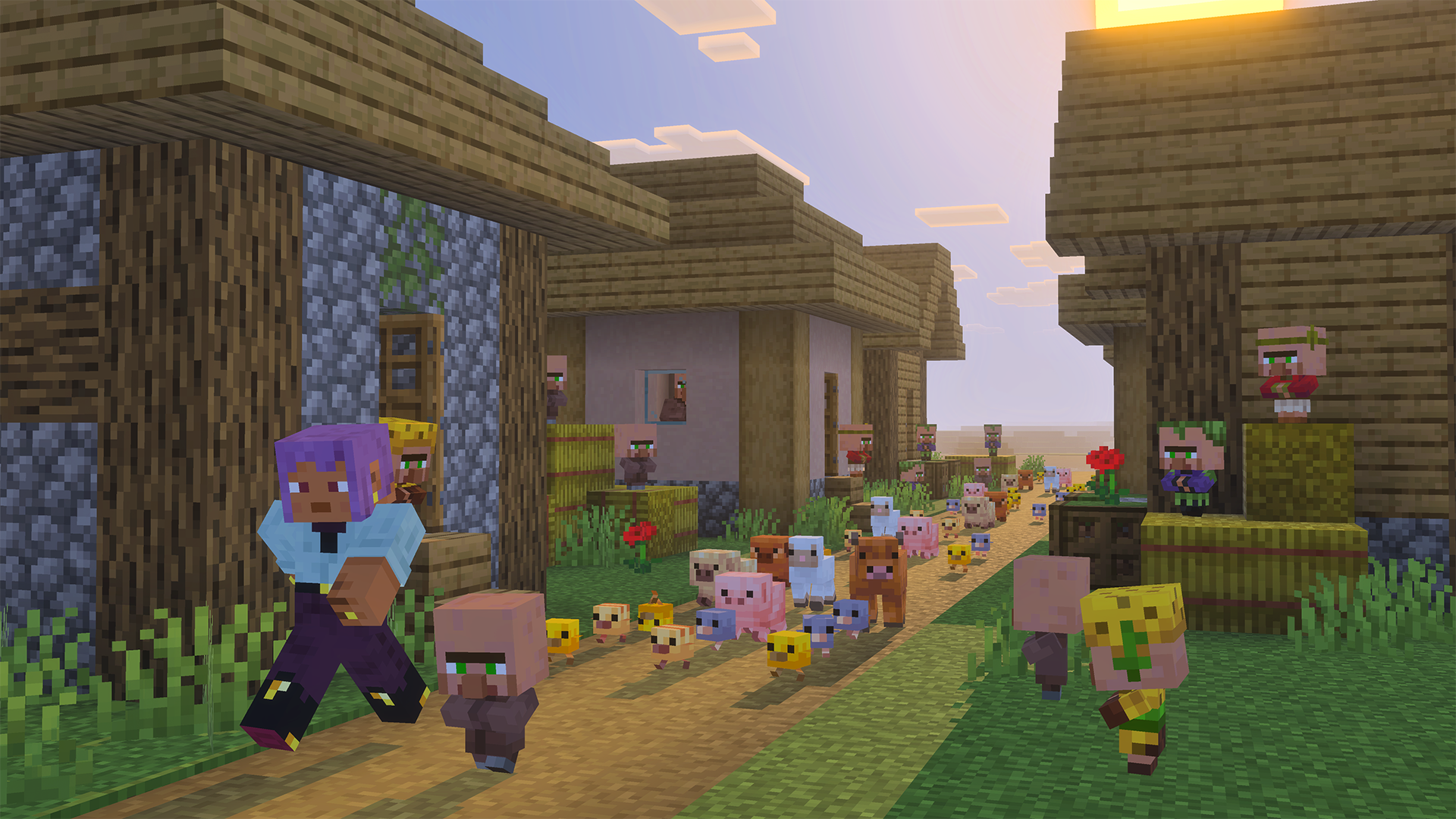
Not all of Minecraft Live’s announcements were about real-world empire building. Minecraft, the game, is getting some updates, too. Its next big drop, Tiny Takeover, will live up to the billing with a redesigned “cuter” look for baby mobs. The update will also add a golden dandelion, which you can feed to a baby mob to make it stay young forever. (Or, at least until you feed it a second one.) Tiny Takeover arrives on March 24.
Mojang also teased the next drop after that. Later this year, Chaos Cubed will add a sulfur cube that changes properties when absorbing different materials. “There is a lot of variety in what the cube can do,” Mojang promises. “Just like there are balls with different ‘bounciness’ and behavior, the sulfur cube can have different physics.”
Finally, the long-rumored Minecraft Dungeons II game is official. We’re still extremely light on details about the sequel to the 2020 spinoff, aside from the fact that you can wishlist it on March 21.
This article originally appeared on Engadget at https://www.engadget.com/gaming/a-minecraft-theme-park-will-open-in-london-in-2027-173000917.html?src=rss
MSI Laptops With Intel Wildcat Lake Are Coming To Rival Apple’s MacBook Neo

Have you been looking longingly at the MacBook Neo, wishing there was a Windows laptop with a similar spec? Well, there already are quite a few laptops with similar capabilities, but none of them will have the MacBook Neo’s specific combination of speed and efficiency. For that, you may need to wait for Intel’s Wildcat Lake processors and
Checking In On Somnium Space, The Blockchain-Based PC Social VR Platform
Somnium Space has updated its platform with improved player profiles and various quality of life features. I took a look into what’s new on the live service platform.
I remember first hearing about Somnium Space through an XR social group a few years ago.
One of the group members was raving about her experience on the platform. She had built a club and wanted us all to visit and take a look around. That early visit didn’t wow me back then as there was a learning curve I couldn’t get past.
Fast forward to today, and Somnium has released a new update with improved player profiles, faster map loading times, new dance animations, and more. But will the platform leave an impression with me this time? I logged back in to find out.

Welcome To Base Reality
I begin my journey in Somnium Space by viewing a short tutorial on how to move and use basic features on the platform. Afterwards, I materialize in an office tower that reveals the world below. This place, which looks like a bunch of sleekly-designed structures mixed with player-owned buildings, is what’s known in-game as “Base Reality”.
Base Reality is a quaintly designed town map bisected by rivers and mountains. In its center is a public courtyard surrounded by a mall, a public pavilion, a planetarium, and a prison for misbehaving players. Overhead are several planets that share the sky with a sun and moon. There are day and night cycles as well as thoughtful spatial sound design featuring singing birds and nighttime crickets.

The overworld’s town mall is a bright echo of vaporwave design. Its empty storefronts state they’re currently for rent or will be soon. The planetarium across the street holds an exhibit on space travel and is narrated by an AI voice that sounds like Morgan Freeman. I walk from building to building in the town center while marveling at the architecture.
Riding around on a free hoverbike, I explore more overworld landmarks. There’s a large park called Magic Forest that’s drenched in pink fog and decorated with statues. Beyond the park is a hill hiding a secret cave, leading to an underground series of tunnels. Cross one of the large bridges over the river and the Somnium Racetrack sits in the distance.

In the middle of the raceway and town center are land parcels. Most of them feature old NFT galleries and defunct cryptocurrency businesses. I drive from building to building, park my car, and walk inside to observe the interiors. Video players that no longer function, old photos of celebrities hawking token-based art, and AI-generated image galleries are what await me.
This is where the town begins to contrast. What’s bright, cheery, and welcoming at the center of the map bleeds into aging neighborhoods of abandoned virtual office concepts. They’re fun to race by and load quickly enough to not cause lag, but I can’t help but wonder about the people who once ran businesses here.
0:00
/1:35
Digital Land And NFTs
In 2022, Somnium Space Founder and CEO Artur Sychov gave Forbes a tour of the platform. The Forbes article extolled the virtues of parcel ownership and claimed digital land bought on the blockchain couldn’t be taken away once purchased.
That might be a problem for a live service experience looking to grow its numbers in the current day. If there’s going to be parcels people can buy and sell, there should be players actively using them to keep things lively.
Somnium now has worldbuilding with instance technology rather than relying on parcel space, but Sychov insists digital land purchasing isn’t going away at all.

“Parcels remain a fundamental part of Somnium Space,” he wrote to UploadVR. “Users can still purchase them using blockchain or traditional currency, and they can build on them either through our easy-to-use Builder application or via the Unity SDK.”
Somnium Space currently handles purchases through either Stripe for traditional currency or a linked crypto wallet through Somnium’s website. Once payment is linked, players can purchase items on the platform’s marketplace or tip one another with either form of currency.

The Call Is Coming From Inside The Game
While I’m not personally wild about web3, Somnium Space’s other features are impressive.
Glimmr is Somnium Space’s in-house social app. You can take a snap of anything and upload it to the social feed right away. Posts can optionally be hidden and unlocked by a monetary donation, or boosted for higher visibility on the general timeline. During a community meeting I was able to pull up the social feed where players were posting snaps of one another in real time.
0:00
/1:09
One jaw-dropping moment came when Sychov mentioned a video call function that lets you facetime players through in-game video and real-world webcams. I tested this with Sychov as he called me via his game menu. A thin smartphone screen appeared as I answered. After hanging up, a player standing next to me also initiated a call. When I picked up this time, I could see the actual person in real life waving at me. I waved back with my avatar and laughed.
“Communication between people in different VR instances which we introduced is already powerful and first in industry, but we realized that connecting real life directly with VR could be even more impactful,” Sychov explained. “That led to the idea of enabling video calls where someone outside VR can call a person inside Somnium. It’s a very natural step toward blending physical and virtual presence.”
Players can also call from their phones into Somnium Space in order to have a physical-to-virtual-phone conversation. The “physical” user must access Somnium’s website on their phone to initiate the call. Their “virtual” friends will be able to pick up on the other side and speak to them that way. Sychov says Somnium Space plans to expand the feature in the future.

Can They Make It?
The VR community is sharply divided on issues such as web3. Either Somnium Space will appeal to someone because of its token implementation or it won’t at all. This challenge is to be reasonably expected and faced with honesty.
That aside, Somnium Space’s UI is one of the best I’ve seen in a live service platform. Its overworld map design is done reasonably well but parcel management currently gives an “abandoned” feel. If the platform can overcome its land issues, Somnium can grow to be a nice alternative to other platforms currently on offer.

Sychov is proud of what Somnium Space has accomplished so far. “Our philosophy is very straightforward: build great technology and the users will come.”
“We’re seeing our user base grow steadily, and we’re focused on providing creators with better tools to build experiences and monetize them in a fair and decentralized ecosystem.”
Somnium Space is available on PCVR. It is currently an 18+ platform with age verification implemented through Stripe.
Firefox Announces Built-In VPN and Other New Features – and Introduces Its New Mascot
A free built-in VPN is coming to Firefox on Tuesday, Mozilla announced this week:
Free VPNs can sometimes mean sketchy arrangements that end up compromising your privacy, but ours is built from our data principles and commitment to be the world’s most trusted browser. It routes your browser traffic through a proxy to hide your IP address and location while you browse, giving you stronger privacy and protection online with no extra downloads. Users will have 50 gigabytes of data monthly in the U.S., France, Germany and U.K. to start. Available in Firefox 149 starting March 24.
We also recently shared that Firefox is the first browser to ship Sanitizer API, a new web security standard that blocks attacks before they reach you [for untrusted HTML XSS vulnerabilities].
“The roadmap for Firefox this year is the most exciting one we’ve developed in quite a while,” says Firefox head Ajit Varma. “We’re improving the fundamentals like speed and performance. We’re also launching innovative new open standards in Gecko to ensure the future of the web is open, diverse, and not controlled by a single engine.
“At the same time we’re prioritizing features that give users real power, choice and strong privacy protections, built in a way that only Firefox can. And as always, we’ll keep listening, inviting users to help shape what comes next and giving them more reasons to love Firefox.”
Two new features coming next week:
Split View puts two webpages side by side in one window, making it easy to compare, copy and multitask without bouncing between tabs. Rolling out in Firefox 149 on March 24.
Tab Notes let you add notes to any tab, another tool to help with multitasking and picking up where you left off. Available in Firefox Labs 149 starting March 24.
And Firefox also released a video this week introducing their new mascot Kit.


Read more of this story at Slashdot.
OpenAI reportedly plans to double its workforce to 8,000 employees
While other tech companies have been laying off employees year after year, OpenAI is doing the opposite. According to a report from the Financial Times, the AI giant is looking to expand its workforce to 8,000 employees by the end of 2026, nearly doubling staff from its current headcount of 4,500.
The FT reported that the new hires will be across several departments, including product development, engineering, research and sales. OpenAI’s hiring spree will also include “specialists” for “technical ambassadorship,” or employees tasked with helping businesses better utilize its AI tools, according to the report. As the FT noted, OpenAI is likely trying to amp up the competition against Anthropic and its Claude AI chatbot. According to the AI Index from Ramp, a fintech startup that manages corporate expenses, businesses are now 70 percent more likely to go with Anthropic when buying AI services for the first time as opposed to OpenAI.
OpenAI made waves in February when it announced a contract with the Department of Defense to use its AI models, following a public fallout between Anthropic and the federal agency. On top of the government contract, OpenAI is also in “advanced talks” with private equity firms like Brookfield Asset Management to deploy its AI tools across a firms’ portfolio of companies, according to Reuters.
This article originally appeared on Engadget at https://www.engadget.com/ai/openai-reportedly-plans-to-double-its-workforce-to-8000-employees-161028377.html?src=rss