
There is two weeks to go until the GNOME 50 stable release while out today is the release candidate of Mutter 50. This Mutter 50.rc release brings some exciting last-minute enhancements to this Wayland compositor…
Monthly Archives: March 2026
New Pivot Mach 4 offers trail-friendly features and capability at XC weights
Pivot’s newest XC bike is the revamped Mach 4 SL. Gone is the choice between two models (short and long travel), replaced by a single version with adjustable travel between 110mm and 120mm.
Rear suspension is delivered by Dave Weagle’s venerable DW-link design.
The V4 includes down-tube storage that, along with the increase in travel from 95-115mm on the previous bike, should make this a more trail-friendly and versatile bike than the outgoing V3.
- Read more: Pivot Mach 4 SL Team XX SL review
Adjustable travel
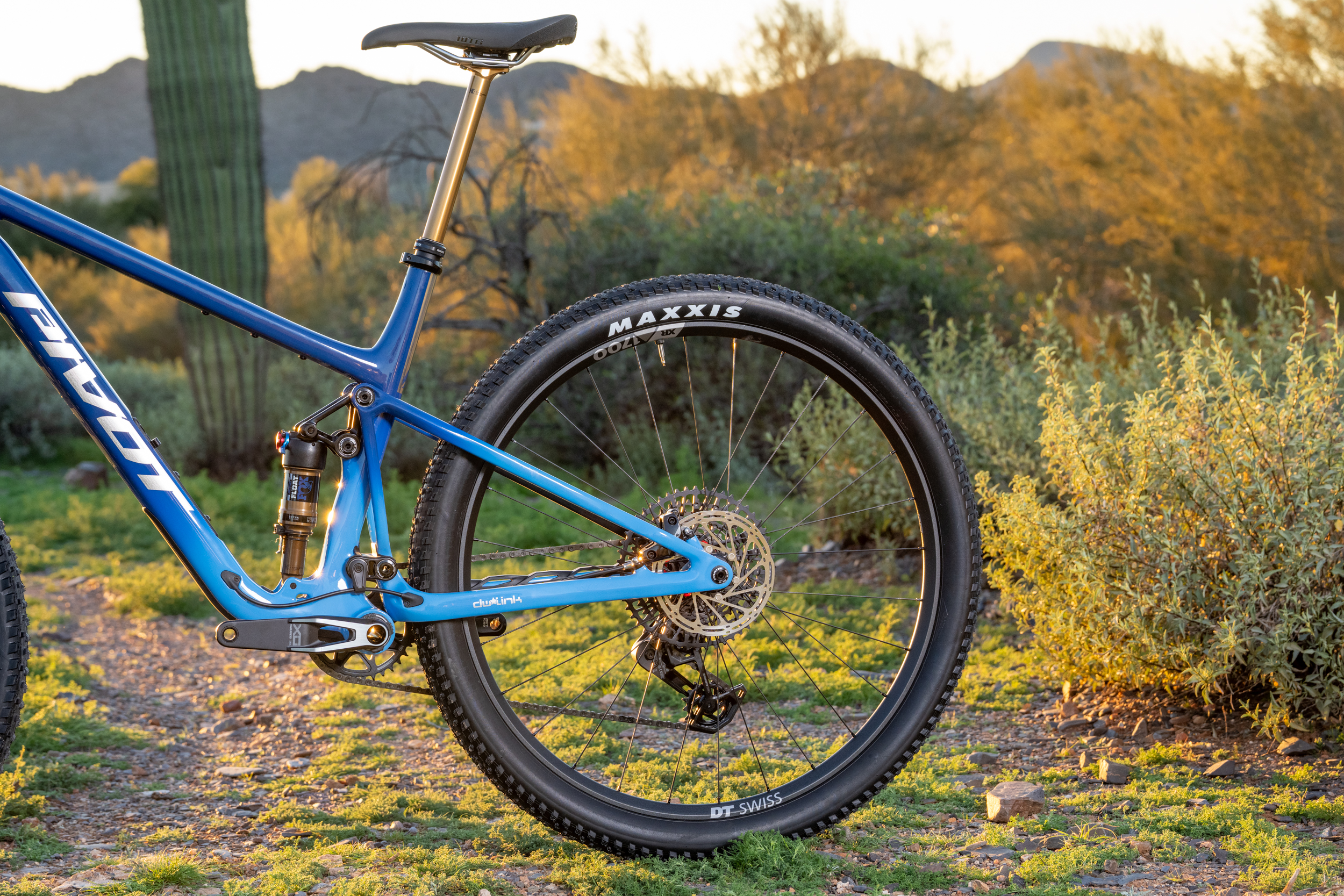
Cross-country bikes have been seeing a gradual increase in travel and aggressive geometry in recent years, so it’s interesting to see the new Mach 4 SL following suit.
Although officially labelled an XC bike by Pivot, it could easily demolish trail centres as a downcountry bike, too.
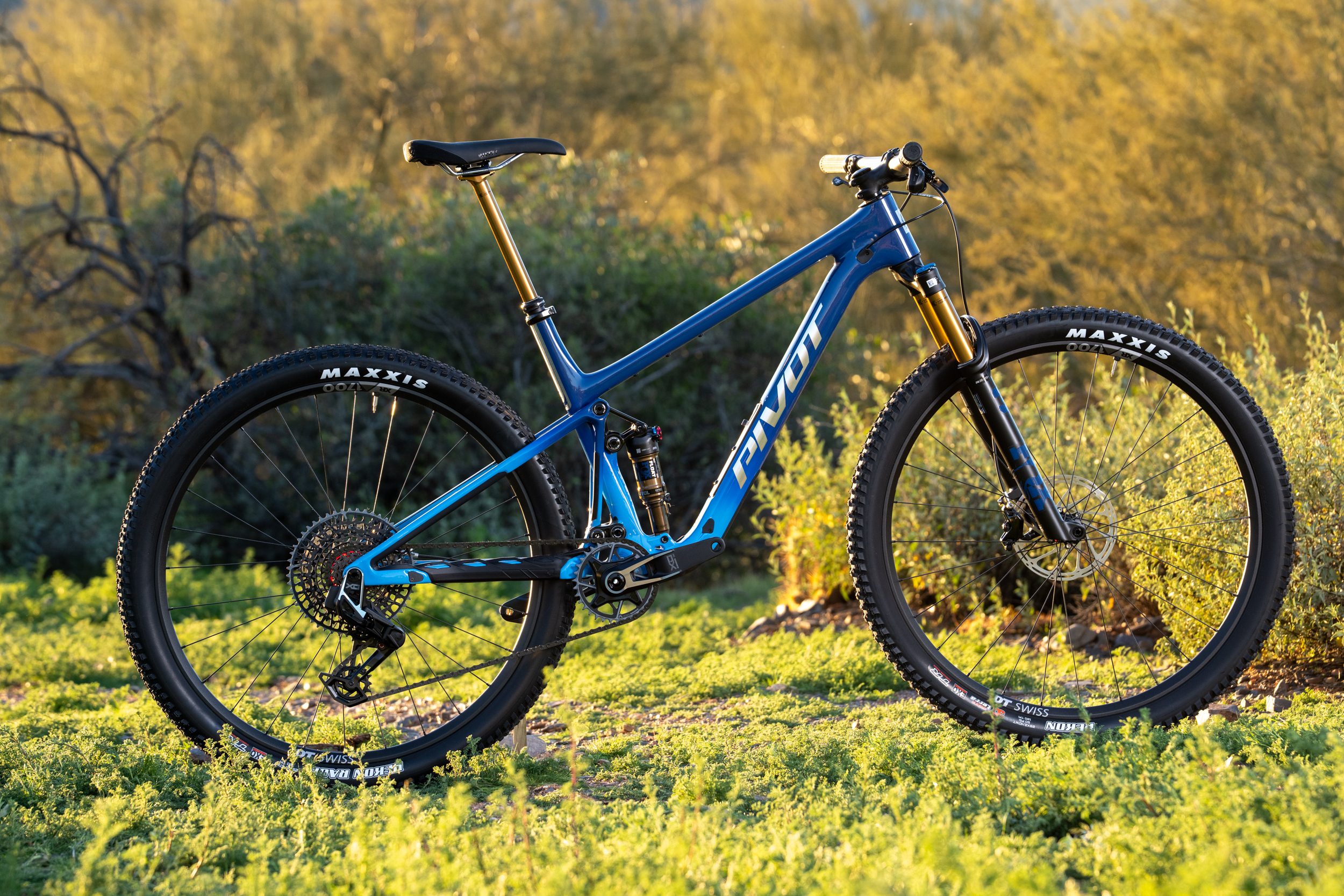
Previous versions of the Mach 4 were offered in either short- or long-travel guises. The former, 95mm/103mm-travel, bike was supplied with a 100mm-travel fork and aimed at XC and marathon racing on less technical tracks. The latter 106mm/115mm-travel bike had a 120mm fork and was aimed at more technical XC racing and downcountry riding.
Pivot has done away with this, now offering one frame configuration with longer travel adjustable between 110mm and 120mm – 5mm more than the outgoing model, even in it’s longest-travel setting.
The inclusion of down-tube storage makes the new bike even more trail- and downcountry-friendly than the more race-focused V3.
Geometry
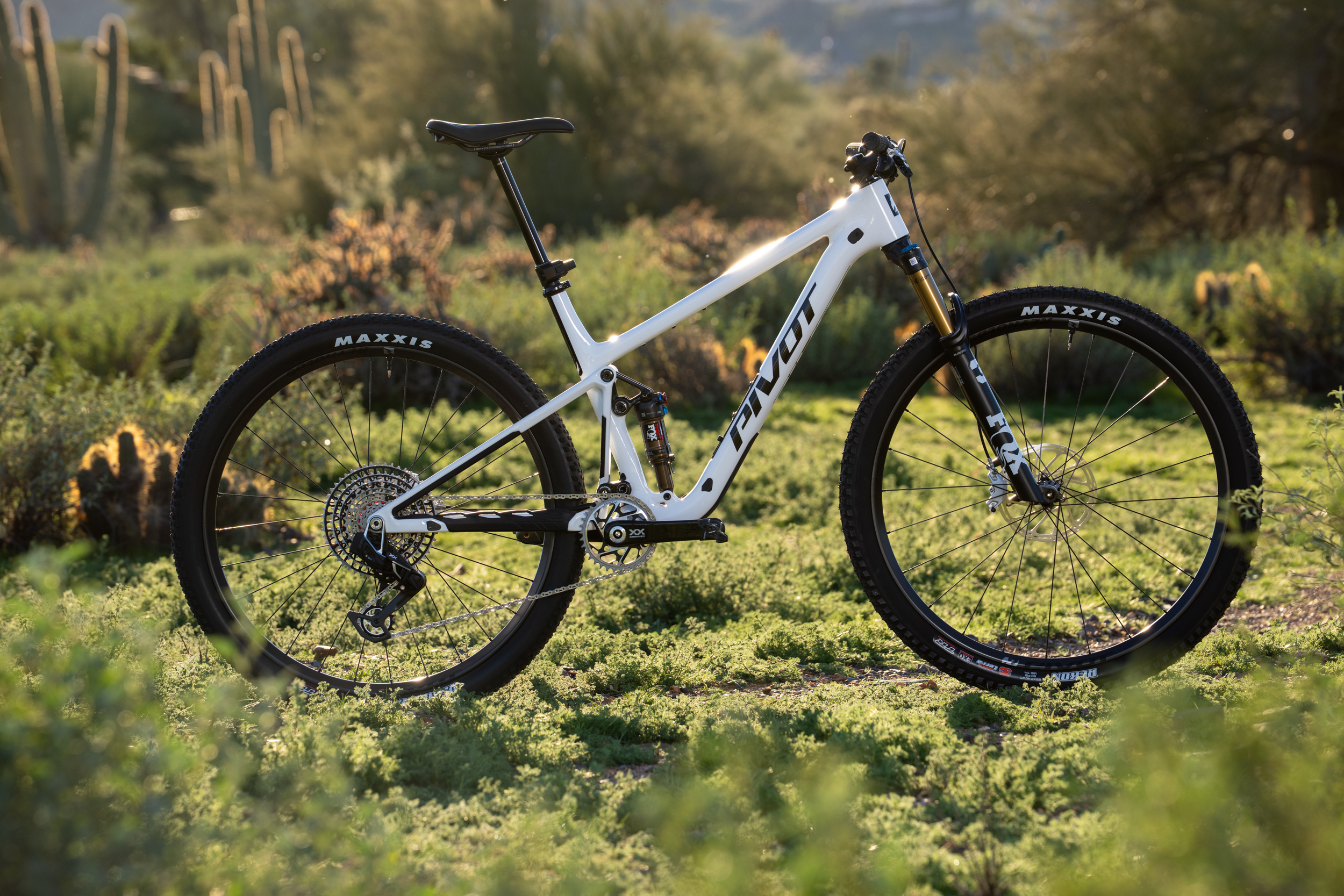
The head angle is an aggressive two degrees slacker than the old Mach 4 SL’s 68-degree head angle.
The bottom bracket height is slightly higher, at 336mm (compared to the outgoing version’s 329mm), but due to the increased rear-wheel travel, expect the dynamic geometry (when the bike is under sag) to be very similar.
There are five sizes on offer: XS, S, M, L and XL. Reach starts at 410mm and goes up to 495mm for the XL, while the wheelbase measures 1,131mm for the XS and 1,236mm for the XL.
Build options
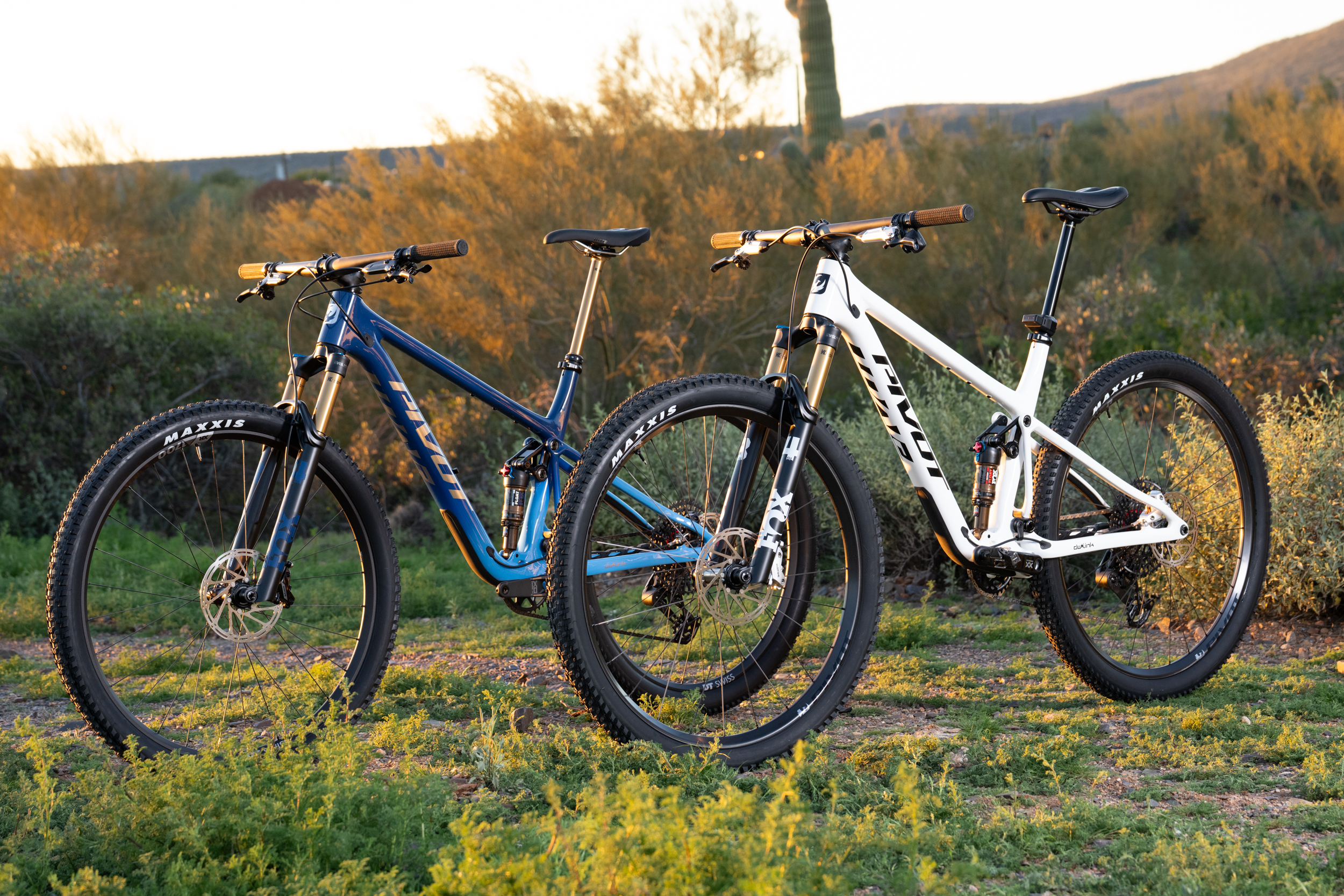
There are four models: Team, Pro, Expert and Ride. The Ride starts at $6,399 and prices rise to $13,999 for the top-spec Team model. The Mach 4 SL is available in Blue Stellar Fade and White Avalanche colourways.
There are both RockShox and a Fox-equipped Team-build models available. The Team XX SL Eagle Transmission model has Fox Factory suspension and SRAM XX SL Eagle Transmission.
The Team XX SL Eagle Transmission Flight Attendant bike comes with RockShox Flight Attendant suspension from the SID Ultimate fork and unconfirmed model of RockShox shock, and XX SL Eagle Transmission.
The Pro build has Fox Factory suspension and SRAM’s X0 Eagle Transmission.
The Expert build has Shimano XT Di2 shifting and Fox Performance suspension.
The Ride model is the most budget-conscious, with a Fox Performance 34 Step-Cast fork, Performance Float shock and SRAM Eagle 70/90 mechanical Transmission.
A frame-only option is also available for riders wanting to build their own ideal setup,
Pricing and availability
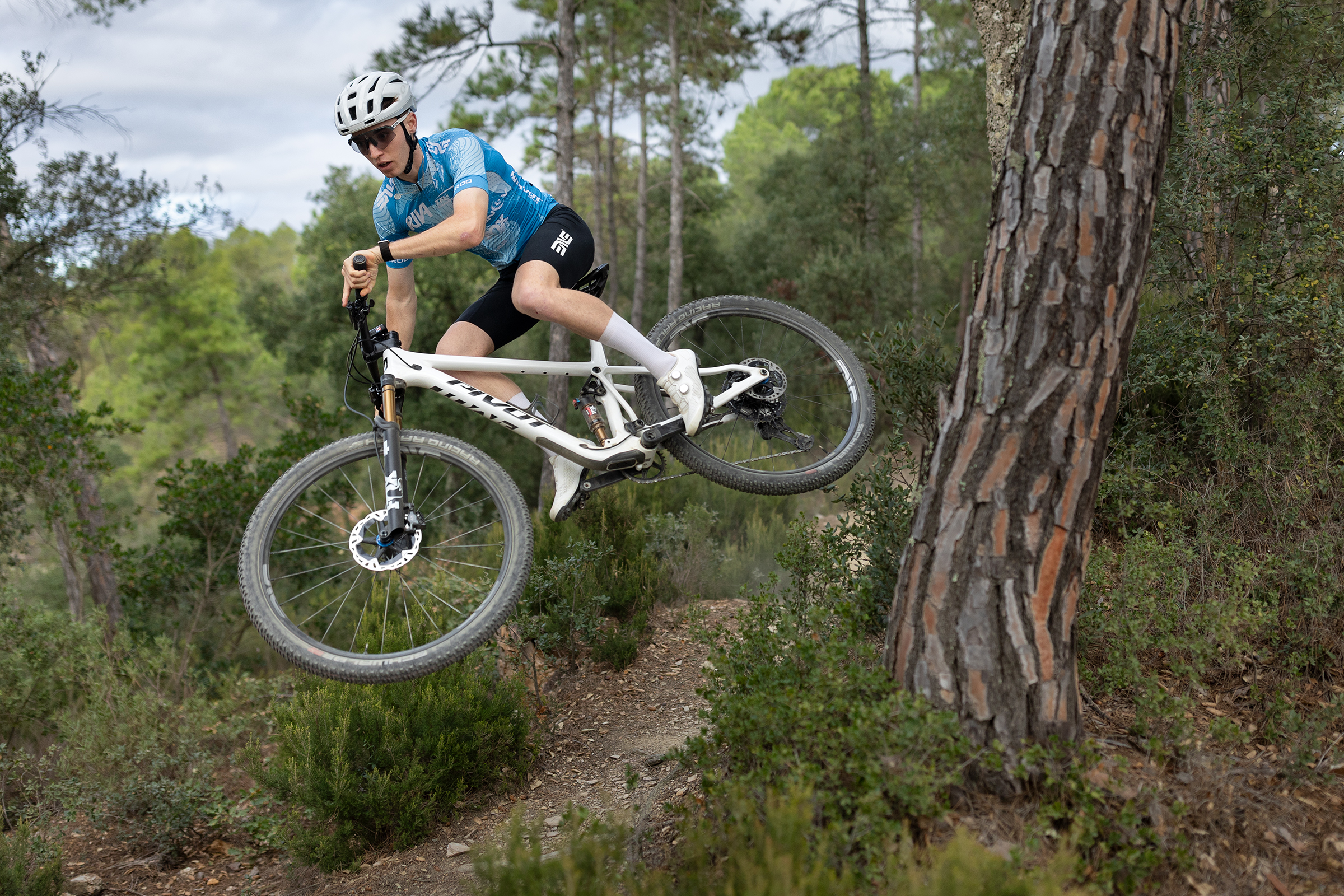
There are four models available, including two Team builds and a frame-only option.
- Mach 4 SL V4 Team XX Eagle Transmission Flight Attendant: £13,999 / $13,999 / €12,999
- Mach 4 SL V4 Team XX Eagle Transmission: £11,999 / $11,999 / €12,299
- Mach 4 SL V4 Pro X0 Eagle Transmission: £8,799 / $8,799 / €8,799
- Mach 4 SL V4 Expert XT Di2: £7,499 / $7,499/ €7,199
- Mach 4 SL V4 Ride 70/90 Eagle Transmission: £6,399 / $6,399 / €6,199
- Mach 4 SL V4 Frameset: £TBC / $TBC / €TBC
Vivo X300 Ultra Debuts With Mind-Blowing 400mm Zeiss Extender And 200MP Sensor
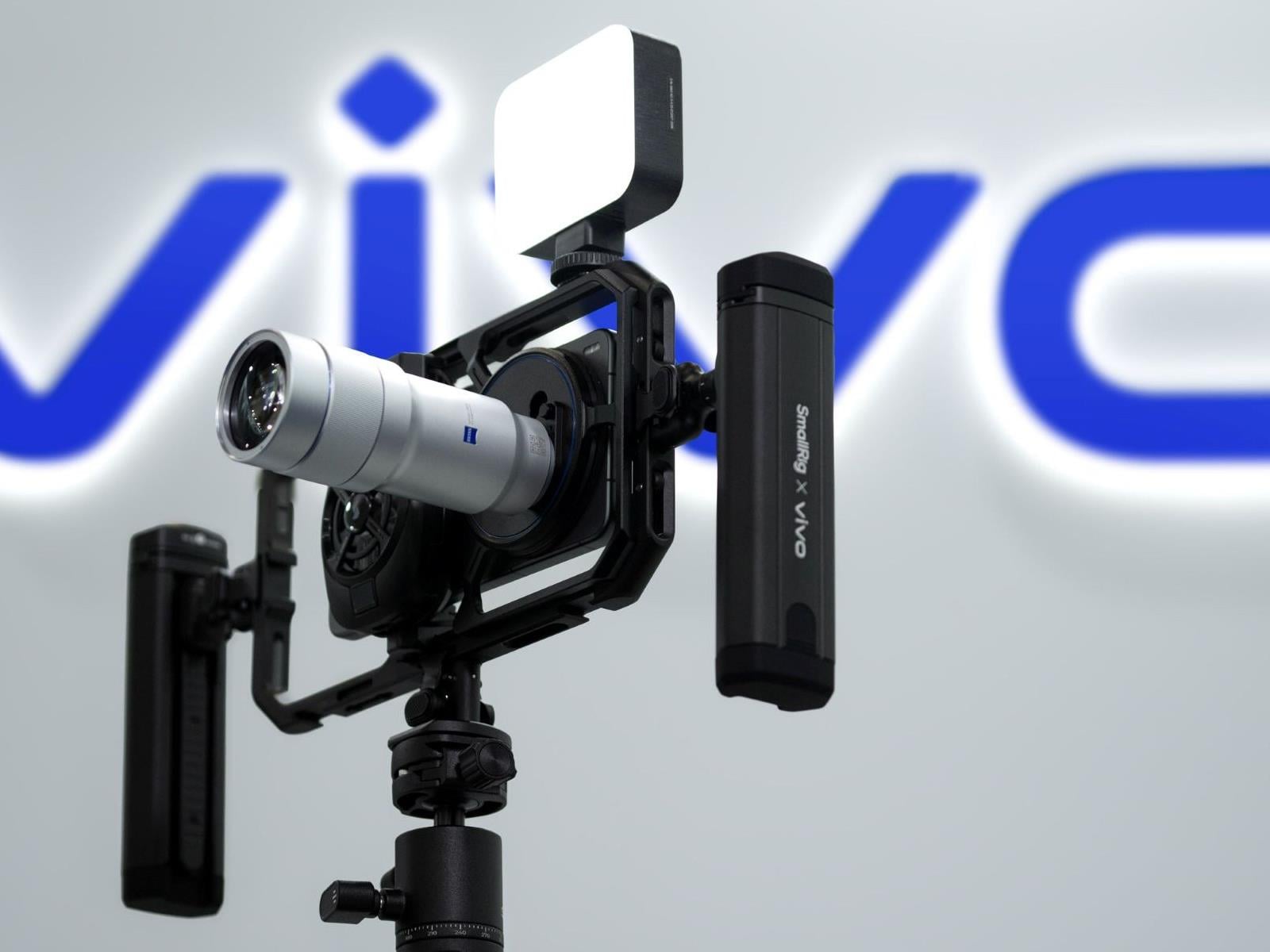
Talk about phallic envy: Vivo has officially pulled the covers off its new X300 Ultra and ZEISS Telephoto Extender accessory. It’s large, in your face, quite possibly overpowered, and yes, it is happy to see you.
Indeed, the X300 Ultra will be an imaging beast with its onboard 200-megapixel telephoto sensor (likely a Sony IMX90E), which
AI-Generated Art Can’t Be Copyrighted After Supreme Court Declines To Review the Rule
The Supreme Court of the United States declined to review a case challenging the U.S. Copyright Office’s stance that AI-generated works lack the required human authorship for copyright protection, leaving lower court rulings intact. The Verge reports: The Monday decision comes after Stephen Thaler, a computer scientist from Missouri, appealed a court’s decision to uphold a ruling that found AI-generated art can’t be copyrighted. In 2019, the U.S. Copyright Office rejected Thaler’s request to copyright an image, called A Recent Entrance to Paradise, on behalf of an algorithm he created. The Copyright Office reviewed the decision in 2022 and determined that the image doesn’t include “human authorship,” disqualifying it from copyright protection.
After Thaler appealed the decision, U.S. District Court Judge Beryl A. Howell ruled in 2023 that “human authorship is a bedrock requirement of copyright.” That ruling was later upheld in 2025 by a federal appeals court in Washington, DC. As reported by Reuters, Thaler asked the Supreme Court to review the ruling in October 2025, arguing it “created a chilling effect on anyone else considering using AI creatively.” The U.S. federal circuit court also determined that AI systems can’t patent inventions because they aren’t human, which the U.S. Patent Office reaffirmed in 2024 with new guidance. The UK Supreme Court made a similar determination.


Read more of this story at Slashdot.
TNP Spring Classics Series Announced: First Race this Saturday
Team Not Pogi is bringing the chaos, tactics, and punchy brutality of the Spring Classics to Watopia and beyond with a three-race themed series designed to replicate the character of the biggest one-day races in cycling.
What Makes It Special
- Themed around the Spring Classics rather than generic race formats
- ZRS category brackets with a true mass start
- Bike upgrades and steering enabled for tactical variety
- Powerups revealed dynamically at banners
- Routes chosen to reflect the character of each real-world race
- Two timeslots for each race
Race Details
Saturday, March 7: Ride the White Roads: Strade Bianche Challenge
Inspired by Tuscany’s gravel sectors, this race is about rhythm and resilience. Rolling terrain, punchy climbs, and repeated efforts make positioning everything. Three laps of Two Village Loop will be relentless without being predictable. Expect splits to form early and selection to happen naturally as the elastic stretches and snaps.
- Route: Two Village Loop (3 laps)
- Distance: 38.6 km
- Elevation: 264 m
- Sign up for 08:00 and 17:50 GMT
Saturday, March 21: La Primavera Spring Classic
A longer, endurance-style classic with a sting in the tail. Dust in the Wind rewards patience as much as power. Riders who burn too many matches early may find themselves isolated when it matters most. This is one for the tacticians and late attackers.
- Route: Dust in the Wind
- Distance: 52.4 km
- Elevation: 528 m
- Sign up for 08:00 and 17:50 GMT
Sunday, April 5: Cobbled Classic: Flanders Edition
Shorter on paper. Brutal in reality. Richmond’s UCI Worlds course delivers sharp climbs and constant pressure, perfectly suited to a Flanders-style showdown. Expect explosive racing, repeated accelerations, and no place to hide in the finale.
- Route: 2015 Worlds Course (2 laps)
- Distance: 32.8 km
- Elevation: 156 m
- Sign up for 07:55 and 17:55 GMT
New Cervélo Caledonia takes on the Giant Defy and Cannondale Synapse – and it’s yours from £3,000
Cervélo has launched its all-new Caledonia endurance bike, bringing with it some of the improvements that debuted on last year’s brilliant but pricey Caledonia 5.
The new Caledonia sits at the sportier end of the endurance spectrum and looks to be a key rival to purist long-distance bikes such as Giant’s svelte Defy and Cannondale’s aero and well-equipped Synapse.
The key upgrades to the Caledonia design for the latest model are a lighter construction, bigger tyre clearance, a practical threaded bottom bracket and clever internal routing that enables cockpit swaps without splitting brake hoses.
However, for me, the biggest deal about the New Caledonia is it’ll be available from £3,000 / $3,200 / €2,999 for the 12-speed 105 model, up to a SRAM Force/Reserve carbon-wheel equipped flagship for £5,250 / $6,850 / €6,499.
- Read more: Cervélo Caledonia 5 Ultegra Di2 review – it rides like a dream, but the price is a nightmare
Lighter frame
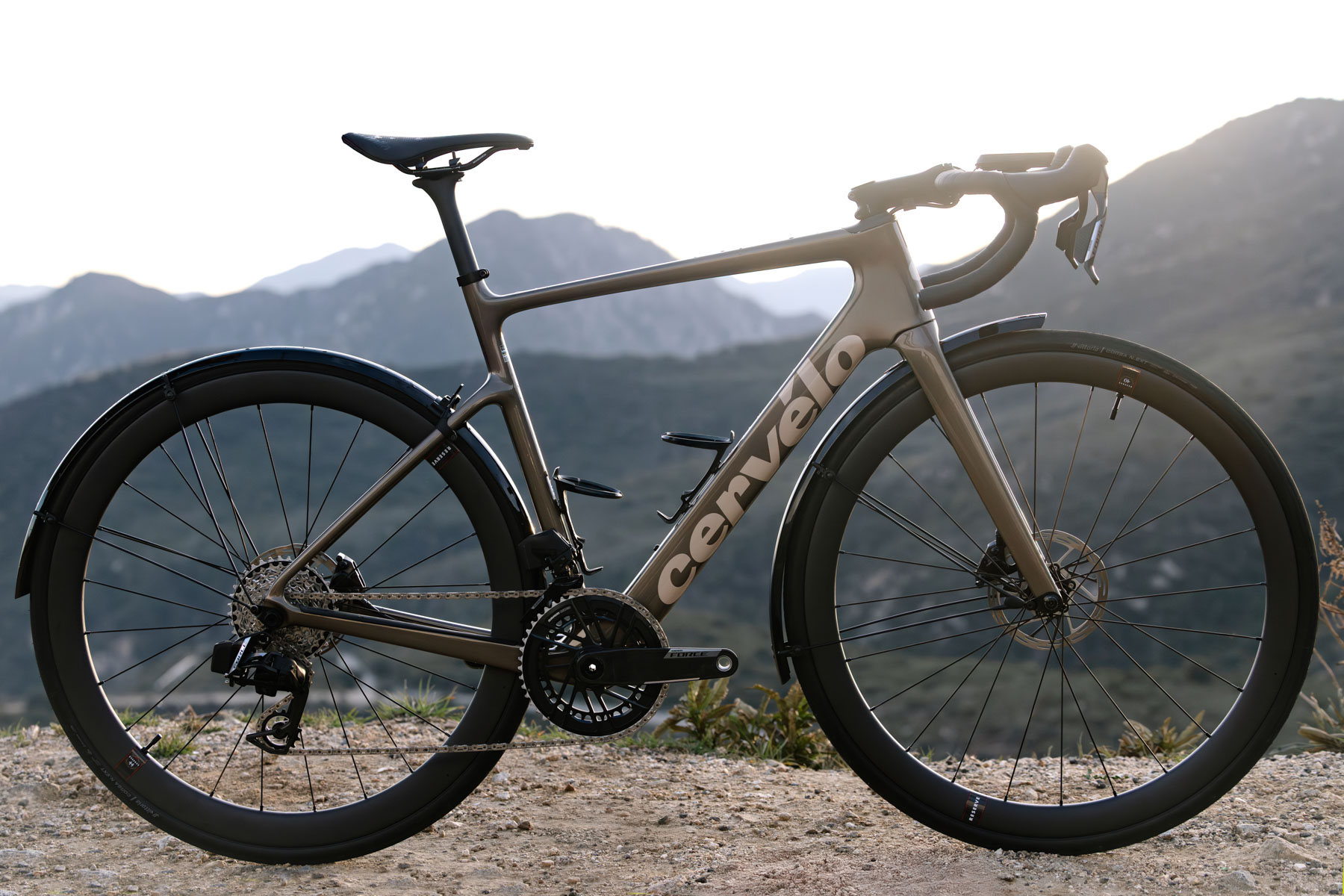
Cervélo has worked on the carbon fibre layup of the Caledonia’s frame, resulting in improved head-tube and bottom-bracket stiffness, while increasing compliance thanks to a reshaped seat tube and shaving 53g from the frame weight.
That brings the Caledonia frame under the 1kg mark, dropping from the original’s claimed 1,031g (painted, size 54) to around 988g. Like the 5, the frame gets removable mudguard/fender mounts.
Unlike the Caledonia 5, the standard Caledonia doesn’t have the clever down-tube storage.
Spec details

The Caledonia has been brought in line with the Caledonia 5, with a larger 36mm clearance – or 34mm with fenders/mudguards.
In what’s now becoming an industry-wide shift away from press-fit bottom brackets, the Caledonia has made the switch to the ubiquitous T47 threaded bottom bracket standard.
Unlike its electronic-only sibling, the Caledonia 5, the new bike has mechanic-friendly routing. This supports both the high-end fully integrated Cervélo setup (ST31/32, HB18) as found on the Caledonia 5, Áspero 5 and Soloist, and semi-external routing with a standard 1 1/8-inch interface, meaning it’s compatible with many aftermarket stems.
Being able to switch out the stem without splitting brake hoses also makes for a bike that’s easier to pack for travel. It should make the Caledonia a fine companion for bucket-list overseas sportives or Gran Fondos.
Long-distance geometry

Cervélo has evolved the geometry and the fork trail to accommodate larger tyres, while maintaining the speed-oriented but comfortable geometry. That means a 72-degree head angle, short 415mm chainstays and mid-length wheelbase.
The New Caledonia shares its geometry with the Caledonia 5 – a bike with wonderfully reactive handling – while feeling stable and smooth over rougher surfaces.
Cervélo Caledonia range details
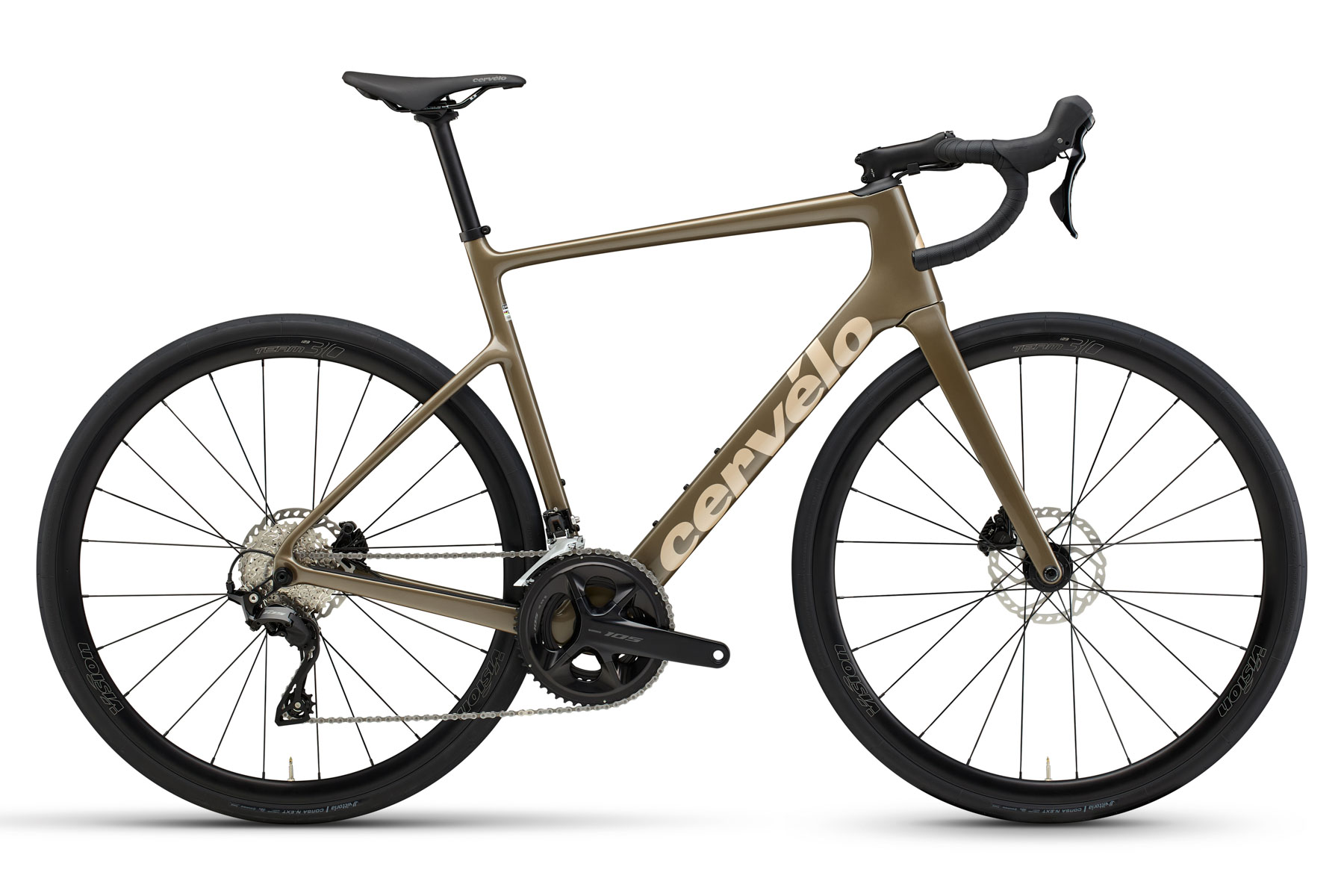
The Caledonia range consists of four bikes. The base model has Shimano 105 mechanical, moving up to 105 Di2, then SRAM Rival and topping out with SRAM Force and carbon wheels.
All models are available in six sizes: 48/51/54/56/58/61cm.
Cervélo Caledonia 105
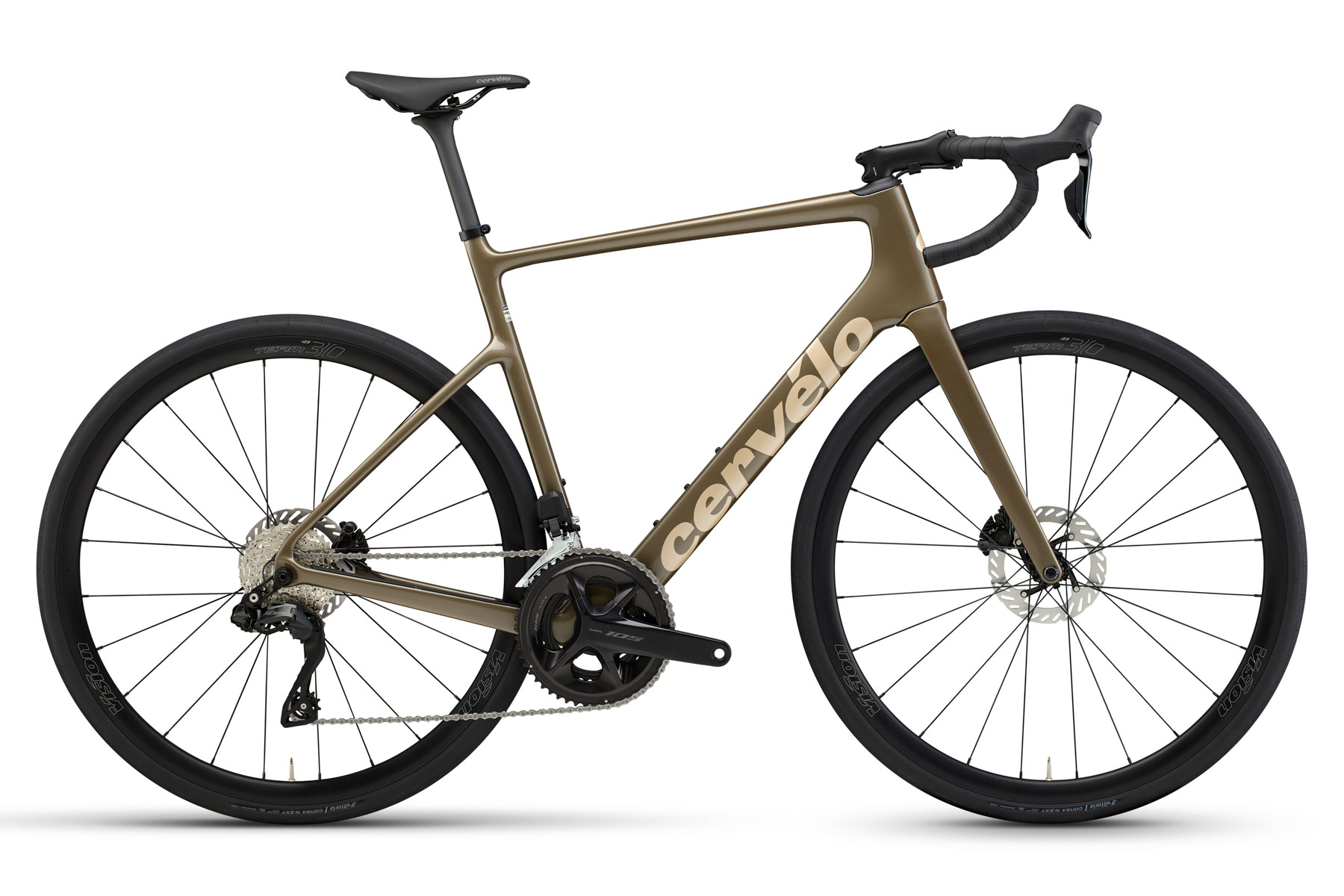
- Spec highlights: Shimano 12-speed 105 (52/36, 11-34), Vision Team i23 disc tubeless-compatible wheels with J-bend spokes on standard hubs, Cervélo HB23 bar, ST36 stem, Vittoria Corsa N.EXT TLR G2.0 32c tyres
- Price: £3,000 / $3,250 / €2,999 / AU$4,400 / CAN$4,400
Cervélo Caledonia 105 Di2
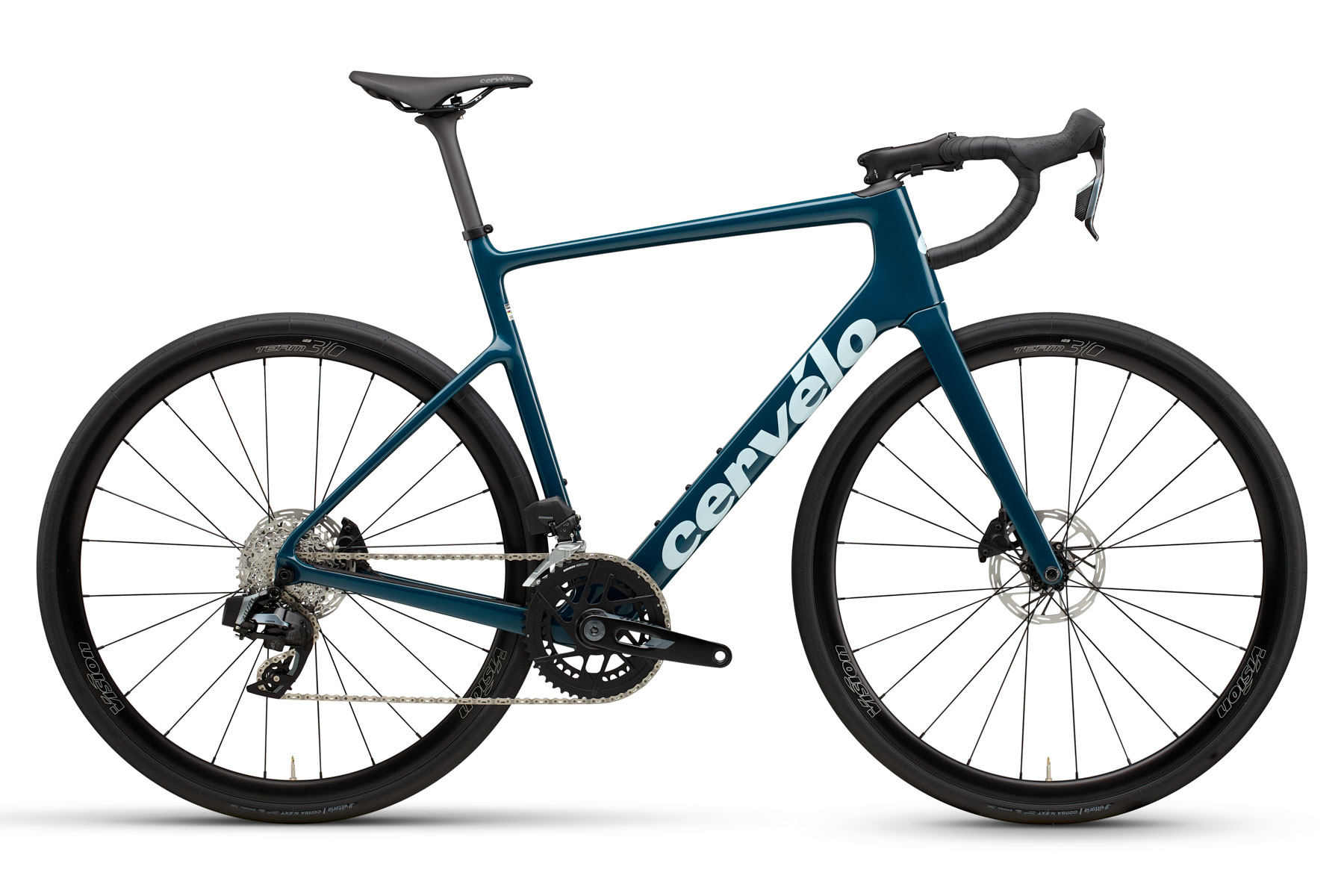
- Spec highlights: Shimano 12-speed 105 Di2 (52/36, 11-34), Vision Team i23 disc tubeless-compatible wheels with straight-pull hubs, Cervélo HB23 bar, ST36 stem, Vittoria Corsa N.EXT TLR G2.0 32c tyres
- Price: £4,000 / $4,500 / €3,999 / AU$5,200 / CAN$5,600
Cervélo Caledonia Rival AXS
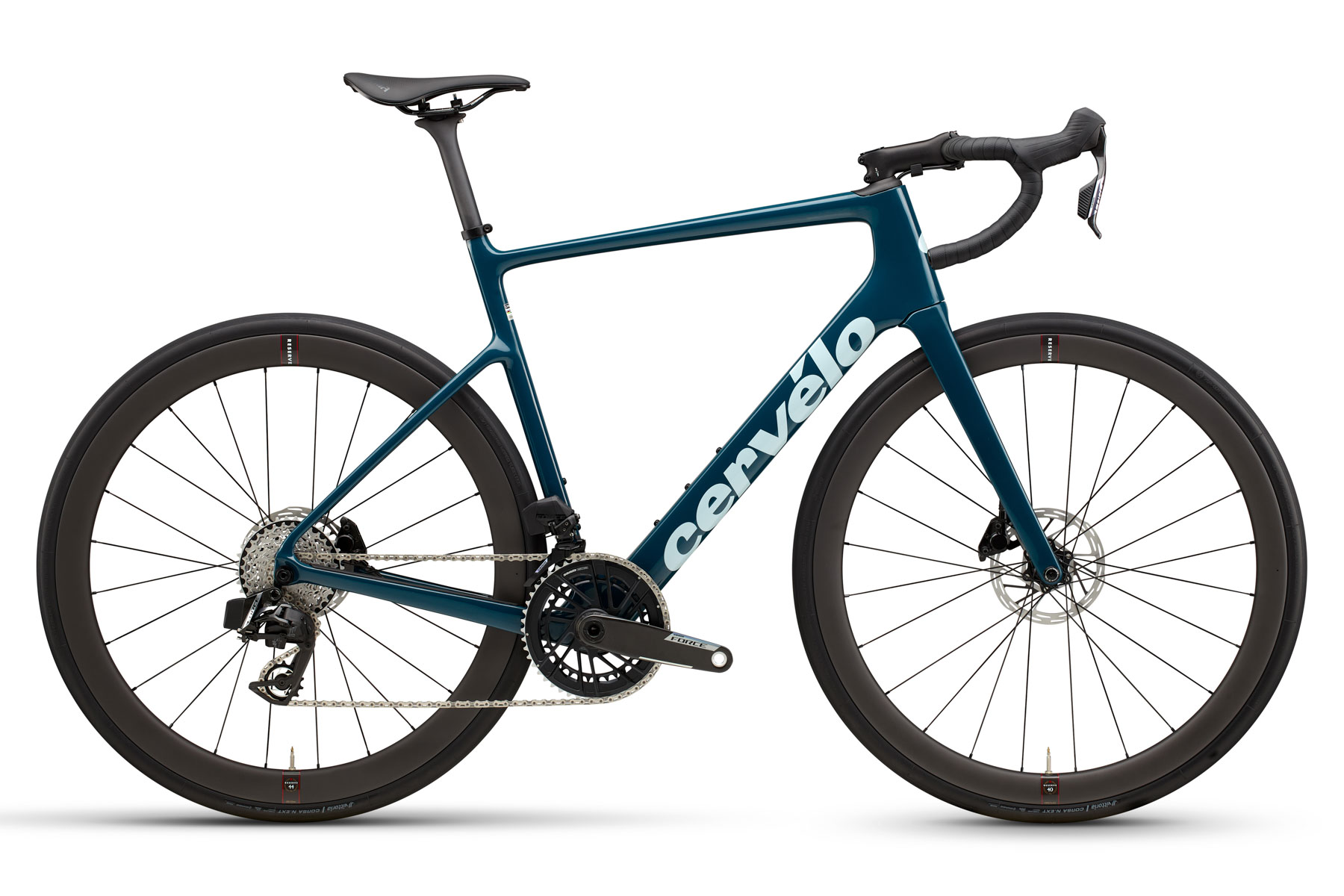
- Spec highlights: SRAM Rival AXS E1 (48/35, 10-36), Vision Team i23 disc tubeless-compatible wheels with straight-pull hubs, Cervélo HB23 bar, ST36 stem, Vittoria Corsa N.EXT TLR G2.0 32c tyres
- Price: £4,000 / $4,500 / €3,999 / AU$5,900 / CAN$6,000
Cervélo Caledonia Force AXS
- Spec highlights: SRAM Force AXS E1 (48/35, 10-36), Reserve 40/44 carbon wheels, Cervélo HB23 bar, ST36 stem, Vittoria Corsa N.EXT TLR G2.0 30c tyres
- Price: AXS £5,250 / $6,500 / €6,499 / AU$9,000 / CAN$8,650
New MacBook Airs come with M5, double the storage, and higher starting prices
Most of Apple’s laptop lineup is getting refreshed today—the high-end MacBook Pros are getting M5 Pro and M5 Max chip refreshes, and the MacBook Air is getting upgraded with an M5.
The more significant update might be the storage, though: Apple is bumping the Air’s base storage from 256GB up to 512GB, and Apple says the storage will be up to twice as fast as the M4 MacBook Air.
But that’s also increasing the Air’s starting price from $999 to $1,099 for the 13-inch model, and from $1,199 to $1,299 for the 15-inch model. Whether you describe this as a price increase or a price cut depends on your point of view; the 512GB version of the M4 MacBook Air would have cost you $1,199. But for people who just want the cheapest Air and don’t particularly care about the specs, the pricing is now $100 higher than it was before.
Apple is offering two versions of the M5 in the new Airs: one with 8 GPU cores enabled, and one with all 10 GPU cores enabled. Upgrading to the fully-enabled chip will run you an extra $100, and you’ll also need to have the fully-enabled chip to step up to the 24GB or 32GB RAM upgrades or the 1TB, 2TB, or 4TB storage upgrades. All versions of the M5 include a total of four high-performance cores—now dubbed “super cores”—and six efficiency cores.
An Apple N1 Wi-Fi and Bluetooth chip rounds out the internal upgrades.
Like the other products Apple has announced so far this week, the new MacBook Airs will be available for pre-order on March 4, and you’ll be able to get them on March 11.
The new MacBook Airs are part of a string of announcements that Apple is making this week in the run-up to a “special experience” event on Wednesday morning. So far, the company has also announced a new iPhone 17e, an updated iPad Air with an M4 chip and additional RAM, new MacBook Pros, and updated Studio Displays.
Increasing the starting price of the MacBook Air, incidentally, leaves even more room in Apple’s lineup for the new, cheaper MacBook that the company is said to be planning. If Apple is planning to launch this cheaper MacBook this week, the announcement will likely come tomorrow,
OnePlus 15T To Features Snapdragon 8 Elte Gen 5 And Razor-Thin Bezels All Around

OnePlus looks set to disrupt the flagship smartphone world with the upcoming OnePlus 15T, a device that combines top-dog performance with a smaller, more palm- and pocket-friendly form factor. Also, the company has confirmed that the phone’s rumored skinny bezel is indeed skinny, beating out the iPhone 17 Pro.
In the sea of large 6.5-inch
Apple’s cheap MacBook could be called the MacBook Neo
“MacBook Neo” appears to be the name of Apple’s long-rumored cheap MacBook, based on a regulatory posting on Apple’s website, MacRumors reports. The gaffe was quickly removed from Apple’s site (pour one out for the poor soul who posted it). Previous rumors didn’t attach a name to the low-cost MacBook — I figured Apple would just revive the clean and simple “MacBook” branding. The name MacBook Neo sounds like something we’d see from ASUS or Acer, it’s just trying a bit too hard to seem cool.
To recap, Apple is expected to unveil its first low-cost MacBook laptop tomorrow (and personally, I think it has a good shot at peeling away disgruntled Windows users). It’s rumored to be powered by one of the company’s A-series mobile chips, instead of the M-series hardware in its laptops and desktops so far. Apple reportedly isn’t skimping on the case — it’s expected to be all metal, except with plenty more colors than the company’s existing lineup. In many ways, the MacBook Neo sounds like a revival of Apple’s cute and colorful iBook laptops, except for far less money than those machines, with no handle for toting around.
Apple kicked off its week of spring announcements with the iPhone 17e and iPad Air M4 yesterday, both of which are relatively modest upgrades. (Still, it’s nice to have MagSafe on the iPhone 17e.) This morning, Apple unveiled the MacBook Air M5 and MacBook Pro M5 Pro/Max systems, both of which are slightly more expensive than the previous models. We also got a new addition to Apple’s monitor lineup with the 5K MiniLED Studio Display XDR. Along with the MacBook Neo, we may also see an upgraded Mac Studio desktop announced tomorrow.
This article originally appeared on Engadget at https://www.engadget.com/computing/laptops/apples-cheap-macbook-could-be-called-the-macbook-neo-153800133.html?src=rss
1.2 Million Impacted As Heartless Hackers Attack Cancer Center In Ransomware Breach

Even in the world of cyber-criminals, there are some targets that simply won’t earn you any admiration. One such case is a cyber attack involving the University of Hawaii’s Cancer Center Epidemiology Division, with the data targeted including the social security numbers and driver’s licenses of somewhere between 87K (MEC Study pool) to 1,15
Sovereign Tech Fellowship Opens Up To Community Managers, Technical Writers
Germany’s Sovereign Tech Agency announced a new and expanded Sovereign Tech Fellowship program that is now open to community managers and technical writers, beyond just FOSS maintainers from the prior round…
This 104-Piece Craftsman Set Is Just Like My First Tool Box, and It’s Over 50% Off Right Now
We may earn a commission from links on this page. Deal pricing and availability subject to change after time of publication.
If you’re starting a home tool set or looking to graduate from a beginner set of hand tools to expand the variety of DIY projects you can tackle, a quality set of wrenches and drivers is key. Everyone who does DIY and home repair projects knows that a comprehensive set of bits and sockets will save you hours of aggravation while you’re working. This 104-piece Craftsman tool set is a good investment because it has a variety of sockets, ratchets, and driver tips.
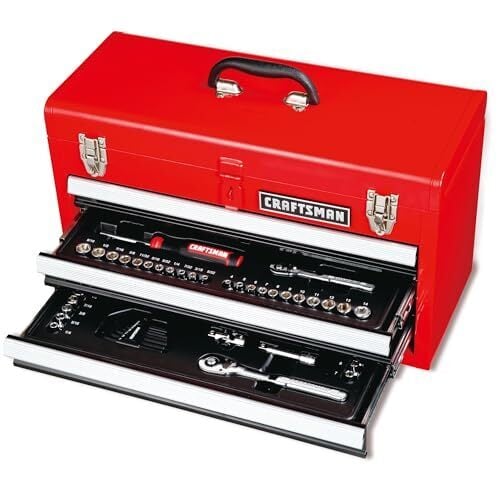
What comes in the box
This Craftsman 104-piece mechanics tool set comes with a 3/8-inch ratchet, a 1/4-inch ratchet, a hand driver handle, 48 standard sockets, 12 deep sockets, 16 Allen wrenches, two extension bits, a corner adapter, 22 driver bits, and a classic red Craftsman tool box. The ratchets are low profile, allowing them to be used in tight spaces. The sockets come in SAE sizes 5/32-inch through 1/2-inch and metric sizes 4 mm through 21 mm. The bits include flat head, Phillip’s head, Robert’s bits, and star tip. The tool box comes with drawer organizers so there’s a spot for every tool. The driver handle and the ratchets are all standard sizes, so you’ll be able to use them with other sockets and bits or replacements if you lose any parts.
Hand tools can be expensive, and getting a set that includes a wide range of bits and sockets will save you trips to the hardware store while you’re working on a project because it allows you to tackle a variety of fastener types from screws to bolts. This set has 104 pieces, and it’s 51% off at $79.98, making each tool less than $1 apiece. As a bonus, this set comes with the classic red Craftsman tool box, which on its own can cost between $50 and $75.
Why I recommend Craftsman tools
Craftsman is known for the lifetime warranty on their hand tools, and everything in this tool set is covered by that besides the tool box and the drawer inserts. Although their tools are often covered by a warranty, I have only used it once on a 20-year-old ratchet that finally slipped its gears; most of the time, you’ll be free from the hassle of even needing to get a replacement.
In addition to the warranty, Craftsman tools are known for being durable. I had a mechanics tool set very similar to this one that I got as a teenager, and I still have most of the tools that came with it, save for a few that went missing over the years. I’ve used the sockets for car repair, to fix a heat pump, to assemble carts with wheels, and on a variety of construction projects, and I’ve had very few issues with them.
Craftsman tools have a good reputation for durability and the sets that come in the red portable tool boxes are a classic for home DIY shops. Having a simple and efficient way to pack up your tools when you’re working on an outdoor project or away from home will make your tool set much more accessible, and you’ll use it more if you can quickly grab it and go.
Our Best Editor-Vetted Tech Deals Right Now
Samsung Galaxy S26, Unlocked Android Smartphone + $100 Gift Card, 512GB, Powerful Processor, Galaxy AI, Immersive Viewing, Durable Battery, 2026, Black
—
$899.99
(List Price $1,199.99)
Samsung Galaxy Buds 4 Pro AI Noise Cancelling 2.0 Wireless Earbuds (Black) + $30 Amazon Gift Card
—
$249.99
(List Price $279.99)
Samsung Galaxy S26, Unlocked Android Smartphone + $100 Gift Card, 512GB, Powerful Processor, Galaxy AI, Immersive Viewing, Durable Battery, 2026, Black
—
$899.99
(List Price $1,199.99)
Samsung Galaxy Buds 4 Pro AI Noise Cancelling 2.0 Wireless Earbuds (Black) + $30 Amazon Gift Card
—
$249.99
(List Price $279.99)
Deals are selected by our commerce team
U.S. Physical Game Sales Just Hit Their Lowest ‘All-Time Tracked’ Point In 30 Years

At the same time the rate of decline has slowed, so that’s good, right?
Apple Unveils MacBook Pro With M5 Pro And M5 Max To Supercharge On-Device AI
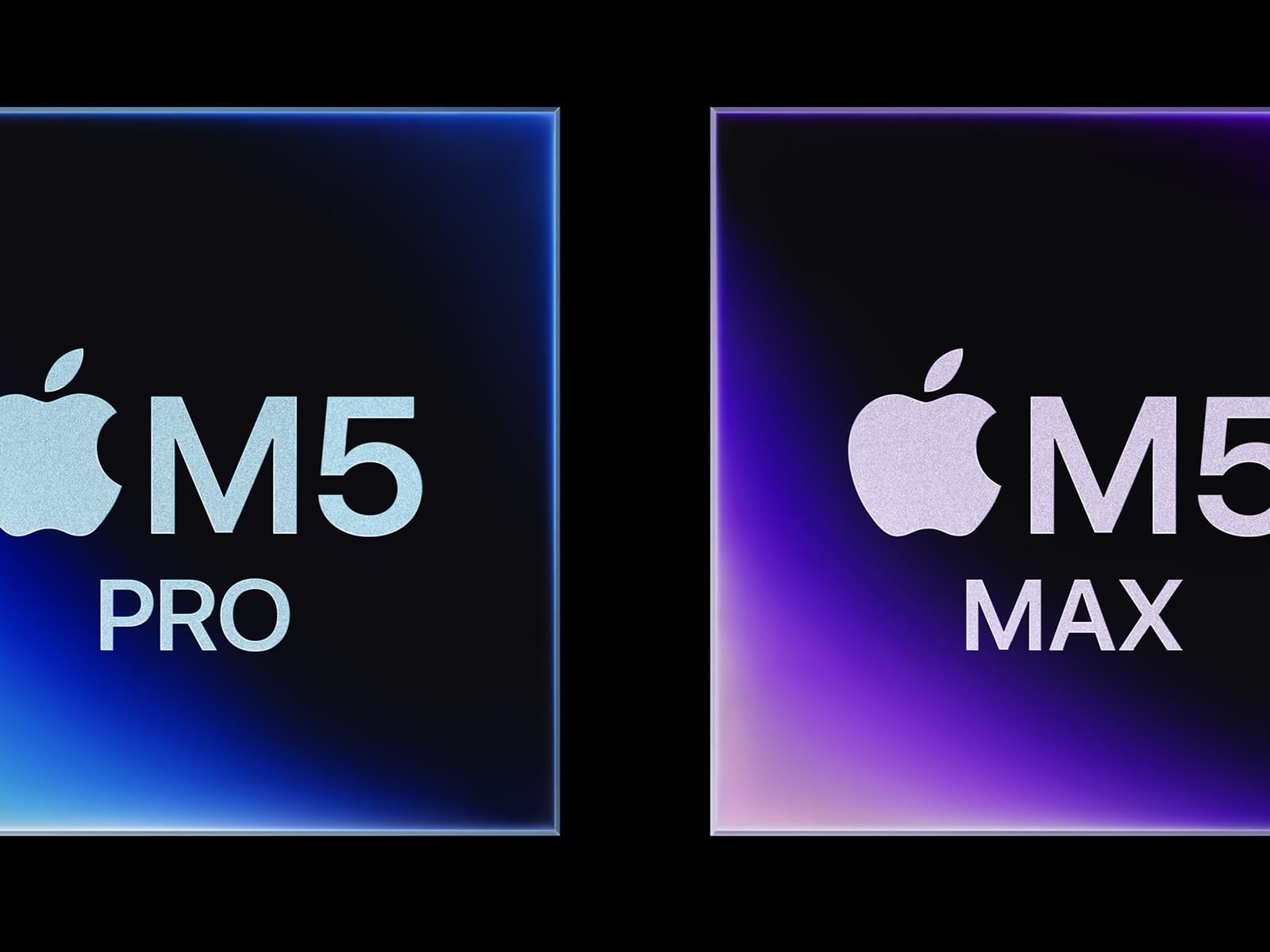
Apple CEO Tim Cook promised this would be a “big week” for the Cupertino company, which has already seen the launch of a new iPad Air with M4 silicon and an A19-powered iPhone 17e. Now a day later, Apple has introduced a refreshed MacBook Pro powered by its new M5 Pro and M5 Max chips built on an also-new Apple-designed Fusion Architecture.
“This
2027 Audi RS5 first drive: Big thrills with a big battery
There’s more waffling going on about the future of electric vehicles in America right now than you might expect at a Belgian breakfast buffet. Some brands like Hyundai are staying committed, some brands like Honda are dialing back, and everyone else is simply doing their damndest to provide as many propulsion options as possible
Count Audi in that last category. On the EV side, it recently launched the new Q6 E-Tron and refreshed the ballistic E-Tron GT. On the internal combustion side, it has a new A6, and there’s a full-size, three-row SUV coming in the form of the Q9. The company’s latest car, though, can be found in the middle: Meet the new RS5, Audi’s latest and greatest plug-in hybrid.
RS stands for “RennSport,” or “Racing Sport” in German, the moniker applied to Audi’s highest performing cars. RS designates an elite group of machines intended to be a bit more edgy and exclusive than your BMW M cars or Mercedes-Benz AMGs. The 2027 RS5 marks the first time an RS has come with both a big battery and a big engine, but the RS5 is much more than a novelty with a plug.
Tricky diff
Tim Stevens for Engadget
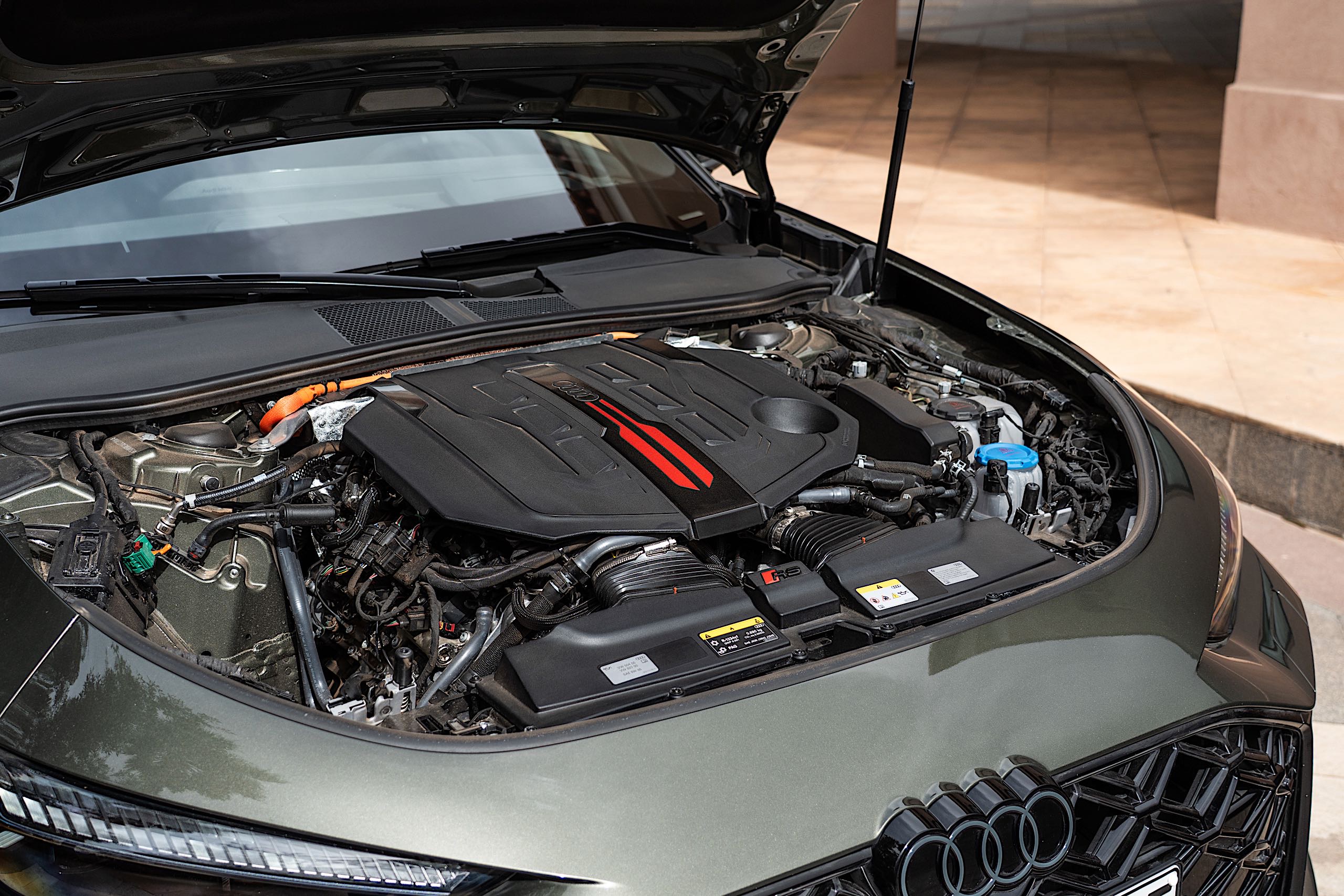
The main grunt of the new RS5 comes from a 2.9-liter, twin-turbocharged V-6 mounted up front under the hood. On its own, that engine produces 503 horsepower, a figure that you might think is plenty. Here, though, it has some help here in the form of not one but two electric motors.
The first is a typical hybrid arrangement, a 174-hp motor wedged in between the engine and transmission. This is the primary means of electric propulsion for the car, giving it a total, maximum system output of 630 hp and 609 lb-ft.
Because that motor is positioned where it is, the RS5 can still make full use of its eight-speed automatic transmission when driven only by the electric motor. That means a top speed of 87 mph before the engine kicks in. Once it does, it’ll take you all the way up to 177 mph.
There’s a second motor at the back, though, which is far more interesting. No, it isn’t there to drive the rear axle like on the RAV4 Hybrid. The RS5 has a traditional Quattro setup with a mechanical differential in the middle to distribute power between the front and rear wheels.
The small, 11-hp motor at the back exclusively controls a new type of system that Audi calls Dynamic Torque Control. This motor uses planetary gearsets to selectively and effectively magnify the power to either the left or the right axle at the back. It may be small, but this motor makes the RS5 do some wonderful things.
Drift time
Tim Stevens for Engadget
For maximum fun in the new RS5, dial it over to what Audi calls Torque Rear mode. This configures the new rear differential to send maximum twist to the outside rear wheel. Combine that with the center differential, which can send up to 85 percent of the engine’s power to the rear, and the result is a remarkably willing drift partner.
After less than 30 seconds behind the wheel on a closed track in Marrakesh, I was confidently sliding my way through a set of cones in a slalom, then pirouetting around a cone at the end in a tight circle, clouds of tire smoke hanging in the air. Normally, drifting a 5,200-pound, 630-hp machine rolling on sticky tires is a real nightmare. It’s delightfully easy in the RS5.
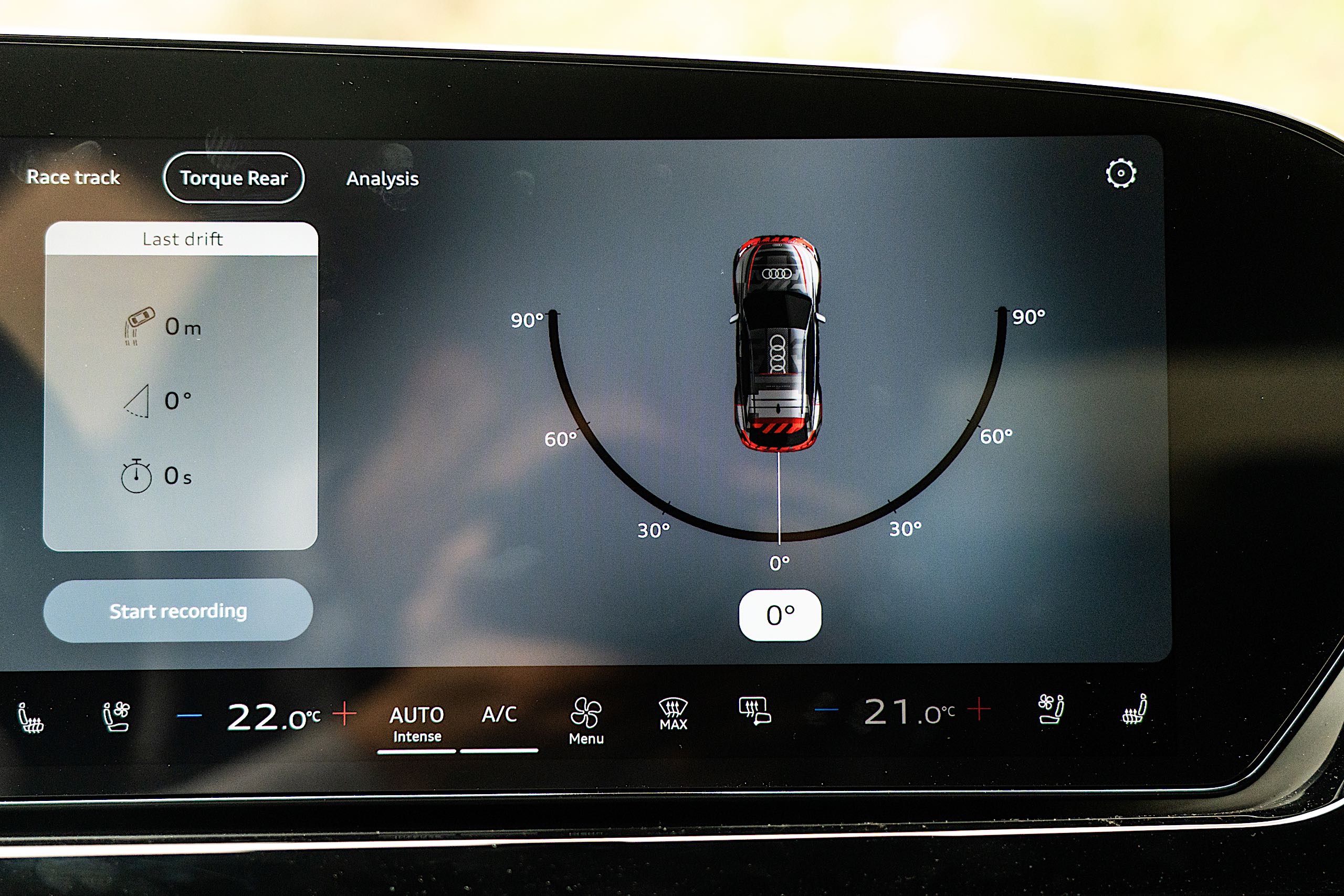
The car’s differential setup not only makes this easy but also tracks just how successful you are at it. It records the time, length and even angle of your most dramatic drifts. You can even replay them on the touchscreen if you’re so inclined, scrubbing back and forth to see what kinds of G forces you were generating.
This is part of a new extension to its infotainment system called the Audi Driving Experience. It’ll also track lap times around race tracks, giving you a bit more information in the timeless pursuit of tenths of a second.
Tim Stevens for Engadget
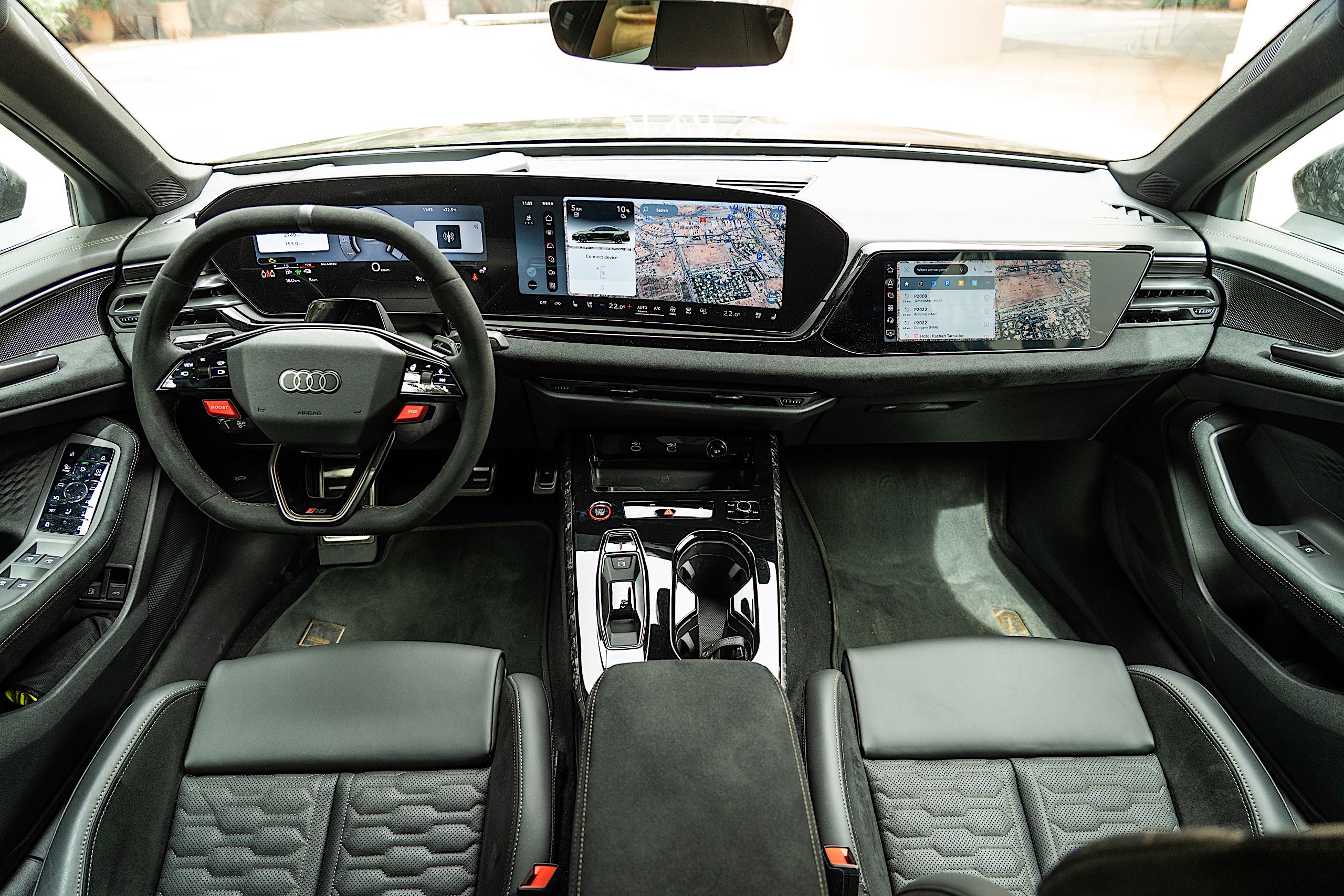
Audi also added a few custom screens showing the power distribution of the car and letting you monitor things like critical system temperatures and tire pressures at every corner. Otherwise, though, it’s much the same interface as seen on most new Audis, with a 14.5-inch central touchscreen, an 11.9-inch gauge cluster and an optional 10.9-inch display way over on the right for the passenger.
That’s a lot of displays, with the left two encased within an oversized, sweeping panel that stands tall and proud out of the dashboard. Too tall, actually. If big bezels ruin your day, look away, because there’s a lot of wasted space here.
Likewise, if you don’t like steering wheels with capacitive touch controls, you’re not going to love the RS5. Audi has brought back the little scroll wheels under your thumbs, at least, but everything else on there is just a flat surface.
Putting the power down
Tim Stevens for Engadget
I spent the better part of a day driving the RS5 through the wild streets of Marrakesh and up into the Atlas Mountains to the south. In the city, I left the car in EV mode, letting that primary electric motor and the car’s 25.9-kilowatt-hour battery (22 kWh net) do the heavy lifting. Audi says the car can cover up to 54 miles in this mode, and while I didn’t have time to go that far on battery power, it seemed like an achievable estimate.
The car is perfectly pleasant in this mode, silent and even reasonably quick. In Comfort mode, the suspension is at its softest, and despite those giant wheels, the RS5 did perfectly fine over the decidedly imperfect Moroccan roads. But it wasn’t until I got far away from the city that I could start to open things up a bit, working my way through the various drive modes and eventually all the way up to RS Sport, the most performance-oriented.
Here, the suspension is at its stiffest and the throttle at its sharpest, transmission swinging through its ratios eagerly to keep the engine singing. Jump on the gas, and the car really does leap forward, the electric motor doing its part to cover the power delay caused by the turbochargers in the mix.
You can feel that rear differential here, too, adding an extra bit of pivot to the rear when you’re powering out of corners. But, on the way in, you really can feel the substantial weight of this car, the front end scrubbing and pushing forward when you ask too much of it.
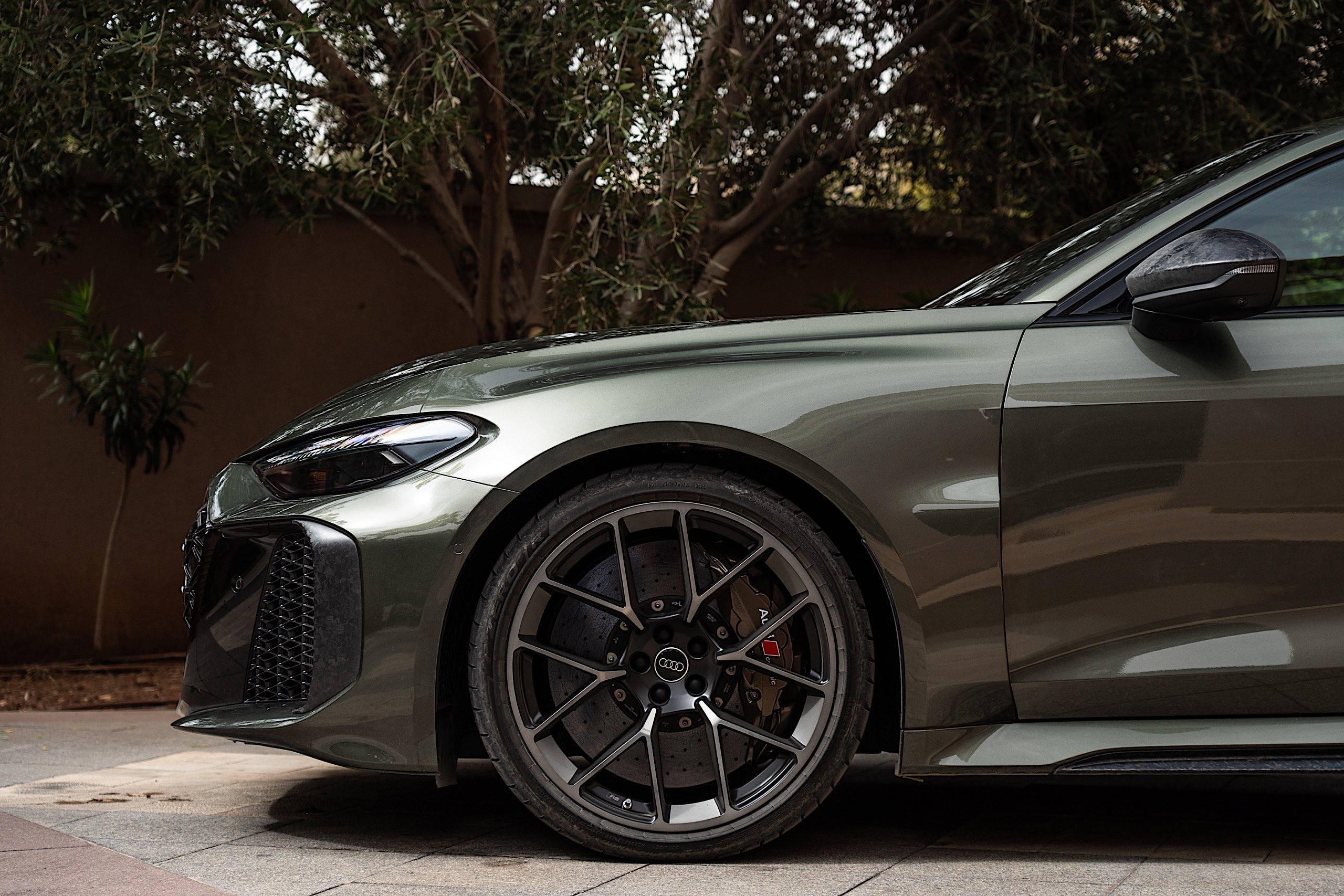
Again, this model gained more than 1,000 pounds over the old RS5, and though the improved suspension, drivetrain, tires and even giant, ceramic brakes all help to reduce its feel, there’s no hiding that much mass.
Wrap-up
Yes, the RS5 has gained a lot of weight, and that hurts its nimbleness on track, but remember that this is a large, luxury sedan. It was never meant to be a lithe track toy. Despite that, the new RS5 actually feels far more fun and aggressive than its predecessor, a characteristic at least partially due to that trick new rear differential and the instant response of the new hybrid system. 54 miles of emissions-free range doesn’t hurt, either.
The big question is cost, and sadly, Audi’s not ready to answer that one yet. You do, at least, have a little time to save. The new RS5 doesn’t hit American shores until sometime in 2027.
This article originally appeared on Engadget at https://www.engadget.com/transportation/2027-audi-rs5-first-drive-big-thrills-with-a-big-battery-152057907.html?src=rss
Apple intros M5 Pro and Max MacBook Pros and its first new monitors in years
Apple updated its low-end MacBook Pro with the Apple M5 back in October of last year, but the higher-end 14-inch and 16-inch Pros stuck with the M4 Pro and M4 Max chips. This morning Apple circled back around and updated the rest of the lineup, adding the M5 Pro and M5 Max to the higher-end machines and bumping the base storage—the M5 Pro now comes with 1TB of storage by default, while M5 Max chips come with 2TB of storage by default. The internal storage is said to be “up to 2x faster” than the previous-generation Pros. Apple is also bumping the base storage for the M5 MacBook Pro from 512GB to 1TB.
Unlike Apple’s other announcements this week, though, these upgrades also come with increases to their starting prices; the 14-inch MacBook Pro with an M5 Pro now starts at $2,199 instead of $1,999, and the 16-inch model with an M5 Pro starts at $2,699 instead of $2,499. The M5 MacBook Pro now starts at $1,699, up from $1,599. Granted, you’re getting double the storage you used to get in those old base models, but you no longer have the option to pay less if you don’t need 1TB of space.
The M5 Pro and M5 Max look like fairly major updates from the M4 Pro and M4 Max. Both use an 18-core CPU with six higher-performing cores and 12 lower-performing cores, but Apple is changing how it talks about each kind of core. The high-performance cores are now called “super cores,” a change that Apple says will retroactively apply to the high-performance cores in the basic Apple M5; M5 has four of them, and M5 Pro and M5 Max have six of them.
Apple Announces “Fusion Architecture” With M5 Pro & M5 Max
Apple announced today the new Fusion Architecture with the M5 Pro and M5 Max SoCs that also feature a next-generation GPU…
[$] Free software needs free tools
One of the contradictions of the modern open-source movement is
that projects which respect user freedoms often rely on proprietary
tools that do not: communities often turn to non-free software for
code hosting, communication, and more. At Configuration Management
Camp (CfgMgmtCamp) 2026, Jan Ainali spoke
about the need for open-source projects to adopt open tools;
he hoped to persuade new and mature projects to switch to open
alternatives, even if just one tool, to reduce their dependencies on
tech giants and support community-driven infrastructure.
Apple Just Announced Five New Mac Products
Apple is continuing to announce new products ahead of its big March 4 event. Yesterday, it was the iPhone 17e and M4 iPad Air. Today, it’s all about the Mac. Apple made a number of announcements: a new M5 MacBook Air, M5 Pro and M5 Max MacBook Pros, and new Studio Display options for anyone who wants to take out a mortgage on their external displays. All of these new products will be available preorder tomorrow, and go on sale March 11.
M5 MacBook Air
This first announcement isn’t all that exciting, but it does make sense for Apple. The company is now shipping MacBook Airs with the M5 chip, following the M5 MacBook Pro it launched in October. That doesn’t come with any real design or feature changes: These are largely the same 13 and 15-inch MacBook Airs you can buy with M4. However, you do get Apple’s latest-gen chip, which comes with performance upgrades.
M5 comes with a 10-core CPU and four “super” cores and six efficiency cores, up to a 10-core GPU, a 16-core neural engine for AI processing, and 153GB/s memory bandwidth. Apple says that M5 can process AI tasks up to four times faster than M4, and comes with 28% more memory bandwidth. While those are the direct comparisons with M4, many of Apple’s stats in its press release compare the M5 to M1, likely for two reasons. The year-over-year gains between chips aren’t huge, and, because of that, people tend to hold onto M-series Macs for a long time. Apple is likely trying to target M1 MacBook Air users who might be starting to think about an upgrade.
The biggest change aside from M5 is the starting storage amount: The M5 MacBook Air now comes with 512GB of storage in the base model, so 256GB is no longer an option. That’s good news, as the latter can run out fast, but it does mean the MacBook Air now starts at $1,099, rather than the $999 the machine has been known for. You can configure the new Airs with up to 4TB of storage, too, if you need it, though any storage you get is going to be faster than previous MacBook Airs. Apple says the new SSDs are 2x faster in regard to both read and write speeds.
The M5 chip also supports Wi-Fi 7 and Bluetooth 6, which is an upgrade over M4’s support for Wi-Fi 6E and Bluetooth 5.3. Apple is shipping the new Airs with a 40W “Dynamic Power Adapter” that can charge up to 60W.
M5 Pro and M5 Max MacBook Pros
If you’re looking for the fastest MacBooks money can buy, turn your attention to the MacBook Pros. This is bigger news than the MacBook Air, as Apple already shipped products with the M5 chip. Now, the company is debuting M5 Pro and M5 Max for the first time in the new MacBook Pros—though, once again, these chips are really the only thing new about these machines.
Still, that’s a big deal, if you take Apple at its word. The company says that M5 Pro and M5 Max have the world’s fastest CPU Core (“using shipping competitive systems and select industry-standard benchmarks”), and are built using Apple’s new “Fusion Architecture.” That means these chips combine two dies on one chip, with a CPU up to 18 cores and a GPU up to 20 cores (M5 Pro) or 40 cores (M5 Max). M5 Pro can be configured with up to 64GB of RAM and 4TB of storage, while M5 Max can go up to 128GB of RAM and 8TB of storage.
The name of the game for Apple here is AI processing. The company says that M5 Pro can generate AI images 3.7 times faster than M4 Pro, and process LLM prompts 3.9 times faster. Meanwhile, M5 Max can generate AI images 3.8 times faster than M4 Max, and LLM prompt processing is four times faster. The gains are even larger when compared to M1 Pro and M1 Max, of course, which Apple highlights for similar reasons to the M5 MacBook Air: M1 Pro and M1 Max MacBook Pro owners are holding onto their laptops.
As with the M5 MacBook Air, Apple is doubling the read/write speeds of the SSDs in these MacBook Pros. The base model M5 Pro MacBook Pro now comes with a 1TB SSD, while the M5 Max comes with 2TB. It also comes with Wi-Fi 7 and Bluetooth 6 support. Those upgrades come at an increased base cost, however: The 14-inch M5 Pro MacBook Pro now starts at $2,199, while the 16-inch MacBook Pro with M5 Pro starts at $2,699—$200 more than before.
Studio Display and Studio Display XDR
Apple also announced refreshes to its external displays—Studio Display and Studio Display XDR. The Studio Display refresh is rather minor: It now comes with a 12MP Center Stage camera, with some image enhancements and support for Desk View—Apple’s feature that lets you show off your desk with just the webcam. It also has improved microphones and speakers, and Thunderbolt 5 support. But the display itself is much the same as the previous model, and still starts at $1,599.
If you want features like a high refresh rate 120Hz display, you’ll need to look to the Studio Display XDR. This display packs Apple’s “pro” features: It comes with a 27-inch 5K display with mini-LED, and can reach 1,000 nits of brightness (2,000 nits in HDR). Those features come at a cost, however: $3,299, to be exact.
Cyberpunk 2077 Has Never Been Better And Is Coming To Game Pass This Month

Game Pass has some certified bangers coming to the service this month