Meet the MacBook Neo, Apple’s long-rumored low-cost Mac. Powered by the A18 Pro chip from the iPhone 16 Pro series, the $599 MacBook Neo is Apple’s first attempt at delivering a genuinely affordable Mac laptop. (Ironically, it comes after Apple raised the base prices of the new MacBook Air M5 and MacBook Pro M5 Pro/Max.) It’s well below the $1,099 MacBook Air, but Apple didn’t skimp on the design.
For $599 you get 256GB of storage and no Touch ID on the keyboard; another $100 doubles the storage and adds Touch ID. All models of the MacBook Neo ship with an extremely scant 8GB of RAM — but at this price, we can withhold judgement on whether that’s enough until we put this thing though some testing.
The A18 Pro chip includes a 6-core CPU, 5-core GPU and 16-core Neural Engine — based on pure numbers that’s far behind what you’ll get with a current M-series processor, but again it may be enough juice for the basic computing tasks this laptop seems geared towards.
There’s still a sturdy aluminum case, with no cheap plastic to be seen. It includes a 13-inch Retina display, a 1080p webcam, two USB-C ports, a headphone jack and optional Touch ID. You’ll need to use one of those ports for charging, as there’s no MagSafe connector on this MacBook. The side-firing speakers support Dolby Atmos playback. And the MacBook Neo comes in four colors than usual: silver, indigo, blush and citrus. The keyboard is color-matched to the case, too.
The display appears to be fairly basic. The 13-inch LCD has a 2,408-by-1,506 and 500 nits of brightness. There’s no True Tone features for adjusting the screen’s color temperature to your surroundings; this is the first display Apple has released in years without that feature. It also doesn’t support the P3 wide color gamut, another feature present on most other Apple screens.
And while its mobile chip isn’t nearly as powerful as the Air’s M4, it’s still fast enough to handle many productivity tasks without much trouble. As we argued last week, the Neo could just be the cheap MacBook to tempt over Windows users disgruntled with Microsoft’s AI obsession.
It’s easy to view the MacBook Neo cynically as a sign that Apple is running out of ideas. But given how many PC options there are between $500 and $1,000, it simply makes sense for Apple to offer something in that range. The company experimented with a low-cost offering by selling the the older M1 MacBook Air at Walmart for $700 in 2024, which later went down to $650 last year. The only question now is how long Apple can maintain its prices, as the AI-induced RAM shortage will likely lead to some increases this year. HP claims RAM now accounts for a third of its PC costs, double the amount from last year.
As with everything else Apple announced this week, the MacBook Neo is up for pre-order today, and it’ll ship on March 11.
This article originally appeared on Engadget at https://www.engadget.com/computing/laptops/the-599-macbook-neo-is-apples-cheapest-mac-laptop-yet-141028666.html?src=rss
It’s been a busy week for Apple, which has seen the launch of new M5 Pro and M5 Max silicon along refreshed MacBook Pro laptops that incorporate the latest M-series chips, an iPhone 17e, and a few other products. Yet one more to add to the pile is a retooled MacBook Air powered by Apple’s regular M5 chip and the double the storage as the previous
Most of Apple’s announcements this week have been fairly straightforward internal updates to existing products, give or take some big architectural changes to its high-end processors.
But Apple has saved its most interesting announcement for today: the MacBook Neo is a brand-new lower-cost member of Apple’s laptop family, and will take over for the 13-inch MacBook Air as the company’s entry-level laptop. The new laptop starts at $599, the same as the M1 MacBook Air that Apple has been selling through Wal-Mart in the US, and much lower than the $1,099 starting price for the new M5 MacBook Air.
The new MacBook will go up for pre-order today and will be available on March 11, and you’ll be able to buy it directly through Apple’s website and retail stores in addition to third-party retailers. It’s available in four colors: silver, indigo, a pink-ish color called “blush,” and the yellow-ish “citrus.”
Sasha Levin has announced the release of the 6.19.6, 6.18.16, 6.12.75, 6.6.128, 6.1.165, 5.15.202, and 5.10.252 stable kernels. Each contains
important fixes throughout the tree; users of these kernels are
advised to upgrade.
Last week marked the release of systemd 260-rc1 with a new “mstack” feature, a new “FANCY_NAME” field for os-release, dropping System V service script support, and other changes. Out today is systemd 260-rc2 release with more changes in further working its way toward a stable release for empowering 2026 Linux distributions…
Resident Evil Requiem (2026) hasn’t been out for more than a week, and there’s already a basic PC VR mod waiting in the wings.
While Capcom may have “no plans” for VR support, VR modder ‘Praydog’ has released a Resident Evil Requiem mod that lets you play the entire game with a PC VR headset— albeit with a few caveats.
While Praydog’s REFramework supports motion controllers across a host of Resident Evil games, the VR mod for Requiem is still a gamepad-only experience for now. Notably, early players, such as YouTuber ‘Beardo Benjo‘, liken it to a “first pass.”
Praydog has developed their mod suite to work with all games running on the RE Engine, so it’s likely the Requiem mod will see a fair amount of tweaking in the coming days. It’s still probably best to wait if you plan on playing it from start to finish in VR though.
It’s pretty basic for now, essentially only allowing you to play in first-person VR without much more VR-native considerations made, including menus, motion controls, or immersive affordances for cutscenes. Provided Praydog smooths out those issues, like they did with Resident Evil Village (2021) and Resident Evil 7 (2017), it stands to become the most immersive RE game to date.
In the meantime, you can nab the mod for free over on Praydog’s RE Framework GitHub and following along with all of the nightly updates too. Additionally, you can support Praydog via their Patreon page.
Check out the VR mod in action, courtesy Beardo Benjo:
At Mobile World Congress, Cristiano Amon of Qualcomm argued that the coming 6G networks will power an AI-driven “agent economy,” where devices and AI assistants constantly communicate across the network. “AI will fundamentally change our mobile experiences,” Qualcomm chief executive, Cristiano Amon says. “It’s going to change how we think about our smartphones. Think about our personal computing. Think about and interact with a car. The car is now a computing surface. If you actually believe in the AI revolution, 6G will be required. Resistance is futile.” The company says early consumer testing could begin around the 2028 Los Angeles Olympics, with broader rollouts expected by 2029. Fortune’s Kamal Ahmed reports: Akash Palkhiwala is Qualcomm’s chief financial officer and chief operating officer. I spent some time with him at the company’s stand, as his leading engineers took me through a 6G future where individuals will have real-time information delivered to them via their glasses. Palkhiwala compliments me on my watch, which only does one thing. It tells me the time. “6G is going to be the first time that connectivity and AI come together in the network. What we’re building is the first AI-native wireless network that’s ever been built,” he explains.
“The traffic that we expect on 6G is way different than what we had before,” says Palkhiwala. “Before, it was all about consumer traffic. We expect 6G to be driven by [AI] agent traffic. Think about all these use cases where there are AI agents sitting on various devices — your glasses, your watch, your phone, your PC. These agents are going to be talking back and forth across the network to other agents and services. “The traffic completely changes. 6G is being built with this idea that the traffic that goes on the network is not just going to be consumer voice calls or downloading videos, we’re going to have agents talking to each other, so the reliability of the network becomes very important.”
On-device capabilities (the ability of your phone to process far more data); edge computing (locally sourced IT technology rather than distant data centers); more efficient use of available bandwidth (AI-enabled load control); and greater cloud access will all come together to produce a new wireless network. […] “Today we are in the application economy,” he notes. “On the phone, you want to make a travel reservation, you go to one application. You want to order an Uber, you go to a second application. You want to order food, you go to a third application, movie tickets, etc. The user has to go through that effort. In the future, you think of the app economy moving over to an agent economy, where there’s one agent I’m interacting with, and I can ask that agent to book me a movie ticket or a plane ticket, to order food for me, get an Uber for me. It knows everything about me.”
Google has released its Android Security Bulletin for March with patches for 129 vulnerabilities, one of which is a zero-day flaw in a Qualcomm display component that may be under “targeted, limited exploitation.”
The latest update also fixes 10 critical severity bugs across Android components. CVE-2026-0006 is a remote code execution vulnerability in the System component that attackers could exploit with no additional privileges or user interaction. CVE-2025-48631 is a denial-of-service flaw in System, while CVE-2026-0047 is an escalation of privilege vulnerability in Framework. There are seven critical escalation of privilege flaws being patched in Kernel components.
Google is also addressing issues in Qualcomm, MediaTek, Arm, Misc OEM, Unisoc, and Imagination Technologies components, which may not affect all Android devices.
One zero-day patched
The zero-day patched with this security update is as an integer overflow or wraparound in a Qualcomm Graphics subcomponent that allows local attackers to trigger memory corruption. The vulnerability—labeled CVE-2026-21385—affects 235 Qualcomm chipsets. According to Qualcomm’s own security advisory, the vulnerability was reported on Dec. 18, 2025 through the Google Android Security team, with customers notified on Feb. 2, 2026.
Update your Android ASAP
Android users should install the latest security patch as soon as it becomes available—you should get a notification prompting you to do so. Google pushes updates for its own Pixel devices and the core Android Open Source Project (AOSP) code, while other manufacturers release patches for their respective devices around the same time. If you have a Samsung, Motorola, or Nokia, for example, you may experience a slight delay.
There are two patch levels labeled as 2026-03-01 and 2026-03-05, the latter of which fixes all issues included in the former. This month’s patches apply to AOSP versions 14, 15, 16, and 16-qpr2. You can check for available updates via Settings > Security & privacy > System & updates > Security update.
Heading toward the Linux 7.0 kernel and marked for back-porting to current stable Linux kernel versions is employing a new SEV-SNP security feature found on AMD Zen 5 processors for enhancing security of guest virtual machines…
As if you needed reminding, next week is March 10, or MAR10 Day, as the marketing wizards at Nintendo have been calling it for the last decade or so. You can usually rely on Mario Day for some plumber-related goodies, and Nintendo has announced that three retro games are coming to Nintendo Switch Online next week.
Those games are Mario’s Tennis and Mario Clash for the newly launched Virtual Boy app, and Mario Vs. Donkey Kong for the Game Boy Advance. Both the GBA and Virtual Boy emulators are part of the Nintendo Switch Online + Expansion Pack membership plan, so you’ll need to be on that tier to play them this Mario Day.
Both of the soon-to-be added Virtual Boy titles originally came out in 1995. Mario Clash is something of a 3D reimagining of the arcade Mario Bros. game, while Mario’s Tennis was actually the first game in the Mario Tennis series, making it a nice companion piece to Mario Tennis Fever, which recently launched on Switch 2. They join 3d Tetris, Galactic Pinball, Golf, The Mansion of Innsmouth, Red Alarm, Teleroboxer and Virtual Boy Wario Land in the Virtual Boy NSO library so far, with more titles on the way. Remember that you’ll need either the $100 Virtual Boy replica or $25 cardboard headset to play them on your Switch.
Mario Vs. Donkey Kong for the GBA is a more unexpected addition, not least because Nintendo remade the charming puzzle-platformer for Switch just a few years ago. Having the source material available on the console too via NSO is obviously nice, but there are other still absent Mario games from the iconic handheld’s enviable library that I’d personally have liked to have seen sooner (*cough* Mario Tennis: Power Tour).
All three games will be playable on March 10.
This article originally appeared on Engadget at https://www.engadget.com/gaming/nintendo/three-retro-mario-titles-are-coming-to-nintendo-switch-online-on-mario-day-130223937.html?src=rss
Starting an exercise routine doesn’t guarantee that you’ll lose weight, but a lot of us add exercise into our routines when we have a weight loss goal. Read on, and I’ll explain what you really need to know about exercise for weight loss—what kind, how much, and whether it even matters at all.
Yes, exercise (sort of) helps you lose weight
There’s a cliché in the fitness world that the best weight-loss exercises are “fork putdowns and plate pushaways.” I hate when people turn fitness goals into restrictive eating goals, so this framing irritates me, but there is a grain of truth to it.
The true part is that your body weight is determined by both how much activity you do and how much you eat. You need to pay attention to both sides of the equation if you want predictable results. So if you just add exercise, without changing how you eat, you might end up eating more without realizing it, and thus stay the same weight.
But that’s only part of the picture. Technically, you can lose weight just by eating less food, without adding exercise at all. But is that a good idea? Not at all. Exercise is good for us, in terms of heart health, mental health, ability to stay functional as you age, and a hundred more reasons. Those benefits apply whether we’re losing weight or not.
How exercise helps you to eat healthier
Ultimately, the role of exercise in weight loss isn’t (just) to make the weight loss happen, but to keep you healthier while you’re losing weight. That includes maintaining muscle mass and improving heart health, both of which I’ll talk about in a moment. But there’s more: An under-appreciated aspect of exercise is that the more you do it, the more you set yourself up for a healthier diet, a less restrictive attitude toward eating, and better energy levels.
Let’s say we have a pair of twins who don’t exercise much, and they each burn about 2,000 calories a day. One decides to lose weight by eating 1,500 calories, changing nothing else. The other adds enough exercise each day to burn about 500 calories, and thus gets to continue eating 2,000. Both twins are now in a 500 calorie deficit, and should lose about a pound a week. Same thing, right? Not quite.
Who’s going to have more room in their diet to eat more protein, fiber, healthy fats, vitamins, and minerals? The person who’s eating 2,000.
Who’s more likely to be able to have their favorite dessert from time to time, instead of cutting it out for the length of the diet? The person who’s eating 2,000.
Who’s going to be able to eat more carbs, thus fueling themselves better for whatever amount of exercise that they end up doing? The person who’s eating 2,000.
So because both twins are using the same 500-calorie deficit, by the numbers you could say these approaches are equivalent. But the people taking these two approaches will have drastically different experiences.
The most important type of exercise for weight loss: strength training
If you can only do one type of exercise while you try to lose weight, I’d argue it shouldn’t be anything to do with calorie burn at all. It should be strength training.
This includes any type of exercise where the goal is to build strength and muscle. Lifting weights in a gym is the most straightforward example, but you can do strength building exercises with other types of equipment or, in some cases, with no equipment at all. I have a list here of 12 bodyweight exercises that will actually build strength, once you get strong enough that the basics like pushups and air squats get too easy. In general, if you can do more than 15 of something before your muscles fatigue, you should move on to a heavier weight or a harder exercise.
This is because we don’t just want to work on endurance (that’s not the point of strength training). It’s because we want to convince our bodies to build muscle—or at least to hold on to the muscle we already have.
When we lose weight, we’re usually hoping to lose fat, but muscle often goes along with it. Losing muscle means we’re more likely to regain the weight lost. It also means we’ll have a harder time doing other types of exercise; better to run on strong legs than weak legs. And it can also make us weaker when it comes to everyday activities. Muscle loss is a huge problem for older adults, but strength training can slow or reverse it.
How much strength training to do when losing weight:
Train twice a week, minimum.
Try to work every body part, including upper and lower body muscles, with pushing and pulling motions.
Aim for a minimum of three sets of each exercise, with anywhere between 5 and 15 reps per set. By the end you should feel like you can’t do any more (or that maybe you could have done one or two more reps, tops).
The second most important type of exercise for weight loss: low to medium intensity cardio
As we saw in our example with the twins, exercise can burn enough calories to increase our overall calorie budget. And even though technically exercise isn’t necessary to create a calorie deficit, it sure seems to help.
Research shows that people who exercise regularly have an easier time losing weight, and an easier time keeping the weight off, than people who don’t exercise. For example, this study had people burn 400 or 600 calories per supervised cardio session, five times a week, but didn’t restrict their diet or give them any diet advice at all. Most of the participants lost weight, averaging about 10 pounds lost at the end of 10 months. By contrast, non-exercising controls, on average, finished the study within about a pound of where they started.
That said: Burning that many calories, five days a week, is a lot of time and work. We’re talking somewhere in the ballpark of 45 to 60 minutes per day, at a low to medium intensity (that study had people at 70-80% of their max heart rate, or in terms of heart rate zones, roughly zones 2 and 3).
Low and moderate intensity exercise makes the most sense for weight loss because it doesn’t cause a lot of fatigue (so you can do plenty of exercise without feeling too tired) and it tends not to spike hunger as much as intense exercise. If you’re a beginner, walking can count as cardio. As you get fitter, you may want to switch to jogging or another exercise like cycling.
How much low and medium intensity cardio to do when losing weight:
Start with a little more than whatever you’re doing now, and increase from there.
First try to hit the guidelines of 150 minutes/week (about 30 minutes, five times a week) and then see if you can ramp up to 300 minutes/week (about an hour, five times a week).
If you can’t hit those specific numbers, do what you reasonably can.
Aim for “zone 2-3” intensity. It should feel like work, but not torture. The thought of working at that intensity for 45 minutes should inspire a sense of “OK, let’s get this done,” not “oh my god, I’m going to die.”
This low-intensity exercise doesn’t have to be the only exercise you do. If you’d like to run some fast intervals, or play a sport, or take a power yoga class, or anything outside of these recommendations, go for it! Just remember that the low-intensity stuff is a powerful tool for burning calories while keeping your energy up and not feeling excessively hungry.
The worst type of exercise for weight loss: HIIT
I’m going to say something that will sound controversial here, although I don’t think many legit fitness professionals would disagree. HIIT is overrated.
HIIT refers to high-intensity interval training, which can be a time-efficient way of improving your aerobic fitness, at least in the short term. It’s a cool concept, but the name HIIT has been slapped on all kinds of workouts that aren’t really HIIT. Even if you’re doing “real” HIIT, it’s not a magic bullet for weight loss, and shouldn’t be the bulk of your training.
HIIT is basically the opposite of the low intensity cardio I talked about above. HIIT is too fatiguing to do for more than a very short workout, and you probably won’t want to do it every day. If you’re doing a ton of HIIT and wondering why you feel exhausted, that’s why. It also tends to make some people hungrier, which counteracts the calorie-burning benefits. (That said, people react differently to this, so feel free to try it and see whether hunger is an issue for you or not.)
What’s worse, you might be so fatigued from HIIT, or so sore from a session of fake-HIIT, that you end up skipping your strength training workouts. So not only is HIIT a less effective form of cardio, it can also stop you from getting in some of those other important workouts.
All that said: You can do some HIIT if you enjoy HIIT or if you’re interested in the aerobic benefits. Just don’t make it your bread-and-butter. Runners often use an 80/20 rule: 80% of your workouts should be easy intensity; the other 20% can include harder stuff. And no, HIIT isn’t going to spike your cortisol, at least not in a bad way. That’s a whole ’nother myth.
An anonymous reader quotes a report from MacRumors: OpenAI today updated its most popular ChatGPT model, debuting GPT-5.3 Instant. GPT-5.3 Instant is supposed to provide more accurate answers and better contextualized results when searching the web. The update also cuts down on unnecessary dead ends, caveats, and overly declarative phrasing, plus it has fewer hallucinations.
According to OpenAI, it tweaked the Instant model to address complaints about tone, relevance, and conversational flow, which are issues that don’t show up in benchmarks. GPT-5.2 Instant had a “cringe” tone that could be overbearing or make unsubstantiated assumptions about user intent or emotions. The new model will have a more natural conversational style and will cut back on dramatic phrases like “Stop. Take a breath.”
Users found that GPT-5.2 Instant would refuse questions it should have been able to answer, or respond in ways that felt overly cautious around sensitive topics. GPT-5.3 Instant cuts down on refusals and tones down overly defensive or moralizing preambles when answering a question. The model will no longer “over-caveat” after assuming bad intent from the user. GPT-5.3 Instant also provides higher-quality answers based on information from the web. OpenAI says that it is able to better balance what it finds online with its own knowledge, so it is less likely to overindex on web results.
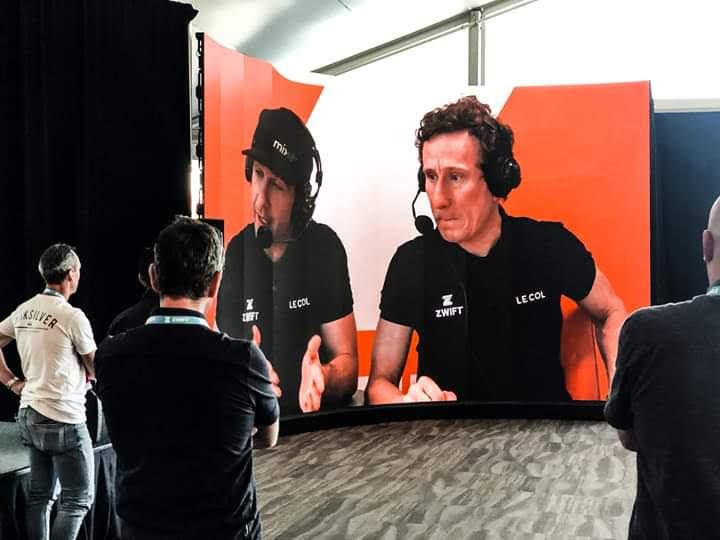
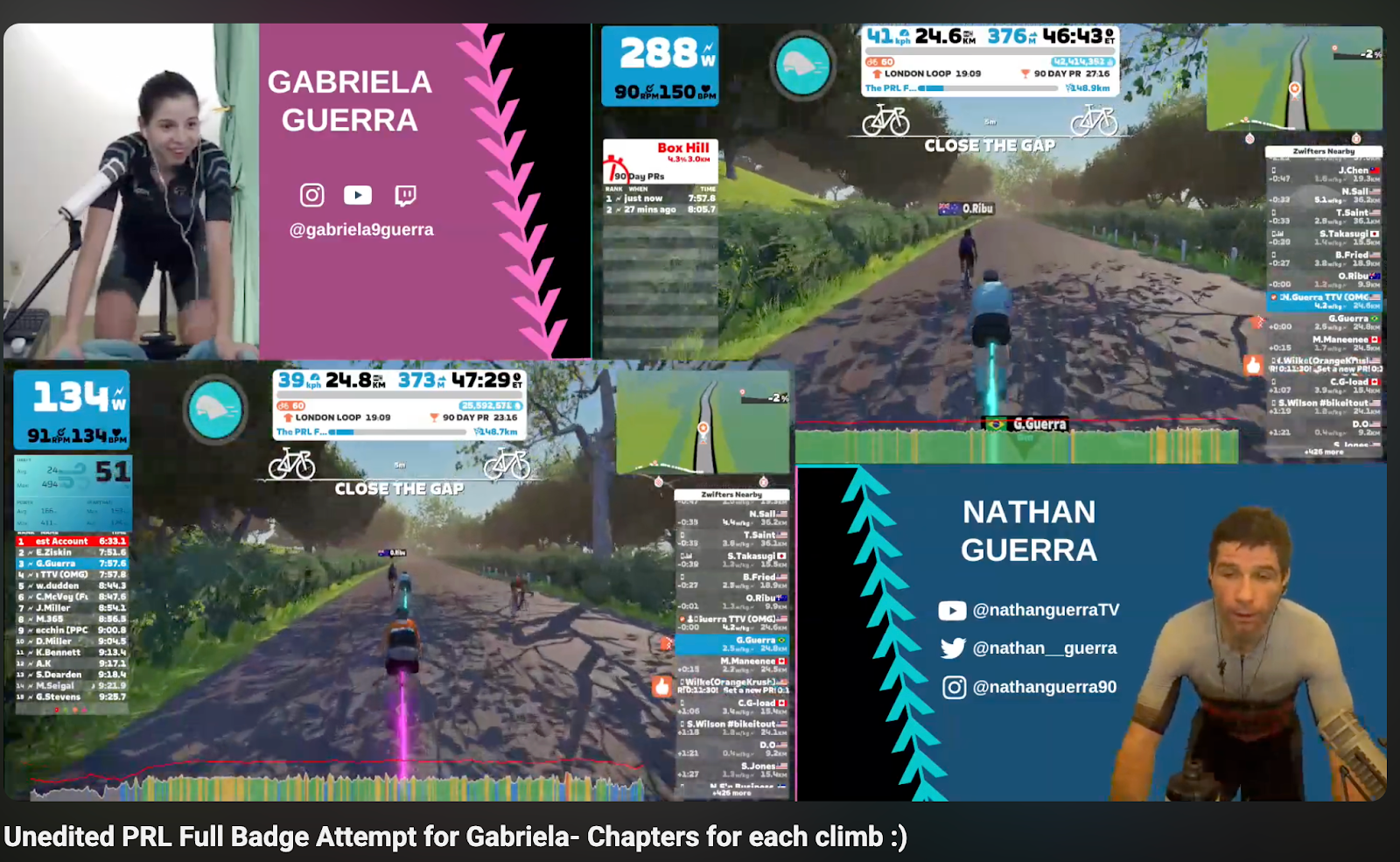
If you race or train on Zwift, you’ve probably seen Nathan and Gabriela “Gabi” Guerra doing their thing – Nathan anchoring many of the Zwift races and Gabi killing it racing in all of the top events.
But do you know the story of how this loving “power” couple (pun intended) met on Zwift, fell in love, and got married? It’s quite a story of virtual attraction becoming IRL love, and all the challenges associated with a modern-day romance.
Long Distance Longing
In October of 2021, Gabi, who was living in Germany and had just started virtual riding and racing on Zwift, was racing in one of the elite races and saw Nathan anchoring one of the broadcasts. Nathan, who lives in Wisconsin, is an OG of Zwift racing, both as a rider and as a commentator. He’s one of the most knowledgeable esports racers in the world and freely educates others (like me) via his race streams.
Gabi liked what she was seeing and tagged him on one of his videos – making the first connection. She wrote “Nice Job” on his stream, thinking nothing of it.
To her surprise, he responded.
And they started chatting.
Zwift Badge Hunting: “What is going on here?”
For the next 4 months, they would go on badge-hunting rides with each other on Zwift, getting to know each other better. Nathan had been divorced for 5 years, and says, “I was starting to ask myself ‘What is going on here?’”
One night, as they were hunting for a badge in the Makuri Islands, he could feel the attachment happening. They had common goals, and he was wondering if this could be more than a friendship.
“She straight up rejected me!” he recalls, laughing a bit.
Gabi wasn’t looking for a relationship. She was 28, had some bad experiences in the past, and was looking for more of a buddy. She wasn’t sure she was ready to go further. “I started crying. It was very emotional to me. So it took me a while.”
Gabi always dreamed of getting married. As a kid, she even created a checklist of what she wanted in a husband. Was Nathan the one? She worried that she might never get the marriage badge (the two jokingly suggested Zwift add a marriage badge).
“Okay, we have to meet. But where? Zwift Insider’s house, of course!”
Finally, after nailing most of the badges in Zwift, in January 2022, Nathan and Gabi decided they had to meet. In. Real. Life. But where? Gabi lived in Germany, and Nathan lived in Wisconsin.
So the most obvious choice was… Northern California!?
Well, yes! You see, Nathan had asked a bunch of his friends for help in deciding where to meet, and Eric Schlange, Mr. Zwift Insider, invited them to his home. Gabi would fly into San Francisco, and Nathan would drive across the country with his mom. “I would walk 500 miles for you,” Nathan says, quoting The Proclaimers.
So, in April of 2022, they both set out for California. As a sign that they were meant to be, just as Nathan and his mom were driving up to the pickup location at the airport, Gabi walked out of the door. Synchronicity!
First Date IRL
They both hung out at Eric’s house with Eric and his wife. They rode together and had a great time. But Gabi was having a hard time convincing herself it was okay to date Nathan. To believe, after believing it was not possible anymore. She was trying hard to give herself permission.
On one of the rides, deep into the redwoods, they got lost. To Gabi, this was a good test to see if she could feel safe with him. Nathan passed that test of manhood by getting them safely back to Eric’s house.
By the end of the week, they decided that they were, in fact, now dating – and they held hands for the very first time. They decided to take the next, gulp, step: meet the parents (and the kids!).
Since Gabi was from two cultures, Brazil and Germany, Nathan was about to perform a worldwide tour de force. And since Nathan had five children from his first marriage, Gabi would have to meet them, plus his mom.
The question was: could Nathan and Gabi pass the family test, and could Gabi be comfortable with American culture as they decided they would live together in the United States?
Nathan Goes To Germany
So, Nathan goes to Germany in June 2022 to meet Gabi’s mom and stepfather. While there, Gabi decides to challenge Nathan a bit to test him – again. One of the challenges is hiking up a mountain to see if they can make it and if he will keep her safe. He passes that test. But does he pass the parents test (who have been skeptical of this whole thing from the beginning)? Yes, he does! Victory for Nathan.
Now it’s Gabi’s turn.
Gabi Goes To Wisconsin
For Gabi, this was also a chance to see if she could fit into the American lifestyle. She wasn’t sure. Could she live with Nathan and 5 kids from a previous marriage? It was hard for her to imagine that life. She digs deep into her emotions. It would be a big leap for her. She wants more than a 2- or 3-year-long-distance relationship. She loves the kids (even though they could be messy at times). But the whole thing is starting to stress her out, and this was a very important decision.
She needs space to think, so she decides to remove herself from the situation and get a different perspective.
Gabi Goes To Brazil, Alone
To get away from the pressure, Gabi goes home to Brazil to stay with her grandparents, sister, and extended family to get their thoughts on all that was going on with her and Nathan.
“They really rejected him right away. They didn’t even want to meet with him. They thought it was a terrible idea,” says Gabi.
Gabi is in a bind. While her stepdad in Germany gave her the green light, her family in Brazil was sending a hard red.
She calls Nathan, crying.
Nathan Goes To Brazil (With A Ring)
Upon hearing what happened and sensing her sadness amid the confusion, Nathan decides to buy a ticket right away to meet them. And, unbeknownst to Gabi, he buys a ring.
He arrives to a dinner with her extended family who mostly don’t speak English. They discuss everything – divorce, marriage, life, faith. It is tense for a bit. But then, suddenly out of the blue, her grandma stops, looks at Nathan, and says: “I understand. I get it. I trust you.” And at that moment, everything changed. A huge weight was taken off Gabi’s shoulders as her family accepted Nathan into their world.
Later on, Gabi takes Nathan on a ride she loves. To a place where she used to pray. Nathan is full of jitters. He’s about to propose to her. She doesn’t know this. He wonders if she will say yes. He’s hesitant but decides now is the time to make the move.
And she says, “Yes.”
And then she breaks her hip.
Broken Hip
Nathan returns to Wisconsin with a smile since Gabi said ‘yes’ to getting married. Gabi stays in Brazil, and while out on a training ride, crashes and breaks her hip. After stabilizing the break, she packs up and heads to Wisconsin to begin her new life together with Nathan, on crutches.
Getting Married, the Honeymoon, And Beyond!
On December 27, 2022, the two tie the knot at a private ceremony and head out for a honeymoon at a beautiful cabin in the middle of the woods. Nathan remembers that they had a delicious wine at Eric’s house, so he orders it to be there when Gabi arrives. Since Gabi can’t ride outside as she is still recovering, they do some zwifting in the cabin.
Nathan realizes that Gabi is an amazing athlete: “I’ve never seen an athlete like you.” With Nathan as her coach, Gabi starts to excel in virtual cycling. Gabi is now racing full-time and coaching five women. Nathan continues his development of virtual cycling with the creation of Leadout Esports.
Gabi is starting to get used to living with kids and being a parent – she tries to stay calm when the house is a mess and will occasionally toss a dirty cereal bowl down the hall. But she loves the kids, and they love her.
The Value of Distance, First
They both agree that the way they got to know each other from a distance made their IRL relationship better because they started with communication. They had a chance to discuss things like bringing together mixed families and attachment styles before they met, so that they could be more sure that they were a good match.
Ride on, Gabi and Nathan! You’ve definitely earned your marriage badge!
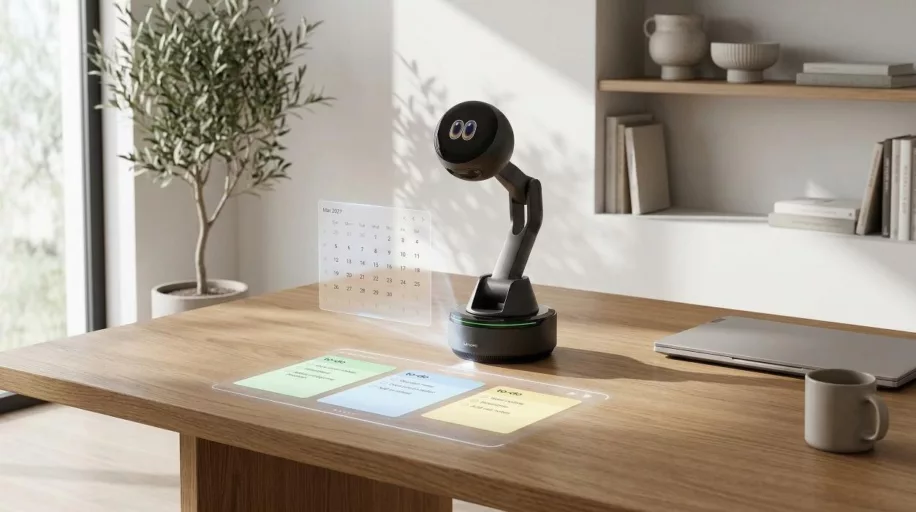
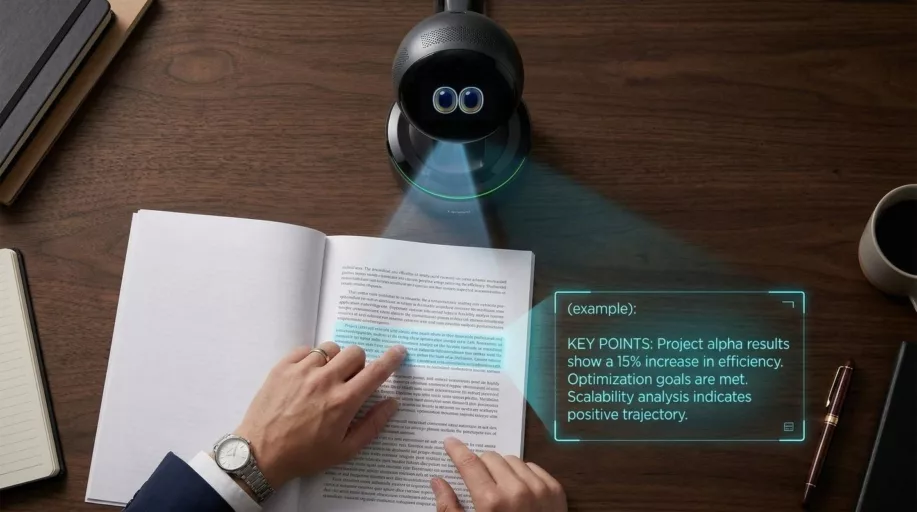
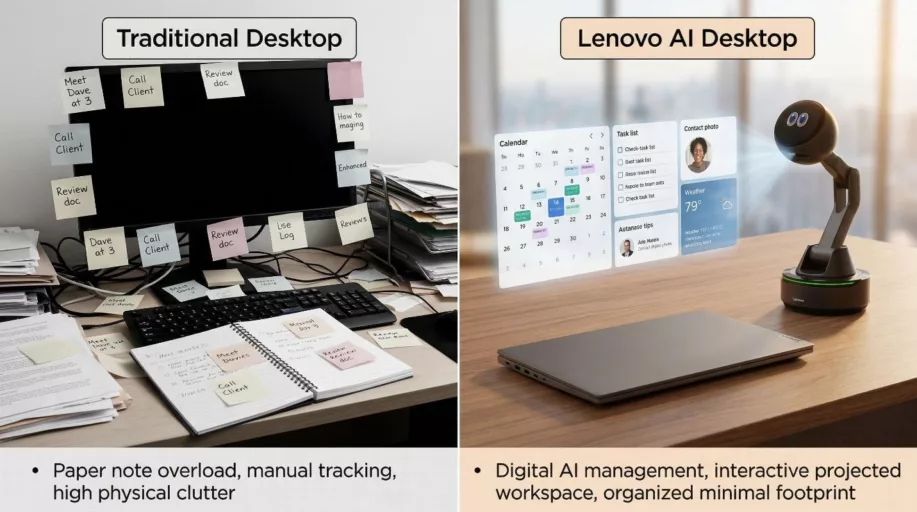
The “AI PC” has dominated headlines for two years, but we are finally moving past the era of chatbots living in a browser tab. At MWC 2026, Lenovo unveiled a vision for the future that feels less like a software upgrade and more like a new category of office furniture. The Lenovo AI Workmate Concept isn’t just another assistant; it is a robotic, “always-on” desk companion designed to bridge the gap between our physical movements and our digital work.
While competitors focus on “Agentic AI” that clicks buttons in the cloud, Lenovo is betting on Spatial AI—the idea that your desk, your printed documents, and even your hand gestures are the primary interface for the next decade of computing.
The Evolution of Lenovo’s AI Ambition
Lenovo is no stranger to digital assistants, but its journey has been one of quiet persistence. Long before the current generative AI explosion, Lenovo experimented with early iterations such as Lenovo Voice and the Alexa-powered Smart Assistant. However, those were peripheral.
The real shift began in early 2026 with the introduction of Lenovo Qira, a unified “Personal Ambient Intelligence” ecosystem. Unlike previous attempts, Qira is integrated at the system level across PCs and Motorola smartphones, focusing on on-device processing via the Personal Knowledge Base (PKB). The AI Workmate is the physical manifestation of this ecosystem. Lenovo is uniquely positioned to win this space because they own the hardware; they aren’t just building a “brain”—they are building the body that houses it.
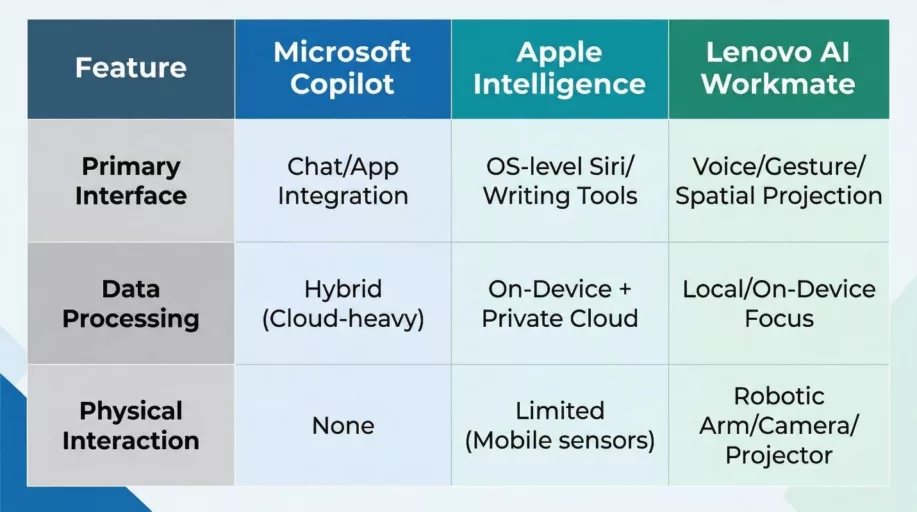
Comparing the 2026 AI Assistant Landscape
The market for personal AI assistants is projected to reach approximately $37.7 billion in 2026. As we move through this year, the competition has split into three distinct “kingdoms”:
The Cloud Titans (Google Gemini & Microsoft Copilot):Google Gemini and Microsoft Copilot remain the kings of big data, unparalleled at scanning “the whole library” of your corporate files. However, they remain largely “screen-bound.”
The Privacy Loyalists (Apple Intelligence): Apple focuses on seamless, secure integration within the iPhone and Mac ecosystem. It is excellent for “Smart Writing,” but lacks a physical presence in the room.
The Physical Pioneers (Lenovo AI Workmate): This is where Lenovo carves its niche. While ChatGPT helps you write an email, the AI Workmate helps you scan a physical stack of papers on your desk, summarizes them locally, and projects the resulting PowerPoint outline onto your wall.
The Feature Set: Spatial and Physical AI
The AI Workmate Concept stands out because it treats the physical environment as a canvas. Its feature set is designed for the high-pressure professional who is tired of toggling between windows:
Spatial Interaction & Projection: Using built-in projectors, it can “extend” your monitor. If your screen is full, it projects your Slack notifications or a document summary onto your desk surface.
Document Summarization: It features a high-resolution camera that can scan a physical document placed in front of it, instantly converting it into a structured digital summary or a slide deck.
Gesture Control: Instead of reaching for a mouse to dismiss a notification, a simple wave of the hand tells the Workmate to snooze or file the alert.
Privacy-First “Always-On”: Because processing is handled by the NPU on the device, it can remain “always-listening” for voice commands without the privacy anxiety of cloud-based speakers.
Fitting Into the Future of Work
In a 2026 workspace, human-centric design is a top priority. The AI Workmate fits this trend by acting as a “buffer” between the user and their screen. It reduces cognitive load by handling the “drudge work”—organizing notes, monitoring screen time, and reminding users to take breaks—through natural interaction rather than jarring pop-ups.
For the home office, it acts as a central hub. It synchronizes schedules across multiple family devices and can transition into a “Work Companion” mode—a clock-like form factor (inspired by the Lenovo AI Work Companion Concept) that manages your daily plan with one-click automation.
The Roadmap to Success: Strategy and Pricing
To move this from a “Concept” to a market leader, Lenovo must avoid the “gadget” trap. Here is the recommended blueprint:
Open API for “Physical Macros”: Lenovo should allow developers to create “Physical Macros.” Imagine a photographer placing a memory card on the desk, and the Workmate automatically projects an “Import and Edit” button.
Seamless Integration with “Aura Edition”: The Workmate must be the “sidekick” to Lenovo’s Aura Edition PCs. If it doesn’t feel like a natural extension of the ThinkPad, users won’t adopt it.
Enterprise Security Certification: Since the Workmate “sees” your desk, Lenovo must obtain top-tier security certifications to convince IT departments the camera isn’t a vulnerability.
Pricing Strategy: To compete with high-end peripherals, Lenovo should offer two tiers:
AI Workmate Pro ($599): The full robotic-arm version with projection and spatial sensors. This is priced as a premium productivity tool, similar to a high-end monitor.
AI Work Companion ($199): The “clock-style” version focusing on voice and scheduling without the robotics.
Wrapping Up
The Lenovo AI Workmate Concept is a bold declaration that the future of work isn’t just about faster chips—it’s about physical-digital harmony. By leveraging its massive hardware footprint and moving AI processing onto the device via Qira, Lenovo is building a unique value proposition that Microsoft and Google cannot easily replicate.
If Lenovo can price the Pro model under $600 and prove that its spatial projection is more than just a gimmick, they won’t just be selling a companion; they will be defining the hardware architecture of the AI era.
If you’ve ever wondered if TikTok would ever offer a more secure messaging experience, you now have an answer. TikTok has told the BBC that it will not protect direct messages sent in the app with end-to-end encryption, because it believes it will make users less safe. In a briefing about security at its London office, TikTok said that implementing the technology would prevent its safety teams or law enforcement from being able to read messages if needed. The ByteDance-owned app framed it as a deliberate decision, made in an effort to keep users, especially younger ones, safe on its platform.
With end-to-end encryption, only the sender and receiver are able to read messages exchanged between them. The technology isn’t typically implemented in China, where ByteDance is located, though TikTok didn’t say whether its parent company had an influence on its decision. TikTok said messages sent through its app are still protected by standard encryption and only authorized employees will be able to access them if the app gets a request from authorities or gets user reports for harmful behavior.
You have a lot of other apps to choose from if you want to communicate through apps with end-to-end encryption. Apple’s iMessage and Google Messages use the technology, and there’s also Facebook Messenger, WhatsApp, Telegram and Signal. It looks like TikTok just isn’t the place to go if you want to use secure messaging, though it’s unclear if its US entity also shares the same stance. If you’ll recall, TikTok signed a deal to spin off its US business, which is now an entity called the TikTok USDS Joint Venture. A group of non-Chinese investors, including Oracle, purchased an 80 percent stake on the app, while ByteDance retained only a 19.9 percent stake. The entity will be in charge of content moderation in the country and will retrain TikTok’s algorithm on US users’ data.
This article originally appeared on Engadget at https://www.engadget.com/apps/tiktok-wont-add-end-to-end-encryption-to-dms-123431502.html?src=rss