Microsoft Begins the First-Ever Secure Boot Certificate Swap Across Windows Ecosystem

Microsoft has begun automatically replacing the original Secure Boot security certificates on Windows devices through regular monthly updates, a necessary move given that the 15-year-old certificates first issued in 2011 are set to expire between late June and October 2026.

Secure Boot, which verifies that only trusted and digitally signed software runs before Windows loads, became a hardware requirement for Windows 11. A new batch of certificates was issued in 2023 and already ships on most PCs built since 2024; nearly all devices shipped in 2025 include them by default. Older hardware is now receiving the updated certificates through Windows Update, starting last month’s KB5074109 release for Windows 11. Devices that don’t receive the new certificates before expiration will still function but enter what Microsoft calls a “degraded security state,” unable to receive future boot-level protections and potentially facing compatibility issues down the line.

Windows 10 users must enroll in Microsoft’s paid Extended Security Updates program to get the new certificates. A small number of devices may also need a separate firmware update from their manufacturer before the Windows-delivered certificates can be applied.


Read more of this story at Slashdot.

Hubble showcases the Egg Nebula in all its dying-star glory

Hubble may no longer be the gold standard, but it can still capture some impressive images. The telescope’s latest snapshot is our clearest view yet of the Egg Nebula. Roughly 3,000 light-years away from Earth, the nebula’s name is derived from its dense layer of gas and dust cloaking a central star.

The new image shows the nebula’s four beams of starlight (from that central star) escaping from its gas-and-dust “shell.” On either side of the disc-like cloud are fast-moving outflows of hot molecular hydrogen. The orange highlights in this image indicate the glow of infrared light.

As the beams of starlight stretch out from the center, they illuminate concentric rings of gas. The gas’s ripple-like pattern suggests it was created by successive bursts from the star, with a little more ejecting every few hundred years.

Hubble image of the Egg Nebula. A disc of gas and dust surrounded by beams of light and concentric rings of dust.
SA / Hubble & NASA, B. Balick (University of Washington)

The Egg Nebula, found in the constellation Cygnus, was first discovered in 1975. Nebulae in this preplanetary phase are rare finds. Since the stage only lasts a few thousand years (and because they’re often faint), they’re relatively difficult for astronomers to spot. By comparing this new image with previous Hubble snapshots of the Egg Nebula, astronomers can learn more about it and shed more light on its processes. But for the rest of us, it makes for some pretty sweet eye candy, right?

This article originally appeared on Engadget at https://www.engadget.com/science/space/hubble-showcases-the-egg-nebula-in-all-its-dying-star-glory-174239769.html?src=rss

This LG 77-Inch OLED TV Is Half Off Right Now

We may earn a commission from links on this page. Deal pricing and availability subject to change after time of publication.

LG has some of the best OLED TVs on the market, from entry-level models that suit a lower budget to ultra-premium, high-tech options. If you want OLED-quality performance from a reliable brand without breaking the bank, the LG B5 is an intuitive smart TV with the brand’s signature vivid color, contrast-rich visuals, and strong gaming features. Right now, this 77-inch LG B5 OLED TV is $1,500 off at Best Buy in a Presidents Day Deal, bringing its original $2,999.99 price tag down to $1,499.99.

The B5 is LG’s most affordable 2025 OLED TV, and its biggest draw is excellent OLED picture quality, with true blacks, strong color accuracy, and detailed contrast (as well as built-in burn-in mitigation). It’s suitable for both streaming and gaming, with 4K resolution, a 120Hz refresh rate with low input lag and VRR, G-Sync, and FreeSync support, as well as HDMI 2.1 ports. It uses the easy-to-navigate webOS platform and includes a range of streaming apps, free channels, and AI features like AI Voice ID, which can recognize individual viewers and switch to their profile. 

While it has a lot in common with the C4, the lower price tag and the fact that it supports Wi-Fi 6E make this model more appealing for some buyers. And for a huge OLED TV, it’s aggressively priced, making the 77-inch LG B5 OLED TV a smart value buy for gamers and everyday viewers at $1,500 off. However, if you want better brightness and more advanced processing, you may want to level up to the C4 or the newer C5.

Our Best Editor-Vetted Presidents’ Day Deals Right Now


HP Omen 35L (Intel Core Ultra 9 285K, RTX 5080, 2TB SSD, 64GB RAM)


—


(List Price $2,949.99 With Code “PRESDAYPC100”)

Deals are selected by our commerce team

AI-Generated Playlists Are Coming to YouTube Music

If you’re of a certain age, you might remember mixtapes: cassettes made up of a series of tracks you or a friend think work well together, or otherwise enjoy. (They took some work to put together, too.) Digital music sort of killed mixtapes, but, in their place, came playlists. You could easily put together a collection of your favorite songs, and either burn them to a CD, or, as streaming took over, let the playlist itself grow as large as you wanted.

Anyone can make a playlist, but there’s an art to it. Someone with a keen ear for music can build a playlist you can let play for hours. Maybe you have a friend who’s good at making playlists, or maybe you’re that friend in your group. They can be a fun way to share music, and find some new music to add to your own library.

Now, generative AI wants to replace human intervention altogether. Rather than you or a friend building a playlist, you can ask AI to do it for you. And YouTube Music is the latest service to give it a try.

YouTube announced its new AI playlist generator in a post on X on Monday. If you subscribe to either YouTube Premium or YouTube Music Premium, you can ask YouTube’s AI to make a playlist based on whatever parameters you want. To try it out, open YouTube Music, then head to your Library and tap “New.” Next, choose the new “AI Playlist” option, then enter the type of music you’re looking for. You could ask YouTube Music to generate a playlist of pop-punk songs, or to make something to play when focusing on work. Really, it’s whatever you want, and if the AI gets it wrong, you can try it again.


This Tweet is currently unavailable. It might be loading or has been removed.

It’s pretty straightforward, and nothing revolutionary. Other music streaming services have their own AI playlist generators too. Spotify, for example, has had one for a couple of years, but recently rolled out Prompted Playlist as well, which lets you generate playlists that update with time, and takes your listening history into account. With this update, however, YouTube is likely trying to drum up some interest in its streaming service and encourage users to pay for it. Just this week, the company put lyrics—once a free feature—behind the Premium paywall. I suppose it thinks that if you can’t read what your favorite artists are singing, and you’d like to have a bot make your playlists for you, you might just subscribe to its platform.

This could be a good change in the long run for YouTube Music subscribers. I’m on Apple Music, so I don’t really use AI-generated playlists. I like the Apple-curated playlists, as well as the ones my friends and I make and share. But who knows: Maybe human-generated playlists are going the way of the mixtape.

Microsoft will start refreshing Secure Boot certificates in March for Windows 11 and Windows 10 ESU users

Get ye to Windows Update, because there’s a good chance you’ve got new Secure Boot certificates to install. Microsoft just announced that it will be refreshing those certificates, which were originally introduced when Secure Boot debuted in 2011, as a security precaution. Secure Boot was a way for Microsoft to protect systems from running unsigned and potentially malicious code before Windows launched. It went on to be an installation requirement for Windows 11, as well as anti-cheat software used in Valorant, Call of Duty: Black Ops 6/7 and Battlefield 6.

Without the new Secure Boot certificates, Microsoft says your system will still function normally, but it will enter “a degraded security state that limits its ability to receive future boot-level protections.” Basically, you won’t be protected from malware and viruses targeting vulnerabilities in older versions of Windows. As expected, Microsoft also notes that unsupported versions of Windows won’t be receiving the new Secure Boot certificates. They’re only coming to Windows 11 systems, as well as Windows 10 PCs subscribed to Microsoft’s Extended Security Updates.

Microsoft says many users will be able to pick up the updated Secure Boot certificates by visiting Windows Update, but a few may need additional firmware updates from their system (or motherboard’s) OEM. You’ll also be able to track the status of your security certificates in the Windows Security app in the “coming months.”

“As cryptographic security evolves, certificates and keys must be periodically refreshed to maintain strong protection,” Nuno Costa, Partner Director of Windows Servicing and Delivery, wrote in a blog post today. “Retiring old certificates and introducing new ones is a standard industry practice that helps prevent aging credentials from becoming a weak point and keeps platforms aligned with modern security expectations.”

Costa says Microsoft has been working with OEMs like Dell and HP to ensure a smooth transition to the new Secure Boot certificates. Many new systems built in 2024 already have the updated certs, while “almost all” devices shipped last year have them as well. Microsoft has also been alerting IT customers to this transition since last year.

This article originally appeared on Engadget at https://www.engadget.com/computing/microsoft-will-start-refreshing-secure-boot-certificates-in-march-for-windows-11-and-windows-10-esu-users-170000777.html?src=rss

A Bitcoin Blunder for the Ages: $40 Billion Accidentally Given Away

An anonymous reader shares a report: The hundreds of prize payouts were mostly just a few bucks each, part of a promotional campaign by a South Korean cryptocurrency exchange. The total reward pot: 620,000 Korean won, or about $425. Then came a colossal mistake. A staffer for Bithumb, South Korea’s No. 2 crypto exchange, didn’t distribute 620,000 Korean won. Rather, the prizes, due to an input error, emerged in a different currency: 620,000 bitcoins, valued at more than $40 billion.

That meant a winner who should have received a sum of 2,000 won — enough to buy a cheap cup of coffee — reaped, at least momentarily, more than $120 million in bitcoins. Enough recipients sought to sell or withdraw bitcoin that the market sank 17%, before Bithumb halted transactions after roughly 30 minutes. Those affected included investors who had held bitcoin before the botched giveaway. The losses totaled about $685,000, Bithumb says.

The company has since said it has reversed the transactions or had recipients voluntarily return more than 99% of the misdistributed bitcoins. But Bithumb is still trying to convince users who during the brief window of trading managed to offload more than 100 bitcoins, valued at roughly $9 million, to give back the equivalent funds.


Read more of this story at Slashdot.

Upgraded Google safety tools can now find and remove more of your personal info

Do you feel popular? There are people on the Internet who want to know all about you! Unfortunately, they don’t have the best of intentions, but Google has some handy tools to address that, and they’ve gotten an upgrade today. The “Results About You” tool can now detect and remove more of your personal information. Plus, the tool for removing non-consensual explicit imagery (NCEI) is faster to use. All you have to do is tell Google your personal details first—that seems safe, right?

With today’s upgrade, Results About You gains the ability to find and remove pages that include ID numbers like your passport, driver’s license, and Social Security. You can access the option to add these to Google’s ongoing scans from the settings in Results About You. Just click in the ID numbers section to enable detection.

Naturally, Google has to know what it’s looking for to remove it. So you need to provide at least part of those numbers. Google asks for the full driver’s license number, which is fine, as it’s not as sensitive. For your passport and SSN, you only need the last four digits, which is enough for Google to find the full numbers on webpages.

Read full article

Comments

Ayaneo’s massive Next 2 handheld has a similarly massive price tag

There appears to be no limit to how chonky and eye-wateringly expensive PC gaming handhelds can get, with the latest behemoth being the Ayaneo Next 2. First announced back in November, the latest Windows handheld in Ayaneo’s Next lineup is now up for pre-order, with a spec sheet that makes some of its rivals look modest.

If you missed the announcement at the end of last year, the Next 2 is packing a 9-inch OLED display with a 2,400 x 1,504 resolution and a maximum refresh rate of 165Hz (adjustable down to 60Hz). The Next 2 is powered by an AMD Ryzen AI Max+ 395 chip and has a massive 115Mh battery under the hood.

To put all of that into perspective, the Next 2’s display is more than 1.5 inches larger than the Steam Deck OLED’s, and goes bigger than even the Lenovo Legion Go 2’s 8.8-inch panel. Its battery is the largest of the three by some margin too, and according to Ars Technica it weighs in at around 3.14 pounds (around 1424g), making it more than twice as heavy as the very heavy Xbox ROG Ally X. Get those wrists to the gym if you’re considering picking one of these up.

Ayaneo is ticking all the boxes where inputs are concerned too. Its latest handheld has dual touchpads (a feature ASUS left out on the ROG Xbox Ally X), Hall Effect sticks, an 8-way D-Pad and four customizable rear buttons.

All of this tech inevitably comes at a high price, with the entry-level model that ships with 32GB of RAM and 1TB of storage coming in at $1,999, or $1,799 if you take advantage of early bird pricing. This model is equipped with the slightly less capable Ryzen AI Max 385 CPU.

If you want the more powerful AI+ 395 chip you have a few options. A variant of the Next II with 64GB of RAM and 1TB of storage costs $2,699, but you can order now at the early bird price of $2,299. For 128GB of RAM and 2TB of storage you’ll be handing over a slightly hilarious $4,299 at full price. Early birds can order now for $3,499.

This article originally appeared on Engadget at https://www.engadget.com/gaming/pc/the-ayaneo-next-2-is-a-massive-pc-handheld-with-a-price-tag-to-match-165326534.html?src=rss

US judicial body removes climate research paper after complaints from Republicans

A US judicial body has revised an internal document to remove climate research. The Reference Manual on Scientific Evidence is a document used by judges when they have to oversee cases involving complex scientific matters. The climate science chapter has now been deleted, so they’ll be on their own with climate-related cases.

This move came after a group of Republican state attorneys wrote a letter to complain about the chapter on climate change. The language in the document, which was authored by researchers from Columbia University, suggests that climate change is driven by the actions of humans. This was a no-go to those state attorneys, despite being an established fact.

“Nothing is ‘independent’ or ‘impartial’ in issuing a document on behalf of America’s judges declaring that only one preferred view is ‘within the boundaries of scientifically sound knowledge,'” the letter states. It’s worth noting that the document is nearly 2,000 pages long and declares preferred views on numerous subjects, though the state attorneys only have an issue with the one.

The Republicans also complained that the report called the Intergovernmental Panel on Climate Change an “authoritative science body.” The grounds for this complaint seem to derive from a short paper from a Canadian conservative think tank.

US court agency pulls climate change from science advisory document https://t.co/2ornJlJN1X

— Ars Technica (@arstechnica) February 10, 2026

The letter’s authors would not settle for any revisions, according to a report by Ars Technica. Rather, they demanded the entire chapter be removed. So it was removed and now judges can rule on climate cases using the tried and true method known as “vibes.”

Interestingly, the introduction of the document by Supreme Court Justice Elena Kagan still mentions the climate chapter. They had better break out some correction tape. The full text of the now-deleted chapter has been posted by RealClimate, if you want to give it a gander.

More than 99.9 percent of peer-reviewed scientific papers agree that climate change is real and caused by humans. It looks like some segments of society want a judicial system ruled by that remaining 0.01 percent.

This article originally appeared on Engadget at https://www.engadget.com/big-tech/us-judicial-body-removes-climate-research-paper-after-complaints-from-republicans-164829295.html?src=rss

Soul Retreat Offers Photorealistic Nature Meditation On Quest

Soul Retreat is a new Quest 3 & 3S app that uses real-world location captures to take users on a relaxing virtual getaway.

The new VR meditation app from Soul Retreat Labs takes users to photorealistic landscapes inspired by real locations like Scotland’s Glen Coe and Spain’s La Besurta.

These soothing locales have been recreated through a system the developer calls GroundedPresence, an advanced photogrammetry stack. The result is a realistic experience that replicates the feeling of relaxing on a sunny beach or hiking through breezy hills.

0:00

/1:16

A voiceover guides you through their meditation, talking you through breathing exercises or telling short stories to distract you from whatever stress you have in the day, and you can shift the time from day to night with a simple gesture or voice command. This narrator adapts with each session, with the studio promising a personalized experience.

Soul Retreat is currently available to download for free on Meta Quest 3 and 3S, with an optional Soul Retreat Plus subscription service costing either $6.99 a month, $34.99 a year, or a $69.99 lifetime payment.

The free option gives you access to two environments with a third being rotated weekly, while the paid option lets you explore all 10 current retreats. More will be added as Soul Retreat continues its development, the studio promises.

Dave Farber RIP

From the NANOG list comes the sad news of the
passing of Dave Farber.

His professional accomplishments and impact are almost endless, but
often captured by one moniker: “grandfather of the Internet,”
acknowledging the foundational contributions made by his many
students at the University of California, Irvine; the University of
Delaware; the University of Pennsylvania; and Carnegie Mellon
University.

Directive 8020 brings sci-fi survival horror to PS5, Xbox Series X/S and PC on May 12

Supermassive Games has announced a new release date for the next entry in the Dark Pictures Anthology series. Directive 8020 is coming to PS5, Xbox Series X/S and Steam on May 12. The studio behind Until Dawn and The Quarry revealed the news with the help of a fresh trailer for the sci-fi survival horror game.

The story focuses on the crew of a spaceship that has crash landed onto another world. The survivors have to contend with an alien lifeform that’s hunting them and can mimic its prey (no prizes for guessing that Supermassive took inspiration from The Thing here). If these astronauts want to stay alive, though, they’ll put the lives of everyone on a dying Earth at risk.

As with Supermassive’s previous games, Directive 8020 is largely driven by the narrative choices players make at key moments, such as whether to save a crewmate and put the character you’re currently controlling at risk, or to abandon them. You might also have to pick between two seemingly identical versions of the same person and let one of them back into the crew. The game has segments in which you’ll have to fight or stealthily avoid enemies as well.

This time around, Supermassive is introducing a feature called Turning Points, through which you can go back to previous decisions and opt for another path (perhaps to see different endings more easily, keep certain characters alive or make sure you get all the achievements or trophies). A permadeath mode does away with that option for a more traditional survival horror experience. 

You can go it alone or get some friends to join you for five-player local co-op action — the studio’s games have long been good fodder for pass-the-controller couch co-op. Supermassive will add online multiplayer support down the line.

The developer originally planned to release Directive 8020 in October 2025. However, Supermassive announced last July that it was delaying the game amid its latest round of layoffs.

This article originally appeared on Engadget at https://www.engadget.com/gaming/directive-8020-brings-sci-fi-survival-horror-to-ps5-xbox-series-xs-and-pc-on-may-12-163358560.html?src=rss

What People Are Getting Wrong This Week: Is Snow Fake?

We may earn a commission from links on this page.

Memphis city council members Pearl Eva Walker and Yolanda Cooper Sutton (and many other people online) say that snow is fake.

Sutton recently posted a video on her Facebook page to demonstrate the artificiality of snow. Over footage of her husband holding a snowball and a lighter, Sutton says, “So we decided to see what was really hitting the ground.” Her husband holds a flame to the snowball, and it does not melt.

“It’s not melting [it stinks] when you set fire to it OMG, Jesus Christ, what is happening!!!” Sutton asks.

In the video’s comment section, fellow council member Walker reportedly replied, “man made,” and included another video showing the same phenomenon. It looks like that specific video was taken down, but these kinds of posts are pretty common after snowstorms like the ones that just blanketed the US. Here are a couple of examples:

So: What’s happening? Has plastic snow replaced the real stuff? Is this a flurry of misinformation? Are all these people just flakes?

All available evidence suggest snow is real

First, snow is real, but I understand why the Memphis council members would be suspicious. These videos are convincing, and they’re not AI nor the result of people deliberately hoaxing with prop snow. They are documents of what happens when you hold a flame up to real, actual, fell-from-the-sky snow. You’d expect that holding fire to a snowball would make it melt into water in your hand but it just doesn’t. No shade to people running their own experiments, but they’re missing that snow can be counterintuitive.

Why it seems like snow doesn’t melt from flames

Snow is 90–95% air, so there’s a lot less water than people might expect no matter how it melts. But the main thing going on is sublimation—a solid changing directly to a gas without first becoming liquid. When you hold a flame to snow, especially packed snow, much of it will become water vapor without becoming liquid water first. Sublimation is also why snow can seem to disappear without the temperature going above freezing. You can see sublimation in action in the video below.

Snow is also porous. When a snowball melts, water is sucked to the center of the mass through capillary action, and it fills up the spaces that were once air. The video below shows unpacked snow on the ground being hit with a torch. Some of the snow is sublimating in response to the heat, while some of the surface snow is melting into water and being sucked into the empty spaces in the snow below it. You can see how it goes from “powdery” snow to more wet snow by the end of the video. (Also, these yahoos are going to burn down the trailer soon):

But what about the snow turning black?

The scorch marks on the “burning snow” have an explanation as well: The flame from a match or a lighter is result of fuel burning—butane from a lighter; wood or paper from matches. As the fuel burns, it produces carbon soot, which reacts to the cold snow by condensing onto its surface. The soot isn’t scorch marks from the snow burning. It’s scorch marks from the butane or wood/paper burning. You can tell the snow itself isn’t burning, because it never catches fire.

That leaves only the burning plastic smell that some report. That’s actually the smell of the butane from the lighter not fully burning and/or the smell of the mercaptans sometimes added to butane so we can smell it. The result is a chemical odor that is easy to mistake for burning plastic, especially when you hold a flame up to soot you’ve already deposited on a cold surface. In this video, the conspiracy theorist used a candle instead of a lighter, and notes that it doesn’t smell like burning plastic. That’s because butane was absent.

How to do the “burning snow” illusion yourself

You can try all this yourself to amaze your friends with the wonders of sublimation and/or trick a bunch of people on social media. It’s easy:

  • Grab some snow and pack it into a tight snowball. A more solid surface will help soot stick to it.

  • Apply flame from a standard butane lighter for a few seconds. If you use matches, you won’t get the same burning plastic smell.

  • Cool scorch mark, right? Note how little water is dripping and how the snow is “disappearing.”

  • Note the edges of the scorch mark. Here’s where water that did melt was pulled toward the center of the snowball.

  • If you want to debunk the snow-burn conspiracy, simply hold the snow in your hand instead, and you will find that it melts into water.

Is it possible to make fake snow?

What if the government wanted to create a fake snow storm for some reason? It’s possible—you can see fake snow at ski resorts during bad winters; you can buy your own snow-maker on Amazon for less than $100. The problem would be the scale. All “they control the weather” conspiracies fall apart when you consider the scale.

Artificial snow is produced by spraying a mist of pressurized water into air that’s below freezing. You could cover some trails at a ski resort without a problem, but a whole city or state would require a lot of snow. Industrial snow-making-machines use about 160,000 gallons of water to create one-acre-foot of snow. To cover a town that’s 25 square miles with six inches of snow, you’d need about 1.28 billion gallons of water pumping through thousands of snow-guns. It would cost a lot, use a ton a fuel, and it wouldn’t fool anyone anyway—those machines are loud as hell, and the snow wouldn’t fall from the sky; it would shoot out of snow guns. You’d end up like, “What am I even doing with my life?”

You could also try seeding existing clouds with silver iodide to try to make it snow, but that’s expensive too, and no one really one knows if it works at all.

Bottom line: We can’t control the weather

Humankind can collectively alter weather patterns—global climate change and all that—but we can’t control weather. We can’t make it snow on command in Memphis without anyone noticing thousands of roaring machines shooting artificial snow into the air any more than we can control hurricanes. The snow falling from the sky is real and it’s made of frozen water crystals, just like it always has been.

Zwift Update Version 1.107 (158475) Released

Zwift version 1.107 begins its phased rollout today. This is a minor update containing mostly bug fixes. See details below…

Workout Card Improvements

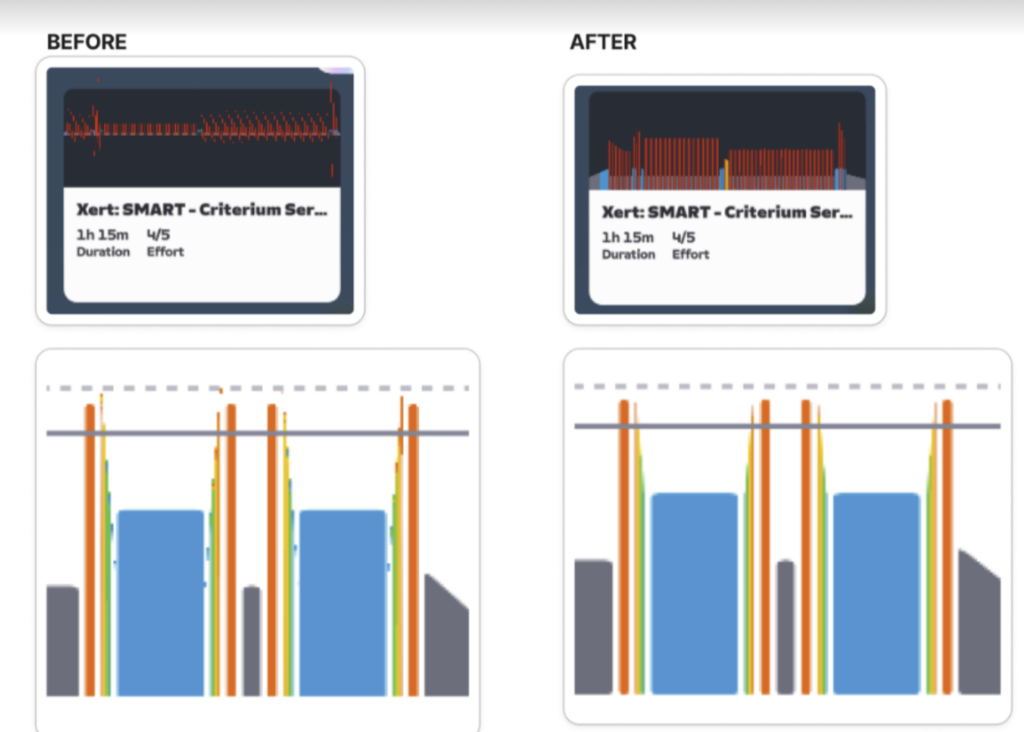
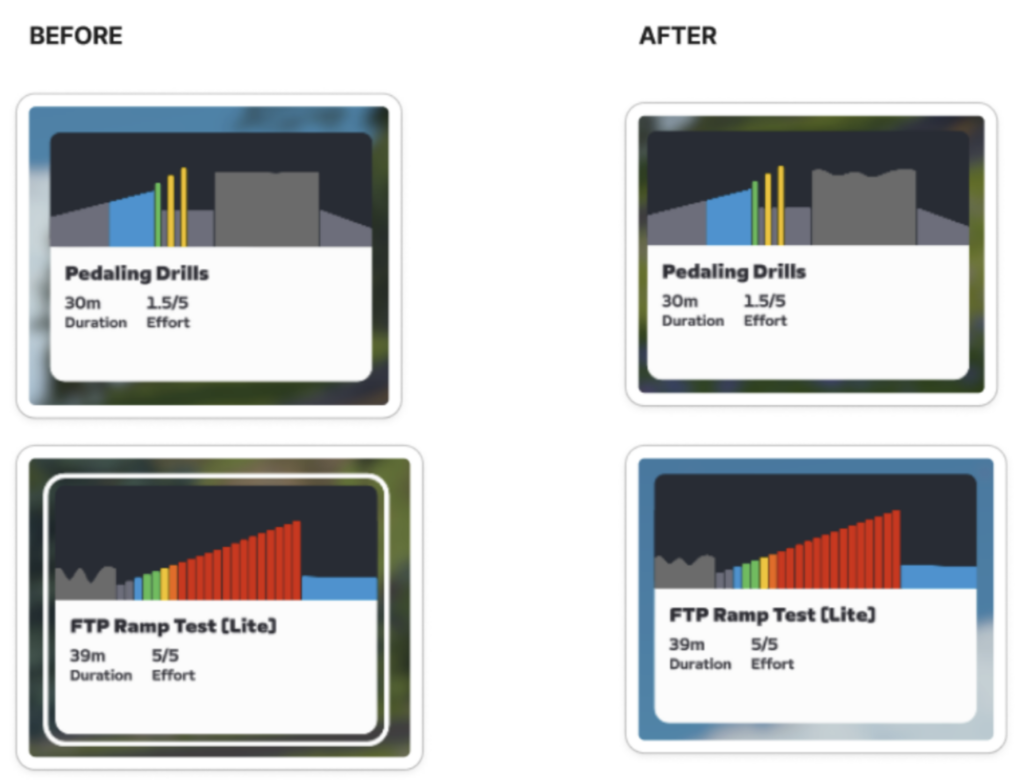
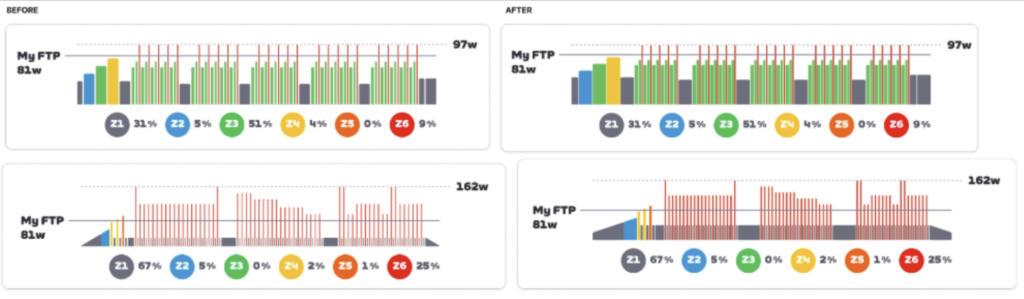
Zwift says this release includes “Various visual improvements to how workout blocks are displayed in workout cards on the Home Screen. These changes include fixes to how small workout blocks, free ride segments, and workouts with many blocks are displayed.”

The more detailed display of the workout that you see when clicking the card has also been modified. Examples below:

Neon Shore Loop is Open

Makuri Islands’ Neon Shore Loop route was originally launched as event-only to host TTT races for the ZRL Round 3, which wraps up this week. This update makes the route free rideable, and it can also be scheduled for meetups once it’s added to the list in Companion app.

Note: this isn’t a new badge, it’s just a change from the route being event-only to being open for free rides, meetups, etc. If you already raced the route in ZRL, you’ve already got the route badge.

Release Notes

Zwift supplied the following additional release notes:

  • Fixed an issue that could cause chat emojis to not be visible after game updates or fresh installations.
  • Fixed an issue that could cause Coffee Stop to not work when joining an event from a workout.
  • Fixed an issue that could cause Power Segment leaderboard results to be delayed.
  • Windows: Fixed an issue that could cause heart rate values from CORE sensors to be missing.
  • iOS/Android: Fixed an issue that could cause bodies of water to be missing in some locations in Makuri.

Discuss this update in Zwift’s forum > (link coming soon)

Questions or Comments?

If you spotted any other changes or bugs in the update, please comment below!

Meta, TikTok and Snap are participating in an online safety ratings system

Numerous major social platforms including Meta, YouTube, TikTok and Snap say they will submit to a new external grading process that scores social platforms on how well they protect adolescent mental health. The program comes from the Mental Health Coalition’s Safe Online Standards (SOS) initiative, which comprises about two dozen standards covering areas like platform policy, functionality, governance and transparency, content oversight and more. The SOS initiative is led by Dr. Dan Reidenberg, Managing Director of the National Council for Suicide Prevention.

In announcing these companies’ participation, the Mental Health Coalition writes “SOS establishes clear, user-informed data for how social media, gaming, and digital platforms design products, protect users ages 13–19, and address exposure to suicide and self-harm content. Participating companies will voluntarily submit documentation on their policies, tools, and product features, which will be evaluated by an independent panel of global experts.”

After evaluation, the platforms will be given one of three ratings. The highest achievable safety rating is “use carefully,” which comes with a blue badge that compliant platforms can display. Despite being the highest rating, the requirements seem fairly run-of-the-mill. The description includes things like “reporting tools are accessible and easy to use,” and “privacy, default and safety functions are clear and easy to set for parents.” As for what actions the standards ask of the companies being rated, the “use carefully” rating says “platforms and filters help reduce exposure to harmful or inappropriate content.”

The other ratings include “partial protection” which is described in part as “some safety tools exist on the platforms, but can be hard to find or use,” and “does not meet standards” which would be given if “filters and content moderation do not reliably block harmful or unsafe content.”

The Mental Health Coalition, founded in 2020, has mentioned Facebook and Meta as partners since the early days of the organization. In 2021 the organization said it would bring together “leading mental health experts partner with Facebook and Instagram to destigmatize mental health and connect people to resources” during the COVID-19 pandemic.

In 2022 the nonprofit published a case study with “support from Meta” that found “mental health content on social media can reduce stigma while increasing individuals’ likelihood to seek resources, therefore positively impacting mental health.”

In 2024, the MHC “in partnership with Meta” launched a campaign called the Time Well Spent Challenge. In it, the group urged parents to have “meaningful conversations” with teens about “healthy” social media use, focusing less on whether teens should be on these apps at all and more on keeping them on-platform in a “time well spent” way, from reduced screen time to “using social media for good” and reviewing their feeds together.

That same year it partnered with Meta again to establish “Thrive,” a program that allows tech companies to share data regarding materials that violate self-harm or suicide content guidelines. The Mental Health Coalition lists Meta as a “creative partner” on its website.

Last year it was alleged that Meta buried internal data showing the ill effects of its products on users’ mental health. The internal research, dubbed “Project Mercury,” began in 2020. Since then the company has introduced some bare-minimum attempts at addressing mental health concerns, such as Instagram teen accounts. Meta is now on trial in California facing allegations over child harm from addictive products, the first in a series of upcoming lawsuits against the social media giant.

Other companies participating in the rating program include Roblox, which has recently faced stiff accusations over the wellbeing of children on the platform, and Discord which has beefed up its age-verification processes in response to its own serious child endangerment concerns.

This article originally appeared on Engadget at https://www.engadget.com/social-media/meta-tiktok-and-snap-are-participating-in-an-online-safety-ratings-system-162921333.html?src=rss