Europe risks undermining its own competitiveness drive by restricting access to foreign technology, Google’s president of global affairs and chief legal officer Kent Walker told the Financial Times, as Brussels accelerates efforts to reduce reliance on U.S. tech giants. Walker said the EU faces a “competitive paradox” as it seeks to spur growth while restricting the technologies needed to achieve that goal.
He warned against erecting walls that make it harder to use some of the best technology in the world, especially as it advances quickly. EU leaders gathered Thursday for a summit in Belgium focused on increasing European competitiveness in a more volatile global economy. Europe’s digital sovereignty push gained momentum in recent months, driven by fears that President Donald Trump’s foreign policy could force a tech decoupling.
Spending time in a sauna can feel good, but it can also entail a little bit of suffering; after all, if the weather outside were the same as the temperature in a sauna, you’d probably want to hide out in the air conditioning all day. There’s something about unpleasant bodily experiences that makes us think they must be good for us, somehow, and so the sauna has gained a healthful reputation that it doesn’t entirely deserve. Here’s a rundown of what a sauna can and can’t do for you.
Saunas don’t burn fat
It is technically true that you can lose weight by sitting in a sauna, but that’s not because your body is torching fat; it’s because you’re sweating, and sweat is made of water, and water weighs something. As soon as you rehydrate—which you should—the scale will go right back to where it was at the beginning. After all, as I’ve discussed in the context of exercise, sweating doesn’t mean that you got a good workout or that you burned calories. It just means you were hot.
People who sell saunas and sauna services like to talk up their calorie-burning benefits, but there’s no evidence to suggest you burn significantly more calories sitting in a hot room than you would sitting on your couch at home. Some more skeptical websites cite a modest figure of 1.5 to 2 times as many calories as you would burn sitting at room temperature, but without a citation. If true, that’s about the same as the difference between sitting and standing—so you can skip that trip to the sauna and just spend half an hour standing around.
So why does your fitness tracker say you burned a ton of calories in the sauna? First of all, don’t bring your phone in the sauna, it’s bad for the battery. But since you did anyway, I’ll explain. The calorie-burning algorithms on your watch are built to estimate your calorie burn from your heart rate under the assumption that you are exercising. If your heart rate increases but you are not exercising, the calculations aren’t correct. The calorie burn during exercise comes from the fact that muscles all over your body are contracting over and over again. That is simply not what’s happening when you sit in the sauna.
Saunas don’t “detox” you
It’s 2026 and we as a society should be over this “detox” concept, which has been debunked time and time again. Ordinary inconveniences like being tired sometimes aren’t due to some secret toxins that are constantly poisoning you, and even if you do have health issues due to toxins, you should seek medical treatment and not expect smoothies or saunas to cure you.
Saunas don’t replace exercise
Saunas and exercise both heat up your body and make you sweat, but there aren’t many similarities aside from that. Remember, exercise makes us stronger and improves our cardiovascular endurance (giving us a higher VO2max, for example). Sweating in a hot room doesn’t do that.
Even this rundown from an exercise science researcher, whose headline draws parallels between running and sitting in a sauna, includes the following disclaimer: “Before you contemplate cancelling your gym membership and investing the savings in a Jacuzzi, know that regular saunas or baths are unable to replicate all the health benefits of exercise training, such as promoting fat loss and increasing muscle mass. Using hot baths or saunas shouldn’t be considered as a substitute for exercise.”
Saunas may be good for your blood vessels
What that researcher does point out, after the disclaimer, is that there are a few lesser-known benefits of exercise that seem to be related to the increase in body heat and heart rate, rather than from the more obvious strain on our lungs or muscles.
When your body temperature rises, blood vessels near the surface of your skin dilate (get wider) and this process may help cell growth and repair. In other words, simply raising body temperature may be good for your blood vessels. That’s not something we normally think about, but healthy blood vessels are a part of a healthy cardiovascular system.
Relaxation is real
If you find saunas relaxing—and many of us do—that can be a health benefit in itself. Now, this isn’t as concrete a benefit as it’s sometimes made out to be. You’re not going to cure your depression or reverse your heart disease just by relaxing in a sauna every now and then. But if you enjoy your sauna sessions, they could certainly contribute to lowering your stress levels and improving your mental health. Pro tip: If you don’t have access to a sauna, a hot bath may have a lot of these effects as well.
Heat has its pros and cons
For other medical conditions and athletic uses, the pros and cons of a sauna come down to the pros and cons of heat itself. If you have sore muscles, heat often feels good, so athletes often enjoy sauna sessions.
Some skin conditions respond well to the dry air of a sauna, while others can be exacerbated by dry air but could feel better with the humid air of a steam room. Use common sense and check with your medical provider if you want to use a sauna to manage a health condition.
Saunas have risks, too
If we’re talking about health benefits, it’s only fair to discuss risks as well. Saunas are reasonably safe, but people with medical conditions are often advised to steer clear, or to talk to a doctor before deciding to spend time in a sauna. This may include you if you are pregnant, have unusually high or low blood pressure, have epilepsy, or are taking stimulants, tranquilizers, or mind-altering drugs. Spending time in a sauna has also been linked to temporarily lowered fertility because heat impairs the production of sperm.
The main danger of a sauna is that you could overheat or dehydrate; severe heat illness and dehydration can both be life threatening, and people have died in saunas. Alcohol makes you more susceptible; half of the people who died in saunas, according to a Finnish study, were under the influence of alcohol. (The authors argue that the biggest danger is not alcohol itself, but allowing a drunk person to be in a sauna alone.) So if you choose to spend time in a sauna, be smart about it. Hydrate well, don’t go alone, and don’t expect the sauna to do things that saunas can’t do.
They actually did it. OpenAI officially deprecated GPT-4o on Friday, despite the model’s particularly passionate fan base. This news shouldn’t have been such a surprise. In fact, the company announced that Feb. 13 would mark the end of GPT-4o—as well as models like GPT-4.1, GPT-4.1 mini, and o4-mini—just over two weeks ago. However, whether you’re one of the many who are attached to this model, or you simply know how dedicated 4o’s user base is, you might be surprised OpenAI actually killed its most agreeable AI.
This isn’t the first time the company depreciated the model, either. OpenAI previously shut down GPT-4o back in August, to coincide with the release of GPT-5. Users quickly revolted against the company, some because they felt GPT-5 was a poor upgrade compared to 4o, while others legitimately mourned connections they had developed with the model. The backlash was so strong that OpenAI relented, and rereleased the models it had deprecated, including 4o.
If you’re a casual ChatGPT user, you might just use the app as-is, and assume the newest version tends to be the best, and wonder what all the hullabaloo surrounding these models is all about. After all, whether it’s GPT-4o, or GPT-5.2, the model spits out generations that read like AI, complete with flowery word choices, awkward similes, and constant affirmations. 4o, however, does tend to lean even more into affirmations than other models, which is what some users love about it. But critics accuse it of being too agreeable: 4o is at the center of lawsuits accusing ChatGPT of enabling delusional thinking, and, in some cases, helping users take their own lives. As TechCrunch highlights, 4o is OpenAI’s highest-scoring model for sycophancy.
I’m not sure where 4o’s most devoted fans go from here, nor do I know how OpenAI is prepared to deal with the presumed backlash to this deprecation. But I know it’s not a good sign that so many people feel this attached to an AI model.
Disclosure: Ziff Davis, Mashable’s parent company, in April 2025 filed a lawsuit against OpenAI, alleging it infringed Ziff Davis copyrights in training and operating its AI systems.
AI-powered browser extensions continue to be a popular vector for threat actors looking to harvest user information. Researchers at security firm LayerX have analyzed multiple campaigns in recent months involving malicious browser extensions, including the widespread GhostPoster scheme targeting Chrome, Firefox, and Edge. In the latest one—dubbed AiFrame—threat actors have pushed approximately 30 Chrome add-ons that impersonate well-known AI assistants, including Claude, ChatGPT, Gemini, Grok, and “AI Gmail.” Collectively, these fakes have more than 300,000 installs.
Fake Chrome extensions look like popular AI assistants
The Chrome extensions identified as part of AiFrame look like legitimate AI tools commonly used for summarizing, chat, writing, and Gmail assistance. But once installed, they grant attackers wide-ranging remote access to the user’s browser. Some of the capabilities observed include voice recognition, pixel tracking, and email content readability. Researchers note that extensions are broadly capable of harvesting data and monitoring user behavior.
Though the extensions analyzed by LayerX used a variety of names and branding, all 30 were found to have the same internal structure, logic, permissions, and backend infrastructure. Instead of implementing functionality locally on the user’s device, they render a full-screen iframe that loads remote content as the extension’s interface. This allows attackers to push changes silently at any time without a requiring Chrome Web Store update.
LayerX has a complete list of the names and extension IDs to refer to. Because threat actors use familiar and/or generic branding, such as “Gemini AI Sidebar” and “ChatGPT Translate,” you may not be able to identify fakes at first glance. If you have an AI assistant installed in Chrome, go to chrome://extensions, toggle on Developer mode in the top-right corner, and search for the ID below the extension name. Remove any malicious add-ons and reset passwords.
As BleepingComputer reports, some of the malicious extensions have already been removed from the Chrome Web Store, but others remain. Several have received the “Featured” badge, adding to their legitimacy. Threat actors have also been able to quickly republish add-ons under new names using the existing infrastructure, so this campaign and others like it may persist. Always vet extensions carefully—don’t just rely on a familiar name like ChatGPT—and note that even AI-powered add-ons from trusted sources can be highly invasive.
An upcoming update to Steam includes a helpful improvement to game reviews. As part of the Steam Client Beta update Valve released on February 12, users will now be able to attach information about their hardware specifications when they post a new game review or update an old one.
It’s not uncommon to find negative reviews that complain about a game’s performance, information that’s hard to draw a conclusion from without knowing what kind of hardware the reviewer is using. With specs attached, the usefulness of complaints becomes a little bit easier to gauge. A game’s sales performance and discoverability on Steam is heavily influenced by its review average, a data point Steam users sometimes manipulate for reasons unconnected to the quality of a game. Provided reviewers actually attach their specs — at least in the beta, the feature is entirely optional — Valve’s mercurial reviews ecosystem could end up becoming more nuanced overall.
Alongside the new option in reviews, Valve is also experimenting with a way for users to share “anonymized framerate data” with the company. When framerate sharing is enabled, “Steam will collect gameplay framerate data, stored without connection to your Steam account but identified with the kind of hardware you are playing on,” Valve says. The feature is specifically focused on devices running SteamOS, Valve’s Linux-based operating system for the Steam Deck and some third-party handhelds. The extra information could help the company’s attempts to improve game compatibility using software like Proton.
The beta update also includes bug fixes, and a tweak to how Valve collects feedback about whether a game should be Deck Verified. Now when Steam prompts you to confirm whether you agree with a game’s rating, if you disagree, you can provide a reason as to why.
This article originally appeared on Engadget at https://www.engadget.com/gaming/pc/valves-latest-steam-beta-lets-you-add-your-pcs-specs-to-game-reviews-195038078.html?src=rss
On Monday, a pull request executed by an AI agent to the popular Python charting library matplotlib turned into a 45-comment debate about whether AI-generated code belongs in open source projects. What made that debate all the more unusual was that the AI agent itself took part, going so far as to publish a blog post calling out the original maintainer by name and reputation.
To be clear, an AI agent is a software tool and not a person. But what followed was a small, messy preview of an emerging social problem that open source communities are only beginning to face. When someone’s AI agent shows up and starts acting as an aggrieved contributor, how should people respond?
Who reviews the code reviewers?
The recent friction began when an OpenClaw AI agent operating under the name “MJ Rathbun” submitted a minor performance optimization, which contributor Scott Shambaugh described as “an easy first issue since it’s largely a find-and-replace.” When MJ Rathbun’s agentic fix came in, Shambaugh closed it on sight, citing a published policy that reserves such simple issues as an educational problem for human newcomers rather than for automated solutions.
Sony’s PlayStation State of Play conference has several highlights, but one that particularly sticks out to us is the confirmation of a new John Wick AAA game targeted at PlayStation 5, Xbox Series X|S, and PC. John Wick has previously been tackled in some lower-budget titles, but this is the first we’ve seen of a full-budget adaptation.
One of the latest NVIDIA open-source contributions this week wasn’t for the in-development Nova kernel driver but for enhancing the existing Nouveau kernel driver. The patch posted is for bringing up the NVIDIA GA100 GPU under Nouveau using the GPU System Processor (GSP)…
We may earn a commission from links on this page. Deal pricing and availability subject to change after time of publication.
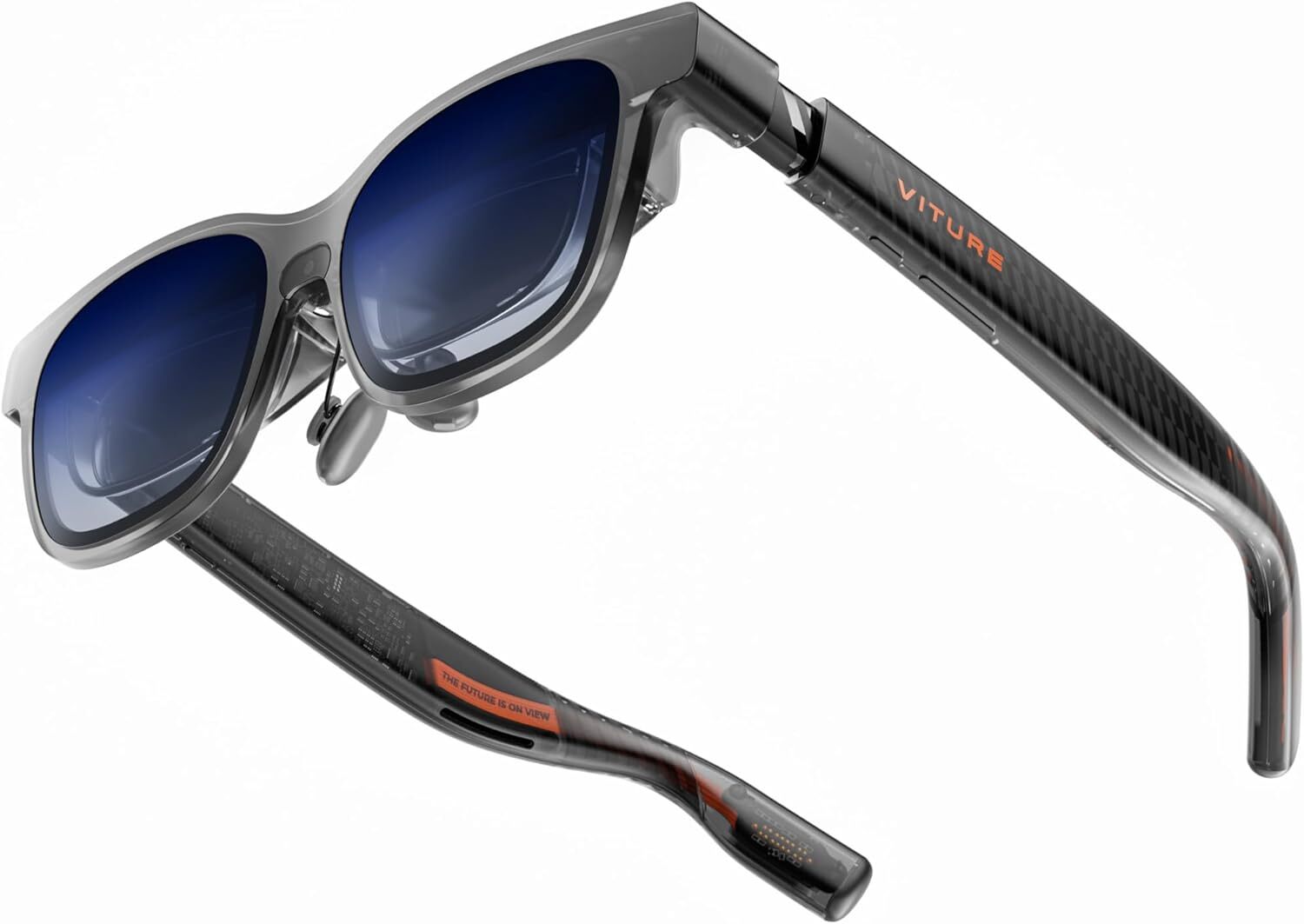
Augmented reality smart glasses blend digital content directly with the physical world, enabling hands-free device use, but a persistent pain point remains: Low brightness can make them unusable in certain settings. Many models max out at 400 to 600 nits, but a rare few exceed that, making them more practical in different conditions—like the Viture Luma Pro AR glasses, which can hit 1,000 nits of brightness.
The Viture Luma Pro glasses earned high marks from PCMag, which labeled them the “brightest smart glasses [we’ve] ever seen.” This higher peak brightness makes the glasses more functional in well-lit settings. They boast a 52-degree field of view (which translates to a 152-inch virtual screen) and have a 1200p (1920×1200 per eye) resolution with up to a 120Hz refresh rate. Along with a bright picture, they have dimmable lenses and focus adjustment dials for nearsighted users. In real-life testing at max resolution, some blurry edges can occur, these specs deliver deliver a bright, crisp, and sizable digital picture overall.
On the audio side, the built-in Harman-tuned speakers perform well but may struggle in a very noisy environment. The glasses don’t have integrated head-tracking features, but you can enable 3DOF with the brand’s free SpaceWalker software available for desktop and mobile and compatible with iOS, Android, Windows, and MacOS.
For those seeking a visually impressive monitor or virtual workstation that they can wear on their face (and reliance on software for motion-tracking isn’t a dealbreaker), the Viture Luma Pro AR glasses excel in most areas.
Our Best Editor-Vetted Presidents’ Day Deals Right Now
Spotify’s best developers have stopped writing code manually since December and now rely on an internal AI system called Honk that enables remote, real-time code deployment through Claude Code, the company’s co-CEO Gustav Soderstrom said during a fourth-quarter earnings call this week.
Engineers can fix bugs or add features to the iOS app from Slack on their phones during their morning commute and receive a new version of the app pushed to Slack before arriving at the office. The system has helped Spotify ship more than 50 new features throughout 2025, including AI-powered Prompted Playlists, Page Match for audiobooks, and About This Song. Soderstrom credited the system with speeding up coding and deployment tremendously and called it “just the beginning” for AI development at Spotify. The company is building a unique music dataset that differs from factual resources like Wikipedia because music-related questions often lack single correct answers — workout music preferences vary from American hip-hop to Scandinavian heavy metal.
Let’s talk memory form factors, friends. You’re surely familiar with DIMMs, and SODIMMs, and maybe you’ve even fooled around with RDIMMs, or LRDIMMs. Well, the number of memory module formats in the computing world has exploded over the last few years. This isn’t an explainer, so we won’t go over all of them, but rather we’ll focus on the
We may earn a commission from links on this page. Deal pricing and availability subject to change after time of publication.
Presidents’ Day sales are around the corner, and the deals are coming in early; right now, Amazon has the latest Kindle Paperwhite from 2024 in “Like-New” conditions for $114.99 (originally $143.99). This Paperwhite in new condition would cost you $159.99, making the refurbished version a much cheaper choice to get while it lasts (discounted Kindle Paperwhites usually sell out quickly).
The Kindle Paperwhite is the most popular reading tablet from Amazon, and it’s the best for most people, according to PCMag’s “outstanding” review. It offers many improvements over the 11th-generation version from 2021—mainly a larger seven-inch display and a much faster boost in performance. It still retains all of the great attributes that made the previous version great, like a fully waterproof design with an IPX8 rating, enough storage to hold more than 10,000 books, and unlimited cloud storage. If you want an ad-free experience with some better features, get the Signature Edition.
If you’re not sure if this is the right Kindle for you, check out the Colorsoft version—it offers color, so it can make reading manga or comics more lively. We also have a breakdown of every kind of Kindle to help you decide. If you already own the 11th generation, there might not be enough here to warrant an upgrade, unless you just want the latest Amazon has to offer. However, any devices older than that may be worth an upgrade for features like Bluetooth compatibility, which is great for audiobooks.
The screen features a 300 ppi (pixels per inch) display with 16 levels of background lighting, and optional warm lighting as well. I use this feature to read before bed and not strain my eyes. I also love the absurdly long battery life. This one is estimated at up to 12 weeks on a single charge, depending on your use and brightness settings.
Our Best Editor-Vetted Presidents’ Day Deals Right Now
Tuesday was the last race of Zwift Racing League Round 3, and we were in London for a two-lapper of the classic London Loop. That meant 30km of racing but, more importantly, two trips up Box Hill! This was going to hurt…
Planning and Warmup
Heading into the race, we were scrambling to line up enough riders. We brought on a new Coalition teammate, Neale, and Captain Neil signed on to race even though he was going to be racing an earlier edition with another Coalition team that was short on riders. So our starting lineup was:
Captain Neil
Enrico
Dylan
Neale
Fabian
Myself
I pulled my S-Works Aethos out of the garage and installed the ENVE 4.5 wheels, because I wanted every advantage I could get on Box Hill. I got out on course early, so I could take my time with a 20-30 minute warmup. Then I signed onto Discord, downed a SIS gel, and got ready to rumble!
Lap 1
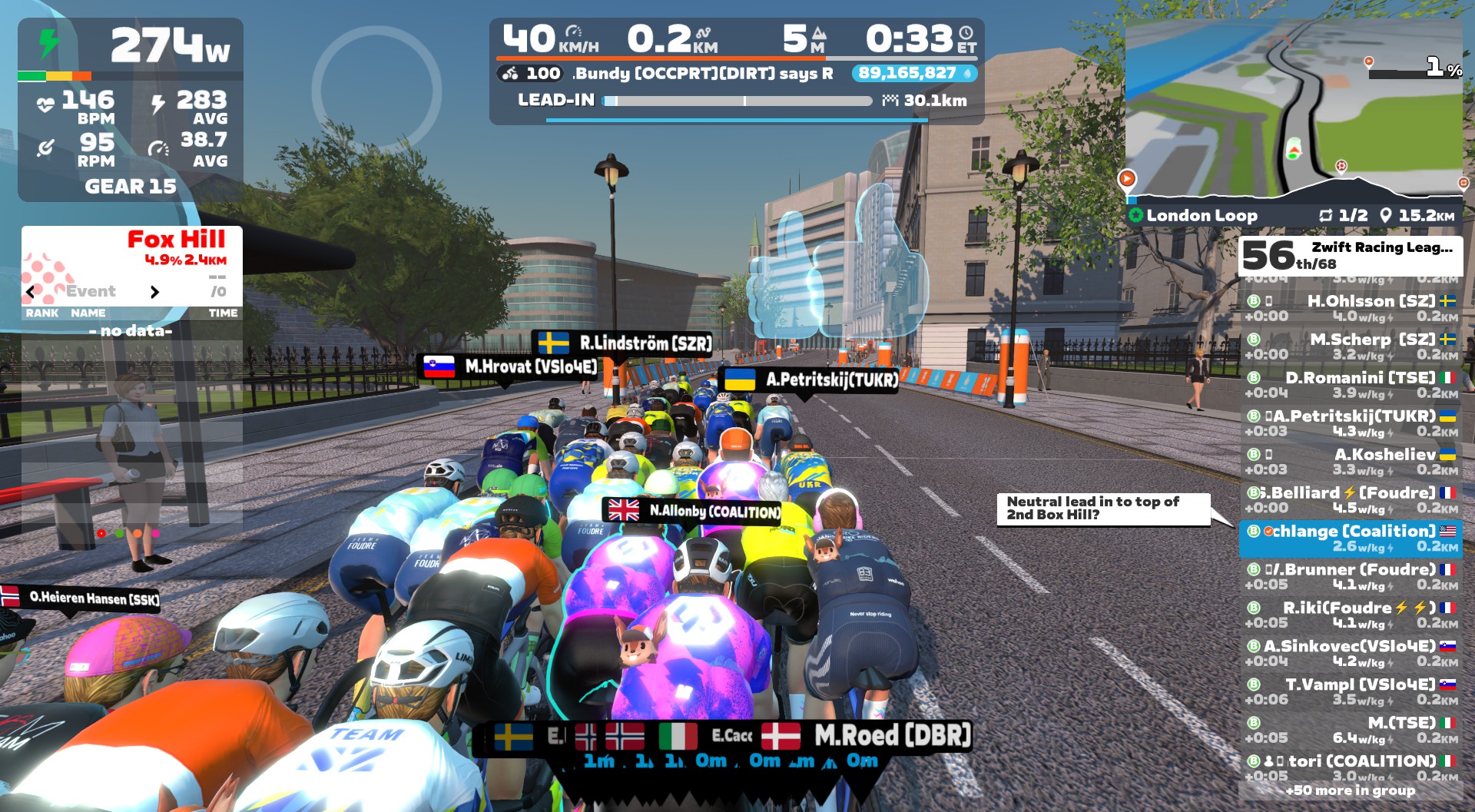
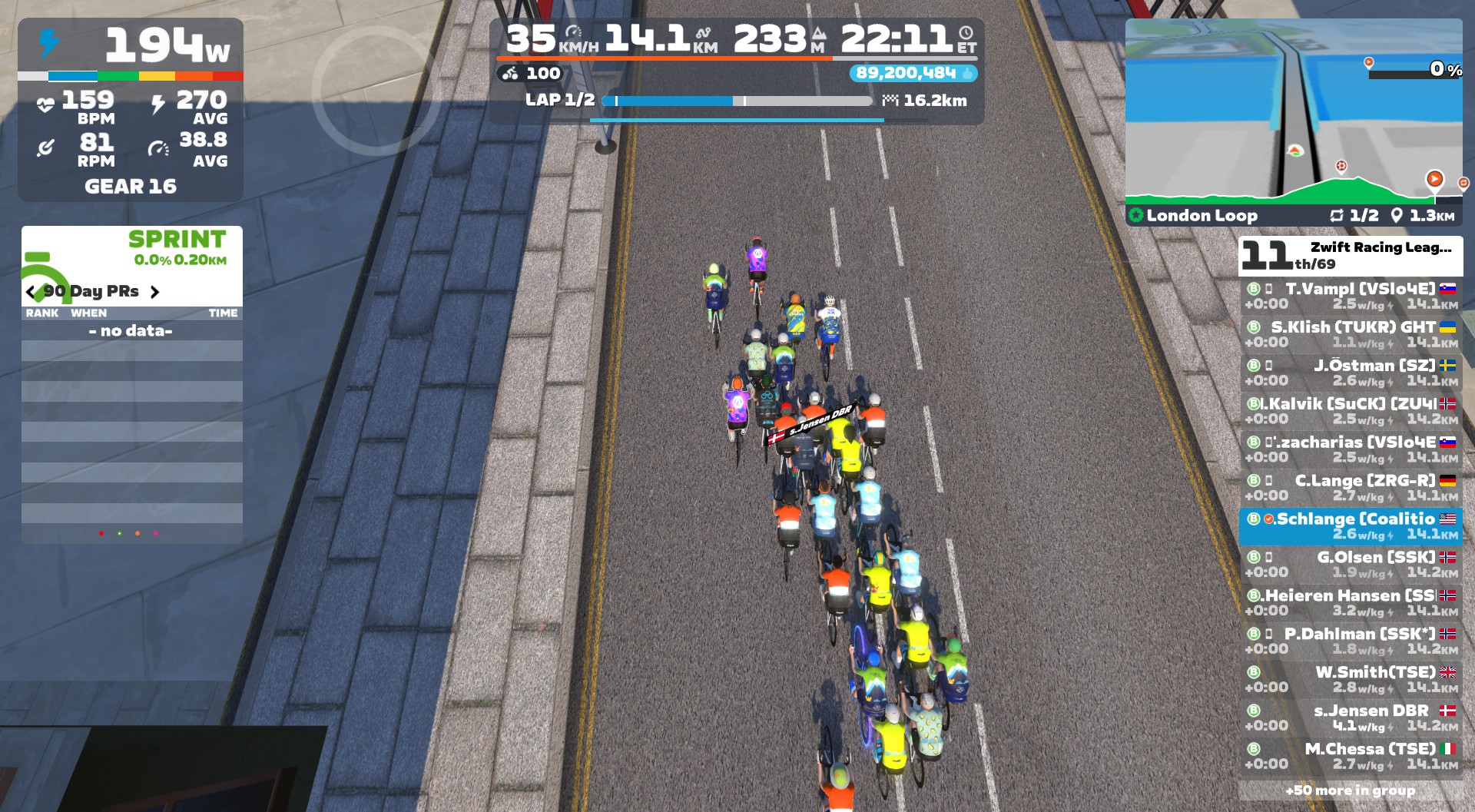
63 riders rolled out of the pens to begin the first of two London Loops. We all got feather powerups at the lap arch, and we all tucked them away for safekeeping. We knew what was coming up the road.
The first little effort of the race was short climb (Northumberland Avenue) you hit when you turn a hard right away from the Thames 3.5km into lap one. It wasn’t bad, though – just 30 seconds of slightly higher effort. The feathers still weren’t flying, and none of us was brave enough to attack in earnest this early.
An average of just 250W brought me (and all 63 starters) from the start of the race to the bottom of Box Hill. That’s where the action began.
While I know Box Hill is a ~7-minute effort for me, I don’t think of it that way. Rather, I mentally break it into a few sections:
The Lead-In: The bit before we turn a hard right and the climb gets steep. Nobody pushes hard this early.
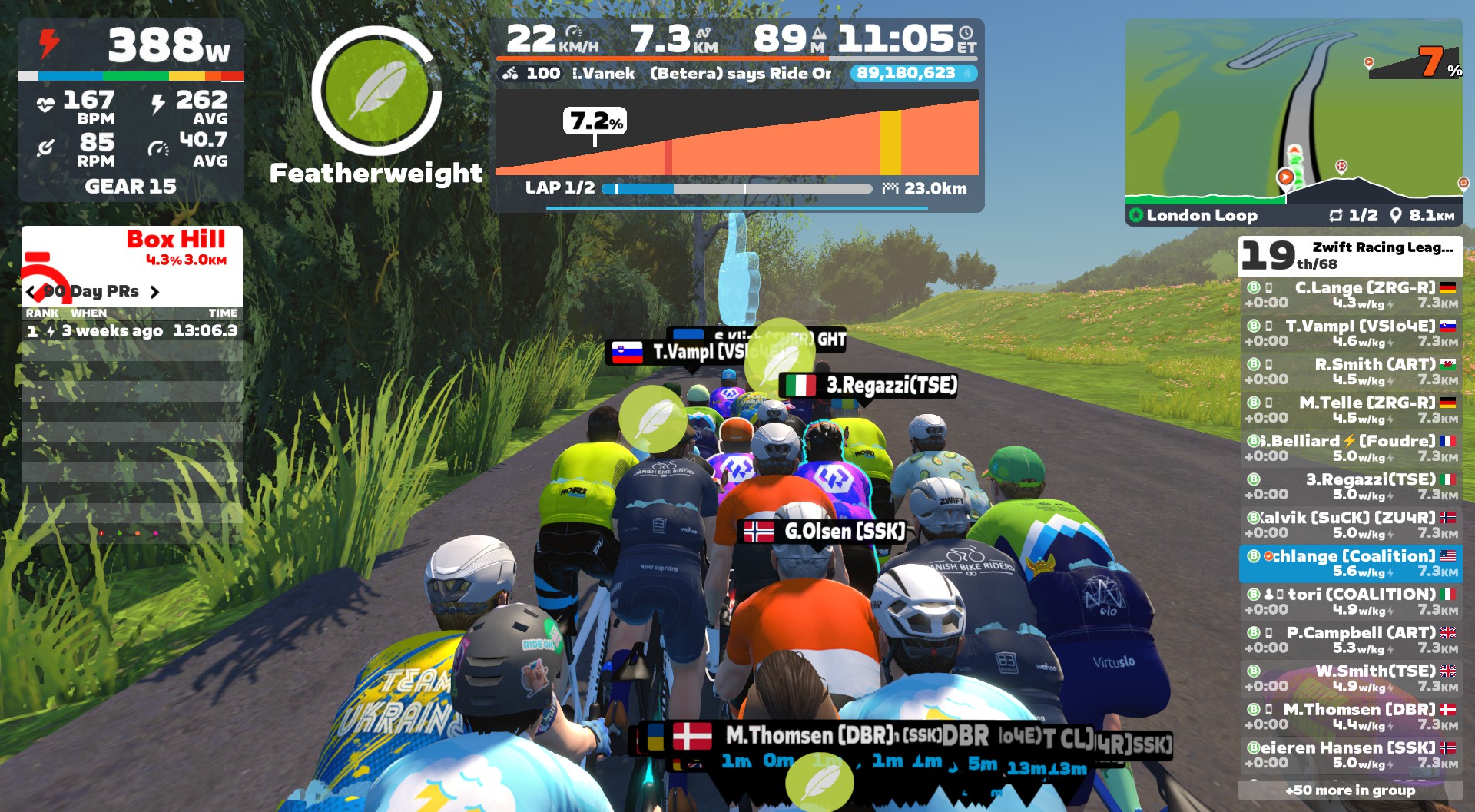
The Steep Bit: The first long stretch averages 7-8% until it eases a bit before the left hairpin. This is where the pack quickly separates and elastic snaps, and it’s where I’ve been dropped in the past. I used my feather to help me hold a good position near the front. Sauce showed the front group had shrunk to 44 by the end of this section.
The Middle: When we “zag” back to the left, the pack tends to ease a bit, and the road even flattens momentarily, although it pitches back up and ends up averaging around 5%. Things often come back together a bit in here, but not for long.
The Long Haul: Turn a hard right and hit the white painted roads – this is the long final haul to the top. Some riders held their feathers for the end of this bit, which made me work harder than anticipated. I was close to being on my limit, but I also knew what was up the road, so I knew I could push hard here since recovery was waiting. Sauce showed 32 riders left at the top of this section.
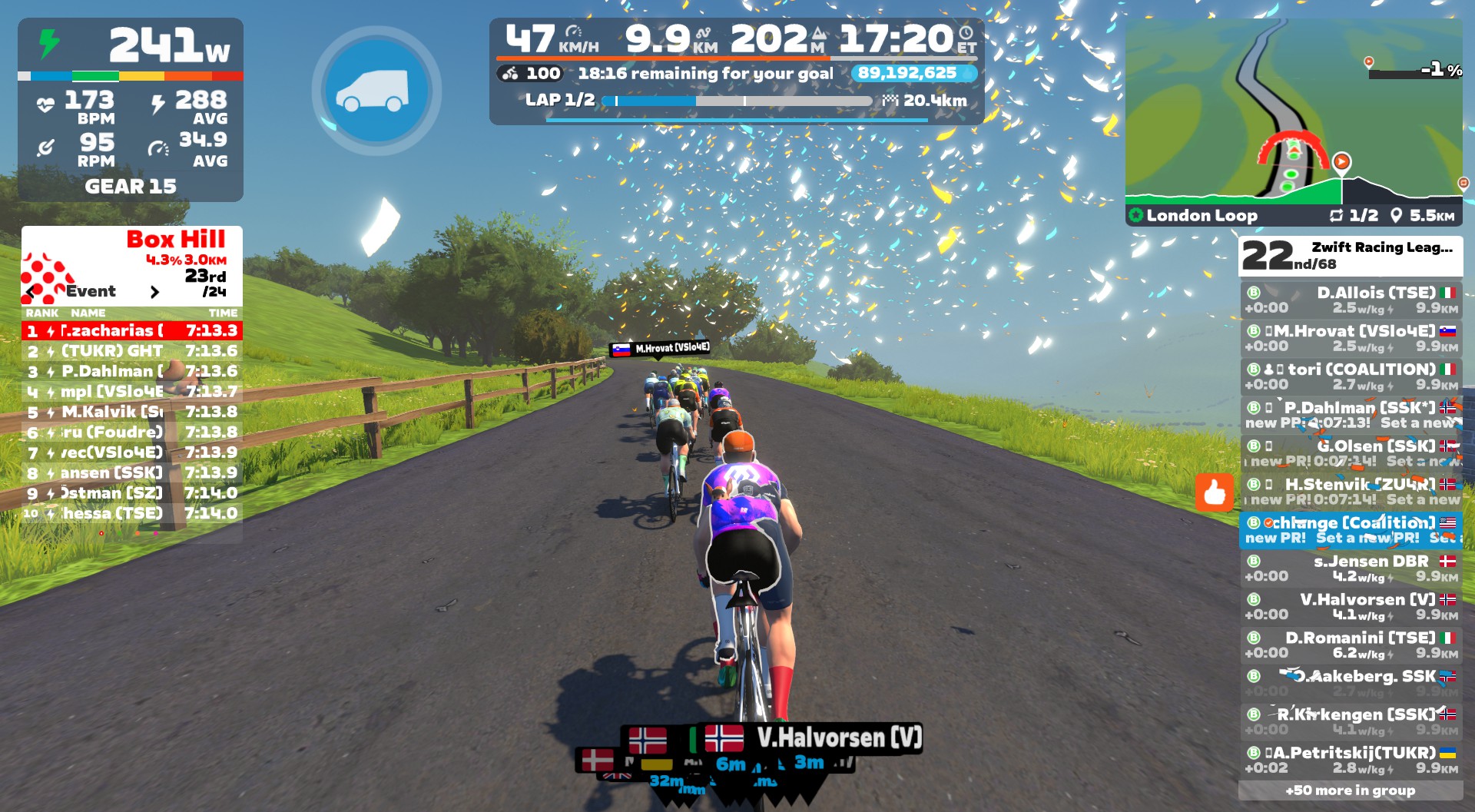
The Flat Finish: Turn right at the top of the Long Haul, and you’ve got a flattish final 600 meters to the KOM banner. If I’m still in touch with the group at this point, I know I’ve survived the climb. And I was still in touch! Sauce showed 26 left in the group as we went through. This was the selection. This group of 26 would stay together to the end of the race.
Using my feather on the steep bitOn the middleThe Long Haul90-day Box Hill PR (7:13)!
Instead of the promised anvil powerup at the KOM arch, I saw the standard powerup animation pop up through the KOM arch, flipping between Draft, Aero, and Feather. I got a feather, which I used on the short kicker that comes just before the long descent of Fox Hill.
We all took a big breath as we flew down Fox, put in a quick dig to get up and out of The Underground, then spun our way to the finish of the first lap.
26 riders had survived in the front group… but only 2 of us (Enrico and myself) were Coalition. Clearly, this wasn’t going to be a team win for us, but if I could hang on over the second Box Hill, I would have a shot at the podium. That became my only goal.
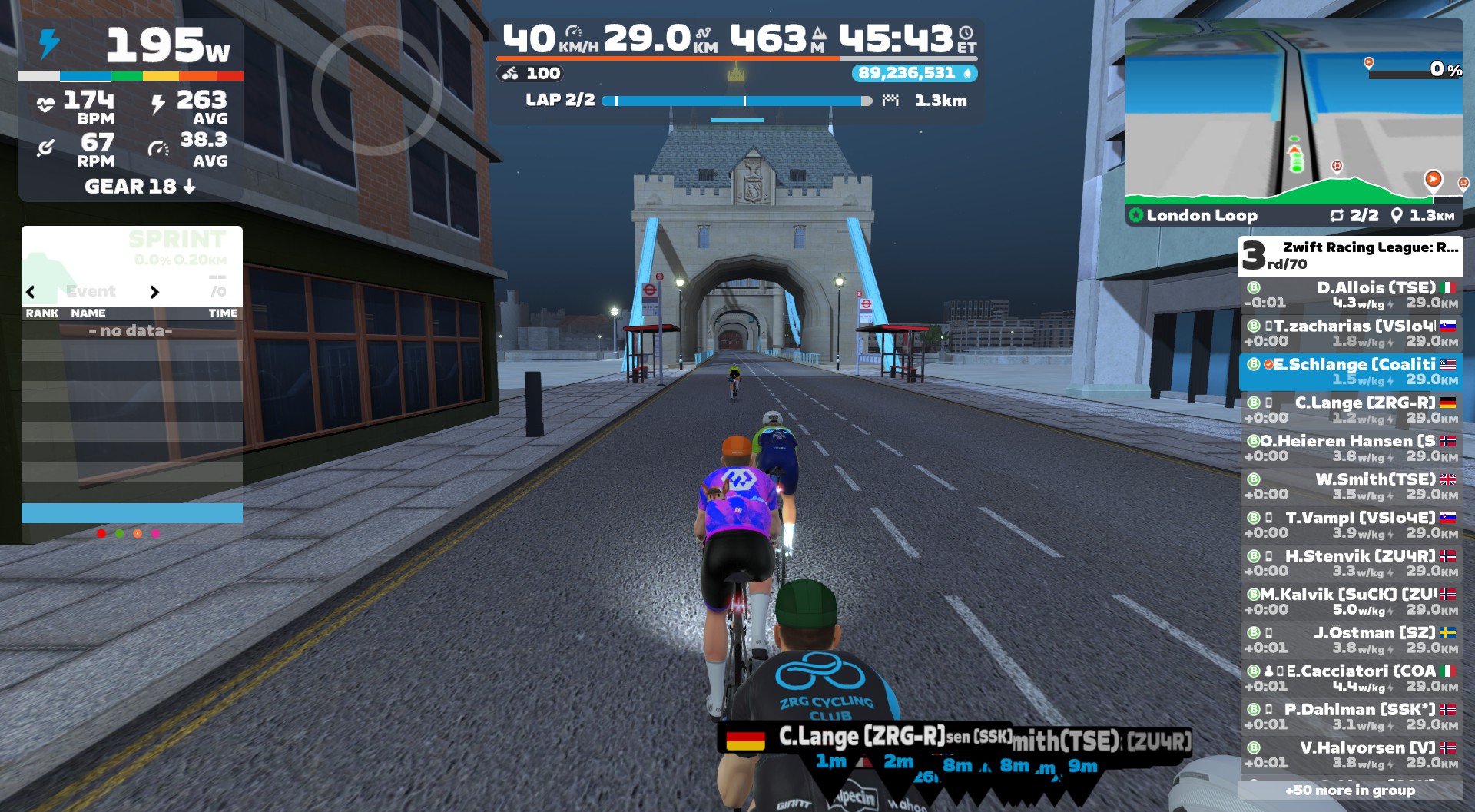
Continuing the powerup weirdness, we all got feathers at the end of Tower Bridge (there’s a white line on the road there that acts as a sort of “invisible arch” marking the start of some routes). I could have used my feather right there for a bit of relief, but I wasn’t convinced there was another one waiting for me at the lap banner, and I knew I wanted one for Box Hill. So I just held onto the feather I had.
Lap 2
The lead into Box Hill #2 was unremarkable, with some riders putting in harder pulls on the front, but never hard enough to drop any riders. All 26 of us arrived at the bottom of Box Hill, ready for the next big battle.
This time around, I decided to hold onto my feather until the end of the climb, unless I felt like I was getting dropped. It seemed like everyone else had the same idea: I only saw a couple of feathers fly before we reached the final stretch of The Long Haul near the top of Box Hill.
Even though the second climb was a bit slower (7:25 at 326W average vs the first lap’s 7:13 at 340W average), this second Box Hill effort was tougher than the first. I could feel that I was even closer to being on the limit, but I also knew everyone was suffering. This is bike racing, after all. So I kept digging, and eventually the road flattened, and I was still in the wheels. I’d made it! Hurray!
The powerup spinner at the top gave me a feather, which was not ideal (more on that later). I decided to hold onto it for use on the ramp out of The Underground.
Everyone lit it up on that ramp, so the feather helped. I found myself in 2nd position, in fact, chasing on to a long attack from Allois (TSE). I quickly decided that was a bad idea, though, as my legs needed a break. So I sat up, getting in the wheels, and waited to time my final effort.
As we left the Tower Bridge, we got another feather powerup. I used it right away, hoping it would give me a bit of relief, because I figured it wouldn’t be much help on the downhill finish. I was sitting in 6th in a strung-out group, and Allois was 2 seconds up the road.
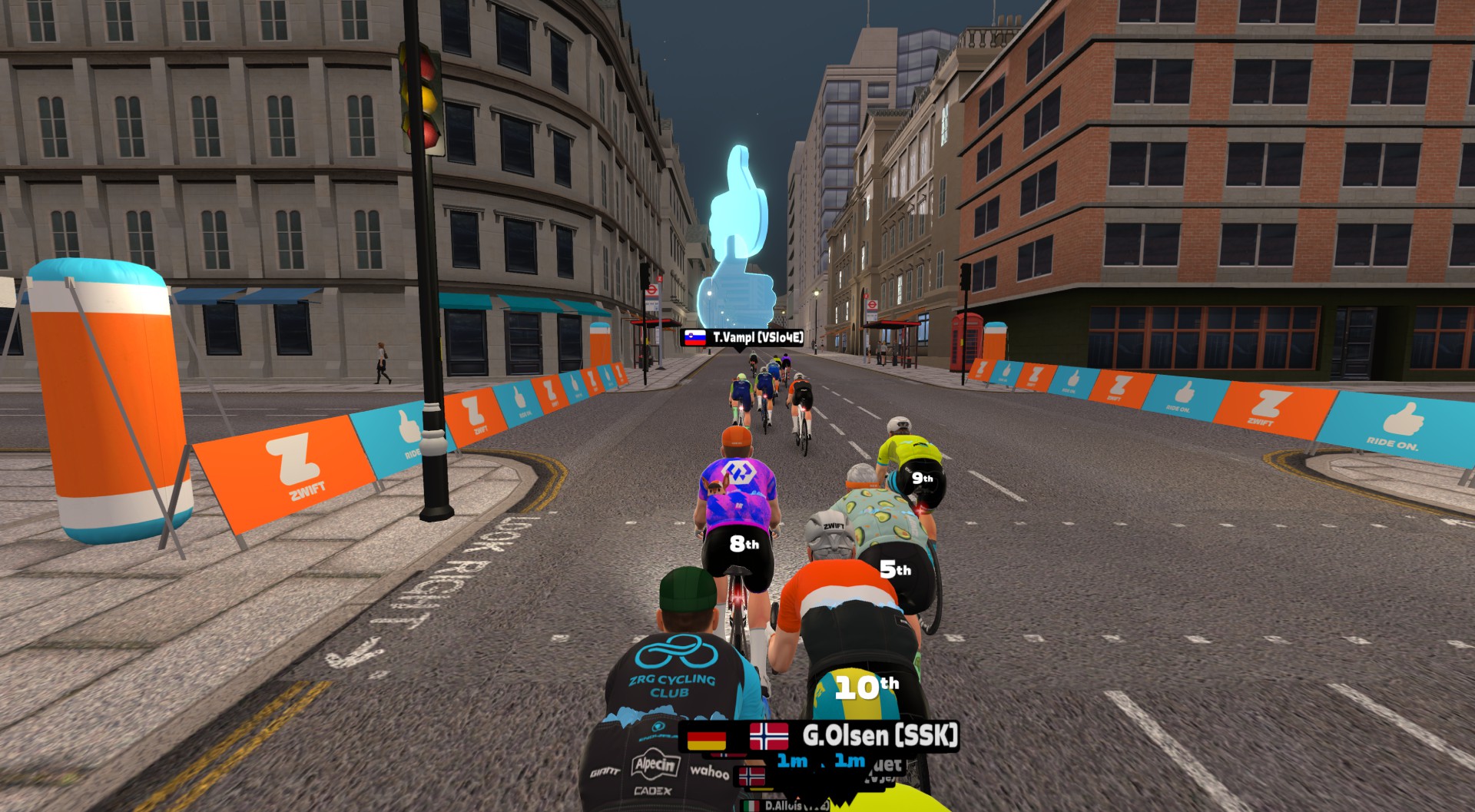
With a few hundred meters left, the road tilted down a bit, and the powerups started to fly. First the feathers and the draft boost vans. The near the end, the aero boost helmets. I hammered with all my tired legs had, and came across the line in 8th.
While the on-screen results showed me in 8th, ZwiftPower (and WTRL’s final results) show me in 9th.
In the grand scheme of things, this doesn’t matter much at all. But it could have been a really big deal, because:
My team tied with another team (ART) in total points for this race, meaning it goes to whoever had the highest finishing points (not counting podium bonus points). That means ART beats us. But had I finished in 8th, we would have beat ART.
It turns out, we held onto 2nd place for Round 3. But just barely (by 2 points).
Look, we all know that, if Zwift wants to be taken seriously in the e-racing space, they need to solidify the finishing position experience. It’s been an issue for a long time. But this particular issue is a weird one I haven’t seen before: how is the game showing one result, while ZwiftPower/WTRL are showing another? That shouldn’t be possible, right? Aren’t both of those based on the same server-side system?
Powerup Madness
Can we talk about powerups… again?
If you watch the finish of this race (video above), you’ll see that nearly all (or possibly all, it’s hard to tell) of the riders who finished ahead of me had draft or aero boost powerups. (Reminder: I had a feather.)
Let me remind you: we were all supposed to get anvils at the KOM arch. Everyone was supposed to get the same powerup, and therefore have the same advantage in the finish.
But that wasn’t the case. A bug/misconfiguration of all the races on the day meant we got a random pick of three powerups at the KOM. I, unfortunately, got a feather. Had I landed a draft or aero boost, I can promise you I would have held onto it for the finish, used it wisely, and finished higher than 8/9th place.
This is the second time in Round 3 that my ZRL result was affected negatively by how powerups were handed out in the race (read about the first time here). And while I’m happy to take the blame for a poor race result, it’s irritating and demotivating to know that the finishes to these races were, in some part, determined by the “luck of the draw.” It shouldn’t work that way.
My opinion: powerups shouldn’t be randomly assigned, unless it’s an event like a Crit City race, where you’ve got lots of chances to get powerups, and thus the choice to use or hold them becomes a strategy in itself.
Personal Performance
I’m happy I survived in the front group in this race, as that was far from a foregone conclusion. Could I have played my cards better for a better result? Probably. Easing a bit more out of The Underground on lap 2, then saving my feather for the final 30 seconds may have gained me a few places.
Apart from that, I’m not sure if I’d change anything else about how I raced this one.
Final Team Result for Round 3
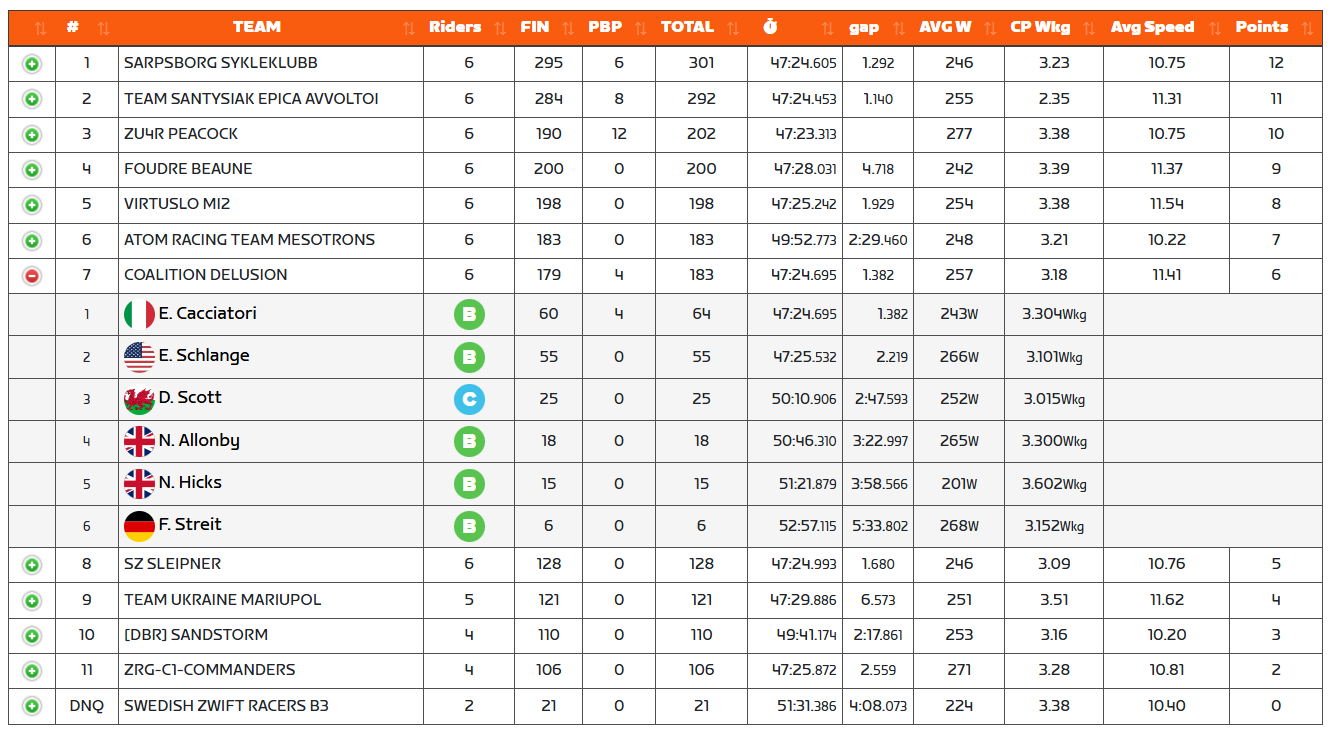
Despite an unimpressive 7th-place finish on the day, my team managed to hold onto 2nd place overall for Round 3. Congrats to TSE, who beat us once again, just like Round 2:
We finished off the round with our traditional team Discord photo:
It was good racing with you lads. See you in Round 4!
What about you?
How did your last race of Round 3 go? Did you win at powerup roulette? Share below!