An anonymous reader writes: Electric buses are proving unreliable this winter for Vermont’s Green Mountain Transit, as it needs to be over 41 degrees for the buses to charge, but due to a battery recall the buses are a fire hazard and can’t be charged in a garage.
Spokesman for energy workers advocacy group Power the Future Larry Behrens told the Center Square: “Taxpayers were sold an $8 million ‘solution’ that can’t operate in cold weather when the home for these buses is in New England.”
“We’re beyond the point where this looks like incompetence and starts to smell like fraud,” Behrens said.
“When government rushes money out the door to satisfy green mandates, basic questions about performance, safety, and value for taxpayers are always pushed aside,” Behrens said. “Americans deserve to know who approved this purchase and why the red flags were ignored.”
General manager at Green Mountain Transit (GMT) Clayton Clark told The Center Square that “the federal government provides public transit agencies with new buses through a competitive grant application process, and success is not a given.”
Nevada is taking action against the rapidly growing Wild West of prediction markets. The state’s gambling regulators and attorney general sued Kalshi on Tuesday. They accuse the company of bypassing Nevada law by operating a sports gambling market without proper licenses. In addition, they say Kalshi provides services to individuals under 21, which violates state law.
The lawsuit follows a federal appeals court’s rejection of Kalshi’s request to prevent the state from pursuing legal action. And it comes a day after the Trump administration claimed that only the federal government has the right to enforce the industry.
Prediction markets, which allow users to bet on events such as sports, political outcomes and wars, have exploded in popularity. Business Insiderreports that Kalshi did 27 times as much business during this year’s Super Bowl as last year’s. Some of that growth has been at the expense of regulated gambling; Nevada’s gambling operations did less business during this year’s game.
“Kalshi has continued to dramatically expand its business, rather than attempting to maintain any kind of status quo,” Nevada regulators wrote in a letter this month.
Kalshi and rival Polymarket insist that their businesses are “event contracts” and should be regulated as financial investments rather than gambling. The Trump administration, rife with conflicts of interest in this area, agrees. The Chair of the Commodity Futures Trading Commission (CFTC) filed an amicus brief on Tuesday, claiming that it alone has the authority to enforce the prediction market.
“The CFTC will no longer sit idly by while overzealous state governments undermine the agency’s exclusive jurisdiction over these markets by seeking to establish statewide prohibitions on these exciting products,” CFTC Chair Michael Selig wrote in a Wall Street Journal op-ed.
Donald Trump Jr. (Photo by Olivier Touron / AFP via Getty Images)
OLIVIER TOURON via Getty Images
Not coincidentally, prediction markets are a growing part of the Trump family business. Donald Trump Jr. is a paid adviser to Kalshi. He’s also an investor in and unpaid adviser to Polymarket. In January, his family’s social media business said it would launch its own prediction market platform.
Prediction markets have the potential to be a hotbed of insider trading. According to blockchain analyst DeFi Oasis, fewer than 0.04 percent of Polymarket accounts have captured over 70 percent of the platform’s total profits, totaling over $3.7 billion.
Last month, The Guardianhighlighted the case of a Polymarket user who bet tens of thousands of dollars on “yes” to the question, “Israel’s military action against Iran by Friday?” Within 24 hours, Israel bombed Iran, leaving hundreds dead. The user made $128,000 on that bet. The Guardian traced the blockchain data to a wallet associated with an X account. Its location on the social platform was set to Beit Ha’shita, a northern Israeli settlement. The user later transferred their bets to two other accounts, apparently to avoid detection. In January, the accounts held 10 live bets on Israeli military strategy.
Another anonymous user made over $400,000 by betting that Nicolás Maduro would be ousted by the end of January. The bets were placed in the hours and days leading up to the US strikes on Venezuela. In another case, eight jointly owned accounts collectively generated over $161,000 by betting on the country’s María Corina Machado Parisca winning the Nobel Peace Prize. The accounts’ handles used names such as “fmaduro,” “madurowilllose,” “striketheboats” and “trumpdeservesit”.
This article originally appeared on Engadget at https://www.engadget.com/big-tech/nevada-sues-kalshi-for-operating-a-sports-gambling-market-without-a-license-175721982.html?src=rss
Everyone loves shiny new products, so what can we expect to see at Apple’s first launch event of 2026? We don’t know anything for certain, but we have plenty of educated guesses that have been sourced from industry reports and speculation from analysts.
Budget-Friendly MacBook
There have been rumors swirling that Apple is preparing to launch a cheaper alternative to the MacBook Air. Bloombergreported on this all the way back in November. Industry rumors indicate that Apple will be stuffing this laptop with an iPhone processor, the A18 Pro, to keep the price down.
Worth pointing out the three colors from the invite are light green, blue and yellow — which just so happen to be the colors Apple has tested the low-cost MacBook with, as I wrote yesterday. Coincidence? We shall see. https://t.co/1FFVkfw9JZpic.twitter.com/ssKDDzdJsw
It’s also been suggested that this laptop will only include 8GB of RAM, which kind of flies against the company’s recent stance to outfit all Macs with at least 16GB of RAM. However, that would certainly help with the cost. You might have heard about a little thing called AI that chomp chomps on all RAM it can find.
TechRadar has reported that this could be Apple’s biggest laptop launch in years, with potential initial shipments hitting 8 million units. The price is likely to be somewhere in the $699 to $799 range, which is pretty nifty. However, I’d still go for an Air at $999. They are absolute workhorses.
MacBook Pro with M5 Pro and Max chips
It’s likely that Apple will release more powerful MacBook Pro models this year and the timing seems to match up. Bloomberg’s Mark Gurman has suggested a March launch and the event is on March 4.
The company has already released a MacBook Pro with an M5 chip, but both the M5 Pro and Max are likely on the horizon. We could be getting new laptops outfitted with these chips in various display sizes.
Devindra Hardawar for Engadget
There have also been reports that both of the higher-end M5 chips are getting a redesign to help improve heat dissipation and reduce defective chip rates. Additionally, the new chiplet design would allow the M5 Pro and Max to raise the total number of CPU and GPU cores. The Max is expected to have more cores than the Pro.
This idea is helped along by the fact that MacBook Pro M4 Max orders are currently delayed. This is typically the case with an outgoing model as stock dries up to make room for new releases. Also, the Pro and Max variants typically get announced in the Fall, so we are due.
New iPads
Rumors have been circulating that we are about to get new iPads, including an update to the base model and the Air. The standard model, which would be the 12th-gen release, is expected to upgrade the A16 chip to an A18. This should also allow for the integration of Apple Intelligence tools, if that’s your bag.
As for specs, Mark Gurman has suggested that it’ll be getting an upgrade to the A19 chip, which is nice. Also, it could be getting MagSafe support. That sounds like an iterative upgrade, but the price is expected to remain steady at $599.
Other Possibilities
The following stuff is less likely, though certainly possible. There have been rumors that Apple is currently preparing a revamped Studio Display and Mac Studio desktop. The reports suggest a release sometime in the first half of the year, and March is right in the middle of that timeframe.
It’s also possible that the company will reveal an upgrade to the MacBook Air with the M5 chip. Reports indicate that this is unlikely to happen during this event, but it is worth noting that the M4 Air came out in March of last year. In other words, it’s a toss up.
The inclusion of Shanghai essentially rules out Siri, as expected, given the delays. https://t.co/mgNLR4qCYy
What’s not a toss up? You shouldn’t expect anything regarding the long-anticipated Siri refresh. This looks to be a hardware event, so any software updates will likely have to wait until WWDC this summer. In any event, Engadget will be on hand to report on all of Apple’s new products.
This article originally appeared on Engadget at https://www.engadget.com/computing/heres-what-to-expect-at-apples-product-launch-event-on-march-4-173612772.html?src=rss
Back in 2022 Intel announced OpenPGL as an open-source library for path guiding to help enhance the quality of path-based renderers. With time Blender began making use of OpenPGL and other industry interest and adoption. Unfortunately, Intel quietly ended work on OpenPGL in 2025 but has now fortunately found a new home…
Microsoft says a Microsoft 365 Copilot bug has been causing the AI assistant to summarize confidential emails since late January, bypassing data loss prevention (DLP) policies that organizations rely on to protect sensitive information. From a report: According to a service alert seen by BleepingComputer, this bug (tracked under CW1226324 and first detected on January 21) affects the Copilot “work tab” chat feature, which incorrectly reads and summarizes emails stored in users’ Sent Items and Drafts folders, including messages that carry confidentiality labels explicitly designed to restrict access by automated tools.
Copilot Chat (short for Microsoft 365 Copilot Chat) is the company’s AI-powered, content-aware chat that lets users interact with AI agents. Microsoft began rolling out Copilot Chat to Word, Excel, PowerPoint, Outlook, and OneNote for paying Microsoft 365 business customers in September 2025.
Windows 11’s latest Release Preview drop, with builds numbered 26100.7918 and 26200.7918, hits with a noticeably different vibe than some of Microsoft’s recent Windows releases. Instead of another dubious Copilot expansion, or an AI-powered reinvention of something that already worked fine, this one leans into practical improvements, system
The Food and Drug Administration has reversed its shocking refusal to consider Moderna’s mRNA flu vaccine for approval.
The refusal was revealed last week in a sharply worded press release from Moderna. Subsequent reporting found that the decision was made by political appointee Vinay Prasad, the Trump administration’s top vaccine regulator, who overruled a team of agency scientists and a top career official in rejecting Moderna’s application.
In an announcement Wednesday morning, Moderna said the FDA has now agreed to review its vaccine after the company held a formal (Type A) meeting with the FDA and proposed a change to the regulatory pathways used in the application.
Linux hardware vendor System76 has begun teasing a redesign of their Thelio chassis that is used by their modern desktops and workstations. Helping distinguish System76 from other Linux desktop/PC vendors has been their custom-engineered, built-in-the-USA enclosures and now they are preparing to launch a next-generation design…
Ring’s AI-powered “Search Party” feature, which links neighborhood cameras into a networked surveillance system to find lost dogs, was never intended to stop at pets, according to an internal email from founder Jamie Siminoff obtained by 404 Media.
Siminoff told employees in early October, shortly after the feature launched, that Search Party was introduced “first for finding dogs” and that the technology would eventually help “zero out crime in neighborhoods.” The on-by-default feature faced intense backlash after Ring promoted it during a Super Bowl ad. Ring has since also rolled out “Familiar Faces,” a facial recognition tool that identifies friends and family on a user’s camera, and “Fire Watch,” an AI-based fire alert system.
A Ring spokesperson told the publication Search Party does not process human biometrics or track people.
Ticketing marketplace SeatGeek has announced a partnership with Spotify that will direct an artist’s fans to its platform from the Spotify app. The integration is currently limited to a few participating venues for which SeatGeek is the primary ticket seller.
While SeatGeek is one of the largest online marketplaces for the secondary ticketing market, the company’s announcement makes clear that this Spotify integration only applies to venues where it’s the primary ticketing company. For now, that’s just 15 US partner venues, primarily professional sports arenas like AT&T Stadium in Arlington, Texas.
Spotify has experimented with direct ticket sales in the past, but now focuses on signing on partners to integrate into the streaming experience. The company currently lists 46 ticketing partners, including Ticketmaster, AXS and others. The app also allows users to follow specific venues to be notified about upcoming concerts and events.
This article originally appeared on Engadget at https://www.engadget.com/entertainment/streaming/spotify-debuts-seatgeek-integration-for-concert-ticket-sales-162248870.html?src=rss
The x86 platform driver updates were merged recently for the ongoing Linux 7.0 merge window. As is a common theme for platform-drivers-x86, a lot of the feature work is around Linux laptop drivers for enhancing the support on modern hardware…
The American poet Henry Wadsworth Longfellow called music “the universal language of mankind.” Is that still true when the so-called music is being generated by a probabilistic robot instead of a human? We’re about to find out. Google has announced its latest Lyria 3 AI model is being deployed in the Gemini app, vastly expanding access to AI music generation.
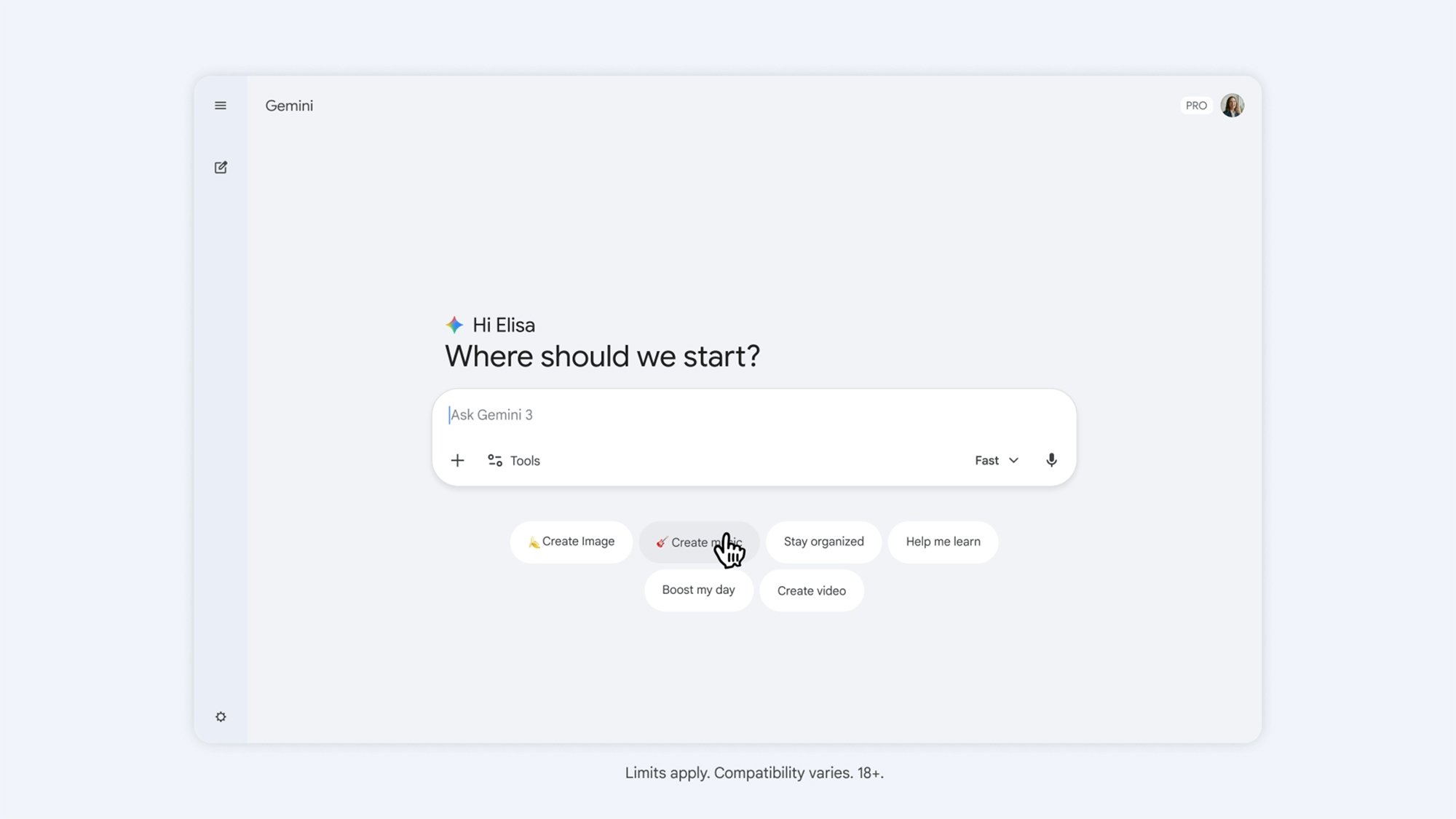
Google DeepMind has been tinkering with Lyria for a while now, offering limited access in developer-oriented products like Vertex AI. Lyria 3 is more capable than previous versions, and it’s also quicker to use. Just select the new “Create music” option in the Gemini app or web UI to get started. You can describe what you want and even upload an image to help the robot get the right vibe. And in a few seconds, you get music (or something like it).
In case there was any uncertainty about whether Lyria tracks still counted as a human artistic endeavor, worry not! Unlike past versions of the model, you don’t even have to provide lyrics in your prompt. You can be vague with your request, and the model will create suitable lyrics for the 30-second song. Although with that limit, “jingle” might be more accurate.
Google Gemini can help you write text, generate images and video, and write code. Now, the AI bot can generate music too, taking on the likes of Suno when it comes to producing tunes from a simple text prompt. The update is courtesy of the new Lyria 3 audio generation model, which is built into Gemini as of today. Developed by Google DeepMind, Lyria has been accessible in other Google products (such as Vertex AI and YouTube Shorts) to a select number of users, but this is the first time Google is making the model widely available to anyone who wants to try it.
There’s a new Create music button in Gemini. Credit: Google
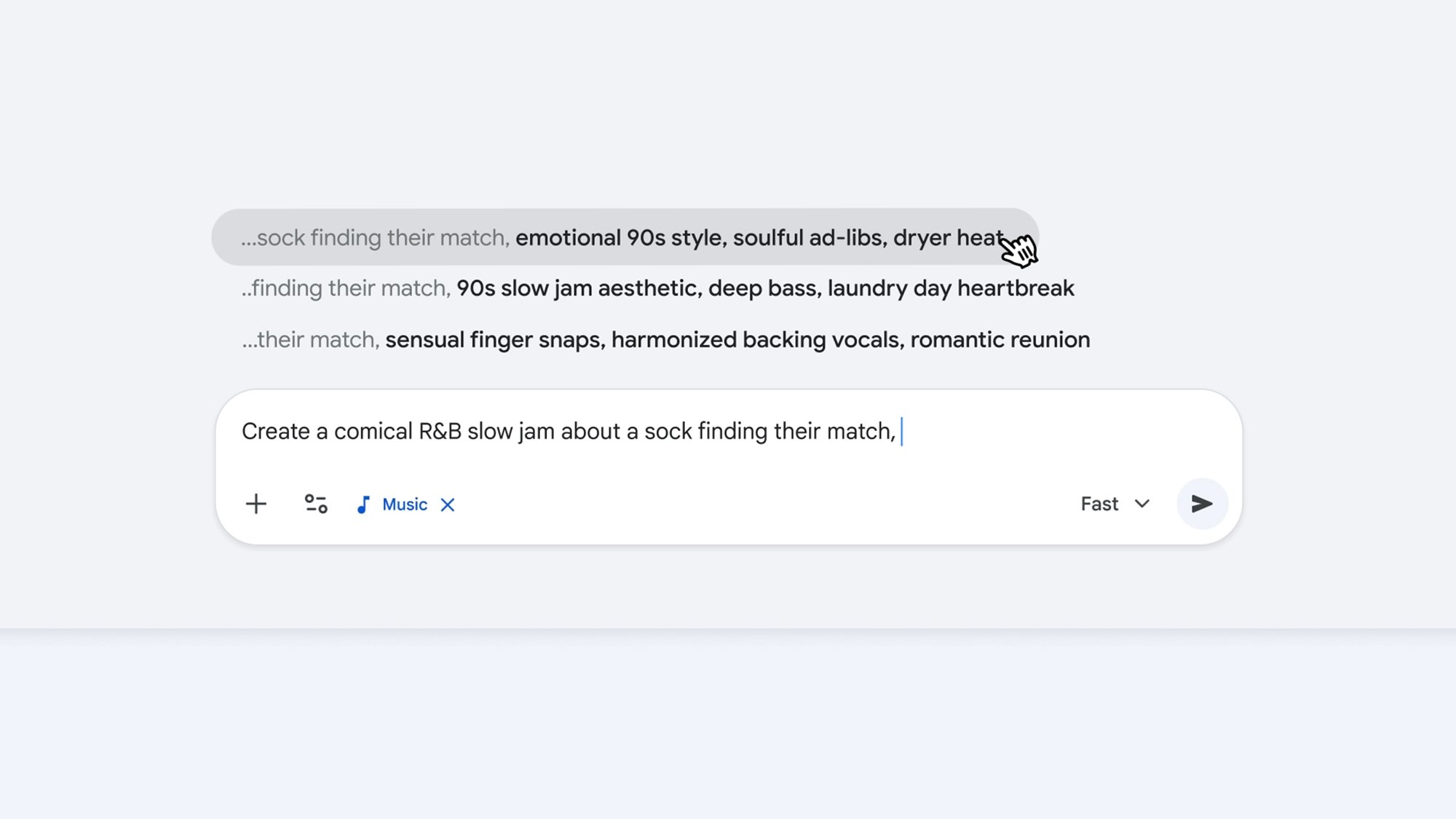
Lyria works the same way as creating images or video: just describe what you want, and the AI does the rest. You might want to hear “a comical R&B slow jam about a sock finding their match” (as per Google’s own example), or perhaps “a sea shanty about the dangers of AI slop”—it’s up to you.
When you click the “Create music” button inside the Gemini app, you also have the option to pick an existing track to remix, rather than starting from scratch—If you’re perhaps stuck for inspiration. These presets cover everything from folk ballads to Latin pop, so you can see the kind of musical scope covered. You can also supply Lyria 3 inside Gemini with an image or video, and get it to compose something that matches the mood of the content you’ve supplied, including both music and lyrics. The example Google gives is supplying Gemini with a few photos of your dog, and then having it come up with a tune about the pooch and their adventures.
You can get some help with your prompting if you need it. Credit: Google
The tracks are limited to 30 seconds each at the moment, and while music making is available to all Gemini users, if you’re paying for the Plus, Pro, or Ultra subscriptions, you’ll get higher usage limits (though it isn’t specified what these are). As per the official announcement blog post, the aim “isn’t to create a musical masterpiece, but rather to give you a fun, unique way to express yourself.” You’re not going to be able to set up your own AI-generated band on Spotify with this, but you can churn out a few entertaining tracks for your own (or someone else’s) amusement.
I haven’t been able to try out the feature as of yet, but I have heard a few samples that Google supplied. They come across as rather generic and ordinary, exactly as you might expect something to sound that’s the averaging out of vast amounts of audio training data—like song genres distilled into their most common ingredients and repackaged.
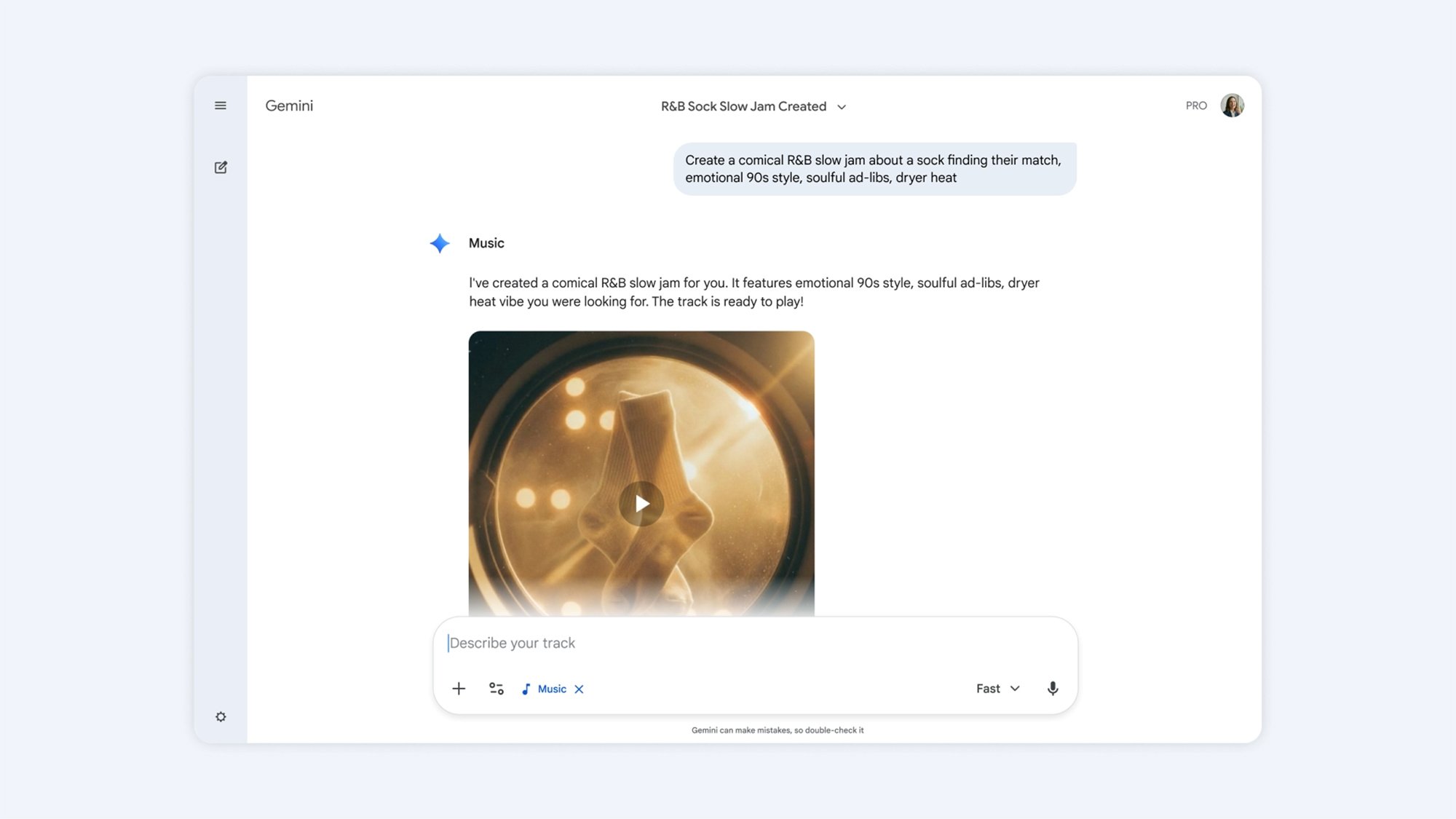
You also get cover art with your artificial tunes. Credit: Google
Google says all created tracks will contain invisible watermarks powered by SynthID, flagging them as AI creations, and you can upload audio tracks to Gemini and run a SynthID check on them. The updated Lyria 3 model is also coming to the Dream Track music maker for YouTube Shorts creators. Lyria 3 is now rolling out inside Gemini, and is available to users aged 18 and above in English, German, Spanish, French, Hindi, Japanese, Korean, and Portuguese. It’s available first on the web app, and will show up on the mobile app over the next few days. Expansions in “quality and coverage” are planned in the future, Google says.
WordPress has started rolling out an AI assistant built into its site editor and media library that can edit and translate text, generate and edit images through Google’s Nano Banana model, and make structural changes to sites like creating new pages or swapping fonts.
Users can also invoke the assistant by tagging “@ai” in block notes, a commenting feature added to the site editor in December’s WordPress 6.9 update. The tool is opt-in — users need to toggle on “AI tools” in their site settings — though sites originally created using WordPress’s AI website builder, launched last year, will have it enabled by default.
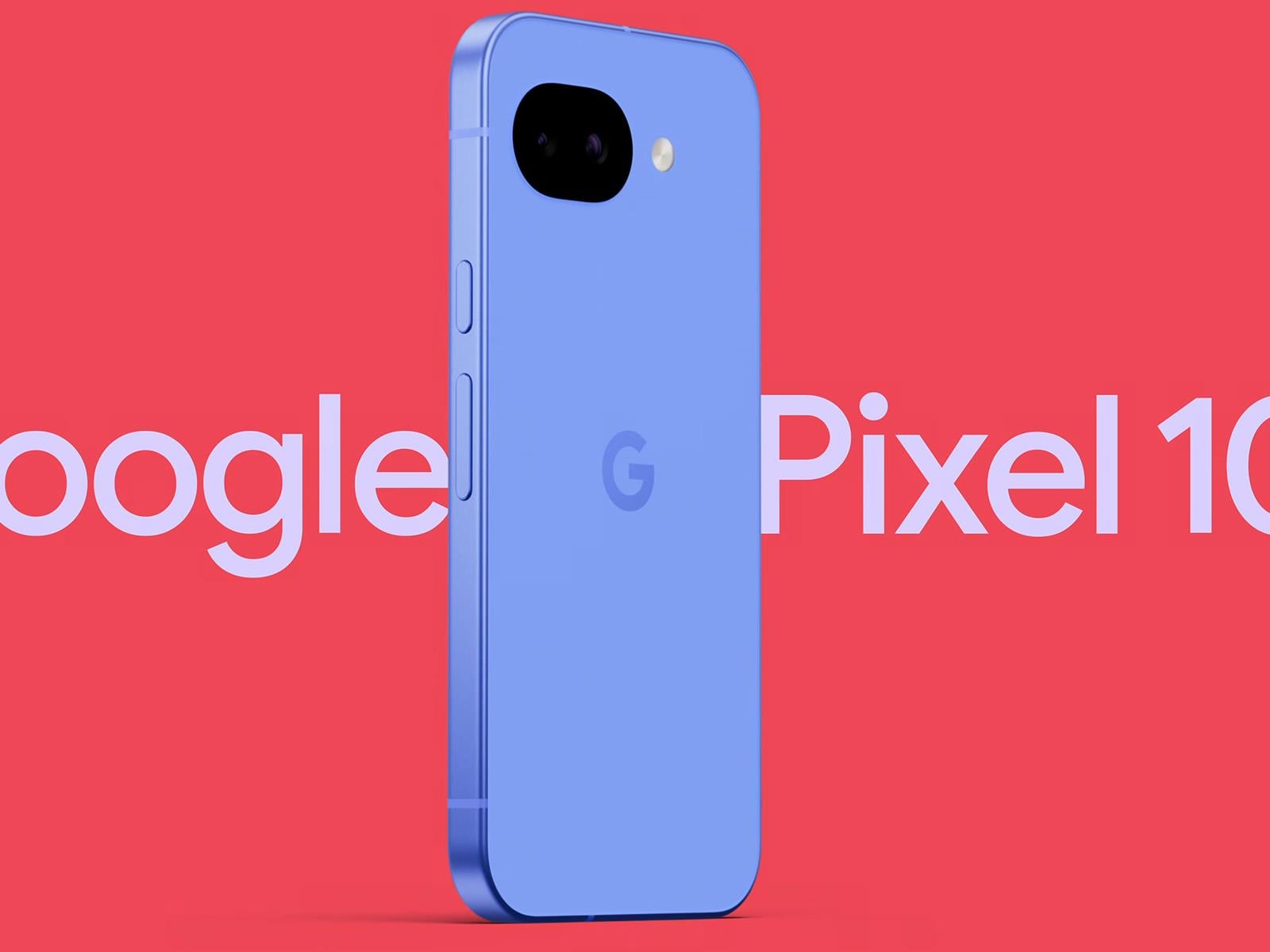
Official pricing is set for Google’s new Pixel 10a smartphone, a midrange handset that will go up against Apple’s upcoming iPhone 17e that is expected to be unveiled during an Apple Experience event on March 4. Google gets the jump on its rival by a solid two weeks, and to entice buyers who may be on the fence, it’s dangling a few promotional